
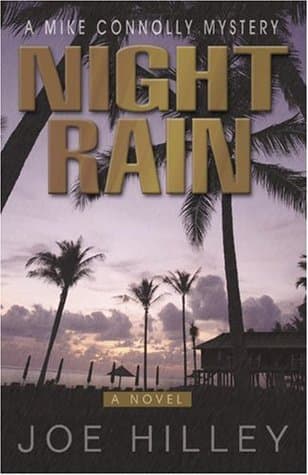
Core Idea
- Difficulty
- Medium
- Read it if
- You enjoy thrillers where natural disasters serve as catalysts for uncovering hidden crimes, and you appreciate a narrative that delves into the moral complexities of a small, isolated community.
- Skip it if
- You prefer fast-paced, action-heavy thrillers with minimal character development or if you dislike stories where the environment plays a significant, almost character-like, role in the plot.
Key Takeaways from Night Rain
The Allure of the Storm
Natural disaster as both threat and opportunity for human transgression.
Natural disasters, like the hurricane hitting Dauphin Island, often expose darker sides of human nature. While most people leave, the storm's chaos offers a chance for those with bad intentions, like Dibber Landry, to act without fear. The breakdown of order and focus on survival create a space where small thefts can become serious crimes. This shows how extreme situations can make people break rules they would normally follow, seeing the disaster as an opportunity and a cover for their actions. It highlights how easily civility can disappear when normal controls are gone.
“The hurricane was a mask, a cloak of invisibility for deeds best left unseen.”
In the book: Dibber Landry's decision to remain on Dauphin Island specifically to plunder evacuated homes, seeing the hurricane as an opportunity rather than solely a danger.
Try this: Consider how societal structures and the presence of law enforcement act as crucial deterrents to crime, and how their absence, even temporary, can reveal underlying opportunism in some individuals.
Related ideas: disaster-opportunism, moral-relativism, societal-breakdown
Secrets Buried by the Tide
Small island communities harbor deep, interconnected mysteries.
Small, isolated communities, especially old ones like Dauphin Island, often hold deep secrets and hidden connections. Their close-knit nature means everyone's lives are linked, creating a complex web of relationships, grudges, and untold stories. When a major event, like a murder, happens, it not only reveals a crime but also uncovers layers of shared history that residents have kept hidden. The murder of Inez Marchand, found by Dibber, is not a single event but a thread that pulls at the island's past, bringing old truths to the surface. This interconnectedness makes investigations hard, as motives and alibis are often tied to a shared, unspoken history.
“On an island like this, everyone knows everyone, and everyone has a secret they hope the tide never washes ashore.”
In the book: The murder of Inez Marchand is not a simple case but quickly reveals a 'web of secrets' that Mike Connolly must untangle, implying a history of hidden island dynamics.
Try this: When investigating complex situations in small communities, look beyond the immediate facts to understand the historical context and interpersonal relationships that might be driving underlying conflicts.
Related ideas: community-secrets, interconnected-lives, island-mentality
The Accidental Witness
Unintended discoveries can thrust ordinary people into extraordinary circumstances.
The story clearly shows how a small mistake can lead someone into a much more dangerous and complex situation. Dibber Landry only wanted to steal during the hurricane's chaos. However, finding Inez Marchand's body turns him from a common looter into the main suspect in a murder case. This shift highlights how quickly fate can change and how one misstep can have huge consequences. Dibber's situation shows that even those with bad intentions can become unwilling players in bigger, more sinister events, forcing them to face realities far beyond their initial understanding or control. His accidental role as a witness is both a curse and the start of the whole mystery.
“He went looking for trinkets and found a nightmare he couldn't unsee.”
In the book: Dibber's act of plundering Inez Marchand's house directly leads to his discovery of her dead body, immediately implicating him and changing his role from thief to murder suspect.
Try this: Be aware that even small, seemingly isolated actions can have unforeseen and significant repercussions, particularly when they intersect with hidden truths or ongoing conflicts.
Related ideas: unintended-consequences, catalyst-event, moral-dilemma
Justice in the Eye of the Storm
Seeking truth when natural and human chaos intertwine.
The novel presents a situation where seeking justice is complicated by a natural disaster and human lies. Mike Connolly's challenge is not just to solve a murder, but to do so amid a literal and figurative 'storm.' The hurricane provides cover for the crime, hides evidence, scatters witnesses, and disrupts communication. Also, the distrust and protective nature of a small community, heightened by fear, make finding the truth difficult. This point emphasizes how environmental chaos can make criminal investigations harder, requiring more resourcefulness and persistence from those seeking truth.
“The storm wasn't just physical; it was in the air, in the lies, in the fear that gripped the island.”
In the book: Mike Connolly's investigation is directly hampered by the approaching hurricane, which impacts the ability to collect evidence, interview residents, and maintain a clear chain of events.
Try this: Recognize that investigations conducted during periods of crisis or societal upheaval require adaptive strategies and a heightened awareness of how the environment influences human behavior and access to information.
Related ideas: crisis-investigation, environmental-impact, truth-seeking
The Unlikely Advocate
Sometimes, the accused's only hope lies with an outsider.
Dibber Landry, a known small-time criminal and now the main suspect, is in a desperate situation with little credibility. His only hope is Mike Connolly, who, because of his job and moral compass, is willing to challenge assumptions and look deeper. This dynamic shows the important role of a fair, dedicated advocate, especially when the accused is an outsider or has low social standing. Connolly's willingness to 'untangle a web of secrets no one else will touch' speaks to the need for people who can look past quick judgments and question easy stories, even if it means going against community agreement or authority. It supports the idea that justice often needs someone to fight for seemingly lost causes.
“He was the only one willing to look beyond the obvious, beyond the easy answer.”
In the book: Dibber, despite his history of plundering, turns to Mike Connolly for help, indicating that Connolly is seen as his last resort or the only one capable of believing his innocence and uncovering the real killer.
Try this: In situations where someone is quickly judged or condemned, actively seek out alternative perspectives and be open to the possibility that the obvious conclusion is not always the correct one.
Related ideas: advocacy-for-accused, challenging-assumptions, moral-courage
The Weight of Reputation
Past misdeeds can unjustly condemn an individual in the present.
Dibber Landry's reputation as a looter immediately makes him the prime suspect in Inez Marchand's murder, regardless of actual evidence. This shows the strong and often harmful effect of a person's past on their present, especially in a close community. Once a 'bad character' story is set, it is very hard to change, leading to an immediate assumption of guilt. The book suggests that society and local authorities too quickly rely on existing reputations instead of conducting a thorough, unbiased investigation. Dibber's challenge is not just proving his innocence, but overcoming the deep belief that he is capable of, and likely responsible for, the crime. This highlights the dangers of confirmation bias and prejudgment in the justice system.
“His history weighed on him like a shroud, making every denial sound like another lie.”
In the book: Dibber is 'charged with murder' almost immediately after finding the body, largely due to his known intentions of plundering and his presence at the scene, rather than concrete forensic evidence pointing to him as the killer.
Try this: When evaluating individuals or situations, consciously work to separate past reputation from present facts to avoid confirmation bias and ensure fair judgment.
Related ideas: reputational-bias, presumption-of-guilt, character-assassination
The Silent Language of the Island
The environment itself holds clues and shapes the narrative.
Dauphin Island, as a barrier island, is not just a setting but an active part of the story. Its unique geography, the coming hurricane, and its isolation are key to the plot. The environment controls event timing, witness availability, and evidence preservation or destruction. The 'night rain' and storm surge can wash away clues or reveal hidden parts of the landscape. This emphasizes the importance of environmental context in crime stories. The island's changing nature and vulnerability to nature reflect the instability and hidden depths of its human residents, making the physical setting a character that constantly influences actions and fates.
“The wind and the waves knew more than any human soul on that island, if only you knew how to listen.”
In the book: The hurricane's approach directly impacts residents' decisions to evacuate, Dibber's opportunity to loot, and the subsequent challenges Mike Connolly faces in his investigation due to the storm.
Try this: In any complex problem-solving scenario, consider how the physical environment and its unique characteristics might be influencing the situation, providing hidden clues, or creating obstacles.
Related ideas: environmental-narrative, setting-as-character, geographical-impact
The Burden of Proof
Establishing innocence requires dismantling complex layers of circumstantial evidence and prejudice.
For Dibber Landry, proving his innocence is very hard. He is found at the crime scene, his past criminal intent (looting) provides a believable motive, and his reputation strengthens the prosecution's case. Mike Connolly's job is huge: to break down this structure of circumstantial evidence, prejudice, and convenient assumptions. This means not only finding the real killer but also carefully showing why Dibber could not have committed the crime. It illustrates the challenges faced by those accused with strong circumstantial cases against them, where the assumption of guilt requires great effort to reverse, even without direct evidence. It highlights the often-unequal playing field of the justice system, especially for those already seen as 'undesirable.'
“It wasn't enough to say he didn't do it; he had to prove what everyone already believed was wrong.”
In the book: Dibber is 'charged with murder' based on his presence and known intent, forcing Mike Connolly to 'untangle a web of secrets' to prove his client's innocence, rather than the state proving guilt beyond a reasonable doubt.
Try this: When evaluating legal cases or accusations, critically assess the quality and nature of the evidence presented, distinguishing between direct proof, circumstantial indicators, and potential biases.
Related ideas: presumption-of-innocence, circumstantial-evidence, legal-challenge
Night Rain Quotes
“The rain fell, a steady, relentless drumming that seemed to echo the beat of his own anxious heart.”
“Some secrets, once unearthed, refuse to be buried again.”
“He'd learned long ago that the most dangerous lies were often the ones you told yourself.”
“The past wasn't a static thing; it was a living, breathing shadow, always just out of sight, waiting to pounce.”
“Justice, he mused, was rarely a clean, straight line. More often, it was a tangled knot of compromises and regrets.”
“The city at night had a different pulse, a hidden rhythm only those who walked its shadowed streets truly understood.”
“Fear was a cold companion, but it was also a powerful motivator.”
“Every confession carried a price, not just for the confessor, but for everyone caught in its ripple.”
“He found solace in the methodical nature of his work, a small island of order in a chaotic world.”
“The truth, like the rain, eventually found every crack, seeped into every hidden space.”
“Sometimes, the hardest thing to do was simply to let go, to accept that some wounds might never fully heal.”
“The silence after the storm was often more unsettling than the storm itself.”
“A man's past was a tapestry woven with threads of his own making, and sometimes, those threads unraveled in unexpected ways.”
“He knew the kind of darkness that lived in people's hearts, the kind that thrived when no one was watching.”
Quiz
10 questions on the main ideas. Each answer comes with a short explanation.
Question 1
Where does Dibber Landry live at the beginning of 'Night Rain'?
- Mobile, Alabama
- Dauphin Island
- New Orleans, Louisiana
- Pensacola, Florida
Show answer
B. Dauphin Island The book explicitly states that Dibber Landry lives in his uncle's house on Dauphin Island, a barrier island near the mouth of Mobile Bay.
Question 2
What natural disaster is approaching Dauphin Island as most residents evacuate?
- A severe thunderstorm
- A tornado
- A hurricane
- A flood
Show answer
C. A hurricane The synopsis clearly states that 'As a hurricane approaches, most of the island's permanent residents evacuate.'
Question 3
What is Dibber Landry's primary intention for staying on Dauphin Island during the evacuation?
- To protect his uncle's house
- To help other residents who couldn't evacuate
- To engage in plundering
- To experience the storm firsthand
Show answer
C. To engage in plundering The text states, 'most of the island's permanent residents evacuate, but not Dibber, who has plundering on his mind.'
Question 4
Whose house does Dibber Landry specifically target for rummaging?
- His uncle's house
- Inez Marchand's house
- Mike Connolly's house
- A random abandoned vacation home
Show answer
B. Inez Marchand's house The synopsis specifies, 'While rummaging through Inez Marchand's house, Dibber finds more than he expected.'
Question 5
What unexpected discovery does Dibber make while plundering?
- A hidden treasure
- A dead body
- Evidence of another crime
- A valuable piece of art
Show answer
B. A dead body The text directly states, 'While rummaging through Inez Marchand's house, Dibber finds more than he expected-a dead body.'
Question 6
What crime is Dibber Landry subsequently charged with?
- Burglary
- Plundering
- Murder
- Trespassing
Show answer
C. Murder After finding the body, the synopsis states, 'Charged with murder, he turns to Mike Connolly for help.'
Question 7
Who does Dibber Landry seek out for legal assistance after being charged?
- His uncle
- Inez Marchand
- Mike Connolly
- The local police chief
Show answer
C. Mike Connolly The text clearly states, 'Charged with murder, he turns to Mike Connolly for help.'
Question 8
What is Mike Connolly's primary role in the unfolding events?
- To assist in the hurricane relief efforts
- To help Dibber escape the island
- To untangle a web of secrets surrounding the murder
- To prosecute Dibber Landry
Show answer
C. To untangle a web of secrets surrounding the murder The final sentence of the synopsis states, 'It's up to Mike to untangle a web of secrets no one else will touch,' indicating his central role in solving the mystery.
Question 9
The description implies a specific characteristic of the secrets Mike Connolly must uncover. What is it?
- They are widely known but ignored.
- They are simple and easily resolved.
- They are complex and avoided by others.
- They are directly related to the hurricane.
Show answer
C. They are complex and avoided by others. The phrase 'untangle a web of secrets no one else will touch' suggests the secrets are intricate ('web') and difficult or dangerous enough that others have avoided them ('no one else will touch').
Question 10
Based on the provided synopsis, what is the underlying conflict that drives the narrative after the initial discovery?
- Dibber's struggle to survive the hurricane alone.
- Mike Connolly's efforts to prove Dibber's innocence by uncovering hidden truths.
- The community's battle against the storm's aftermath.
- Dibber's internal conflict about his plundering activities.
Show answer
B. Mike Connolly's efforts to prove Dibber's innocence by uncovering hidden truths. The core of the plot after the body's discovery is Dibber being charged with murder and turning to Mike Connolly, whose task is to 'untangle a web of secrets.' This implies Mike's role is to solve the murder, likely leading to Dibber's exoneration.
Night Rain FAQ
What is 'Night Rain' by Joe Hilley about?
'Night Rain' follows Dibber Landry, a resident of Dauphin Island who stays behind during a hurricane to loot houses. He discovers a dead body in Inez Marchand's home, leading to him being charged with murder. Attorney Mike Connolly must then uncover the island's hidden secrets to prove Dibber's innocence.
Who are the main characters in 'Night Rain'?
The primary characters are Dibber Landry, a young man accused of murder, and Mike Connolly, the attorney who takes on his case. Other key figures include the deceased Inez Marchand and various residents of Dauphin Island whose secrets are gradually revealed.
Does 'Night Rain' involve a hurricane?
Yes, a hurricane serves as a significant backdrop and catalyst for the story's events. It provides the opportunity for Dibber Landry's ill-fated plundering and creates an atmosphere of isolation and heightened tension on Dauphin Island.
What kind of genre is 'Night Rain'?
'Night Rain' is primarily a legal thriller and mystery novel. It combines elements of crime fiction with a focus on courtroom drama and the investigation into a complex murder case.
Is 'Night Rain' part of a series?
While the provided description does not explicitly state if 'Night Rain' is part of a series, Joe Hilley has written other legal thrillers. Readers interested in his work might find recurring themes or characters across his bibliography.
What is the role of Dauphin Island in 'Night Rain'?
Dauphin Island is more than just a setting; it's a character in itself. Its isolated nature, the approaching hurricane, and its close-knit community with hidden histories are central to the plot and the unraveling of the murder mystery.
How does 'Night Rain' compare to other legal thrillers?
'Night Rain' distinguishes itself with its unique coastal setting during a hurricane and its focus on a less conventional protagonist accused of murder. It delves into the dark underbelly of a seemingly peaceful community, offering a blend of environmental drama and courtroom suspense.
Does 'Night Rain' have a satisfying conclusion?
As a mystery novel, 'Night Rain' is structured to build suspense and reveal truths. Readers can expect a resolution to the murder case and the uncovering of the secrets surrounding Inez Marchand's death, providing a conclusive ending to the narrative.
Similar books
- The Dry
Jane Harper
4.0 (156k) average on GoodreadsThrillerFeatures a detective returning to a drought-stricken rural town, uncovering long-buried secrets and local tensions.
- Where the Crawdads Sing
Delia Owens
4.5 (975k) average on GoodreadsHistorical FictionExplores a mystery in an isolated natural setting, with themes of justice, prejudice, and an outsider's perspective.
- Big Little Lies
Liane Moriarty
4.3 (748k) average on GoodreadsThrillerUnravels a community's hidden secrets and lies, leading to a shocking revelation, though in a different setting.
- Gone Girl
Gillian Flynn
4.1 (2.3M) average on GoodreadsThriller'Night Rain' distinguishes itself from 'Gone Girl' by grounding its mystery in a tangible, isolated island community and utilizing a powerful natural environment (the storm) as a central narrative force. Flynn's novel, conversely, focuses more intensely on psychological manipulation within a domestic setting and urban landscape, with unreliable narrators driving the intricate plot. Hilley's strength is the external, communal secret versus Flynn's internal, personal deceit.
- The Likeness
Tana French
4.0 (126k) average on GoodreadsThrillerWhile Tana French's 'The Likeness' delves into the deep psychological aspects of identity and belonging within a tightly knit, insular academic group, 'Night Rain' offers a broader, more communal mystery. Hilley's work uses the storm as an overt, almost elemental force that drives the plot and unearths secrets, whereas French's narrative relies more on the internal psychological landscapes of its characters and the intricate dynamics of their relationships to unravel its mystery.
- The Diary of a Young Girl
Anne Frank
4.2 (2.7M) average on GoodreadsBiographyDuring the Nazi occupation, a teenage girl's diary, written from a secret annex, shares observations on humanity, hope, and the wait for freedom.





Enjoyed the summary?
A summary gives you the shape of the book. The book itself has the detail, the examples and the voice.
Find Night Rain on AmazonAs an Amazon Associate, BookBrief earns from qualifying purchases. How we're funded