
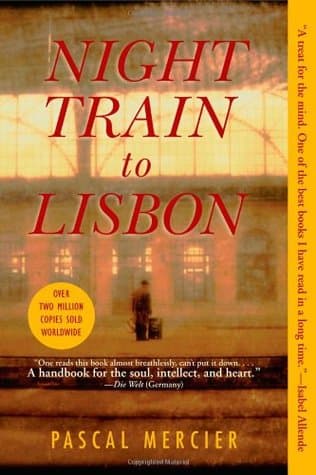
Synopsis
Covers the whole plot, including the ending.
- Difficulty
- Medium
- Pacing
- Moderate
- Mood
- Introspective, Philosophical, Melancholy, Thought-provoking
- Read it if
- You enjoy philosophical meditations on life, identity, and the pursuit of meaning, interwoven with a compelling narrative of discovery and a deep dive into another person's history.
- Skip it if
- You prefer fast-paced thrillers or plot-driven stories over introspective character studies and philosophical discourse.
Night Train to Lisbon Plot Summary
Covers the whole plot, including the ending.
The Encounter and the Departure
Raimund Gregorius, a meticulous Latin teacher in Bern, Switzerland, has an ordinary morning suddenly disrupted. On his way to school, he sees a young Portuguese woman on a bridge, seemingly about to jump. He talks to her, asking about her language, and she replies in Portuguese. Later, she appears in his classroom, writes 'Silveira' on the blackboard, and then disappears. This encounter, along with finding a forgotten book by a Portuguese author, Amadeu de Prado, in an old bookstore, deeply affects Gregorius. The book, 'A Goldsmith of Words,' resonates with him. Feeling an unexplained pull, he impulsively buys a train ticket, leaves a note for the school, and departs on the night train to Lisbon, leaving his predictable life behind.
Immersion in Prado's World
Arriving in Lisbon, Gregorius, who renames himself 'Mundus' in his mind, immediately reads Amadeu de Prado's writings. He finds another copy of 'A Goldsmith of Words' and starts translating it, feeling a strong connection to Prado's thoughts on life, death, and human experience. He is particularly moved by Prado's eloquent and often sad reflections. Gregorius decides that to truly understand Prado's words, he must understand the man himself. He starts his investigation by visiting the bookstore where he found the book, hoping for clues about the author. His first attempts to find information about Prado lead nowhere, but his determination grows.
The Ophthalmologist and the Sister
Gregorius's search leads him to Dr. João Eça, an ophthalmologist who treated Amadeu de Prado and still wears glasses Prado prescribed. Eça is initially cautious but eventually shares some insights into Prado's character and his reputation as a brilliant, yet mysterious, doctor and intellectual. Eça also directs Gregorius to Prado's sister, Adriana, who lives in the old family house. Adriana is devoted to her deceased brother and has kept the house as a memorial to him, preserving his room exactly as he left it. She is reluctant to talk about Amadeu but is interested in Gregorius's genuine interest and deep respect for her brother's work, slowly opening up to him.
The Priest and the Resistance
Through Adriana, Gregorius learns about Amadeu's difficult relationship with his father, a well-known judge with traditional views, and his early intellectual development. He also meets Father Bartolomeu, Amadeu's former Latin teacher and a close friend. Father Bartolomeu reveals Amadeu's deep opposition to the Salazar dictatorship and his secret involvement in the resistance movement. He recounts how Amadeu, despite his privileged background, became a doctor for the poor and a quiet but active participant against the regime, using his medical skills to help injured resistance fighters. This adds another layer to Prado's complex character, showing him as a man of deep thought and courageous action.
The Friendship of Jorge O'Kelly
Gregorius seeks out Jorge O'Kelly, Amadeu's closest friend from their youth, now a successful lawyer. O'Kelly provides a different view of Amadeu, describing their intense intellectual discussions and their strong bond. He speaks of Amadeu's sharp mind, his philosophical depth, and his often melancholic mood. O'Kelly also reveals the complexities of Amadeu's personal life, including his unrequited love for Catarina, a fellow resistance member. Their friendship, though marked by intellectual rivalry and occasional disagreements, was important to Amadeu's life, and O'Kelly's memories give Gregorius a glimpse into Prado's private world and emotional state.
Estefânia and the Resistance Network
Continuing his investigation, Gregorius finds Estefânia, an elderly woman who was important in the resistance network and knew Amadeu well. She describes Amadeu's role in the underground movement, especially his medical skills and his courage in treating injured dissidents at great personal risk. Estefânia speaks of Amadeu's quiet determination and his commitment to justice, despite the dangers. She also mentions a complex emotional dynamic within the group, particularly between Amadeu, Jorge, and Catarina, hinting at the personal sacrifices and emotional toll of their secret activities.
Catarina and the Unspoken Love
Gregorius eventually finds Catarina, the woman Amadeu loved. She is now an old woman, living a quiet life. Catarina reveals the depth of Amadeu's unspoken love for her and the difficult choices they had to make during the dictatorship. She explains that their shared commitment to the resistance made a conventional romantic relationship impossible. She speaks of Amadeu's deep respect for her and her own complex feelings for him. This encounter gives Gregorius a key piece of the puzzle, showing Amadeu's emotional vulnerability and the personal cost of his political beliefs, adding a sad dimension to his character.
The Death and the Legacy
Through his various interviews, Gregorius learns about Amadeu de Prado's death from an aneurysm at a relatively young age. The suddenness of his death left many questions unanswered and his philosophical work unfinished. Gregorius also discovers that Prado, despite his reclusive nature, had a great impact on everyone he met, whether through his medical care, his intellectual discussions, or his quiet acts of rebellion. The more Gregorius learns, the more he understands that Prado's life was a demonstration of individuality, intellectual honesty, and quiet defiance in the face of oppression, leaving a lasting philosophical and personal mark.
Reflections on a Borrowed Life
As Gregorius compiles his notes and finishes his translation of 'A Goldsmith of Words,' he begins to reflect on his own life in Bern. His journey to Lisbon, initially an impulsive escape, has become an exploration of identity, purpose, and the meaning of a well-lived life. He realizes that by learning about Prado's life, he has, in a way, lived a parallel existence, experiencing emotions and ideas he had long suppressed. He thinks about whether he truly understood Prado, or if his quest was more about understanding himself through the lens of another's extraordinary life. He considers the courage it takes to live authentically.
The Return and the Transformation
After months in Lisbon, having gathered all the details of Amadeu de Prado's life, Gregorius decides to return to Bern. He carries with him not only his completed translation and notes but also a changed view on life. He is no longer the timid Latin teacher he once was. The encounter with the Portuguese woman, the discovery of Prado's book, and the subsequent journey have opened him up to new possibilities and a deeper understanding of human experience. While his old life awaits, he knows he cannot simply go back to his previous existence; he has been permanently changed by the lives he has touched and the insights he has gained in Lisbon.
Night Train to Lisbon Characters
Raimund Gregorius (Mundus)
Protagonist
A meticulous Latin teacher who abandons his life to explore another's.
Raimund Gregorius is a 57-year-old Latin and Greek teacher in Bern, Switzerland, known for his methodical habits and solitary existence, nicknamed 'Mundus' by his students for his encyclopedic knowledge. His life is meticulously ordered until a chance encounter with a mysterious Portuguese woman and the discovery of Amadeu de Prado's book, 'A Goldsmith of Words,' shatter his routine. He is driven by an insatiable intellectual curiosity and a deep, unacknowledged yearning for a more authentic and passionate existence. His journey to Lisbon is an impulsive act of self-discovery, fueled by an obsession to understand Prado's life and philosophy, which he hopes will illuminate his own.
Relationships: Amadeu de Prado (obsessive intellectual and existential connection); Adriana de Prado (growing understanding and respect); The Portuguese Woman (catalyst for his journey)
Amadeu de Prado
Central Figure (deceased)
A brilliant Portuguese doctor, essayist, and resistance fighter whose life Gregorius investigates.
Amadeu de Prado is the enigmatic and brilliant Portuguese doctor and essayist whose book, 'A Goldsmith of Words,' captivates Gregorius. He was a man of profound intellect, deeply philosophical, and a master of language, yet also intensely private and melancholic. Born into a privileged family, he rebelled against his conservative judge father and the Salazar dictatorship, becoming a doctor to the poor and a covert member of the resistance. His writings explore loneliness, mortality, language, and the search for an authentic life. His life was a testament to his moral courage and intellectual integrity, leaving a lasting impact on those who knew him.
Relationships: Raimund Gregorius (object of his obsession); Adriana de Prado (devoted, overprotective sister); Jorge O'Kelly (closest friend and intellectual sparring partner); Catarina (unrequited love and fellow resistance member); Father Bartolomeu (mentor and confidante)
Adriana de Prado
Supporting
Amadeu's reclusive, fiercely devoted sister and guardian of his memory.
Adriana de Prado is Amadeu's older sister, who has dedicated her life to preserving her brother's memory and legacy after his premature death. She lives in the family house, maintaining Amadeu's room as a shrine, untouched since his passing. She is initially distrustful and intensely protective of Amadeu's privacy, viewing Gregorius's inquiries with suspicion. However, Gregorius's genuine respect for Amadeu's work slowly breaks down her barriers, and she becomes a crucial source of information, revealing intimate details about her brother's family life, his struggles with their father, and his emotional world.
Relationships: Amadeu de Prado (fiercely devoted sister); Raimund Gregorius (initially wary, then trusting source of information)
Jorge O'Kelly
Supporting
Amadeu's closest friend and fellow intellectual, now a successful lawyer.
Jorge O'Kelly was Amadeu de Prado's closest friend from childhood and his intellectual confidante. Now a successful and respected lawyer, O'Kelly provides Gregorius with a different, more nuanced perspective on Amadeu. He speaks of their shared youth, their intense philosophical discussions, and the complexities of their friendship, which included rivalry and deep affection. O'Kelly also sheds light on Amadeu's involvement in the resistance, his unrequited love for Catarina, and his often melancholic nature. His memories are vital for understanding Amadeu's intellectual and emotional landscape beyond his public persona.
Relationships: Amadeu de Prado (closest friend and intellectual rival); Raimund Gregorius (reluctant but informative source)
Catarina
Supporting
Amadeu's unrequited love and fellow resistance fighter.
Catarina was a key member of the anti-Salazar resistance movement and the woman Amadeu de Prado deeply loved, though their love remained largely unexpressed due to the circumstances of their clandestine lives. Now an elderly woman, she lives a quiet life, haunted by the past. She provides Gregorius with poignant insights into Amadeu's emotional vulnerability, his sacrifices, and the profound personal costs of their political activism. Her memories reveal the unspoken depths of their connection and the tragic beauty of a love that could not fully blossom amidst the dangers of their shared cause.
Relationships: Amadeu de Prado (unrequited love and comrade in resistance); Raimund Gregorius (key source of emotional insight)
Father Bartolomeu
Supporting
Amadeu's former Latin teacher and spiritual mentor.
Father Bartolomeu was Amadeu de Prado's Latin teacher during his school years and later became a trusted confidante. He represents a link to Amadeu's early intellectual and moral development. The priest sheds light on Amadeu's rebellious spirit, his intellectual brilliance even as a young man, and his growing disillusionment with the conservative regime. He also confirms Amadeu's deep involvement in the resistance, offering a perspective on Amadeu's moral compass and his courageous choices, highlighting the deep respect and bond they shared despite their differing paths.
Relationships: Amadeu de Prado (mentor and spiritual advisor); Raimund Gregorius (informative source)
Dr. João Eça
Supporting
Amadeu's ophthalmologist and a connection to his professional life.
Dr. João Eça is an ophthalmologist whom Gregorius seeks out because he was Amadeu de Prado's eye doctor. Eça is a meticulous and somewhat rigid man, initially reluctant to discuss Prado. However, his connection to Prado, symbolized by the glasses he still wears that Prado prescribed, makes him a valuable, if initially terse, source. He provides insights into Prado's professional life as a doctor, his reputation, and his personal demeanor, offering a glimpse into the more public, clinical side of Amadeu's life, distinct from his philosophical and political activities.
Relationships: Amadeu de Prado (patient and doctor); Raimund Gregorius (initial point of contact in Lisbon)
Estefânia
Supporting
An elderly woman who was a key figure in the resistance and knew Amadeu well.
Estefânia is an elderly woman who was an integral part of the anti-Salazar resistance network in which Amadeu de Prado was involved. She provides Gregorius with direct accounts of Amadeu's courage, his medical contributions to the underground, and the dangerous environment in which they operated. Her memories highlight Amadeu's practical heroism and his commitment to the cause, offering a vivid picture of the political climate and the personal risks taken by those who opposed the dictatorship. She provides a perspective on Amadeu's active role in shaping the political landscape of his time.
Relationships: Amadeu de Prado (fellow resistance member); Raimund Gregorius (valuable historical source)
The Portuguese Woman
Mentioned
A mysterious figure who acts as the initial catalyst for Gregorius's journey.
The Portuguese woman is an enigmatic figure who appears briefly at the beginning of the novel. Gregorius encounters her on a bridge, seemingly on the verge of suicide, then later in his classroom, where she writes 'Silveira' on the blackboard before vanishing. Her sudden appearance and disappearance, coupled with her mysterious nature, act as the initial, almost mystical, catalyst that propels Gregorius out of his stagnant life and onto the night train to Lisbon. She embodies the unpredictable, life-altering encounters that can shatter routine and open new pathways.
Relationships: Raimund Gregorius (mysterious catalyst)
Night Train to Lisbon Themes
Identity and Self-Discovery
The novel explores identity through Raimund Gregorius's journey. By learning about Amadeu de Prado's life, Gregorius is not just researching another person, but questioning and rebuilding his own identity. Leaving his old life in Bern and immersing himself in Lisbon is an act of self-discovery, where he confronts his own limits, unfulfilled desires, and the kind of life he truly wants. He deals with the idea of living an authentic life, inspired by Prado's courage and intellectual honesty, finding a new sense of self.
“We leave something of ourselves behind when we leave a place, we stay there, even if we go far away. And there are things in us that we can find again only by going back to that place.”
The Power of Language and Literature
Language and literature are central to 'Night Train to Lisbon.' Amadeu de Prado's philosophical writings, especially 'A Goldsmith of Words,' drive Gregorius's entire journey. The novel shows how words can cross time and space, allowing a deceased author to deeply affect a living reader. Gregorius's translation of Prado's work is not just an academic task but a personal effort to understand and embody Prado's thoughts. The story itself is rich with philosophical ideas about language, its ability to define reality, and its limits in fully capturing human experience.
“Words are the goldsmith's tools, and the goldsmith of words is a silversmith of the soul.”
The Search for Meaning and Authenticity
Both Gregorius and Prado, in their own ways, search for meaning and authenticity. Gregorius's comfortable but sterile life in Bern lacks meaning, which he tries to fix by immersing himself in Prado's tragic existence. Prado, despite his brilliance, constantly struggled with how to live a life true to himself amid personal and political pressures. The novel suggests that authenticity often requires courage, challenging societal norms, and a willingness to confront one's deepest fears and desires, even if it leads to solitude or suffering.
“Is it possible that we are so imbued with the desire to live that we cannot look at life itself?”
Loneliness and Connection
Loneliness is a theme, explored through Gregorius's isolated life in Bern and Prado's often solitary intellectual and emotional journey. Gregorius's pursuit of Prado can be seen as an attempt to connect with another human being on a deep level, even after death. The novel also examines different forms of connection: the intense intellectual bond between Prado and Jorge O'Kelly, Adriana's unwavering devotion, and the unspoken love between Prado and Catarina. It suggests that while deep connections are possible, fully understanding another person remains difficult, and some solitude is part of being human.
“We are alone, even if we are not alone. We are alone in our thoughts, in our feelings, in our decisions.”
Memory and the Past
The narrative looks at memory and the past, as Gregorius carefully reconstructs Amadeu de Prado's life through interviews and historical records. The various characters offer fragmented, often subjective, memories of Prado, showing how personal stories shape the understanding of history and identity. The novel explores how the past is preserved, interpreted, and sometimes distorted by those who lived through it. Gregorius's journey is an act of historical and personal archeology, showing how understanding the past is important for understanding the present and shaping the future.
“Memory is a way of holding onto the things you love, the things you are, the things you never want to lose.”
Plot Devices & Literary Techniques
Dual Narrative/Interwoven Lives
The story of Gregorius's present intertwines with Prado's past.
The novel employs a dual narrative structure, where the present-day journey of Raimund Gregorius in Lisbon is intricately interwoven with the past life of Amadeu de Prado, which Gregorius is actively investigating. This device allows the reader to experience Gregorius's intellectual and emotional transformation in real-time while simultaneously piecing together the complex life of Prado through flashbacks, interviews, and the reading of his writings. The two lives, separated by time, mirror and illuminate each other, creating a profound sense of connection and a layered understanding of themes like identity and meaning.
The Found Manuscript/Book
Prado's book serves as the catalyst and central object of investigation.
The discovery of Amadeu de Prado's book, 'A Goldsmith of Words,' acts as the primary catalyst for Raimund Gregorius's entire journey. This 'found manuscript' device is crucial because it provides Gregorius (and the reader) with direct access to Prado's philosophical mind and personal reflections, even before meeting anyone who knew him. The book is not merely a plot device; it is a character in itself, shaping Gregorius's quest, providing him with questions, and ultimately serving as the ultimate goal of his translation work, symbolizing the power of literature to transcend time and inspire profound change.
The Impulsive Departure
Gregorius's sudden abandonment of his life drives the initial plot.
Gregorius's decision to abandon his established life in Bern and spontaneously board the night train to Lisbon is a pivotal plot device. It signifies a radical break from routine and a leap into the unknown, immediately establishing the theme of self-discovery and the rejection of a stagnant existence. This impulsive act sets the entire narrative in motion, freeing Gregorius from his inhibitions and allowing him to fully immerse himself in his quest. It underscores the idea that profound change often begins with a single, courageous, and often irrational decision.
The Unseen Protagonist (Prado)
Amadeu de Prado's life is revealed solely through others' memories and his writings.
Amadeu de Prado, though central to the plot, is an 'unseen protagonist' in the sense that he is already deceased when the story begins. His character is constructed entirely through the fragmented memories of those who knew him, his philosophical writings, and Gregorius's interpretations. This device creates a sense of mystery and allows for a multi-faceted portrait of Prado, as each interviewee offers a different perspective, often colored by their own experiences and relationships with him. It highlights the subjective nature of memory and the challenge of truly knowing another person, even after extensive investigation.
Night Train to Lisbon Quotes
“We leave something of ourselves behind when we leave a place, we stay there, even if we go away. And there are things in us that we can find again only by going back to that place.”
“When we are able to make a decision, we will discover the strength we never knew we had.”
“The greatest distance between two points is a straight line, if you're not ready for it.”
“What would happen if we were to feel for a moment the full weight of the truth?”
“We should read only books that bite and sting us. If the book we are reading doesn't wake us up with a blow to the head, what's the point?”
“It is not the truth that matters, but the search for it.”
“To be able to choose, you have to know who you are. And to know who you are, you have to be able to choose.”
“The most important things in life are often those that cannot be spoken.”
“Only when you are alone can you be yourself.”
“Perhaps the course of a life is not determined by its greatest events, but by its smallest deviations.”
“The world is a book, and those who do not travel read only one page.”
“We are condemned to be free.”
“A life lived without passion is a mere existence.”
“To understand a man, you have to understand the language he speaks.”
Quiz
10 questions on the plot and the characters. Each answer comes with a short explanation.
Question 1
What prompts Raimund Gregorius to abandon his life and take the night train to Lisbon?
- He receives a mysterious inheritance from a Portuguese relative.
- He is fired from his teaching position and decides to travel.
- A chance encounter with a mysterious Portuguese woman and a book by Amadeu de Prado.
- He has a premonition in a dream that tells him to go to Lisbon.
Show answer
C. A chance encounter with a mysterious Portuguese woman and a book by Amadeu de Prado. Raimund Gregorius's life takes a drastic turn after a chance encounter with a mysterious Portuguese woman and his discovery of a book by Amadeu de Prado, which sparks his obsession and leads him to Lisbon.
Question 2
Who is Amadeu de Prado, the author whose writings captivate Gregorius?
- A famous Swiss philosopher and contemporary of Gregorius.
- A fictional Portuguese doctor and essayist who rebelled against Salazar's dictatorship.
- A renowned Lisbon historian whose works detail the city's past.
- Gregorius's estranged brother who moved to Portugal years ago.
Show answer
B. A fictional Portuguese doctor and essayist who rebelled against Salazar's dictatorship. Amadeu de Prado is a fictional Portuguese doctor and essayist whose profound writings on life, loneliness, and mortality, along with his rebellious stance against the Salazar dictatorship, become the focus of Gregorius's investigation.
Question 3
What is Gregorius's profession before his journey to Lisbon?
- A university professor of philosophy.
- A Latin teacher at a Swiss college.
- A librarian in a large public library.
- A translator of ancient languages.
Show answer
B. A Latin teacher at a Swiss college. Raimund Gregorius, often referred to as 'Mundus' by his students, was a Latin teacher at a Swiss college, a profession that highlights his intellectual and somewhat rigid previous life.
Question 4
Which of the following themes is NOT explicitly explored in Amadeu de Prado's writings, as described in the book?
- Loneliness and mortality
- Friendship and loyalty
- The joy of scientific discovery
- Love and death
Show answer
C. The joy of scientific discovery Prado's writings delve into profound existential themes like loneliness, mortality, death, friendship, love, and loyalty. The joy of scientific discovery is not listed as a primary focus of his philosophical essays.
Question 5
How does Gregorius primarily gather information about Amadeu de Prado's life in Lisbon?
- He attends lectures about Prado at the University of Lisbon.
- He reads official government archives about Prado's political activities.
- He speaks to people who were entangled in Prado's life, such as his family, friends, and colleagues.
- He hires a private detective to investigate Prado's past.
Show answer
C. He speaks to people who were entangled in Prado's life, such as his family, friends, and colleagues. Gregorius's investigation is deeply personal and involves him actively seeking out and speaking to individuals who knew Amadeu de Prado, slowly piecing together the fragmented story of his life through their memories and perspectives.
Question 6
What political context is relevant to Amadeu de Prado's life in Portugal?
- The Carnation Revolution and the establishment of democracy.
- Salazar's dictatorship, against which Prado rebelled.
- Portugal's entry into the European Union.
- The Portuguese colonial wars in Africa.
Show answer
B. Salazar's dictatorship, against which Prado rebelled. Amadeu de Prado was a figure who rebelled against Salazar's dictatorship, a key historical detail that shapes his character and the challenges he faced in his life.
Question 7
The novel explores 'the possibility of truly understanding another person.' How does Gregorius's journey reflect this theme?
- He successfully writes a definitive biography of Prado, claiming complete understanding.
- He realizes that despite his efforts, a full and objective understanding of another's inner life remains elusive.
- He discovers that Prado was a fictional character created by the mysterious Portuguese woman.
- He finds that understanding Prado's life is only possible through direct, personal experience of the same events.
Show answer
B. He realizes that despite his efforts, a full and objective understanding of another's inner life remains elusive. One of the central themes is the inherent difficulty in truly comprehending another person's subjective experience. Gregorius's journey, while revealing much about Prado, ultimately underscores the limits of such understanding, as he grapples with the complexities and contradictions of Prado's life.
Question 8
What significant personal transformation does Gregorius undergo during his time in Lisbon?
- He becomes a successful author himself, writing a book about his experiences.
- He returns to Switzerland with a renewed appreciation for his old, predictable life.
- He sheds his rigid, academic persona and opens himself to new experiences, emotions, and a deeper engagement with life.
- He decides to become a doctor, inspired by Amadeu de Prado's profession.
Show answer
C. He sheds his rigid, academic persona and opens himself to new experiences, emotions, and a deeper engagement with life. Gregorius's journey to Lisbon is not just about understanding Prado, but also about self-discovery. He moves from a solitary, intellectually confined existence to one where he engages more deeply with people, emotions, and the vibrant complexities of life, shedding his former rigid self.
Question 9
How does the 'ability of language to define our very selves' manifest in the novel?
- Gregorius's mastery of Latin allows him to perfectly translate Prado's Portuguese texts.
- Prado's essays and personal writings are central to understanding his identity, showing how his words shaped and reflected who he was.
- The diverse languages spoken in Lisbon confuse Gregorius, preventing him from forming connections.
- The novel suggests that language is ultimately an inadequate tool for self-expression.
Show answer
B. Prado's essays and personal writings are central to understanding his identity, showing how his words shaped and reflected who he was. Prado's philosophical essays and personal notes are the primary window into his soul and identity. The novel emphasizes how his carefully chosen words, his reflections on life, and his intellectual struggles, as expressed through language, profoundly define his character and legacy.
Question 10
What is the overarching impact of Gregorius's obsession with Amadeu de Prado?
- It leads him to abandon his search and return to his old life, finding it more comforting.
- It results in him becoming a recluse, isolating himself further from society.
- It compels him to confront his own life, identity, and the choices he has made, leading to a profound personal re-evaluation.
- It inspires him to write a fictional novel based on Prado's life, but without seeking personal understanding.
Show answer
C. It compels him to confront his own life, identity, and the choices he has made, leading to a profound personal re-evaluation. Gregorius's obsession with Prado is not merely an academic exercise; it forces him to look inward and reflect on his own unlived life, his fears, desires, and the meaning of his own existence, ultimately leading to a significant personal awakening and transformation.
Night Train to Lisbon FAQ
What is Night Train to Lisbon about?
Night Train to Lisbon follows Raimund Gregorius, a Swiss Latin teacher who, after a chance encounter, impulsively abandons his life to travel to Lisbon. He becomes obsessed with the writings of a Portuguese doctor and essayist, Amadeu de Prado, and spends his time in Lisbon piecing together Prado's life through interviews with those who knew him, uncovering a story of rebellion against Salazar's dictatorship, profound relationships, and intellectual struggle.
Why should I read Night Train to Lisbon?
You should read Night Train to Lisbon for its profound exploration of philosophical themes like loneliness, mortality, the search for meaning, and the possibility of truly understanding another person's life. It's a deeply immersive experience that combines a compelling detective-like narrative with rich historical context of Salazar's Portugal and introspective character studies.
What is the background/setting of Night Train to Lisbon?
The story is primarily set in Lisbon, Portugal, during the present day, but delves extensively into the past, specifically the era of António de Oliveira Salazar's dictatorship. This historical backdrop is crucial, as Amadeu de Prado's life and his philosophical writings are deeply intertwined with his resistance to the oppressive regime and the choices he made under its shadow.
What are the most memorable quotes?
One memorable quote is Amadeu de Prado's reflection: "We leave something of ourselves behind when we leave a place, we stay there, even if we go away. And there are things in us that we can find again only by going back to that place." Another is Gregorius's realization: "When we understand, we no longer have to judge." These quotes encapsulate the novel's themes of identity, memory, and empathy.
What writing style does the author use?
Pascal Mercier employs a reflective, philosophical, and often melancholic writing style. The narrative frequently shifts between Gregorius's present-day investigations and extensive excerpts from Amadeu de Prado's profound, essayistic writings. This dual approach creates a layered experience, blending narrative progression with deep intellectual contemplation.
What minor details add significant meaning?
The constant presence of the Portuguese language itself, which Gregorius must learn and immerse himself in, is more than a plot device; it symbolizes his complete surrender to a new culture and his effort to understand Prado on a deeper, more intrinsic level. Also, the specific locations in Lisbon, like the old bookshops and cafes, are not just settings but repositories of memory and history that Gregorius meticulously uncovers.
What are some subtle foreshadowing moments?
The initial, almost dreamlike encounter with the mysterious Portuguese woman on the bridge in Bern subtly foreshadows Gregorius's profound and irreversible break from his mundane life. Her fleeting presence acts as a catalyst, suggesting that his life is on the precipice of a dramatic, fated change, which is then solidified by his discovery of Prado's book.
What unexpected character connections exist?
An unexpected connection is between Amadeu de Prado and the powerful, influential Salazar himself. Prado, as a doctor, once saved Salazar's life. This act creates a complex moral dilemma for Prado, as he despises the dictator but is bound by his Hippocratic oath, and this singular event shapes much of his later life and philosophical struggles.
What are unspoken character motivations?
Raimund Gregorius's unspoken motivation for his sudden departure is a profound sense of existential boredom and a yearning for a life of passion and meaning, which he perceives to be missing from his own academic existence. His obsession with Amadeu de Prado is not just intellectual curiosity, but a desperate search for a blueprint for a more authentic way of living.
What psychological complexities do characters exhibit?
Amadeu de Prado exhibits immense psychological complexity, torn between his medical duty, his intellectual calling as a writer, and his fierce opposition to the dictatorship. He grapples with guilt, the burden of expectations from his family, and the profound loneliness of his unique intellectual path, often feeling isolated even among those he loves.
What are the major emotional turning points?
A major emotional turning point for Gregorius is his decision to board the night train, representing a complete surrender to impulse and the unknown. For Prado, a significant turning point is his decision to save Salazar's life, which forces him to confront his moral code against his political convictions, deeply impacting his self-perception and future actions.
How do relationship dynamics evolve?
Relationship dynamics in the novel are explored through Gregorius's retrospective lens as he uncovers Prado's past. He sees the complex love between Prado and Estefânia, marked by passion and betrayal, and the deep, intellectual bond Prado shared with his sister, Adriana, which often bordered on possessiveness. These dynamics reveal the many facets of human connection and its inherent difficulties.
Which parts remain ambiguous or open-ended?
The ultimate impact of Gregorius's journey on his own future remains somewhat ambiguous. While he finds a renewed sense of purpose and connection through Prado's life, the novel doesn't explicitly detail what his 'new life' will entail beyond his return to Switzerland, leaving readers to ponder the lasting transformation of his character.
What are controversial scenes or decisions?
Amadeu de Prado's decision to save Salazar's life is a highly controversial moment. While driven by his Hippocratic oath, it places him in a morally compromising position, aiding the very regime he despises. This act is debated by characters in the novel, highlighting the ethical complexities and the grey areas of human choice under extreme circumstances.
Night Train to Lisbon ending explained: how it ends & what it means
The novel ends with Gregorius returning to Switzerland, having completed his exhaustive investigation into Amadeu de Prado's life. He brings with him not just knowledge of Prado, but a profound transformation of himself. The ending signifies that while he may physically return to his old world, he is irrevocably changed, having found a deeper understanding of life, mortality, and the human spirit through another's journey, suggesting that true understanding comes from stepping outside oneself.
Similar books
- The Unbearable Lightness of Being
Milan Kundera
4.1 (342k) average on GoodreadsLiterary FictionExplores philosophical themes of existence, freedom, and love within a European historical context.
- Siddhartha
Hermann Hesse
4.0 (583k) average on GoodreadsHistorical FictionFeatures a protagonist's journey of self-discovery and philosophical awakening.
- Stoner
John Williams
4.3 (103k) average on GoodreadsLiterary FictionA quiet, reflective character study of a man's life, his passions, and his struggles.
- The Old Man and the Sea
Ernest Hemingway
3.8 (831k) average on GoodreadsLiterary FictionA Cuban fisherman's long struggle with a giant marlin becomes a story of endurance and dignity, now retold for young adults with illustrations, phonetic guides, and writing prompts in Traditional Chinese.
- One Hundred Years of Solitude
Gabriel García Márquez
4.1 (753k) average on GoodreadsLiterary FictionThrough the multi-generational story of the Buendía family, a mythical town deals with the repeating patterns of time, love, and solitude, as the extraordinary mixes with the ordinary.
- The Goldfinch
Donna Tartt
3.9 (720k) average on GoodreadsLiterary FictionHaunted by a tragic explosion and clutching a stolen Dutch masterpiece, a young orphan navigates the opulent drawing rooms of New York and the gritty underbelly of the art world, desperately seeking connection and redemption amidst a life spiraling into crime and obsession.





Enjoyed the summary?
A summary gives you the shape of the book. The book itself has the detail, the examples and the voice.
Find Night Train to Lisbon on AmazonAs an Amazon Associate, BookBrief earns from qualifying purchases. How we're funded