
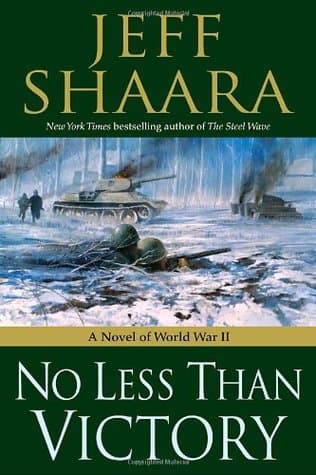
Synopsis
Covers the whole plot, including the ending.
- Difficulty
- Medium
- Pacing
- Moderate
- Mood
- Gritty, intense, somber, epic
No Less Than Victory Plot Summary
Covers the whole plot, including the ending.
The Ardennes Surprise
In December 1944, Allied commanders, including General Eisenhower, expected the war to end quickly after D-Day's success. But Hitler, ignoring his generals, planned a huge counteroffensive in the Ardennes Forest. This surprise attack, called 'Watch on the Rhine' (later known as the Battle of the Bulge), aimed to split Allied forces and capture the port of Antwerp. German Panzer divisions, led by Field Marshal Gerd von Rundstedt, broke through thin American lines, causing chaos among unprepared GIs. The harsh winter, with heavy snow and freezing temperatures, added to the confusion and hardship for American troops, who were often cut off from supplies and communication.
Bastogne Under Siege
As the German attack grew, the town of Bastogne, an important crossroads, became a main target. The American 101st Airborne Division, with other units, was surrounded and attacked by stronger German forces. Despite freezing weather, low supplies, and constant shelling, the American paratroopers, led by Brigadier General Anthony McAuliffe, refused to surrender. When given an ultimatum, McAuliffe famously replied, 'Nuts!' Their defense tied up many German resources and became a symbol of American resolve, gaining crucial time for the Allied counterattack to start. The soldiers' bravery against huge odds was essential.
Patton's Race to Relieve
General George S. Patton Jr., commanding the U.S. Third Army, had to relieve the besieged troops in Bastogne. Showing his usual speed and aggressive leadership, Patton turned his entire army ninety degrees, moving them north through the difficult winter terrain. His engineers worked hard to clear roads and build bridges, allowing a fast advance. Despite the bad weather and strong German resistance, Patton's forces pushed through, finally breaking Bastogne's encirclement on December 26th. This decisive action, combined with better weather allowing Allied air support, was a turning point in the Battle of the Bulge, stopping the German attack and starting their slow retreat.
The Rhine Crossing and Final Push
After the Battle of the Bulge, the Allies regrouped and pressed their advantage, pushing the Germans back towards their homeland. The Rhine River, Germany's last major natural barrier, was the next big objective. Allied forces, including Patton's, made daring crossings of the Rhine, often under heavy fire. The capture of the Remagen Bridge, though unexpected, gave an early foothold. These crossings showed the final breach of German defenses and opened the way for Allied armies to sweep across Germany. The scale and coordination of these operations showed the overwhelming Allied superiority in manpower and materiel.
Hitler's Last Stand in the Bunker
As Allied armies closed in from the west and Soviets advanced from the east, Adolf Hitler went to his bunker under Berlin. Surrounded by a few loyalists, he became more deluded, giving orders to imaginary armies and refusing to admit Germany's coming defeat. He blamed his generals, believing they betrayed him, and ordered a 'scorched earth' policy for Germany, preferring total destruction to surrender. His power weakened as key figures like Albert Speer subtly defied his irrational commands, trying to lessen their nation's destruction. The bunker's atmosphere was one of despair, paranoia, and fanaticism.
The Discovery of the Camps
As American and other Allied forces moved deeper into Germany, they found concentration and extermination camps. The scale and horror of the Holocaust were revealed to the world through the eyes of these shocked soldiers. They found starved survivors, piles of unburied bodies, and chilling evidence of systematic genocide. The GIs faced an evil they could not comprehend, forever changing their understanding of the war. The liberation of these camps, such as Buchenwald and Dachau, was a somber moment, showing the conflict's moral stakes and the Nazi regime's true nature.
The Final Days of Berlin
While Western Allies pushed from the west, the Soviet Red Army launched its final, brutal attack on Berlin. The city became a battleground of intense fighting, as German soldiers, militia, and even children fought to the last, often under Hitler's direct command from his bunker. The Soviets, driven by revenge and the need to capture Berlin, advanced street by street, house by house. The sounds of shelling and gunfire were constant, and the city was destroyed. Berlin's fall was unavoidable, marking the symbolic and actual end of the Nazi regime.
Hitler's Suicide and the End of the War
With Soviet troops blocks from the Reich Chancellery, Adolf Hitler, after marrying Eva Braun and dictating his will, committed suicide on April 30, 1945. His body was then burned outside the bunker, as he instructed, to prevent it from falling into enemy hands. This act of self-destruction signaled the end of the 'Thousand Year Reich' and threw the remaining Nazi leadership into disarray. While some German resistance continued for a few more days, news of Hitler's death removed the central figure holding the regime together. The war in Europe was now in its final hours, leading to widespread German surrender.
V-E Day: Victory in Europe
After Hitler's suicide and the surrender of various German forces, the official unconditional surrender was signed on May 7, 1945, at Reims, and ratified on May 8, 1945, in Berlin. This day is celebrated as Victory in Europe Day (V-E Day). Across Allied nations, jubilant crowds filled the streets, celebrating the end of nearly six years of devastating warfare in Europe. For the soldiers, it meant the end of fighting, though many still dealt with trauma and the huge task of rebuilding. The war was over, but its scars, especially the concentration camp revelations, would forever shape the world.
The Aftermath and the Future
Immediately after V-E Day, the huge task of occupation, denazification, and rebuilding a shattered Europe began. The story reflects on the psychological toll on soldiers and the changes caused by the war. Figures like Eisenhower and Patton considered peace and the challenges of a post-war world, while characters like Albert Speer faced judgment for their roles in the Nazi regime. The Holocaust's discovery left a lasting mark, ensuring the atrocities would never be forgotten. Victory was achieved, but the price was immense, and Germany and Europe's future remained uncertain, facing reconstruction and ideological division.
Principal Figures
General Dwight D. Eisenhower
Protagonist
Supreme Commander of the Allied Expeditionary Force.
Eisenhower is depicted as a strategic and diplomatic leader, constantly balancing the demands of his Allied commanders and political superiors. He grapples with the immense responsibility of the entire European theater, making tough decisions that affect millions of lives. He is initially confident after Normandy but is deeply shaken by the surprise of the Battle of the Bulge, demonstrating his human vulnerability and the pressure he operates under. His focus is always on the larger picture of victory and maintaining Allied unity.
Relationships: General George S. Patton Jr. (subordinate/fraternal rivalry); Field Marshal Bernard Montgomery (allied commander/political tension)
General George S. Patton Jr.
Protagonist
Commander of the U.S. Third Army.
Patton is portrayed as an aggressive, charismatic, and often controversial figure. His strategic brilliance and unwavering resolve are highlighted during his swift and decisive relief of Bastogne. He is a master of armored warfare, deeply devoted to his troops, and possesses a profound understanding of the psychological aspects of combat. Despite his abrasive personality and sometimes insubordinate tendencies, his effectiveness as a battlefield commander is undeniable, inspiring both fear in his enemies and fierce loyalty in his men.
Relationships: General Dwight D. Eisenhower (superior/complex); Various GIs (commander/inspirational)
Adolf Hitler
Antagonist
Führer of Nazi Germany.
Hitler is presented as a figure increasingly detached from reality, consumed by delusion and paranoia in the final months of the war. His decisions become more irrational and destructive, leading to the utter ruin of Germany. He refuses to acknowledge defeat, clinging to a twisted vision of a 'Thousand Year Reich' even as his armies collapse and his capital is besieged. His character embodies the ultimate evil and fanaticism of the Nazi regime, culminating in his desperate suicide in the bunker.
Relationships: Albert Speer (confidant/manipulator); Field Marshal Gerd von Rundstedt (commander/scapegoat)
Albert Speer
Supporting
Reich Minister of Armaments and War Production.
Speer is depicted as a pragmatist and a survivor within Hitler's inner circle. While initially loyal to Hitler, he secretly works to sabotage Hitler's 'scorched earth' decrees in the final days, attempting to preserve Germany's infrastructure for the post-war era. He is intelligent and calculating, observing Hitler's descent into madness with a mixture of fear and calculated defiance. His internal struggle between loyalty and the preservation of his nation's future provides a unique perspective from within the collapsing Nazi regime.
Relationships: Adolf Hitler (subordinate/confidant/eventual defiance)
Field Marshal Gerd von Rundstedt
Supporting
German Commander of the Western Front.
Rundstedt is portrayed as an old, experienced, and weary German officer, a professional soldier who understands the futility of Hitler's later strategies. He is given command of the Ardennes offensive but harbors deep doubts about its success, recognizing the overwhelming Allied superiority. He is a tragic figure, forced to execute commands he knows are doomed, constantly clashing with Hitler's unrealistic expectations. His perspective offers insight into the disillusionment and despair within the German high command.
Relationships: Adolf Hitler (commander/disillusioned subordinate)
Private Jesse Adams
Supporting
An American GI fighting in the Ardennes.
Jesse Adams represents the ordinary American soldier facing the brutal realities of combat, particularly during the Battle of the Bulge. He experiences the shock of the German offensive, the freezing conditions, and the constant threat of death. His perspective allows the reader to connect with the ground-level experience of the war, including the fear, camaraderie, and resilience of the front-line troops. He witnesses firsthand the horrors of war and the profound impact of battle on the individual.
Relationships: Fellow GIs (comrades in arms)
Private Peter Brandt
Supporting
A young German soldier.
Peter Brandt offers a glimpse into the experience of a young German soldier, often caught between his duty and the growing realization of Germany's impending defeat. He represents the ordinary German fighting for his homeland, sometimes with misguided loyalty, sometimes with a dawning sense of the regime's true nature. His experiences highlight the immense human cost of the war on both sides, and the propaganda that fueled the German war effort. His perspective is a counterpoint to the Allied GIs.
Relationships: Fellow German soldiers (comrades)
Brigadier General Anthony McAuliffe
Supporting
Acting Commander of the 101st Airborne Division at Bastogne.
McAuliffe is a symbol of American defiance and resolve during the Battle of the Bulge. His famous one-word response, 'Nuts!', to the German surrender demand encapsulates the fighting spirit of the encircled American troops in Bastogne. He is a calm and determined leader under immense pressure, inspiring his men to hold out against overwhelming odds. His leadership is crucial in preventing the fall of Bastogne, which would have had catastrophic consequences for the Allied front.
Relationships: 101st Airborne troops (commander/inspiration)
Themes & Insights
The Brutality and Folly of War
The novel shows the terrible human cost of war, from the freezing conditions and constant fighting of the Battle of the Bulge to the destruction of German cities. It highlights the immense suffering of soldiers on both sides, the psychological trauma, and the waste of human life. Hitler's desperate, last-ditch efforts, which only prolonged the war and intensified destruction, underscore this theme. The ultimate revelation of the concentration camps is the clearest example of war's potential for depravity.
“The snow was no longer just snow; it was a blanket of white despair, stained with the red of young men's blood.”
Leadership and Command
This theme explores different styles and challenges of military leadership. Eisenhower's diplomatic and strategic oversight, Patton's aggressive battlefield genius, and Rundstedt's weary professionalism under a delusional dictator are all examined. The burden of command, the need to make impossible decisions, and leadership's impact on morale and outcome are central. Hitler's increasingly irrational and destructive leadership contrasts sharply with Allied commanders' efforts to win with as little additional loss of life as possible.
“A general's burden was not the weight of the war, but the weight of every man's life under his command.”
Resilience and Sacrifice
This theme celebrates the strong spirit of soldiers who fought against huge odds, especially during the Battle of the Bulge. The tenacity of American GIs in Bastogne, holding out against encirclement and extreme conditions, shows this resilience. The sacrifices made by countless individuals, both in combat and through their hardships, are honored. It highlights the courage needed to keep fighting when hope seems lost and the personal cost of defending freedom against tyranny.
“'Nuts!' The single word echoed, a defiant roar against the storm, a testament to American grit.”
The Nature of Evil and Its Aftermath
The novel confronts the Nazi regime's profound evil, ending with Allied soldiers' shocking discovery of the concentration camps. This theme explores how such atrocities could happen and their psychological impact on witnesses. Hitler's descent into madness and his 'scorched earth' policy show the ultimate destructive power of unchecked evil. The aftermath involves not just military victory but a moral reckoning with the Holocaust and the huge challenge of facing and overcoming the ideology that allowed such horrors.
“They had fought a war, but they had not known the true face of the enemy until they opened the gates of hell.”
Plot Devices & Literary Techniques
Multiple Points of View
Shifting perspectives provide a comprehensive look at the war.
The novel employs multiple points of view, alternating between key historical figures like Eisenhower, Patton, Hitler, Speer, and Rundstedt, as well as fictional GIs. This allows for a panoramic understanding of the war's final phase, from high-level strategic decisions to the brutal reality of the front lines. It provides insight into the motivations, fears, and internal struggles of individuals on both sides of the conflict, creating a rich, multi-dimensional narrative that is both personal and grand in scope. This technique enhances the historical accuracy and emotional resonance of the story.
Dramatic Irony
The audience knows the outcome, enhancing tension for characters.
The reader, knowing the historical outcome of World War II, experiences dramatic irony as characters like Hitler cling to delusions of victory or Allied commanders face unforeseen setbacks. This device heightens the tension, particularly during the Battle of the Bulge, as the audience understands the true scale of the German gamble and its eventual failure, even as the characters on the ground fight for their lives without that foreknowledge. It also underscores the tragic folly of Hitler's final decisions, as his self-destructive path is clear to the reader.
Foreshadowing
Hints of impending doom or revelation build suspense.
Shaara uses foreshadowing to build suspense and convey the inevitable march towards the war's conclusion. Early mentions of Hitler's increasingly erratic behavior hint at his ultimate demise, while the growing reports of atrocities in the East subtly prepare the reader for the eventual horrifying discovery of the concentration camps. This device creates a sense of impending doom for the German regime and a mounting tension for the Allied forces as they push deeper into enemy territory, knowing that significant challenges and revelations still lie ahead.
Historical Allusion
References to past events and figures add depth and context.
The narrative frequently alludes to previous battles, historical figures, and political events that shaped World War II. These allusions provide essential context for the characters' decisions and motivations, enriching the historical fabric of the story. For instance, references to past German military successes or the failures of the appeasement era help to explain the mindset of both the Allied and Axis leaders. This device grounds the fictionalized narrative in factual history, lending it authenticity and depth, and reminding the reader of the broader historical tapestry.
Quiz
10 questions on the plot and the characters. Each answer comes with a short explanation.
Question 1
What is the primary focus of Jeff Shaara's novel 'No Less Than Victory'?
- The D-Day landings in Normandy.
- The final act of the war in Europe, specifically the Battle of the Bulge and its aftermath.
- The naval battles in the Pacific theater.
- The strategic planning of the Allied forces before the war.
Show answer
B. The final act of the war in Europe, specifically the Battle of the Bulge and its aftermath. The book's description clearly states it covers the 'European war’s unforgettable and harrowing final act,' which includes the Battle of the Bulge and the end of the war in Europe.
Question 2
What event marks the beginning of the desperate German counteroffensive described in the book?
- The successful Allied invasion of Normandy.
- The fall of Berlin to Soviet forces.
- The German launch of an offensive in the Ardennes forest in mid-December 1944.
- The surrender of Italy.
Show answer
C. The German launch of an offensive in the Ardennes forest in mid-December 1944. The text explicitly states, 'In mid-December 1944, the Germans launch a desperate and ruthless counteroffensive in the Ardennes forest...' which is known as the Battle of the Bulge.
Question 3
What was Hitler's primary objective with the Ardennes offensive?
- To capture the port of London.
- To divide the Allied armies and capture the vital port at Antwerp.
- To launch a final assault on Moscow.
- To secure a peace treaty with the Allied powers.
Show answer
B. To divide the Allied armies and capture the vital port at Antwerp. The text states, 'Through the frigid snows of the mountainous terrain, German tanks and infantry struggle to realize Hitler’s goal: divide the Allied armies and capture the vital port at Antwerp.'
Question 4
Which of the following characters is NOT mentioned as a viewpoint character in the novel?
- Dwight D. Eisenhower
- Erwin Rommel
- George S. Patton
- Albert Speer
Show answer
B. Erwin Rommel The book's description lists Eisenhower, Patton, Gerd von Rundstedt, and Albert Speer as viewpoint characters. Erwin Rommel is not mentioned.
Question 5
What does the text suggest about Hitler's mindset as the war neared its end?
- He was willing to negotiate for peace to save German lives.
- He believed in a swift surrender to avoid further destruction.
- He was determined to fight to the end, regardless of the cost in German lives, to preserve his vision of the 'Thousand Year Reich'.
- He focused all his efforts on planning his escape to South America.
Show answer
C. He was determined to fight to the end, regardless of the cost in German lives, to preserve his vision of the 'Thousand Year Reich'. The text states, 'He will spare nothing–not even German lives–to preserve his twisted vision of a “Thousand Year Reich.”', indicating his fanatical dedication to his ideology even in defeat.
Question 6
What shocking discovery do American GIs make as they sweep through Germany?
- Hidden caches of Nazi gold.
- Evidence of secret German rocket technology.
- The ruins of Hitler's bunker.
- Concentration camps and the horrors of the Holocaust.
Show answer
D. Concentration camps and the horrors of the Holocaust. The text mentions, 'As the Americans sweep through the German countryside, they unexpectedly encounter the worst of Hitler’s crimes, the concentration camps, and young GIs find themselves absorbing firsthand the horrors of the Holocaust.'
Question 7
The Battle of the Bulge is described as a 'horrific slugging match' and the 'last gasp' by Hitler's forces. What does this suggest about its significance in the war?
- It was a decisive Allied victory that immediately ended the war.
- It was a strategically brilliant but ultimately unsuccessful German gamble.
- It was a minor skirmish that had little impact on the war's outcome.
- It was primarily fought between American and Soviet forces.
Show answer
B. It was a strategically brilliant but ultimately unsuccessful German gamble. Describing it as a 'last gasp' and a 'horrific slugging match' implies it was a major, brutal effort by the Germans that, while initially surprising, ultimately failed and represented their final significant offensive push in the West.
Question 8
Which German commander, a viewpoint character, is described as an 'old soldier' in the context of the war's end?
- Albert Speer
- Adolf Hitler
- Gerd von Rundstedt
- Joseph Goebbels
Show answer
C. Gerd von Rundstedt The text specifically mentions 'Germany’s old soldier, Gerd von Rundstedt' as one of the viewpoint characters.
Question 9
The novel contrasts the 'spirit of the soldier' with the 'horror of a madman's dreams.' What does this juxtaposition likely represent within the narrative?
- The struggle between good and evil, embodied by the soldiers' resilience and Hitler's destructive ideology.
- The internal conflict within the German military command.
- The personal ambitions of Allied leaders versus the suffering of the common soldier.
- The differing perspectives of American and German soldiers on the war's purpose.
Show answer
A. The struggle between good and evil, embodied by the soldiers' resilience and Hitler's destructive ideology. This phrasing suggests a thematic exploration of the contrast between the bravery, sacrifice, and humanity of soldiers (the 'spirit of the soldier') and the destructive, irrational ideology and actions driven by Hitler (the 'horror of a madman's dreams').
Question 10
Given the book's focus on the final act of the European war and the discovery of concentration camps, what is a likely underlying theme explored by Jeff Shaara?
- The technological advancements in warfare during WWII.
- The complex geopolitical maneuvering between the Allied powers.
- The human cost of war, the nature of evil, and the importance of remembering historical atrocities.
- The economic factors that led to the outbreak of World War II.
Show answer
C. The human cost of war, the nature of evil, and the importance of remembering historical atrocities. The combination of brutal fighting (human cost of war), Hitler's ideology and actions (nature of evil), and the discovery of the Holocaust (importance of remembering historical atrocities) points to these as central themes.
No Less Than Victory FAQ
What is No Less Than Victory about?
No Less Than Victory by Jeff Shaara is the final book in his World War II trilogy, focusing on the harrowing final act of the war in Europe. It covers the German counteroffensive in the Ardennes (the Battle of the Bulge) and the eventual collapse of Nazi Germany, including the discovery of concentration camps.
What historical events are covered in No Less Than Victory?
The book primarily covers the Battle of the Bulge, which began in December 1944 as a surprise German counteroffensive. It also details the final months of the war in Europe, culminating in Germany's surrender in May 1945 and Hitler's suicide.
Who are the main characters in No Less Than Victory?
The narrative is told through the perspectives of key historical figures, including Allied commanders like Eisenhower and Patton, German General Gerd von Rundstedt, and Albert Speer, Hitler's Minister of Armaments. It also features the experiences of ordinary American GIs.
Is No Less Than Victory a sequel?
Yes, No Less Than Victory is the third and final book in Jeff Shaara's World War II trilogy. It brings the story of the European theater to a close after the events of previous books.
What is the significance of the Battle of the Bulge in the book?
The Battle of the Bulge is depicted as a desperate and ruthless last-ditch effort by Hitler's forces to divide the Allied armies. It represents a brutal and chaotic period of fighting that tested the resolve of the American soldiers.
How does the book portray Hitler's mindset?
The book portrays Hitler as a fanatical leader unwilling to accept defeat, even at the cost of German lives. His 'Thousand Year Reich' vision is shown to be a destructive obsession that led to immense suffering.
What is the emotional impact of discovering the concentration camps?
The discovery of the concentration camps by American GIs is presented as a shocking and horrifying experience, bringing the atrocities of the Holocaust firsthand to the soldiers and underscoring the inhumanity of the Nazi regime.
How does No Less Than Victory compare to other WWII fiction?
Jeff Shaara is known for his detailed and character-driven historical fiction. No Less Than Victory, like his other works, aims to provide an immersive and emotionally resonant account of pivotal historical moments through the eyes of those who lived them.
What is the overall message or theme of No Less Than Victory?
The book explores themes of soldierly spirit in the face of overwhelming odds, the horrors of war and fanaticism, and the profound impact of witnessing unspeakable evil. It highlights the human cost of a madman's dreams and the eventual triumph of Allied forces.
Where can I buy No Less Than Victory?
No Less Than Victory is available at most major online retailers, bookstores, and libraries. You can typically find it on websites like Amazon, Barnes & Noble, and through your local bookseller.
About the author

Jeff Shaara is an American author known for his historical fiction, particularly focusing on the American Civil War and the Revolutionary War. His notable works include The Last Full Measure, Rise to Rebellion, The Glorious Cause, The Steel Wave, and No Less Than Victory, which explore significant events and figures in American history through engaging narratives.
Similar books
- The Naked and the Dead
Norman Mailer
3.9 (23k) average on GoodreadsHistorical FictionWhile both Shaara and Mailer explore the grim realities of war, "No Less Than Victory" is a more traditional historical fiction, prioritizing factual events and documented figures. Mailer's "The Naked and the Dead," though based on his wartime experiences, is a more intensely psychological and philosophical novel, using fictional characters to explore themes of power, fear, and human nature in a much more abstract and existential manner. Shaara aims for historical reconstruction; Mailer aims for a deeper, often darker, exploration of the human condition under duress, with less emphasis on strict historical adherence.
- To Kill a Mockingbird
Harper Lee
4.3 (4.5M) average on GoodreadsHistorical FictionIn the 1930s Jim Crow South, Harper Lee writes about racial injustice, moral growth, and the quiet courage of a lawyer father, Atticus Finch, as seen through his young daughter's eyes.
- The Great Gatsby
F. Scott Fitzgerald
3.9 (3.8M) average on GoodreadsHistorical FictionIn the opulent Roaring Twenties, a mysterious millionaire's lavish parties hide his desperate, tragic pursuit of a lost love, exposing the emptiness within the American Dream.
- Pride and Prejudice
Jane Austen
4.3 (3M) average on GoodreadsHistorical FictionIn a society focused on status and money, Elizabeth Bennet navigates love and pride, challenging Mr. Darcy and social expectations to find true affection.
- Angels & Demons
Dan Brown
3.9 (2.7M) average on GoodreadsThrillerA Harvard symbologist races through Rome's ancient sites, deciphering cryptic clues to unmask the Illuminati and stop a vengeful plot to destroy the Vatican with a stolen antimatter weapon.
- The Kite Runner
Khaled Hosseini
4.3 (2.4M) average on GoodreadsHistorical FictionIn pre-Taliban Afghanistan, a wealthy boy's betrayal of his servant's son during a kite-running tournament starts a lifelong journey for amends as his country collapses.





Enjoyed the summary?
A summary gives you the shape of the book. The book itself has the detail, the examples and the voice.
Find No Less Than Victory on AmazonAs an Amazon Associate, BookBrief earns from qualifying purchases. How we're funded