
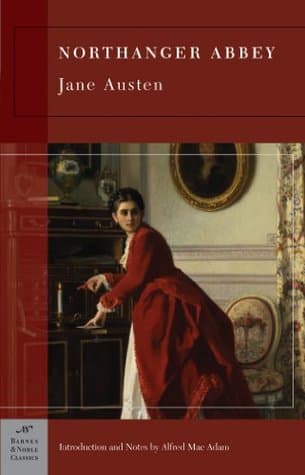
Synopsis
Covers the whole plot, including the ending.
- Difficulty
- Medium
- Pacing
- Moderate
- Mood
- Witty, Charming, Satirical, Romantic, Observational
- Read it if
- You enjoy satirical takes on popular genres, coming-of-age stories, and classic romance with a witty narrator.
- Skip it if
- You prefer fast-paced plots, high-stakes drama, or explicitly modern sensibilities.
Northanger Abbey Plot Summary
Covers the whole plot, including the ending.
A Plain Heroine's Introduction
Catherine Morland is a plain, unremarkable girl from a large family in Fullerton. She shows little early promise, preferring boyish games to feminine accomplishments. At seventeen, she begins to show signs of beauty and an interest in novels. A wealthy neighbor, Mrs. Allen, invites Catherine to accompany her and her husband to Bath for the social season. This is Catherine's first trip into the world beyond her quiet home. The invitation excites Catherine, who expects the romance and adventure she has read about.
New Acquaintances in Bath
In Bath, Catherine quickly becomes close friends with Isabella Thorpe, a lively, fashionable young woman who also loves gothic novels. Isabella's brother, John Thorpe, a boisterous and conceited young man, begins to pursue Catherine, though she finds him tiresome. More importantly, Catherine meets Henry Tilney, a charming, witty, and intelligent clergyman, and his elegant sister, Eleanor Tilney. Catherine is immediately captivated by Henry's conversation and kind manner, finding him much more agreeable than John Thorpe. She joins the Tilney's sophisticated circle, much to John Thorpe's annoyance, as he tries to monopolize her time.
Misunderstandings and Growing Affections
Catherine's time in Bath includes social calls, dances, and walks, often complicated by her new friends' conflicting demands. John Thorpe repeatedly tries to stop her from joining the Tilneys, often making up stories or rude remarks about Henry. Despite his efforts, Catherine's affection for Henry grows with each meeting. She enjoys his playful teasing and insightful observations, finding him a refreshing change from the superficiality she sees in others. Isabella, meanwhile, gets engaged to Catherine's brother, James Morland, and the two friends delight in their shared family connection, discussing future plans and their love for novels.
The Invitation to Northanger Abbey
General Tilney, Henry and Eleanor's father, takes a sudden interest in Catherine, believing her to be a wealthy heiress because of John Thorpe's exaggerated claims about her family's fortune. Impressed by her perceived wealth and gentle nature, he invites Catherine to accompany Eleanor and Henry to their family estate, Northanger Abbey, for several weeks. Catherine is overjoyed, especially as it means more time with Henry and exploring a real abbey, which her gothic novel-fueled imagination has filled with romantic and mysterious expectations. She eagerly accepts, unaware of the General's true motives.
Arrival at Northanger Abbey
Upon arriving at Northanger Abbey, Catherine's imagination runs wild. The old architecture, secluded rooms, and historical atmosphere fuel her gothic fantasies. She immediately starts looking for hidden passages, secret documents, and evidence of past tragedies, much to Henry's amusement. He playfully teases her about her expectations, gently reminding her that reality often differs from fiction. Despite her initial disappointment that the abbey is not as terrifying as she hoped, Catherine enjoys Eleanor and Henry's company, and the beauty of the surrounding countryside. Her innocent nature, however, continues to lead her to misinterpret events.
Catherine's Suspicions and Henry's Rebuke
Catherine's gothic reading leads her to a dangerous conclusion: she suspects General Tilney of having murdered his late wife, Henry and Eleanor's mother, or at least of having imprisoned her. Driven by these theories, she secretly explores the General's private rooms, looking for clues. Henry finds her and, though initially amused, becomes seriously displeased and gives her a stern lecture. He reminds her of the difference between fiction and reality, and the impropriety of her suspicions, especially about his own family. Catherine is deeply mortified by her foolishness and ashamed of her wild imagination.
Isabella's Betrayal and James's Disappointment
While at Northanger Abbey, Catherine receives upsetting letters from her brother, James. He reveals that Isabella Thorpe has broken off their engagement. Isabella, always seeking social climbing and wealth, had become infatuated with Captain Frederick Tilney, Henry's older brother, a known flirt. She pursued him relentlessly, hoping for a better match. When Captain Tilney eventually leaves Bath without proposing, Isabella tries to rekindle her engagement with James, but he, deeply hurt and disillusioned, refuses. Catherine is shocked and saddened by her friend's betrayal and her brother's heartbreak.
General Tilney's Discovery and Catherine's Expulsion
General Tilney eventually learns the truth about Catherine's financial situation from John Thorpe, who, out of spite and a desire to harm Catherine's reputation, reveals that the Morlands are not wealthy. Realizing he has been misled and that Catherine is not the heiress he imagined, the General's behavior toward her drastically changes. Without explanation or regard for proper conduct, he rudely orders Catherine to leave Northanger Abbey immediately. He arranges for her to travel home alone in a common carriage, an act of extreme disrespect and cruelty that deeply humiliates Catherine and distresses Eleanor.
Henry's Intervention and Confession
Catherine arrives home in Fullerton, mortified and heartbroken by the General's harsh treatment. Shortly after, to her astonishment and relief, Henry Tilney arrives at the Morland parsonage. He apologizes for his father's behavior and explains that he was unaware of the General's cruel actions until after Catherine had left. Henry then confesses his love for Catherine, stating that despite his father's disapproval of her lack of fortune, he wishes to marry her. Catherine, who has long loved Henry, joyfully accepts his proposal, marking a turning point in her emotional journey.
Reconciliation and Resolution
Initially, General Tilney opposes Henry and Catherine's marriage because of her lack of fortune. However, Eleanor Tilney's own happiness is secured when she gets engaged to a wealthy nobleman, Lord Chetwynd. With Eleanor's marriage providing the General with a satisfactory alliance, and perhaps softened by time and a growing realization of Henry's steadfast love for Catherine, he eventually relents. The novel ends with General Tilney giving his grudging consent to the union, allowing Catherine and Henry to marry and live happily, having overcome social prejudice and Catherine's youthful naivety.
Northanger Abbey Characters
Catherine Morland
Protagonist
An innocent and imaginative young woman who matures through experience.
Catherine is introduced as a plain, unsophisticated girl from a large, respectable, but not wealthy, family. She is naturally good-hearted, kind, and possesses a vivid imagination, largely fueled by her love for gothic novels. Initially naive and easily influenced, she often misinterprets social cues and believes the best in everyone, even the manipulative Isabella Thorpe. Her journey is one of self-discovery, learning to distinguish between the romanticized world of fiction and the complexities of real life. She is sincere, unpretentious, and values genuine affection over superficial charm or wealth.
Relationships: Henry Tilney (Love interest, mentor, eventual husband); Eleanor Tilney (Close friend); Isabella Thorpe (Initial close friend, later betrayed); John Thorpe (Unwanted suitor, antagonist); James Morland (Brother); General Tilney (Antagonist, Henry's father)
Henry Tilney
Love Interest, Mentor
A witty, intelligent, and perceptive clergyman who falls for Catherine.
Henry Tilney is a cultivated and charming young clergyman with a keen intellect and a playful sense of humor. He is perceptive and articulate, often using irony and wit in his conversations. Unlike many men of his time, he respects women's intelligence and engages Catherine in thoughtful discussions, gently guiding her understanding of the world. He is kind and honorable, standing up for Catherine against his father's cruelty and demonstrating genuine affection despite her lack of fortune. He serves as a voice of reason and reality, helping Catherine to shed her gothic delusions.
Relationships: Catherine Morland (Love interest, eventual wife); Eleanor Tilney (Sister); General Tilney (Father, strained relationship due to differing values); Frederick Tilney (Brother)
Eleanor Tilney
Supporting
Henry's kind and elegant sister, who befriends Catherine.
Eleanor Tilney is a gentle, well-mannered, and refined young woman. She is kind and considerate, offering Catherine genuine friendship and support, particularly during Catherine's difficult departure from Northanger Abbey. Despite her own constrained circumstances under her domineering father, she maintains a quiet dignity and strong moral compass. She embodies the ideal of a well-bred Georgian lady, but her compassion and understanding make her a true friend to Catherine, often acting as a buffer between Catherine and the General's harshness.
Relationships: Catherine Morland (Close friend); Henry Tilney (Brother); General Tilney (Father); Lord Chetwynd (Eventual husband)
General Tilney
Antagonist
Henry and Eleanor's proud, mercenary, and domineering father.
General Tilney is a formidable and imposing figure, proud of his wealth and social standing. He is domineering, autocratic, and deeply concerned with appearances and financial gain. He initially welcomes Catherine into his home due to John Thorpe's false claims of her wealth, and when he discovers her true, more modest circumstances, he cruelly casts her out. His character embodies the negative aspects of social ambition and materialism, contrasting sharply with the genuine affection and integrity of his children. He is a source of conflict and represents the societal pressures and prejudices that Catherine must overcome.
Relationships: Henry Tilney (Son, strained relationship); Eleanor Tilney (Daughter); Catherine Morland (Initial target for his son's marriage, later disdained)
Isabella Thorpe
Antagonist/Supporting
Catherine's fickle and manipulative friend, driven by social ambition.
Isabella Thorpe is a beautiful, vivacious, and superficially charming young woman. She quickly befriends Catherine in Bath, sharing her love for novels and appearing to be a devoted companion. However, Isabella is deeply superficial, vain, and entirely driven by social climbing and a desire for wealth. She is a consummate flirt and a calculating opportunist, readily abandoning her engagement to James Morland for the wealthier Captain Tilney, only to attempt to regain James when her plans fail. She represents the dangers of false friendship and the perils of prioritizing material gain over genuine affection.
Relationships: Catherine Morland (Initial close friend, later betrays); James Morland (Fiancée, later jilted); John Thorpe (Brother); Frederick Tilney (Object of flirtation)
John Thorpe
Antagonist/Supporting
Isabella's boorish and conceited brother, who falsely pursues Catherine.
John Thorpe is a boisterous, self-important, and conceited young man. He is a friend of James Morland and attempts to court Catherine, but his manners are rough, his conversation tiresome, and his character generally disagreeable. He is a habitual exaggerator and liar, particularly concerning his wealth and social connections. His false claims about the Morland family's fortune contribute to General Tilney's initial interest in Catherine, and his later malicious revelations cause her expulsion from Northanger Abbey. He embodies vulgarity and social pretension.
Relationships: Catherine Morland (Unwanted suitor); Isabella Thorpe (Sister); James Morland (Friend)
James Morland
Supporting
Catherine's kind but somewhat naive brother, engaged to Isabella Thorpe.
James Morland is Catherine's older brother, a kind and amiable young man, though somewhat naive and easily taken in by Isabella Thorpe's charms. He is genuinely fond of his family and happy for Catherine's social success. His engagement to Isabella highlights his good nature and his susceptibility to manipulation. His heartbreak and disillusionment when Isabella jilts him serve as a cautionary tale about trusting superficial appearances, mirroring Catherine's own lessons in discernment.
Relationships: Catherine Morland (Sister); Isabella Thorpe (Fiancée, later jilted); John Thorpe (Friend)
Frederick Tilney
Supporting/Mentioned
Henry's older brother, a charming but unreliable captain.
Captain Frederick Tilney is Henry and Eleanor's older brother, an officer in the army. He is handsome, charming, and a notorious flirt, often described as a 'rake.' He briefly captivates Isabella Thorpe, leading her to break off her engagement with James Morland, but he ultimately has no serious intentions and leaves Bath without proposing to her. He represents the superficial and potentially destructive elements of the social world, contrasting with Henry's more grounded and honorable character.
Relationships: Henry Tilney (Brother); Eleanor Tilney (Sister); Isabella Thorpe (Object of flirtation)
Northanger Abbey Themes
The Perils of Imagination vs. Reality
This theme is central to Catherine's journey. Her love for gothic novels leads her to project dramatic, often sinister, fantasies onto real-life situations, especially during her stay at Northanger Abbey. She imagines General Tilney to be a murderer and the abbey to hold dark secrets, a direct result of her undiscriminating reading. Henry Tilney acts as the voice of reason, gently guiding her to understand the difference between sensational literature and the more mundane, yet complex, realities of human behavior. Her eventual disillusionment with her gothic theories shows her growth into a more discerning person, learning to observe and judge actual events rather than fictional constructs. The novel itself satirizes the excesses of gothic literature while subtly warning against its potential to distort perception.
“Charming as were all these things, and charming as were many others, they were at present nothing more than an amusement to Catherine, while she was to learn the real art of being happy herself.”
Social Class and Fortune
The novel examines how social class and financial standing influence marriage and social interactions in Georgian England. General Tilney's interest in Catherine is based entirely on the mistaken belief that she is a wealthy heiress, and his cruel expulsion of her is solely due to his discovery of her modest fortune. Isabella Thorpe's mercenary pursuit of Captain Tilney over James Morland further highlights how deeply ingrained the pursuit of wealth and status was in marital decisions. Austen contrasts these superficial motives with the genuine affection between Catherine and Henry, suggesting that true love and virtue should go beyond social calculations, though societal pressures ultimately force even Henry to delay his proposal until his father's consent is secured.
“A family of ten children will always be called a poor family, whatever its income may be.”
Female Education and Discernment
Catherine's development throughout the novel comments on female education, particularly the role of reading. Initially, Catherine's education is haphazard, and her reading is largely confined to sensational gothic novels, which leave her ill-equipped to navigate the complexities of society. Her experiences in Bath and at Northanger Abbey, along with Henry Tilney's insightful guidance, teach her crucial lessons in discernment. She learns to judge character more accurately, to see through superficial charm (like Isabella's) and boorishness (like John Thorpe's), and to understand people's motives. Her journey emphasizes the importance of developing critical thinking and a balanced perspective, rather than relying solely on romanticized ideals.
“She was heartily ashamed of her folly. A moment’s reflection was enough to convince her of such a monstrous absurdity.”
The Nature of True Friendship and Love
The novel explores the contrast between superficial friendships and genuine connections. Catherine's initial friendship with Isabella Thorpe appears intense but is revealed to be entirely one-sided and self-serving on Isabella's part. Isabella's betrayal of Catherine's brother, James, and her general fickleness show the dangers of trusting those motivated purely by self-interest. In contrast, Catherine's relationship with Eleanor Tilney is marked by mutual respect and kindness, while her love for Henry Tilney is built on intellectual compatibility, shared humor, and deep affection, enduring despite social obstacles and financial differences. The novel champions the lasting power of sincere affection and loyalty over fleeting infatuations and mercenary motives.
“To be disgraced in the eyes of a man with whom she had just been on the point of union, was something to which she had never been used, and which she could not immediately get over.”
Plot Devices & Literary Techniques
Gothic Parody
The novel satirizes the conventions and excesses of popular gothic literature.
Austen uses gothic elements not to create genuine suspense, but to poke fun at the genre. Catherine's overactive imagination, fueled by novels like 'The Mysteries of Udolpho,' leads her to expect secret passages, imprisoned wives, and murderous villains at Northanger Abbey. The reality, however, is far more mundane. Henry Tilney's playful teasing about Catherine's gothic theories and the narrator's ironic commentary constantly highlight the absurdity of her expectations, contrasting them with the more subtle, psychological dramas of real life. This parody serves to both entertain and to make a point about the dangers of an undiscriminating imagination.
Dramatic Irony
The audience is aware of information that Catherine, the protagonist, is not.
Dramatic irony is frequently employed, particularly regarding General Tilney's motives and John Thorpe's character. The reader quickly discerns General Tilney's mercenary intentions when he invites Catherine to Northanger Abbey, knowing he believes her to be wealthy, while Catherine remains blissfully unaware. Similarly, the reader sees through Isabella and John Thorpe's superficiality and manipulative natures long before Catherine does. This creates a sense of tension and anticipation, as the reader waits for Catherine to realize the truth, thereby highlighting her innocence and providing insight into the deceptive nature of some characters.
Bildungsroman (Coming-of-Age Story)
The narrative focuses on Catherine Morland's psychological and moral growth.
Northanger Abbey is fundamentally a bildungsroman, charting Catherine Morland's development from a naive, impressionable girl into a more mature, discerning young woman. Her journey begins with her sheltered life in Fullerton, progresses through her social education in Bath, and culminates in her challenging experiences at Northanger Abbey. Through her interactions with various characters, her misjudgments, and her ultimate realization of her own follies, Catherine learns valuable lessons about human nature, social dynamics, and the difference between fiction and reality. Her transformation is central to the novel's purpose, emphasizing the importance of experience and critical thought in personal growth.
Free Indirect Discourse
The narrator blends their voice with the character's thoughts and feelings.
Austen frequently employs free indirect discourse, allowing the reader direct access to Catherine's thoughts and perceptions while maintaining the narrator's distinct voice. This technique immerses the reader in Catherine's innocent worldview, making her gothic fantasies and naive interpretations feel immediate and understandable, even as the narrator subtly critiques or gently mocks them. It allows for a nuanced portrayal of Catherine's internal state and her gradual shift in perspective without explicit narration of her thoughts, creating a close bond between the reader and the protagonist.
Northanger Abbey Quotes
“No, I am sure I never shall be worth any thing, till I have been a few months in Bath.”
“A young man does not like to have his company solicited.”
“I cannot speak well enough to be unintelligible.”
“To sit in idleness over your book, regardless of what is passing around you, is a habit I have never been able to acquire.”
“The person, be it gentleman or lady, who has not pleasure in a good novel, must be intolerably stupid.”
“A woman, especially, if she have the misfortune of knowing any thing, should conceal it as well as she can.”
“I have no idea of there being any romance in Bath.”
“The advantages of natural good taste are not to be purchased with money.”
“Where people are really attached, poverty itself is wealth.”
“Remember the country and the age in which we live. Remember that we are English, that we are Christians.”
“The greatest blessing of life is to be able to do without being beholden to anybody for anything.”
“It is a truth universally acknowledged, that a single man in possession of a good fortune, must be in want of a wife.”
“I am not fond of the country. I think it very dull.”
“To look almost pretty is an acquisition of higher delight to a girl who has been looking plain the first fifteen years of her life, than almost any other that could befall her.”
Quiz
10 questions on the plot and the characters. Each answer comes with a short explanation.
Question 1
What is Catherine Morland's primary initial flaw that leads her into various scrapes?
- Her excessive pride and vanity.
- Her naivete and overactive imagination, fueled by Gothic novels.
- Her manipulative nature and desire for wealth.
- Her shyness and inability to converse with others.
Show answer
B. Her naivete and overactive imagination, fueled by Gothic novels. Catherine's inexperience and love for Gothic novels lead her to misinterpret situations and people, particularly at Northanger Abbey.
Question 2
Where does Catherine Morland first meet Henry Tilney?
- At Northanger Abbey.
- At a ball in Bath.
- At Fullerton, her family home.
- During a walk in the countryside.
Show answer
B. At a ball in Bath. Catherine first encounters Henry Tilney at an assembly ball in Bath, where they share a dance and begin their acquaintance.
Question 3
What is the name of the family that invites Catherine to stay at Northanger Abbey?
- The Thorpes
- The Morlands
- The Tilneys
- The Allens
Show answer
C. The Tilneys Catherine is invited to Northanger Abbey by the Tilney family, specifically by General Tilney after Isabella Thorpe falsely implies Catherine is wealthy.
Question 4
What specific type of literature does 'Northanger Abbey' primarily satirize?
- Sentimental novels
- Epic poetry
- Gothic novels
- Travel narratives
Show answer
C. Gothic novels The novel directly pokes fun at the conventions and exaggerated plots of Gothic novels, which Catherine is an avid reader of.
Question 5
Why does General Tilney suddenly send Catherine away from Northanger Abbey?
- He discovers her true social standing and lack of fortune.
- He catches her trying to uncover a dark secret about his past.
- He learns of her secret engagement to Henry.
- He finds her to be a troublesome and ill-mannered guest.
Show answer
A. He discovers her true social standing and lack of fortune. General Tilney, having been misled by John Thorpe about Catherine's wealth, rudely dismisses her once he learns she is not as rich as he believed.
Question 6
Which character is depicted as a superficial and gossipy friend to Catherine in Bath, eventually revealing her true, self-serving nature?
- Eleanor Tilney
- Isabella Thorpe
- Mrs. Allen
- Miss Tilney
Show answer
B. Isabella Thorpe Isabella Thorpe quickly befriends Catherine but proves to be fickle and interested only in advantageous matches, eventually betraying Catherine's brother, James.
Question 7
What is Henry Tilney's profession or aspiration that sets him apart from many other male characters in Austen's novels?
- He is a wealthy landowner.
- He is a military officer.
- He is a clergyman.
- He is a lawyer.
Show answer
C. He is a clergyman. Henry Tilney is a clergyman, which is a respectable but not necessarily wealthy profession, distinguishing him from characters solely focused on inherited fortunes.
Question 8
What is the 'heady power of literature' referred to in the book's description, and how does Catherine experience it negatively?
- It inspires her to write her own novel, but she finds it too challenging.
- It allows her to escape reality, causing her to neglect her social duties.
- Her immersion in Gothic novels leads her to imagine a dark, murderous past for General Tilney, nearly ruining her reputation.
- She becomes overly critical of others based on literary archetypes, alienating her friends.
Show answer
C. Her immersion in Gothic novels leads her to imagine a dark, murderous past for General Tilney, nearly ruining her reputation. Catherine's love for Gothic novels causes her to suspect General Tilney of having murdered his wife, a delusion that Henry Tilney gently but firmly corrects, highlighting the danger of blurring fiction and reality.
Question 9
How does Catherine's understanding of 'love' evolve throughout the novel, moving beyond initial superficial attractions?
- She learns that love is primarily about securing a wealthy and prestigious match, regardless of personal feelings.
- She realizes that true love involves a deep intellectual and emotional connection, valuing character over superficial charm or wealth.
- She discovers that love is an illusion, and all relationships are based on convenience.
- Her perception of love remains unchanged, always prioritizing physical attractiveness.
Show answer
B. She realizes that true love involves a deep intellectual and emotional connection, valuing character over superficial charm or wealth. Catherine initially falls for the superficial charm of Isabella Thorpe and is swayed by John Thorpe's boasts, but through her experiences and her relationship with Henry, she learns to value genuine character, intelligence, and kindness in a partner.
Question 10
What is the significance of the novel being published posthumously in 1818, considering its satirical nature and 'caution to the female sex'?
- It suggests that Austen's critique of society was too radical for publication during her lifetime.
- It highlights that the themes of female discernment and the dangers of unchecked imagination remained relevant even after her death.
- The posthumous publication indicates it was an unfinished work, explaining its lighter tone.
- It was held back because its humor was considered inappropriate for the time.
Show answer
B. It highlights that the themes of female discernment and the dangers of unchecked imagination remained relevant even after her death. The novel's themes of a young woman learning to navigate society, discern true character, and avoid the pitfalls of a misled imagination were timeless concerns for women in Austen's era and beyond, making its eventual publication significant for its continued social commentary.
Northanger Abbey FAQ
What is the central premise of 'Northanger Abbey'?
The novel follows Catherine Morland, a naive young woman from a country parsonage, as she experiences the fashionable society of Bath and later visits Northanger Abbey. Her journey is marked by her innocent misinterpretations of people and events, heavily influenced by her love for gothic novels, ultimately leading to her growth and understanding of the real world.
Who are the primary romantic interests for Catherine Morland?
Catherine's main romantic interest is Henry Tilney, a witty and intelligent clergyman she meets in Bath. She also briefly entertains the attentions of John Thorpe, a boorish and self-important young man, whose character serves as a foil to Henry's refined nature.
How does Bath contribute to Catherine's initial development?
Bath is Catherine's first exposure to a wider, more fashionable society outside her sheltered home. Here, she forms friendships with Isabella Thorpe and Eleanor Tilney, and meets Henry Tilney, which begins her social education and introduces her to different facets of human nature, both genuine and superficial.
What role does Northanger Abbey play in the story?
Northanger Abbey is the ancestral home of the Tilney family, and Catherine's visit there forms the climax of her gothic-inspired delusions. She imagines dark secrets and crimes within its walls, heavily influenced by the novels she reads, which leads to embarrassing situations and ultimately a harsh lesson in reality.
How does Catherine Morland grow and change by the end of the novel?
By the novel's conclusion, Catherine sheds her initial naiveté and gothic fantasies. She learns to distinguish between appearance and reality, recognizes true character, and understands the complexities of human motivation, ultimately maturing into a more discerning and less impressionable young woman capable of true love.
What specific gothic novel elements does Catherine misinterpret at Northanger Abbey?
Catherine, influenced by 'The Mysteries of Udolpho,' imagines General Tilney to be a tyrannical villain who perhaps imprisoned or even murdered his wife. She searches for secret passages, hidden documents, and a locked chest, believing them to hold clues to his supposed crimes, all of which are figments of her overactive imagination.
What is the significance of the locked chest Catherine finds in Mrs. Tilney's room?
The locked chest is a crucial symbol of Catherine's gothic delusions. She expects it to contain incriminating evidence or a dark secret, but upon forcing it open, she finds only ordinary household items like old blankets. This anticlimax serves as a stark rebuttal to her romanticized expectations and a comedic highlight of her naiveté.
How do the names 'Tilney' and 'Thorpe' subtly reflect the characters' personalities?
The name 'Tilney' evokes a sense of refinement and a slightly 'still' or 'tilled' quality, suggesting a cultivated, stable family, which aligns with Henry and Eleanor's genteel nature. 'Thorpe', on the other hand, sounds more rugged and common, perhaps hinting at the boorish and unrefined character of John Thorpe and his sister Isabella.
What social commentary is made through Isabella Thorpe's character?
Isabella Thorpe embodies the superficiality and mercenary nature of some elements of Bath society. Her rapid engagement to James Morland for his supposed inheritance, and subsequent abandonment of him for Captain Tilney, exposes the transactional and often dishonest motivations behind social climbing and flirtation in the period.
How does Catherine's initial 'sweetness' contribute to her vulnerability?
Catherine's inherent sweetness and good nature make her overly trusting and easily manipulated, particularly by Isabella Thorpe. She assumes everyone shares her innocent intentions, which prevents her from recognizing deceit or ulterior motives, leaving her susceptible to disappointment and misunderstanding.
Discuss the psychological impact of gothic novels on Catherine's perception of reality.
Gothic novels profoundly warp Catherine's perception, leading her to project their sensational plots onto real-life situations and individuals. This creates a cognitive bias where she actively seeks out and interprets innocuous events as sinister, demonstrating how media consumption can distort one's understanding of the world.
How does Henry Tilney's teasing affect Catherine's self-awareness?
Henry Tilney's playful teasing, especially his discussions about gothic novels and his ironic predictions, serves as a gentle yet persistent challenge to Catherine's naive worldview. While sometimes embarrassing, his wit encourages her to reflect on her own assumptions and eventually helps her differentiate between fantasy and reality.
What is the psychological basis for General Tilney's harsh treatment of Catherine?
General Tilney's cruelty stems from his avarice and class consciousness. He believes Catherine to be wealthy due to John Thorpe's exaggerated claims, and when he discovers she is not, he harshly expels her from Northanger Abbey, demonstrating his transactional view of relationships and social status.
Is 'Northanger Abbey' primarily a satire or a serious commentary on female education?
While 'Northanger Abbey' is undeniably a brilliant satire of gothic novels and social conventions, it also functions as a serious commentary on female education. It advocates for women to develop critical thinking skills, distinguish between fiction and reality, and cultivate discernment to navigate the complexities of the real world, rather than relying solely on romanticized ideals.
To what extent is Catherine Morland a 'heroine' in the traditional sense, given her flaws?
Catherine challenges the traditional notion of a flawless heroine. Her appeal lies in her fallibility, her innocence, and her journey of self-discovery. Austen presents her as a relatable character whose growth from naiveté to discernment makes her a heroine defined not by inherent perfection, but by her capacity for learning and moral improvement.
Does Austen genuinely endorse the cautionary message about novel reading, or is it ironic?
Austen's stance on novel reading is complex. While the novel satirizes Catherine's excessive and uncritical consumption of gothic fiction, leading to her delusions, Austen herself was a novelist. The preface defends novels as a legitimate art form. The message is likely a nuanced one: novels are valuable, but readers, especially young women, must engage with them critically and not confuse fiction with reality.
How does the ending, with General Tilney's eventual consent, reflect Austen's view on societal pressures?
General Tilney's eventual consent to Catherine and Henry's marriage, driven by his desire to smooth over his earlier rudeness and his son's determination, highlights the pervasive influence of social propriety and familial pressure even on a character as self-serving as the General. It suggests that even the most obstinate individuals can be swayed by reputation and the desire for social peace.
What is the lasting appeal of 'Northanger Abbey' compared to Austen's other works?
'Northanger Abbey's' lasting appeal lies in its unique blend of sharp satire, charming coming-of-age story, and its meta-commentary on the novel genre itself. Its lighter tone and focus on a heroine's intellectual awakening, rather than solely romantic angst, offers a refreshing contrast to some of Austen's more emotionally intense works, making it a delightful and accessible introduction to her genius.
About the author

Jane Austen was an English novelist known primarily for her six major novels, which implicitly interpret, critique, and comment upon the British landed gentry at the end of the 18th century. Austen's plots often explore the dependence of women on marriage for the pursuit of favourable social standing and economic security. Her works are an implicit critique of the novels of sensibility of the second half of the 18th century and are part of the transition to 19th-century literary realism. Her deft use of social commentary, realism and biting irony have earned her acclaim among critics and scholars.
Similar books
- Sense and Sensibility
Jane Austen
4.1 (958k) average on GoodreadsHistorical FictionExplores societal pressures and romantic entanglements with a focus on female characters.
- Emma
Jane Austen
3.2 (13k) average on GoodreadsRomanceFeatures a well-meaning but often misguided heroine learning from her mistakes in love and social interactions.
- Pride and Prejudice
Jane Austen
4.3 (3M) average on GoodreadsHistorical FictionWhile both novels feature strong heroines navigating societal expectations and misunderstandings, Pride and Prejudice offers a more complex and nuanced exploration of class, pride, and prejudice, with deeper character arcs for Elizabeth Bennet and Mr. Darcy. Northanger Abbey's satire is more overtly literary, targeting a specific genre, whereas Pride and Prejudice's social critique is broader and more integrated into the characters' personal growth.
- To Kill a Mockingbird
Harper Lee
4.3 (4.5M) average on GoodreadsHistorical FictionIn the 1930s Jim Crow South, Harper Lee writes about racial injustice, moral growth, and the quiet courage of a lawyer father, Atticus Finch, as seen through his young daughter's eyes.
- The Great Gatsby
F. Scott Fitzgerald
3.9 (3.8M) average on GoodreadsHistorical FictionIn the opulent Roaring Twenties, a mysterious millionaire's lavish parties hide his desperate, tragic pursuit of a lost love, exposing the emptiness within the American Dream.
- Angels & Demons
Dan Brown
3.9 (2.7M) average on GoodreadsThrillerA Harvard symbologist races through Rome's ancient sites, deciphering cryptic clues to unmask the Illuminati and stop a vengeful plot to destroy the Vatican with a stolen antimatter weapon.




Enjoyed the summary?
A summary gives you the shape of the book. The book itself has the detail, the examples and the voice.
Find Northanger Abbey on AmazonAs an Amazon Associate, BookBrief earns from qualifying purchases. How we're funded