
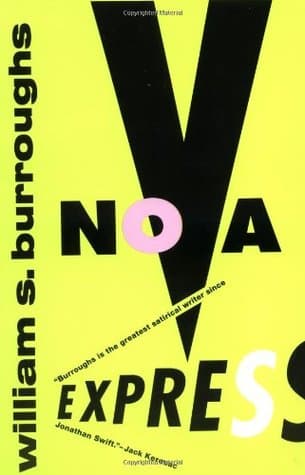
Synopsis
Covers the whole plot, including the ending.
- Difficulty
- Hard
- Pacing
- Variable
- Mood
- Surreal, Disorienting, Anarchic, Dark, Experimental
- Read it if
- You enjoy experimental, non-linear narratives, surrealist science fiction, and challenging literary works that deconstruct language and reality.
- Skip it if
- You prefer traditional plot structures, clear character arcs, and straightforward science fiction stories.
Nova Express Plot Summary
Covers the whole plot, including the ending.
Introduction to the Nova Mob
The novel begins by showing the main conflict: the Nova Police, led by Inspector Lee, are getting ready to stop the Nova Mob, intergalactic criminals who want to control the universe. The Nova Mob, including figures like Sammy The Butcher, Green Tony, and Izzy The Push, uses 'word and image' machines to control and distort reality. They trap sentient beings in cycles of addiction and control. Inspector Lee and his allies see these criminals not just as lawbreakers but as parasites feeding on existence itself. The first parts set a chaotic, fragmented tone, typical of Burroughs' cut-up technique, immediately putting the reader into a disorienting fight for reality.
The Nature of the Nova Express
Burroughs explains the 'Nova Express' itself. This is not a physical train but a metaphor for how the Nova Mob spreads its control. It is a system of addiction, language, and viral information that spreads like a disease, taking over minds and bodies. The Nova Mob uses various 'control addicts' and 'reality engineers' to carry out their plans, which involve hijacking human perception and creating false realities. The text describes this process with many metaphors, often grotesque, linking it to drug addiction, sexual perversion, and the subtle nature of mass media and political talk. Inspector Lee's mission is an attempt to free the universe from this widespread influence.
Confrontation with the Nova Criminals
The story moves through a series of fragmented encounters and conceptual battles between the Nova Police and members of the Nova Mob. These are not typical shootouts but rather ideological and linguistic confrontations. Inspector Lee uses his own 'word-and-image' weapons, trying to disrupt the Mob's control by exposing their lies and breaking down their constructed realities. Characters like The Brown Artist and Jacky Blue Note are shown as architects of these false realities, using art and sound to enslave populations. The battles are often depicted as psychic or informational warfare, with the goal being to free perception rather than to win physically.
The Virus of Language
A main focus is on language as a virus, a core part of Burroughs's philosophy. The Nova Mob does not just use language; they are language, or rather, the parasitic parts of it that hijack consciousness. They spread 'word-viruses' that infect and control individuals, turning them into extensions of the Mob's will. Inspector Lee's counter-strategy involves 'cut-ups' and 'fold-ins' – literary techniques meant to break the linear, controlling stories imposed by the Mob. By disrupting syntax and meaning, Lee aims to free minds from the predetermined thought patterns put in place by the Nova Criminals, allowing new, unscripted realities to appear.
Exposing the Nova Mob's Origin
Inspector Lee and his allies investigate the history and origins of the Nova Mob. They find them to be ancient, parasitic entities that have always tried to control life. They are shown as a cosmic virus, a harmful force that came before humanity and has caused countless cycles of destruction and enslavement across the universe. Their methods are adaptable, appearing in different forms throughout history, from religious dogma to political propaganda. This exploration adds a cosmic horror element to the conflict, suggesting that the fight against the Nova Mob is a struggle against an inherent flaw in existence itself, or at least, a deeply ingrained pattern of control.
The Nature of Reality and Perception
Throughout the story, Burroughs questions the idea of objective reality. He suggests that what humans see as real is often a carefully built illusion, a 'soft machine' designed to keep them docile and controllable. The Nova Mob are the ultimate builders of these illusions, but the novel also hints that humans help in their own enslavement by accepting these fabricated realities without question. Inspector Lee's mission becomes less about physical fighting and more about waking people up to how arbitrary their perceived world is. He encourages them to break free from the 'control addicts' who profit from their ignorance. The cut-up technique itself shows this idea in action.
The Role of Addiction and Control
Addiction is a widespread theme, presented not just as a physical need but as a metaphor for all forms of control. The Nova Mob thrives on creating and exploiting addictions – to drugs, sex, power, fame, and even specific thought patterns or emotional states. They are 'control addicts' themselves, getting their energy from the control they have over others. Inspector Lee realizes that breaking these cycles of addiction is essential to defeating the Mob. The novel suggests that true freedom comes from detoxifying not just the body, but the mind and spirit, from all outside sources of control and manipulation. This allows individuals to reclaim their own will.
The Nova Police's Counter-Offensive
Inspector Lee and his Nova Police force develop increasingly experimental methods to fight the Nova Mob. These include not just the cut-up technique, but also 'silence' and 'word-deletion' as weapons, aiming to create empty spaces where the Mob's controlling language cannot exist. They try to expose the Mob's operations by making 'reality-film' documentaries that show the underlying control mechanisms. The strategies are often non-linear and focus on disrupting the Mob's patterns rather than directly attacking them. The goal is to make their parasitic existence impossible by removing the consensual reality they depend on.
The Universal Scrap Heap
The climax of the conceptual battle shows the Nova Mob's ultimate goal: to reduce the entire universe to a 'universal scrap heap' – a sterile, controlled environment where all creativity, spontaneity, and independent thought are removed. They want absolute stillness, a reality where they are the only ones operating, feeding on the remains of life. This vision is deeply nihilistic and represents the ultimate win of control over freedom. Inspector Lee's fight is thus a defense of chaos, unpredictability, and the very potential for newness against a force that wants to end all evolution and turn existence into a predetermined, lifeless script.
The End Game and Lingering Threat
While the story does not have a clear, traditional 'ending,' it implies a conceptual victory for Inspector Lee and the Nova Police in disrupting the Nova Mob's immediate operations. However, the novel suggests that the 'Nova Express' is not a single entity that can be completely destroyed, but rather a pervasive, almost eternal principle of control inherent in the universe. The fight is continuous, a constant struggle against the forces that want to enslave consciousness. The final sections leave the reader understanding that staying watchful against 'control addicts' and the manipulation of reality is an ongoing, vital task, even if the immediate threat has been stopped.
Principal Figures
Inspector Lee
Protagonist
A dedicated agent of the Nova Police fighting the Nova Mob.
Inspector Lee serves as the primary protagonist and the reader's guide through the chaotic landscape of the Nova Express. He is a member of the Nova Police, an organization dedicated to dismantling the reality-warping operations of the Nova Mob. Lee is depicted as a shrewd, relentless investigator, not in a conventional detective sense, but as a conceptual warrior who understands the insidious nature of the Mob's 'word and image' machines. He employs radical, often meta-textual, strategies to combat the Mob, embodying Burroughs' own philosophical and literary approaches to liberation.
Relationships: Nova Police (Leader/fellow agent, working collectively against the Mob.); Nova Mob (Primary antagonist, constantly seeking to dismantle their operations.)
Sammy The Butcher
Antagonist
A key member of the Nova Mob, representing destructive control.
Sammy The Butcher is one of the prominent members of the Nova Mob, a figure of grotesque violence and control. He embodies the Mob's destructive impulse, acting as an enforcer and a manipulator of reality through brutal means. His character highlights the visceral, predatory aspect of the Nova Mob's operations, symbolizing the raw, unthinking force that seeks to reduce sentient beings to mere fodder for their control mechanisms. Sammy represents the direct, blunt force of the Mob's oppression.
Relationships: Nova Mob (Fellow member, collaborating in universal enslavement.); Inspector Lee (Antagonistic force, targeted by the Nova Police.)
Green Tony
Antagonist
Another Nova Criminal, associated with subtle and insidious forms of control.
Green Tony is another key member of the Nova Mob, often associated with more insidious and pervasive forms of control than overt violence. While still a criminal, his methods might involve more sophisticated manipulation of perception, language, or social structures. He represents the hidden, almost invisible ways the Nova Mob infiltrates and corrupts societies and individual minds. Green Tony contributes to the multifaceted nature of the Mob's threat, showing that their power isn't solely in brute force but also in subtle, pervasive influence.
Relationships: Nova Mob (Fellow member, contributing to the Mob's control schemes.); Inspector Lee (Antagonist, a target of the Nova Police's dismantling efforts.)
Iron Claws
Antagonist
A formidable Nova Criminal known for his grip on reality and individuals.
Iron Claws is presented as another powerful figure within the Nova Mob, whose name suggests an unyielding, unbreakable grip on whatever he controls. He symbolizes the Mob's ability to firmly establish and maintain their fabricated realities, making it incredibly difficult for individuals to break free. Iron Claws represents the rigid, unyielding structures of control that the Nova Police must constantly work to dismantle. His character reinforces the idea that the Mob's power is deeply entrenched and requires significant effort to dislodge.
Relationships: Nova Mob (Fellow member, reinforcing the Mob's control structures.); Inspector Lee (Antagonistic force, representing the Mob's unyielding grip.)
The Brown Artist
Antagonist
A Nova Criminal who uses art and aesthetics as tools of manipulation.
The Brown Artist is a member of the Nova Mob who weaponizes art, aesthetics, and perhaps propaganda to influence and control populations. This character highlights how creative expression can be co-opted and perverted into a tool for manipulation, shaping perceptions and desires to serve the Mob's agenda. The Brown Artist embodies the insidious nature of cultural control, where the very forms designed to inspire and connect are instead used to enslave and divide, demonstrating the Mob's pervasive reach into all aspects of life.
Relationships: Nova Mob (Fellow member, using art as a tool for control.); Inspector Lee (Antagonist, whose art must be deconstructed by the Nova Police.)
Jacky Blue Note
Antagonist
A Nova Criminal who manipulates through sound and rhythm.
Jacky Blue Note is a Nova Criminal who utilizes sound, music, and rhythm as instruments of control. This character suggests that even seemingly abstract or emotional mediums can be weaponized to influence consciousness, creating specific moods, thought patterns, or compulsive behaviors that serve the Nova Mob. Jacky Blue Note's role underscores the idea that control operates on multiple sensory levels, affecting not just what people see or read, but also what they hear and feel, demonstrating the Mob's comprehensive approach to enslavement.
Relationships: Nova Mob (Fellow member, manipulating through sonic influence.); Inspector Lee (Antagonist, whose sonic manipulations are targeted by the Nova Police.)
Izzy The Push
Antagonist
A Nova Criminal associated with pushing addiction and dependency.
Izzy The Push is a Nova Criminal whose name explicitly links him to the promotion of addiction and dependency. He represents the direct purveyor of the 'control drug' that enslaves individuals, whether it be literal narcotics or metaphorical addictions to power, fear, or false promises. Izzy embodies the exploitative nature of the Nova Mob, highlighting their role in fostering and profiting from human weakness and vulnerability. His character is a stark reminder of the Mob's parasitic relationship with sentient life.
Relationships: Nova Mob (Fellow member, specializing in addiction and dependency.); Inspector Lee (Antagonist, representing the Mob's addiction-spreading arm.)
The Nova Police
Supporting
The collective force fighting against the Nova Mob.
The Nova Police are a collective entity, a counter-force to the Nova Mob, representing the forces of liberation and the dismantling of control. While Inspector Lee is their most prominent agent, the Nova Police as a whole are committed to exposing and neutralizing the Mob's reality-warping operations. They utilize unconventional methods, including 'word-and-image' weapons and cut-up techniques, to free minds from the Mob's influence. They symbolize the potential for collective resistance against oppressive systems, advocating for mental and spiritual freedom.
Relationships: Inspector Lee (Their lead agent and embodiment of their mission.); Nova Mob (Their primary target and existential enemy.)
Themes & Insights
Control and Addiction
This is the main theme, shown through the Nova Mob's efforts to enslave the universe using 'word and image' machines. Burroughs argues that all forms of control — political, social, psychological, and even linguistic — act like addiction. The Nova Mob are 'control addicts' themselves, continuing cycles of dependency. The novel suggests that real freedom comes from breaking these cycles, as seen in Inspector Lee's attempts to 'detoxify' minds from the Mob's influence by disrupting their controlling narratives and showing how manipulation works. The very structure of the Nova Express is built on exploiting weaknesses and encouraging reliance.
“The Nova Mob is not human. It is a virus. It is the human virus.”
The Virus of Language
Burroughs proposes that language itself can be a virus, a tool for control rather than pure communication. The Nova Mob manipulates reality by infecting minds with 'word-viruses,' specific phrases and concepts that limit thought and perception. Inspector Lee's 'cut-up' technique directly counters this, aiming to break the linear, controlling patterns of language to free consciousness. The novel shows how rhetoric, propaganda, and even everyday speech can be used to build false realities and keep individuals enslaved. This highlights the power of words to shape, or distort, understanding. It suggests that liberation begins with deconstructing the language that holds us captive.
“Language is a virus from outer space.”
Reality as a Construct
The novel constantly questions what objective reality is, suggesting that what we see as real is often a carefully built illusion or a 'soft machine' designed by outside forces. The Nova Mob are the ultimate builders of these false realities, using their technology to create and maintain illusions that serve their agenda. Inspector Lee's mission is to expose these constructs, showing how arbitrary and manipulative perceived reality is. This theme encourages readers to critically examine their own perceptions and the stories they are given, promoting skepticism towards 'truth' presented by authority figures or mass media.
“Your reality is a soft machine, an image machine, a dream machine.”
The Nature of Evil and Parasitism
The Nova Mob is shown not just as criminals, but as a parasitic, almost cosmic evil that feeds on sentient life and consciousness. They are an ancient force, an inherent flaw in existence that wants to reduce all life to a sterile, controlled state. Their evil is not born of human malice, but of an insatiable drive for absolute control and the elimination of spontaneity. This theme explores the idea of a fundamental, almost biological, drive for domination, showing how such forces can appear in various forms throughout history, from political tyranny to the subtle manipulations of culture.
“The Nova Mob are the ultimate control addicts, feeding on all forms of life.”
Plot Devices & Literary Techniques
The Cut-Up Technique
A literary method of deconstructing text to reveal hidden meanings or create new ones.
Burroughs famously employs the cut-up technique throughout the novel, where existing texts are physically cut into pieces and rearranged to form new narratives. This device is not just a stylistic choice but a thematic one: it mirrors Inspector Lee's efforts to dismantle the Nova Mob's 'word and image' machines. By breaking linear narratives and predetermined meanings, the cut-up technique aims to expose the underlying control mechanisms embedded in language and media, allowing for new, unscripted realities to emerge and freeing the reader's perception from programmed thought patterns. It is both a weapon against control and a method of creation.
Word and Image Machines
Conceptual devices used by the Nova Mob to control and manipulate reality.
These are not literal machines but metaphors for the systems of language, media, and propaganda that the Nova Mob uses to generate and control reality. They function by creating and disseminating 'word-viruses' and 'image-viruses' that infect consciousness, shaping perceptions, desires, and beliefs. The 'Nova Express' itself is the ultimate word and image machine, constantly broadcasting controlling narratives. This device highlights Burroughs' belief that modern society is heavily manipulated by pervasive, often invisible, systems that dictate what people see, hear, and think, thereby enslaving them to a fabricated reality.
Metaphorical Characters
Characters who embody abstract concepts or functions of control.
Many characters in Nova Express, particularly the members of the Nova Mob (e.g., Sammy The Butcher, The Brown Artist, Jacky Blue Note), function less as traditional individuals and more as personifications of specific forms of control, addiction, or manipulation. Sammy represents brute force, The Brown Artist represents aesthetic control, and Jacky Blue Note represents sonic manipulation. This device allows Burroughs to explore complex abstract ideas through tangible, albeit grotesque, figures, making the pervasive and multifaceted nature of the Nova Mob's influence more comprehensible and impactful. They are less psychological portraits and more symbolic representations of universal forces.
Non-Linear Narrative
A fragmented and disjointed storytelling approach that reflects the chaotic nature of reality.
The novel deliberately eschews a traditional linear plot in favor of a fragmented, kaleidoscopic narrative. This non-linear structure, often a result of the cut-up technique, mirrors the chaotic and unstable nature of the reality the Nova Mob creates. It also forces the reader to actively participate in constructing meaning, rather than passively receiving a predetermined story. This device serves to disorient and challenge the reader's assumptions about narrative and reality, immersing them in the very disjunctive experience Inspector Lee is trying to combat, thereby reinforcing the theme of reality as a malleable construct.
Nova Express Quotes
“The Nova Mob is a self-perpetuating, parasitic organism. It feeds on all forms of life and its ultimate aim is to reduce the universe to a state of total passivity.”
“Your mind is a looking glass. You only see what you are looking for.”
“Language is a virus from outer space.”
“Cut the word lines. Cut the image lines. Cut the control lines.”
“The Earth is a Nova Express terminal. All passengers are subject to random searches and seizures.”
“When you think of the Nova Mob, think of the ultimate in parasitic organizations. They don't just want your money, they want your thoughts, your feelings, your very being.”
“Rub out the word. Rub out the image. Rub out the sound. Rub out the human.”
“The Nova Express is not a train or a rocket. It is a method of control, a way of moving time and space.”
“This is a war of the wills. A struggle for control of reality itself.”
“You can't fight the Nova Mob with conventional weapons. You have to use their own techniques against them.”
“The human nervous system is an open city. The Nova Mob can walk in any time they like.”
“All out for Nova Express! All out for total control!”
“The Nova Mob exists in the space between words, in the silence of thought, in the gaps of perception.”
“The only way out is through. The only way to win is to become the enemy and then destroy yourself.”
Quiz
10 questions on the plot and the characters. Each answer comes with a short explanation.
Question 1
Who is the protagonist tasked with stopping the Nova Criminals in 'Nova Express'?
- Sammy The Butcher
- Inspector Lee
- Green Tony
- The Brown Artist
Show answer
B. Inspector Lee Inspector Lee of the Nova Police is the central figure attempting to dismantle the Nova Criminals' operations.
Question 2
What is the primary goal of the Nova Criminals in 'Nova Express'?
- To establish a new intergalactic trade route.
- To unleash untold destruction and maintain control through their word and imagery machine.
- To develop a universal antidote to all diseases.
- To negotiate a peace treaty with the Nova Police.
Show answer
B. To unleash untold destruction and maintain control through their word and imagery machine. The Nova Criminals, referred to as 'control addicts,' aim to wreak untold destruction and maintain their power through manipulative media.
Question 3
Which of the following is NOT explicitly named as a Nova Criminal in the book's description?
- Iron Claws
- Jacky Blue Note
- Dr. Benway
- Izzy The Push
Show answer
C. Dr. Benway While Dr. Benway is a recurring character in Burroughs's work, he is not listed among the specific Nova Criminals in the description provided for 'Nova Express'.
Question 4
What concept, introduced in 'The Soft Machine', is further explored and escalated in 'Nova Express' regarding human vulnerabilities?
- The importance of interspecies communication.
- Endemic lusts of the mind and body that pray upon men, turning them into beasts.
- The benefits of advanced cybernetic implants.
- The discovery of faster-than-light travel.
Show answer
B. Endemic lusts of the mind and body that pray upon men, turning them into beasts. The description states 'The Soft Machine introduced us to the conditions of a universe where endemic lusts of the mind and body pray upon men, hook them, and turn them into beasts. Nova Express takes William S. Burroughs’s nightmarish futuristic tale one step further.'
Question 5
What specific 'machine' is Inspector Lee tasked with attacking and dismantling?
- A time-travel device built by the Nova Criminals.
- The word and imagery machine of the 'control addicts'.
- A weaponized satellite network.
- An automated drug distribution system.
Show answer
B. The word and imagery machine of the 'control addicts'. Inspector Lee's mission is to 'attack and dismantle the word and imagery machine of these 'control addicts''.
Question 6
The novel 'Nova Express' is described as being part sci-fi and part what other literary genre/style?
- Romantic comedy
- Gothic horror
- Swiftian parody
- Historical fiction
Show answer
C. Swiftian parody The book description explicitly states: 'This surrealist novel is part sci-fi, part Swiftian parody, and always pure Burroughs.'
Question 7
What term is used to describe the Nova Criminals, highlighting their motivation for power and manipulation?
- Freedom fighters
- Control addicts
- Economic innovators
- Spiritual gurus
Show answer
B. Control addicts The description refers to the Nova Criminals as 'control addicts,' indicating their obsessive desire for power and manipulation.
Question 8
How does 'Nova Express' build upon the themes established in 'The Soft Machine'?
- By introducing a more benevolent alien race.
- By taking the 'nightmarish futuristic tale one step further' into a world dominated by the Nova Criminals.
- By shifting the focus from individual corruption to corporate espionage.
- By concluding the narrative with a definitive resolution to human suffering.
Show answer
B. By taking the 'nightmarish futuristic tale one step further' into a world dominated by the Nova Criminals. The description explicitly states 'Nova Express takes William S. Burroughs’s nightmarish futuristic tale one step further,' implying an escalation of the previous book's themes.
Question 9
Given the description of the Nova Criminals' 'word and imagery machine,' what is a likely method they use to exert control?
- Direct physical coercion and military conquest.
- Psychological manipulation and propaganda through media.
- Economic sanctions and financial blackmail.
- Biological warfare and genetic engineering.
Show answer
B. Psychological manipulation and propaganda through media. The 'word and imagery machine' strongly suggests a focus on controlling perception, thought, and reality through language and visual media, a hallmark of psychological manipulation and propaganda.
Question 10
The novel is characterized as 'always pure Burroughs.' What does this phrase imply about the book's style and content for readers familiar with his work?
- It adheres strictly to traditional narrative structures and clear character arcs.
- It features a conventional, family-friendly adventure story.
- It maintains his characteristic experimental, cut-up technique, dark humor, and transgressive themes.
- It is a straightforward, optimistic vision of the future.
Show answer
C. It maintains his characteristic experimental, cut-up technique, dark humor, and transgressive themes. 'Pure Burroughs' implies the continuation of his signature style, which includes experimental prose (like the cut-up method), a surreal and often disturbing vision, and a focus on themes of control, addiction, and societal decay, far from conventional storytelling.
Nova Express FAQ
What is the core premise of 'Nova Express' and how does it connect to 'The Soft Machine'?
'Nova Express' escalates the dystopian conditions introduced in 'The Soft Machine' by presenting a universe where the Nova Criminals have already seized significant control. The novel focuses on Inspector Lee's mission to dismantle their 'word and imagery machine,' which is the mechanism through which they exert their parasitic influence and enslave humanity through addiction and control.
Who are the primary antagonists in 'Nova Express' and what are their motivations?
The primary antagonists are the Nova Criminals, a collective of entities like Sammy The Butcher, Green Tony, and Iron Claws. They are 'control addicts' driven by an insatiable desire to manipulate and dominate reality, using language, images, and various forms of addiction to ensnare and exploit sentient beings, ultimately aiming for universal destruction and entropy.
What is the 'Nova Police' and what is their role in the narrative?
The Nova Police is an organization dedicated to combating the Nova Criminals and their destructive influence across the universe. Led by figures like Inspector Lee, their role is to investigate, disrupt, and ultimately dismantle the Criminals' control mechanisms, which manifest as word and imagery machines that enslave populations.
How does Burroughs utilize the 'cut-up' technique in 'Nova Express'?
Burroughs employs the 'cut-up' technique extensively to disorient the reader and mirror the fragmented, manipulated reality depicted in the novel. By juxtaposing seemingly unrelated phrases and images, he aims to break down conventional narrative structures, exposing the underlying control mechanisms embedded in language itself and forcing a re-evaluation of meaning.
What is the significance of the 'word and imagery machine' concept?
The 'word and imagery machine' represents the primary tool of the Nova Criminals, illustrating how language, media, and symbolic representations are used to create and enforce reality, control thoughts, and induce addiction. Dismantling this machine is crucial because it directly addresses the source of their power to manipulate consciousness and enslave populations.
Are specific historical or political figures subtly referenced through the Nova Criminals?
While not explicitly named, the Nova Criminals embody archetypal figures of control and oppression, often seen as allegories for various historical dictators, propagandists, and systems of power. Burroughs often drew parallels between his fictional villains and real-world figures who manipulated information and exerted coercive control over populations, reflecting his anti-authoritarian stance.
What is the 'soft machine' and how does it manifest in 'Nova Express'?
The 'soft machine' refers to the human body and mind, susceptible to programming and control, often through addiction and conditioning. In 'Nova Express,' it manifests as the vulnerability of individuals to the Nova Criminals' word and imagery machines, which exploit innate desires and fears to turn people into compliant 'beasts' or extensions of their control apparatus.
Does Inspector Lee represent a specific type of hero or philosophical stance?
Inspector Lee, often seen as an alter-ego for Burroughs himself, represents a relentless investigator and liberator, embodying a stance against all forms of control and addiction. His methods are often unconventional, reflecting Burroughs's belief that to fight a fragmented, non-linear enemy, one must adopt equally disruptive and non-linear tactics.
What role do concepts of addiction and withdrawal play in the Nova Criminals' methods?
Addiction is central to the Nova Criminals' control, as they exploit both physical and psychological dependencies to enslave their victims. Withdrawal is presented not just as a physical state but as a potential pathway to liberation, where breaking free from the Criminals' 'fixes' allows for a clearer perception of reality and a chance to resist their programming.
How does the novel explore the psychology of 'control addicts' like the Nova Criminals?
The novel portrays the Nova Criminals as beings consumed by an insatiable need for control, viewing the universe as a resource to be manipulated and destroyed for their own gratification. Their 'addiction' to control is depicted as a self-perpetuating cycle of parasitic exploitation, devoid of empathy, leading to universal entropy.
In what ways does 'Nova Express' deconstruct the idea of 'reality' itself?
'Nova Express' posits that reality is largely a construct of language and perception, heavily manipulated by those in power. By fragmenting narrative and imagery, Burroughs forces the reader to question the solidity of their own perceived reality, suggesting that what we consider 'real' can be a carefully crafted illusion designed for control.
How does the novel's surrealism contribute to its psychological impact?
The novel's pervasive surrealism, characterized by dreamlike sequences and illogical juxtapositions, mirrors the fragmented and controlled mental states of its characters and the manipulated universe itself. This disorienting style is designed to bypass rational thought, accessing deeper psychological anxieties about control, identity, and the instability of perception.
Is 'Nova Express' ultimately optimistic or pessimistic about humanity's chances against control?
The novel presents a complex, often ambiguous view. While Inspector Lee wages a relentless fight, the sheer pervasiveness of the Nova Criminals' influence suggests a deeply entrenched struggle. However, the very act of fighting back and exposing the control mechanisms offers a glimmer of hope for potential liberation, albeit a difficult and ongoing one.
How can 'Nova Express' be interpreted as a critique of language and media?
Burroughs views language and media not as neutral tools but as inherent 'control machines' capable of programming and enslaving consciousness. The novel critiques how these systems are exploited by the Nova Criminals to shape perception, create false realities, and enforce obedience, urging readers to critically examine the messages they consume.
Does the novel offer any concrete solutions or only highlight the problem?
While it vividly highlights the problem of control and addiction, 'Nova Express' offers more of a methodological solution than a concrete one: the strategy of 'cut-up' and disruption. By dismantling and reassembling existing narratives and realities, the Nova Police (and by extension, the reader) can expose the underlying control structures and potentially break free from their influence.
What is the significance of the 'Nova' prefix in the title and throughout the book?
The 'Nova' prefix (meaning 'new' or 'star that suddenly increases in brightness') suggests both a catastrophic event and a radical transformation. It signifies a new, destructive era ushered in by the Criminals, but also potentially a new form of consciousness or resistance that the Nova Police aim to ignite, a 'nova' of liberation against the darkness of control.
How does the Swiftian parody aspect manifest in the novel?
The Swiftian parody manifests through Burroughs's grotesque exaggeration of human vices and societal control mechanisms, often using dark humor and satire to critique power structures. Like Swift, he creates a distorted, nightmarish world to reflect and amplify the absurdities and horrors of real-world political and social systems.
Is there a definitive end to the conflict with the Nova Criminals, or is it perpetual?
The novel suggests that the conflict with the Nova Criminals is not a singular battle with a definitive end, but rather a perpetual struggle against ubiquitous forces of control and entropy. It emphasizes that vigilance and continuous disruption are necessary, implying that the 'war' is ongoing and requires constant effort to prevent total subjugation.
About the author

William Seward Burroughs II was an American writer and visual artist, widely considered a primary figure of the Beat Generation and a major postmodern author who influenced popular culture and literature. Burroughs wrote eighteen novels and novellas, six collections of short stories and four collections of essays, and five books have been published of his interviews and correspondences; he was initially briefly known by the pen name William Lee. He also collaborated on projects and recordings with numerous performers and musicians, made many appearances in films, and created and exhibited thousands of visual artworks, including his celebrated "Shotgun Art".
Similar books
- A Scanner Darkly
Philip K. Dick
4.0 (89k) average on GoodreadsThrillerExplores themes of reality, perception, and the effects of drugs on the mind, with a similarly disorienting feel.
- Dhalgren
Samuel R. Delany
3.8 (9k) average on GoodreadsFantasyDelany's Dhalgren is another landmark of experimental science fiction, sharing Nova Express's disregard for conventional narrative and its exploration of fragmented realities. However, Dhalgren builds a more immersive, if disorienting, world with a clearer, albeit ambiguous, central character journey, allowing for a different kind of reader engagement. Delany's linguistic experimentation often leans into poetic density and ambiguity within a recognizable, if strange, urban landscape, while Burroughs's cut-up technique actively disassembles language itself as a weapon against control.
- The Hunger Games
Suzanne Collins
4.3 (6.4M) average on GoodreadsFantasyIn a future where children fight to the death on live television, Katniss Everdeen volunteers for the arena, turning a death sentence into a fight for survival and a spark of rebellion.
- 1984
George Orwell
4.2 (3.1M) average on GoodreadsPoliticsIn a future where surveillance and thought control are absolute, a man's search for truth clashes with the Party, showing that hope can be a form of rebellion.
- Divergent
Veronica Roth
4.2 (2.9M) average on GoodreadsFantasyIn a society divided by virtues, a sixteen-year-old's difference from the norm starts a rebellion that threatens her world.
- Animal Farm
George Orwell
4.0 (2.7M) average on GoodreadsPoliticsA farm animals' rebellion against humans turns into a pig-led dictatorship, showing how power corrupts and revolutionary ideals are betrayed.




Enjoyed the summary?
A summary gives you the shape of the book. The book itself has the detail, the examples and the voice.
Find Nova Express on AmazonAs an Amazon Associate, BookBrief earns from qualifying purchases. How we're funded