
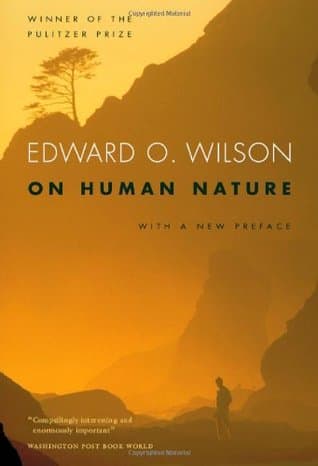
Core Idea
- Difficulty
- Medium
- Read it if
- You are interested in understanding the biological and evolutionary underpinnings of human behavior, culture, and societal structures, and are open to a sociobiological perspective on topics like ethics, religion, and free will.
- Skip it if
- You are uncomfortable with biological determinism or reductionist explanations for complex human phenomena, or prefer purely sociological, psychological, or philosophical approaches that de-emphasize genetic influence.
Key Takeaways from On Human Nature
The Biological Imperative
Human behavior is deeply rooted in our evolutionary and genetic heritage.
Wilson states that humans are not blank slates. Instead, we are products of millions of years of evolution, which has left a clear mark on our behaviors, emotions, and social structures. Our 'human nature' is not a vague idea but a set of genetic predispositions, or epigenetic rules, that influence how we see the world, learn, and react. These rules, shaped by natural selection, guide our tendencies towards cooperation, aggression, altruism, pair bonding, and our capacity for culture and language. This biological imperative does not determine every individual action, but it sets the boundaries and statistical likelihoods for different behaviors across populations. Understanding this biological foundation helps us grasp the origins and limits of human potential and social organization, moving beyond only cultural or environmental explanations.
“The core of human nature is a set of genetically programmed epigenetic rules—innate predispositions and learning biases—that guide our development and decision-making.”
In the book: Wilson frequently references studies in behavioral genetics, ethology, and anthropology, drawing parallels between human social structures and those observed in other social animals, particularly insects and primates, to highlight the evolutionary continuity of certain behaviors.
Try this: Recognize that certain human tendencies (e.g., tribalism, desire for status, kin preference) have deep evolutionary roots. Instead of fighting against these inherent biases, design social systems, policies, and educational approaches that acknowledge and strategically channel these predispositions towards prosocial outcomes, rather than assuming infinite malleability.
Related ideas: sociobiology, epigenetic-rules, evolutionary-psychology, nature-nurture
The Four Categories of Behavior
Human social behaviors can be categorized into four fundamental types, each with an evolutionary basis.
Wilson divides human social interactions into four basic types: selfishness (benefiting oneself), altruism (benefiting another at a cost to oneself), spite (harming another at a cost to oneself), and cooperation (working together for mutual benefit). He argues these are not just learned cultural constructs but deeply ingrained, genetically influenced strategies that evolved under specific environmental pressures. How these behaviors appear depends on the context and is subject to natural selection, especially through kin selection and reciprocal altruism. Understanding these categories offers a framework for analyzing the complex patterns of human social dynamics, showing the evolutionary logic behind many of our interpersonal and intergroup relationships.
“The fundamental categories of human social behavior are selfishness, altruism, spite, and cooperation. Each has a genetic basis that has been shaped by natural selection.”
In the book: Wilson discusses the theoretical models of kin selection (Hamilton's Rule) to explain the evolution of altruism towards relatives and reciprocal altruism for non-relatives, citing examples from various species, including human hunter-gatherer societies where food sharing and mutual defense are critical for survival.
Try this: When observing social phenomena, try to identify which of the four behavioral categories is predominantly at play. This framework can help predict group dynamics, understand conflict, and foster cooperation by identifying the underlying incentives and disincentives that align with these evolved tendencies. For example, promoting 'reciprocal altruism' in teams.
Related ideas: kin-selection, reciprocal-altruism, game-theory, social-evolution
The Limits of Free Will
Our choices are constrained by a biological leash, challenging the notion of absolute free will.
Wilson argues that while humans can create culture, learn, and make choices, these abilities operate within a framework set by our biological inheritance. Our 'free will' is not absolute but a complex decision-making process limited by evolved predispositions and cognitive biases. We are more likely to learn certain things, adopt certain values, and react to certain stimuli in predictable ways because these tendencies helped our ancestors survive. This 'biological leash' means that culture can only move so far from its genetic programming before encountering resistance or becoming unhelpful. This view challenges purely sociological or philosophical explanations of human behavior. It suggests that a complete understanding requires acknowledging the deep biological currents influencing our choices and social structures. It implies that some ideals, though noble, may be hard to maintain against our biological tendencies.
“The genes hold culture on a leash. The leash is very long, but inevitably, values will be constrained in accordance with their effects on the human gene pool.”
In the book: Wilson points to the universality of certain cultural traits across diverse societies (e.g., incest taboo, division of labor by sex, religious belief, myth-making) as evidence of underlying genetic predispositions, despite vast cultural differences. He also discusses the difficulty in sustaining utopian societies that attempt to entirely suppress evolved human tendencies.
Try this: When trying to implement social change or personal habit formation, recognize that some behaviors are more 'natural' or easier to adopt than others due to our biological predispositions. Instead of forcing unnatural behaviors, look for ways to align desired outcomes with existing biological tendencies, or acknowledge the significant effort required to counteract them. For instance, designing communities that account for territoriality rather than ignoring it.
Related ideas: genetic-determinism, cultural-evolution, epigenetics, behavioral-genetics
The Innate Drive for Religion
Religious belief is an evolved adaptation, not merely a cultural invention.
Wilson suggests that the human tendency for religious belief is not just a cultural artifact or an accident of history, but an evolved adaptation. He argues that the cognitive biases that support religious thought—such as a tendency to see agency in natural phenomena, to create stories, and to form strong in-group bonds—gave early human groups significant survival and reproductive advantages. Religion, in this view, helps solidify social cohesion, enforce moral codes, provide comfort in uncertainty, and motivate group action. It taps into our innate need for meaning and belonging. While specific religious doctrines are cultural, the underlying human capacity and drive for such systems are deeply biological. This suggests that trying to eliminate this aspect of human nature might fail or lead to its expression in other forms.
“The brain is a product of evolution. The mind is a set of strategies and beliefs that has been shaped by natural selection to promote the survival and reproduction of the genes. Religious belief is one of the most powerful and pervasive of these strategies.”
In the book: Wilson cites the universality of religious or spiritual beliefs across diverse cultures and throughout history, even in the absence of contact. He also points to the psychological benefits of group cohesion and shared purpose that religion often provides, which would have been advantageous for survival in ancestral environments.
Try this: Understand that the human need for meaning, ritual, and community is profound. If traditional religious outlets decline, these needs will likely be met through other means (e.g., secular ideologies, fervent fandoms, identity groups). Design communities and social movements that acknowledge and constructively channel these innate drives for belonging and shared purpose, rather than dismissing them as irrational.
Related ideas: evolution-of-religion, cognitive-biases, group-cohesion, myth-making
The Paradox of Altruism
Altruism, seemingly selfless, is ultimately rooted in genetic self-interest.
Wilson addresses the long-standing question of altruism: how can a behavior that reduces an individual's fitness continue in a world governed by natural selection? His answer lies in 'genetic self-interest,' mainly through kin selection and reciprocal altruism. Altruism towards relatives is explained by shared genes; helping a sibling or child helps propagate one's own genetic material. Altruism towards non-relatives often works on the principle of reciprocity: 'I'll scratch your back if you scratch mine,' with an expectation of future return, even if subconscious. Truly 'pure' or self-sacrificial altruism that offers no genetic or reciprocal benefit is, according to Wilson, rare and evolutionarily unstable. This view challenges romantic ideas of human kindness, suggesting that even our most noble acts have an underlying, though complex, evolutionary reason. It is not that humans are incapable of 'good,' but that 'good' must, at some level, offer an evolutionary advantage.
“Pure, unbounded altruism, if it existed, would be quickly eliminated by natural selection. What we call altruism is almost always genetically selfish.”
In the book: Wilson details W.D. Hamilton's rule for kin selection (rB > C), demonstrating how altruism towards relatives is favored when the benefit to the recipient (B) times the coefficient of relatedness (r) outweighs the cost to the altruist (C). He also discusses reciprocal altruism in species like vampire bats and in human societies, where food sharing and mutual defense are common.
Try this: When seeking to encourage prosocial behavior, frame it in terms of mutual benefit or emphasize shared group identity (which mimics kinship). Understand that appeals to pure, selfless altruism may be less effective than structuring systems where helping others implicitly or explicitly benefits the helper or their genetic relatives/social group. For example, promoting volunteerism by highlighting community benefits and social recognition.
Related ideas: kin-selection, reciprocal-altruism, evolutionary-ethics, inclusive-fitness
The Origin of Morality
Moral codes are adaptive strategies for social cohesion, not divinely inspired absolutes.
Wilson states that human morality, far from being a purely philosophical or divine construct, is an evolved phenomenon. Moral codes, such as rules against murder, theft, and incest, and commands for honesty and cooperation, are seen as adaptive strategies that improve group cohesion, reduce internal conflict, and help individuals within a social unit survive and reproduce. These 'moral sentiments' are deeply ingrained predispositions that make us open to learning and internalizing specific ethical rules. While the specific content of morality varies culturally, the basic capacity and need for a moral framework are biological universals. This view suggests that ethical systems are not absolute truths but practical solutions to common social problems faced by early humans, reflecting their usefulness in promoting genetic fitness.
“Morality, like religion, is a set of rules invented by human beings to promote the survival and reproduction of their genes. It is a biological product, not a divine one.”
In the book: Wilson points to the universality of certain moral rules across diverse, isolated human cultures and primate societies (e.g., fairness, reciprocity). He also discusses how group selection pressures might have favored groups with stronger internal moral cohesion, allowing them to outcompete less cohesive groups.
Try this: When evaluating or constructing ethical systems, consider their practical utility in fostering cooperation and group stability, rather than solely relying on abstract philosophical principles. Recognize that moral disagreements often stem from conflicts between different evolved predispositions or different interpretations of what best serves group welfare. Focus on finding common ground in terms of shared survival and reproductive interests.
Related ideas: evolutionary-ethics, moral-philosophy, group-selection, social-norms
The Genetic Basis of Culture
Culture is not an independent force but an extension of our biological predispositions.
Wilson argues against the idea of culture as a completely separate, independent area of human experience. Instead, he sees culture as an emergent property of our evolved biological nature. Our brains are structured to create, transmit, and absorb cultural information, from language and art to social norms and technologies. This capacity for culture is itself a biological adaptation that offered great advantages, allowing for flexible responses to environmental challenges and the accumulation of knowledge across generations. The specific forms culture takes are influenced by environment and history, but the underlying 'rules' for cultural development—the types of stories we tell, the ways we organize societies, the symbols we create—are limited and guided by our genetic predispositions. Therefore, culture is not a rejection of biology but its most sophisticated expression, extending our biological reach.
“Culture is a product of the human mind, which is itself a product of evolution. The brain is structured to create and absorb culture.”
In the book: Wilson emphasizes the human capacity for symbolic thought, language, and abstract reasoning as unique biological adaptations that underpin culture. He also highlights how certain cultural universals (e.g., music, storytelling, social hierarchies) suggest underlying cognitive structures that are genetically influenced.
Try this: When designing educational programs, marketing campaigns, or even art, consider how they align with or challenge fundamental human cognitive biases and learning predispositions. Cultural products that resonate deeply often tap into these evolved patterns of thought and emotion. Understanding these links can make cultural transmission more effective and impactful.
Related ideas: cultural-evolution, memetics, cognitive-science, biocultural-evolution
The Human Dilemma
Our biological heritage presents both opportunities and constraints for shaping our future.
Wilson ends with an observation on the 'human dilemma': we are both products of a long evolutionary history and beings capable of self-reflection and conscious choice. Our biological predispositions, while helpful in the past, may not always align with the demands of a rapidly changing modern world. For example, our tribal instincts, once essential for survival, can now fuel global conflict. The challenge is to recognize these deep-seated biological limits and tendencies, not to give in to them, but to intelligently navigate and, when necessary, override them through informed cultural and ethical choices. Ignoring our biological nature is risky, as it leads to unrealistic expectations and failed social experiments. Accepting it, even its less pleasant aspects, offers the only realistic way to shape a more sustainable and humane future, by working with our nature rather than constantly against it.
“The human species is a product of evolution, and our social behavior is constrained by the same genetic rules that govern other species. To understand ourselves, we must understand those rules.”
In the book: Wilson often references historical failures of utopian societies that ignored fundamental human drives like status, territoriality, or kin preference. He also implicitly points to modern challenges like environmental degradation, which can be linked to evolved short-term thinking versus long-term planning.
Try this: Approach societal problems with a 'biologically informed' lens. Instead of striving for perfection that might contradict human nature, aim for resilient and adaptable solutions that acknowledge our inherent flaws and strengths. This involves designing institutions that mitigate our destructive tendencies (e.g., checks and balances for power) while amplifying our prosocial ones (e.g., community building).
Related ideas: bioethics, future-of-humanity, evolutionary-mismatch, social-engineering
The Consilience of Knowledge
A unified understanding of human nature requires integrating biology with the humanities and social sciences.
Wilson advocates for 'consilience'—the unity of knowledge across different fields. He argues that a full understanding of human nature cannot be achieved by separating biology from the social sciences and humanities. Instead, these disciplines must come together to form a more complete picture. Biology provides the basic evolutionary and genetic framework; psychology explains individual behavior and cognition; sociology and anthropology detail cultural variation and social structures; and the humanities explore the meaning, values, and artistic expressions of human experience. Each layer informs and enriches the others. Rejecting the artificial division between the 'two cultures' (science and humanities), Wilson believes that true intellectual progress, and ultimately, a more accurate self-understanding, lies in combining these different perspectives into a coherent, interdisciplinary whole. This integration is essential for addressing complex global challenges that cross disciplinary boundaries.
“The only way to understand the human condition, in all its complexity, is to integrate the knowledge of the natural sciences with that of the social sciences and the humanities.”
In the book: Wilson's entire book is an exercise in consilience, drawing on entomology, genetics, neuroscience, anthropology, history, and philosophy to build his arguments about human nature. He explicitly calls for an end to the 'two cultures' divide, citing the intellectual impoverishment that results from disciplinary silos.
Try this: Actively seek out interdisciplinary perspectives in your work and learning. When tackling complex problems, deliberately engage with insights from both scientific and humanistic fields. For example, a policy maker addressing crime should consider not only sociological factors but also evolutionary predispositions towards aggression or cooperation, alongside ethical and philosophical considerations of justice.
Related ideas: consilience, interdisciplinarity, two-cultures, holistic-understanding
The Imperative of Self-Knowledge
Understanding our biological nature is the key to navigating our future responsibly.
Wilson concludes with a call for radical self-knowledge. He states that humanity has gained great power over its environment and even its own biology, often without a deep understanding of its intrinsic nature. This lack of self-awareness, this 'Faustian contract,' risks leading us down dangerous paths, from environmental destruction to social engineering experiments that ignore basic human predispositions. To navigate the future responsibly, to make wise decisions about genetic engineering, artificial intelligence, environmental policy, and social structures, we must first understand who we are, where we came from, and what our inherent biological limits and potentials are. This self-knowledge is not a limitation but a liberation, allowing us to align our aspirations with our reality and to build a future that is truly human-centered, rather than one based on ideological fantasies. It is the most urgent scientific and ethical quest of our time.
“We are a species that has risen to dominance by a Faustian contract, trading a certain degree of self-knowledge for raw power. Now, the time has come to pay the price and gain the self-knowledge.”
In the book: Wilson implicitly points to contemporary issues like the ecological crisis, the rise of totalitarian regimes, and the challenges of technological advancement as consequences of humanity's power outstripping its self-understanding. He suggests that a deeper biological understanding could have averted or could now mitigate many of these problems.
Try this: Prioritize personal and collective self-reflection informed by evolutionary insights. Support scientific research into human behavior and genetics. Engage in critical thinking about social policies and technological developments, asking how they align with or diverge from our evolved human nature. Advocate for education that integrates biological understanding into discussions of ethics, society, and the future.
Related ideas: self-awareness, human-condition, bioethics, existential-risk
On Human Nature Quotes
“The brain is a product of evolution. The mind is a product of the brain.”
“The epigenetic rules are the largely innate programs that bias individuals to absorb certain cultural forms and to avoid others.”
“We are a product of the laws of physics, chemistry, and biology, and we are not exempt from them.”
“The dilemma of human nature is that we have paleolithic emotions, medieval institutions, and godlike technology.”
“The most distinctive human qualities are those that give rise to the most distinctive human problems.”
“If the mind is to be truly free, it must not only be free of external constraints but also of internal ones.”
“Biology is the most powerful engine of human self-understanding.”
“The ultimate goal of science is to understand everything, including ourselves.”
“No species, however magnificent, has the right to destroy another.”
“The human mind is a device for survival and reproduction, and reason is just one of its tools.”
“The true evolutionary epic, unfolding in the brain, is the story of the genetic leash.”
“Man's most dangerous enemy is himself.”
“The only way to make sense out of change is to plunge into it, move with it, and join the dance.”
“Our species has an innate tendency to acquire a moral sense.”
Quiz
10 questions on the main ideas. Each answer comes with a short explanation.
Question 1
According to Wilson in 'On Human Nature,' what is the primary scientific discipline that he argues is essential for understanding human behavior, challenging traditional views?
- Cultural Anthropology
- Sociology
- Sociobiology
- Behavioral Psychology
Show answer
C. Sociobiology Wilson argues that sociobiology, the systematic study of the biological basis of all social behavior, is crucial for understanding human behavior, extending concepts from his earlier work on insect societies to humans.
Question 2
Wilson's work, particularly 'Sociobiology' and 'On Human Nature,' sparked significant controversy. What was the central debate these books ignited regarding human behavior?
- The role of free will versus determinism
- The influence of economic systems on social structure
- Whether human behavior is controlled by biological heritage or solely by culture/environment
- The origins of language and its impact on cognition
Show answer
C. Whether human behavior is controlled by biological heritage or solely by culture/environment The core of the controversy Wilson addressed was the nature-nurture debate: to what extent is human behavior shaped by our biological heritage (genes, evolution) versus cultural and environmental factors.
Question 3
In 'On Human Nature,' Wilson discusses the concept of 'epigenetic rules.' What do these rules primarily describe?
- The specific cultural norms that dictate social behavior in different societies.
- The processes by which genes are expressed or silenced without altering the DNA sequence itself.
- The inherited regularities of mental development that bias individuals to perceive and act in certain ways.
- The historical progression of human societies from simple to complex forms.
Show answer
C. The inherited regularities of mental development that bias individuals to perceive and act in certain ways. Epigenetic rules, in Wilson's context, refer to the genetically determined regularities of sensory perception and mental development that bias individuals toward certain patterns of thought and behavior, linking genes to culture.
Question 4
Wilson suggests that even complex human phenomena like religion have roots in our biological past. What does he propose as a primary evolutionary advantage or function of religious belief systems?
- To foster scientific inquiry and understanding of the natural world.
- To provide comfort and reduce anxiety about death, thereby promoting individual fitness.
- To strengthen group cohesion and enforce moral codes, contributing to tribal survival and competition.
- To stimulate artistic expression and cultural diversity.
Show answer
C. To strengthen group cohesion and enforce moral codes, contributing to tribal survival and competition. Wilson argues that religion, from an evolutionary perspective, serves to bind groups together, reinforce altruism within the group, and provide a shared mythology that strengthens social cohesion, which would have been advantageous for survival and reproduction in ancestral environments.
Question 5
According to Wilson, what is the 'hereditary leash' in the context of human culture?
- The genetic predisposition for humans to form monogamous pairs.
- The idea that while culture is diverse, it is ultimately constrained and guided by underlying genetic predispositions.
- The historical transmission of cultural norms from one generation to the next.
- The limitations imposed on human technological advancement by environmental factors.
Show answer
B. The idea that while culture is diverse, it is ultimately constrained and guided by underlying genetic predispositions. The 'hereditary leash' is Wilson's metaphor describing how, despite the apparent freedom and diversity of human culture, there are underlying genetic predispositions and evolutionary constraints that guide and limit the forms culture can take, keeping it within certain bounds dictated by our biology.
Question 6
Wilson suggests that understanding our biological heritage can help us address future challenges. Which of the following is NOT an implication he draws from sociobiology for shaping human destiny?
- That we can selectively breed for desirable human traits to improve the species.
- That understanding our innate predispositions can help us design better social environments.
- That our biological constraints mean certain utopian ideals are likely unattainable.
- That a deeper self-understanding can lead to more informed ethical choices.
Show answer
A. That we can selectively breed for desirable human traits to improve the species. While Wilson discusses the influence of genes on behavior, he explicitly warns against eugenics or selective breeding for human traits, emphasizing instead that understanding our nature allows us to better manage our future within those biological constraints, rather than trying to engineer human biology directly.
Question 7
In his discussion of altruism, Wilson distinguishes between 'hard-core' and 'soft-core' altruism. What is the key difference?
- Hard-core altruism is genetic, while soft-core altruism is learned.
- Hard-core altruism is reciprocal and self-serving, while soft-core altruism is truly selfless.
- Hard-core altruism is largely unconscious and genetically programmed, while soft-core altruism is consciously calculated and ultimately expects a return.
- Hard-core altruism is limited to kin, while soft-core altruism extends to strangers.
Show answer
C. Hard-core altruism is largely unconscious and genetically programmed, while soft-core altruism is consciously calculated and ultimately expects a return. Wilson defines hard-core altruism as largely unconscious, genetically predisposed acts of self-sacrifice (often for kin), while soft-core altruism is consciously reciprocal, where the giver ultimately expects a return or benefit, even if indirect, making it 'self-serving' in an evolutionary sense.
Question 8
Wilson's preface to 'On Human Nature' mentions the uproar that engulfed 'Sociobiology.' What was a primary reason for this backlash from critics, particularly from certain political and religious groups?
- His advocacy for a global government based on scientific principles.
- His perceived reduction of complex human behaviors to genetic determinism, potentially justifying social inequalities.
- His rejection of the theory of evolution in favor of intelligent design.
- His argument that human population growth was unsustainable and required drastic measures.
Show answer
B. His perceived reduction of complex human behaviors to genetic determinism, potentially justifying social inequalities. Many critics feared that Wilson's emphasis on biological underpinnings of human behavior would lead to genetic determinism, justifying existing social hierarchies, racism, and sexism, and undermining the concept of human free will and social reform.
Question 9
Wilson argues that the human mind is not a blank slate but is predisposed to learn certain things more easily than others. What concept does he use to illustrate this point, for example, with fears of snakes or heights?
- Cultural relativism
- Prepared learning
- Operant conditioning
- Social constructivism
Show answer
B. Prepared learning Wilson uses the concept of 'prepared learning' to explain that humans (and other animals) are genetically predisposed to learn certain associations (like fearing snakes or heights) more readily than others because these biases had survival value in our evolutionary past.
Question 10
Considering Wilson's thesis in 'On Human Nature,' what is the ultimate 'dilemma' he presents for humanity's future?
- The conflict between technological advancement and environmental preservation.
- The choice between embracing a purely materialistic worldview or holding onto spiritual beliefs.
- The tension between our biologically evolved predispositions and the rational, ethical choices we must make for a sustainable future.
- The challenge of achieving global economic equality in the face of limited resources.
Show answer
C. The tension between our biologically evolved predispositions and the rational, ethical choices we must make for a sustainable future. Wilson's ultimate dilemma is that humanity must confront the fact that our rational, ethical aspirations for the future are constantly in tension with our deeply ingrained, biologically evolved predispositions and impulses. Understanding this biological heritage is key to navigating our future responsibly.
On Human Nature FAQ
What is the main argument of 'On Human Nature'?
Edward O. Wilson argues that human behavior is significantly shaped and constrained by our biological heritage. He explores how evolutionary forces have influenced our social structures, ethics, and cultural development, suggesting that these biological underpinnings are crucial for understanding human destiny.
Does 'On Human Nature' claim that human behavior is entirely determined by biology?
No, Wilson does not argue for complete biological determinism. Instead, he proposes that while biology provides the foundational predispositions and limits, culture and environment interact with these biological tendencies to produce the complex array of human behaviors observed. He emphasizes the interplay between nature and nurture.
What is sociobiology, and how does 'On Human Nature' relate to it?
Sociobiology is the scientific study of the biological (especially evolutionary) bases of all social behavior. 'On Human Nature' serves as a more accessible and focused explanation of the relevance of sociobiological principles to understanding human behavior, following the controversial reception of Wilson's earlier, more comprehensive work, 'Sociobiology: The New Synthesis'.
How does 'On Human Nature' address the nature-nurture debate?
'On Human Nature' directly challenges the prevailing view that human behavior is solely a product of culture or environment. Wilson re-frames the nature-nurture debate by asserting that human nature is a complex product of both biological evolution and cultural learning, with biology providing fundamental constraints and predispositions.
Does understanding human biology limit human destiny?
Wilson suggests that while our biological heritage does impose certain limits and predispositions, understanding these can actually empower us. By recognizing the biological roots of our behaviors, we can make more informed decisions about shaping our future and developing ethical frameworks that align with human nature, rather than working against it.
How is 'On Human Nature' different from purely philosophical or psychological texts on human behavior?
Unlike purely philosophical or psychological texts that might focus solely on mental states, ethical reasoning, or social conditioning, 'On Human Nature' grounds its analysis in evolutionary biology. Wilson integrates insights from genetics, ethology, and anthropology to provide a scientific framework for understanding human behavior, emphasizing our biological continuity with other species.
What impact did 'On Human Nature' have on the intellectual community?
'On Human Nature' reignited significant intellectual controversy, challenging established views in social sciences and humanities. It sparked intense debate about the role of biology in human affairs, pushing scholars to reconsider the interplay between genes, culture, and ethics.
Is 'On Human Nature' still relevant today?
Absolutely. 'On Human Nature' remains highly relevant as discussions about genetics, evolutionary psychology, and the biological bases of behavior continue to evolve. Its core arguments provide a foundational perspective for understanding contemporary issues in psychology, ethics, and social policy, urging a biologically informed view of humanity.
About the author

Edward O. Wilson was an American biologist, naturalist, and author known for his work in the fields of ecology and sociobiology. His notable books include "The Meaning of Human Existence," which explores the biological basis of human life, and "On Human Nature," which examines the interplay between biology and culture. Wilson's contributions to science have earned him significant recognition, including two Pulitzer Prizes.
Similar books
- The Selfish Gene
Richard Dawkins
4.1 (140k) average on GoodreadsPsychologyExplores the gene's eye view of evolution and its implications for altruism and behavior.
- Sapiens: A Brief History of Humankind
Yuval Noah Harari
4.4 (502k) average on GoodreadsPsychologyOffers a broad evolutionary and historical perspective on human development, albeit with different emphasis.
- The Perks of Being a Wallflower
Stephen Chbosky
4.2 (1.3M) average on GoodreadsPsychologyThrough letters, a shy high school freshman learns to navigate first love, trauma, and self-discovery, stepping off the sidelines and into life.
- Eleanor Oliphant Is Completely Fine
Gail Honeyman
4.3 (708k) average on GoodreadsLiterary FictionA lonely woman's structured life changes when an IT guy and an elderly man help her learn to open her heart.
- One Flew Over the Cuckoo's Nest
Ken Kesey
4.2 (631k) average on GoodreadsPsychologyIn a mind-bending asylum, the boisterous Randle McMurphy wages a defiant war against the tyrannical Nurse Ratched, inspiring his fellow inmates, including the seemingly catatonic Chief Bromden, to reclaim their lost humanity.
- The Bell Jar
Sylvia Plath
4.0 (591k) average on GoodreadsPsychologyIn the suffocating grip of 1950s expectations, a brilliant young woman's descent into mental illness is painted with such vivid, internal clarity that her 'insanity' feels terrifyingly rational and inevitable.





Enjoyed the summary?
A summary gives you the shape of the book. The book itself has the detail, the examples and the voice.
Find On Human Nature on AmazonAs an Amazon Associate, BookBrief earns from qualifying purchases. How we're funded