
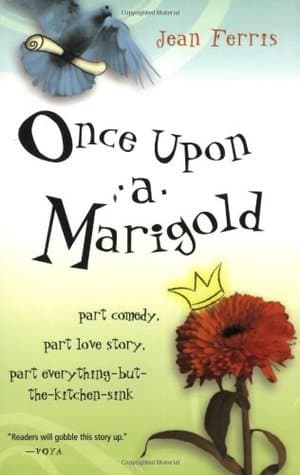
Synopsis
Covers the whole plot, including the ending.
- Difficulty
- Easy
- Pacing
- Moderate
- Mood
- Whimsical, Humorous, Romantic, Adventurous
- Read it if
- You enjoy lighthearted fairy tale retellings with a clever hero, a brave princess, and a touch of romance and humor.
- Skip it if
- You prefer gritty, dark fantasy or stories without clear-cut good vs. evil.
Once Upon a Marigold Plot Summary
Covers the whole plot, including the ending.
Christian's Cave and the Royal Family
Christian, a young man raised in a cave by a kind troll named Edward, spends his days watching the nearby castle of King Swithbert and Queen Olympia. He is captivated by Princess Marigold, who is a few years younger. From his hidden spot, Christian learns the royal family's routines and develops a deep, unspoken affection for the princess. Edward, his adoptive father, encourages Christian's observations but warns him about the dangers of the human world, especially royal life. Christian's unique upbringing has given him a keen sense of observation and a desire to protect those he cares about. These traits will soon be tested.
The Princess's Letters and Christian's New Role
Princess Marigold, feeling isolated, begins writing letters and leaving them in a hollow tree. Christian, having found her secret spot, reads them and feels drawn further into her world. He writes a response, signing it 'Your Friend,' and a secret correspondence begins. One day, Christian sees an advertisement for a royal assistant. Driven by his desire to be closer to Marigold and protect her, he applies. Despite his unusual background, his intelligence and quiet demeanor impress King Swithbert, and he is hired, much to Queen Olympia's subtle disapproval. Christian's new position gives him access to the castle and the royal family.
Queen Olympia's Schemes Begin
As Christian settles into his role, he starts to notice Queen Olympia's manipulative behavior. She is determined to marry Princess Marigold off to Prince Caz, a notoriously cruel and unattractive suitor from a powerful neighboring kingdom. Christian overhears conversations and observes Olympia's calculated actions, realizing that her plans for Marigold are not for the princess's happiness but for her own ambition. He worries about Marigold's future and begins to actively seek information about the Queen's true intentions, his protective instincts growing. The pressure mounts as Prince Caz's arrival nears, and Marigold remains unaware of the danger.
The Poisoned Cake and the First Attempt
Christian discovers Queen Olympia's plan to poison Princess Marigold during a royal banquet by serving her a specially prepared cake. He observes Olympia giving specific instructions to the royal baker, which raises his suspicions. Knowing he cannot directly accuse the Queen without proof, Christian plans. During the banquet, he subtly switches the poisoned cake with an identical, harmless one meant for another guest, ensuring Marigold eats the safe slice. The Queen's attempt is thwarted, but she remains unaware of Christian's intervention. This incident confirms Christian's fears about Olympia's evil intentions and strengthens his resolve to protect Marigold, making him even more vigilant.
The 'Accident' at the Lake
Queen Olympia orchestrates another 'accident' for Princess Marigold, arranging for her to go boating on a lake known for its treacherous currents. Christian, having grown increasingly suspicious of the Queen's every move, follows Marigold covertly. As the princess's boat drifts into a dangerous part of the lake and begins to capsize, Christian acts. He swims to her rescue, pulling her to safety just as the boat completely overturns. Marigold is shaken but unharmed, attributing the incident to bad luck. Christian, however, knows it was no accident and realizes the Queen's determination to eliminate her daughter is more serious than he initially imagined, pushing him to find a more permanent solution.
Edward's Wisdom and the Royal Betrothal
Feeling overwhelmed by the Queen's plotting and the impending marriage to Prince Caz, Christian seeks advice from his adoptive father, Edward the troll. Edward, with his knowledge of human nature and royal politics, helps Christian understand the deeper implications of Olympia's actions and the potential dangers. Meanwhile, a formal betrothal ceremony is held, solidifying Marigold's engagement to the dreadful Prince Caz. Marigold, though unhappy, feels powerless to resist her mother's will. Christian attends the ceremony, his heart heavy, knowing he must act quickly to prevent the marriage and protect Marigold from her own mother, who now seems to have complete control.
The Truth About Prince Caz
Christian gathers evidence of Prince Caz's cruel and tyrannical nature, including stories from his own kingdom and his mistreatment of servants. He also discovers that Queen Olympia has been manipulating the King and the court, presenting Caz in a falsely favorable light. During a royal gathering, Christian takes an opportunity to expose Caz, cleverly arranging for the Prince's true character to be revealed through a series of incidents and testimony. The court is horrified, and King Swithbert, finally seeing through his wife's deception, is furious. This public exposure damages Olympia's credibility and makes the marriage to Caz impossible, buying Christian precious time.
The Queen's Ultimate Plan and the Sleeping Potion
Despite Prince Caz's exposure, Queen Olympia remains determined. She devises her most sinister plan yet: to administer a powerful sleeping potion to Princess Marigold, making her appear gravely ill or even dead, thus forcing King Swithbert to agree to the marriage with Prince Caz under the guise of an urgent political alliance. Christian, through his continued vigilance, discovers the Queen's plan to use a special 'tonic' during a private ceremony. He realizes the potion is intended to induce a deep, enchanted sleep from which Marigold might never awaken, or at least not until after the marriage has been forced through, solidifying Olympia's power.
The Counter-Potion and the Swap
Knowing the sleeping potion is imminent, Christian rushes to Edward for help. Edward, drawing upon his ancient knowledge of herbs and magic, quickly makes a powerful counter-potion that will neutralize the Queen's enchantment without harming Marigold. Christian then faces the perilous task of swapping the potions. During a moment of distraction, he skillfully replaces Queen Olympia's deadly sleeping potion with Edward's harmless, neutralizing one. The Queen, unaware of the switch, administers what she believes to be the sleeping potion to Marigold, confident her plan will succeed. Christian watches anxiously, hoping his quick thinking and Edward's magic will save the princess once more.
The Queen's Downfall and the Princess's Awakening
Queen Olympia proudly announces Marigold's 'illness' and pushes for the immediate marriage to Prince Caz. However, when Marigold awakens, perfectly fine and more defiant than ever, Olympia's deception is undeniable. King Swithbert, finally seeing the full extent of his wife's treachery, has her arrested. With Olympia's reign of terror over, Marigold is free from the forced marriage. She and Christian, no longer bound by secrecy, confess their feelings for each other. The kingdom celebrates, and Christian, once a cave-dweller, is recognized for his bravery and intelligence, hinting at a future where love and honesty prevail over ambition and deceit.
The Royal Wedding and a New Beginning
With Queen Olympia imprisoned and Prince Caz banished, the kingdom is at peace. King Swithbert, recognizing Christian's noble character, intelligence, and the deep love between him and Marigold, gives his blessing for their marriage. A joyous royal wedding is held, uniting the commoner Christian with Princess Marigold. The kingdom rejoices, celebrating a union founded on true love and mutual respect, rather than political gain. Christian, now a Prince, and Marigold, his beloved Princess, embark on a new chapter, promising a reign filled with fairness, compassion, and happiness, marking a hopeful new beginning for their realm.
Principal Figures
Christian
Protagonist
A kind-hearted, intelligent young man raised by a troll, deeply in love with Princess Marigold.
Christian is an orphaned boy raised by Edward the troll in a cave near the royal castle. He is highly observant, intelligent, and possesses a strong moral compass. Despite his unusual upbringing, he is articulate and quick-witted. His deep affection for Princess Marigold drives his actions, leading him to overcome his humble origins and infiltrate the royal court. He is resourceful, brave, and remarkably adept at deduction, making him an unlikely but effective hero. He values honesty and protects those he cares about fiercely.
Relationships: Princess Marigold (deep romantic love and protective bond); Edward (adoptive father, mentor, and trusted friend); Queen Olympia (antagonist, object of suspicion and opposition)
Princess Marigold
Co-protagonist
A gentle and intelligent princess, initially naive, who yearns for genuine connection.
Princess Marigold is the kind and intelligent daughter of King Swithbert and Queen Olympia. She is initially somewhat naive and sheltered, longing for a true friend and a life beyond royal expectations. Her secret letters reveal her inner thoughts and desires. Despite her gentle nature, she possesses an underlying strength and a strong sense of justice that emerges as she becomes aware of her mother's manipulations. She is capable of deep affection and loyalty, especially once she realizes Christian's true character and devotion.
Relationships: Christian (deep romantic love and confidante); King Swithbert (loving father, but initially oblivious to the Queen's schemes); Queen Olympia (manipulative mother, source of her unhappiness); Prince Caz (unwanted suitor, source of dread)
Queen Olympia
Antagonist
The ambitious and manipulative queen, determined to secure power through her daughter's marriage.
Queen Olympia is the primary antagonist of the story. She is cunning, ambitious, and ruthless, driven by a desire for power and control. She sees her daughter, Marigold, as a pawn in her schemes to forge powerful alliances, even if it means sacrificing Marigold's happiness or life. She is adept at manipulation and deception, often feigning concern while secretly plotting. Her cold and calculating nature makes her a formidable opponent, but her overconfidence ultimately leads to her downfall. She embodies the corrupting influence of unchecked ambition.
Relationships: King Swithbert (husband, whom she manipulates); Princess Marigold (daughter, whom she plots against for political gain); Christian (unwitting adversary, who thwarts her plans)
Edward
Supporting
A wise and kind-hearted troll who raises Christian and provides guidance.
Edward is Christian's adoptive father and a wise, ancient troll. He is gentle, intelligent, and possesses a vast knowledge of human nature, magic, and herbs. Despite being a troll, he is far from monstrous, demonstrating immense compassion and patience. He provides Christian with guidance, practical advice, and emotional support, acting as a moral compass and a source of crucial information. His unique perspective and magical abilities are instrumental in helping Christian thwart Queen Olympia's plans, particularly in creating counter-potions.
Relationships: Christian (adoptive father and mentor); Princess Marigold (indirect protector through Christian)
King Swithbert
Supporting
The good-natured but somewhat oblivious king, easily swayed by his manipulative wife.
King Swithbert is Princess Marigold's father and Queen Olympia's husband. He is a generally kind and well-meaning ruler but is often portrayed as somewhat naive and easily manipulated by his cunning wife. He genuinely loves his daughter but is slow to perceive the true nature of Olympia's schemes. His desire for peace and stability within his kingdom makes him susceptible to Olympia's political machinations. He eventually comes to his senses, realizing the depth of his wife's treachery, and acts decisively to protect his daughter and kingdom.
Relationships: Princess Marigold (loving father); Queen Olympia (wife, initially trusting but later betrayed and angered by her actions); Christian (initially an employee, later respected and accepted as a son-in-law)
Prince Caz
Supporting
A cruel and undesirable suitor chosen by Queen Olympia for Marigold.
Prince Caz is the suitor Queen Olympia chooses for Princess Marigold. He is described as unattractive, arrogant, and notoriously cruel, with a reputation for tyranny in his own kingdom. He embodies the worst qualities of a royal heir, caring only for power and his own gratification. His presence highlights the true danger Marigold faces under her mother's scheme. He serves as a contrast to Christian's noble character and a clear representation of the unhappiness Marigold would endure if forced into the marriage.
Relationships: Princess Marigold (unwanted fiancé); Queen Olympia (ally in her scheme for power)
The Royal Baker
Mentioned
An unwitting pawn in Queen Olympia's early assassination attempts.
The Royal Baker is a minor character who is briefly mentioned as being manipulated by Queen Olympia. He is instructed to prepare a specific cake, which the Queen intends to poison for Marigold. He is not malicious but simply follows royal orders, unaware of the sinister purpose behind the Queen's requests. His unwitting involvement highlights Olympia's cunning and her ability to use innocent people to further her dark agenda.
Relationships: Queen Olympia (employer, unwitting tool)
The Royal Staff
Mentioned
The general castle employees who serve the royal family.
The royal staff consists of various unnamed servants, guards, and attendants within the castle. They provide the backdrop for Christian's observations and work, and occasionally serve as sources of information or unwitting participants in the Queen's schemes. Their presence emphasizes the structured, hierarchical environment of the castle and the constant watchful eyes Christian must navigate. They are generally loyal to the King and the true well-being of the kingdom, though some may be intimidated by the Queen.
Themes & Insights
Love vs. Ambition
This theme explores the contrast between Christian and Marigold's selfless love and Queen Olympia's destructive ambition. Christian's every action is motivated by his love and desire to protect Marigold, even at great personal risk, as seen when he switches the poisoned cake or saves her from the lake. Conversely, Olympia's ambition for power drives her to manipulate, deceive, and even attempt to murder her own daughter. The story clearly champions love as a force for good, capable of overcoming adversity and corruption, ultimately leading to a happy and just resolution.
“He didn't know much about love, but he knew it wasn't supposed to feel like a calculated risk.”
Appearance vs. Reality
The story often highlights the deceptive nature of appearances. Queen Olympia maintains a facade of a caring mother and loyal wife, while secretly plotting against her family. King Swithbert is initially blind to his wife's true character, trusting her outward display of concern. Christian, despite his humble origins, has a noble heart and keen intelligence that belies his simple appearance. Conversely, Prince Caz, a royal, is revealed to be cruel and unworthy. The story encourages readers to look beyond superficial judgments and see the true character and intentions of individuals. True nobility comes from within, not from birthright.
“A crown doesn't make a man good, just as a cave doesn't make him bad.”
The Power of Observation and Intelligence
Christian's main strength is his keen observation skills and sharp intelligence, honed by his unique upbringing. He can discern patterns, overhear crucial conversations, and deduce Queen Olympia's sinister intentions long before anyone else. His ability to connect seemingly disparate events, such as the specific instructions for the cake or the 'accident' at the lake, allows him to anticipate and thwart the Queen's plots. This theme shows that cleverness and attentiveness can be more powerful tools than brute force or social standing, enabling an underdog to triumph against formidable adversaries.
“He saw things others missed, the tiny shifts in expression, the unspoken words, the hidden agendas.”
Family and Betrayal
Family is central, focusing on both the loving, unconventional bond between Christian and Edward, and the betrayal within the royal family. Queen Olympia's willingness to betray and harm her own daughter for personal gain is a shocking and dark aspect of the story. In contrast, King Swithbert's eventual realization of his wife's treachery and his protective love for Marigold shows the potential for redemption and justice within family bonds. Christian's loyalty to Marigold, a chosen 'family' member, contrasts sharply with Olympia's familial disloyalty, emphasizing the importance of genuine care and trust within a family unit.
“Some bonds are born of blood, others of kindness. And kindness, sometimes, is stronger.”
Plot Devices & Literary Techniques
Secret Correspondence
Marigold and Christian's hidden letters in a hollow tree.
This device serves as the initial bridge between Princess Marigold and Christian, allowing them to form an emotional connection before they ever meet face-to-face. The letters reveal Marigold's inner thoughts and loneliness, drawing Christian closer to her world and motivating him to seek a position in the castle. It establishes their intellectual and emotional compatibility, laying the groundwork for their romantic relationship and providing Christian with valuable insight into Marigold's character and vulnerabilities.
The 'Innocent' Observer
Christian's initial role as a seemingly harmless royal assistant.
Christian's position as a low-ranking royal assistant allows him to observe the court and Queen Olympia's actions without arousing suspicion. His unassuming role makes him invisible to the Queen, enabling him to gather crucial information and witness her plots firsthand. This device grants him access and proximity to the royal family that he would otherwise never have, making him the perfect 'fly on the wall' to uncover the truth and ultimately intervene effectively.
The Wise Mentor
Edward the troll's role in guiding Christian.
Edward, Christian's adoptive troll father, functions as the wise mentor. He provides Christian with invaluable advice, ancient knowledge, and practical solutions, such as concocting the counter-potion. His unique perspective, detached from human politics yet deeply understanding of human nature, allows him to offer clear-headed guidance. This device ensures Christian has the necessary resources and moral support to navigate the complex and dangerous royal intrigues, emphasizing the importance of mentorship in a hero's journey.
The Sleeping Potion
Queen Olympia's ultimate attempt to control Marigold's fate.
The sleeping potion is a classic fairytale device used by Queen Olympia as her final, desperate attempt to force the marriage to Prince Caz and secure her power. It raises the stakes significantly, placing Marigold in immediate, life-threatening danger. Its magical nature underscores the fantasy elements of the story and provides a clear, dramatic climax where Christian must act decisively with Edward's counter-magic to save the princess, leading directly to the antagonist's downfall.
Once Upon a Marigold Quotes
“Happily Ever After is not a finish line, it is a journey.”
“Some secrets are like seeds. They need time and the right conditions to grow into something beautiful or something terrible.”
“True love isn't about finding someone perfect; it's about finding someone who is perfect for you.”
“A good disguise isn't about looking different, it's about acting different.”
“Sometimes the bravest thing you can do is to ask for help.”
“The most important stories are often the ones we tell ourselves.”
“Even the smallest acts of kindness can have the biggest ripples.”
“You can't truly know someone until you've seen them when they think no one is watching.”
“Fear can be a useful tool, but never let it be your master.”
“Magic isn't always about spells and potions; sometimes it's just about seeing the world with open eyes.”
“A true friend is someone who knows all your flaws and loves you anyway.”
“Sometimes, the most ordinary things are the most extraordinary.”
“It's not what you are, but who you are that truly matters.”
“The future is not written in stone; it's written in the choices we make today.”
Quiz
10 questions on the plot and the characters. Each answer comes with a short explanation.
Question 1
What is Christian's initial job or role when he first meets Princess Marigold?
- He is a royal stable boy.
- He is a commoner living in a cave with a troll.
- He is a traveling merchant.
- He is a knight in training.
Show answer
B. He is a commoner living in a cave with a troll. Christian is introduced as a commoner who lives in a cave with a troll, which is where Marigold encounters him when she's playing.
Question 2
What special ability does Christian possess that aids him throughout the story?
- He can speak to animals.
- He has prophetic dreams.
- He is exceptionally good at inventing and building things.
- He can turn invisible at will.
Show answer
C. He is exceptionally good at inventing and building things. Christian is a clever inventor, constantly creating gadgets and contraptions that prove useful, such as his 'thinker' for solving problems.
Question 3
Who is the primary antagonist in 'Once Upon a Marigold'?
- King Swithbert
- Princess Marigold's aunt
- Queen Olympia
- The troll, Murgle
Show answer
C. Queen Olympia Queen Olympia is the main villain, scheming to usurp the throne and eliminate her own daughter, Princess Marigold, to achieve her goal.
Question 4
What is the name of the troll Christian lives with?
- Grog
- Murgle
- Bartholomew
- Snarl
Show answer
B. Murgle Christian shares his cave dwelling with a troll named Murgle, who, despite his appearance, is a loyal companion.
Question 5
What is Queen Olympia's ultimate goal in her schemes?
- To marry a powerful king from another kingdom.
- To take over the kingdom and rule it herself.
- To discover a hidden treasure.
- To banish all commoners from the kingdom.
Show answer
B. To take over the kingdom and rule it herself. Queen Olympia's primary motivation is to seize control of the kingdom, even if it means eliminating her own daughter, Marigold, who stands in her way.
Question 6
How does Christian primarily communicate with Marigold after she is confined?
- Through secret letters delivered by a bird.
- Using a complex system of knots in a rope.
- By sneaking into her chambers disguised as a servant.
- They use a magical mirror for instant communication.
Show answer
B. Using a complex system of knots in a rope. Christian devises a clever system of knots on a rope, each representing a letter or common phrase, allowing him and Marigold to exchange messages while she is imprisoned.
Question 7
What role does the 'thinker' machine play in Christian's plans?
- It is a device used to hypnotize people.
- It helps him predict the future.
- It is a complex calculating machine designed to solve problems.
- It allows him to communicate with Murgle telepathically.
Show answer
C. It is a complex calculating machine designed to solve problems. The 'thinker' is one of Christian's key inventions, a mechanical device that helps him process information and come up with solutions to difficult problems, especially when foiling Olympia's plans.
Question 8
What is the primary theme explored through Christian and Marigold's relationship?
- The importance of wealth and status.
- Love overcoming societal barriers and expectations.
- The pursuit of magical powers.
- The dangers of technology.
Show answer
B. Love overcoming societal barriers and expectations. Despite Christian being a commoner and Marigold a princess, their love story emphasizes that true affection and character can transcend social class and expectations.
Question 9
How does Queen Olympia attempt to get rid of Marigold early in the story?
- She tries to marry her off to an evil king.
- She attempts to poison her at a royal banquet.
- She sends her away to a distant boarding school.
- She arranges for Marigold to be 'lost' during a hunting trip.
Show answer
D. She arranges for Marigold to be 'lost' during a hunting trip. Queen Olympia orchestrates a hunting trip with the intention of Marigold getting lost or meeting an unfortunate 'accident' in the wilderness, allowing her to take over.
Question 10
What is the ultimate fate of Queen Olympia?
- She is banished to a remote island.
- She is turned into a frog by a wizard.
- She is tricked into revealing her own schemes and is imprisoned.
- She escapes the kingdom and is never seen again.
Show answer
C. She is tricked into revealing her own schemes and is imprisoned. Christian and Marigold, through their combined cleverness, manage to expose Queen Olympia's deceitful plans, leading to her capture and imprisonment.
Once Upon a Marigold FAQ
What is the central conflict Christian faces regarding Princess Marigold?
Christian, a commoner raised by a troll in a cave, is deeply in love with Princess Marigold. His central conflict is the immense social barrier between them, as he believes he is unworthy and an impossible match for royalty, which initially prevents him from openly pursuing his feelings or believing in their future together.
Who is Queen Olympia and what are her primary motivations?
Queen Olympia is Princess Marigold's mother and the primary antagonist. Her motivations are driven by a ruthless ambition to seize absolute power over the kingdom, which she plans to achieve by eliminating Marigold and marrying King Swithbert, thereby consolidating her control and ensuring her reign.
How does Christian first discover Queen Olympia's nefarious plot?
Christian, with his keen hearing and observational skills, overhears Queen Olympia plotting with her henchmen, the Duke and the Marquis, about her intentions to harm Marigold and take over the kingdom. This pivotal discovery transforms his personal romantic dilemma into an urgent quest to protect the princess.
What role does the troll, specifically 'Troll', play in Christian's upbringing and character?
Troll, Christian's adoptive parent, provides him with a loving and unconventional upbringing in a cave. Troll teaches Christian practical skills, fosters his independent thinking, and instills a strong moral compass, which are crucial for Christian's resourcefulness and courage throughout his adventures.
What is the significance of the 'Marigold' flower motif in the story?
The marigold flower, after which Princess Marigold is named, symbolizes sunshine, passion, and creativity. It subtly reflects Marigold's bright personality and her potential for growth and happiness, while also hinting at Christian's deep affection for her, which is as constant and vibrant as the flower itself.
Are there any subtle hints about Christian's true parentage before its revelation?
Yes, there are subtle hints such as Christian's innate intelligence, his refined mannerisms despite his upbringing, and his unusual name for a commoner. These details, though minor, foreshadow his surprising connection to nobility and his rightful place within the kingdom's history.
What is the true identity of the Duke and the Marquis, and how does it connect to the overarching plot?
The Duke and the Marquis are revealed to be Queen Olympia's loyal, albeit somewhat bumbling, henchmen, complicit in her schemes to usurp the throne. Their true identities as instruments of her ambition underscore the depth of Olympia's treachery and the widespread corruption she attempts to sow.
How does Christian's unique upbringing contribute to his emotional resilience?
Christian's upbringing by Troll in a cave, rather than a conventional household, fosters a strong sense of self-reliance and adaptability. He learns to problem-solve creatively and navigate unusual circumstances, which builds his emotional resilience and prepares him for the challenges of protecting Marigold and facing Queen Olympia.
Analyze Marigold's character arc concerning her agency and perception of her mother.
Marigold initially appears somewhat naive and sheltered, trusting her mother, Queen Olympia, implicitly. Her character arc involves a gradual awakening to Olympia's true nature, forcing her to confront betrayal and develop her own agency, ultimately empowering her to make difficult decisions for her kingdom and her own future.
What psychological impact does Christian's perceived social status have on his initial romantic pursuits?
Christian's perceived low social status as a commoner living with a troll deeply impacts his romantic pursuits, causing him significant self-doubt and feelings of unworthiness. This internal conflict makes him hesitant to express his feelings to Marigold, believing their love to be impossible due to societal expectations.
How does King Swithbert's passivity contribute to the kingdom's vulnerability to Queen Olympia's schemes?
King Swithbert's passivity and trusting nature, particularly concerning his queen, leave the kingdom vulnerable to Olympia's machinations. His inability to perceive her true intentions or take decisive action allows her plot to unfold almost unimpeded, highlighting the dangers of unchecked power and blind trust.
Is the ending of the story a traditional 'happily ever after' for Christian and Marigold, or is it more nuanced?
While the ending resolves the immediate threats and brings Christian and Marigold together, it presents a nuanced 'happily ever after.' Their journey involved significant challenges, and their future, though hopeful, is built on overcoming societal barriers and personal sacrifices, suggesting that true happiness requires ongoing effort and mutual understanding.
What is the underlying message about judging people based on appearances or social standing?
The book strongly conveys the message that judging individuals based on their appearances or social standing is misguided and unjust. Christian, despite his humble origins, proves to be noble and heroic, challenging the societal prejudices that initially deemed him an unsuitable match for Marigold.
How does the story challenge or reinforce classic fairy tale tropes?
The story both challenges and reinforces classic fairy tale tropes. It reinforces the 'commoner falls for princess' trope but challenges the idea that royalty is inherently good, presenting a villainous queen. It also subverts the expectation of a prince charming by having a resourceful commoner, Christian, be the true hero.
What is the significance of the magic or fantasy elements in a story that also deals with political intrigue?
The magic and fantasy elements, such as Christian's unique upbringing with a troll and the general whimsical setting, serve to heighten the stakes and create a unique atmosphere. They provide a backdrop for the very human themes of love, betrayal, and political intrigue, allowing the story to blend adventure with deeper emotional resonance.
Could Queen Olympia's actions be interpreted as anything other than pure evil, perhaps a desperate grab for power?
While Queen Olympia's actions are undeniably malevolent, one could interpret them as a desperate grab for power stemming from a deep-seated insecurity or a perceived lack of control. Her ambition might be fueled by a desire for absolute authority, seeing Marigold as an obstacle rather than a beloved daughter, though this doesn't excuse her heinous methods.
How does the author use humor to balance the serious themes of betrayal and danger?
The author effectively uses humor, often through the quirky interactions between Christian and Troll, the bumbling nature of the Duke and Marquis, and Christian's internal monologues, to balance the serious themes. This comedic relief prevents the story from becoming too dark, making the dangerous situations more palatable and engaging for a younger audience.
What lesson does Christian learn about heroism that goes beyond physical bravery?
Christian learns that true heroism extends beyond mere physical bravery; it encompasses intelligence, resourcefulness, loyalty, and empathy. His ability to outwit Queen Olympia, protect Marigold, and stand up for what is right, often through clever planning rather than brute force, exemplifies a more nuanced understanding of heroic qualities.
Similar books
- Ella Enchanted
Gail Carson Levine
4.0 (387k) average on GoodreadsFantasyFeatures a clever, strong female protagonist in a fairy tale setting with a touch of romance and humor.
- Princess Academy
Shannon Hale
4.0 (105k) average on GoodreadsFantasyWhile both involve princesses and royal settings, Once Upon a Marigold offers a more contained, character-driven narrative focused on individual relationships and clever problem-solving. Princess Academy delves into more sprawling world-building, societal structures, and the agency of women within those confines, exploring deeper themes beyond the immediate romance and plot.
- Harry Potter and the Sorcerer's Stone
J.K. Rowling
4.5 (7M) average on GoodreadsFantasyRescued from a miserable life under the stairs, an orphaned boy discovers he's a wizard destined for a magical school, where he uncovers a dangerous secret tied to the dark wizard who murdered his parents.
- The Hunger Games
Suzanne Collins
4.3 (6.4M) average on GoodreadsFantasyIn a future where children fight to the death on live television, Katniss Everdeen volunteers for the arena, turning a death sentence into a fight for survival and a spark of rebellion.
- 1984
George Orwell
4.2 (3.1M) average on GoodreadsPoliticsIn a future where surveillance and thought control are absolute, a man's search for truth clashes with the Party, showing that hope can be a form of rebellion.
- Divergent
Veronica Roth
4.2 (2.9M) average on GoodreadsFantasyIn a society divided by virtues, a sixteen-year-old's difference from the norm starts a rebellion that threatens her world.






Enjoyed the summary?
A summary gives you the shape of the book. The book itself has the detail, the examples and the voice.
Find Once Upon a Marigold on AmazonAs an Amazon Associate, BookBrief earns from qualifying purchases. How we're funded