

Synopsis
Covers the whole plot, including the ending.
- Difficulty
- Medium
- Read it if
- You are interested in a philosophical coming-of-age story exploring themes of solitude, nature, art, and the search for meaning beyond conventional success.
- Skip it if
- You prefer fast-paced plots or avoid introspective narratives focused on an individual's internal development and philosophical musings.
Peter Camenzind Quotes
“The way to a man's heart is through his stomach.”
“I wanted to be a man, but I was only a boy.”
“Life is a journey, not a destination.”
“Every man has his own path, and he must follow it alone.”
“True happiness consists in living for others.”
“Nature is the greatest teacher.”
“To be truly alive, one must embrace suffering as well as joy.”
“The world is full of beauty, if only we take the time to see it.”
“Love is the only solution.”
“One must learn to live with oneself first, before one can live with others.”
“The greatest wisdom comes from the simplest things.”
“Every parting is a foretaste of death, every reunion a foretaste of resurrection.”
“It is not the great deeds, but the small acts of kindness that truly matter.”
“The true artist does not create, but reveals what is already there.”
Quiz
10 questions on the plot and the characters. Each answer comes with a short explanation.
Question 1
What is Peter Camenzind's initial motivation for leaving his Swiss mountain village?
- To escape a forced marriage.
- To seek new experiences and broaden his horizons.
- To find a cure for an illness.
- To pursue a career in art.
Show answer
B. To seek new experiences and broaden his horizons. Peter Camenzind leaves his home with an eager desire to explore the world and find new experiences, driven by an initial youthful idealism.
Question 2
Which specific country does Peter travel to where he begins to experience significant disillusionment?
- Germany
- England
- Italy
- Spain
Show answer
C. Italy The text explicitly states that 'Traveling through Italy and France, Camenzind is increasingly disillusioned by the suffering he discovers around him.' Italy is the first mentioned country where this shift begins.
Question 3
What primary emotion does Peter experience as a result of his failed romances and tragic friendship?
- Anger
- Indifference
- Hopelessness
- Enlightenment
Show answer
C. Hopelessness The description states that 'after failed romances and a tragic friendship, his idealism fades into crushing hopelessness.'
Question 4
What role does the character of Boppi play in Peter Camenzind's journey?
- Boppi becomes Peter's new romantic interest, leading to further heartbreak.
- Boppi serves as a mentor, guiding Peter towards philosophical understanding.
- Boppi is an invalid whom Peter cares for, renewing his love for humanity and joy.
- Boppi represents the suffering Peter initially sought to escape.
Show answer
C. Boppi is an invalid whom Peter cares for, renewing his love for humanity and joy. Peter 'finds peace again only when he cares for Boppi, an invalid who renews Camenzind's love for humanity and inspires him once again to find joy in the smallest details of every life.'
Question 5
The novel's narrative arc, moving from youthful idealism to disillusionment and then to renewed peace through service, reflects which common philosophical theme in Hesse's work?
- The rejection of all societal norms and conventions.
- The journey of self-discovery and spiritual awakening through suffering and compassion.
- The inherent evil of human nature and the futility of seeking happiness.
- The superiority of intellectual pursuits over emotional experiences.
Show answer
B. The journey of self-discovery and spiritual awakening through suffering and compassion. Peter's journey from naive idealism, through suffering and disillusionment, to finding peace and purpose through caring for another, embodies a classic Hessean theme of spiritual growth and self-realization often achieved through hardship and empathy.
Question 6
What is the ultimate source of Peter's renewed joy and peace towards the end of the novel?
- Achieving artistic recognition and fame.
- Returning to his isolated mountain village and abandoning all worldly connections.
- Engaging in selfless care for another human being and appreciating simple life details.
- Finding a new romantic partner who fulfills his desires.
Show answer
C. Engaging in selfless care for another human being and appreciating simple life details. The text states he 'finds peace again only when he cares for Boppi, an invalid who renews Camenzind's love for humanity and inspires him once again to find joy in the smallest details of every life.'
Question 7
How does Peter's initial 'eager' search for new experience contrast with his later discovery of 'suffering' in Italy and France?
- The contrast highlights Peter's naivety, as he expected only beauty and adventure, not hardship.
- The contrast suggests that Peter was actively seeking suffering as a form of self-punishment.
- The contrast implies that the suffering was a direct result of his own poor choices, not external factors.
- The contrast is superficial, as Peter quickly adapted to the suffering without internal change.
Show answer
A. The contrast highlights Peter's naivety, as he expected only beauty and adventure, not hardship. Peter's initial eagerness suggests an idealistic view of travel and new experiences. The subsequent disillusionment upon encountering suffering highlights the stark contrast between his expectations and the reality of the world, revealing his initial naivety.
Question 8
The transformation of Peter's 'idealism' into 'crushing hopelessness' after personal tragedies, and then to 'peace' through caring for Boppi, exemplifies which philosophical shift?
- A shift from nihilism to hedonism.
- A shift from an egocentric pursuit of experience to an altruistic, compassionate engagement with the world.
- A shift from rationalism to empiricism.
- A shift from democratic ideals to monarchical principles.
Show answer
B. A shift from an egocentric pursuit of experience to an altruistic, compassionate engagement with the world. Peter's initial journey is driven by personal desire for experience. His subsequent despair is overcome not by further self-seeking, but by the selfless act of caring for Boppi, which re-establishes his connection to humanity and brings him peace—a clear move from self-focused to other-focused existence.
Question 9
Hesse uses the motif of 'the road' and travel extensively. How does Camenzind's experience on the road specifically challenge the romanticized notion of travel as purely enriching and liberating?
- It shows that travel is only enriching if one stays within their home country.
- It demonstrates that while travel offers new sights, it often leads to deeper personal suffering and disillusionment rather than pure liberation.
- It argues that travel is inherently boring and offers no real value.
- It suggests that travel is only beneficial for those who are already content with their lives.
Show answer
B. It demonstrates that while travel offers new sights, it often leads to deeper personal suffering and disillusionment rather than pure liberation. Peter eagerly takes to the road, but his travels through Italy and France lead to 'increasingly disillusioned by the suffering he discovers around him,' indicating that the road, while offering new experiences, also exposes him to harsh realities that challenge a purely romanticized view of travel.
Question 10
Considering the provided synopsis, what practical advice might a reader infer about finding contentment, based on Peter Camenzind's ultimate resolution?
- Contentment is found by pursuing grand adventures and avoiding all forms of suffering.
- True contentment often arises not from seeking personal gratification, but from empathetic engagement and service to others, finding beauty in simple acts.
- Contentment is an illusion; one should embrace perpetual hopelessness.
- The path to contentment requires one to completely isolate themselves from society.
Show answer
B. True contentment often arises not from seeking personal gratification, but from empathetic engagement and service to others, finding beauty in simple acts. Peter's journey concludes with him finding 'peace again only when he cares for Boppi... and inspires him once again to find joy in the smallest details of every life.' This strongly suggests that empathy, service, and appreciation of simple things are key to his contentment.
Peter Camenzind FAQ
What is the main theme of 'Peter Camenzind'?
'Peter Camenzind' explores themes of youthful idealism, disillusionment caused by the world's suffering, and the eventual rediscovery of purpose and love for humanity through compassion and simple acts of care. It's a journey from naive hope to despair and ultimately to a more mature form of peace.
Who is Peter Camenzind?
Peter Camenzind is the protagonist, a young man from a Swiss mountain village who embarks on a journey through Europe seeking experience and meaning. He starts as an idealist but becomes increasingly disheartened by the world's harsh realities until he finds solace in caring for others.
Does travel bring happiness to Peter Camenzind?
Initially, travel excites Peter, offering new experiences and broadening his horizons. However, it also exposes him to profound suffering and personal disappointments, leading to disillusionment rather than lasting happiness, until he finds a different kind of fulfillment.
What is the significance of Boppi in Peter Camenzind's journey?
Boppi is an invalid whom Peter cares for, and this relationship becomes a pivotal turning point. Through caring for Boppi, Peter finds renewed love for humanity, a sense of purpose, and the ability to appreciate the small joys in life, pulling him out of his hopelessness.
How does 'Peter Camenzind' reflect Hermann Hesse's philosophical views?
The novel reflects Hesse's recurring themes of the individual's search for meaning, the tension between idealism and reality, and the importance of empathy and connection to nature and humanity. It showcases his early exploration of spiritual and personal development.
Is 'Peter Camenzind' a coming-of-age story?
Yes, 'Peter Camenzind' is fundamentally a Bildungsroman, or a coming-of-age story. It chronicles Peter's psychological and moral growth from an idealistic young man to a more mature and compassionate individual who finds peace through service and connection.
How is 'Peter Camenzind' different from other philosophical novels about travel?
'Peter Camenzind' distinguishes itself by its specific focus on the protagonist's internal transformation from disillusionment to finding solace in simple acts of care and human connection, rather than solely finding answers in grand philosophical concepts or external adventures. It emphasizes empathy as a path to meaning.
Does Peter Camenzind find lasting peace?
Yes, after a period of intense disillusionment and hopelessness, Peter Camenzind does find lasting peace. This peace is not found in grand adventures or romantic love, but in the quiet, selfless act of caring for another human being, which reconnects him with his love for life.
About the author

Hermann Karl Hesse was a German-Swiss poet, novelist, and painter. His best-known works include Demian, Steppenwolf, Siddhartha, and The Glass Bead Game, each of which explores an individual's search for authenticity, self-knowledge and spirituality. In 1946, he received the Nobel Prize in Literature.
Similar books
- Siddhartha
Hermann Hesse
4.0 (583k) average on GoodreadsHistorical FictionExplores a similar spiritual journey of self-discovery and enlightenment through various life experiences and renunciations.
- Narcissus and Goldmund
Hermann Hesse
4.2 (45k) average on GoodreadsHistorical FictionExamines the dichotomy between intellectual and sensual paths to truth, much like Camenzind grapples with different life philosophies.
- Walden
Henry David Thoreau
3.8 (158k) average on GoodreadsBiographyFocuses on the profound impact of nature and solitude on self-reflection and the pursuit of a meaningful, simplified life.
- The Magic Mountain
Thomas Mann
4.1 (38k) average on GoodreadsLiterary FictionBoth novels feature protagonists who withdraw from conventional life to undergo a period of intense self-reflection and philosophical education. However, Mann's The Magic Mountain provides a far more expansive, intellectually rigorous, and satirical critique of European society and thought. Hans Castorp's seven-year stay in the sanatorium allows for a deeply layered exploration of ideas, human nature, and societal decay, whereas Peter Camenzind's journey, while emotionally resonant, is less ambitious in its intellectual scope and social commentary. Mann's psychological depth and narrative complexity surpass Hesse's early efforts in Peter Camenzind.
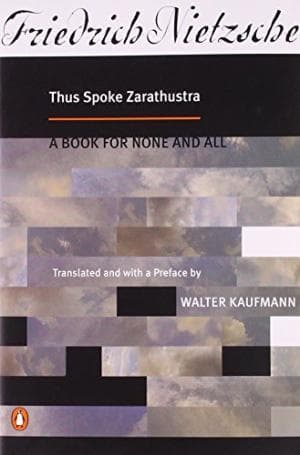
- Thus Spoke Zarathustra
Friedrich Nietzsche
4.0 (111k) average on GoodreadsPsychologyWhile not a direct narrative comparison, both works deal with a solitary figure's philosophical journey and return to humanity. Nietzsche's Zarathustra, however, is a prophet of radical self-overcoming and the will to power, advocating for a profound transformation of values. Peter Camenzind's journey, while involving disillusionment, ultimately leads to a more gentle, compassionate form of service and acceptance, reflecting a quieter, more humanistic path. Nietzsche's work is a polemic and a philosophical poem, intensely challenging and often confrontational, whereas Hesse's novel is a more introspective and gentle exploration of an individual's spiritual awakening.
- Brave New World
Aldous Huxley
4.0 (1.4M) average on GoodreadsFantasyIn a future where happiness comes from chemicals and individuality is gone, one man's desire for real experience threatens the calm, controlled society.





Enjoyed the summary?
A summary gives you the shape of the book. The book itself has the detail, the examples and the voice.
Find Peter Camenzind on AmazonAs an Amazon Associate, BookBrief earns from qualifying purchases. How we're funded