
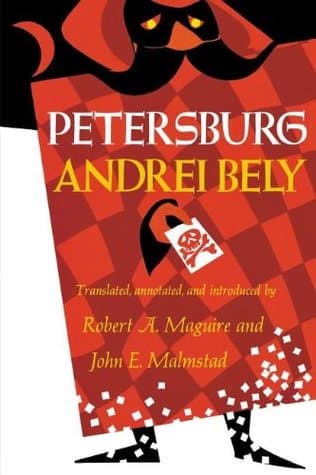
Synopsis
Covers the whole plot, including the ending.
- Difficulty
- Hard
- Pacing
- Variable
- Mood
- Atmospheric, Philosophical, Surreal, Intense, Melancholic
- Read it if
- You enjoy experimental literary fiction, rich symbolism, philosophical depth, and a deeply atmospheric portrayal of a city as a character.
- Skip it if
- You prefer straightforward narratives, fast-paced plots, or a clear-cut resolution to conflicts.
Petersburg Plot Summary
Covers the whole plot, including the ending.
The Senator's Morning and the Nihilist's Return
The novel begins in St. Petersburg, 1905, during political unrest. Apollon Apollonovich Abbleukov, a senator, starts his day with his usual precision. He thinks about geometric forms and the order he believes supports the universe and the state. His ordered world is threatened by the revolutionary feelings in Russia. At the same time, his son, Nikolai Apollonovich Abbleukov, a philosophy student and member of a revolutionary group, returns to Petersburg after being abroad. Nikolai is a conflicted intellectual, divided between his family's aristocratic background and his abstract revolutionary ideas. His return is not just personal; his group leader, Alexander Ivanovich Dudkin, has told him to commit a terrorist act.
The Sardine Tin and the Fatal Assignment
Nikolai Apollonovich, feeling alienated, meets his revolutionary contact, Alexander Ivanovich Dudkin. Dudkin, a more unstable and mystical revolutionary, gives Nikolai a sardine tin, saying it has a time bomb. The target, not yet explicitly told to Nikolai, is his father, Senator Apollonovich Abbleukov. Nikolai is horrified by the idea of killing his father and struggles with the moral and philosophical weight of his task. The bomb becomes a central, threatening symbol, its ticking a constant, internal countdown to a catastrophic event that will shatter the Abbleukov family and the senator's ordered world.
The Senator's Fears and Nikolai's Procrastination
Senator Abbleukov, despite his calm appearance, feels growing unease. He senses a coming threat to the established order, imagined as revolutionary 'scythians' in the city's shadows. He does not know the specific danger from his own son. Meanwhile, Nikolai Apollonovich cannot decide what to do. He carries the sardine tin bomb, moving through Petersburg's streets, always about to complete his mission but always finding a reason to delay. His thoughts are full of philosophy, self-doubt, and a growing sense of the absurd. The bomb stays unplanted, a ticking burden on his conscience and a source of increasing worry for Dudkin.
Dudkin's Delirium and the Copper Horseman
Alexander Ivanovich Dudkin, becoming more unstable, falls into a feverish state. He sees visions, especially of the Bronze Horseman statue, a symbol of imperial power and Peter the Great's imposing order on Russia. Dudkin believes the Horseman represents Petersburg's oppressive spirit and Russia's fate. He worries about the unexploded bomb and Nikolai's inaction, fearing the plan will fail. His mental state shows the chaotic and often irrational parts of the revolutionary movement, blurring political action, mysticism, and madness. He tries to contact Nikolai, urging him to finish the mission.
The Arrival of Sofya Petrovna and the Social Whirl
The tense atmosphere in the Abbleukov home becomes more complex with the return of Sofya Petrovna, Senator Abbleukov's wife and Nikolai's mother. Sofya is a socialite, unaware of the political unrest and her son's deadly secret. Her presence adds a contrasting element of superficiality and social maneuvering to the grim revolutionary plot. She tries to restart her social life and navigate Petersburg high society, completely unaware of the drama happening around her husband and son. Her lack of awareness shows the disconnect between the city's elite and the violent revolutionary movement.
The Bomb's Relocation and Nikolai's Despair
Driven by duty, fear, and a sense of alienation, Nikolai places the sardine tin bomb in his father's study. However, his conscience immediately acts against it. Overwhelmed by guilt and the horrific idea of killing his father, he sends an anonymous note to his father, warning him of the bomb. This act shows his deep internal conflict and his inability to fully commit to the revolutionary cause. He then flees, filled with despair and a sense of coming doom, the bomb's ticking in his mind as he walks the city streets, a hunted man by his own doing.
The Senator's Discovery and the Near Miss
Senator Abbleukov gets the anonymous note and, horrified, finds the sardine tin bomb in his study. At first disbelieving, he must face the reality of the threat. His life's order is shattered. In a moment of panic, he grabs the ticking bomb and throws it out his window just as it explodes. The explosion, though harmless outside, is a shock, tearing through the senator's world and making him see the violent chaos that has entered his home. He is shaken, his detachment broken.
Dudkin's Final Act and the Dissolution of the Cell
After the failed assassination, Alexander Ivanovich Dudkin, in a final, frantic act, confronts the 'Mongol,' a figure implied to be the true, manipulative leader of their revolutionary group. Dudkin, driven by his visions and a wish to cleanse the revolutionary movement, kills the Mongol. This act marks the violent end of their specific revolutionary group and Dudkin's complete break from any organized political action. His madness ends in this symbolic act of internal purification, leaving him alone and further taken over by his delusions.
Nikolai's Flight and the Aftermath
After the bomb's explosion, Nikolai Apollonovich, haunted by his actions and the near-killing of his father, leaves Petersburg. His departure shows his rejection of both his aristocratic background and the revolutionary path he briefly followed. The Abbleukov family is broken; Apollon Apollonovich's rigid world is cracked, and Sofya Petrovna remains mostly unaware of the deeper issues. Petersburg, though still full of revolutionary tension, slowly tries to return to its normal rhythm. The immediate crisis ends, but the underlying unease and potential for future violence remain, showing Russia's unstable state in 1905.
The Senator's Reflection and the City's Enduring Mystery
Afterward, Senator Apollon Apollonovich Abbleukov is changed. His strict adherence to order and bureaucracy is shaken. He must face the chaotic, unpredictable forces that support human existence and the Russian state. He thinks about his life, his relationship with his son, and Petersburg's enigmatic, almost spectral nature. The city, with its deceptive appearances and hidden depths, continues to have its powerful, almost mystical influence. The novel ends with unresolved tension, showing that while one crisis has passed, the fundamental conflicts and potential for upheaval in Petersburg and Russia continue, caught between East and West, order and chaos.
Petersburg Characters
Apollon Apollonovich Abbleukov
Protagonist/Antagonist
A high-ranking, rigidly bureaucratic senator, embodying the oppressive imperial order.
Apollon Apollonovich is a senator in the Imperial Russian government, a man defined by his meticulous routines, geometric thinking, and unwavering belief in order and the state. He sees the world in terms of lines, cubes, and the abstract logic of bureaucracy. He is emotionally detached, particularly from his son, Nikolai. His greatest fear is chaos and the revolutionary forces threatening his carefully constructed world. He is initially oblivious to the direct threat posed by his own son, making his eventual discovery of the bomb a profound shock that shatters his stoic exterior. He represents the old, dying order of imperial Russia.
Relationships: Nikolai Apollonovich Abbleukov (Estranged son, target of assassination); Sofya Petrovna Abbleukova (Wife, socially superficial)
Nikolai Apollonovich Abbleukov
Protagonist
The senator's intellectual son, a conflicted revolutionary assigned to bomb his father.
Nikolai is a philosophy student, an intellectual drawn to revolutionary ideals, but deeply conflicted and alienated. He is a 'man of ideas' rather than action, plagued by existential angst, self-doubt, and a sense of unreality. Tasked with bombing his own father, he struggles immensely with the moral implications of parricide, constantly procrastinating and eventually sabotaging the mission by warning his father. His internal monologues are filled with philosophical musings, reflecting the intellectual turmoil of the era. He represents the younger generation, caught between tradition and radical change, ultimately unable to fully commit to either.
Relationships: Apollon Apollonovich Abbleukov (Father, target of assassination); Sofya Petrovna Abbleukova (Mother, distant); Alexander Ivanovich Dudkin (Revolutionary contact, cell leader)
Alexander Ivanovich Dudkin
Supporting/Antagonist
A mystical and increasingly unhinged revolutionary, Nikolai's handler.
Dudkin is a revolutionary, but one whose motivations are tinged with mysticism, paranoia, and eventually madness. He is Nikolai's direct contact and the one who delivers the bomb. He is haunted by visions, particularly of the Bronze Horseman, which he sees as a symbol of Petersburg's oppressive spirit. His mental state deteriorates throughout the novel, reflecting the irrational and fanatical elements within the revolutionary movement. He desperately pushes Nikolai to complete the mission, ultimately taking matters into his own hands by murdering the 'Mongol' leader, signifying his complete descent into delusion.
Relationships: Nikolai Apollonovich Abbleukov (Revolutionary subordinate, target of his frustration); The Mongol (Revolutionary leader, victim of his madness)
Sofya Petrovna Abbleukova
Supporting
Apollon's frivolous, society-obsessed wife and Nikolai's distant mother.
Sofya Petrovna is Senator Abbleukov's wife and Nikolai's mother. She is entirely absorbed in the superficialities of Petersburg high society, concerned with balls, gossip, and appearances. She is largely oblivious to the political turmoil gripping Russia and the deadly drama unfolding within her own family. Her character serves as a stark contrast to the intense ideological and personal struggles of her husband and son, highlighting the disconnect between the city's elite and the revolutionary underground. Her presence adds a layer of social satire to the novel, emphasizing the absurdity and detachment of the aristocratic class.
Relationships: Apollon Apollonovich Abbleukov (Husband, emotionally distant); Nikolai Apollonovich Abbleukov (Son, distant and uncomprehending)
The Mongol
Antagonist/Mentioned
The shadowy, manipulative leader of the revolutionary cell.
The Mongol is a mysterious and enigmatic figure, the true, manipulative leader of the revolutionary cell to which Nikolai and Dudkin belong. He is largely unseen but his presence is felt as a sinister, controlling force. He represents the more ruthless and abstract aspects of the revolutionary movement, using individuals like Nikolai as pawns in a larger, impersonal game. His name evokes a sense of foreignness and historical invasion, linking the revolutionary threat to ancient, destructive forces. He is ultimately murdered by Dudkin in a fit of mystical rage.
Relationships: Alexander Ivanovich Dudkin (Subordinate, eventually his murderer); Nikolai Apollonovich Abbleukov (Subordinate, pawn in his schemes)
Lippanchenko
Supporting/Mentioned
A minor revolutionary figure, often seen as boorish and somewhat comical.
Lippanchenko is a minor character, a fellow revolutionary who is often portrayed in a somewhat grotesque or comical light. He represents the more mundane, often crude, aspects of the revolutionary underground, contrasting with Nikolai's intellectualism and Dudkin's mysticism. He is less concerned with ideology and more with the practicalities of conspiracy, though he often appears incompetent. His presence adds a touch of the absurd and the earthy to the otherwise high-minded or delirious revolutionary figures, highlighting the diverse and often contradictory elements within the movement.
Relationships: Nikolai Apollonovich Abbleukov (Fellow revolutionary); Alexander Ivanovich Dudkin (Fellow revolutionary)
The Bronze Horseman
Symbol/Mentioned
The statue of Peter the Great, a powerful symbol of imperial power and the spirit of Petersburg.
While not a character in the traditional sense, the Bronze Horseman (the equestrian statue of Peter the Great) functions as a spectral, almost sentient presence in the novel, particularly in Dudkin's fevered imagination. It embodies the oppressive, imperial spirit of Petersburg, the will that imposed a city on a swamp, and the heavy hand of state power. Dudkin sees it as a demonic force, a symbol of the city's artificiality and its crushing weight on the Russian soul. It represents the historical forces and the 'spirit' of the city that characters like Dudkin feel compelled to rebel against or that Apollon Apollonovich unknowingly serves.
Petersburg Themes
Identity and Self-Discovery
The novel looks at the fragmented identities of its characters, especially Nikolai Apollonovich, who struggles to balance his aristocratic background with his revolutionary ideas. Petersburg itself is a city dealing with its identity, caught between its European appearance and its ancient, 'Scythian' Russian soul. Characters look for meaning amidst political chaos and personal alienation, often finding only more fragmentation. Nikolai's inability to fully commit to either his father's world or the revolutionary cause shows the difficulty of forming a clear identity in a turbulent time.
“Petersburg — or rather, the phantoms of Petersburg — appeared to him as a hallucination.”
The Nature of Reality and Illusion
Bely often blurs reality, dream, and hallucination. Petersburg is often described as an illusory city, a 'phantom' existing more in its inhabitants' minds than as a physical place. Characters like Dudkin have vivid hallucinations, and even Apollon Apollonovich's rigid world is built on abstract, geometric illusions. This theme questions what is real and how much of human experience is made from perception, thought, and psychological states. The bomb, for example, is both a physical object and a powerful psychological idea.
“All Petersburg is a phantom.”
Political Radicalism and Parricide
The plot of Nikolai being told to bomb his father directly addresses political radicalism mixed with the idea of killing a father figure. The revolutionary act is not just political but also personal and symbolic, representing the younger generation's wish to destroy the old order (the 'father'). Nikolai's internal struggle shows the moral and psychological costs of such extremism. The novel explores the fanaticism, mysticism, and often self-destructive parts of the revolutionary movement, as seen in Dudkin's madness and his murder of the Mongol.
“A son, a brother, a father — what is that compared to the ideal?”
Order vs. Chaos
Senator Apollon Apollonovich represents order, carefully structuring his life and the state around geometric principles and bureaucratic precision. This order is constantly threatened by the revolutionary chaos in Petersburg. The novel contrasts Apollon's rigid, abstract order with the fluid, unpredictable, and often violent forces of revolution and human psychology. The bomb's explosion, even if harmless, shatters Apollon's perceived order, making him face existence's inherent chaos. The city itself, built on a swamp, symbolizes imposing artificial order on a wild, chaotic natural world.
“The senator's head was a cube.”
The Spirit of Petersburg and Russia
Petersburg is not just a setting but a character, showing Russia's paradoxical spirit – a city built on a swamp, a European facade over an Asiatic soul. It is a place of grandeur and decay, order and chaos, reason and madness. The novel looks at the tension between Russia's Western identity (symbolized by Peter the Great and his city) and its ancient, mystical, 'Scythian' roots. Characters are shaped by the city's atmosphere, and its symbolic weight reflects the larger struggle for Russia's national identity and future.
“Petersburg is the brain of Russia.”
Plot Devices & Literary Techniques
Stream of Consciousness
Narrative technique mirroring characters' internal thoughts and perceptions.
Bely employs stream of consciousness to delve deeply into the characters' inner lives, particularly Nikolai's and Dudkin's. The narrative often shifts abruptly, mimicking the free flow of thoughts, memories, and associations, blurring the lines between external reality and internal experience. This technique allows for a fragmented, subjective portrayal of events, emphasizing the psychological turmoil and philosophical musings of the characters. It contributes to the novel's sense of unreality and its exploration of the mind's role in shaping perception, making the reader privy to the characters' anxieties, delusions, and intellectual struggles.
Symbolism (e.g., The Sardine Tin Bomb, The Bronze Horseman)
Objects and figures imbued with deeper, often shifting, metaphorical meanings.
Bely uses extensive symbolism to enrich the novel's themes. The sardine tin bomb is not just a weapon but a symbol of parricide, revolutionary extremism, and the ticking countdown to chaos. The Bronze Horseman statue represents oppressive imperial power, Peter the Great's violent imposition of order, and a demonic force in Dudkin's mind. Geometric shapes symbolize Apollon Apollonovich's rigid, abstract worldview. The very city of Petersburg is symbolic of Russia's conflicted identity. These symbols are often fluid, taking on different meanings depending on the character's perception, deepening the novel's exploration of reality and illusion.
Narrative Voice and Metafiction
A self-aware narrator who comments on the story and its construction.
The novel features a highly self-aware, intrusive narrator who frequently addresses the reader directly, comments on the act of storytelling, and even questions the reality of the characters and events. This metafictional approach undermines the traditional sense of a fixed reality, reinforcing the theme of illusion. The narrator's presence reminds the reader that they are engaging with a constructed text, further blurring the boundaries between fiction and reality. This device contributes to the novel's modernist aesthetic and its exploration of consciousness and representation.
Repetition and Leitmotifs
Recurring words, phrases, and images that create a hypnotic effect and emphasize themes.
Bely extensively uses repetition of words, phrases, and images (leitmotifs) to create a rhythmic, almost musical quality in the prose. Recurring elements like the 'yellow-red' color of the Petersburg sunsets, the sound of the bomb's 'tick-tock,' or descriptions of Apollon Apollonovich's 'cube' head, serve to emphasize key themes and character traits. This technique builds a hypnotic atmosphere, reinforcing the sense of obsession and the cyclical nature of certain ideas. It also creates a cohesive, dreamlike texture, where certain images become ingrained in the reader's mind, much like they are in the characters' consciousness.
Grotesque and Absurdism
Exaggerated, distorted imagery and situations that highlight the irrationality of the world.
The novel frequently employs grotesque and absurdist elements to depict the distorted reality of Petersburg and its inhabitants. Characters are often described with exaggerated physical features or behave in bizarre, irrational ways. The situation of a son being tasked to bomb his own father, and the comical misplacing of the bomb, leans into the absurd. This device highlights the irrationality and inherent madness lurking beneath the surface of seemingly ordered society, reflecting the profound psychological and social upheaval of early 20th-century Russia. It also serves to critique the dehumanizing aspects of bureaucracy and revolution.
Petersburg Quotes
“Petersburg is a phantom city, a city of ghosts, a city of the dead.”
“The Bronze Horseman gallops through the centuries, and Petersburg gallops with him.”
“Everything is a mask, and behind the mask—nothing.”
“The Neva flows not with water, but with the blood of time.”
“In Petersburg, even the stones whisper conspiracies.”
“A man is but a shadow cast by the city's walls.”
“The revolution is not in the streets; it is in the mind.”
“Memory here is a labyrinth without an exit.”
“The fog does not conceal; it reveals the city's true form.”
“Every step on these pavements echoes with the footsteps of ghosts.”
“To live in Petersburg is to be suspended between dream and nightmare.”
“The bomb ticks not in the briefcase, but in the soul.”
“Colors here are not hues, but screams of the atmosphere.”
“In this city, even love is a political act.”
Quiz
10 questions on the plot and the characters. Each answer comes with a short explanation.
Question 1
What is the primary setting and time period of 'Petersburg'?
- Moscow during the 1917 Russian Revolution
- St. Petersburg in 1905
- Kiev in the late 19th century
- Petrograd during World War I
Show answer
B. St. Petersburg in 1905 The novel is set in St. Petersburg (often called Petersburg) during the turbulent year of 1905, a period marked by social unrest and revolutionary activity in Russia, which Bely uses to explore the city's identity and broader Russian themes.
Question 2
Which literary technique is prominently used in 'Petersburg' to depict the city?
- Linear narrative with clear chronological events
- A kaleidoscope of images and impressions
- Minimalist dialogue and sparse descriptions
- First-person memoir style
Show answer
B. A kaleidoscope of images and impressions Bely employs a fragmented, impressionistic style, blending various elements like weather reports, news, and psychology to create a vivid, chaotic portrayal of Petersburg, reflecting the ambiguities of Russian identity.
Question 3
According to the description, what does Petersburg symbolize in the novel?
- A stable center of Russian tradition
- The ambiguities and paradoxes of the Russian character
- A purely Western European city without Russian influence
- An isolated village untouched by politics
Show answer
B. The ambiguities and paradoxes of the Russian character Petersburg is depicted as 'an eastern window on the west,' symbolizing the complex dualities in Russian culture—caught between Eastern and Western influences, and embodying contradictions in society and identity.
Question 4
What elements are blended and juxtaposed in 'Petersburg' to create its narrative?
- Only historical events and political speeches
- History, culture, and politics
- Exclusively personal diaries and letters
- Fantasy elements and mythological tales
Show answer
B. History, culture, and politics Bely integrates history, culture, and politics with everyday details like weather reports and fashions, creating a multifaceted exploration of the city's essence during a time of upheaval.
Question 5
How does the novel approach the search for identity in 'Petersburg'?
- Through a single protagonist's introspective journey
- By focusing solely on the city's architectural history
- As an exhilarating search involving various societal elements
- Through a detached, scientific analysis of demographics
Show answer
C. As an exhilarating search involving various societal elements The search for identity is dynamic and collective, jostling together people from Petersburg society with diverse aspects like psychology and current events, aiming to uncover the identity of both the city and Russia.
Question 6
Which critic described 'Petersburg' as 'The one novel that sums up the whole of Russia'?
- Leo Tolstoy
- Fyodor Dostoevsky
- Anthony Burgess
- Vladimir Nabokov
Show answer
C. Anthony Burgess Anthony Burgess, a renowned British writer and critic, praised 'Petersburg' for its comprehensive portrayal of Russian essence, highlighting its significance in capturing the nation's complexities.
Question 7
What role does the year 1905 play in the novel's context?
- It is a peaceful year of cultural renaissance
- It marks a short, turbulent period of social and political unrest
- It is the year Petersburg was founded
- It represents a time of economic prosperity and stability
Show answer
B. It marks a short, turbulent period of social and political unrest 1905 was a year of revolution and upheaval in Russia, including events like Bloody Sunday and widespread strikes, which Bely uses to mirror the chaotic and paradoxical nature of Petersburg and Russian society.
Question 8
In what way is Petersburg described as 'an eastern window on the west'?
- It faces geographically eastward towards Asia
- It serves as Russia's gateway to Western ideas while retaining Eastern roots
- It was originally a Western colony taken over by the East
- It exclusively imports goods from Western Europe
Show answer
B. It serves as Russia's gateway to Western ideas while retaining Eastern roots This phrase captures Petersburg's dual identity: as a city built by Peter the Great to modernize Russia along Western lines, yet deeply embedded in Eastern Slavic culture, reflecting the broader tensions in Russian identity.
Question 9
How does Bely's narrative style in 'Petersburg' affect the reader's understanding of the city?
- It provides a clear, factual guide to Petersburg's landmarks
- It immerses the reader in a sensory and psychological experience of urban chaos
- It simplifies complex historical events into easy-to-follow plots
- It focuses on rural contrasts to highlight city life
Show answer
B. It immerses the reader in a sensory and psychological experience of urban chaos By jostling together diverse elements—from weather to fashion—Bely creates a fragmented, immersive narrative that conveys the city's vibrant, contradictory nature, challenging readers to piece together its identity.
Question 10
What ultimate goal does the novel's search for Petersburg's identity aim to achieve?
- To catalog every building and street in the city
- To provide a tourist guide for visitors
- To uncover the identity of Russia itself
- To critique Western European urban planning
Show answer
C. To uncover the identity of Russia itself Bely uses Petersburg as a microcosm; by exploring the city's multifaceted character during a critical historical moment, he seeks to reveal deeper truths about the broader Russian nation and its cultural paradoxes.
Petersburg FAQ
What is 'Petersburg' by Andrei Bely about?
The novel follows the intertwined lives of several characters in St. Petersburg during the 1905 Russian Revolution, particularly focusing on Nikolai Apollonovich Ableukhov, a young intellectual who becomes entangled in a terrorist plot against his own father, Senator Apollon Apollonovich Ableukhov. Through their personal dramas and the city's chaotic atmosphere, Bely explores Russia's cultural identity, political turmoil, and the clash between Western rationalism and Eastern mysticism.
Why should I read 'Petersburg'?
It's considered a masterpiece of Russian Symbolist literature that captures the psychological and political disintegration of pre-revolutionary Russia through innovative prose. Bely's experimental style—blending stream-of-consciousness, poetic imagery, and philosophical musings—makes it a challenging but rewarding read for those interested in modernist fiction, Russian history, or dense, symbolic narratives about societal collapse.
What is the background/setting of 'Petersburg'?
Set in St. Petersburg over a few days in October 1905 during the failed Russian Revolution, the novel depicts a city on the brink of chaos. The setting reflects Russia's identity crisis as a 'window to the West,' with its Western-style architecture and bureaucracy clashing with Eastern spiritual traditions, all amid political protests, bomb threats, and a pervasive sense of impending doom.
What are the most memorable quotes from 'Petersburg'?
Notable quotes include: 'Petersburg is a phantom city, a city of mists and mirages' (highlighting its elusive identity), and 'The bomb is ticking in the senator's brain' (symbolizing both the literal terrorist plot and the psychological disintegration of the characters). These lines encapsulate the novel's themes of unreality and internal conflict.
What writing style does Andrei Bely use in 'Petersburg'?
Bely employs a highly experimental, Symbolist style characterized by fragmented narratives, vivid sensory imagery (e.g., colors and sounds), and stream-of-consciousness techniques. He blends historical facts with surreal visions, creating a kaleidoscopic effect that mirrors the city's chaotic state and the characters' inner turmoil.
What minor details add significant meaning in 'Petersburg'?
The recurring image of the 'yellow fog' symbolizes the moral and political confusion engulfing the city, while the 'red domino' costume worn by Nikolai Apollonovich represents his hidden revolutionary identity and the mask-like nature of Petersburg society. These small elements reinforce themes of deception and ambiguity.
What are some subtle foreshadowing moments in 'Petersburg'?
Early references to 'explosions' and 'collapsing structures' foreshadow both the literal bomb plot and the societal breakdown. Nikolai's initial detachment from his father's world hints at his eventual involvement in the assassination attempt, while weather descriptions of gathering storms mirror the coming political upheaval.
What unexpected character connections exist in 'Petersburg'?
Nikolai Apollonovich's involvement with the terrorist group connects him to his father's political enemy, Dudkin, a revolutionary who later reveals ties to the Ableukhov family's past. This web of relationships underscores how personal and political conflicts are deeply intertwined in Petersburg's society.
What are unspoken character motivations in 'Petersburg'?
Nikolai Apollonovich's participation in the bomb plot stems not just from political idealism but from an Oedipal desire to destroy his father's authoritarian legacy. Senator Apollon Apollonovich's rigid bureaucracy masks a deep fear of chaos and loss of control, reflecting Russia's struggle between tradition and revolution.
What psychological complexities do characters exhibit in 'Petersburg'?
Nikolai Apollonovich embodies the conflicted intellectual, torn between revolutionary fervor and paralyzing doubt, while his father, the senator, represents the decaying establishment clinging to order amid madness. Their psychological states blur with the city's identity, showing how external chaos internalizes as mental fragmentation.
What are the major emotional turning points in 'Petersburg'?
Key moments include Nikolai's realization of the bomb's real target (his father), which triggers guilt and crisis; the senator's confrontation with his own irrelevance during a political meeting; and the climactic failed assassination that leaves characters emotionally shattered, symbolizing the revolution's collapse.
How do relationship dynamics evolve in 'Petersburg'?
The father-son relationship between Apollon and Nikolai deteriorates from cold formality to near-murderous conflict, mirroring Russia's generational divide. Meanwhile, alliances among revolutionaries like Dudkin fracture under pressure, showing how idealism gives way to betrayal and isolation in the turbulent setting.
Which parts of 'Petersburg' remain ambiguous or open-ended?
The novel's ending is ambiguous: the bomb plot fails, but it's unclear if Nikolai achieves redemption or remains trapped in his existential despair. The fate of Petersburg itself—whether it symbolizes Russia's renewal or eternal stagnation—is left open, reflecting the unresolved tensions of the era.
What are controversial scenes or decisions in 'Petersburg'?
Nikolai's decision to join a plot targeting his father sparks debate over whether it's a political act or personal rebellion. The surreal, often disjointed narrative style has divided readers, with some praising its innovation and others finding it confusing or overly abstract.
'Petersburg' ending explained: how it ends & what it means
The novel ends with the bomb plot thwarted and characters like Nikolai and his father surviving but emotionally broken. This ambiguous conclusion suggests that while the immediate revolution failed, the psychological and societal cracks it revealed persist, leaving Russia's future uncertain and symbolizing the endless cycle of crisis in its identity.
About the author

Andrei Bely was a Russian Symbolist writer, poet, and literary critic. He is best known for his novel "Petersburg" (1913), a seminal work of Russian Modernism, celebrated for its experimental style and complex portrayal of the city and its inhabitants. Bely's theoretical writings also significantly influenced the Symbolist movement.
Similar books
- Ulysses
James Joyce
3.7 (111k) average on GoodreadsLiterary FictionShares experimental narrative techniques, stream-of-consciousness, and a deep exploration of a single city over a short period.
- The Master And Margarita
Mikhail Bulgakov
4.3 (243k) average on GoodreadsFantasyFeatures satirical elements, philosophical depth, and a blend of realism with the fantastical within a Russian urban setting.
- The Secret Agent
Joseph Conrad
3.6 (19k) average on GoodreadsThrillerBoth novels delve into political conspiracy and anarchism in a major European city, but Conrad's The Secret Agent adheres to a traditional realist approach to character development and plot, examining the external forces and tragic consequences of political extremism. Bely's Petersburg ventures deeper into the internal, almost metaphysical, chaos and psychological fragmentation that precedes and underlies such societal upheaval, employing a highly stylized and symbolic narrative.
- The Old Man and the Sea
Ernest Hemingway
3.8 (831k) average on GoodreadsLiterary FictionA Cuban fisherman's long struggle with a giant marlin becomes a story of endurance and dignity, now retold for young adults with illustrations, phonetic guides, and writing prompts in Traditional Chinese.
- One Hundred Years of Solitude
Gabriel García Márquez
4.1 (753k) average on GoodreadsLiterary FictionThrough the multi-generational story of the Buendía family, a mythical town deals with the repeating patterns of time, love, and solitude, as the extraordinary mixes with the ordinary.
- The Goldfinch
Donna Tartt
3.9 (720k) average on GoodreadsLiterary FictionHaunted by a tragic explosion and clutching a stolen Dutch masterpiece, a young orphan navigates the opulent drawing rooms of New York and the gritty underbelly of the art world, desperately seeking connection and redemption amidst a life spiraling into crime and obsession.




Enjoyed the summary?
A summary gives you the shape of the book. The book itself has the detail, the examples and the voice.
Find Petersburg on AmazonAs an Amazon Associate, BookBrief earns from qualifying purchases. How we're funded