
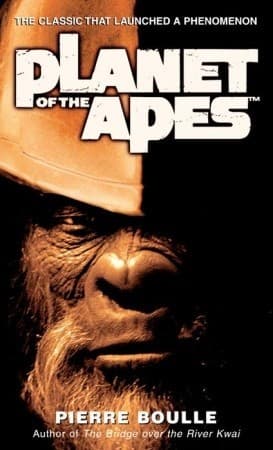
Synopsis
Covers the whole plot, including the ending.
- Difficulty
- Medium
- Pacing
- Moderate
- Mood
- Thought-provoking, Ironic, Suspenseful, Philosophical
- Read it if
- You enjoy thought-provoking science fiction with a strong allegorical bent, exploring themes of societal roles, intelligence, and humanity's place in the universe.
- Skip it if
- You prefer action-heavy sci-fi over philosophical exploration, or are looking for a story with a conventionally optimistic ending.
Planet of the Apes Plot Summary
Covers the whole plot, including the ending.
A Message in a Bottle: Jinn and Phyllis's Discovery
The story starts with Jinn and Phyllis, a rich couple on a space cruise. They find a bottle with a manuscript inside. They read it. The manuscript, in French, tells of Ulysse Mérou's amazing and terrible experiences. Jinn and Phyllis, at first doubtful, are drawn into the tale of a planet where apes are the intelligent species, and humans are primitive animals. This setup creates a feeling of wonder and disbelief, hinting at the unusual nature of Ulysse's story and a possible shocking ending.
Arrival on Soror: A New World's Strange Inhabitants
Ulysse Mérou, a journalist, goes on a space trip to the star Betelgeuse with Professor Antelle, a scientist, and his assistant, Levain. After two years (which feel like months due to time dilation), they find a planet orbiting Betelgeuse, which they name Soror. From space, they see plants and a city, but no clear signs of advanced life. When they land, they meet beautiful, naked, and seemingly primitive humans who act like wild animals, living simply in nature. The three astronauts are happy at first, thinking they have found paradise, but soon realize these humans have no intelligence, language, or self-awareness.
The Ape Hunt and Human Capture
While watching the primitive humans, Ulysse, Antelle, and Levain see a hunt. Gorillas, chimpanzees, and orangutans, dressed, riding horses, and using guns, hunt the wild humans. Professor Antelle and Levain are caught in the stampede. Ulysse, hidden at first, is also captured. This brutal event changes their view of the planet and shows the true order: apes are the intelligent species, and humans are just beasts. The astronauts are now captive animals, no different from the native human population.
Life in the Ape City: A Human in a Cage
Ulysse is taken to a research facility in the ape city, where he is caged with other humans. He is watched, poked, and experimented on, like an animal in a zoo. He sees the different roles of the ape species: gorillas are the military/workers, orangutans are the conservative religious/political leaders, and chimpanzees are the scientists. Professor Antelle, unable to handle the role reversal and shame, quickly becomes animalistic, losing his intelligence and becoming like the native humans. Levain dies during an experiment. Ulysse, however, holds onto his intellect, trying to find a way to show he is human.
Meeting Zira: A Sympathetic Scientist
During his captivity, Ulysse tries to communicate, drawing shapes and speaking French, but no ape understands him. Zira, a chimpanzee scientist who studies human behavior, notices his efforts. Zira is interested in Ulysse's unusual intelligence, which is far beyond that of other humans she has studied. She starts treating him differently, being kind to him and studying him more closely. She names him 'Ulysse' after a myth, seeing his unique qualities, though she still sees him as a very intelligent animal.
The Breakthrough: Ulysse Speaks
Ulysse's efforts pay off when he says a clear word in French during an experiment. Zira is surprised and brings her fiancé, Cornélius, a chimpanzee scientist, to see it. After much effort, Ulysse shows he can speak and understand. This discovery is important, challenging the apes' long-held beliefs about human inferiority. While Cornélius is careful, Zira becomes Ulysse's supporter, seeing the deep meaning of his intelligence. This event changes Ulysse's captivity, making him a subject of intense scientific and philosophical discussion, not just an animal.
Public Revelation and Political Turmoil
With Zira and Cornélius's help, Ulysse is shown to the ape scientific community. His ability to speak and reason causes a commotion. Some chimpanzees are fascinated, but the conservative orangutan leaders, led by Dr. Zaius, are upset and threatened by Ulysse. They fear that acknowledging human intelligence could upset their society and challenge their myths about ape superiority. Ulysse must learn their language quickly to defend himself and explain where he came from. He tries to tell the story of humanity's advanced civilization, but his claims are met with doubt and hostility from the establishment.
The Theory of Evolution and Ape Dominance
Through talks with Zira and Cornélius, Ulysse learns about ape history and their theories of evolution. The apes believe they evolved from primitive forms to their current state, while humans stayed animalistic. Ulysse tries to present his own theory: that humans were once the main species on Earth, and apes evolved from them. This idea is mocked and seen as heresy by the orangutans. He finds that the apes have old artifacts, which they say are from their own ancestors, but Ulysse recognizes them as possibly human-made, suggesting a hidden past they do not want to face.
Discovery of the Human Past: The Buried City
Cornélius, driven by science, starts an archaeological dig in a forbidden area outside the city, based on Ulysse's suggestions. He uncovers ruins of an advanced human city, with complex technology and art. This proves that an intelligent human civilization existed on Soror long before the apes became dominant. The evidence goes against the apes' history and religious beliefs. Dr. Zaius and the orangutan council are angry, seeing the threat this poses to their social order. They try to hide the findings, but the truth is known among the scientific chimpanzees.
Escape and the Return to Earth
Despite the political issues, Ulysse, with Zira and Cornélius's help, secretly fixes his spaceship. He takes Nova, a primitive human woman with whom he has a child, with him. Professor Antelle, fully animalistic, is left behind. Ulysse, Nova, and their infant son launch into space, leaving Soror, hoping to return to a civilized Earth. Their escape is a desperate attempt to survive and find a world where intelligence is valued. The future of Soror and the apes, left to deal with the truth of their origins, is unknown.
The Final Twist: Earth's Fate Revealed
After another long space journey, Ulysse brings his ship back to Earth. He hopes for a triumphant return to a world of intelligent humans. However, when he lands, he sees a terrible sight: the welcoming committee is uniformed, intelligent gorillas, speaking their own language. A gorilla official approaches his ship, smoking a cigar, and looks at him with scorn. Ulysse is devastated, realizing that Earth has suffered the same fate as Soror. The manuscript ends suddenly, leaving Ulysse's ultimate fate unclear, but suggesting a repeating and unavoidable dominance of apes over humans across the cosmos.
Jinn and Phyllis's Reaction: A Chilling Epilogue
The story returns to Jinn and Phyllis, the space tourists who found Ulysse's manuscript. After reading the tale, they discuss what it means. Jinn dismisses Ulysse's story as a fantasy, especially the idea of intelligent humans. He says, 'It's quite obvious they couldn't possibly have built a civilization like that.' Phyllis agrees, finding the idea funny. The shocking reveal is when the reader realizes that Jinn and Phyllis are intelligent, speaking apes, confirming Ulysse's final, devastating discovery about Earth. This ending shows the widespread nature of the ape-dominated future and recontextualizes the whole story, leaving the reader with a feeling of irony and dread.
Planet of the Apes Characters
Ulysse Mérou
Protagonist
A human journalist who documents his harrowing experiences on Soror.
Ulysse Mérou is a curious and intelligent French journalist who embarks on a space journey. He is the central narrator of the manuscript found by Jinn and Phyllis. Resourceful and observant, Ulysse maintains his intellect and humanity even when reduced to an animalistic state by the apes. He is driven by a desperate need to communicate and prove his intelligence, not just for his own survival but to uphold the dignity of his species. He forms a bond with Nova and later with Zira and Cornélius, becoming a bridge between the two species. His resilience and intellectual tenacity are key to his survival and the revelation of the planet's true history.
Relationships: Professor Antelle (travel companion, mentor figure); Levain (travel companion, assistant); Nova (mate, mother of his child); Zira (sympathetic ape scientist, advocate); Cornélius (ape scientist, Zira's fiancé, Ulysse's ally)
Professor Antelle
Supporting
A brilliant human scientist who quickly succumbs to primitivism on Soror.
Professor Antelle is a renowned human scientist and the leader of the expedition to Soror. Initially a figure of great intellect and authority, he is unable to cope with the psychological trauma of being treated as an animal by the apes. Unlike Ulysse, Antelle rapidly regresses, losing his ability to speak, reason, and even recognize his former companions. He becomes a feral, primitive human, indistinguishable from the native inhabitants of Soror. His tragic devolution serves as a stark warning about the fragility of civilization and intellect when stripped of social context and dignity.
Relationships: Ulysse Mérou (travel companion, former protégé); Levain (travel companion, assistant)
Levain
Supporting
Professor Antelle's assistant, who is killed early in captivity.
Levain is Professor Antelle's assistant and the third member of the human expedition. He is less developed as a character than Ulysse or Antelle but shares their initial wonder and subsequent terror. Levain is one of the first human astronauts to be captured by the apes and tragically dies during a laboratory experiment, highlighting the brutal and indifferent treatment of humans by the ape scientists. His death further emphasizes the precarious position of Ulysse and the other captive humans.
Relationships: Ulysse Mérou (travel companion); Professor Antelle (travel companion, employer)
Nova
Supporting
A primitive human woman who becomes Ulysse's mate.
Nova is a beautiful, primitive native human of Soror. She is unable to speak or reason but possesses an innate gentleness and beauty that captivates Ulysse. She is initially one of the humans captured in the ape hunt and is kept in the same research facility as Ulysse. Ulysse forms a deep emotional and physical bond with her, and they eventually have a child together. Nova represents the natural, uncorrupted state of humanity on Soror, serving as a poignant contrast to the intellectual apes and a symbol of Ulysse's desire to preserve a semblance of his species.
Relationships: Ulysse Mérou (mate, partner, mother of his child)
Zira
Supporting
A compassionate chimpanzee scientist who champions Ulysse.
Zira is a brilliant and empathetic chimpanzee scientist specializing in human behavior and psychology. She is the first ape to recognize Ulysse's exceptional intelligence and becomes his primary advocate within ape society. Despite her initial scientific detachment, she develops a genuine concern for Ulysse, viewing him as a unique subject rather than just an animal. Her open-mindedness and willingness to challenge established ape dogma make her a crucial ally for Ulysse, even as it puts her at odds with the conservative orangutan leadership. She is engaged to Cornélius.
Relationships: Ulysse Mérou (scientific subject, friend, advocate); Cornélius (fiancé, scientific collaborator)
Cornélius
Supporting
A gifted chimpanzee scientist and Zira's fiancé, who discovers evidence of human civilization.
Cornélius is a highly intelligent chimpanzee scientist, engaged to Zira. He is initially more skeptical than Zira about Ulysse's intelligence but becomes convinced after witnessing Ulysse's abilities firsthand. Cornélius is a meticulous researcher and an intellectual, driven by scientific truth. He undertakes the archaeological dig that uncovers the ruins of a human city, providing undeniable proof of a past human civilization and validating Ulysse's claims. His findings shake the foundations of ape society and make him a target of the conservative orangutan faction, but he remains committed to scientific discovery.
Relationships: Ulysse Mérou (scientific subject, ally); Zira (fiancé, scientific collaborator)
Dr. Zaius
Antagonist
A powerful orangutan minister who vehemently opposes Ulysse's revelations.
Dr. Zaius is a prominent orangutan, serving as the Minister of Public Health and the Guardian of the Sacred Scrolls. He represents the conservative, religious, and political establishment of ape society. Zaius is deeply committed to maintaining the existing social order and the ape-centric view of history. He views Ulysse's intelligence and the evidence of a past human civilization as a dangerous heresy that threatens to destabilize ape society. He actively works to suppress Ulysse's claims and Cornélius's archaeological findings, driven by a fear of chaos and a belief in the inherent inferiority of humans.
Relationships: Ulysse Mérou (adversary, threat to social order); Zira (subordinate, often at odds with her progressive views); Cornélius (subordinate, his scientific findings are a threat to Zaius's authority)
Jinn
Mentioned
One of the space tourists who discovers Ulysse's manuscript.
Jinn is one of the two space tourists who find Ulysse's manuscript in a bottle floating in space. He is initially intrigued by the story but ultimately dismisses it as a fantastical tale, particularly the notion of intelligent humans. His final remarks, in conjunction with the revelation of his own species, provide the ultimate ironic twist to the narrative.
Relationships: Phyllis (travel companion, partner)
Phyllis
Mentioned
One of the space tourists who discovers Ulysse's manuscript.
Phyllis is the other space tourist with Jinn, who also reads Ulysse's manuscript. Like Jinn, she finds the idea of intelligent humans absurd and dismisses the manuscript's claims. Her final agreement with Jinn's assessment reinforces the profound irony of the novel's ending.
Relationships: Jinn (travel companion, partner)
Planet of the Apes Themes
The Fragility of Civilization and Intelligence
The novel shows how quickly civilization and intelligence can be lost. Professor Antelle's fast change to an animal after losing his dignity shows how important environment and psychology are to maintaining human intellect. The story's premise—intelligent humans becoming primitive animals—demonstrates that advanced civilization is not a sure thing, but a delicate structure that can fall, allowing other species to rise. Ulysse's constant effort to stay sane and communicate highlights this fragility.
“What does a man lose when he loses his intellect? His humanity, perhaps. But what is humanity without intellect?”
Speciesism and Prejudice
A main theme is the prejudice shown by both humans and apes. At first, Ulysse and his friends see the native humans as mere animals, not intelligent. This mirrors how the apes treat all humans. The apes, especially the orangutans, strongly believe in their own superiority and human inferiority, refusing to accept any proof that challenges this view. This theme criticizes how societies create hierarchies based on arbitrary differences and how hard it is to overcome deep-seated prejudices, even with clear evidence, as seen with Dr. Zaius's resistance to Cornélius's findings.
“It is quite obvious they couldn't possibly have built a civilization like that.”
The Nature of Intelligence and Communication
The book explores what defines intelligence and the role of communication. Ulysse's struggle to speak and be understood is central to his fight for survival and recognition. The apes' initial inability to understand his language or drawings shows the barriers between intelligent species. The slow process by which Zira and Cornélius come to understand Ulysse shows that intelligence is not just about natural ability but also about shared ways of understanding. The novel suggests that not being able to communicate well can lead a species to be seen as primitive.
“The greatest tragedy is to possess intelligence but lack the means to express it.”
The Cyclical Nature of History and Evolution
The most important theme is the idea that history and evolution repeat, rather than moving in a straight line. The discovery of a human civilization before the apes on Soror, along with Ulysse's return to an ape-dominated Earth, suggests a recurring pattern where one dominant species rises and falls, only to be replaced by another. This challenges the idea that humans are special and implies a universal rule where intelligence and dominance can shift between species. The ending leaves the reader with a chilling feeling that humanity's fate on Soror is not unique but a possible future for any civilization, including Earth's.
“It was as if the universe had decided, for some unknown reason, to reverse the order of things, not just on Soror, but everywhere.”
The Dangers of Stagnation and Complacency
The novel warns against the dangers of intellectual and societal stagnation. The apes on Soror, especially the orangutans, resist new ideas and scientific discovery, clinging to tradition and old beliefs. This complacency, driven by fear of challenging their founding myths, stops them from understanding their true history and the threats they face. Similarly, the implied downfall of human civilization on Earth and Soror could be from a form of intellectual or social stagnation that made them vulnerable to being overthrown by a rising species, suggesting that progress and adaptability are important for survival.
“Tradition weighed heavily on their minds, more heavily than any scientific truth.”
Plot Devices & Literary Techniques
Frame Story / Manuscript Discovery
A story within a story, found by characters who are later revealed to be significant.
The novel employs a frame story where the primary narrative (Ulysse's account) is discovered as a manuscript in a bottle by two space tourists, Jinn and Phyllis. This device creates immediate intrigue and suspense, as the reader experiences Ulysse's story through the filter of these external characters. The true power of this device is revealed in the final pages when Jinn and Phyllis are shown to be intelligent apes, thus delivering a shocking twist that recontextualizes the entire narrative and foreshadows Ulysse's ultimate fate on Earth. It serves to amplify the irony and the cyclical nature of the plot.
Relativistic Time Dilation
Allows for vast amounts of time to pass on Earth while the protagonists experience only months.
The concept of relativistic time dilation, a real phenomenon in physics, is used to explain the vast time difference between Ulysse's journey and the passage of time on Earth. While Ulysse and his crew experience only a few months during their two-year journey to Betelgeuse, and then their return trip, centuries could have passed on their home planet. This scientific principle is crucial for the shocking ending, enabling Earth to undergo a profound societal transformation (from human to ape dominance) during the protagonists' absence without requiring an implausibly rapid shift in real-time for Ulysse.
Anthropomorphism and Inversion
Attributes human-like qualities to apes and animalistic traits to humans, reversing societal roles.
Boulle masterfully uses anthropomorphism for the apes, endowing them with complex societies, language, technology, and distinct social classes (gorillas for labor/military, orangutans for politics/religion, chimpanzees for science). Conversely, humans are depicted with animalistic traits, being mute, naked, and treated as beasts. This inversion of traditional roles is the core satirical device of the novel, forcing the reader to confront prejudices and question the inherent superiority of humanity. It highlights the arbitrary nature of 'civilization' and 'barbarism' when species roles are reversed.
Dramatic Irony
The audience knows more about the characters' fate or situation than the characters themselves.
Dramatic irony is prevalent throughout the novel, particularly in the framing device. From the moment Jinn and Phyllis discover the manuscript, the reader is aware that they are intelligent apes, a fact Ulysse Mérou only discovers at the very end of his story. This creates a constant undercurrent of dread and anticipation for the reader, who understands the full implications of Ulysse's narrative in a way Ulysse himself cannot until the final pages. The irony deepens as Jinn and Phyllis dismiss the 'absurd' idea of intelligent humans, unknowingly reading about their own species' rise to power.
Satire and Social Commentary
Uses humor, irony, or exaggeration to criticize human society and its flaws.
Pierre Boulle uses the ape society on Soror as a satirical mirror to human civilization. The distinct roles of the ape species (gorillas as laborers, orangutans as conservative leaders, chimpanzees as intellectuals) can be seen as exaggerated reflections of human social structures and prejudices. The apes' scientific debates, religious dogma, and political infighting, particularly their resistance to inconvenient truths, are thinly veiled critiques of human institutions. The novel satirizes human arrogance, speciesism, and the fragility of intellectual progress, suggesting that humans are not so different from their simian counterparts.
Planet of the Apes Quotes
“Man is truly the king of the animals, for his brutality exceeds theirs.”
“On the planet Soror, it is the apes who are the masters and men who are the beasts.”
“Intelligence is not a monopoly of the human race.”
“We apes have evolved; you humans have remained in a state of nature.”
“The truth is often stranger than fiction, and more terrifying.”
“In this world, it is not the fittest who survive, but the most adaptable.”
“Language is the key to civilization, and we have lost it.”
“The apes have built a society on the ruins of human greatness.”
“Fear is the greatest motivator, and the apes fear what they do not understand.”
“We are not so different, you and I. We both seek to understand our place in the universe.”
“The past is a mirror in which we see our future.”
“In the end, it is not strength but wisdom that prevails.”
“The line between beast and being is thinner than we think.”
“On Soror, I found a world where my own kind were the monsters.”
Quiz
10 questions on the plot and the characters. Each answer comes with a short explanation.
Question 1
What is the primary method by which the narrator's story is preserved and shared in the book?
- It is written in a diary found by archaeologists.
- It is recorded on a tape and left in a cave.
- It is confided to space in a manuscript inside a bottle.
- It is transmitted via radio waves to Earth.
Show answer
C. It is confided to space in a manuscript inside a bottle. The book opens with the narrator stating he is 'confiding this manuscript to space' in a bottle, hoping to warn humanity about the threat posed by the apes, which frames the entire story as a discovered document.
Question 2
What are the professions of the two human protagonists who arrive on the Planet of the Apes?
- A soldier and a doctor
- A journalist and a scientist
- An engineer and a teacher
- A pilot and a historian
Show answer
B. A journalist and a scientist The two humans who travel to the planet are identified as a journalist (the narrator, Ulysse Mérou) and a scientist (Professor Antelle), as described in the book's summary.
Question 3
How do the apes on the planet primarily view and treat humans?
- As equals to be negotiated with
- As primitive beings to be studied and exhibited
- As spiritual guides to be worshipped
- As pests to be exterminated
Show answer
B. As primitive beings to be studied and exhibited In the simian civilization, humans are considered speechless, naked animals; they are exhibited at fairs and used for biological research, reflecting a role reversal where apes dominate.
Question 4
What happens to Professor Antelle after arriving on the Planet of the Apes?
- He is killed by the apes immediately.
- He escapes and lives in the wild.
- He is put into a zoo by the apes.
- He becomes a leader among the humans.
Show answer
C. He is put into a zoo by the apes. The summary states that the scientist (Professor Antelle) is put into a zoo, highlighting how humans are treated as animals in this ape-dominated society.
Question 5
Why does the narrator believe it is crucial to share his manuscript with space?
- To boast about his adventures on an alien planet
- To help avert a scourge threatening the human race
- To seek rescue for himself from the apes
- To document scientific discoveries for future generations
Show answer
B. To help avert a scourge threatening the human race The opening lines reveal the narrator's purpose: not to save himself, but to warn humanity about the 'appalling scourge' (the rise of ape civilization) that menaces them, emphasizing the book's cautionary theme.
Question 6
What key trait allows the journalist to resist the apes' domination, unlike his companion?
- Physical strength and combat skills
- Spiritual strength and creative intelligence
- Knowledge of ape language from prior study
- Alliances with rebel apes
Show answer
B. Spiritual strength and creative intelligence The summary specifies that only the journalist retains the 'spiritual strength and creative intelligence' to fight back and remain human, distinguishing him from Professor Antelle, who succumbs to the zoo.
Question 7
In the ape civilization on the planet, what has happened to human beings according to the book's description?
- They have evolved into a superior form of life.
- They have become inert after reaching the apotheosis of their genius.
- They have formed a hidden underground society.
- They have been completely wiped out by disease.
Show answer
B. They have become inert after reaching the apotheosis of their genius. The book describes that on this planet, humans 'having reached the apotheosis of [their] genius, has become inert,' suggesting a decline into passivity and loss of civilization, which the apes now dominate.
Question 8
What literary devices are highlighted as characteristic of Pierre Boulle's storytelling in this book?
- Romanticism and emotional depth
- Wit, irony, and disciplined intellect
- Horror and supernatural elements
- Poetic prose and lyrical descriptions
Show answer
B. Wit, irony, and disciplined intellect The summary notes Boulle's 'customary wit, irony, and disciplined intellect and style,' which shape the satirical and thought-provoking nature of the narrative, critiquing human society through the ape allegory.
Question 9
How does the book's premise primarily serve to explore human conflicts?
- By depicting a war between humans and apes for resources
- By reversing roles to critique human arrogance and civilization
- By focusing on romantic relationships across species
- By advocating for animal rights and ethical treatment
Show answer
B. By reversing roles to critique human arrogance and civilization The role reversal—where apes rule and humans are subjugated—allows Boulle to satirize human society, exploring themes of intelligence, dominance, and the fragility of civilization, as indicated in the summary's mention of 'man's conflicts.'
Question 10
What is the intended effect of the narrator's plea 'Lord have pity on us!' in the opening?
- To express personal despair over his imprisonment
- To invoke religious symbolism for the ape society
- To underscore the dire threat to humanity from the ape scourge
- To signal the start of a prayer ritual in the story
Show answer
C. To underscore the dire threat to humanity from the ape scourge This exclamation, paired with the manuscript's purpose to 'avert the appalling scourge,' heightens the urgency and grave warning about the simian threat, framing the story as a desperate message for human salvation.
Planet of the Apes FAQ
What is 'Planet of the Apes' about?
The novel follows journalist Ulysse Mérou and scientist Professor Antelle, who travel to a distant planet where intelligent apes dominate a primitive human species. Mérou is captured and studied in a laboratory while Antelle is placed in a zoo, forcing Mérou to use his intelligence to survive and expose the truth about this inverted civilization.
Why should I read 'Planet of the Apes'?
Beyond its iconic premise, Boulle's novel is a sharp satire on human civilization, scientific ethics, and social hierarchies. Its exploration of intelligence, cruelty, and what defines 'humanity' remains profoundly relevant, wrapped in a suspenseful narrative with a shocking twist ending.
What is the background/setting of 'Planet of the Apes'?
The story is set on the planet Soror, orbiting Betelgeuse, where apes have built a technologically advanced society mirroring 20th-century Earth. Humans exist as mute, primitive creatures hunted or kept in captivity, while apes hold roles as scientists, politicians, and journalists in cities like the capital.
What are the most memorable quotes?
Key quotes include the opening line: 'I am confiding this manuscript to space... to avert the appalling scourge that is menacing the human race,' and Mérou's realization: 'On the planet of the apes, man, having reached the apotheosis of his genius, has become inert.' These highlight the novel's themes of warning and decay.
What writing style does the author use?
Boulle employs a concise, ironic prose style with journalistic clarity, blending scientific detail with social satire. The narrative is framed as a manuscript found in space, creating a meta-fictional layer that reinforces its themes of communication and truth.
What minor details add significant meaning?
Small details like the apes' use of human-like artifacts (clothes, cars) and their debates over human 'souls' mirror human history ironically. The chimpanzee Zira's initial skepticism toward Mérou's intelligence reflects scientific bias, while the humans' mute state symbolizes lost potential.
What are some subtle foreshadowing moments?
Early scenes foreshadow the twist: Mérou notes the apes' advanced technology resembles Earth's, and their dismissive attitude toward humans hints at a deeper connection. The prologue's warning about a 'scourge' and the framed narrative structure subtly prepare readers for the revelation about Earth.
What unexpected character connections exist?
The bond between Mérou and the chimpanzee scientists Zira and Cornelius is pivotal, as they defy ape society to help him. Conversely, Professor Antelle's degradation in the zoo contrasts with Mérou's resilience, showing how environment shapes identity. The epilogue reveals the narrator is an ape, tying back to the prologue's manuscript.
What are unspoken character motivations?
Zira and Cornelius are driven by scientific curiosity and empathy, risking their careers to understand Mérou. Mérou himself is motivated by a desperate need to prove his humanity and warn Earth, while the ape establishment fears losing power if humans are recognized as intelligent.
What psychological complexities do characters exhibit?
Mérou grapples with isolation and identity crisis as he's treated as a specimen. The apes, especially the orangutans, display cognitive dissonance, denying human intelligence to uphold their worldview. Antelle's mental decline in captivity illustrates how oppression can erase self-awareness.
What are the major emotional turning points?
Key moments include Mérou's first successful communication with Zira, which sparks hope; his public speech proving his intelligence, causing upheaval; and the heartbreaking separation from Nova and his child when escaping. The final reveal on Earth delivers a profound emotional shock.
How do relationship dynamics evolve?
Mérou and Zira's relationship shifts from scientist-subject to allies and friends, challenging ape prejudices. Mérou's bond with the primitive human Nova evolves from pity to deep connection, symbolized by their child. The ape society's reaction to Mérou exposes tensions between progressives and traditionalists.
Which parts remain ambiguous or open-ended?
The origin of the ape civilization is left ambiguous—whether it evolved independently or from human ruins. The fate of Mérou's hybrid child on Soror is unresolved, and the prologue's narrator (an ape) leaves the ultimate impact of the warning uncertain, inviting reader interpretation.
What are controversial scenes or decisions?
Mérou's use of violence to escape and his abandonment of Nova and their child on Soror raise ethical questions. The apes' brutal treatment of humans in labs and fairs mirrors real-world atrocities, challenging readers to reflect on cruelty and complicity in oppressive systems.
'Planet of the Apes' ending explained: how it ends & what it means
Mérou returns to Earth with Nova and their son, only to find it now ruled by apes with humans as primitive beasts. This twist reveals Soror was a future Earth or parallel, implying humanity's self-destruction. It underscores themes of cyclical history and the fragility of civilization.
What deeper themes does the book explore beyond its premise?
Boulle critiques colonialism, scientific arrogance, and social Darwinism through the inverted hierarchy. The novel questions whether intelligence defines worth and warns about technological progress without ethical growth, using the apes' society as a dark mirror of human flaws.
About the author
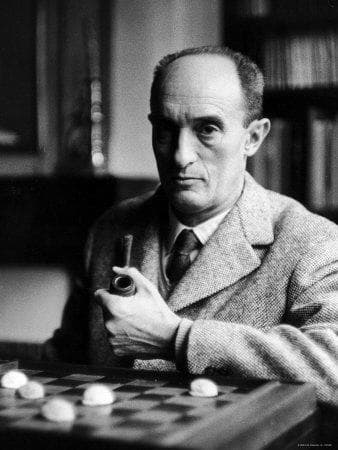
Pierre Boulle was a French author known for his contributions to fiction, particularly in the science fiction and war genres. He is best known for his novels "Planet of the Apes," which explores themes of evolution and society, and "The Bridge Over the River Kwai," which depicts the experiences of prisoners of war during World War II.
Similar books
- Brave New World
Aldous Huxley
4.0 (1.4M) average on GoodreadsFantasyExplores dystopian societies and the nature of humanity through a satirical lens.
- Animal Farm
George Orwell
4.0 (2.7M) average on GoodreadsPoliticsFeatures animals taking on human roles to satirize societal structures and power.
- Flowers for Algernon
Daniel Keyes
4.1 (478k) average on GoodreadsPsychologyDeals with the implications of intelligence and the challenges of being an 'outsider' in society.
- The Dispossessed
Ursula K. Le Guin
4.2 (88k) average on GoodreadsPoliticsLe Guin's 'The Dispossessed' offers a deeply complex and nuanced portrayal of two contrasting alien societies with intricate social structures, political ideologies, and psychologically rich characters. Boulle's ape society, while effective for its satirical purpose, is less detailed in its internal workings and its characters serve more as vehicles for the allegorical plot, lacking the same depth and internal conflict seen in Le Guin's work.
- Harry Potter and the Sorcerer's Stone
J.K. Rowling
4.5 (7M) average on GoodreadsFantasyRescued from a miserable life under the stairs, an orphaned boy discovers he's a wizard destined for a magical school, where he uncovers a dangerous secret tied to the dark wizard who murdered his parents.
- The Hunger Games
Suzanne Collins
4.3 (6.4M) average on GoodreadsFantasyIn a future where children fight to the death on live television, Katniss Everdeen volunteers for the arena, turning a death sentence into a fight for survival and a spark of rebellion.




Enjoyed the summary?
A summary gives you the shape of the book. The book itself has the detail, the examples and the voice.
Find Planet of the Apes on AmazonAs an Amazon Associate, BookBrief earns from qualifying purchases. How we're funded