
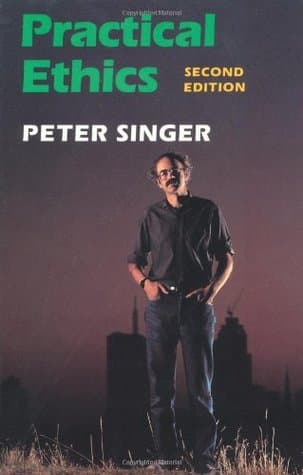
Core Idea
- Difficulty
- Medium
- Read it if
- You are interested in a rigorous, secular, and often provocative application of utilitarian ethics to real-world problems like animal rights, abortion, euthanasia, and global poverty, and are prepared to challenge your own moral intuitions.
- Skip it if
- You prefer virtue ethics, deontology, or religious ethical frameworks, or find an exclusively utilitarian approach to complex moral issues overly reductionist or emotionally cold.
Key Takeaways from Practical Ethics
The Principle of Equal Consideration
Moral worth is based on the capacity for suffering, not intelligence or species.
Singer argues that the ability to suffer or experience enjoyment is the fundamental basis for moral consideration. This idea, called the Principle of Equal Consideration of Interests, means that if two beings have similar interests (e.g., in avoiding pain), those interests should be given equal weight, regardless of their race, sex, intelligence, or species. He says that denying equal consideration based on species (speciesism) is as arbitrary and wrong as racism or sexism. This does not mean all beings are equal in all ways, but that their interests in avoiding suffering or seeking well-being should be weighed equally when those interests are comparable. This broadens the moral community and challenges human-centered biases in Western thought.
“The capacity for suffering and enjoyment is a prerequisite for having interests at all, a condition that must be satisfied before we can speak of interests in a meaningful way.”
In the book: Singer frequently draws parallels between speciesism and historical forms of discrimination like racism and sexism, arguing that the underlying logic – using an irrelevant characteristic to deny equal consideration – is identical. He points to the vast suffering inflicted upon animals in factory farming and scientific experimentation as direct violations of this principle.
Try this: When making ethical decisions, consciously identify all sentient beings whose interests might be affected. Evaluate their interests impartially, giving equal weight to similar interests regardless of species or other arbitrary distinctions. For instance, when considering dietary choices, weigh the interest of animals in avoiding suffering equally with human interests in taste or convenience.
Related ideas: speciesism, utilitarianism, sentience, equal-consideration
The Moral Status of Animals
Animals are not mere means; their suffering warrants serious ethical consideration.
Using the Principle of Equal Consideration, Singer systematically refutes common reasons for widespread animal exploitation. He states that if a being can suffer, its suffering matters morally. This challenges the Cartesian view of animals as unfeeling machines and the Judeo-Christian idea of human dominance. Singer argues that animals, especially in factory farms and research labs, experience immense and unnecessary pain. He sees modern agricultural and scientific practices as clear examples of speciesism, where human interests (often minor, like taste or curiosity) are prioritized over animals' strong interests in avoiding extreme pain and distress. He supports vegetarianism/veganism and significant changes in animal research.
“If a being suffers, there can be no moral justification for refusing to take that suffering into consideration.”
In the book: Singer details the horrific conditions in factory farms, including cramped cages, forced feeding, and painful mutilations without anesthesia (e.g., debeaking, castration). He also discusses the often-dubious benefits of animal experimentation versus the undeniable suffering inflicted.
Try this: Adopt a vegetarian or vegan diet to minimize complicity in animal suffering. Support ethical farming practices and advocate for stricter animal welfare laws. Critically evaluate the necessity and ethics of products tested on animals or derived from intensive animal agriculture.
Related ideas: animal-liberation, factory-farming, animal-rights, speciesism
Abortion and Infanticide
The moral status of a fetus or infant depends on personhood, not merely humanity.
Singer addresses the sensitive topics of abortion and infanticide by distinguishing between a 'human being' (a member of the species Homo sapiens) and a 'person' (a being capable of self-awareness, rationality, and future planning). He argues that simply being human does not automatically grant a right to life. A fetus, especially in early stages, lacks the traits of a person, so its destruction is not morally equal to killing an adult human. This view extends to severely disabled newborns who may never develop personhood. He suggests that in some tragic cases, infanticide might be morally acceptable if it prevents greater suffering for the child and family, and if no 'person' is destroyed. This is arguably the most controversial part of his work, challenging deep-seated beliefs about the value of human life.
“The potentiality principle, which confers a right to life on a fetus because it has the potential to become a person, is flawed.”
In the book: Singer contrasts the moral status of a fetus with that of a pig or chicken, arguing that a mature animal capable of suffering has a stronger claim to consideration than a non-sentient or barely sentient fetus. He also references cases of anencephalic infants or those with severe, untreatable conditions.
Try this: Engage in nuanced discussions about the start of personhood, moving beyond species membership as the sole determinant of moral status. Consider the quality of life and potential for suffering when evaluating difficult end-of-life or beginning-of-life ethical dilemmas, rather than relying solely on biological definitions.
Related ideas: personhood, sanctity-of-life, potentiality-principle, right-to-life
Euthanasia and End-of-Life Choices
Voluntary euthanasia can be ethically justified when a person's quality of life is severely diminished.
Consistent with his personhood argument, Singer supports voluntary euthanasia for individuals suffering from incurable and painful conditions who autonomously choose to end their lives. He emphasizes respect for individual autonomy and the reduction of suffering. For Singer, the idea that all human life is sacred and must be preserved at all costs is often misapplied when it leads to prolonged agony for someone who wishes to die with dignity. He also discusses non-voluntary euthanasia for individuals who are not (and never were) persons, like those in a persistent vegetative state. In such cases, the decision is based on the non-person's best interests and the impact on others. This challenges legal and religious rules that prioritize the continuation of biological life over its quality or individual choice.
“If a person chooses to die, and the choice is autonomous and informed, then respect for autonomy suggests that their wish should be granted.”
In the book: Singer cites cases of individuals suffering from terminal illnesses like advanced cancer or debilitating neurological disorders who express a clear desire to end their suffering. He also brings up the immense emotional and financial burden on families caring for individuals in persistent vegetative states.
Try this: Advocate for legal frameworks that allow for voluntary euthanasia or assisted dying under strict guidelines, ensuring informed consent and psychological evaluations. Engage in open discussions about end-of-life planning, living wills, and the right to refuse medical treatment.
Related ideas: autonomy, sanctity-of-life, quality-of-life, dignity-in-dying
The Obligation to Assist
Affluent individuals have a strong moral duty to prevent suffering in the global poor.
Singer presents one of his most compelling and challenging arguments: that people in wealthy nations have a strong moral duty to reduce suffering and poverty in developing countries. He uses the 'drowning child' analogy: if you see a child drowning in a shallow pond and can save them with little cost to yourself (e.g., getting your clothes wet), you are morally obligated to do so. He argues that distance or the presence of many other potential helpers does not lessen this duty. The implication is that much of the discretionary spending by the wealthy is morally wrong when compared to the urgent needs of those suffering from preventable diseases, starvation, and lack of basic necessities. This requires a new look at personal priorities and the ethics of consumption.
“If it is in our power to prevent something bad from happening, without thereby sacrificing anything of comparable moral importance, we ought, morally, to do it.”
In the book: The 'drowning child' thought experiment is central. He also cites statistics on preventable deaths from poverty-related causes, contrasting them with the vast sums spent on luxury goods and non-essential items in developed countries.
Try this: Donate a significant portion of discretionary income to effective charities that address global poverty and suffering. Re-evaluate personal spending habits, prioritizing essential needs and ethical investments over luxuries. Advocate for government policies that increase foreign aid and promote fair trade.
Related ideas: effective-altruism, global-poverty, famine-relief, moral-duty
Environmental Ethics
Humans are part of, not masters of, the natural world; our impact requires moral consideration.
Singer extends his utilitarian framework to environmental ethics, arguing against a human-centered view that values nature only for its usefulness to humans. While he acknowledges that non-sentient parts of the environment (like rocks or rivers) do not have interests in the same way sentient beings do, he stresses the interconnectedness of ecosystems and the great suffering that environmental destruction causes animals. He also notes that human well-being is connected to a healthy planet, giving a utilitarian reason for environmental protection even for those who do not believe in intrinsic natural value. However, he leans toward a more holistic view where the flourishing of complex ecosystems and the sentient life within them holds significant moral importance. This view challenges the short-sighted exploitation of natural resources and calls for a more sustainable and respectful relationship with the planet.
“Our concern for the environment should not be based solely on how it benefits humans, but on the intrinsic value of natural ecosystems and the suffering of sentient beings within them.”
In the book: Singer discusses the impact of pollution, deforestation, and climate change on animal populations and the broader ecosystem. He contrasts the immediate, tangible suffering of animals with the often abstract or future-oriented benefits claimed by industrial exploitation.
Try this: Reduce personal carbon footprint through sustainable consumption, energy conservation, and responsible waste management. Support policies that protect natural habitats and biodiversity. Consider the ethical implications for sentient life when making decisions about land use, resource extraction, and environmental policies.
Related ideas: anthropocentrism, deep-ecology, sustainability, biodiversity
Political Violence and Civil Disobedience
Violence is rarely justified, but civil disobedience can be a powerful ethical tool for change.
Singer applies his utilitarian perspective to the ethics of political violence and civil disobedience. He argues that violence is almost always counterproductive, leading to more suffering and often undermining its own goals. However, he acknowledges that in extreme situations, when all non-violent options have been exhausted and there is a clear, high chance of achieving a greater good while minimizing harm, violence might be reluctantly justified. Civil disobedience, on the other hand, is often a more ethically sound and effective way to challenge unjust laws or policies. By non-violently breaking laws considered immoral, activists can highlight injustices, appeal to public conscience, and pressure authorities for change. This is provided the acts are public, non-violent, and undertaken with a willingness to accept the consequences. This offers a framework for evaluating the ethical validity of protest movements.
“If violence is to be used, it must be used only as a last resort, and with a reasonable prospect of success in achieving a morally superior outcome.”
In the book: Singer analyzes historical examples of both violent revolutions and non-violent resistance, such as the Civil Rights Movement, to assess their effectiveness and moral costs. He emphasizes the unpredictable and often escalating nature of violence.
Try this: When faced with injustice, prioritize non-violent forms of protest and advocacy. If considering civil disobedience, ensure actions are public, non-violent, and strategically aimed at specific injustices. Critically evaluate the potential harm and benefit of any proposed political action, especially those involving force.
Related ideas: non-violence, social-justice, protest, utilitarian-calculus
Refugees and Immigration
Affluent nations have a moral responsibility to assist refugees, based on suffering and capacity to help.
Singer extends the duty to assist to the plight of refugees. He argues that wealthy nations, with their greater resources, have a clear moral duty to accept and help those fleeing persecution, war, or extreme poverty. Refugees often experience immense and immediate suffering, and wealthy countries have a significant capacity to alleviate this. He criticizes nationalistic or xenophobic arguments that prioritize the interests of current citizens over the desperate needs of those seeking refuge. While acknowledging practical concerns like economic impact, Singer emphasizes that these concerns rarely outweigh the moral need to prevent severe suffering and death. This challenges restrictive immigration policies and calls for a more compassionate and globally responsible approach to humanitarian crises.
“Where people are fleeing persecution or starvation, the principle of preventing suffering without comparable sacrifice applies with particular force.”
In the book: Singer highlights the dire circumstances faced by refugees – loss of home, family, livelihood, and often facing violence or starvation. He contrasts this with the relative security and abundance in potential host nations.
Try this: Advocate for more humane and generous refugee policies. Support organizations that assist refugees. Challenge xenophobic narratives and promote understanding and empathy for displaced persons. Consider sponsoring or volunteering to help refugee families integrate into new communities.
Related ideas: humanitarian-aid, global-ethics, xenophobia, asylum
The Challenge of Practical Ethics
Ethical reasoning requires consistency, impartiality, and a willingness to question deeply held beliefs.
Singer's work is not only about specific issues but also about the method of ethical reasoning. He consistently advocates for a utilitarian approach, where the morally right action produces the greatest good for the greatest number, or minimizes suffering. This requires impartiality, a willingness to consider all affected interests equally, and a rigorous application of logic, even when it leads to conclusions that are counter-intuitive or challenge deep-seated societal norms and personal biases. He stresses that ethics is not just about feelings or cultural traditions, but about building coherent, defensible arguments. The 'practical' aspect lies in applying this rigorous framework to real-world problems, showing that philosophical ethics has tangible implications for how we live and act. This makes the book a powerful call for intellectual honesty and moral courage.
“Ethics is not a matter of subjective preference, but a matter of reasoning about how we ought to live.”
In the book: Throughout the book, Singer systematically dismantles common justifications for various practices (e.g., eating meat, strict anti-abortion stances) by exposing their inconsistencies or speciesist biases, always returning to the core principle of equal consideration of interests.
Try this: Develop a consistent ethical framework for personal and public decision-making. Actively question your own biases and assumptions. Engage in reasoned debate on ethical issues, seeking to understand different perspectives while rigorously testing arguments for logical coherence and impartiality.
Related ideas: utilitarianism, impartiality, moral-reasoning, cognitive-bias
Practical Ethics Quotes
“The way to decide whether an act is wrong is to take the viewpoint of the impartial spectator, and ask whether it would be preferred by a fully informed, impartial, and rational spectator.”
“If we can prevent something bad from happening, without thereby sacrificing anything of comparable moral importance, we ought, morally, to do it.”
“The capacity for suffering and enjoyment is a prerequisite for having interests at all, a condition that must be satisfied before we can speak of interests in a meaningful way.”
“Racists violate the principle of equality by giving greater weight to the interests of members of their own race when there is a clash between their interests and the interests of those of another race. Sexists violate the principle of equality by favouring the interests of their own sex.”
“To give preference to the life of a being simply because it is a member of our species would be to commit a form of speciesism.”
“The point of view of the universe is not a mystical notion. It is simply the point of view of an impartial rational spectator.”
“A being's right to life is not based on its species, but on its capacity for conscious experience.”
“We cannot, of course, be absolutely certain that a fetus feels pain, but we can be reasonably sure that it does by the time it has developed a cerebral cortex.”
“It is not wrong to take the life of a being who, whatever its species, is incapable of experiencing pleasure or pain.”
“The ethical vegetarian is not saying that eating meat is wrong in itself. The ethical vegetarian is saying that it is wrong to cause suffering to animals for the sake of gastronomic pleasure.”
“Giving money to help strangers far away is not an act of supererogation, but a duty.”
“The greater the amount of suffering prevented, the better the outcome, other things being equal.”
“We are responsible not only for what we do but also for what we could have prevented.”
“If we reject speciesism, we must reconsider many of our practices concerning animals, especially the practice of raising and killing them for food.”
Quiz
10 questions on the main ideas. Each answer comes with a short explanation.
Question 1
Which of the following best describes Singer's foundational ethical approach as presented in 'Practical Ethics'?
- Deontological, emphasizing duties and rules regardless of consequences.
- Virtue ethics, focusing on character development and moral virtues.
- Consequentialist, specifically a form of preference utilitarianism.
- Ethical relativism, asserting that moral truths are relative to cultures.
Show answer
C. Consequentialist, specifically a form of preference utilitarianism. Singer's ethical framework in 'Practical Ethics' is largely consequentialist, particularly a form of preference utilitarianism, where the best action is the one that satisfies the most preferences.
Question 2
According to Singer, what is the primary criterion for considering a being's interests?
- The ability to reason and use language.
- Membership in the human species.
- The capacity for suffering and enjoyment (sentience).
- The ability to form complex social structures.
Show answer
C. The capacity for suffering and enjoyment (sentience). Singer argues that the capacity to suffer or experience enjoyment is the fundamental criterion for having interests that deserve equal consideration, rejecting speciesism.
Question 3
Singer's concept of 'speciesism' is most analogous to which of the following forms of discrimination?
- Classism.
- Racism or sexism.
- Ageism.
- Elitism.
Show answer
B. Racism or sexism. Singer explicitly draws parallels between speciesism and racism or sexism, arguing that both involve giving unequal consideration to interests based on an arbitrary group membership (species, race, or sex).
Question 4
In his discussion of abortion, Singer distinguishes between a 'person' and a 'human being'. What is a key characteristic Singer uses to define a 'person'?
- Possession of a soul.
- Genetic makeup of Homo sapiens.
- Self-awareness, rationality, and autonomy.
- The ability to feel pain.
Show answer
C. Self-awareness, rationality, and autonomy. Singer defines a 'person' as a being capable of self-awareness, rationality, and autonomy, which he argues is distinct from merely being a 'human being' (a member of the species Homo sapiens). This distinction is crucial for his arguments on abortion and euthanasia.
Question 5
Regarding overseas aid, Singer argues for a strong obligation to assist those in absolute poverty. Which principle underpins this argument?
- We should prevent bad things from happening if we can do so without sacrificing anything of comparable moral importance.
- Charity is a moral good, but not an obligation.
- Nations have a primary duty to their own citizens above all others.
- The free market will eventually solve global poverty, so direct intervention is unnecessary.
Show answer
A. We should prevent bad things from happening if we can do so without sacrificing anything of comparable moral importance. Singer famously argues that if we can prevent something bad from happening without sacrificing anything of comparable moral importance, we ought to do it. This principle extends to our obligation to help those in absolute poverty.
Question 6
Singer's discussion of euthanasia differentiates between 'voluntary', 'involuntary', and 'nonvoluntary' euthanasia. What distinguishes 'nonvoluntary' euthanasia?
- The patient explicitly requests to die.
- The patient is killed against their explicit wishes.
- The patient is unable to express a wish (e.g., infants, comatose individuals), and others make the decision for them.
- The patient's family decides without consulting medical professionals.
Show answer
C. The patient is unable to express a wish (e.g., infants, comatose individuals), and others make the decision for them. Nonvoluntary euthanasia applies when the being in question is unable to express a preference, such as infants or individuals in a persistent vegetative state. Decisions are then made based on their best interests by others.
Question 7
When addressing political violence, Singer suggests that civil disobedience can be justified under certain conditions. Which of the following is NOT typically a condition Singer would emphasize for the justification of civil disobedience?
- The injustice being protested is substantial and severe.
- All legal and constitutional avenues for change have been exhausted.
- The act of disobedience is likely to be effective in bringing about change.
- The disobedient act must always involve violence to demonstrate conviction.
Show answer
D. The disobedient act must always involve violence to demonstrate conviction. Singer generally advocates for non-violent civil disobedience, emphasizing effectiveness and exhaustion of other means, not a requirement for violence. His utilitarian framework would weigh the harm of violence against the potential good.
Question 8
Singer discusses the 'deep misunderstanding of, and consequent violent reaction to' his book in Germany, Austria, and Switzerland. What specific aspect of his work was primarily at the heart of this controversy?
- His arguments for vegetarianism and animal liberation.
- His advocacy for strong overseas aid obligations.
- His views on the moral status of severely disabled infants and euthanasia, perceived as reminiscent of Nazi eugenics.
- His critique of traditional religious ethics.
Show answer
C. His views on the moral status of severely disabled infants and euthanasia, perceived as reminiscent of Nazi eugenics. The appendix added to the second edition details the severe backlash, particularly in German-speaking countries, due to misinterpretations of his arguments on the moral status of severely disabled infants and euthanasia, which critics linked to historical eugenics programs.
Question 9
Singer's 'replaceability argument' in the context of animal ethics suggests that if a being lives a pleasant life and is painlessly killed, it can be replaced by another being that will also live a pleasant life, without a net loss of utility. This argument typically applies to which types of beings?
- Only beings incapable of any form of sentience.
- Self-conscious beings with a sense of future and personal identity.
- Beings that are sentient but not self-conscious (e.g., some non-human animals).
- All human beings, regardless of cognitive capacity.
Show answer
C. Beings that are sentient but not self-conscious (e.g., some non-human animals). The replaceability argument is typically applied to sentient but not self-conscious beings, as they are considered not to have a 'right to life' in the same way a self-conscious being with future-oriented preferences would. Singer does not apply it to self-conscious beings.
Question 10
When discussing environmental ethics, Singer argues that our ethical framework should extend beyond human interests. What is the main reason he gives for including non-human elements in our moral consideration?
- Only self-conscious non-human animals have moral standing.
- The suffering of sentient non-human animals and the long-term impact on human well-being are key considerations.
- He advocates for a purely ecocentric ethic where individual organisms are irrelevant.
- The environment has intrinsic value independent of any sentient experience.
Show answer
B. The suffering of sentient non-human animals and the long-term impact on human well-being are key considerations. While Singer's framework is primarily based on the interests of sentient beings, his environmental ethics emphasize the suffering of sentient non-human animals caused by environmental degradation and the long-term consequences for human well-being, consistent with his preference utilitarianism.
Practical Ethics FAQ
What is the core argument of Peter Singer's Practical Ethics?
Peter Singer's Practical Ethics applies ethical reasoning to real-world dilemmas, advocating for a consistent, utilitarian approach to moral decision-making. It examines how our actions impact others and argues for extending moral consideration beyond traditional boundaries.
Does speciesism work as a valid ethical framework according to Singer?
No, Singer argues against speciesism, defining it as a prejudice or bias in favor of members of one's own species and against those of other species. He contends that the capacity to suffer, not species membership, should be the basis for moral consideration.
What is utilitarianism, and how does Singer apply it?
Utilitarianism is an ethical theory stating that the best action is the one that maximizes overall well-being or happiness. Singer applies this by evaluating actions based on their consequences, aiming to produce the greatest good for the greatest number, often considering all sentient beings.
How does Practical Ethics differ from traditional deontological ethics?
Practical Ethics, rooted in utilitarianism, focuses on the consequences of actions to determine their morality, contrasting with deontological ethics which emphasizes duties, rules, and the inherent rightness or wrongness of actions, regardless of their outcomes.
What is Singer's stance on animal rights and their moral status?
Singer argues that animals capable of suffering deserve moral consideration equal to that of humans in relevant aspects. He advocates for ending practices that cause animal suffering, such as factory farming and certain types of animal experimentation, based on their capacity for pain.
Does Practical Ethics provide a framework for addressing global poverty?
Yes, Singer discusses our moral obligation to assist those in need, particularly in the context of global poverty. He argues that if we can prevent suffering without sacrificing anything of comparable moral importance, we are ethically bound to do so.
What are some of the controversial topics covered in the book?
The book delves into highly controversial subjects including abortion, euthanasia, embryo experimentation, the moral status of animals, political violence, and our obligations to the environment and refugees. Singer addresses these with rigorous ethical analysis.
How does Singer approach the topic of equality and discrimination?
Singer argues for the principle of equal consideration of interests, meaning that the interests of all beings should be given equal weight, regardless of race, sex, ability, or species. He critiques discrimination based on these arbitrary distinctions.
Why did Peter Singer's book face strong reactions in Germany, Austria, and Switzerland?
The book provoked significant controversy in these countries due to its discussions on euthanasia and the moral status of severely disabled infants, which were sometimes misinterpreted or deliberately misrepresented, leading to accusations and protests.
About the author
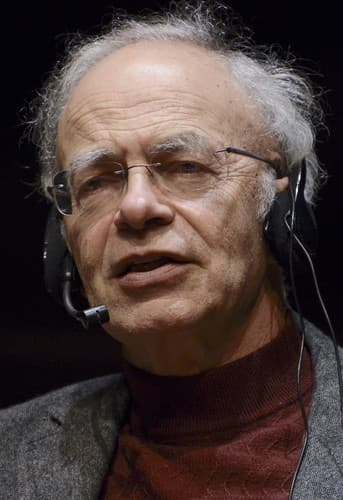
Peter Singer is an Australian philosopher known for his work in ethics and animal rights. His notable books include "Animal Liberation," which argues for the ethical treatment of animals, and "Practical Ethics," which explores various ethical dilemmas in contemporary society. Singer's writings have significantly influenced discussions on utilitarianism and moral philosophy.
Similar books
- Animal Liberation
Peter Singer
4.3 (7k) average on GoodreadsPoliticsExpands on the ethical arguments for animal rights, a core theme in 'Practical Ethics'.
- Utilitarianism
John Stuart Mill
3.7 (19k) average on GoodreadsPoliticsProvides the foundational philosophical framework upon which Singer's arguments are largely built.
- 1984
George Orwell
4.2 (3.1M) average on GoodreadsPoliticsIn a future where surveillance and thought control are absolute, a man's search for truth clashes with the Party, showing that hope can be a form of rebellion.
- Animal Farm
George Orwell
4.0 (2.7M) average on GoodreadsPoliticsA farm animals' rebellion against humans turns into a pig-led dictatorship, showing how power corrupts and revolutionary ideals are betrayed.
- Freakonomics: A Rogue Economist Explores the Hidden Side of Everything
Steven D. Levitt
4.0 (709k) average on GoodreadsBusinessThis book uses economic principles to reveal the surprising incentives behind everything from drug dealing and real estate to cheating teachers and the decline of crime.
- I Am Malala: The Story of the Girl Who Stood Up for Education and Was Shot by the Taliban
Malala Yousafzai
4.1 (419k) average on GoodreadsPoliticsA teenage girl from a Taliban-controlled valley refuses to give up her books, becoming a global voice for education even after an assassination attempt.





Enjoyed the summary?
A summary gives you the shape of the book. The book itself has the detail, the examples and the voice.
Find Practical Ethics on AmazonAs an Amazon Associate, BookBrief earns from qualifying purchases. How we're funded