
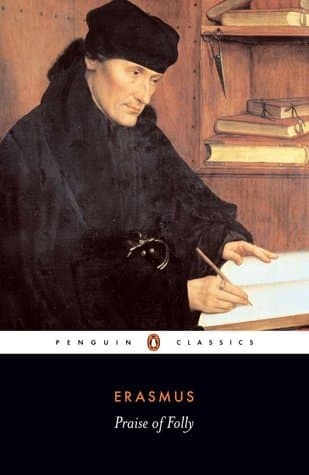
Core Idea
- Difficulty
- Medium
- Read it if
- You are interested in Renaissance satire, the history of Christian thought, or a humorous yet incisive critique of human nature and societal institutions that remains relevant today.
- Skip it if
- You prefer straightforward philosophical treatises over allegorical satire, or you are easily offended by critiques of religious and academic establishments from a historical perspective.
Key Takeaways from Praise of Folly
Folly's Grand Oration
Folly herself, as the narrator, reveals humanity's true nature.
Erasmus uses the character of Folly (Stultitia) to deliver a sharp satire on human behavior. By letting Folly speak, he creates a way to offer honest criticism under the guise of funny self-praise. Folly argues that she is the true source of all joy, pleasure, and even the structure of society, because people are often too foolish to see their own self-interest or the absurdities around them. This narrative choice is important because it allows Erasmus to criticize institutions and individuals without directly facing their anger, as the criticisms come from a 'foolish' character. It's a clever way to set up the entire work, introducing all the observations about human nature and societal structures.
“For what is there in life that is not foolish, if we will but open our eyes?”
In the book: The entire opening monologue, where Folly introduces herself and boasts about her pervasive influence on all aspects of life, from birth to governance.
Try this: When trying to deliver difficult feedback or critique, consider using a third-party perspective or a lighthearted, self-deprecating tone to make the message more palatable and less confrontational. Humor can disarm.
Related ideas: satire, persona, rhetoric, human-nature
The Ignorance of the Learned
Erasmus exposes the vanity and intellectual pretense of scholars and theologians.
Erasmus's sharpest criticisms are for the 'learned' — the philosophers, grammarians, rhetoricians, and especially the theologians of his time. Folly points out their focus on unimportant details, their academic arguments over obscure points, and their complete separation from practical wisdom or real spiritual understanding. They are shown as arrogant, self-important people who value complex, often meaningless, intellectual exercises over truth or compassion. This part highlights a timeless issue: how intellectual pursuits can become goals in themselves, leading to intellectual snobbery and an inability to connect with the real world or common sense. It's a strong criticism of academic pride.
“Among the learned, the more foolish one is, the more he is admired by the foolish.”
In the book: Folly's detailed descriptions of grammarians squabbling over minute linguistic points, philosophers constructing elaborate but useless systems, and theologians engaging in endless, often violent, debates about scholastic minutiae like how many angels can dance on the head of a pin.
Try this: Before engaging in complex discussions, ask yourself if the intellectual exercise serves a practical purpose or if it's merely an indulgence in academic showmanship. Prioritize clarity and impact over jargon and obscurity.
Related ideas: intellectualism, pedantry, scholasticism, academic-hubris
Clerical Corruption and Hypocrisy
The Church's leaders are depicted as driven by greed and power, not piety.
Erasmus, a devout Catholic, openly exposed the deep corruption within the Roman Catholic Church. Through Folly, he criticizes the clergy for their greed, their pursuit of worldly power and wealth, and their abandonment of true Christian ideals. Popes, cardinals, and bishops are shown living in luxury, more concerned with war and political maneuvering than with spiritual guidance or the well-being of their followers. Monks are mocked for their superficial piety, their endless rituals, and their focus on outward appearance instead of inner virtue. This criticism is not an attack on faith itself, but a strong request for the Church to return to its basic principles, reflecting the wider calls for reform during the Renaissance.
“The popes, cardinals, bishops, and priests, though they assume to be successors of the Apostles, yet they live as if they had no concern with the world to come.”
In the book: Folly's vivid descriptions of popes leading armies, bishops accumulating wealth, and monks debating the color of their habits while neglecting charity and prayer. She details how indulgences and relics are exploited for financial gain.
Try this: Critically examine institutions and leaders, regardless of their perceived sanctity. True leadership should be measured by actions and adherence to stated values, not by titles or outward displays of power.
Related ideas: church-reform, clericalism, hypocrisy, renaissance-critique
The Folly of Worldly Power
Kings and princes are shown to be puppets of flattery and self-delusion.
Folly also criticizes secular rulers, arguing that kings and princes are often the most deluded. They are surrounded by flatterers who reinforce their grand illusions, leading them to pursue pointless conquests, engage in expensive wars, and ignore the true well-being of their subjects. Their 'wisdom' is often just a cover for their folly, as they prioritize personal glory and power over justice and peace. Erasmus suggests that power itself encourages a detachment from reality, making rulers vulnerable to their own self-importance and the flattery of their courts. This observation remains very relevant, highlighting the dangers of unchecked authority and the damaging effect of constant praise.
“What is a king, if not a magnificent fool, surrounded by even greater fools?”
In the book: Folly's description of kings who believe they are divine, despite being weak and dependent on others, and who are easily manipulated by their advisors and courtiers for personal gain.
Try this: Be wary of environments where dissent is stifled and flattery is rewarded. Seek out diverse perspectives and constructive criticism, especially when in positions of authority, to avoid self-delusion.
Related ideas: power-dynamics, flattery, tyranny, political-satire
Happiness Through Delusion
Folly argues that much of human happiness stems from self-deception.
Folly paradoxically claims that she is the source of much human happiness. She argues that without self-delusion, comforting illusions, and a good amount of ignorance, life would be unbearable. People find joy in their hobbies, their vanity, their romantic ideals, and their belief in superstitions — all of which Folly claims as her territory. She suggests that 'wisdom,' if it meant a clear, unfiltered view of reality, would only lead to despair and inaction. This is a profound and uncomfortable truth: sometimes, a certain level of self-deception is necessary for contentment and motivation. It challenges the purely rational view of happiness, suggesting that emotional and psychological comfort often depends on moving away from strict logic.
“For what is life itself but a play of Folly?”
In the book: Folly enumerates various examples: the lover who sees only beauty in their beloved, the old man who believes himself young, the superstitious person who finds comfort in rituals, and even the artist who finds joy in their creations despite their flaws.
Try this: Recognize that while truth is important, sometimes a degree of selective focus or positive reframing can be beneficial for mental well-being. Understand the difference between harmful delusion and comforting self-encouragement.
Related ideas: happiness, self-deception, illusion, psychology
The Wisdom of 'Christian Folly'
True piety often appears foolish to the worldly, aligning with Christ's teachings.
Towards the end of her speech, Folly takes a surprising turn, aligning herself with true Christian piety. She argues that the teachings of Christ and his apostles — humility, self-sacrifice, turning the other cheek — would seem utterly foolish to the 'wise' of the world. The pursuit of spiritual salvation, the rejection of worldly goods, and the embrace of suffering for a higher purpose are all actions that go against conventional human logic. This 'Christian Folly' is presented as the highest form of wisdom, a sharp contrast to the earlier criticisms of clerical hypocrisy. Erasmus uses this to suggest that true faith often requires a radical change in values, embracing what the world considers absurd for the sake of divine truth. This is a powerful conclusion, elevating the 'foolishness' of faith above the 'wisdom' of worldly pursuits.
“For the wisdom of this world is foolishness with God.”
In the book: Folly quotes extensively from the New Testament, particularly St. Paul, highlighting passages that emphasize humility, poverty of spirit, and the rejection of worldly wisdom as paths to God.
Try this: Reflect on your core values. Are you pursuing what society deems 'wise' or what truly aligns with your deepest convictions, even if it seems unconventional or 'foolish' to others?
Related ideas: christian-humanism, piety, spirituality, paradox
The Universal Nature of Folly
No profession or social class is exempt from Folly's pervasive influence.
One striking aspect of Folly's speech is her claim to rule universally. She carefully examines every part of society — from merchants to lawyers, artists to soldiers, women to children, and even the gods themselves — showing how each group is subject to some form of folly. Merchants are driven by greed, lawyers by dishonesty, soldiers by empty glory, and lovers by irrational passion. This broad scope shows Erasmus's view that folly is not an exception but an inherent part of the human condition, an unavoidable element that shapes our decisions and interactions. It's a humbling realization that even those who believe they are wise are often just cleverly deluded.
“Everywhere I go, I find my disciples, eager to embrace my gifts.”
In the book: Folly's systematic enumeration of various professions and social types, detailing the specific follies inherent in each: the proud soldier, the self-important poet, the gossiping woman, the doting parent, etc.
Try this: Cultivate self-awareness by regularly reflecting on your own biases, irrationalities, and areas where you might be prone to self-deception. No one is immune to folly.
Related ideas: human-condition, social-critique, universalism, self-awareness
Satire as a Tool for Reform
Erasmus uses humor and irony to provoke thought and encourage change.
Erasmus's choice of satire is not just for entertainment; it is a deliberate and effective way to advocate for reform. By letting Folly speak, he can voice criticisms that would be dangerous or unwise if delivered directly. The humor disarms the reader, making them more open to uncomfortable truths. The irony creates layers of meaning, where seemingly lighthearted observations carry deep moral and theological weight. This approach reflects the humanist belief in the power of rhetoric to shape public opinion and inspire intellectual and spiritual renewal. It shows that criticism delivered with wit and charm can often have more impact than a direct attack, especially when aimed at powerful institutions.
“Who says that truth cannot be spoken in jest?”
In the book: The entire structure of the book, where Folly's seemingly innocent self-praise gradually morphs into a devastating critique of society, culminating in a defense of 'Christian Folly.' The use of classical allusions and witty turns of phrase throughout.
Try this: When seeking to influence or persuade, consider how humor and indirect communication can open minds. A light touch can sometimes achieve more than a heavy hand in challenging established norms.
Related ideas: humanism, rhetorical-strategy, irony, social-commentary
The Renaissance Spirit of Inquiry
The book embodies the era's critical examination of tradition and authority.
Written at the beginning of the 16th century, Praise of Folly is a classic product of the Renaissance. It reflects the era's growing spirit of inquiry, its critical re-evaluation of established traditions, and its questioning of unquestioned authority — particularly that of the Church and academic philosophy. Erasmus, as a leading humanist, championed a return to original sources (ad fontes), advocating for simpler, purer forms of Christianity and classical learning. The book's satirical dismantling of medieval scholasticism and corrupt religious practices signals the intellectual ferment that would soon lead to the Protestant Reformation. It shows the Renaissance's intellectual courage and its commitment to challenging the status quo for truth and progress.
“The world is changing, and old ideas must make way for new understanding.”
In the book: The direct attacks on 'old ideas' and 'old concepts' mentioned in the book's summary, and the explicit critique of scholastic theologians and their complex, often meaningless, debates, which were a hallmark of medieval thought.
Try this: Embrace a spirit of continuous inquiry and be willing to critically examine long-held beliefs and traditions. Questioning the status quo is essential for intellectual growth and societal progress.
Related ideas: renaissance, humanism, ad-fontes, intellectual-history
Enduring Relevance of Human Folly
Erasmus's observations on human nature remain timeless and universally applicable.
Despite being written over 500 years ago, Praise of Folly remains relevant today because the basic human follies Erasmus identified are timeless. Human tendencies toward vanity, greed, intellectual arrogance, self-delusion, and the pursuit of superficial power are always present, just in new forms. The criticism of institutional hypocrisy, whether religious or secular, remains very relevant. Erasmus's work acts as a constant mirror, reflecting our own absurdities and encouraging self-reflection. It reminds us that while contexts change, the core challenges of human nature and societal organization continue, making his 'laughing pamphlet' a continuously valuable source of insight into the enduring human condition.
“Though centuries pass, humanity's follies remain remarkably constant.”
In the book: The ability to easily map Erasmus's critiques of ancient and Renaissance figures onto modern politicians, celebrities, religious leaders, and academic figures, demonstrating the cyclical nature of human behavior.
Try this: Use historical texts not just as relics of the past, but as lenses through which to understand contemporary issues and human behavior. Recognize that understanding human folly is the first step towards mitigating its negative effects.
Related ideas: timelessness, human-condition, self-reflection, social-relevance
Praise of Folly Quotes
“For what is more foolish than to take delight in oneself?”
“Man's life is but a game of chance.”
“Indeed, what is this life of ours but a perpetual folly?”
“The greater the folly, the greater the pleasure.”
“For if you were to strip all things bare, and look at them truly, what would you find but mere vanity?”
“Ignorance is the mother of devotion.”
“Happy are those who know not how to be unhappy.”
“The world is nothing but a stage, and all the men and women merely players.”
“For what is there that is not full of folly, if we look at it with the eyes of reason?”
“Who could live without those sweet flatteries and illusions?”
“Priests, who are so ignorant that they can only read but not understand.”
“The greatest part of mankind are fools.”
“For to be wise in one's own conceit is the greatest of follies.”
“The very gods themselves are not without their follies.”
Quiz
10 questions on the main ideas. Each answer comes with a short explanation.
Question 1
Who is the primary narrator and speaker throughout 'Praise of Folly'?
- Erasmus himself
- A wise philosopher
- Folly personified
- A Roman Emperor
Show answer
C. Folly personified The entire essay is delivered as a speech by Folly, personified as a goddess, who praises her own influence on humanity.
Question 2
According to the description, what is one of the main targets of Folly's satire in the initial, lighter section of the work?
- The wisdom of ancient Greek philosophers
- The benefits of rational thought
- Human superstition and ignorance
- The beauty of Renaissance art
Show answer
C. Human superstition and ignorance The text states 'O Elogio da Loucura... é um panfleto risonho contra o que ele tinha como os males da humanidade- a superstição, o fanatismo, a ignorância'.
Question 3
Which historical period is mentioned as influencing the 'desmoronava' (crumbling) world that 'Praise of Folly' strikes against?
- The Enlightenment
- The Middle Ages
- The Renaissance
- The Roman Empire
Show answer
C. The Renaissance The description explicitly states the work was 'abalado pelo vento do Renascimento' (shaken by the wind of the Renaissance).
Question 4
As the essay progresses, the tone shifts from satirical to what other characteristic, particularly in its critique of the Catholic Church?
- Purely humorous and lighthearted
- More somber and critical
- Increasingly self-congratulatory
- Focused solely on political commentary
Show answer
B. More somber and critical The text notes, 'começa com um aspecto satírico para depois tomar um aspecto mais sombrio, numa série de orações, já que a loucura aprecia a auto-depreciação, e passa então a uma apreciação satírica dos abusos supersticiosos da doutrina católica'.
Question 5
What specific aspect of the Catholic Church does Folly criticize through satire?
- The architectural style of cathedrals
- The use of Latin in services
- Superstitious abuses of doctrine and corrupt practices
- The monastic vows of poverty and chastity
Show answer
C. Superstitious abuses of doctrine and corrupt practices The description states Folly 'passa então a uma apreciação satírica dos abusos supersticiosos da doutrina católica e das supostas práticas corruptas da Igreja Católica Romana'.
Question 6
What is the ultimate purpose of 'Praise of Folly' as described in the provided text?
- To endorse the prevalent superstitions of the time
- To celebrate the power of the Church without critique
- To deliver a 'coup de grâce' to old ideas and concepts
- To provide a historical account of 16th-century Europe
Show answer
C. To deliver a 'coup de grâce' to old ideas and concepts The text characterizes the work as 'o golpe de misericórdia assestado nas velhas idéias, nos velhos conceitos, no mundo que se desmoronava'.
Question 7
The essay concludes with a 'clear and sometimes emotional testament' to what ideals?
- Pagan Roman virtues
- Atheistic humanism
- Christian ideals
- Secular political reforms
Show answer
C. Christian ideals The description states, 'O ensaio termina com um testamento claro e por vezes emocionante dos ideais cristãos'.
Question 8
Considering Folly's appreciation for 'auto-depreciação' (self-depreciation), how does this rhetorical device serve Erasmus's broader satirical aims?
- It allows Folly to appear genuinely humble and avoid criticism.
- It subtly critiques the vanity of those who believe themselves wise, by having Folly mock herself.
- It is a literal endorsement of self-pity as a virtue.
- It distracts the reader from the true targets of the satire.
Show answer
B. It subtly critiques the vanity of those who believe themselves wise, by having Folly mock herself. By having Folly, the embodiment of human irrationality and imperfection, engage in self-depreciation, Erasmus can ironically highlight the flaws of those who take themselves too seriously, including the 'wise' and powerful, thus making his critique more palatable and incisive.
Question 9
How does Erasmus's choice of Folly as a narrator contribute to the effectiveness of his critique against 'false and grotesque science'?
- Folly's ignorance makes her an unreliable narrator, thus discrediting all scientific inquiry.
- By praising 'grotesque science,' Folly ironically exposes its absurdity and lack of true wisdom.
- Folly is depicted as a leading scholar of her time, lending authority to her scientific observations.
- She advocates for a new, empirical approach to science, contrasting with the old methods.
Show answer
B. By praising 'grotesque science,' Folly ironically exposes its absurdity and lack of true wisdom. Folly's praise is inherently ironic. When she lauds 'false and grotesque science,' she is, in effect, highlighting its flaws and irrationality by presenting it as something admirable through her deluded perspective, thereby allowing Erasmus to criticize it without directly attacking it in his own voice.
Question 10
The description mentions 'Praise of Folly' was written 'no começo do século XVI'. What does this historical context imply about its immediate impact or reception, given its critical nature?
- It was likely ignored due to the lack of widespread literacy at the time.
- It would have been immediately embraced by the Catholic Church as a call for internal reform.
- It contributed to the intellectual ferment preceding or accompanying the Protestant Reformation, challenging established norms.
- Its critiques were considered entirely novel and had no precedents in European thought.
Show answer
C. It contributed to the intellectual ferment preceding or accompanying the Protestant Reformation, challenging established norms. The early 16th century was a period of significant religious and intellectual upheaval, leading up to and including the Protestant Reformation. A work satirizing superstition, corruption in the Church, and old ideas would have resonated with and contributed to the critical spirit of the era, challenging the status quo and preparing the ground for broader reforms.
Praise of Folly FAQ
What is 'Praise of Folly' about?
'Praise of Folly' is a satirical essay by Erasmus that critiques the follies and abuses of humanity, including superstition, fanaticism, ignorance, and the corruption within the Catholic Church, ultimately advocating for genuine Christian ideals.
When was 'Praise of Folly' written?
This influential work was written at the beginning of the 16th century, specifically in 1509, during the dawn of the Renaissance.
Does 'Praise of Folly' criticize the Catholic Church?
Yes, a significant portion of the book is dedicated to a satirical appreciation of the superstitious abuses of Catholic doctrine and the perceived corrupt practices of the Roman Catholic Church.
What is the role of 'Folly' as a character in the book?
Folly herself is the narrator of the essay, delivering a speech in praise of her own virtues and influence, which allows Erasmus to satirize various aspects of society and human behavior through her perspective.
How does 'Praise of Folly' differ from other Renaissance satires?
While sharing common satirical elements, Erasmus's work distinguishes itself by using a personified Folly as the orator and by its profound yet humorous critique of both secular and religious institutions, culminating in a clear exposition of Christian ideals, rather than just mere mockery.
Is 'Praise of Folly' still relevant today?
Many readers find 'Praise of Folly' highly relevant today due to its timeless critique of human nature, hypocrisy, and institutional corruption, making its observations applicable across different eras and societies.
What is the central message of 'Praise of Folly'?
The central message evolves from biting satire to a serious call for a return to true Christian piety and sincere faith, contrasting it with the superficiality, ignorance, and corruption that Erasmus observed in his time.
How does Erasmus use humor in 'Praise of Folly'?
Erasmus employs irony, wit, and paradox throughout the book, allowing the character of Folly to praise vices and absurdities, thereby subtly exposing them and making his criticisms more palatable and memorable.
About the author

Erasmus was a Dutch philosopher and theologian of the Renaissance era, known for his critical approach to religion and society. His notable work, "Praise of Folly," offers a satirical critique of various aspects of society and the Church, highlighting the need for reform. Erasmus's writings significantly influenced the development of humanist thought in Europe.
Similar books
- Utopia
Thomas More
3.5 (59k) average on GoodreadsPoliticsA contemporary Renaissance satire that critiques society through an imagined ideal world.
- Gargantua and Pantagruel
François Rabelais
3.7 (14k) average on GoodreadsFantasyA sprawling, satirical Renaissance work that uses humor and exaggeration to comment on society, religion, and education.
- The Diary of a Young Girl
Anne Frank
4.2 (2.7M) average on GoodreadsBiographyDuring the Nazi occupation, a teenage girl's diary, written from a secret annex, shares observations on humanity, hope, and the wait for freedom.
- Night
Elie Wiesel
4.3 (970k) average on GoodreadsBiographyIn the darkness of Auschwitz and Buchenwald, a teenage Elie Wiesel faces the extermination of his family, the loss of his faith, and the lasting scars of humanity's deepest cruelty.
- Steve Jobs
Walter Isaacson
4.1 (957k) average on GoodreadsBusinessSteve Jobs was a visionary who fused creativity and technology to revolutionize six industries and shape our digital world.
- Unbroken: A World War II Story of Survival, Resilience and Redemption
Laura Hillenbrand
4.4 (767k) average on GoodreadsBiographyLouis Zamperini's incredible World War II odyssey transforms him from a rebellious youth and Olympic runner into a survivor of a plane crash, shark-infested waters, and brutal Japanese POW camps, only to find redemption through forgiveness.





Enjoyed the summary?
A summary gives you the shape of the book. The book itself has the detail, the examples and the voice.
Find Praise of Folly on AmazonAs an Amazon Associate, BookBrief earns from qualifying purchases. How we're funded