
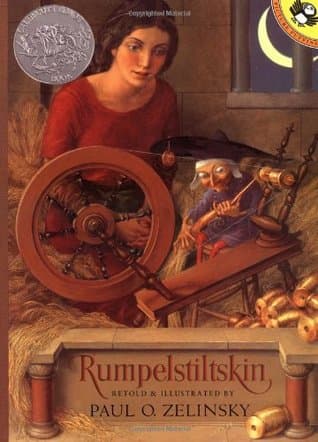
Synopsis
Covers the whole plot, including the ending.
- Difficulty
- Easy
- Pacing
- Moderate
- Mood
- Mysterious, Classic, Whimsical, Suspenseful
- Read it if
- You enjoy classic fairy tales with beautiful illustrations and a touch of magic and suspense.
- Skip it if
- You prefer modern narratives with complex character development over traditional, moralistic fables.
Rumpelstiltskin Plot Summary
Covers the whole plot, including the ending.
The Miller's Boast and the King's Demand
A miller, wanting to impress a powerful king, falsely claims his daughter, Lisa, can spin straw into gold. The king, who loves wealth, calls the girl to his castle. He takes her to a large room full of straw, gives her a spinning wheel, and says if she does not spin all the straw into gold by morning, she will die. Lisa, who has no such skill, is left alone, scared and sad, knowing her father's lie has put her life in danger.
The First Bargain with the Strange Little Man
As Lisa cries in the straw-filled room, a small, strange man appears. He asks why she is crying, and she tells him her impossible problem. The man offers to spin the straw into gold for her, but wants payment. Having nothing else, Lisa gives him her pearl necklace. The man then sits at the spinning wheel and spins all the straw into shiny gold thread by morning. When the king arrives, he is surprised and happy, but his desire for wealth grows, making him demand more.
A Second Room and a Second Bargain
The king, seeing the success of the first night, is not happy. He takes Lisa to a bigger room, filled with a lot of straw, and threatens her with death if she does not spin it all into gold by morning. Again, Lisa is left alone, overwhelmed by the impossible job. The strange man appears again, offering his help. This time, Lisa gives him her ring, which he takes. He spins all the straw into gold again, making the king happier and Lisa safe from immediate danger for a while.
The Ultimate Demand and the Ultimate Price
Still not happy, the king takes Lisa to a third, even grander room, filled with a huge amount of straw. He promises her that if she can spin all this straw into gold, he will marry her and make her queen. If she fails, she will die. The man appears a third time. Lisa, having no more jewelry to offer, is very upset. The man then suggests a scary deal: if she agrees to give him her first child when she becomes queen, he will spin the straw into gold. Desperate and seeing no other choice, Lisa agrees to the terrible condition.
The Royal Wedding and the Birth of a Child
The man spins the large pile of straw into gold, filling the room with wealth. The king, very happy with the money, keeps his promise and marries Lisa, making her his queen. Life as queen is good at first, and the scary deal with the man fades from her memory among the luxury of her new life. Time passes, and the queen has her first child, a baby boy, bringing happiness to her royal life and the kingdom.
The Little Man's Return and the Queen's Despair
One day, soon after her son's birth, the strange man suddenly appears in the queen's room. He calmly reminds her of their deal: her first child for his help in spinning straw into gold. The queen, who had forgotten the promise, is shocked and upset. She pleads with him, offering all the kingdom's riches, but the man does not change his mind. He says a living thing is more valuable to him than all treasures and gets ready to take her baby.
A Second Chance: Guessing the Name
Seeing the queen's deep sadness and tears, the man, perhaps feeling some pity, gives her a small chance to keep her child. He tells her that if she can guess his name within three days, she can keep her baby. If she fails, he will take the child. The queen, with new hope, agrees to the challenge. She immediately sends messengers throughout the kingdom to find every name they can.
The Search for Names and Failed Attempts
The queen's messengers return with many names, both common and unusual. For the first two days, the queen tries every name she knows and every name her messengers brought her. She tries names like John and Peter, and more unique ones like Caspar and Melchior. Each time, the man appears, listens to her guesses, and with a smirk, says she is wrong. The queen grows more desperate as the deadline gets closer and her son's future is uncertain.
The Messenger's Discovery
On the evening of the second day, one of the queen's messengers, having gone far into the woods looking for more names, finds a small, hidden hut. Looking inside, he sees the same strange man dancing wildly around a fire. To the messenger's surprise, the man is singing a happy song, revealing his name: "Tomorrow I brew, today I bake, and then the baby I will take. For little does my lady dream that Rumpelstiltskin is my name!" The messenger rushes back to the castle to tell the queen what he found.
The Revelation and Rumpelstiltskin's Rage
On the third and final day, when the man appears to claim the baby, the queen first tries a few more wrong names to build suspense. Then, with a confident smile, she asks, "Is your name Rumpelstiltskin?" The man is very angry. His face turns red, he stomps his foot so hard it goes deep into the floor, and in his rage, he tears himself in two. With a final, angry scream, Rumpelstiltskin disappears forever, freeing the queen and her child from his terrible deal.
Principal Figures
Lisa (The Miller's Daughter / The Queen)
Protagonist
A beautiful, innocent girl forced into an impossible situation, who becomes queen.
Lisa is initially portrayed as a simple, innocent, and beautiful miller's daughter. She is thrust into an impossible predicament due to her father's foolish boast and is consumed by fear and despair when faced with the king's demands. Despite her initial helplessness, she demonstrates a desperate will to survive, leading her to make the fateful bargains with the little man. As queen, she experiences joy but also profound terror and guilt over her forgotten promise. Her love for her child ultimately drives her to cleverness and determination to save him.
Relationships: The Miller (Father, whose boast endangers her); The King (Husband, initially a demanding ruler, later her unknowing benefactor); Rumpelstiltskin (Magical helper and antagonist, who holds her to a terrible bargain); Her Baby (Son, whose life she fights to protect)
Rumpelstiltskin
Antagonist
A mysterious, magical, and malevolent little man who helps Lisa for a price.
Rumpelstiltskin is a strange, diminutive, and powerful magical being. He is cunning, opportunistic, and takes pleasure in the desperation of others. While he provides an invaluable service by spinning straw into gold, his motivations are entirely self-serving, culminating in his demand for Lisa's firstborn child. He is prideful, easily angered when outsmarted, and his unique name is his greatest secret and his ultimate vulnerability. His actions are the driving force behind the central conflict of the story.
Relationships: Lisa (His bargainer and eventual adversary); Her Baby (His desired prize)
The King
Supporting
A greedy and powerful ruler obsessed with gold.
The King is a figure of immense power and insatiable greed. He is easily swayed by promises of wealth and shows little regard for human life, threatening Lisa with death multiple times. He marries Lisa solely for the gold she seemingly produces, indicating a transactional view of relationships. He is ultimately unaware of the magical means by which his wealth is acquired or the terrible bargain his queen made, making him a catalyst for the plot but not a central player in the moral dilemma.
Relationships: Lisa (Wife, married for her perceived ability to produce gold); The Miller (Subject, whose boast he exploits)
The Miller
Supporting
Lisa's father, whose boast sets the entire plot in motion.
The Miller is a proud and foolish man who, out of a desire for status or to impress the king, makes a reckless and false boast about his daughter's abilities. His lie places Lisa in mortal danger, demonstrating his lack of foresight and responsibility. He disappears from the narrative once Lisa is taken to the castle, having served his purpose as the initial instigator of the conflict. He represents the dangers of vanity and exaggeration.
Relationships: Lisa (Daughter, whom he imperils with his lie); The King (Ruler he seeks to impress)
The Messenger
Supporting
A loyal servant who accidentally discovers Rumpelstiltskin's name.
This unnamed messenger is a crucial supporting character who, through sheer luck and diligence, uncovers the secret that saves the queen's child. He is depicted as a dutiful servant, sent out by the queen to find names, and his chance encounter with Rumpelstiltskin's hut in the woods is the turning point of the story. His discovery highlights the theme of fate and the unexpected ways solutions can arise.
Relationships: Lisa (Loyal servant to the Queen)
Themes & Insights
The Peril of Lies and Boasting
The miller's lie about his daughter's ability to spin straw into gold starts the story. This lie puts Lisa in a dangerous situation, showing how simple exaggerations can have bad results. The king's greed, caused by this lie, then increases the demands, showing how one lie can lead to bigger problems. The queen's later secret deal with Rumpelstiltskin happens because she tries to keep the first lie going.
“One day it happened that the miller was talking with the king, and to make himself seem important, he said, 'I have a daughter who can spin straw into gold.'”
The Price of Desperation and Bargains
Lisa's desperate situation, facing death from the king, makes her make more and more dangerous deals with Rumpelstiltskin. At first, she trades items (a necklace, a ring), but as the danger grows, her desperation leads her to promise her first child. This idea looks at the moral compromises people make under great pressure and the lasting, often forgotten, results of such agreements. The story warns about the real cost of making deals when you are most vulnerable.
“When the little man asked, 'What will you give me then, if I spin it for you?' she had nothing left but her firstborn child, and in her desperation, she promised it to him.”
The Power of a Name and Identity
Rumpelstiltskin's name is his most protected secret and his main source of power and weakness. Knowing his name gives the queen power over him, letting her break the terrible deal. This shows the old belief in the special meaning of true names, connecting identity to control. By saying his name when he is proud, Rumpelstiltskin accidentally gives the queen the way to defeat him. This shows how even the most powerful can be brought down by a small piece of information.
“Tomorrow I brew, today I bake, and then the baby I will take. For little does my lady dream that Rumpelstiltskin is my name!”
Greed and Its Consequences
The king's great desire for gold is a main opposing force in the story. He constantly demands more gold, increasing the danger for Lisa, and only marries her because he thinks she can make wealth. His obsession blinds him to the human cost of his demands and stops him from seeing the magic at work. This idea shows how uncontrolled greed can lead to exploitation and suffering, pushing characters to desperate acts to satisfy it.
“But the king's greed only grew, and the next morning he led her to an even larger room filled with straw.”
Plot Devices & Literary Techniques
The Rule of Three
A classic fairy tale structure that builds tension and signifies completion.
The 'Rule of Three' is prominently used throughout the story, enhancing its narrative rhythm and escalating tension. Lisa is presented with three rooms of straw, each progressively larger, and is given three days to guess Rumpelstiltskin's name. This repetition with variation builds suspense, emphasizes the growing stakes, and provides a clear structural progression towards the climax. It's a common device in folklore, making the story feel familiar and satisfying as the final attempt or challenge is met.
The Magical Helper / Imp
A supernatural being who offers aid for a sinister price.
Rumpelstiltskin embodies the archetype of the magical helper, but with a malevolent twist. He possesses extraordinary abilities (spinning straw into gold) that are beyond human reach, offering a solution to an impossible problem. However, his assistance always comes with a steep, often hidden, price. This device introduces a supernatural element and creates the central conflict, as the protagonist becomes indebted to a powerful, unpredictable force. He represents both a solution and a new, greater threat.
Foreshadowing (The Bargain)
An early agreement that hints at future conflict and consequences.
The bargain for the firstborn child serves as significant foreshadowing. While Lisa makes the promise in a moment of extreme desperation and later forgets it, the reader is aware of the terrible consequence looming over her future. This creates dramatic irony and suspense, as the audience anticipates the little man's inevitable return to claim his prize, making the queen's later distress more poignant and the eventual resolution more impactful.
The Riddle/Name Game
A classic motif where a secret name holds power and offers a chance at freedom.
The guessing of Rumpelstiltskin's name is a central plot device, rooted in ancient folklore's belief in the power of names. It transforms the queen's struggle from a physical impossibility (spinning gold) into an intellectual challenge. The riddle-like nature of the task creates a race against time and highlights the antagonist's vulnerability. It provides a clever, non-violent means for the protagonist to defeat a powerful magical entity, emphasizing wit over strength.
Rumpelstiltskin Quotes
“What will you give me if I spin this straw into gold for you?”
“I have nothing to give you.”
“Then promise me your firstborn child.”
“The queen was in despair and thought of all the things she had promised.”
“I will give you three days to guess my name. If you cannot, the child is mine.”
“Is your name Conrad? No. Is your name Harry? No.”
“The little man danced about the fire, singing, 'Tonight I bake, tomorrow I brew, the next I'll have the young queen's child.'”
“Is your name Rumpelstiltskin?”
“The devil told you that! The devil told you that!”
“He stamped his right foot so hard that it went into the ground up to his waist.”
“Then he took hold of his left foot with both hands and tore himself in two.”
“The miller's daughter became queen, and she and the king lived happily ever after.”
Quiz
10 questions on the plot and the characters. Each answer comes with a short explanation.
Question 1
What does the miller's daughter promise Rumpelstiltskin in exchange for his help spinning straw into gold?
- Her firstborn child
- All the gold he can carry
- Her father's mill
- A royal title
Show answer
A. Her firstborn child In Paul O. Zelinsky's retelling, the miller's daughter desperately promises her firstborn child to Rumpelstiltskin when he offers to spin straw into gold for her, as she has nothing else of value to offer.
Question 2
Why does the king initially lock the miller's daughter in a room with straw?
- To test her honesty about her spinning abilities
- To punish her for lying
- To protect her from Rumpelstiltskin
- To teach her how to spin gold
Show answer
A. To test her honesty about her spinning abilities The king locks her in the room because her father, the miller, boasts that she can spin straw into gold. The king wants to see if this claim is true, testing her abilities.
Question 3
What does Rumpelstiltskin demand from the queen when he returns to claim her child?
- That she guess his name within three days
- That she spin more gold for him
- That she give him half the kingdom
- That she marry him
Show answer
A. That she guess his name within three days When the queen (formerly the miller's daughter) begs to keep her child, Rumpelstiltskin gives her a chance: if she can guess his name within three days, she can keep the baby.
Question 4
How does the queen learn Rumpelstiltskin's name?
- A messenger overhears him singing it in the woods
- Her father tells her after remembering it
- The king discovers it in an old book
- Rumpelstiltskin reveals it in a dream
Show answer
A. A messenger overhears him singing it in the woods In Zelinsky's version, the queen sends a messenger to search for names, and he overhears Rumpelstiltskin singing a song that reveals his name while dancing around a fire in the woods.
Question 5
What is a key theme emphasized in Paul O. Zelinsky's retelling of 'Rumpelstiltskin'?
- The power of names and identity
- The importance of wealth over family
- The dangers of trusting strangers
- The value of hard work in spinning
Show answer
A. The power of names and identity Zelinsky's retelling, like many versions, highlights themes of names and identity, as knowing Rumpelstiltskin's name gives the queen power over him and saves her child.
Question 6
In Zelinsky's illustrations, how are the scenes with Rumpelstiltskin often depicted to enhance the story's mood?
- With dark, shadowy tones to create mystery
- In bright, cheerful colors to show happiness
- Using only black and white for simplicity
- With abstract shapes to confuse the reader
Show answer
A. With dark, shadowy tones to create mystery Zelinsky's oil paintings use rich, dark hues and shadows in scenes with Rumpelstiltskin to amplify the story's mysterious and eerie atmosphere, complementing the text.
Question 7
What does the miller's boast about his daughter ultimately lead to?
- Her being forced into a dangerous situation with the king
- Her becoming a famous spinner in the village
- Rumpelstiltskin rewarding the miller with gold
- The king imprisoning the miller for lying
Show answer
A. Her being forced into a dangerous situation with the king The miller's false claim that his daughter can spin straw into gold puts her in peril, as the king locks her up to test this ability, setting the main plot in motion.
Question 8
How does Rumpelstiltskin react when the queen correctly guesses his name?
- He becomes enraged and tears himself in two
- He calmly accepts defeat and leaves forever
- He congratulates her and offers more help
- He transforms into a golden statue
Show answer
A. He becomes enraged and tears himself in two In Zelinsky's and many traditional retellings, Rumpelstiltskin flies into a rage upon hearing his name guessed correctly, and in his fury, he tears himself apart, disappearing from the story.
Question 9
What role does creativity play in Paul O. Zelinsky's version of 'Rumpelstiltskin', as suggested by the book's description?
- It is showcased through both the storytelling and the artistic illustrations
- It is only important in the spinning of gold
- It is downplayed to focus on moral lessons
- It is used to modernize the setting of the story
Show answer
A. It is showcased through both the storytelling and the artistic illustrations The description notes Zelinsky's 'smooth retelling and glowing pictures,' indicating that creativity is central to both the narrative style and the oil paintings, enriching this classic tale.
Question 10
According to the New York Times Book Review quote in the description, why might adults appreciate Zelinsky's 'Rumpelstiltskin'?
- Because it offers depth for reinterpretation upon rereading
- Because it simplifies the story for children
- Because it includes modern political themes
- Because it has longer text than other versions
Show answer
A. Because it offers depth for reinterpretation upon rereading The review states that 'like most classic fairy tales, this one rewards periodic rethinking,' suggesting adults can find new insights and meanings with each reading, adding to its appeal.
Rumpelstiltskin FAQ
What is 'Rumpelstiltskin' by Paul O. Zelinsky about?
The story follows a miller's daughter who is forced by the king to spin straw into gold or face death. A mysterious little man named Rumpelstiltskin helps her in exchange for her necklace, ring, and eventually her firstborn child, leading to a dramatic confrontation where she must guess his name to break the bargain.
Why should I read Paul O. Zelinsky's version of 'Rumpelstiltskin'?
Zelinsky's retelling is praised for its graceful simplicity and stunning oil paintings that enrich the classic tale. It appeals to children with its familiar mystery while offering adults deeper themes to ponder, such as the consequences of promises and the power of names.
What is the background/setting of 'Rumpelstiltskin'?
The story is set in a medieval European kingdom, depicted through Zelinsky's richly detailed illustrations that evoke a fairy-tale atmosphere. The miller's cottage, the king's castle with its straw-filled rooms, and the forest where Rumpelstiltskin dwells are key locations that enhance the magical yet perilous world.
What are the most memorable quotes from the book?
Key lines include Rumpelstiltskin's chant, 'Today I bake, tomorrow I brew, the next I'll have the young queen's child,' and the miller's boast, 'My daughter can spin straw into gold,' which sets the plot in motion. These quotes highlight the tale's rhythmic language and pivotal moments.
What writing style does Paul O. Zelinsky use in this retelling?
Zelinsky employs a straightforward, elegant narrative style that stays true to traditional fairy-tale rhythms, making it accessible for children. His prose is complemented by lush, oil-painted illustrations that add visual depth and emotional resonance to the story.
What minor details in the illustrations add significant meaning?
In Zelinsky's paintings, subtle details like the changing expressions on the miller's daughter's face—from fear to desperation to relief—convey her emotional journey. The depiction of Rumpelstiltskin's isolated hut and quirky demeanor hints at his loneliness and otherworldly nature.
What are some subtle foreshadowing moments in the story?
Rumpelstiltskin's insistence on taking the miller's daughter's firstborn child foreshadows the climax, while his cryptic rhymes and secretive behavior hint at the importance of names. The king's greed for gold early on sets up the high stakes that drive the plot.
What unexpected character connections exist in the tale?
The miller's boast connects him indirectly to Rumpelstiltskin's interventions, while the messenger who overhears Rumpelstiltskin's name chant becomes a crucial link in helping the queen. These connections emphasize how seemingly minor characters impact the central conflict.
What are the unspoken motivations of the miller's daughter?
Beyond survival, she is driven by a desire to protect her future child and secure her position as queen, showing maternal instinct and resilience. Her willingness to bargain with Rumpelstiltskin stems from fear but evolves into strategic cunning as she seeks to outsmart him.
What psychological complexities does Rumpelstiltskin exhibit?
Rumpelstiltskin displays a mix of helpfulness and malevolence; he aids the miller's daughter but demands steep prices, suggesting a deep-seated need for recognition or companionship. His rage when his name is revealed hints at a fragile ego tied to his hidden identity.
What are the major emotional turning points in the story?
Key moments include the miller's daughter's initial terror when tasked with spinning gold, her relief when Rumpelstiltskin helps, her despair upon promising her child, and her triumphant joy when she guesses his name. These shifts highlight her growth from victim to empowered figure.
How does the relationship between the miller's daughter and Rumpelstiltskin evolve?
It begins as a transactional alliance based on desperation, with Rumpelstiltskin as a savior. It turns adversarial when he claims her child, culminating in a battle of wits where she defeats him by uncovering his secret, shifting the power dynamic entirely.
Which parts of the story remain ambiguous or open-ended?
The origin and true nature of Rumpelstiltskin are left mysterious—whether he is a magical being, a trickster, or something else. The fate of the king, who benefits from the gold without facing consequences, is also not addressed, leaving room for interpretation.
What are controversial scenes or decisions in 'Rumpelstiltskin'?
The miller's decision to boast about his daughter's false ability puts her in grave danger, raising questions about parental responsibility. Rumpelstiltskin's demand for a firstborn child as payment is often debated for its ethical implications in a children's story.
'Rumpelstiltskin' ending explained: how it ends & what it means
The story ends with the miller's daughter, now queen, guessing Rumpelstiltskin's name, causing him to tear himself apart in rage. This symbolizes the power of knowledge and identity over magical bargains, with the queen securing her child's safety and her own autonomy.
About the author

Paul O. Zelinsky is an American author and illustrator known for his work in children's literature. He is recognized for his beautifully illustrated adaptations of classic fairy tales, including "Rumpelstiltskin" and "Rapunzel." Zelinsky's contributions to the genre have earned him significant recognition, including the Caldecott Medal for his illustrations.
Similar books
- Harry Potter and the Sorcerer's Stone
J.K. Rowling
4.5 (7M) average on GoodreadsFantasyRescued from a miserable life under the stairs, an orphaned boy discovers he's a wizard destined for a magical school, where he uncovers a dangerous secret tied to the dark wizard who murdered his parents.
- The Hunger Games
Suzanne Collins
4.3 (6.4M) average on GoodreadsFantasyIn a future where children fight to the death on live television, Katniss Everdeen volunteers for the arena, turning a death sentence into a fight for survival and a spark of rebellion.
- 1984
George Orwell
4.2 (3.1M) average on GoodreadsPoliticsIn a future where surveillance and thought control are absolute, a man's search for truth clashes with the Party, showing that hope can be a form of rebellion.
- Divergent
Veronica Roth
4.2 (2.9M) average on GoodreadsFantasyIn a society divided by virtues, a sixteen-year-old's difference from the norm starts a rebellion that threatens her world.
- The Hobbit, or There and Back Again
J.R.R. Tolkien
4.3 (2.9M) average on GoodreadsFantasyA comfort-loving hobbit named Bilbo Baggins is whisked away by a mischievous wizard and a band of dwarves on an unexpected journey to reclaim stolen treasure from a fearsome dragon, discovering courage and a magical ring along the way.
- Animal Farm
George Orwell
4.0 (2.7M) average on GoodreadsPoliticsA farm animals' rebellion against humans turns into a pig-led dictatorship, showing how power corrupts and revolutionary ideals are betrayed.






Enjoyed the summary?
A summary gives you the shape of the book. The book itself has the detail, the examples and the voice.
Find Rumpelstiltskin on AmazonAs an Amazon Associate, BookBrief earns from qualifying purchases. How we're funded