
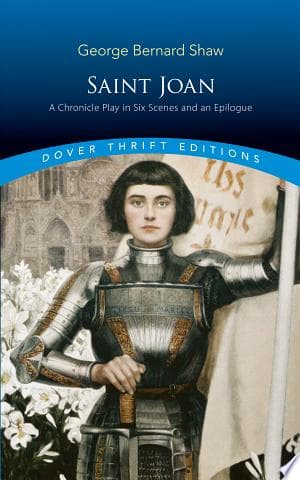
Synopsis
Covers the whole plot, including the ending.
- Difficulty
- Medium
- Pacing
- Moderate
- Mood
- Thought-provoking, Dramatic, Historical, Challenging
- Read it if
- You enjoy historical dramas that blend sharp political commentary with spiritual themes, or are interested in a unique, humanizing portrayal of Joan of Arc.
- Skip it if
- You prefer fast-paced action over philosophical dialogue and historical debate, or are looking for a purely devotional or traditional depiction of Joan.
Saint Joan Plot Summary
Covers the whole plot, including the ending.
Scene 1: Robert de Baudricourt's Castle
The play opens at Vaucouleurs, in Robert de Baudricourt's castle. Robert is frustrated by his servants' incompetence and France's war against England. Joan, a young peasant girl, arrives and insists that God has commanded her to lead the French army and crown the Dauphin, Charles VII, at Reims. Despite initial disbelief and mockery from Robert and his steward, Joan's unwavering conviction, combined with her ability to predict events and influence others, eventually sways Robert. He is astonished when his hens begin laying again after Joan's arrival, and his soldiers are suddenly willing to follow her. He reluctantly agrees to provide her with a horse, armor, and an escort to Chinon to meet the Dauphin.
Scene 2: Chinon Castle
At Chinon, the Dauphin, Charles VII, is weak, indecisive, and cowardly. He is surrounded by advisors like the Archbishop of Reims, Lord de La Trémouille, and Gilles de Rais (Bluebeard), who are more interested in court intrigue and personal gain than in fighting the English. When Joan arrives, Charles tries to test her by hiding among his courtiers. However, Joan immediately identifies him, claiming divine guidance. She convinces him and his council that she is sent by God to drive out the English and crown him at Reims. Her sincerity and passion, along with a private conversation where she seemingly reveals a secret known only to Charles, win him over, and she is given command of the army.
Scene 3: Orleans Battlefield
The scene shifts to the English camp near Orleans, where the Earl of Warwick and his chaplain, John de Stogumber, discuss the unsettling news of Joan's arrival and her victories. They are joined by Peter Cauchon, Bishop of Beauvais, who is deeply concerned about Joan's claims of direct divine inspiration, seeing it as a challenge to the Church's authority. Joan, accompanied by Dunois (the Bastard of Orleans), arrives on the battlefield. She rallies the demoralized French troops, leading them in a daring and successful assault against the English fortifications. Her courage and faith turn the tide of the battle, lifting the siege of Orleans and marking a turning point in the Hundred Years' War. Dunois, initially skeptical, comes to recognize her extraordinary leadership.
Scene 4: Orleans Aftermath
Following the victory at Orleans, Joan insists on marching directly to Reims to crown the Dauphin, as she believes God commands. However, Dunois, the Archbishop, and other French commanders argue against it, citing strategic difficulties and the need for more careful planning. They are wary of Joan's impulsiveness and her disregard for conventional military tactics. Joan grows frustrated with their worldly concerns and lack of faith. She publicly challenges Dunois to pray for a favorable wind to cross the Loire River, which miraculously appears. This event further strengthens her reputation as a divine instrument but also increases the unease among the established powers who feel their authority undermined by her direct connection to God.
Scene 5: Reims Cathedral
The coronation of Charles VII at Reims Cathedral is a moment of triumph for France and the fulfillment of Joan's mission. However, the scene also highlights her growing isolation. While the French nobles and clergy celebrate, they also express their discomfort with Joan. The Archbishop warns her against pride and heresy, and even Dunois suggests she should return home now that her work is done. Charles, now King, feels threatened by her popularity and influence. Joan, despite her success, feels a deep sense of loneliness and misunderstanding. She reaffirms her commitment to God's will and her desire to continue fighting the English, even as she senses the shifting loyalties and the growing resentment against her.
Scene 6: The English Camp at Rouen
Bishop Cauchon and the Earl of Warwick meet in the English camp at Rouen to discuss Joan's capture. Cauchon, representing the Church, sees Joan as a dangerous heretic whose direct communication with God bypasses the Church's authority, threatening its very foundation. Warwick, representing feudal nobility, sees her as a threat to the established social order and the concept of nation-states, as her appeals to French nationalism undermine feudal loyalties. They agree that Joan must be dealt with, not just as a military prisoner, but as a challenge to their respective institutions. They decide she must be tried by an ecclesiastical court, ensuring that the charges will focus on heresy and witchcraft, rather than solely on military matters.
Scene 7: Joan's Trial
Joan is brought before an ecclesiastical court in Rouen, presided over by Bishop Cauchon, the Inquisitor, and other English and French clerics. She faces relentless questioning regarding her visions, her male attire, and her refusal to submit to the authority of the Church. Joan steadfastly defends her actions, claiming her voices come directly from God and that she is accountable only to Him. She struggles to understand the legal and theological intricacies of the charges against her, maintaining her simple faith. The judges, particularly the Inquisitor, are determined to make her confess to heresy, viewing her individualism and direct connection to God as a grave threat to the Church's hierarchical structure.
Scene 8: The Abjuration
Under immense pressure, facing the threat of immediate burning and terrified by the prospect of eternal damnation, Joan is presented with a document of abjuration. She is told that if she signs it, she will be spared the stake and sentenced to perpetual imprisonment. Overwhelmed and exhausted, she reluctantly signs the document, effectively confessing to heresy and renouncing her voices. However, the moment she learns that her sentence means imprisonment for life, she realizes she cannot live without her freedom and her voices. She retracts her abjuration, declaring that her voices were indeed from God and that she prefers death to denying them.
Scene 9: The Execution
Having retracted her abjuration, Joan is condemned as a relapsed heretic. She is led to the marketplace in Rouen to be burned at the stake. Before her execution, she asks for a cross, which is given to her by a kind English soldier. As the flames rise, she cries out to God and her voices. Her death deeply affects those who witness it, particularly John de Stogumber, the English chaplain, who is deeply shaken by her courage and the horror of the act. He realizes the great injustice they have committed. Joan's martyrdom cements her status as a saint and a symbol of faith and defiance, leaving a lasting impact on history.
Epilogue: Twenty-Five Years Later
Twenty-five years after Joan's death, an Epilogue takes place in the Dauphin's bedroom. Charles VII, now a successful king, is visited by the ghosts of characters from the play: Warwick, Cauchon, Dunois, and even John de Stogumber, who has become a changed man. They discuss Joan's rehabilitation trial, which has cleared her name and declared her a martyr. They reflect on her impact, the political and religious implications of her life and death, and the irony of her official recognition by the very institutions that condemned her. The scene culminates with a vision of Joan herself, who asks if she should return to Earth. The characters, though acknowledging her sainthood, express their discomfort with her return, highlighting humanity's resistance to true saints and prophets.
Principal Figures
Joan
Protagonist
A devout peasant girl who believes she is divinely chosen to save France.
Joan is a young, illiterate peasant girl from Domrémy who possesses an extraordinary conviction that she is guided by the voices of saints and God to lead the French army, crown the Dauphin, and expel the English. She is courageous, practical, intelligent, and fiercely independent, with a simple, unshakeable faith. Her direct relationship with God challenges the established authority of both the Church and the feudal nobility. Despite her youth, she exhibits remarkable leadership and military acumen, but her obstinacy and inability to compromise with worldly powers ultimately lead to her downfall.
Relationships: Robert de Baudricourt (Skeptical enabler who eventually succumbs to her will.); Charles VII (The Dauphin) (Initially a weak leader whom Joan inspires and crowns, but who later betrays her.); Dunois (A respected military commander who becomes Joan's loyal but sometimes exasperated comrade-in-arms.); Archbishop of Reims (A representative of the Church who recognizes Joan's power but fears her challenge to its authority.); Peter Cauchon (Bishop of Beauvais and her primary ecclesiastical antagonist, who genuinely believes her to be a heretic.); Earl of Warwick (English nobleman and her primary political antagonist, who sees her as a threat to feudalism.)
Charles VII (The Dauphin)
Supporting
The weak, indecisive heir to the French throne whom Joan crowns King.
Charles VII is depicted as a timid, self-pitying, and insecure young man, more interested in comfort and flattery than in leading his nation. He initially doubts Joan but is swayed by her conviction and the perceived miracle of her identifying him. While he benefits immensely from her leadership, he is also easily influenced by his courtiers and ultimately proves unable to protect Joan, seeing her as a political liability once her usefulness wanes. He represents the worldly, pragmatic, and ultimately unheroic side of leadership, valuing stability over divine inspiration.
Relationships: Joan (His savior and the instrument of his coronation, whom he later abandons.); Lord de La Trémouille (His chief advisor and a corrupt, self-serving courtier.); Archbishop of Reims (A spiritual advisor who also wields political influence over Charles.)
Dunois (The Bastard of Orleans)
Supporting
A pragmatic and skilled French military commander who fights alongside Joan.
Dunois is a capable and respected military leader, known for his strategic mind and bravery. He is initially skeptical of Joan's divine claims but quickly recognizes her extraordinary leadership and ability to inspire. He becomes her most loyal and effective comrade-in-arms, valuing her military contributions. However, he is also a pragmatist and a professional soldier, often clashing with Joan over her impulsive tactics and her disregard for conventional warfare. He represents the practical, military perspective that, while valuing Joan's effectiveness, ultimately cannot fully comprehend or accept her mystical origins.
Relationships: Joan (Her most effective military ally and a conflicted admirer.)
Peter Cauchon
Antagonist
Bishop of Beauvais and the primary ecclesiastical judge at Joan's trial.
Cauchon is a highly intelligent, devout, and principled churchman who genuinely believes Joan to be a dangerous heretic. He sees her direct communication with God and her rejection of ecclesiastical authority as a profound threat to the entire structure of the Catholic Church. He is not portrayed as malicious but as a defender of the established order and theological orthodoxy. He believes he is saving Joan's soul by forcing her to recant, even if it means condemning her to death. His actions are driven by a fear of Protestantism and the fragmentation of the Church that he believes Joan's individualism foreshadows.
Relationships: Joan (Her chief theological accuser and judge, convinced of her heresy.); Earl of Warwick (A political ally who shares a common interest in suppressing Joan, though for different reasons.)
Earl of Warwick
Antagonist
An English nobleman who represents the political and feudal opposition to Joan.
Warwick is a shrewd and sophisticated English nobleman, representing the feudal aristocracy and the burgeoning concept of nationalism. He understands the political implications of Joan's actions, recognizing that her appeals to a unified 'France' threaten the established feudal system where allegiances are tied to lords and territories, not to a nation-state. He is more interested in the political and social order than in theological heresy, but he aligns with Cauchon because Joan poses a threat to both their institutions. He is pragmatic and cynical, viewing Joan as a dangerous revolutionary.
Relationships: Joan (Her primary political enemy, seeing her as a threat to the English dominion and feudal order.); Peter Cauchon (A political ally against Joan, despite their differing motivations.)
Archbishop of Reims
Supporting
A high-ranking French cleric who initially supports Joan but grows wary of her influence.
The Archbishop represents the established French Church. He is initially willing to accept Joan as a tool for French victory, recognizing the propaganda value of a divinely inspired leader. However, he becomes increasingly uncomfortable with Joan's direct claims of divine authority, seeing it as a challenge to the Church's monopoly on spiritual interpretation and its hierarchical structure. He is pragmatic and cautious, prioritizing the Church's power and tradition over individual inspiration, and he warns Joan against pride and heresy.
Relationships: Joan (A spiritual advisor who grows increasingly wary of her independence.); Charles VII (A key advisor, influencing the King's decisions regarding Joan.)
John de Stogumber
Supporting
A zealous English chaplain who initially condemns Joan but is profoundly changed by her execution.
Stogumber is a fervent, nationalistic English chaplain, initially portrayed as narrow-minded, prejudiced, and eager to see Joan condemned as a witch. He embodies the crude, unthinking jingoism of the English side. However, witnessing Joan's courage and suffering at the stake profoundly shocks him, breaking through his bigotry. He is overwhelmed by guilt and remorse, realizing the monstrous injustice of her execution. His character serves as a powerful illustration of the human capacity for change and empathy, even in the face of deep-seated prejudice.
Relationships: Joan (Initially her fervent accuser, later her remorseful witness and advocate.)
Robert de Baudricourt
Supporting
A gruff, skeptical French nobleman who first gives Joan her military escort.
Robert de Baudricourt is a local lord, a practical and somewhat cynical man, frustrated by the ongoing war and the incompetence around him. He initially dismisses Joan as a madwoman, but he is gradually worn down by her unwavering conviction, her practical intelligence, and the seemingly miraculous events that occur in her presence (like his hens laying eggs again). He reluctantly provides her with the means to go to Chinon, representing the initial, grudging acceptance of Joan by the established order, despite their skepticism.
Relationships: Joan (Her first reluctant patron, convinced by her sheer force of will.)
Themes & Insights
Conflict Between Individual Inspiration and Institutional Authority
This is the central theme of 'Saint Joan.' Joan's direct communication with God and her insistence on following her 'voices' challenge the established authority of both the Catholic Church (represented by Cauchon and the Archbishop) and the feudal state (represented by Warwick and Charles VII). The play explores how institutions, designed to maintain order and tradition, perceive and react to radical individual spiritual or political genius. Joan's personal faith is seen as a threat to the Church's hierarchical structure and the nobility's power, leading to her condemnation. Her tragedy lies in the inability of the established world to accommodate her unique form of leadership and spirituality.
“What is to become of us if we are to be outfaced by a mere shepherd girl with the gift of persuading all men that she is inspired of God?”
Nationalism vs. Feudalism
Shaw uses Joan to explore the early concept of nationalism in 15th-century France. Joan's appeals to 'France' as a unified entity, rather than simply a collection of feudal territories loyal to various lords, is a revolutionary idea. The Earl of Warwick, representing the English feudal system, explicitly recognizes this as a threat to the existing social and political order. Joan's vision of a unified France under a single king, driven by a common national identity, directly undermines the fragmented allegiances of feudalism. This theme highlights how Joan's impact extended beyond military victories to fundamentally alter the political landscape.
“A French nation! What is a French nation?”
The Nature of Sainthood and Heresy
The play explores the fine line between sainthood and heresy, particularly from the Church's perspective. Joan's accusers, especially Bishop Cauchon, genuinely believe her to be a heretic because her claims of direct divine inspiration bypass the Church's necessary mediation. Her 'Protestantism' – her individual relationship with God – is a dangerous precedent for the Catholic Church. Shaw suggests that saints are often inconvenient and revolutionary figures who challenge the status quo, and that their 'heresy' is often simply a new truth that the established order is not yet ready to accept. Her eventual canonization highlights the ironic and often belated recognition of true spiritual genius.
“The Church is not bound by the names of its saints, but by the will of God.”
The Burden of Genius and Leadership
Joan's story illustrates the burden that comes with extraordinary genius and leadership, especially when it is ahead of its time. She possesses an innate intelligence, courage, and strategic mind that surpasses those around her, yet she is constantly misunderstood, feared, and ultimately betrayed by the very people she helps. Her inability to compromise her principles, combined with the inability of others to fully grasp her vision, isolates her. The play suggests that true leaders and prophets often face loneliness and persecution because their insights challenge the comfort and conventions of society, making them an 'impossible' presence for the ordinary world.
“I am alone on the earth. I have always been alone.”
The Irony of Posthumous Recognition
The Epilogue explores the irony of Joan's posthumous recognition as a saint by the very institutions that condemned her. Twenty-five years later, everyone acknowledges her greatness and sainthood, yet they all express discomfort and even fear at the idea of her actually returning. This highlights humanity's tendency to venerate figures only after they are safely dead and no longer pose a direct challenge to the status quo. Shaw suggests that while we might appreciate the historical impact of saints and prophets, we are often unwilling to truly live with their radical demands in the present.
“Oh, when will the world be ready to receive its saints? How long, O Lord, how long?”
Plot Devices & Literary Techniques
The Voices
Joan's direct communication with saints and God.
Joan's 'voices' are the central supernatural element and a key plot device. They serve as her primary motivation and source of authority, driving all her actions and decisions. For Joan, they are irrefutable divine commands. For others, they are either a sign of madness, heresy, or a convenient political tool. The ambiguity of the voices allows Shaw to explore themes of faith, skepticism, and the conflict between individual revelation and institutional dogma. They also provide Joan with an unwavering conviction that makes her both powerful and tragically inflexible, as she cannot compromise on what she believes to be God's direct will.
The Epilogue
A scene set 25 years after Joan's death, featuring historical figures reflecting on her legacy.
The Epilogue is a crucial structural device that breaks from conventional dramatic realism. It serves several functions: it provides historical context by showing the official rehabilitation of Joan; it allows Shaw to directly explore the play's themes of sainthood, nationalism, and institutional resistance to genius from a retrospective viewpoint; and it highlights the ironic distance between how a saint is perceived in life (as a threat) and after death (as an object of veneration). By having the characters, including Joan herself, discuss her legacy, Shaw offers a meta-commentary on the play's own themes and the enduring human discomfort with radical truth.
Dramatic Irony
The audience's awareness of Joan's historical fate and sainthood.
Shaw masterfully employs dramatic irony throughout the play. The audience knows from the outset that Joan will be canonized as a saint, yet they witness her condemnation as a heretic. This creates tension and highlights the tragic misunderstanding of her contemporaries. The irony underscores Shaw's point that 'saints' are often inconvenient figures in their own time, only to be recognized and celebrated centuries later. It forces the audience to question the nature of heroism, justice, and the fallibility of institutions that judge those ahead of their time, making her condemnation even more poignant.
The Trial
The formal ecclesiastical proceedings against Joan.
Joan's trial is not just a plot point but a central dramatic and thematic device. It is a meticulously detailed and historically accurate representation of an Inquisition trial, used by Shaw to expose the mechanisms of institutional power, theological dogma, and legalistic reasoning that can condemn an innocent person. The trial serves as a crucible for Joan's character, demonstrating her unwavering faith and simple logic against the complex, often circular, arguments of her accusers. It highlights the clash between individual conscience and institutional authority, and the inherent conflict when a direct, unmediated spirituality confronts rigid religious orthodoxy.
Saint Joan Quotes
“You are a soldier, and you are in the field. You are in danger. You are in the hands of God. You are in the hands of the enemy. You are in the hands of your own people. You are in the hands of yourself.”
“What other judgement can I judge by but my own?”
“I am not afraid. I was born to do this.”
“You think that God is a gentleman in a white cravat, and that he will not speak to a peasant girl.”
“If I am not, may God put me there; and if I am, may God keep me there.”
“The Church is not a stone building. It is the souls of men.”
“I tell you there are no such things as miracles. There are only great men and great women, and what they do.”
“I have to find out what I am myself. I am a soldier. I am a saint. I am a woman. I am a child. I am everything.”
“You have not heard the last of me. Wherever there is a soul in torment, there I shall be.”
“The world is not ready for saints. It is not ready for anything but war.”
“One day, when men are wiser, they will understand.”
“I am only a girl. But I am a girl with a mission.”
“To be what I am, and to do what I do, I must be a saint.”
“It is not for us to judge. It is for God to judge.”
Quiz
10 questions on the plot and the characters. Each answer comes with a short explanation.
Question 1
What is the primary reason Robert de Baudricourt initially hesitates to give Joan a horse and armor?
- He believes she is a witch and fears her power.
- He thinks she is a simple country girl with no military experience.
- He is loyal to the English and does not want to help the French cause.
- He believes her voices are a sign of madness, not divine inspiration.
Show answer
B. He thinks she is a simple country girl with no military experience. Robert de Baudricourt initially dismisses Joan as an ordinary peasant girl, not understanding her divine mission or military potential.
Question 2
Which specific feat does Joan accomplish that convinces the Dauphin and his court of her divine mission?
- She correctly identifies the Dauphin despite him being disguised among his courtiers.
- She accurately predicts the outcome of a major battle.
- She performs a miracle by healing a sick soldier.
- She reveals a secret about the Dauphin's past that only he would know.
Show answer
A. She correctly identifies the Dauphin despite him being disguised among his courtiers. Joan's ability to pick out the Dauphin from a crowd where he's deliberately hidden is presented as a key sign of her divine guidance.
Question 3
What is the primary concern of the English chaplain, John de Stogumber, regarding Joan?
- Her military tactics, which he views as unconventional and dangerous.
- Her perceived heresy and challenge to the established Church.
- Her influence over the French soldiers, which he believes is unnatural.
- Her common birth, which he feels disqualifies her from leadership.
Show answer
B. Her perceived heresy and challenge to the established Church. John de Stogumber is particularly incensed by what he perceives as Joan's blasphemy and defiance of the Church, viewing her as an affront to orthodoxy.
Question 4
Which of the following best describes the historical context of the play's setting?
- The War of the Roses, a conflict between two English noble houses.
- The Crusades, a series of religious wars in the Middle East.
- The Hundred Years' War, a protracted conflict between England and France.
- The Black Death pandemic, which devastated Europe.
Show answer
C. The Hundred Years' War, a protracted conflict between England and France. The play is set during the latter stages of the Hundred Years' War, a defining conflict for both England and France.
Question 5
What is the Duke de La Tremouille's primary motivation for initially opposing Joan?
- He fears her military prowess will overshadow his own.
- He believes she is a witch sent by the devil.
- He is concerned about the financial cost of supporting her campaign and disrupting his comfortable life.
- He is secretly an English sympathizer.
Show answer
C. He is concerned about the financial cost of supporting her campaign and disrupting his comfortable life. La Tremouille is portrayed as a man more interested in his own comfort and financial well-being than in the war effort, viewing Joan as an inconvenient disruption.
Question 6
What key theme does Joan's refusal to wear women's clothing and her insistence on wearing armor represent in the play?
- Her desire to conceal her true identity from her enemies.
- Her rejection of traditional gender roles and societal expectations for women.
- Her practical need for protection in battle.
- Her attempt to appear more intimidating to her male subordinates.
Show answer
B. Her rejection of traditional gender roles and societal expectations for women. Joan's choice of attire is a significant symbol of her defiance of convention and her challenge to the patriarchal structures of her time.
Question 7
What is the primary charge on which Joan is ultimately condemned to death by the ecclesiastical court?
- Treason against the English crown.
- Witchcraft and consorting with demons.
- Heresy, specifically for refusing to submit to the authority of the Church and persisting in her 'voices'.
- Murder of English soldiers in battle.
Show answer
C. Heresy, specifically for refusing to submit to the authority of the Church and persisting in her 'voices'. While accusations of witchcraft and treason were present, the official charge that led to her execution was heresy, particularly her refusal to recant her belief in her divine voices and submit to the Church's judgment.
Question 8
What is the significance of the Epilogue in 'Saint Joan'?
- It provides a clear resolution to all the conflicts presented in the play.
- It satirizes the historical figures and their inability to accept a living saint.
- It confirms Joan's sainthood by showing her ascent to heaven.
- It details the immediate aftermath of Joan's death and its impact on France.
Show answer
B. It satirizes the historical figures and their inability to accept a living saint. The Epilogue, where Joan reappears in a dream sequence to her former accusers and supporters, serves as a satirical commentary on humanity's readiness to venerate a dead saint but not to tolerate a living one who challenges the status quo.
Question 9
How does Shaw use the character of the Inquisitor, Brother John Lemaître, to explore the complexities of justice and institutional power?
- Lemaître is portrayed as a purely evil figure, reveling in Joan's suffering.
- Lemaître represents an individual who genuinely believes he is upholding divine law and order, even while condemning Joan.
- Lemaître is shown to be easily swayed by political pressure, ultimately lacking conviction.
- Lemaître secretly admires Joan and tries to save her, but is overruled.
Show answer
B. Lemaître represents an individual who genuinely believes he is upholding divine law and order, even while condemning Joan. Shaw deliberately portrays the Inquisitor not as a villain, but as a man who genuinely believes in the necessity of maintaining the Church's authority and order, highlighting the tragic clash between individual inspiration and institutional power.
Question 10
What does the Archbishop of Rheims represent in his interactions with Joan and the court?
- The unyielding, dogmatic authority of the Church, strictly adhering to doctrine.
- The pragmatic and politically astute wing of the Church, concerned with maintaining its influence and order.
- A sympathetic figure who secretly supports Joan's reformist ideas.
- A purely spiritual leader, detached from worldly affairs.
Show answer
B. The pragmatic and politically astute wing of the Church, concerned with maintaining its influence and order. The Archbishop is less concerned with pure dogma and more with the practicalities of governing and maintaining the Church's authority and stability, often clashing with Joan's radical individualism.
Saint Joan FAQ
What is the central conflict in 'Saint Joan' and how does Joan contribute to it?
The central conflict in 'Saint Joan' is the clash between individual inspiration and institutional authority, specifically embodied by the Catholic Church and the feudal state. Joan, with her direct communication with 'saints' and her disregard for traditional military hierarchy and clerical power, directly challenges the established order and its need for control and conformity.
How does Shaw portray Joan's 'voices' and their impact on her actions?
Shaw portrays Joan's 'voices' not as supernatural phenomena to be debated, but as a representation of her inner conviction, common sense, and strategic genius. These voices compel her to act decisively, guiding her military strategies and her insistence on the Dauphin's coronation, ultimately shaping the course of the Hundred Years' War.
What role does the Archbishop of Rheims play in the early stages of Joan's mission?
The Archbishop of Rheims initially struggles to reconcile Joan's peasant origins and unconventional claims with her miraculous success, fearing her challenge to the Church's monopoly on divine guidance. He eventually acknowledges her divine inspiration but remains wary of her independence, foreshadowing the institutional resistance she will face.
Describe the Dauphin Charles VII's character and his relationship with Joan.
The Dauphin Charles VII is depicted as a weak, indecisive, and somewhat cowardly figure, more interested in self-preservation and comfort than kingship. Joan's relationship with him is one of exasperated leadership; she inspires and pushes him to claim his throne, acting as his moral and strategic backbone, though he ultimately abandons her.
What is the significance of the trial scene in Act VI?
The trial scene in Act VI is the dramatic climax, serving as a powerful indictment of institutional justice and a detailed exploration of the charges against Joan, primarily heresy and witchcraft. It exposes the political and religious motivations behind her persecution, revealing the fear of her independence and the threat she posed to both church and state.
How does Shaw subtly critique the concept of 'miracles' through the character of Robert de Baudricourt?
Shaw critiques the concept of 'miracles' through Robert de Baudricourt's initial skepticism and eventual, reluctant acceptance of Joan. Baudricourt, a pragmatic military man, is swayed not by religious dogma but by the tangible, immediate results of Joan's influence and her ability to inspire, suggesting that her 'miracles' are more about human agency and leadership than divine intervention.
What is the implied connection between Joan's 'Protestantism' and Shaw's own socialist views?
Shaw implies a connection between Joan's individual spiritual authority, which prefigures Protestantism's direct relationship with God, and his own socialist views on individual empowerment and challenging established hierarchies. Joan's defiance of feudal and ecclesiastical power resonates with Shaw's critique of oppressive social structures and his belief in human potential.
How does the Epilogue function to deepen the play's themes rather than simply resolve the plot?
The Epilogue, set 25 years after Joan's death, brings together her former adversaries and allies in a dream sequence, revealing their lingering guilt and the Church's later canonization of Joan. It deepens the play's themes by illustrating the cyclical nature of human ingratitude and the enduring difficulty institutions have in accepting radical truth, even in hindsight.
What is the psychological impact of Joan's isolation on her during the trial?
During the trial, Joan's psychological state is marked by profound isolation and a growing weariness, despite her initial defiance. The relentless questioning, the betrayal by those she trusted, and the threat of eternal damnation wear her down, leading to her temporary recantation, demonstrating the immense pressure she endured.
Analyze the psychological motivations behind Bishop Cauchon's actions towards Joan.
Bishop Cauchon's actions are driven by a complex mix of genuine theological concern for heresy, fear of political instability, and a desire to uphold the Church's absolute authority. Psychologically, he sees Joan not as a simple girl but as a dangerous force of individualism that threatens the very fabric of medieval society and spiritual order.
How does Joan's unwavering self-belief contribute to both her success and her downfall?
Joan's unwavering self-belief, stemming from her 'voices,' is her greatest strength, enabling her to inspire armies and achieve military victories. However, this same obstinacy and refusal to submit to human authority also alienates powerful figures, directly leading to her conviction for heresy and ultimately her execution.
Discuss the psychological burden carried by the Inquisitor, Brother John Lemaître, in his role.
Brother John Lemaître carries the psychological burden of believing he is doing God's work by prosecuting Joan, even as he recognizes her innocence of malice. He represents the chilling logic of institutional power, where adherence to doctrine and the preservation of order justify extreme measures, leading to a kind of moral blindness.
Is Joan truly a 'saint' in Shaw's interpretation, or something else entirely?
In Shaw's interpretation, Joan is not a traditional 'saint' in the miraculous sense, but rather a 'pre-feminist icon' and a proto-Protestant figure, embodying innate intelligence, leadership, and a direct, unmediated connection to truth. Shaw's Joan is a human being whose extraordinary qualities challenge the very structures that later try to define her as a saint.
How does Shaw use the historical context of the Hundred Years' War to comment on modern political and social issues?
Shaw uses the historical context of the Hundred Years' War and Joan's story to comment on modern political and social issues such as nationalism, the dangers of institutional power, the suppression of individuality, and the hypocrisy of authority. He highlights how society often persecutes its greatest innovators before later canonizing them, drawing parallels to contemporary struggles.
What is the significance of the play being subtitled 'A Chronicle Play'?
The subtitle 'A Chronicle Play' signifies Shaw's intention to present a historically grounded, realistic portrayal of Joan's life, rather than a romanticized or supernatural one. It emphasizes the play's documentary-like quality, drawing on historical records to explore the societal forces and human motivations behind her story, aligning with his Fabian socialist approach.
Does Shaw ultimately condemn or sympathize with Joan's persecutors?
Shaw doesn't simply condemn Joan's persecutors; he largely sympathizes with their human frailties and the difficult positions they held within their institutional frameworks. Figures like Cauchon and the Inquisitor genuinely believe they are acting for the good of the Church and society, showing that evil can arise from good intentions and the rigid adherence to doctrine, making their actions tragically understandable.
How does the play challenge traditional notions of heroism and leadership?
The play challenges traditional notions of heroism by presenting Joan not as a flawless, divinely chosen figure, but as a flawed, obstinate peasant girl whose genius lies in her common sense, courage, and ability to inspire. It redefines leadership as stemming from conviction and direct action, rather than noble birth or established authority, highlighting the revolutionary power of an individual.
What is Shaw's commentary on the nature of 'genius' through Joan's character?
Through Joan, Shaw comments that 'genius' is often misunderstood and persecuted by its own time, as it challenges established norms and authorities with radical new ideas. Joan's genius is her practicality, her directness, and her refusal to conform, which ultimately makes her a threat to the comfortable mediocrity of the powerful.
About the author
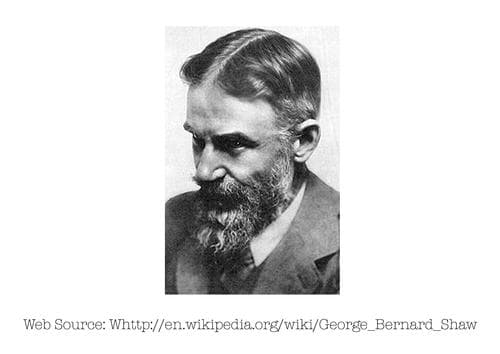
George Bernard Shaw, known at his insistence as Bernard Shaw, was an Irish playwright, critic, polemicist and political activist. His influence on Western theatre, culture and politics extended from the 1880s to his death and beyond. He wrote more than sixty plays, including major works such as Man and Superman (1902), Pygmalion (1913) and Saint Joan (1923). With a range incorporating both contemporary satire and historical allegory, Shaw became the leading dramatist of his generation, and in 1925 was awarded the Nobel Prize in Literature.
Similar books
- A Man for All Seasons
Robert Bolt
3.9 (11k) average on GoodreadsHistorical FictionExplores a historical figure's conflict with church and state over conscience and principle.
- Murder in the Cathedral
T.S. Eliot
3.8 (8k) average on GoodreadsHistorical FictionA historical play centered on a spiritual figure's martyrdom and defiance against worldly power.
- To Kill a Mockingbird
Harper Lee
4.3 (4.5M) average on GoodreadsHistorical FictionIn the 1930s Jim Crow South, Harper Lee writes about racial injustice, moral growth, and the quiet courage of a lawyer father, Atticus Finch, as seen through his young daughter's eyes.
- The Great Gatsby
F. Scott Fitzgerald
3.9 (3.8M) average on GoodreadsHistorical FictionIn the opulent Roaring Twenties, a mysterious millionaire's lavish parties hide his desperate, tragic pursuit of a lost love, exposing the emptiness within the American Dream.
- Pride and Prejudice
Jane Austen
4.3 (3M) average on GoodreadsHistorical FictionIn a society focused on status and money, Elizabeth Bennet navigates love and pride, challenging Mr. Darcy and social expectations to find true affection.
- Angels & Demons
Dan Brown
3.9 (2.7M) average on GoodreadsThrillerA Harvard symbologist races through Rome's ancient sites, deciphering cryptic clues to unmask the Illuminati and stop a vengeful plot to destroy the Vatican with a stolen antimatter weapon.





Enjoyed the summary?
A summary gives you the shape of the book. The book itself has the detail, the examples and the voice.
Find Saint Joan on AmazonAs an Amazon Associate, BookBrief earns from qualifying purchases. How we're funded