
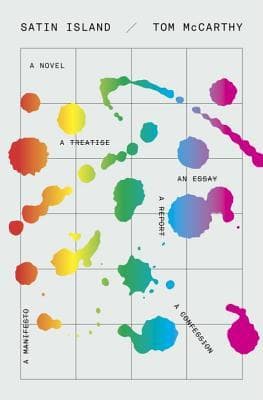
Synopsis
Covers the whole plot, including the ending.
- Difficulty
- Hard
- Pacing
- Slow
- Mood
- Philosophical, Abstract, Contemplative, Disorienting
- Read it if
- You enjoy experimental literary fiction that explores themes of information overload, the nature of reality, and the challenges of meaning-making in the digital age.
- Skip it if
- You prefer plot-driven narratives, clear resolutions, or straightforward prose.
Satin Island Plot Summary
Covers the whole plot, including the ending.
The Turin Airport and the Shroud
U., the narrator, is delayed in Turin Airport. Online, he finds information about the Shroud of Turin. This artifact, with its debated authenticity and layers of interpretation, connects with his intellectual concerns. He considers how our understanding of truth is always filtered, making any perceived reality unstable. This reflection sets the philosophical tone and introduces his main task: writing the 'Great Report' for his employer, the Company, a document meant to summarize the contemporary world.
The Mandate for the Great Report
U. works as a corporate ethnographer for a powerful, almost mythical entity called 'the Company.' His main job is to compile the 'Great Report,' an ambitious document meant to define and summarize the entire contemporary human condition. The Company's exact purpose and leaders are vague, but their influence is widespread. U. struggles with the huge scope of this task, feeling overwhelmed by the data, information, and disconnected events of modern life, always questioning if such a clear summary is even possible.
Obsession with Cargo Cults
U. has a long-standing interest in South Pacific cargo cults. He studies their origins, rituals, and beliefs, especially how these isolated communities saw Western goods and technology as divine or ancestral returns. U. sees similarities between the cargo cults' attempts to understand foreign objects and modern society's efforts to process the overwhelming flow of information and consumer goods, suggesting a shared human need to create stories around perceived meaning.
The Enigmatic Madison
U. is involved with a woman named Madison, but their relationship has a deep sense of distance. Madison travels often, and her presence in U.'s life is fragmented, communicated through brief meetings or cryptic messages. He struggles to understand her, seeing her as a collection of surfaces rather than a whole person. Her transient nature and his inability to define her reflect his broader difficulty in putting together the different parts of the modern world into a coherent story for his Great Report, showing themes of detachment and the limits of understanding.
The Parachutist's Death
Another recurring interest for U. is the seemingly random death of a parachutist. He looks into news reports and speculative accounts, trying to understand the circumstances. The lack of a clear explanation for the death, along with fragmented and contradictory information, mirrors his struggle with the Great Report. U. tries to bring order to this chaotic event, analyzing every detail, but finds himself increasingly lost in the ambiguities, reinforcing his view of an unstable and unknowable reality.
The Developing Interest in Oil Spills
U. develops a new interest in oil spills. He collects images and data about these environmental disasters, fascinated by how the oil spreads, blurs boundaries, and turns landscapes into shapeless, oozing masses. This interest in the formless nature of oil spills becomes a metaphor for his own struggle with the Great Report, which he fears might also remain a 'shapeless, oozing plasma' rather than a clear document. The oil represents the undifferentiated, uncontrollable flow of information and events in the modern world.
The Dream of the Apocalyptic Cityscape
Amid his intellectual and existential wandering, U. has a powerful and vivid dream. The dream shows an apocalyptic city, perhaps a vision of collapse or change. This intense experience provides a sudden shock, briefly cutting through his usual detached observation and overwhelming data. The dream, with its stark images and emotional impact, contrasts with the abstract reality he usually inhabits, suggesting a deeper, more basic understanding or a subconscious comment on his worries about the world.
The Company's Ambiguous Influence
The Company U. works for is ever-present yet elusive. Its headquarters are vaguely defined, its goals unclear, and its leaders largely unseen. U. is a part of a vast, unknowable machine, tasked with a project so grand it borders on the absurd. This ambiguity about his employer contributes to U.'s sense of detachment and his struggle to find meaning. The Company represents a powerful, abstract force that shapes the modern world, yet remains beyond full comprehension, reflecting U.'s own feelings of being lost in a buffer zone of information.
Struggles with Synthesis and Coherence
Throughout his work on the Great Report, U. faces the challenge of putting together the vast, different data points of modern existence into a coherent, meaningful story. He feels overwhelmed by the 'ubiquity of data' and the constant flow of information, which often seems to contradict itself or lack clear connections. His observations on cargo cults, the Shroud of Turin, Madison, and oil spills are all individual threads he tries to weave, but his report threatens to unravel into an 'oozing plasma' rather than a definitive statement. He questions if a unified understanding is even possible.
The Elusive Nature of Truth
A main concern for U. is the elusive nature of truth in the modern world. From the debated authenticity of the Shroud of Turin to the unclear details of the parachutist's death, he constantly finds situations where reality is filtered through 'veils or screens' of interpretation and media. He recognizes that our access to any objective truth is always mediated, making definitive statements or complete understanding difficult, if not impossible. This philosophical view underlies his struggles with the Great Report and his perception of the world as unstable.
The Finality of the Report
As U. continues his work, he increasingly questions whether the Great Report can ever truly be finished or if it can provide 'the first and last word' on the world, as its mandate suggests. The sheer, ever-growing volume of information and constant shifts in the modern world make any sense of closure seem impossible. He considers the paradox of trying to capture an infinitely unfolding present, ultimately recognizing that the report, like reality itself, might be an ongoing process, always incomplete and resistant to a final summary.
Satin Island Characters
U.
Protagonist
A corporate ethnographer tasked with writing the 'Great Report.'
U. is the novel's introspective and highly intellectual narrator, a corporate ethnographer employed by the enigmatic 'Company.' His primary task is to compile the 'Great Report,' a document meant to encapsulate the entirety of the contemporary human condition. Driven by a deep philosophical curiosity, he is prone to obsessions—cargo cults, the Shroud of Turin, oil spills, and a parachutist's death—which he attempts to weave into a cohesive understanding of the world. He is often detached, observing phenomena from a distance, and struggles with the overwhelming ubiquity of data and the elusive nature of truth, feeling lost in 'buffer zones' of information.
Relationships: Madison (Romantic partner, but characterized by elusiveness and distance.); The Company (Employer, an enigmatic and powerful entity that provides his purpose.)
Madison
Supporting
U.'s elusive and transient romantic partner.
Madison is U.'s romantic interest, though their relationship is marked by her frequent travels and a pervasive sense of elusiveness. She functions more as a symbol of the fragmented, ungraspable nature of reality than a fully realized character. U. struggles to pin her down, perceiving her as a collection of surfaces and temporary presences rather than a cohesive individual. Her transient nature mirrors the novel's broader themes of mediation, detachment, and the difficulty of truly knowing another person or, by extension, the world itself. She is a recurring enigma in U.'s life.
Relationships: U. (Romantic partner, characterized by distance and U.'s inability to fully understand her.)
The Company
Mentioned/Antagonistic force (conceptual)
U.'s enigmatic employer, driving the mandate for the Great Report.
The Company is a powerful, amorphous entity that employs U. and tasks him with writing the 'Great Report.' Its true nature, leadership, and ultimate objectives remain largely opaque, contributing to the novel's sense of pervasive ambiguity. The Company represents a kind of meta-corporate force, a symbol of the pervasive, yet often invisible, structures that shape modern society. It is the unseen hand that gives U. his impossible mission, representing the societal pressure to make sense of the world, even when that world resists simple summation. Its influence is felt more than directly observed.
Relationships: U. (Employer-employee relationship, though the employer is largely abstract.)
The Parachutist
Mentioned (conceptual)
The subject of U.'s obsession with an unexplained death.
The parachutist is a figure whose mysterious death becomes a focal point for U.'s intellectual inquiries. The details surrounding the incident are fragmented and ambiguous, making it impossible to ascertain a clear cause or narrative. For U., the parachutist represents the random, inexplicable events that defy easy categorization or understanding in the modern world. His obsession with this case highlights his struggle to impose meaning and order onto chaos, and the futility of seeking definitive truths in a world saturated with partial information and conflicting accounts.
The Shroud of Turin
Mentioned (conceptual)
An ancient artifact symbolizing mediated truth and contested authenticity.
The Shroud of Turin is an ancient linen cloth bearing the faint image of a crucified man, considered by some to be the burial shroud of Jesus. For U., it is a powerful symbol of mediated truth, contested authenticity, and the layers of interpretation that separate us from any original reality. Its history of scientific analysis, religious belief, and ongoing debate perfectly illustrates his premise that our access to truth is always filtered through 'veils or screens.' The Shroud serves as an early catalyst for U.'s philosophical reflections on the nature of reality and representation.
The Cargo Cults
Mentioned (conceptual)
South Pacific communities whose beliefs fascinate U. as a parallel to modern meaning-making.
The cargo cults of the South Pacific are indigenous communities who, after encountering Western goods and technology, developed elaborate belief systems and rituals in an attempt to understand and replicate the arrival of these objects. For U., these cults are a significant intellectual obsession, serving as a metaphor for modern society's own attempts to construct meaning from an overwhelming influx of information and consumerism. He sees in their practices a primal human drive to create narratives and rituals around the incomprehensible, linking ancient forms of sense-making to contemporary cultural phenomena.
Satin Island Themes
The Elusiveness of Truth and Meaning
A main theme is that objective truth is largely inaccessible, always mediated by 'veils or screens' of interpretation, data, and representation. U.'s interest in the Shroud of Turin, an artifact whose authenticity is always debated, shows this. Similarly, his inability to fully understand Madison or find a clear explanation for the parachutist's death highlights how reality resists clear, singular stories. The novel suggests that in the information-saturated modern world, meaning is not found but created, and often imperfectly.
“'Our access to the truth is always mediated by a set of veils or screens, with any world built on those truths inherently unstable.”
The Overload of Information and Data
The novel explores the overwhelming amount of data and information in the contemporary age. U., an ethnographer tasked with summarizing an entire era, is constantly flooded by facts, images, and disconnected events. This data overload makes synthesis incredibly difficult, threatening to turn his 'Great Report' into a 'shapeless, oozing plasma.' The oil spills, with their formless spread, become a metaphor for this undifferentiated flow, suggesting that too much information can be as confusing as too little, leading to a kind of mental paralysis.
“He felt himself overwhelmed by the ubiquity of data, lost in buffer zones, wandering through crowds of apparitions.”
The Nature of Narrative and Storytelling
U. constantly grapples with the human need to create stories, even when facing chaos. His study of cargo cults, who built elaborate narratives around Western goods, highlights this. He sees modern society doing something similar, trying to make coherent stories from different events and information. The 'Great Report' itself is the ultimate storytelling challenge. The novel questions whether a single, definitive story of an era is possible or desired, suggesting that perhaps only fragmented, incomplete stories can truly capture the complexities of contemporary existence.
“We are always trying to find meaning (or just to stay awake) and discern the narratives we think of as our lives.”
Detachment and Alienation
U. shows a deep sense of detachment, both from his personal relationships (like with Madison, who remains elusive) and from the world he observes. His role as an ethnographer encourages this distance, but it also reflects a deeper alienation in modern life. He often feels 'lost in buffer zones,' observing events and people as 'apparitions.' This detachment allows him to analyze, but it also isolates him, preventing real connection or a direct experience of reality, until perhaps his apocalyptic dream offers a brief, intense break from this intellectual remove.
“He felt like he was observing the world from behind a pane of glass, a buffer zone.”
Plot Devices & Literary Techniques
The Great Report
An impossible, all-encompassing document U. is tasked with writing.
The 'Great Report' serves as the central MacGuffin and thematic anchor of the novel. It is U.'s ultimate, seemingly impossible task: to sum up the entire contemporary era. As a plot device, it provides U. with his purpose and drives his intellectual explorations, forcing him to confront the vastness and incoherence of modern information. Simultaneously, it acts as a metaphor for humanity's collective desire to understand and categorize the world, while highlighting the inherent futility of such an endeavor in an age of overwhelming data and mediated truths.
Obsessions (Cargo Cults, Shroud, Oil Spills, Parachutist)
Disparate intellectual fixations that U. attempts to connect.
U.'s various obsessions—the South Pacific cargo cults, the Shroud of Turin, oil spills, and the parachutist's death—are key plot devices. They function not as subplots, but as recurring motifs and intellectual touchstones through which U. explores the novel's central themes. Each obsession offers a different lens through which to examine mediation, meaning-making, and the elusive nature of truth. By juxtaposing these seemingly unrelated phenomena, the novel invites the reader to follow U.'s fragmented thought process and to find their own connections within the overwhelming stream of information.
The Elusive/Absent Character (Madison, The Company)
Characters whose ambiguity and distance reflect the novel's themes.
Madison and The Company serve as plot devices through their very elusiveness and ambiguity. Madison, U.'s transient partner, symbolizes the difficulty of truly knowing another person and the fragmented nature of modern relationships. The Company, U.'s enigmatic employer, represents the vast, opaque, and often incomprehensible forces that shape the contemporary world. Their lack of concrete definition or consistent presence mirrors U.'s struggle to synthesize a coherent understanding of reality, reinforcing the theme that truth and meaning are often mediated, distant, and ultimately ungraspable.
Satin Island Quotes
“The First and Last Man is always the same man. This is the truth of it.”
“All of us, in some sense, are working on the Great Report. Whether we know it or not.”
“What is the opposite of a fact? Not a lie, but a story.”
“Every event, however trivial, however mundane, is a node in a vast, invisible network.”
“The world is already saturated with meaning. Our task is not to create it, but to uncover it.”
“We are all ethnographers of our own lives, constantly observing, constantly interpreting.”
“The past is not a foreign country; it is a foreign language, and most of us are only fluent in fragments.”
“There is no such thing as 'raw data.' All data is already cooked, processed, interpreted.”
“The greatest report would be one that was never written, because it would already be everywhere.”
“Everything is a sign, if only we know how to read it.”
“To understand something fully is to become it, to dissolve into its structure.”
“The world doesn't care about our narratives. It just is.”
“Our lives are footnotes to a text we can never fully read.”
“The future is just the present, recycled and re-presented.”
Quiz
10 questions on the plot and the characters. Each answer comes with a short explanation.
Question 1
What is the narrator's name in 'Satin Island'?
- Tom
- U.
- Madison
- McCarthy
Show answer
B. U. The synopsis explicitly states, 'When we first meet U., our narrator...' indicating 'U.' is his name.
Question 2
What is U.'s profession?
- Journalist
- Philosopher
- Corporate ethnographer
- Historian
Show answer
C. Corporate ethnographer The text describes U. as a 'corporate ethnographer,' tasked with writing the 'Great Report.'
Question 3
What airport is U. waiting in when we first meet him?
- London Heathrow
- Turin airport
- Paris Charles de Gaulle
- New York JFK
Show answer
B. Turin airport The synopsis begins, 'When we first meet U., our narrator, he is waiting out a delay in the Turin airport.'
Question 4
What is the primary goal of the 'Great Report' that U. is tasked with writing?
- To document the history of corporate ethnography
- To sum up the current era
- To analyze the symbolism of the Shroud of Turin
- To investigate the parachutist's death
Show answer
B. To sum up the current era U. is tasked with writing 'the 'Great Report,' an all-encompassing document that would sum up our era.'
Question 5
What specific artifact does U. stumble upon information about, leading him to reflect on mediated truth?
- A ancient map
- The Shroud of Turin
- A rare manuscript
- An obscure philosophical text
Show answer
B. The Shroud of Turin While waiting, U. 'stumbles on information about the Shroud of Turin--and is struck by the degree to which our access to the truth is always mediated by a set of veils or screens.'
Question 6
What is U.'s long-standing obsession mentioned in the synopsis?
- Ancient Roman history
- South Pacific cargo cults
- Modern art movements
- The development of AI
Show answer
B. South Pacific cargo cults The text states, 'Add to that his longstanding obsession with South Pacific cargo cults.'
Question 7
Which of these is NOT an obsession or interest of U. mentioned in the synopsis?
- The Shroud of Turin
- Oil spills
- Ancient Egyptian hieroglyphics
- A recent parachutist's death
Show answer
C. Ancient Egyptian hieroglyphics The synopsis mentions the Shroud of Turin, the parachutist's death, cargo cults, and oil spills as U.'s interests, but not ancient Egyptian hieroglyphics.
Question 8
What concept is U. struck by when researching the Shroud of Turin?
- The timelessness of religious faith
- The power of historical artifacts
- How access to truth is mediated by veils or screens
- The scientific impossibility of certain phenomena
Show answer
C. How access to truth is mediated by veils or screens U. 'is struck by the degree to which our access to the truth is always mediated by a set of veils or screens, with any world built on those truths inherently unstable.'
Question 9
What is U.'s feeling about the ubiquity of data in relation to the Great Report?
- He finds it an invaluable resource for his work.
- He feels overwhelmed and lost by it.
- He believes it simplifies his task of summing up the era.
- He sees it as a clear path to definitive truth.
Show answer
B. He feels overwhelmed and lost by it. The text states, 'Yet at every turn, he feels himself overwhelmed by the ubiquity of data, lost in buffer zones, wandering through crowds of apparitions.'
Question 10
What ultimately startles U.'s senses awake as he worries about the Great Report becoming 'shapeless, oozing plasma'?
- A sudden conversation with Madison
- A dream of an apocalyptic cityscape
- A breakthrough in his research on cargo cults
- News about the parachutist's death investigation
Show answer
B. A dream of an apocalyptic cityscape The synopsis concludes, 'As he begins to wonder if the Great Report might remain a shapeless, oozing plasma, his senses are startled awake by a dream of an apocalyptic cityscape.'
Satin Island FAQ
What is U.'s primary professional task at the beginning of the novel?
U. is employed as a 'corporate ethnographer' and is tasked with writing the 'Great Report.' This ambitious document is intended to be an all-encompassing summary of our current era, capturing its essence and defining characteristics.
What specific object does U. encounter information about in the Turin airport, and how does it influence his thinking?
While waiting in the Turin airport, U. stumbles upon information about the Shroud of Turin. This discovery profoundly impacts him, leading him to ponder how our access to truth is always mediated by layers of veils or screens, making any truth-based world inherently unstable.
Describe U.'s relationship with Madison.
Madison is a woman U. is seeing, but their relationship is characterized by her increasing elusiveness. She becomes more distant and difficult to pin down, mirroring other unresolved mysteries and ambiguities in U.'s life and observations.
What are some of U.'s recurring obsessions outside of his professional work?
U. harbors a longstanding obsession with South Pacific cargo cults, a fascination with the particulars of a recent parachutist's death, and develops an inexplicable interest in oil spills. These diverse obsessions reflect his broader quest for patterns and meaning in seemingly disparate phenomena.
How does U. perceive the data he is meant to synthesize for the Great Report?
U. feels overwhelmed by the sheer ubiquity of data, perceiving it as a shapeless, oozing plasma that resists categorization. He frequently feels lost in 'buffer zones' and describes crowds as 'apparitions,' indicating a sense of detachment and inability to grasp concrete meaning from the information deluge.
What is the significance of the 'Satin Island' title, even though the island itself isn't a central setting?
The title 'Satin Island' likely evokes a sense of artificiality, smoothness, and perhaps a manufactured reality, mirroring U.'s perception of a world mediated by screens and simulations. It could symbolize a constructed, almost too perfect, yet ultimately hollow, environment that U. is trying to decipher.
How do cargo cults connect to U.'s broader project of the Great Report?
Cargo cults, with their attempts to mimic and invoke the arrival of goods and meaning, parallel U.'s own endeavor to create the 'Great Report.' Both involve an effort to understand and replicate a perceived external system, highlighting the human desire to impose order and narrative on complex, often inexplicable, phenomena.
What might the 'parachutist's death' symbolize in the context of U.'s narrative?
The parachutist's death, with its unclear circumstances and U.'s obsession with its 'particulars,' could symbolize the difficulty of grasping concrete truth or the sudden, inexplicable collapses of meaning. It represents a narrative that refuses to cohere, much like the 'Great Report' itself.
How does U.'s dream of an 'apocalyptic cityscape' relate to his waking life and the Great Report?
The dream of an apocalyptic cityscape serves as a jarring sensory awakening for U., contrasting with his often detached and overwhelmed waking state. It suggests a subconscious recognition of the potential for collapse or the ultimate futility of his attempts to encapsulate an era, hinting at a dramatic end point for the amorphous data he grapples with.
How does U.'s role as a 'corporate ethnographer' paradoxically hinder his ability to understand the world?
U.'s role as a corporate ethnographer requires him to observe and categorize, but the very act of constantly processing and mediating data seems to detach him further from genuine experience. He becomes lost in the 'buffer zones' of information, suggesting that over-analysis can lead to a state of perpetual observation without true understanding.
What psychological state does U.'s feeling of being 'overwhelmed by the ubiquity of data' suggest?
U.'s feeling of being overwhelmed by data points to a state of information overload and a potential crisis of meaning. Psychologically, it reflects a struggle to filter, prioritize, and find coherent narratives in a world saturated with fragmented information, leading to a sense of paralysis and an inability to synthesize.
How does U.'s perception of crowds as 'apparitions' reflect his inner state?
Perceiving crowds as 'apparitions' signifies U.'s profound sense of alienation and detachment from other people. It suggests he sees individuals not as concrete beings but as indistinct, ghostly presences, reflecting his own struggle to connect with reality and find solid ground in a world he experiences as mediated and insubstantial.
What might U.'s 'inexplicable interest in oil spills' symbolize about his psychological landscape?
U.'s inexplicable interest in oil spills could symbolize a fascination with rupture, contamination, and the uncontrollable spread of something that defies containment. Psychologically, it might reflect his own sense of internal chaos or the spreading 'plasma' of data that he cannot organize, representing a desire to understand or confront disorder.
Is the 'Great Report' truly possible to write, or is it an inherently futile endeavor according to the novel's themes?
The novel strongly suggests that the 'Great Report' is an inherently futile endeavor. U.'s struggle with data, his feeling of being overwhelmed, and the amorphous nature of the information he gathers all point to the impossibility of definitively summing up an era. The book implies that such a comprehensive, singular truth is unattainable.
What is the novel's stance on the nature of 'truth' in the modern world?
The novel posits that 'truth' in the modern world is always mediated and inherently unstable. U.'s encounter with the Shroud of Turin, his perception of 'veils or screens,' and his inability to grasp concrete realities all suggest that direct, unmediated truth is elusive, if not impossible, to access.
Does 'Satin Island' offer a solution or a critique of our modern, data-saturated existence?
'Satin Island' primarily offers a profound critique rather than a solution. It meticulously captures the experience of living in a data-saturated world, highlighting the difficulties of finding meaning and coherence. While it doesn't prescribe answers, it brilliantly articulates the problem of mediation and information overload.
How does Tom McCarthy's previous work, like 'Remainder' or 'C,' inform the themes of 'Satin Island'?
McCarthy's previous works often explore themes of repetition, authenticity, and the constructed nature of reality. 'Satin Island' extends these concerns by focusing on how information and mediation shape our perception of the world, echoing 'Remainder's' obsession with re-enactment and 'C's' engagement with communication and signal.
What role does the 'body' play in a novel so focused on abstract data and mediation?
Despite the focus on abstract data, the body often appears as a site of disruption or a point of reference for U. The parachutist's death, oil spills (affecting environments and bodies), and even U.'s dream are visceral experiences that contrast with the cerebral nature of his work, suggesting that physical reality persistently intrudes on mediated existence.
Is U. a reliable narrator, given his subjective and often detached observations?
U. is likely not a traditionally reliable narrator, as his observations are filtered through his unique psychological state, his professional lens, and his personal obsessions. His perception of crowds as 'apparitions' and his struggle to find concrete meaning indicate a highly subjective and mediated perspective, which is central to the novel's thematic exploration of truth and reality.
About the author
Tom McCarthy is a British author known for his contributions to contemporary fiction. His notable work, Satin Island, explores themes of culture and modernity through the lens of a corporate anthropologist. McCarthy's writing often challenges traditional narrative structures and engages with philosophical ideas.
Similar books
- White Noise
Don DeLillo
3.9 (87k) average on GoodreadsLiterary FictionBoth explore consumerism, media saturation, and the search for meaning in a postmodern world.
- The Crying of Lot 49
Thomas Pynchon
3.7 (71k) average on GoodreadsLiterary FictionFeatures a protagonist overwhelmed by interconnected, ambiguous information and the search for an underlying truth.
- Infinite Jest
David Foster Wallace
4.3 (74k) average on GoodreadsLiterary FictionLike Satin Island, Infinite Jest tackles themes of information overload, media saturation, and the search for meaning in a complex world. However, Wallace employs a maximalist style that, while challenging, often offers more direct emotional payoff through its extensive character arcs and intricate plot. McCarthy's novel, by contrast, is more compact and focused on abstract philosophical inquiry, often at the expense of conventional narrative satisfaction.
- The Old Man and the Sea
Ernest Hemingway
3.8 (831k) average on GoodreadsLiterary FictionA Cuban fisherman's long struggle with a giant marlin becomes a story of endurance and dignity, now retold for young adults with illustrations, phonetic guides, and writing prompts in Traditional Chinese.
- One Hundred Years of Solitude
Gabriel García Márquez
4.1 (753k) average on GoodreadsLiterary FictionThrough the multi-generational story of the Buendía family, a mythical town deals with the repeating patterns of time, love, and solitude, as the extraordinary mixes with the ordinary.
- The Goldfinch
Donna Tartt
3.9 (720k) average on GoodreadsLiterary FictionHaunted by a tragic explosion and clutching a stolen Dutch masterpiece, a young orphan navigates the opulent drawing rooms of New York and the gritty underbelly of the art world, desperately seeking connection and redemption amidst a life spiraling into crime and obsession.






Enjoyed the summary?
A summary gives you the shape of the book. The book itself has the detail, the examples and the voice.
Find Satin Island on AmazonAs an Amazon Associate, BookBrief earns from qualifying purchases. How we're funded