
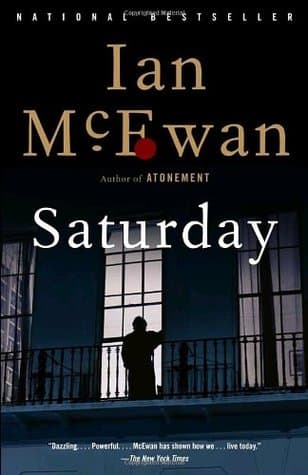
Synopsis
Covers the whole plot, including the ending.
- Difficulty
- Medium
- Pacing
- Variable
- Mood
- Introspective, Suspenseful, Philosophical, Tense
- Read it if
- You enjoy deep dives into a character's internal world, intellectual prose, and a tightly focused narrative that escalates from the mundane to the terrifying.
- Skip it if
- You prefer fast-paced action thrillers or narratives with multiple plotlines and a less introspective style.
Saturday Plot Summary
Covers the whole plot, including the ending.
A Saturday Morning and an Ominous Sky
On a Saturday morning in February 2003, neurosurgeon Henry Perowne wakes before dawn in his London home. He sees a strange, fiery aircraft over the city, at first fearing a terrorist attack, but later learns it is an old Russian cargo plane with engine trouble. The city prepares for a large anti-Iraq War protest, which Henry views with some skepticism, though he understands the political situation. He thinks about his comfortable life, his job, and his family: wife Rosalind, a lawyer, and adult children Daisy, a poet, and Theo, a blues musician. He plans a day of squash, shopping, and a family dinner.
The Squash Game and a Confrontation
Henry drives to his squash game with his anesthetist, Jay Strauss, navigating crowded streets filled with protestors. A distraction leads to a minor car accident. The other driver, Baxter, a young, threatening man, confronts Henry aggressively. Henry, using his professional instincts, notices Baxter's constricted pupils, facial tics, and erratic behavior, diagnosing him with Huntington's disease, a degenerative neurological disorder. He tries to calm the situation by explaining his diagnosis, which only angers Baxter, making him feel exposed. Baxter, with two associates, threatens Henry and demands money.
A Narrow Escape and Lingering Unease
During the confrontation, Henry subtly assesses Baxter and his companions, realizing the immediate danger. He distracts Baxter by mentioning his medical condition, then quickly drives away, leaving Baxter and his friends shouting threats. Henry reaches his squash game, shaken but outwardly composed. He plays with Jay, but his mind keeps returning to the encounter, the unsettling diagnosis, and the lingering threat. He feels a deep unease, a sense that his secure world has been briefly broken by unpredictable violence.
Afternoon Errands and Family Anticipation
After squash, Henry tries to resume his Saturday plans. He visits his elderly mother, who has dementia, finding comfort in their brief, if often disconnected, talks. He then goes food shopping for the evening's family dinner, where Daisy and Theo are expected. Despite these attempts to return to normal, the memory of Baxter and his threats continues to bother him. He finds himself scanning the streets, feeling more vulnerable and aware of potential danger beneath everyday life. He looks forward to the family gathering for comfort and protection.
The Family Gathers
As evening approaches, Henry's daughter, Daisy, a successful poet, arrives from New York, followed by his son, Theo, a talented blues musician. The house fills with their youthful energy and creative talks. Daisy reads some of her new poems, met with pride and critical appreciation from her parents. Theo plays his guitar, showing his musical skill. Rosalind, Henry's wife, returns from work, and the family settles into the comfortable rhythm of their shared life, their individual successes and aspirations joining together. Dinner preparations are underway, promising a warm, intimate evening.
The Home Invasion
Just as the family is about to eat dinner, the doorbell rings. Henry opens it to find Baxter and his accomplice, Nige, on his doorstep. Baxter, seeking revenge and humiliation, forces his way into the house, holding a knife. The peaceful family evening shatters. Baxter terrorizes the family, demanding money and asserting his control. He forces Theo to play his guitar, then breaks it, and humiliates Daisy, demanding she strip and recite a poem. The family is frozen with fear, their secure world completely violated.
Henry's Intervention and Medical Ploy
During the terrifying ordeal, Henry remains calm, observing Baxter's worsening condition. He realizes Baxter is suffering from a full Huntington's chorea attack, made worse by stress and possibly drug use. Henry calmly but firmly confronts Baxter, repeating his diagnosis and explaining the symptoms, appealing to Baxter's fear of his own body and future. He offers to help Baxter, suggesting he could lessen his symptoms, even subtly implying a medical intervention could be a form of 'mercy.' This calculated medical assessment and promise of relief momentarily disarms Baxter, who becomes confused and vulnerable.
The Climax and Resolution
As Henry continues to talk Baxter down, using his medical vulnerability, Rosalind seizes an opportunity. She grabs a heavy medical textbook and strikes Nige, knocking him unconscious. This diversion allows Henry to tackle Baxter, who is already disoriented by his illness and Henry's psychological manipulation. In the struggle, Baxter is subdued. Police, alerted by a neighbor, arrive shortly after, taking Baxter and Nige into custody. The family is safe, but deeply traumatized by the violation of their home and the terror they endured.
Aftermath and Reflection
After the invasion, the Perowne family processes the trauma. Police investigate, and the house is disrupted. Daisy is particularly shaken, having been directly threatened. Henry and Rosalind comfort their children and each other, finding strength in their family bond. The incident forces Henry to confront the fragility of his carefully built life and the constant presence of violence and unpredictability in the world. Despite the horror, there is a deep sense of relief and gratitude for their survival and unity.
A Late-Night Operation
Later that night, Henry receives an emergency call from the hospital. Baxter, having suffered a severe cerebral hemorrhage during his arrest or the struggle, needs immediate neurosurgery. Henry, the very man Baxter terrorized, is the only surgeon available with the necessary expertise. He performs the life-saving operation, showing his professional dedication and ethical commitment, even to his attacker. This surreal turn of events brings a strange, almost poetic, closure to Henry's Saturday, highlighting the complex intersection of personal trauma and professional duty.
A New Day Dawns
Henry finishes the surgery in the early hours of Sunday morning. He returns home to find Rosalind awake, waiting for him. They share a quiet moment, the weight of the past day still heavy between them. The experience has changed Henry's perspective, making him more aware of his family's preciousness and the precariousness of peace. As the new day dawns, bringing the promise of recovery and healing, Henry reflects on the extraordinary events of his Saturday, and the resilience of human connection in the face of chaos.
Saturday Characters
Henry Perowne
Protagonist
A successful, contented neurosurgeon whose ordered world is disrupted by an unexpected confrontation.
Henry Perowne is a highly intelligent, rational, and generally contented neurosurgeon in his late forties. He values order, reason, and the comforts of his well-ordered life in London. He is deeply devoted to his wife, Rosalind, and his children, Daisy and Theo. His profession has instilled in him a keen observational eye, a calm demeanor under pressure, and a strong belief in scientific understanding. He is somewhat detached from political events but possesses a strong moral compass and a deep sense of responsibility, both personal and professional.
Relationships: Rosalind Perowne (Devoted husband, intellectual partner); Daisy Perowne (Loving father, proud of her artistic achievements); Theo Perowne (Supportive father, enjoys his musical talent); Baxter (Victim of his aggression, later his surgeon)
Rosalind Perowne
Supporting
Henry's intelligent and resilient wife, a newspaper lawyer.
Rosalind is Henry's wife, a sharp, successful, and compassionate newspaper lawyer. She shares Henry's intellectual curiosity and provides a grounding presence in his life. She is practical, courageous, and fiercely protective of her family. Her legal background gives her a different perspective on the world than Henry's medical one, but they are united in their values and love for their children. She demonstrates remarkable courage during the home invasion.
Relationships: Henry Perowne (Devoted wife, intellectual partner); Daisy Perowne (Loving mother, encourages her creativity); Theo Perowne (Loving mother, supports his artistic path)
Daisy Perowne
Supporting
Henry and Rosalind's daughter, a talented and sensitive poet.
Daisy is Henry and Rosalind's daughter, a successful poet living in New York. She is artistic, sensitive, and intelligent, embodying the creative spirit of the family. Her poetry often reflects on the complexities of human experience and the natural world. She is deeply connected to her family and her presence brings a vibrant, youthful energy to the home. She is particularly vulnerable during the home invasion, and her trauma is a central focus of the aftermath.
Relationships: Henry Perowne (Loving daughter, shares intellectual discussions); Rosalind Perowne (Loving daughter, close bond); Theo Perowne (Sibling, shares artistic sensibilities)
Theo Perowne
Supporting
Henry and Rosalind's son, a gifted blues musician.
Theo is Henry and Rosalind's son, a talented blues musician. He is passionate about his music, bringing a different form of artistic expression to the family. He is generally laid-back but possesses a strong sense of self. Like his sister, he is deeply connected to his family. His guitar, a symbol of his identity and passion, is tragically broken during the home invasion, representing the violation of his personal space and artistic freedom.
Relationships: Henry Perowne (Loving son, shares a comfortable rapport); Rosalind Perowne (Loving son, close bond); Daisy Perowne (Sibling, shares artistic sensibilities)
Baxter
Antagonist
A violent, disturbed young man suffering from Huntington's disease, who terrorizes the Perowne family.
Baxter is a young, menacing, and unpredictable thug. He is physically imposing but mentally unstable, suffering from the early stages of Huntington's disease, a fact Henry Perowne astutely diagnoses. His aggression is fueled by a combination of his illness, drug use, and a deep-seated sense of humiliation and resentment. He seeks to assert dominance and inflict pain, particularly after feeling belittled by Henry. He represents the chaotic, irrational, and violent forces that threaten Henry's ordered world.
Relationships: Henry Perowne (Aggressor and victim, then patient); Nige (Accomplice)
Jay Strauss
Supporting
Henry's anaesthetist and squash partner.
Jay Strauss is Henry's colleague and friend, an anaesthetist with whom Henry regularly plays squash. He represents the professional and social circle Henry inhabits, a world of educated, successful individuals. He is a sounding board for Henry's initial anxieties after the confrontation with Baxter, offering a sense of normalcy and camaraderie before the day's true horrors unfold.
Relationships: Henry Perowne (Colleague and friend)
Nige
Supporting
Baxter's less intelligent and more subservient accomplice.
Nige is Baxter's accomplice during the home invasion. He is less intelligent and more easily manipulated than Baxter, primarily following Baxter's lead out of loyalty or fear. He is a silent, menacing presence during the terror, but ultimately less effective and more easily subdued than Baxter.
Relationships: Baxter (Accomplice)
Saturday Themes
The Fragility of Order and Civilization
The novel carefully builds Henry Perowne's ordered, rational world, only to systematically break it down over a single day. The opening scene with the mysterious aircraft hints at external threats, while the anti-war protests reflect societal unrest. The home invasion, however, directly violates Henry's personal sanctuary, showing how easily the appearance of civilization can be stripped away by irrational violence and individual pathology. Henry's job as a neurosurgeon, dealing with the brain's delicate order, contrasts sharply with the chaos he experiences.
“He knew this feeling. The world was about to change. Something had broken up there, something in the order of things.”
The Power of Reason vs. Irrationality
Henry Perowne is a man of science and reason, constantly analyzing and diagnosing. His first encounter with Baxter shows this, as he tries to defuse the situation with a medical diagnosis. However, Baxter represents pure irrationality and violence, unaffected by reason. The novel's climax sees Henry using his intellect and medical knowledge not just to diagnose, but to psychologically manipulate Baxter, turning his illness into a weapon against him. This shows that reason, while powerful, must sometimes adapt to or confront irrational forces on their own terms.
“He was a man who believed in the explicability of things, in the power of reason to penetrate and order the world.”
The Nature of Empathy and Professional Ethics
Despite being terrorized by Baxter, Henry Perowne, as a neurosurgeon, is ultimately called upon to save his life. This central irony explores the limits and demands of professional ethics. Henry's ability to separate his personal trauma and perform a life-saving operation on his attacker shows a deep, if detached, form of empathy inherent in his profession. It forces a consideration of whether empathy is a choice or a professional obligation, and how one combines personal animosity with the universal Hippocratic oath.
“It was impossible to feel anything for this man, to connect him to the thug who had invaded his home. This was a brain, a problem to be solved.”
Family as Sanctuary and Resilience
Throughout the novel, Henry's family — Rosalind, Daisy, and Theo — is his greatest source of comfort, meaning, and security. His home is a sanctuary of intellectual and artistic life. The invasion of this home and the threat to his family is the ultimate violation. However, it is also through his family's collective strength, Rosalind's quick action, and their shared love that they survive the ordeal. The family unit emerges from the trauma battered but unbroken, reaffirming its role as a fundamental source of human resilience and belonging.
“This was the true measure of his wealth, the sum of his good fortune. This was his family, his rock.”
The Impact of Global Events on Individual Lives
The novel is set against the impending Iraq War and the large anti-war protests in London. While Henry at first views these global events with some detachment, the narrative subtly links the pervasive sense of unease and potential for violence in the wider world to the personal invasion of his home. The external chaos mirrors and perhaps even foreshadows the internal chaos that erupts in his life, suggesting that no individual, however privileged or insulated, can entirely escape the anxieties and dangers of the larger world.
“The world was a place of endless trouble, and he had his own share of it now, right here in his living room.”
Plot Devices & Literary Techniques
The Unidentified Aircraft
An early morning sighting that foreshadows disruption and external threats.
The mysterious, fiery aircraft Henry observes at dawn serves as an immediate symbol of disruption and potential catastrophe. It introduces an element of uncertainty and fear into Henry's otherwise predictable Saturday, foreshadowing the later, more personal invasion of his home. It sets a tone of unease and vulnerability, hinting that the world is not as stable or controllable as Henry might wish, reflecting the broader anxieties of 2003 with terrorism and war.
Henry's Medical Gaze
The protagonist's professional way of seeing and understanding the world.
Henry's 'medical gaze' is a crucial plot device. His neurosurgeon's training allows him to observe, analyze, and diagnose, even in non-clinical settings. This is most evident in his immediate diagnosis of Baxter's Huntington's disease during their initial confrontation. This professional lens not only provides insight into Baxter's character but also becomes a key tool in Henry's survival, enabling him to exploit Baxter's condition to disarm him during the home invasion. It highlights the intersection of intellect and survival.
The Home Invasion
The central dramatic event that shatters the protagonist's sense of security.
The home invasion is the pivotal plot device, serving as the dramatic climax of the novel. It represents the ultimate violation of Henry's personal sanctuary and challenges his belief in an ordered, rational world. This event forces Henry and his family to confront raw, irrational violence, testing their resilience and moral boundaries. It is the catalyst for Henry's profound re-evaluation of his life and values, forcing him out of his comfortable detachment and into direct, terrifying conflict.
Baxter's Huntington's Disease
A specific medical condition that drives the antagonist's behavior and provides a means for his defeat.
Baxter's Huntington's disease functions as a multifaceted plot device. It provides a medical explanation for his erratic and violent behavior, making him a complex antagonist rather than a purely evil one. Crucially, Henry's ability to diagnose and then articulate this condition becomes the psychological weapon he uses to disorient and ultimately overpower Baxter during the home invasion. Furthermore, it sets up the ironic twist of Henry later operating on Baxter, highlighting the ethical dilemmas of his profession.
Saturday Quotes
“It's the condition of my life that I've been able to give up smoking. That's a good thing, a positive thing. But it's also a condition of my life that I have to think about it all the time.”
“The feeling of well-being, of being in the right place, at the right time, with the right people, is a fragile thing.”
“He knew it, this feeling, this pure unadulterated joy. It was the feeling of a problem solved, a task completed, a thing made whole.”
“It's not about being brave. It's about not being a coward.”
“He thought of the many small kindnesses that people performed for each other without thinking, the endless, quiet, anonymous acts of decency.”
“There are times when the world seems to turn on a single axis, and all points lead to one moment.”
“The great thing about the human mind is its capacity for self-deception.”
“He was a man who loved his work, and who believed in its power to do good.”
“The truth was, he liked to be busy. He liked the feeling of having a purpose, of being useful.”
“You can't just walk away from your own life. It follows you.”
“The world was full of coincidences, of course, but sometimes they seemed to gather themselves into a pattern, a design.”
“He felt the peculiar, almost mystical connection between thought and action, between intention and consequence.”
“The brain was a universe, and he was its cartographer.”
“A good day, a beautiful day, a day of quiet domesticity, was always vulnerable.”
Quiz
10 questions on the plot and the characters. Each answer comes with a short explanation.
Question 1
What is Henry Perowne's profession?
- Newspaper lawyer
- Neurosurgeon
- Anaesthetist
- Historian
Show answer
B. Neurosurgeon Henry Perowne is a successful neurosurgeon, which is central to his character and the plot.
Question 2
In what city is the novel 'Saturday' primarily set?
- New York
- Washington D.C.
- London
- Paris
Show answer
C. London The story unfolds in central London, with Henry navigating its streets and the anti-war protests.
Question 3
What significant global event is impending and forms a backdrop to the novel?
- A major economic recession
- A general election
- The war against Iraq
- The Olympic Games
Show answer
C. The war against Iraq The impending war against Iraq is a significant external conflict, influencing the atmosphere and the presence of protesters.
Question 4
What is the initial 'unusual sighting' Henry Perowne observes in the early morning sky?
- A flock of rare birds
- A meteor shower
- A plane on fire
- A hot air balloon
Show answer
C. A plane on fire Henry wakes to see a burning plane descending, an unsettling start to his day that foreshadows later events.
Question 5
Who is Henry's regular squash partner?
- His son
- His anaesthetist
- His wife
- A university colleague
Show answer
B. His anaesthetist He goes to his regular squash game with his anaesthetist, highlighting his integration of professional and personal life.
Question 6
What is Henry Perowne's initial professional assessment of the 'small-time thug' he confronts after a minor car accident?
- He appears to be under the influence of drugs.
- He has a serious neurological condition.
- He is suffering from severe anxiety.
- He is faking an injury for compensation.
Show answer
B. He has a serious neurological condition. From Perowne's professional eye, something appears to be profoundly wrong with the young man, specifically a neurological issue.
Question 7
What is the primary reason the 'small-time thug' seeks revenge on Henry Perowne?
- Henry damaged his car in the accident.
- Henry refused to give him money.
- He believes Henry Perowne humiliated him.
- Henry reported him to the police.
Show answer
C. He believes Henry Perowne humiliated him. The thug believes the surgeon has humiliated him, which drives his desire for 'savage consequences'.
Question 8
How does the novel depict the contrast between Henry's professional and personal life?
- His professional life is chaotic, while his personal life is orderly.
- Both his professional and personal lives are equally unpredictable.
- He is at ease and in control in the operating room, but the world outside his hospital and home is less predictable.
- He finds both his professional and personal lives equally comforting and predictable.
Show answer
C. He is at ease and in control in the operating room, but the world outside his hospital and home is less predictable. The text states he is 'as at ease here as he is in the operating room' within his home, but 'Outside the hospital, the world is not so easy or predictable.'
Question 9
What specific skill set does Henry Perowne ultimately deploy to protect his family from the thug?
- His physical combat training.
- His extensive legal knowledge from his wife.
- His neurosurgical diagnostic and persuasive abilities.
- His ability to call on influential friends for help.
Show answer
C. His neurosurgical diagnostic and persuasive abilities. Henry Perowne will 'deploy all his skills to keep his family alive', specifically his professional understanding of the thug's condition.
Question 10
What is the general mood or atmosphere that has gathered since the New York and Washington attacks two years prior to the novel's setting?
- A sense of renewed national pride and unity.
- A general darkening and gathering pessimism.
- An optimistic outlook for global peace.
- A focus on economic recovery and prosperity.
Show answer
B. A general darkening and gathering pessimism. The text explicitly mentions 'a general darkening and gathering pessimism since the New York and Washington attacks two years before.'
Saturday FAQ
What is the central premise of 'Saturday'?
The novel follows a single day in the life of Henry Perowne, a successful neurosurgeon, in London on February 15, 2003. His day, initially filled with domestic contentment and professional reflection, gradually descends into a series of unsettling encounters culminating in a home invasion.
Who is Henry Perowne, and what is his profession?
Henry Perowne is the protagonist, a highly accomplished and respected neurosurgeon in his late forties or early fifties. He is characterized by his rational, scientific mind, his appreciation for order, and his deep affection for his family.
What significant real-world event provides the backdrop for the novel?
The novel is set against the massive anti-Iraq War protests in London on February 15, 2003. This political tension and the widespread public dissent permeate the atmosphere of Henry's day, contrasting with his more insulated, privileged life.
How does the opening scene with the burning aircraft set the tone for the day?
The sighting of the burning aircraft, initially thought to be a plane but later identified as a meteor, introduces an element of uncertainty and foreboding. It disrupts Henry's usual sense of order and acts as a subtle omen for the extraordinary events that will unfold.
Who is Baxter, and how does he come into conflict with Henry?
Baxter is a young, aggressive thug who confronts Henry after a minor car accident. Henry's clinical assessment of Baxter's neurological condition (Huntington's disease) during their initial confrontation deeply humiliates Baxter, leading him to later invade Henry's home seeking revenge.
How does Henry Perowne's medical expertise play a crucial role in defusing the home invasion?
Henry uses his diagnostic skills to identify Baxter's Huntington's disease, distracting him with a detailed explanation of his neurological condition. This intellectual engagement and the promise of future medical help temporarily disarm Baxter, allowing Henry to gain control of the situation.
What is the significance of the poem recited by Daisy Perowne during the home invasion?
Daisy recites Matthew Arnold's 'Dover Beach' for Baxter, which unexpectedly captivates him. The poem's themes of loss of faith and a 'darkling plain' resonate with Baxter's own despair and momentarily pacify him, highlighting the power of art to transcend conflict.
How does the character of Theo Perowne, Henry's son, contribute to the narrative?
Theo is a blues musician, representing a more emotional and artistic sensibility compared to his father's scientific one. His presence and his music offer a different perspective on life and ultimately play a role in the resolution of the conflict with Baxter, as his guitar is used as a weapon.
What is the implied connection between the political unrest and Henry's personal turmoil?
While not directly linked, the pervasive atmosphere of fear, uncertainty, and potential violence from the looming war and protests mirrors the sudden eruption of chaos and threat in Henry's personal life. The external world's disorder is reflected in his internal and domestic peace being shattered.
How does Henry Perowne's professional detachment influence his initial interactions with Baxter?
Henry's training as a surgeon leads him to immediately diagnose Baxter's condition, even in a confrontational setting. This professional lens, while offering a rational explanation, also contributes to Baxter's humiliation, as Henry reduces him to a medical case rather than addressing him as an individual.
Explore the psychological impact of the home invasion on Henry Perowne.
The home invasion shatters Henry's sense of security and control, forcing him to confront the fragility of his ordered world. It pushes him beyond his rational comfort zone, compelling him to act with primal instinct to protect his family, revealing a deeper, more vulnerable side.
How does the novel explore the theme of privilege and its limitations?
Henry's comfortable life and professional success initially shield him from the harsher realities of society. However, the encounter with Baxter, a product of a less privileged background, demonstrates that wealth and status offer no ultimate protection against random violence or the pathologies of others.
Discuss the ethical implications of Henry's decision to perform surgery on Baxter.
Henry's decision to operate on Baxter, after Baxter is injured during the home invasion, presents a complex ethical dilemma. It highlights his professional duty to save a life, even that of his attacker, while also serving as a means of ensuring Baxter's incapacitation and preventing further harm to his family.
Is 'Saturday' an optimistic or pessimistic novel, given its ending?
The novel's ending offers a complex mix. While the immediate threat is resolved and the family is safe, the lingering trauma and the realization of life's fragility introduce a pessimistic undertone. However, the resilience of the family and Henry's continued commitment to his work suggest a cautious optimism for moving forward.
How does the novel use the concept of 'luck' in Henry's day?
Henry frequently reflects on his good fortune and the role of chance, from the meteor sighting to the fortunate timing of his family's arrival during the invasion. This highlights the arbitrary nature of events and questions whether his rational control truly governs his life or if he is simply subject to random occurrences.
What is the significance of the recurring motif of the human brain in the novel?
As a neurosurgeon, Henry constantly thinks about the brain, both professionally and philosophically. It represents the seat of consciousness, rationality, and vulnerability. Baxter's brain condition becomes a central plot point, emphasizing how neurological disorders can profoundly shape human behavior and fate.
How does the novel explore the tension between order and chaos?
Henry Perowne's life is meticulously ordered, reflecting his desire for control and predictability. The novel constantly pits this order against the unpredictable chaos of the external world (protests, meteor) and the sudden, violent chaos that invades his home, forcing him to confront the limits of his control.
What role does Henry's wife, Rosalind, play in the narrative, particularly during the crisis?
Rosalind, a newspaper lawyer, represents a grounded and emotionally intelligent presence. During the crisis, she provides crucial support, practical thinking, and emotional strength, balancing Henry's more analytical approach and embodying the familial bond that Baxter seeks to disrupt.
About the author

Ian Russell McEwan is an English novelist and screenwriter. In 2008, The Times featured him on its list of "The 50 greatest British writers since 1945" and The Daily Telegraph ranked him number 19 in its list of the "100 most powerful people in British culture".
Similar books
- Atonement
Ian McEwan
4.4 (70) average on GoodreadsShares McEwan's signature precise prose, focus on moral dilemmas, and the impact of a single event.
- Mrs Dalloway
Virginia Woolf
3.8 (361k) average on GoodreadsFictionExplores a single day in a character's life, delving into their thoughts and the surrounding social landscape.
- The Sense of an Ending
Julian Barnes
3.7 (147k) average on GoodreadsLiterary FictionFeatures an introspective male protagonist grappling with memory, morality, and the consequences of past actions.
- The Corrections
Jonathan Franzen
3.8 (156k) average on GoodreadsLiterary FictionWhile both McEwan's Saturday and Jonathan Franzen's The Corrections are contemporary literary novels that delve into the lives of complex families, their approaches differ significantly. The Corrections offers a sprawling, multi-perspective saga spanning generations and locations, using the family unit as a microcosm for broader American societal critiques, particularly consumerism and disillusionment. In contrast, Saturday is intensely focused on a single day, a single protagonist, and a singular, immediate threat. Franzen's novel employs humor and satire more prominently, whereas McEwan's tone is largely serious and reflective, even when dealing with domestic scenes. McEwan's narrative is a tightly wound psychological thriller disguised as a domestic drama, while Franzen's is a sprawling social commentary.
- The Old Man and the Sea
Ernest Hemingway
3.8 (831k) average on GoodreadsLiterary FictionA Cuban fisherman's long struggle with a giant marlin becomes a story of endurance and dignity, now retold for young adults with illustrations, phonetic guides, and writing prompts in Traditional Chinese.
- One Hundred Years of Solitude
Gabriel García Márquez
4.1 (753k) average on GoodreadsLiterary FictionThrough the multi-generational story of the Buendía family, a mythical town deals with the repeating patterns of time, love, and solitude, as the extraordinary mixes with the ordinary.





Enjoyed the summary?
A summary gives you the shape of the book. The book itself has the detail, the examples and the voice.
Find Saturday on AmazonAs an Amazon Associate, BookBrief earns from qualifying purchases. How we're funded