
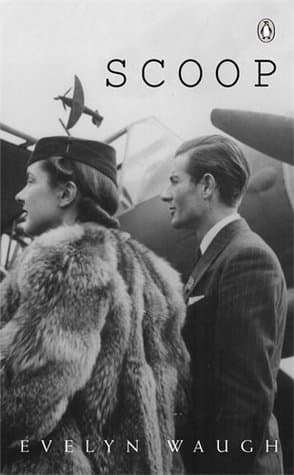
Synopsis
Covers the whole plot, including the ending.
- Difficulty
- Easy
- Pacing
- Fast
- Mood
- Humorous, Satirical, Witty, Absurdist
- Read it if
- You enjoy sharp, witty satire of journalism and social absurdities, with a classic British comedic style.
- Skip it if
- You prefer serious, character-driven dramas or dislike farcical plots and caricatured characters.
Scoop Plot Summary
Covers the whole plot, including the ending.
Lord Copper's Blunder
Lord Copper, the powerful and often misguided owner of the 'Daily Beast' newspaper, is at a dinner party. Mrs. Algernon Smith mentions a promising young writer named John Boot. Mistaking him for a distant cousin, William Boot, a reclusive nature columnist who writes the popular 'Lush Places' column, Lord Copper decides to send 'Boot' to cover a coming war in the fictional African country of Ishmaelia. William Boot, living a quiet life in the English countryside, is horrified by the sudden call to London and the news that he is to become a war correspondent, a job he is completely unsuited for. He tries to protest, but Lord Copper's orders are final, and the newspaper quickly prepares him for departure.
William's Unwilling Departure
Despite having no experience and feeling very uncomfortable with war reporting, William Boot receives an elaborate and unsuitable tropical kit from the 'Daily Beast'. He is given a large expense account, many gadgets he doesn't understand, and endless useless advice. His attempts to explain the mistake to editors and officials are met with blank stares or laughter. He is simply 'Boot,' the new star correspondent, and his fate is set. With a varied group of other journalists from rival papers, including the experienced and cynical Shumble and the flamboyant Wenlock Jakes, William begins the long journey to Ishmaelia, completely out of his depth and full of fear.
Arrival in Jacksonburg
William Boot arrives in Jacksonburg, the capital of Ishmaelia. The city is full of foreign journalists, diplomatic schemes, and general disorder. The 'war' itself is hard to find, with no clear front lines or fighters. The foreign press corps, including seasoned veterans and equally confused newcomers, stay at the luxurious Jacksonburg Hotel. They spend their days inventing stories, filing sensational but often false reports, and competing for non-existent scoops. William, overwhelmed by the heat, noise, and absurdity, struggles to understand anything. He feels isolated, unable to connect with other journalists or find any real news to report. Instead, he relies on his basic survival instincts and a wish to return home.
The Scramble for News
The 'war' in Ishmaelia remains largely a product of the journalists' imaginations. With no real fighting to report, the foreign correspondents resort to making up stories, exaggerating minor events, and copying each other's reports. Wenlock Jakes, a famous correspondent, is especially good at creating dramatic stories from nothing, often sending the same story with small changes to different papers. William Boot, unable to join this pretense, feels increasingly frustrated. He tries to report on local plants and animals, which amuses and confuses his editors back in London. The competition for 'scoops' becomes more desperate, leading to absurd lengths to invent news.
William's Unintentional Scoop
Through accidental encounters and misunderstandings, William Boot stumbles upon a real international conspiracy. German, Italian, and Soviet agents are competing for influence in Ishmaelia. He unknowingly becomes a pawn in their plans, befriending a young, charming German agent and getting caught in a small fight he barely understands. While the other journalists continue to invent their tales, William, because of his naive honesty and simple observations, begins to put together pieces of real events. He sends back a series of factual, though understated, reports about the true nature of the political maneuvering. These, in the context of the fabricated news, are seen as groundbreaking revelations by the 'Daily Beast'.
The Revolution and the Escape
Just as the international powers are about to secure their influence, a real, though brief, revolution breaks out in Ishmaelia. The country's leader, Dr. Benito Azani, is overthrown, and the foreign journalists are suddenly in the middle of actual events. William Boot, far from being a skilled war correspondent, survives the chaos through luck and the kindness of strangers. He meets the deposed Dr. Azani and, through comical misinterpretations, helps him escape. The other journalists, still focused on their made-up stories, are largely unaware of the true nature of the uprising, continuing to send back sensationalized but inaccurate reports.
The Return to Glory
Having unknowingly played a role in the Ishmaelian events, William Boot returns to England. He is hailed as a national hero and the 'Daily Beast's' greatest correspondent. His simple, factual reports, which stood out from the extravagant lies of his rivals, are seen as brilliant investigative journalism. Lord Copper, completely unaware of his initial mistake, takes full credit for discovering William's talent. William receives many awards, public speaking invitations, and a large bonus. He is very uncomfortable with the attention and false praise, wanting only the quiet solitude of his country home and his 'Lush Places' column. The irony of his situation is lost on everyone but himself.
John Boot's Frustration
Meanwhile, the actual John Boot, the aspiring novelist Lord Copper had originally intended to send to Ishmaelia, has been living in obscurity and frustration. He has been trying to get into journalism, sending serious, well-researched articles to various papers, only to be rejected. He watches with growing bitterness as his distant cousin, William, is praised for reports he believes he could have written better. John Boot remains an unrecognized talent, a victim of Lord Copper's random decisions and the chaotic nature of the newspaper world. His situation sharply contrasts with William's undeserved success, showing the theme of unearned recognition.
The Lush Places Legacy
Despite his new fame and the demands of celebrity, William Boot longs for his previous life. He struggles to write anything meaningful for the 'Daily Beast' after his return, finding no inspiration in the manufactured drama of Fleet Street. Eventually, the fickle public and the even more fickle newspaper industry forget about his 'heroics.' William is able to retreat back to his beloved country estate, resuming his 'Lush Places' column, which continues to be popular with readers. The column becomes his sanctuary, a place where he can genuinely express himself and observe the natural world, far from the absurdity and superficiality of the news cycle. His brief experience as a war reporter becomes a distant, confusing memory.
The Cycle Continues
The novel ends with Lord Copper, still confident in his own judgment, about to make another huge error. He is considering sending another unsuspecting person to cover a new, vaguely defined international crisis. The cycle of misinformation, incompetence, and accidental success seems likely to repeat within the 'Daily Beast' empire. The message is that news production, especially under leaders like Lord Copper, is flawed and prone to absurdity. Genuine talent is often overlooked for chance and sensationalism. William Boot's story illustrates this comedic and satirical truth.
Principal Figures
William Boot
Protagonist
A naive nature columnist mistakenly sent to cover a war.
William Boot is a gentle, reclusive, and utterly unqualified nature correspondent for the 'Daily Beast', known for his 'Lush Places' column. He loves the English countryside, its flora and fauna, and possesses a childlike innocence and honesty. He is deeply uncomfortable with social situations, violence, and the bustling world of journalism. His primary motivation is a desire for peace and quiet, and to return to his beloved home. He is a reluctant hero, achieving fame and success purely by accident and through the misinterpretations of others.
Relationships: Lord Copper (His unsuspecting, misguided employer.); John Boot (His overlooked, resentful cousin.); Shumble (A cynical fellow journalist he encounters in Ishmaelia.)
Lord Copper
Antagonist/Catalyst
The omnipotent and often misguided proprietor of the 'Daily Beast'.
Lord Copper is a powerful, self-assured, and utterly incompetent newspaper magnate. He prides himself on his intuitive flair for spotting talent but frequently makes monumental blunders, which he then stubbornly refuses to acknowledge. He speaks in a series of rhetorical questions and pronouncements, often leading his subordinates to guess his true meaning. His driving force is the maintenance of his newspaper's prestige and his own reputation, even if it means distorting reality. He represents the arbitrary and often absurd power structures within the media.
Relationships: William Boot (His accidental star correspondent, whom he believes he 'discovered'.); Mr. Salter (His long-suffering and sycophantic editor.)
Mr. Salter
Supporting
The 'Daily Beast' foreign editor, perpetually trying to decipher Lord Copper.
Mr. Salter is the long-suffering foreign editor of the 'Daily Beast', constantly trying to interpret Lord Copper's vague directives and implement them without offending his unpredictable boss. He is an expert in office politics and sycophancy, always ready with a 'Up to a point, Lord Copper' or 'Definitely, Lord Copper'. He is pragmatic and focused on the operational aspects of the newspaper, even if those operations are based on a faulty premise. He represents the bureaucracy and the fear that underpins the operations of the 'Daily Beast'.
Relationships: Lord Copper (His superior, whose every whim he tries to satisfy.); William Boot (The correspondent he is tasked with managing.)
Wenlock Jakes
Supporting
A flamboyant and utterly dishonest war correspondent.
Wenlock Jakes is a celebrated, yet entirely fraudulent, war correspondent for a rival newspaper. He is a master of invention, capable of fabricating sensational stories out of thin air and submitting the same 'scoop' to multiple papers with minor alterations. He is cynical, ambitious, and completely devoid of journalistic ethics, embodying the worst excesses of Fleet Street. He is driven by fame, money, and the thrill of outmaneuvering his rivals. His reports are more works of fiction than journalism, yet they are widely acclaimed.
Relationships: William Boot (A rival journalist whose genuine honesty contrasts with Jakes's lies.)
Shumble
Supporting
A cynical and experienced foreign correspondent.
Shumble is a seasoned foreign correspondent, weary and cynical from years of covering manufactured conflicts and dealing with the absurdities of the news industry. He is more grounded than Jakes but still participates in the general deception, albeit with less enthusiasm. He observes the chaos of Ishmaelia with a detached amusement, offering occasional, dry commentary. He represents the jaded professionalism that has adapted to, rather than challenged, the flawed system. He is a survivor in the cutthroat world of international journalism.
Relationships: William Boot (A fellow correspondent in Ishmaelia, whom he observes with mild pity.)
John Boot
Mentioned
William's aspiring novelist cousin, the intended Ishmaelia correspondent.
John Boot is the ambitious, earnest, and ultimately overlooked cousin of William Boot. He is an aspiring novelist and journalist, eager to make his mark in the literary world. He is well-read and intelligent, and genuinely seeks to report truth, but lacks the arbitrary stroke of luck that propels William to fame. He represents the genuine talent that is often ignored by the superficiality of the media industry, highlighting the theme of undeserved recognition and the randomness of success.
Relationships: William Boot (His distant cousin, whose success he resents.)
Dr. Benito Azani
Supporting
The deposed, but resilient, leader of Ishmaelia.
Dr. Benito Azani is the initial leader of Ishmaelia, a figure of some local importance who is caught in the crossfire of international intrigue. He is deposed during the brief revolution but manages to escape, largely due to William Boot's unwitting assistance. He is a somewhat comical figure, representing the often-minor players in developing nations whose fates are manipulated by larger global powers. Despite his predicament, he maintains a certain dignity and pragmatism, adapting to his changing circumstances.
Relationships: William Boot (The journalist who inadvertently aids his escape.)
Mrs. Algernon Smith
Mentioned
The dinner guest whose tip leads to Lord Copper's blunder.
Mrs. Algernon Smith is a minor character whose casual comment at a dinner party sets the entire plot in motion. Her innocent mention of 'John Boot' is misheard and misinterpreted by Lord Copper, leading to William Boot's disastrous assignment. She represents the often-unforeseen and trivial origins of major events, highlighting how easily mistakes can be made and perpetuated within a powerful, yet flawed, system.
Relationships: Lord Copper (The recipient of her crucial, yet misinterpreted, advice.)
Themes & Insights
The Absurdity of the Media
The novel satirizes the sensationalism, incompetence, and outright fabrication common in the newspaper industry. Lord Copper's arbitrary decisions, the journalists' invention of news, and the public's gullibility all show the media as a farcical, self-serving entity. This is clear in the entire premise of William Boot, a nature writer, being sent to cover a war, and the praise he later receives for simply reporting facts in a world of lies. The 'war' itself is made up, showing the media's power to create its own reality.
“Up to a point, Lord Copper.”
The Nature of Truth and Fabrication
Scoop explores the blurred lines between truth and fiction, especially in news reporting. The journalists in Ishmaelia, desperate for stories, openly invent events, characters, and conflicts. William Boot's accidental success comes from his inability to fabricate, which makes his simple, factual reports seem revolutionary. The novel suggests that in a world full of manufactured drama, real truth can be overlooked or, ironically, celebrated as a groundbreaking 'scoop' simply because it is rare. This theme is central to the contrast between Wenlock Jakes's elaborate lies and William's ordinary observations.
“News is what a chap who doesn't want to print it tries to suppress. Everything else is public relations.”
Incompetence and Undeserved Success
A main theme is how incompetence and arbitrary decisions can lead to unexpected success, while real talent goes unnoticed. Lord Copper's initial mistake in assigning William Boot to Ishmaelia starts everything. William, despite being completely unqualified, becomes a hero through luck and the misinterpretation of his simple reports. Conversely, his cousin John Boot, a truly aspiring and talented writer, remains unknown. This highlights the randomness of fame and fortune, and the often unfair distribution of recognition in society.
“He had sent the wrong Boot.”
Colonialism and International Intrigue
The fictional African nation of Ishmaelia serves as a backdrop for a satirical look at international power struggles and the lingering effects of colonialism. Various foreign powers (Germany, Italy, Soviet Union) are shown competing for influence, treating the country as a mere pawn in their geopolitical games. The local population and their concerns are largely ignored or misunderstood by the foreign correspondents and diplomats. The chaos and superficiality of the 'war' reflect a broader critique of how Western powers often view and interact with developing nations.
“The continent of Africa is a dark and mysterious place.”
Plot Devices & Literary Techniques
Mistaken Identity
The central comedic device, where one character is confused for another.
The entire plot of 'Scoop' hinges on Lord Copper's mistaken identity of William Boot for his more ambitious cousin, John Boot. This initial error sets in motion a chain of absurd events, as William is thrust into a role he is completely unsuited for. The persistence of this mistake, despite William's attempts to correct it, highlights the inflexibility and self-deception within the 'Daily Beast' and the wider media world. It's a classic comedic trope used to generate irony and satire.
Satire
The use of humor, irony, exaggeration, or ridicule to expose and criticize folly.
Waugh employs biting satire throughout 'Scoop' to lampoon the newspaper industry, political figures, and international relations. The exaggerated characters, the ludicrous situations (like inventing a war), and the cynical dialogue all serve to highlight the absurdities and moral failings of the subjects being criticized. The novel critiques the sensationalism of news, the incompetence of those in power, and the gullibility of the public, using humor as its primary weapon to deliver sharp social commentary.
Dramatic Irony
The audience's knowledge of events or circumstances that characters lack.
Dramatic irony is a pervasive device in 'Scoop', particularly concerning William Boot's 'success'. The reader is aware from the outset that William is a naive nature correspondent and that Lord Copper has made a mistake. This knowledge creates a constant layer of humor and pathos, as we watch William bumble through events and be praised for qualities he doesn't possess. The irony is heightened by the fact that the 'Daily Beast' staff and Lord Copper remain oblivious to the truth, attributing William's accidental triumphs to their own superior judgment.
The MacGuffin (The 'War' in Ishmaelia)
A plot device that drives the story but is ultimately unimportant in itself.
The 'war' in Ishmaelia functions as a MacGuffin. It is the catalyst that sends William Boot to Africa and creates the setting for the journalistic chaos, but its actual details or resolution are largely irrelevant to the novel's core themes. The 'war' is mostly a phantom, a figment of the journalists' imaginations, and its true nature is less important than the absurd reactions and behaviors it provokes among the characters. The fleeting, almost inconsequential nature of the actual conflict underscores the superficiality of the news coverage.
Scoop Quotes
“He had been to a public school and a university and knew, therefore, that the world was full of things that he had never heard of.”
“Up to a point, Lord Copper!”
“The great thing about the British Press is that it is free. Free from all trammels, free from all restrictions, free from all obligations save those which it chooses to impose upon itself.”
“Foreigners are news.”
“He became a hero through no will of his own, simply by being there.”
“The Press is a mighty engine, Mr. Boot. A mighty engine.”
“He had never felt so important in his life.”
“He did not know what was happening, but he knew that it was happening to him.”
“The more one learns about the world, the more one realizes how little one knows.”
“Journalism is not a profession. It is a dodge.”
“The truth is a terrible thing, Mr. Boot. Never let it stand in the way of a good story.”
“He was a man who knew precisely what he wanted, and he wanted it now.”
“Sometimes it is better to be a victim of circumstances than to be the author of one's own misfortunes.”
“News is what a chap who doesn't want to be bothered reads on his way to work.”
“He had achieved success, not by effort, but by the sheer, unadulterated force of his own incompetence.”
Quiz
10 questions on the plot and the characters. Each answer comes with a short explanation.
Question 1
Who is the proprietor of the 'Daily Beast' newspaper?
- Mr. Salter
- Lord Copper
- William Boot
- Mrs. Algernon Smith
Show answer
B. Lord Copper Lord Copper is clearly identified as the proprietor of the 'Daily Beast' and the central figure making decisions about its reporters.
Question 2
What African Republic is the promising 'little war' located in?
- Abyssinia
- Zanzibar
- Ishmaelia
- Rhodesia
Show answer
C. Ishmaelia The book explicitly states that the war is in the African Republic of Ishmaelia, which becomes the primary setting for the narrative.
Question 3
Who gives Lord Copper the initial tip about the 'chap' he should send to Ishmaelia?
- Mr. Salter
- Mrs. Algernon Smith
- Shumble
- Rathbone
Show answer
B. Mrs. Algernon Smith Lord Copper acts on a dinner-party tip from Mrs. Algernon Smith, who mistakenly recommends a different Mr. Boot.
Question 4
What is the primary role of William Boot at the 'Daily Beast' before he is sent to Ishmaelia?
- Political Correspondent
- Literary Editor
- Writer of the 'Lush Places' column
- Sports Reporter
Show answer
C. Writer of the 'Lush Places' column William Boot is known for writing the 'Lush Places' column, which focuses on nature and rural life, a stark contrast to war reporting.
Question 5
What is Lord Copper's characteristic phrase when he is wrong or confused, but wishes to assert authority?
- ''Up to a point, Lord Copper.'
- ''I am perfectly clear on this matter.'
- ''Great brains think alike.'
- ''Definitely, Lord Copper.'
Show answer
D. ''Definitely, Lord Copper.' Lord Copper frequently uses 'Definitely, Lord Copper' as a means to dismiss or incorrectly confirm information, often leading to confusion for his subordinates.
Question 6
What is the name of the rival newspaper that is also heavily involved in covering the Ishmaelian conflict?
- The Daily Mail
- The Daily Excess
- The Daily Chronicle
- The Times
Show answer
B. The Daily Excess The 'Daily Excess' is the primary rival newspaper in the story, constantly vying with the 'Daily Beast' for scoops and often resorting to similar sensationalism.
Question 7
Which character is mistaken for the intended war correspondent, leading to William Boot's misassignment?
- Lord Copper's son
- John Boot, a well-known novelist
- A foreign diplomat named Boot
- Another Daily Beast reporter named Boot
Show answer
B. John Boot, a well-known novelist The mix-up occurs because Mrs. Algernon Smith recommended John Boot, a celebrated author, but Lord Copper's staff mistakenly sends William Boot.
Question 8
What key theme does 'Scoop' primarily satirize through its portrayal of Fleet Street?
- The decline of the British Empire
- The ethical standards and sensationalism of journalism
- The class system in England
- The futility of war
Show answer
B. The ethical standards and sensationalism of journalism The novel is described as a 'brilliantly irreverent satire of 'Fleet Street' and its hectic pursuit of hot news,' directly targeting journalistic practices.
Question 9
How does William Boot ultimately achieve his 'scoop' despite his lack of journalistic skill?
- He uncovers a genuine, hidden political conspiracy.
- He accidentally reports on a minor local event which is exaggerated by the newspaper.
- He unknowingly becomes central to the conflict and is simply present when a major event occurs.
- He bribes a local official for exclusive information.
Show answer
C. He unknowingly becomes central to the conflict and is simply present when a major event occurs. William Boot's success is largely due to pure luck and his unassuming nature; he's in the right place at the right time when a 'revolution' of sorts unfolds around him, without him actively seeking it.
Question 10
What is the typical attitude of the foreign correspondents in Ishmaelia towards the actual events of the 'war'?
- They are meticulous in verifying every detail.
- They often invent or heavily embellish stories to meet deadlines and impress their editors.
- They are genuinely concerned with humanitarian aid.
- They frequently collaborate to ensure accurate reporting.
Show answer
B. They often invent or heavily embellish stories to meet deadlines and impress their editors. The novel satirizes the correspondents by showing them often fabricating or wildly exaggerating events, sometimes even from the comfort of their hotel, rather than actively reporting on a non-existent or minor conflict.
Scoop FAQ
What is the central premise of 'Scoop'?
'Scoop' follows William Boot, a nature correspondent mistakenly sent by newspaper magnate Lord Copper to cover a civil war in the fictional African country of Ishmaelia. The novel satirizes the sensationalism and inaccuracies of Fleet Street journalism as Boot bumbles through the assignment, often fabricating news.
Who is Lord Copper and what is his role in the story?
Lord Copper is the proprietor of the 'Daily Beast' newspaper, known for his dictatorial style and a peculiar habit of always agreeing with the last thing said to him, prefacing his agreement with 'Up to a point, Lord Copper.' His flawed intuition leads him to dispatch the wrong Boot to Ishmaelia, setting the entire comedic plot in motion.
Who is William Boot and what is his typical journalistic beat before Ishmaelia?
William Boot is a shy, unassuming nature correspondent for the 'Daily Beast,' known for his quaint column 'Lush Places,' which features whimsical observations about flora and fauna. He lives a quiet life in the countryside, completely unprepared for the chaos and danger of reporting on a foreign conflict.
How does William Boot end up being sent to Ishmaelia instead of his cousin John Boot?
Lord Copper, acting on a tip from Mrs. Algernon Smith about a talented 'Boot,' mistakenly believes she means William. Despite initial confusion, the error is never corrected, and William is assigned to cover the war, while John Boot, the intended foreign correspondent, is left behind.
What is the significance of the fictional country of Ishmaelia?
Ishmaelia serves as a chaotic, underdeveloped African nation experiencing a civil war between various factions, including the local leader Dr. Benito and the rebel leader Mr. Jackson. It acts as a blank canvas for the foreign correspondents to project their preconceived notions and invent sensational stories, highlighting the absurdity of media coverage.
What is the 'Boot' family's peculiar history with journalism?
The Boot family has a long, if somewhat obscure, history of contributing to the 'Daily Beast,' with various members, including William and John, on the payroll. This family connection is part of what makes Lord Copper's initial misidentification of 'a Boot' so plausible to him, despite the wildly different talents of the cousins.
What is the running gag about Lord Copper's catchphrase 'Up to a point, Lord Copper'?
Lord Copper's catchphrase, 'Up to a point, Lord Copper,' is a satirical device highlighting his inability to form independent opinions. He uses it to agree with the last person who spoke to him, illustrating his lack of conviction and his reliance on others, even when their statements are contradictory.
How does the 'Daily Beast' manipulate news even before William Boot arrives in Ishmaelia?
The 'Daily Beast' has a pre-written set of headlines and stock phrases for foreign news, such as 'BRITISH PRESTIGE HIGH' or 'BRITISH PRESTIGE LOW,' which they apply regardless of actual events. This demonstrates the newspaper's predetermined narrative and its disinterest in factual reporting, prioritizing sensationalism over truth.
What role do characters like Mr. Salter and the other foreign correspondents play in the satire?
Mr. Salter, the foreign editor, and the other correspondents like Wenlock Jakes and Shumble, embody various journalistic stereotypes: the cynical veteran, the opportunist, and the fabricator. They collectively illustrate the competitive, often unethical, environment of foreign reporting, where scoops are often invented rather than discovered.
How does William Boot's naivety contribute to the novel's comedic effect?
William's profound naivety and lack of worldly experience create constant ironic humor. His attempts to report on a war with a nature correspondent's sensibility lead to absurd observations and misunderstandings, making him an unwitting agent of satire as he innocently exposes journalistic malpractice.
What psychological pressures does William Boot face in Ishmaelia?
William faces immense pressure to produce a 'scoop' despite his complete unsuitability for the task and his lack of understanding of the conflict. He struggles with loneliness, fear, and the moral dilemma of fabricating news, which ultimately leads him to embrace the absurd reality of his situation.
How do the other journalists in Ishmaelia react to William Boot, and what does this reveal about their psychology?
The other journalists initially mock William for his inexperience but later exploit his innocence, using him for their own ends or dismissing him as irrelevant. Their competitive and cynical psychology is revealed through their willingness to lie, steal stories, and prioritize personal gain over journalistic integrity.
In what ways does 'Scoop' critique the public's consumption of news?
'Scoop' implies that the public is largely uncritical and easily swayed by sensational headlines, reinforcing the cycle of misinformation. The newspaper's success despite its inaccuracies suggests a public appetite for entertainment and simplified narratives over complex truths, making them complicit in the journalistic farce.
Is William Boot a hero or merely a pawn in the satirical game?
William Boot is more of an unwitting pawn than a traditional hero. While he achieves a 'scoop' by accident, he never actively seeks to expose the truth or challenge the system. His journey highlights the absurdity of the media world, but he remains largely a passive recipient of circumstances, making him a vehicle for Waugh's satire.
What is the ultimate message about truth and fiction in journalism that 'Scoop' conveys?
'Scoop' suggests that in the pursuit of 'hot news,' the line between truth and fiction in journalism often blurs, becoming irrelevant to the media outlets and their consumers. The novel argues that sensationalism and narrative convenience frequently take precedence over factual reporting, leading to a distorted public understanding of events.
How does the novel use irony to deliver its satirical message?
Irony is central to 'Scoop,' from the initial mistaken identity of William Boot to his accidental success as a war correspondent. The irony lies in the fact that the most incompetent journalist achieves the greatest 'scoop,' exposing the arbitrary nature of fame and the superficiality of journalistic success, as well as the absurdity of the real-world events themselves.
What is the significance of the final scene where William Boot returns to his 'Lush Places' column?
William's return to 'Lush Places' signifies his rejection of the chaotic, dishonest world of foreign journalism in favor of his simple, authentic life. It suggests that while he experienced a grand adventure, he found no true fulfillment in the fabricated glory, preferring the genuine peace of his previous existence.
How does Waugh use exaggeration and caricature to enhance the satire?
Waugh employs exaggeration in characters like the perpetually agreeable Lord Copper and the sensationalist journalists, turning them into caricatures of Fleet Street's flaws. This hyperbole amplifies the absurdities of the news industry, making its critique more potent and humorous by pushing its characteristics to their illogical extremes.
About the author

Arthur Evelyn St. John Waugh was an English writer of novels, biographies, and travel books; he was also a prolific journalist and book reviewer. His most famous works include the early satires Decline and Fall (1928) and A Handful of Dust (1934), the novel Brideshead Revisited (1945), and the Second World War trilogy Sword of Honour (1952–1961). He is recognised as one of the great prose stylists of the English language in the 20th century.
Similar books
- Vile Bodies
Evelyn Waugh
3.8 (12k) average on GoodreadsLiterary FictionShares Waugh's signature satirical tone and critique of societal institutions.
- Lucky Jim
Kingsley Amis
3.8 (25k) average on GoodreadsLiterary FictionFeatures an unassuming protagonist thrust into an absurd situation, with a focus on comedic social commentary.
- The Hitchhiker's Guide to the Galaxy
Douglas Adams
4.2 (1.4M) average on GoodreadsFantasyEmploys an absurdist sense of humor and a protagonist who finds himself in extraordinary circumstances through no fault of his own.
- Coming Up for Air
George Orwell
3.8 (12k) average on GoodreadsLiterary FictionWhile both Scoop and Coming Up for Air (1939) are satires of pre-war British society, Orwell's novel focuses more on personal nostalgia, the decline of traditional English life, and the anxieties of impending war. Scoop, in contrast, specifically targets the absurdities and ethical failings of journalism and the press, making its critique more narrowly focused on media manipulation.
- Brave New World
Aldous Huxley
4.0 (1.4M) average on GoodreadsFantasyBrave New World (1932) is a dystopian novel that critiques technological advancement, social conditioning, and the loss of individuality. While it shares Scoop's satirical edge, Huxley's target is a much broader future society and its control mechanisms, whereas Waugh's satire is acutely focused on the contemporary British media landscape, its inherent biases, and its capacity for self-deception and fabrication.
- Nineteen Eighty-Four
George Orwell
4.2 (5.5M) average on GoodreadsFictionWinston Smith dreams of truth and rebellion in a world where Big Brother watches all, but he confronts the terrifying power of a regime that controls not just actions, but thoughts.



Enjoyed the summary?
A summary gives you the shape of the book. The book itself has the detail, the examples and the voice.
Find Scoop on AmazonAs an Amazon Associate, BookBrief earns from qualifying purchases. How we're funded