
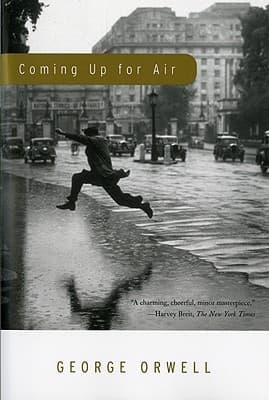
Synopsis
Covers the whole plot, including the ending.
- Difficulty
- Medium
- Pacing
- Moderate
- Mood
- Melancholic, Reflective, Satirical, Nostalgic, Somber
- Read it if
- You appreciate a poignant, satirical look at pre-WWII English society, nostalgia, and the disillusionment of aging.
- Skip it if
- You prefer fast-paced plots or avoid stories with a melancholic, reflective tone about lost innocence and societal change.
Coming Up for Air Plot Summary
Covers the whole plot, including the ending.
A Fat Man's Revelation
George Bowling, a forty-five-year-old insurance salesman, reflects on his physical decline and his mundane life with his wife, Hilda, and their two children in a London suburb. He feels trapped by work and family, and the threat of war gives him a sense of impending doom. George remembers his childhood in Lower Binfield, a simpler time before World War I. He wins ten pounds on a horse race and secretly decides to use the money to revisit his village and fish for the mythical giant carp in a pond he remembers.
The Impulse to Escape
Driven by a need to escape his routine, George plans his secret trip. He tells Hilda he is attending a conference in the Midlands and packs his fishing gear. He seeks more than a holiday; he wants to reconnect with a lost past, to find authenticity and peace his present life lacks. He longs for his youth and the memory of the carp in the pond, a link to that era.
Journey Back to Lower Binfield
George leaves for Lower Binfield, his childhood village, feeling both excited and worried. As he travels, he compares the modern landscape with the pastoral scenes in his memory. He recalls his youth: his father, a corn-chandler; his rebellious elder brother, Joe; and other village residents. The journey itself becomes a trip through time, bringing him closer to a physical past he hopes will offer solace.
Arrival and Disillusionment
Arriving in Lower Binfield, George sees how much it has changed. The sleepy village of his memory is now a sprawling, modernized suburb. Old landmarks are gone, replaced by housing estates, factories, and busy roads. Familiar faces are absent, and the community he remembered has vanished. This disappointment sets a melancholic tone for his visit, as his idealized past clashes with the present.
The Lost Pond
George's main goal is to find the carp pond where he fished as a boy. He remembers it as a secluded, almost mystical place with an elusive, giant carp. After much searching, he finds the pond has been drained and filled in, now covered by a housing development. This is a blow, symbolizing the erasure of his past and the impossibility of recapturing his youth. The loss of the pond represents the broader changes across England.
Encounters with the Past
During his stay, George meets Elsie, a woman he had a brief affair with in his youth. Elsie, now an aging, disillusioned woman, works in a shop. Their reunion is awkward, highlighting the contrast between their youthful hopes and current realities. This meeting makes George confront his past choices, reinforcing his feelings of nostalgia and the irreversible nature of time. He also visits his family home, now occupied by strangers.
The Threat of War
While in Lower Binfield, George sees an unexpected and terrifying event: an accidental bombing by the Royal Air Force during a practice drill. Bombs fall near the village, causing panic and destruction. This shatters any illusions of peace and escape, bringing the world's threats into his personal quest. It reminds him that the world has changed, and the future promises more violence, making his nostalgia futile.
Reflections on Progress and Decay
George spends his remaining time in Lower Binfield reflecting on the rapid changes he has seen. He despairs over the loss of natural beauty, the homogenization of culture, and the replacement of community with suburban sprawl. He sees the coming war not just as a conflict but as a final blow to the world he knew, an outcome of the 'progress' that erased his past. His reflections are pessimistic about England's future.
The Return to Routine
After his disappointing trip, George returns to his suburban home and his routine with Hilda and the children. The escape was short-lived and did not provide the solace he sought. He is more resigned to his fate but also has a clearer, though bleak, understanding of the forces shaping his world. The glimpse of his past only highlighted its loss, leaving him with melancholy and an awareness of the impending global conflict.
The Inevitable Future
In the novel's closing, George Bowling expresses fatalism about the future. He believes war is inevitable and will bring destruction. He foresees a world of totalitarianism, scarcity, and constant conflict, where freedom and simple pleasures will be crushed. His journey to the past confirms his belief that his idyllic youth is gone, replaced by a grim, inescapable future. He feels powerless to change events.
Coming Up for Air Characters
George Bowling
Protagonist
A middle-aged insurance salesman yearning for his lost youth.
George Bowling is a portly, forty-five-year-old insurance salesman living a mundane suburban life. He is deeply nostalgic for his childhood in Lower Binfield, which he idealizes as a time of simplicity and authenticity. George is acutely aware of his physical decline and the suffocating routine of his marriage and job. He is intelligent and reflective, with a keen observational eye for the absurdities and hypocrisies of modern life, but also prone to self-pity and a sense of powerlessness. His internal monologues reveal a man wrestling with disillusionment and a profound fear of the future.
Relationships: Hilda Bowling (Wife, a source of domestic constraint and irritation); Joe Bowling (Rebellious elder brother from his youth); Elsie (Former lover from his youth, a reminder of lost passion)
Hilda Bowling
Supporting
George's conventional and somewhat nagging wife.
Hilda is George's wife, a representative of the conventional, suburban domesticity that George finds stifling. She is practical, concerned with appearances, and preoccupied with the mundane details of household management and social standing. George often perceives her as dull and uninspiring, contributing to his sense of entrapment. While not malicious, she embodies the forces that keep George tethered to a life he finds unfulfilling, often failing to understand his deeper anxieties or nostalgic longings.
Relationships: George Bowling (Husband, a source of mutual irritation and domestic obligation)
Joe Bowling
Mentioned
George's rebellious older brother from his youth.
Joe is George's older brother, who features prominently in George's nostalgic recollections of his childhood. Joe was a wild, adventurous, and somewhat irresponsible figure who ran away from home and joined the army. He represents a spirit of freedom and defiance that George admired and perhaps envied. His character serves to highlight the contrast between George's own conventional path and the more adventurous, albeit ultimately tragic, life Joe pursued, adding another layer to George's reflections on choices and destiny.
Relationships: George Bowling (Brother, a figure of admiration and lost youth)
Elsie
Supporting
A former lover from George's youth, now working in a shop.
Elsie is a woman George had a brief, passionate affair with during his youth in Lower Binfield. She represents a youthful romance and a path not taken. When George encounters her again, she is an older, tired woman, working in a shop, her youthful spark diminished. Her appearance serves as a poignant reminder of the passage of time, the fading of beauty, and the unfulfilled promises of youth. Her interaction with George underscores the theme of disillusionment and the irreversible changes wrought by time.
Relationships: George Bowling (Former lover, a symbol of lost romance and youth)
Old Porteous
Mentioned
The owner of the carp pond from George's youth.
Old Porteous is the owner of the legendary carp pond in George's childhood memories. He is a gruff, eccentric figure who guarded his pond and its mythical giant carp with fierce possessiveness. Porteous symbolizes the old ways, the rural characters who inhabited the pre-war English countryside. His presence in George's memory highlights the contrast between the natural, untamed world of his youth and the industrialized, developed landscape of the present. The disappearance of Porteous and his pond signifies the death of a certain way of life.
Relationships: George Bowling (Figure from childhood, associated with the carp pond)
The Children
Supporting
George and Hilda's two unnamed children.
George and Hilda have two children, a boy and a girl, who remain unnamed and largely undifferentiated. They represent the responsibilities and demands of George's domestic life, contributing to his feeling of being trapped. They are symbols of the future, yet George often views them with a detached, almost resentful affection, seeing them as part of the endless cycle of suburban existence that he finds so stifling. Their presence reinforces the generational divide and George's anxieties about the world they will inherit.
Relationships: George Bowling (Children, a source of domestic responsibility and future anxiety); Hilda Bowling (Children, a shared domestic responsibility)
Coming Up for Air Themes
Nostalgia and the Irretrievable Past
The novel shows George Bowling's intense nostalgia for his childhood in Lower Binfield, a time he sees as simpler, more authentic, and less threatened by war and modernization. His trip is an attempt to recapture this past, especially through the symbol of the giant carp in the pond. However, his journey proves the past is gone; the village is unrecognizable, the pond is gone, and his old flame, Elsie, is aged. This theme highlights the futility of trying to return to a past that exists only in memory, and the pain of seeing its physical destruction.
“You can't get away from it. The past is gone, the future is coming, and the present is hell.”
The Threat of War and Totalitarianism
A pervasive sense of impending war and societal collapse hangs over the novel. George constantly thinks about the growing militarization of Europe and the inevitability of a devastating global conflict. The accidental bombing during his trip is a tangible manifestation of this threat, shattering any illusion of peace. Orwell uses George's thoughts to predict a future dominated by totalitarianism, rationing, and destruction, reflecting anxieties of the pre-World War II era. This theme shows the fragility of peace and the destructive nature of unchecked power.
“The thing that's coming is a world where there won't be any room for people like me, or people like you. It'll be a world of jackboots and truncheons.”
Disillusionment with Modernity and Progress
George Bowling is disillusioned with the 'progress' that has changed England. He laments the destruction of natural beauty, the rise of suburban sprawl, the homogenization of culture, and the loss of community. The transformation of Lower Binfield from a charming village to an industrialized suburb shows this theme. Orwell critiques the soullessness of modern life, the artificiality of advertising, and the erosion of traditional values, suggesting that 'progress' is often a form of decay leading to a less fulfilling and more dangerous world.
“It's all the same, the whole bloody world. All the same, all going the same way. The age of the common man, they call it.”
The Search for Authenticity and Freedom
George's secret trip is driven by a desperate search for authenticity and freedom, an escape from the 'smell of the suburb' and the phoniness of his life. He yearns for a time when life felt more real, less constrained by social expectations and possessions. The giant carp in the pond symbolizes this elusive authenticity and the wild aspects of nature that have been lost. His failure to find the pond or recapture his past highlights the difficulty of finding genuine freedom in a rapidly changing, controlled world.
“What I wanted was a breath of air, a gulp of the past, a sniff of freedom.”
Plot Devices & Literary Techniques
First-Person Narration (Stream of Consciousness)
The story is told entirely through George Bowling's internal thoughts and reflections.
The novel is narrated in the first person by George Bowling, providing direct access to his thoughts, memories, anxieties, and cynical observations. This stream-of-consciousness style allows for deep characterization, revealing George's complex inner world, his profound nostalgia, and his pessimistic worldview. It also enables Orwell to weave social commentary and philosophical reflections seamlessly into the plot, as George's internal monologues often digress into broader critiques of society, modernity, and the impending war. This subjective perspective makes George a highly unreliable but compelling narrator.
Symbolism of the Carp Pond
The carp pond represents George's idealized past and the lost innocence of England.
The carp pond and the mythical giant carp within it serve as powerful symbols throughout the novel. For George, the pond represents the unspoiled, authentic, and peaceful world of his youth, a tangible link to a bygone era. The giant carp itself symbolizes the elusive, almost mythical quality of that lost past, something pure and wild that existed before the onset of industrialization and war. Its discovery that the pond has been filled in and built over is a devastating blow, symbolizing the irretrievable loss of his personal past and the broader destruction of rural England.
Flashbacks and Recollections
Frequent shifts between George's present journey and vivid memories of his childhood.
The narrative frequently employs flashbacks, as George's present-day experiences trigger detailed recollections of his childhood in Lower Binfield. These flashbacks are not linear but rather appear as George's mind wanders, providing rich context for his nostalgia and disillusionment. They contrast the idyllic, simpler world of his youth with the grim realities of his middle age and the modern world. This device allows Orwell to explore themes of memory, the passage of time, and the transformative changes that have occurred in England over three decades, without disrupting the forward momentum of George's journey.
The Accidental Bombing
An unexpected RAF bombing drill shatters George's nostalgic escape.
The accidental bombing by the RAF during George's stay in Lower Binfield is a crucial plot device. It serves as a stark, violent intrusion of the external world's threats into his personal quest for peace and the past. This event shatters any lingering illusions of idyllic escape and forcefully brings the reality of impending war to the forefront of his mind. It acts as a powerful symbol of the destructive forces at play in the modern world, making George's nostalgic yearnings seem increasingly futile and highlighting the inescapable nature of global conflict.
Coming Up for Air Quotes
“It’s a pity that youth has to be wasted on the young.”
“I’m fat, but I’m not a fool.”
“The great thing about it, the thing that makes it so frightening, is that it’s going to happen.”
“We are the children of the Great War, and we are going to be the fathers of the next.”
“The past is a dream, the future is a nightmare.”
“You can’t go home again, not to the home that was.”
“The whole point of life is that it is going to end.”
“We're all getting ready for the great smash.”
“It was a good life, a life of beer and baccy and a bit of a flutter now and again.”
“Down in the bottom of my mind I knew that I was going to die. And I didn't care a damn.”
“The world was coming up for air, and it was going to drown.”
“It’s a world of 'isn’t it wonderful?' when you know perfectly well that it isn’t.”
“But the truth is that when you're young you don't know what you're doing, and when you're old you can't.”
“The one thing that was certain was that it was going to happen.”
“It was all so safe, so solid, so unchangeable. And now look at it.”
Quiz
10 questions on the plot and the characters. Each answer comes with a short explanation.
Question 1
What is George Bowling's profession at the beginning of 'Coming Up for Air'?
- Bank Manager
- Insurance Salesman
- School Teacher
- Factory Worker
Show answer
B. Insurance Salesman George Bowling is explicitly described as a middle-aged insurance salesman, a detail that highlights his ordinary, suburban existence.
Question 2
What prompted George Bowling to take a holiday and return to his childhood village?
- A sudden inheritance
- A mid-life crisis
- Winning money from a bet
- His wife insisted he take a break
Show answer
C. Winning money from a bet The novel states that after winning some money from a bet, George decides to revisit his past.
Question 3
What specific activity does George Bowling intend to do in the pool he remembers from his youth?
- Swimming
- Boating
- Fishing for carp
- Picnicking by the water
Show answer
C. Fishing for carp George's primary nostalgic goal is to fish for carp in the pool he remembers from thirty years before.
Question 4
What is the primary emotional state George experiences upon returning to Lower Binfield?
- Joy and contentment
- Disappointment and disillusionment
- Indifference
- Fear and anxiety
Show answer
B. Disappointment and disillusionment He finds the village 'changed beyond recognition' and the pool 'gone,' leading to a strong sense of loss and disillusionment regarding his nostalgic expectations.
Question 5
What significant event occurs during George's holiday in his old village, symbolizing the encroaching modern world and potential conflict?
- He meets an old flame
- A local fair takes place
- An accidental bombing by the RAF
- He discovers a hidden treasure
Show answer
C. An accidental bombing by the RAF The text explicitly states that 'the principal event of his holiday is an accidental bombing by the RAF,' highlighting the pre-war anxieties.
Question 6
How long has it been since George Bowling last visited his childhood village before his holiday?
- Ten years
- Twenty years
- Thirty years
- Forty years
Show answer
C. Thirty years He goes back to fish for carp in a pool he remembers from 'thirty years before,' indicating the significant passage of time.
Question 7
What does the disappearance of the fishing pool and the unrecognizable changes in the village primarily symbolize?
- The triumph of progress
- The inevitable loss of the past and the destruction of innocence
- George's failing memory
- The economic decline of rural England
Show answer
B. The inevitable loss of the past and the destruction of innocence The profound changes and loss of his childhood landmarks symbolize the theme of lost innocence, the impossibility of returning to the past, and the destructive march of modern industrial society.
Question 8
George Bowling's suburban home life, with his wife and two children in a row house, is presented as:
- A source of great happiness and fulfillment
- A mundane, suffocating existence from which he seeks escape
- A symbol of upper-class comfort and privilege
- An idyllic, simple life free from modern worries
Show answer
B. A mundane, suffocating existence from which he seeks escape The description of him as a 'middle-aged insurance salesman' living in an 'average English suburban row house' with a family he seeks to escape from, implies a sense of mundane, suffocating routine, a common Orwellian critique of modern life.
Question 9
The novel's tone, described as 'comic,' juxtaposed with themes of loss and impending war, creates what kind of effect?
- Pure escapist entertainment
- A lighthearted exploration of nostalgia
- A darkly humorous and ironic commentary on pre-war anxieties and the absurdity of modern life
- A straightforward historical account of the 1930s
Show answer
C. A darkly humorous and ironic commentary on pre-war anxieties and the absurdity of modern life Orwell often used satire and dark humor to critique society. The 'comic novel' aspect, combined with the bleak realities of industrial change and impending war, creates an ironic commentary on the anxieties and absurdities of the period.
Question 10
How does George Bowling's journey to his past ultimately affect his outlook on the future?
- He finds renewed hope and optimism for societal progress.
- He becomes even more convinced of the inevitability of war and the decay of traditional English life.
- He decides to move back to the countryside permanently.
- He dismisses his past entirely and embraces his present suburban life.
Show answer
B. He becomes even more convinced of the inevitability of war and the decay of traditional English life. His disillusionment with the changed village and the accidental bombing reinforce his existing anxieties about the future, particularly the looming threat of war and the irreversible loss of a simpler past, rather than instilling hope.
Coming Up for Air FAQ
What is the central premise of 'Coming Up for Air'?
The novel follows George Bowling, a disillusioned middle-aged insurance salesman, as he attempts to recapture his idyllic childhood by returning to his hometown of Lower Binfield. He hopes to revisit a specific fishing pool and escape the drudgery of his suburban life, only to find profound changes and disillusionment awaiting him.
Who is George Bowling and what are his primary motivations?
George Bowling is the protagonist, a portly, cynical, and introspective man in his late forties. His primary motivation is a deep nostalgia for his pre-World War I childhood, driven by a fear of impending war and a desire to escape the perceived ugliness and conformity of modern life. He seeks solace and meaning in the past.
What significant event triggers George's journey back to Lower Binfield?
George's journey is triggered by winning ten pounds from a horse race bet, which he decides to keep secret from his wife, Hilda. This small windfall provides him with the financial means and the psychological impetus to escape his routine and embark on his nostalgic quest.
How has Lower Binfield changed since George's childhood?
Lower Binfield has undergone radical transformation. The rural landscape has been swallowed by suburban development, the fishing pool George remembers is gone, replaced by a housing estate, and the quaint village feel has been obliterated by modernity, rendering it unrecognizable to him.
What is the significance of the accidental RAF bombing incident?
The accidental RAF bombing, which George witnesses during his trip, serves as a stark and literal manifestation of the impending war he so dreads. It shatters any remaining illusions of peace or escape, directly bringing the future's threat into his nostalgic past.
What is the implied fate of Elsie, George's childhood sweetheart?
Elsie, George's youthful love, is revealed to have become significantly overweight and unattractive, running a shop in Lower Binfield. This transformation deeply disappoints George, symbolizing the irreversible decay of his idealized past and the harsh realities of time.
What is the significance of George's obsession with fishing, particularly for carp?
Fishing, especially for the elusive carp in the remembered pool, symbolizes George's yearning for a simpler, more authentic existence and his desire to 'catch' a piece of his lost youth. The act itself represents a connection to nature and a meditative escape from modern anxieties.
How does George's relationship with his wife, Hilda, reflect his disillusionment?
George's relationship with Hilda is characterized by a lack of genuine connection and mutual understanding. He views her as an embodiment of the suburban monotony and social climbing he despises, further fueling his desire to escape their shared life and seek solace in the past.
What role does the character of Porteous play in George's life?
Porteous is George's friend and colleague, who represents a more conventional, albeit equally unfulfilled, suburban existence. He serves as a foil to George's deeper philosophical anxieties, highlighting the widespread nature of disillusionment in their society.
How does George Bowling's internal monologue reflect the psychological state of pre-WWII England?
George's internal monologue, filled with anxieties about war, the loss of tradition, and the rise of consumerism, mirrors the collective unease and sense of impending doom in England during the late 1930s. His personal fears are a microcosm of broader societal anxieties.
Discuss George's 'coming up for air' metaphor. What does it signify psychologically?
The 'coming up for air' metaphor signifies George's desperate attempt to escape the suffocating pressures of his mundane life and the looming threat of war. Psychologically, it represents a yearning for freedom, authenticity, and a brief reprieve from the overwhelming anxieties that define his existence.
How does Orwell use George's physical appearance and eating habits to reflect his character's psychological state?
George's portly physique and indulgent eating habits (like his love for fried fish and chips) are portrayed as coping mechanisms for his deep-seated unhappiness and anxiety. They symbolize his attempts to fill an emotional void and find comfort in sensory pleasures amidst a life he finds dissatisfying.
What is the psychological impact of George's failed nostalgic quest?
George's failed quest leaves him profoundly disillusioned and resigned. The destruction of his childhood idyll forces him to confront the irreversible nature of time and the futility of escaping the present. He returns to his life with a deeper, more painful awareness of his entrapment.
Is 'Coming Up for Air' primarily a pessimistic novel, or does it offer any glimmers of hope?
While largely pessimistic in its portrayal of modernity and impending war, the novel offers subtle glimmers of hope through George's brief moments of genuine connection to nature and his profound capacity for reflection. His very act of seeking meaning, however futile, suggests an enduring human spirit.
How does the novel serve as a critique of modern consumerism and suburbanization?
Orwell uses George's observations to sharply critique the homogenization brought by suburbanization and the empty promises of consumerism. The transformation of Lower Binfield into a generic housing estate and the proliferation of chain stores symbolize the loss of individuality and authentic community.
What is Orwell's broader message about the nature of memory and nostalgia in 'Coming Up for Air'?
Orwell suggests that memory and nostalgia, while powerful, can be deceptive and ultimately unfulfilling. The past is irretrievable, and clinging to idealized memories can prevent one from confronting present realities. The novel argues for facing the future, however grim, rather than retreating into a lost past.
How does George Bowling embody the 'common man' in Orwell's critique of society?
George Bowling embodies the 'common man' through his ordinary job, suburban existence, and relatable anxieties about money, family, and the future. Orwell uses his perspective to articulate a critique of how larger societal forces, like industrialization and war, impact the individual's sense of self and happiness.
To what extent is George's disillusionment a personal failure versus a societal one?
George's disillusionment is a complex blend of personal and societal factors. While his individual character traits contribute, Orwell strongly emphasizes how external societal changes—war, urban sprawl, consumerism—are the primary drivers of his despair, making his plight a commentary on broader societal failures.
About the author

Eric Arthur Blair, better known by his pen name George Orwell, was an English novelist, essayist, journalist, and critic. His work is characterised by lucid prose, social criticism, opposition to totalitarianism, and support of democratic socialism.
Similar books
- Nineteen Eighty-Four
George Orwell
4.2 (5.5M) average on GoodreadsFictionExplores themes of societal control, memory, and the individual's struggle against overwhelming forces, though 'Coming Up for Air' is less dystopian.
- The Road to Wigan Pier
George Orwell
3.9 (16k) average on GoodreadsPoliticsOffers a critical look at English society and class, blending personal reflection with social commentary.
- A Handful of Dust
Evelyn Waugh
3.9 (23k) average on GoodreadsLiterary FictionShares a satirical perspective on English society and the decline of traditional values, with a protagonist facing disillusionment.
- Brave New World
Aldous Huxley
4.0 (1.4M) average on GoodreadsFantasyWhile both Coming Up for Air and Brave New World (1932) critique modern society, Orwell's novel focuses on the insidious, almost accidental decay of traditional values and the creeping threat of authoritarianism, rooted in a recognizable past and present. Huxley's dystopia, conversely, presents a more radical, technologically engineered future where human nature itself has been fundamentally altered. Orwell's fear is of what we are losing; Huxley's is of what we might become through deliberate design. Orwell's protagonist, Bowling, yearns for a lost past, whereas Huxley's John the Savage struggles against a future that has erased the past entirely. Orwell's critique feels more grounded in immediate social observation, as noted by critics like Alex Zwerdling in Orwell and the Left, who emphasize Orwell's engagement with contemporary political realities.
- The Old Man and the Sea
Ernest Hemingway
3.8 (831k) average on GoodreadsLiterary FictionA Cuban fisherman's long struggle with a giant marlin becomes a story of endurance and dignity, now retold for young adults with illustrations, phonetic guides, and writing prompts in Traditional Chinese.
- One Hundred Years of Solitude
Gabriel García Márquez
4.1 (753k) average on GoodreadsLiterary FictionThrough the multi-generational story of the Buendía family, a mythical town deals with the repeating patterns of time, love, and solitude, as the extraordinary mixes with the ordinary.





Enjoyed the summary?
A summary gives you the shape of the book. The book itself has the detail, the examples and the voice.
Find Coming Up for Air on AmazonAs an Amazon Associate, BookBrief earns from qualifying purchases. How we're funded