
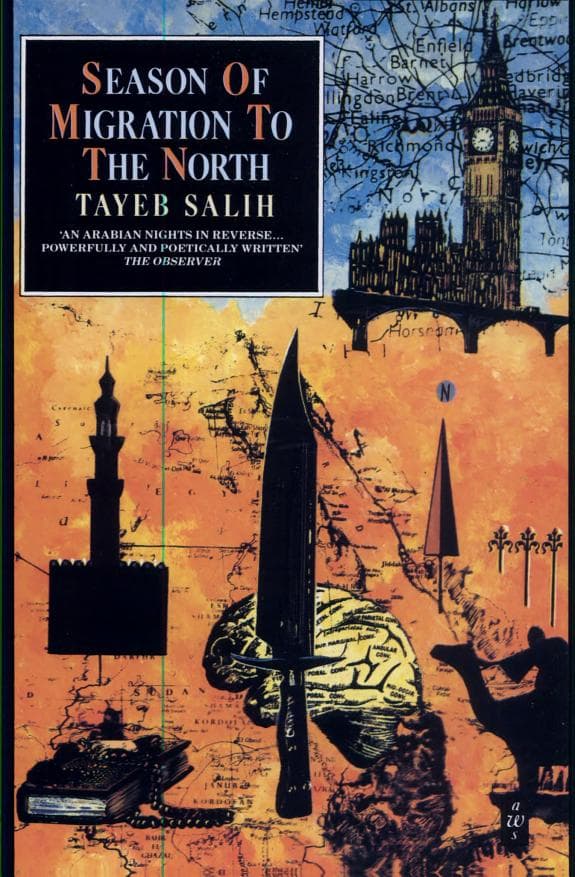
Synopsis
Covers the whole plot, including the ending.
- Difficulty
- Medium
- Pacing
- Moderate
- Mood
- Melancholy, Reflective, Intense, Philosophical
- Read it if
- You appreciate literary fiction that explores themes of post-colonialism, cultural identity, the clash between East and West, and the psychological impact of returning home. Perfect for readers who enjoy deep character studies and philosophical introspection.
- Skip it if
- You prefer fast-paced plots with clear-cut heroes and villains, or shy away from complex narrative structures and dark, tragic themes.
Season of Migration to the North Plot Summary
Covers the whole plot, including the ending.
The Narrator's Return and the Enigmatic Stranger
The unnamed narrator, a young Sudanese man, returns to his village of Wad Hamid on the Nile after seven years of studying poetry and literature in Europe. He feels out of place, struggling to combine his Western education with his traditional upbringing. The village is active with the presence of a new, respected elder named Mustafa Sa'eed, who has recently moved back to his ancestral home. Mustafa, though seemingly a man of the village, has a mysterious and refined air that immediately interests the narrator. During a gathering, Mustafa recites poetry, and the narrator notices a distinct, almost British, accent. This hints at a past that deeply fascinates him and sets the stage for their relationship.
Mustafa's Confession and the Seeds of Curiosity
One evening, Mustafa Sa'eed invites the narrator to his home. After a shared meal, Mustafa, affected by alcohol, tells the narrator a shocking secret: 'I am a liar. I am a fake.' He confesses to having spent a large part of his life in Europe, specifically England, where he was involved in scandalous affairs and even murder. He describes himself as a 'colonizer' in reverse, using his exoticism and intelligence to seduce and destroy European women. This confession disturbs and fascinates the narrator, who sees a similarity between Mustafa's experience and his own, though less destructive, involvement with the West. The narrator feels he must uncover the full truth of Mustafa's past.
The Disappearance of Mustafa Sa'eed
Mustafa Sa'eed mysteriously disappears one winter night, seemingly drowning in the Nile River during a flood. Despite extensive searches, his body is never found. His disappearance shocks the village and leads to speculation. Before his presumed death, Mustafa had given the narrator a key to his study, telling him to look after his wife, Hosna Bint Mahmoud, and his two sons, Mahjoub and Masud. This act makes the narrator the keeper of Mustafa's secrets and the inheritor of his legacy. The narrator feels a strong responsibility, not just for the family, but for understanding the man who so deeply affected his own sense of self and his relationship with the West.
Unveiling the Study and the 'Crime'
The narrator finally enters Mustafa Sa'eed's locked study, which Mustafa had carefully designed to look like a European library, with English books, a fireplace, and even a whiskey cabinet. In this room, the narrator discovers many documents, letters, diaries, and newspaper clippings. These materials detail Mustafa's life in England: his academic skill, his seduction of multiple European women, their later suicides, and his trial for the murder of Jean Morris, his last and most destructive love. The study is a physical example of Mustafa's dual identity and his deliberate creation of a persona, both as an intellectual and as an 'Oriental' seducer. It shows the full extent of his 'crime' against himself and others.
The Trial of Mustafa Sa'eed
Among Mustafa's papers, the narrator finds detailed accounts of his trial for the murder of Jean Morris. Mustafa had stabbed her, and during the trial, he presented himself as a victim of colonialism, a 'savage' responding to the 'civilized' world's actions. He argued that he was a product of the British Empire's own making, a distorted reflection of their desires and prejudices. This defense, though shocking, resulted in a relatively light sentence of seven years. The narrator is deeply disturbed by Mustafa's calculated use of racial stereotypes and colonial guilt to justify his actions, which further complicates his understanding of Mustafa's identity and the blurred lines between victim and perpetrator.
The Narrator's Burden and Hosna's Fate
Following Mustafa's death, the narrator feels a strong duty to protect Hosna Bint Mahmoud and her children. He encourages her to live an independent life, offering her financial support and rejecting the traditional village custom that would have her marry another man. However, the village elders, especially Wad Rayyes, a much older man, pressure Hosna to marry him. Hosna firmly refuses, saying she wants to remain a widow and raise her children, honoring Mustafa's memory. The narrator struggles to intervene effectively, caught between his modern ideas and the deeply held traditions of his community. This shows the clash of cultures within his own land.
Tragedy Strikes: Hosna's Murder
Despite Hosna's strong resistance and the narrator's attempts to protect her, the village's patriarchal customs win. Wad Rayyes, angered by her repeated rejections, brutally murders Hosna Bint Mahmoud in her bed, then commits suicide. This horrific event shocks the village and deeply traumatizes the narrator. The tragedy shows the devastating results of unchecked tradition and the vulnerability of women in a society resistant to change. The narrator feels a deep sense of guilt and failure, realizing that his intellectual understanding of justice was not enough to prevent such an act, and that Mustafa's legacy of destruction has, in a way, extended to his own family.
The Narrator's Existential Crisis
Hosna's murder pushes the narrator into a deep existential crisis. He becomes absorbed by Mustafa Sa'eed's life, feeling as though Mustafa's ghost has entered his own being. He questions his own identity, the value of his Western education, and his place in his Sudanese society. He struggles with the feeling that he is becoming another Mustafa, a man caught between two worlds, capable of both great intellect and destructive actions. He spends sleepless nights in Mustafa's study, reading the documents, trying to understand the man and, by extension, himself. The narrator feels he is about to lose his own sanity, near the same abyss that consumed Mustafa.
Confronting the Nile and a Choice for Life
During an intense moment of his crisis, the narrator finds himself in the Nile, struggling against the current, much like Mustafa Sa'eed is presumed to have done. He experiences a deep internal struggle, feeling the pull of death and the desire to give in to the river, similar to Mustafa's possible suicide. However, at the critical moment, a strong urge to live appears. He fights desperately against the current, choosing life and rejecting the destructive path that Mustafa had seemingly taken. This near-death experience is a turning point, a conscious decision to separate himself from Mustafa's tragic fate and to create his own identity, rooted in his Sudanese reality.
Embracing the Present and the Future
Having survived his ordeal in the Nile, the narrator emerges with a renewed sense of purpose and a clearer understanding of himself. He recognizes the importance of living in the present and engaging with his community, rather than being consumed by the past or by Mustafa Sa'eed's ghost. He accepts his responsibility towards Mustafa's orphaned sons and the broader village. He decides to stay in Wad Hamid, to contribute to its future, and to combine his Western knowledge with his Sudanese roots. This act shows his freedom from Mustafa's shadow and his commitment to building a meaningful life, based on his own identity and community, moving forward from the legacy of colonialism and personal turmoil.
Principal Figures
The Narrator
Protagonist
A young Sudanese intellectual grappling with his identity after studying in Europe.
The unnamed narrator is a highly educated young man who returns to his Sudanese village after seven years of study in England. He is introspective, sensitive, and deeply affected by his encounters with both Western and traditional Sudanese cultures. He initially feels a sense of alienation and struggles to reconcile his modern education with his roots. His fascination with Mustafa Sa'eed stems from a perceived parallel in their experiences, drawing him into a quest to understand Mustafa's past and, by extension, his own identity. He is burdened by the responsibility entrusted to him by Mustafa and deeply disturbed by the tragedies he witnesses.
Relationships: Mustafa Sa'eed (mentor/confidant/alter ego); Hosna Bint Mahmoud (object of protection/responsibility); Mahjoub (friend/village elder); His Grandfather (wise elder/connection to tradition)
Mustafa Sa'eed
Antagonist/Catalyst
A brilliant but destructive Sudanese intellectual with a scandalous past in Europe.
Mustafa Sa'eed is a charismatic, enigmatic, and profoundly intelligent man who returns to Wad Hamid after a controversial life in England. He is a 'colonizer in reverse,' using his intellect and exoticism to seduce and destroy European women, culminating in a murder trial. He meticulously constructs his persona, both as an academic and as a 'savage.' His study is a monument to his dual life, a carefully curated archive of his 'crimes.' He represents the destructive potential of cultural collision and the psychological scars of colonialism, leaving behind a legacy that deeply impacts the narrator and his village.
Relationships: The Narrator (confidant/inheritor of his legacy); Hosna Bint Mahmoud (wife/victim of his legacy); Jean Morris (lover/murder victim); Ann Hammond (lover/suicide victim)
Hosna Bint Mahmoud
Supporting
Mustafa Sa'eed's widow, a strong woman who resists traditional village expectations.
Hosna Bint Mahmoud is Mustafa Sa'eed's second wife and the mother of his two sons. She is a beautiful, proud, and resilient woman who embodies the traditional values of the village but also possesses a fierce independence. After Mustafa's death, she staunchly refuses to remarry, particularly resisting the advances of the much older Wad Rayyes, asserting her right to mourn her husband and raise her children on her own terms. Her tragic fate highlights the brutal clash between individual will and deeply ingrained patriarchal customs within the village.
Relationships: Mustafa Sa'eed (husband); The Narrator (object of protection/responsibility); Wad Rayyes (unwanted suitor/murderer)
Wad Rayyes
Antagonist
An older, traditional village elder who embodies patriarchal dominance.
Wad Rayyes is an elderly, wealthy, and powerful man in the village, known for his multiple marriages and traditional views. He represents the entrenched patriarchal system and the conservative forces that resist change. After Mustafa's death, he becomes obsessed with marrying Hosna Bint Mahmoud, seeing her as his right according to village custom. His relentless pursuit and violent reaction to her rejection ultimately lead to her tragic murder, making him a symbol of the destructive aspects of unchallenged tradition and male entitlement.
Relationships: Hosna Bint Mahmoud (unwanted suitor/murderer); The Narrator (antagonist to his progressive views)
Mahjoub
Supporting
The narrator's childhood friend and a pragmatic, traditional village leader.
Mahjoub is the narrator's childhood friend and a prominent figure in the village. He is practical, grounded, and deeply rooted in traditional Sudanese life. He serves as a foil to the narrator's intellectualism and Mustafa's destructive past, representing the stability and common sense of the community. While he holds traditional views, he is generally well-meaning and helps the narrator navigate village customs. He is a respected member of the community, often acting as an intermediary or voice of the collective village sentiment.
Relationships: The Narrator (childhood friend); Mustafa Sa'eed (acquaintance/village member)
The Narrator's Grandfather
Supporting
A wise and respected elder embodying the wisdom and continuity of Sudanese tradition.
The narrator's grandfather is a revered and wise old man who represents the deep-seated traditions, resilience, and spiritual wisdom of the Sudanese village. He provides a calm and grounding presence amidst the narrator's internal turmoil and the chaos brought by Mustafa's legacy. He offers quiet guidance and a connection to the enduring values of his culture, contrasting sharply with the narrator's Western intellectualism and Mustafa's destructive modernism. He is a symbol of continuity and the strength of the past.
Relationships: The Narrator (grandfather/source of wisdom)
Jean Morris
Mentioned
Mustafa Sa'eed's final European lover, whom he murdered.
Jean Morris was one of Mustafa Sa'eed's lovers in London, and ultimately his victim. She is depicted as a beautiful, intelligent, and complex woman who was drawn to Mustafa's exoticism and intellect. Her relationship with Mustafa was intense and destructive, culminating in her murder by him. Her story, revealed through Mustafa's papers, is crucial to understanding the depths of his psychological manipulation and the tragic consequences of his 'colonizer in reverse' persona.
Relationships: Mustafa Sa'eed (lover/murder victim)
Ann Hammond
Mentioned
One of Mustafa Sa'eed's European lovers who committed suicide.
Ann Hammond was an Englishwoman, a poet, and one of Mustafa Sa'eed's earlier lovers in London. Her story, like others, is uncovered through Mustafa's documents in his study. She fell deeply in love with Mustafa and, unable to cope with his manipulative and emotionally distant nature, eventually committed suicide. She represents another victim of Mustafa's calculated seductions, illustrating a pattern of destruction that predates Jean Morris and highlights the profound psychological impact he had on the women in his life.
Relationships: Mustafa Sa'eed (lover/suicide victim)
Richard
Mentioned
An English friend of Mustafa Sa'eed's who tried to warn his victims.
Richard was an English friend of Mustafa Sa'eed in London, described as an intellectual and a good man. He was aware of Mustafa's destructive patterns with women and attempted to warn some of them, including Jean Morris, about his manipulative nature. His character provides an external, European perspective on Mustafa's actions, demonstrating that not all Europeans were oblivious to Mustafa's true character, and highlighting the complexity of the colonial encounter from a human perspective, beyond simple stereotypes.
Relationships: Mustafa Sa'eed (friend/antagonist to his destructive behavior); Jean Morris (acquaintance/warned her about Mustafa)
Themes & Insights
Identity and Self-Discovery
The novel explores the struggle for identity, especially for people caught between two different cultures. The narrator tries to combine his Western education and his Sudanese heritage, feeling out of place in both. Mustafa Sa'eed, in his 'colonizer in reverse' persona, creates and manipulates his identity, showing how identity can be fluid and performed. Both characters, in their own ways, try to understand who they are, with the narrator ultimately choosing an identity rooted in his homeland after his near-death experience in the Nile.
“'I am no longer a child. I am no longer a young man. I am a man, a human being, a man of this place, and I shall not leave it.'”
Colonialism and Post-Colonial Identity
The novel examines the lasting psychological and societal effects of colonialism. Mustafa Sa'eed's life is a direct result of British colonialism in Sudan; he is educated in England and then uses the colonizer's own tools and stereotypes to get a perverse revenge on European women. His 'crime' is an example of the trauma and rage from colonial rule. The narrator also represents the post-colonial intellectual trying to integrate Western knowledge with local culture. This shows the lasting effect of power imbalances and cultural clashes long after political independence.
“'I am a colonizer, I am a liar, I am a fake. I am a savage, a primitive man, a beast.'”
East vs. West and Cultural Clash
A main theme is the clash and dangerous attraction between Eastern and Western cultures. Mustafa Sa'eed embodies this conflict, mastering Western knowledge only to use it against the West in a destructive way, seeing himself as a 'black Englishman.' The novel shows how both sides see the 'Other' as exotic and the tragic misunderstandings that result. The narrator's journey involves finding a way to bridge this divide within himself, seeking a balance rather than a destructive confrontation. He ultimately chooses his Sudanese roots while acknowledging his exposure to the West.
“'We are all, in a sense, immigrants, even in our own countries. We are all searching for a place where we belong.'”
Tradition vs. Modernity
The story explores the tension between traditional Sudanese customs and modern influences, often with tragic results. The village, shown by figures like Wad Rayyes, holds onto its patriarchal traditions, leading to the brutal murder of Hosna Bint Mahmoud when she defies them. The narrator, with his modern education, tries to protect her, showing the limits of intellectual ideas against deeply set social norms. The novel suggests that while tradition provides stability, following it without question can lead to oppression. It also suggests that modernity, without integration, can lead to alienation or destruction, as seen in Mustafa's life.
“'Life is a game, and the rules are made by the strongest.'”
Destruction and Creation
The novel shows a clear contrast between destructive and creative impulses. Mustafa Sa'eed's life in Europe shows his destructive genius, where his intellect is used to manipulate and harm others, leading to death and despair. His study, a carefully created space of knowledge, paradoxically records his destructive 'crimes.' The narrator, initially drawn to this destructive legacy, ultimately chooses a path of creation and responsibility: caring for Mustafa's sons, engaging with his community, and embracing life. The struggle in the Nile symbolizes this choice, moving from the edge of self-destruction towards a commitment to building and nurturing.
“'I am not a second Mustafa Sa'eed. I am something new.'”
Plot Devices & Literary Techniques
First-Person Narrator (Unreliable/Questioning)
The story is told through the subjective lens of an unnamed, introspective protagonist.
The use of an unnamed first-person narrator allows for deep psychological exploration. The narrator is often questioning and introspective, making him somewhat unreliable as he grapples with his own biases, confusion, and the overwhelming influence of Mustafa Sa'eed. This perspective immerses the reader in his internal struggle to understand Mustafa's complex past and its implications for his own identity. His subjective experience creates a sense of ambiguity and forces the reader to actively interpret the events and characters, particularly Mustafa, through his evolving understanding.
Mustafa Sa'eed's Study/Archive
A physical space that serves as a repository of secrets and a symbol of dual identity.
Mustafa Sa'eed's locked study is a crucial plot device. It is a carefully constructed 'Western' room within a Sudanese home, symbolizing Mustafa's dual identity and his deliberate performance of self. As the narrator explores its contents – diaries, letters, newspaper clippings, books – the study functions as an archive, meticulously detailing Mustafa's past in Europe. This allows the reader to piece together Mustafa's story retrospectively, making the discovery of these documents a central mechanism for revealing plot and character, and for driving the narrator's own existential crisis as he confronts the evidence of Mustafa's 'crimes'.
Foreshadowing and Parallelism
Hints of future events and striking similarities between characters' experiences.
The novel uses subtle and overt foreshadowing, particularly regarding Mustafa's fate and the narrator's own potential path. Mustafa's initial confession of being a 'liar' and his mysterious disappearance into the Nile hint at his destructive nature and ambiguous end. More significantly, the novel draws strong parallels between Mustafa's experiences in Europe and the narrator's, suggesting that the narrator could fall into a similar trap of alienation or destruction. This parallelism creates tension and makes the narrator's eventual choice to embrace life a more powerful act of defiance against a potentially predetermined fate.
The Nile River
A powerful symbol of life, death, and the flow of time and culture.
The Nile River is a pervasive and multifaceted symbol throughout the novel. It represents life and sustenance for the village of Wad Hamid, but also death, as it is the site of Mustafa Sa'eed's presumed drowning and the narrator's near-death experience. It symbolizes the flow of time, carrying both tradition and change. Metaphorically, it can also represent the currents of cultural exchange and conflict, connecting Sudan to the wider world. The narrator's final struggle in the Nile is a climactic moment where he actively chooses life and his connection to his homeland, rejecting the destructive pull that the river (and Mustafa's legacy) represents.
The 'Colonizer in Reverse' Trope
Mustafa Sa'eed's deliberate appropriation of colonial power dynamics.
This trope is embodied by Mustafa Sa'eed, who, as a colonized subject, turns the tables on his colonizers. He uses his intellect, charm, and the exoticism attributed to him by Europeans to manipulate and psychologically 'conquer' European women, leading to their destruction. He deliberately plays into their stereotypes and prejudices, making them victims of their own cultural assumptions. This device critically examines the power dynamics of colonialism, showing how the oppressed can internalize and then weaponize the colonizer's gaze and methods, resulting in a complex and disturbing form of revenge and self-destruction.
Season of Migration to the North Quotes
“I am from here, just as the date palm is from here; but I am like the palm, I have no shade.”
“I am a lie. Why don't you say so? Why don't you say I am a lie?”
“The houses are like women: some are happy and some are sad.”
“I'll liberate Africa with my penis.”
“The world has changed, and we have changed with it.”
“I am the desert of thirst. I am the Nile of hunger.”
“The village is not a place; it is a state of mind.”
“We are all condemned to live in the present.”
“The North is not a direction; it is a dream.”
“I wanted to forget, but memory is a stubborn guest.”
“Love is a knife that cuts both ways.”
“The river does not remember the rain.”
“I am a ship that has sunk in the sea of my own contradictions.”
“The past is a well that never runs dry.”
Quiz
10 questions on the plot and the characters. Each answer comes with a short explanation.
Question 1
What is the narrator's profession in 'Season of Migration to the North'?
- A doctor
- A teacher
- A government official
- A merchant
Show answer
C. A government official The unnamed narrator returns to his village in Sudan after studying in Europe and works as a government official, which reflects his position between traditional Sudanese society and Western influences.
Question 2
Where does Mustafa Sa'eed first meet the narrator in the novel?
- In London
- At a university in Khartoum
- In the narrator's village in Sudan
- On a ship traveling to Europe
Show answer
C. In the narrator's village in Sudan Mustafa Sa'eed arrives in the narrator's Sudanese village after the narrator's return from Europe, and their encounter sets the central plot in motion as Sa'eed shares his mysterious past.
Question 3
What tragic event involving Mustafa Sa'eed's wife, Jean Morris, occurs in the novel?
- She dies in a car accident
- She commits suicide
- Sa'eed murders her
- She leaves him for another man
Show answer
C. Sa'eed murders her Mustafa Sa'eed murders his wife, Jean Morris, in London, which is a key event revealing his destructive relationships and the violent consequences of colonial and cultural conflicts.
Question 4
Why does Mustafa Sa'eed describe himself as a 'false oasis' to the narrator?
- He pretends to be wealthy but is actually poor
- He appears educated and successful but is filled with inner turmoil and violence
- He claims to be from Sudan but was born in Europe
- He acts as a mentor but secretly despises the narrator
Show answer
B. He appears educated and successful but is filled with inner turmoil and violence This metaphor highlights Sa'eed's duality: outwardly, he is a brilliant scholar who assimilated into Western society, but inwardly, he is consumed by rage, trauma, and a sense of alienation, symbolizing the deceptive nature of colonial assimilation.
Question 5
What role does Hosna Bint Mahmoud play in the novel's climax?
- She helps the narrator uncover Sa'eed's secrets
- She murders her husband, Wad Rayyes, and then commits suicide
- She travels to Europe to seek revenge
- She becomes the narrator's wife and moves to Khartoum
Show answer
B. She murders her husband, Wad Rayyes, and then commits suicide Hosna, forced into a marriage with the elderly Wad Rayyes after Sa'eed's death, kills him and then herself, mirroring Sa'eed's violence and highlighting themes of oppression, resistance, and the tragic cycle of conflict between tradition and personal freedom.
Question 6
How does the novel end for the narrator?
- He leaves Sudan permanently for Europe
- He drowns in the Nile River
- He is left struggling in the Nile, symbolizing his unresolved identity crisis
- He becomes a leader in his village
Show answer
C. He is left struggling in the Nile, symbolizing his unresolved identity crisis The novel concludes ambiguously with the narrator in the Nile, fighting to stay afloat, which represents his ongoing struggle between Sudanese roots and Western influences, and the unresolved tensions of post-colonial identity.
Question 7
What is the significance of the 'room of secrets' in Mustafa Sa'eed's house?
- It contains stolen artifacts from Europe
- It holds Sa'eed's diaries and personal effects, revealing his past
- It is a hidden library of forbidden books
- It serves as a memorial for Jean Morris
Show answer
B. It holds Sa'eed's diaries and personal effects, revealing his past After Sa'eed's disappearance, the narrator discovers this locked room containing diaries, photos, and books that detail Sa'eed's life in Europe, including his relationships and crimes, forcing the narrator to confront the complexities of Sa'eed's legacy and his own identity.
Question 8
Which theme is most directly explored through Mustafa Sa'eed's relationships with European women like Isabella Seymour and Ann Hammond?
- The economic challenges of immigrants
- The exoticization and sexualization of the 'Other' in colonial contexts
- The importance of family loyalty
- The benefits of cultural assimilation
Show answer
B. The exoticization and sexualization of the 'Other' in colonial contexts Sa'eed's affairs with European women, who are drawn to him as an exotic figure, critique Orientalist fantasies and the power dynamics of colonialism, showing how both sides are trapped in destructive stereotypes.
Question 9
What does the Nile River symbolize in the novel?
- Purely a source of livelihood for the village
- A barrier between Sudan and Europe
- Continuity, life, death, and the flow of history and identity
- A symbol of Western technological progress
Show answer
C. Continuity, life, death, and the flow of history and identity The Nile represents the enduring essence of Sudanese culture and the cyclical nature of life, but also becomes a site of conflict and reflection, as seen in key scenes like Sa'eed's disappearance and the narrator's final struggle, tying personal journeys to broader historical currents.
Question 10
In what way does the novel's structure, with its frame narrative and embedded stories, contribute to its themes?
- It simplifies the plot for easier understanding
- It emphasizes the linear progress of Sudanese history
- It mirrors the complexity of memory, truth, and the blending of cultures
- It focuses solely on the narrator's personal growth
Show answer
C. It mirrors the complexity of memory, truth, and the blending of cultures The frame narrative (the narrator's return) and embedded stories (like Sa'eed's past) create a layered, non-linear structure that reflects the novel's exploration of fragmented identities, the unreliability of memory, and the interwoven legacies of colonialism, challenging simple narratives of history and self.
Season of Migration to the North FAQ
What is 'Season of Migration to the North' about?
The novel follows an unnamed Sudanese narrator who returns to his village after studying in England, where he meets the enigmatic Mustafa Sa'eed. Through Mustafa's confessions, the story explores his destructive relationships with European women in London, his eventual return to Sudan, and the narrator's own struggles with identity, colonialism, and cultural dislocation.
Why should I read 'Season of Migration to the North'?
It's a profound exploration of post-colonial identity, cultural conflict, and psychological trauma, blending lyrical prose with sharp social critique. The novel's complex narrative structure and rich symbolism offer deep insights into the lasting impacts of colonialism on both colonizer and colonized.
What is the background/setting of 'Season of Migration to the North'?
The story alternates between a rural Sudanese village along the Nile in the 1960s and flashbacks to 1920s London. This dual setting highlights the stark contrasts between traditional Sudanese life and the urban, intellectual European world, mirroring the characters' internal conflicts.
What are the most memorable quotes?
Key quotes include Mustafa Sa'eed's declaration, 'I am the desert of thirst. I am no Othello. Othello was a lie,' reflecting his rejection of romanticized colonial narratives. Another is the narrator's realization, 'I am a lie,' underscoring his fractured identity.
What writing style does the author use?
Salih employs a lyrical, introspective first-person narrative with non-linear storytelling, blending realism with allegory. The prose is rich in symbolism and intertextual references, such as echoes of Shakespeare's 'Othello' and Conrad's 'Heart of Darkness'.
What minor details add significant meaning?
Mustafa Sa'eed's locked room in his house, filled with English books and artifacts, symbolizes his trapped European past and the secrets he hides. The recurring image of the Nile River represents both life and the flow of history, connecting Sudan's ancient heritage with modern turmoil.
What are some subtle foreshadowing moments?
Early mentions of Mustafa's 'strange smile' and his detached demeanor hint at his hidden trauma and violent past. The narrator's initial fascination with Mustafa foreshadows his own descent into confusion and identity crisis later in the novel.
What unexpected character connections exist?
Mustafa Sa'eed's wife, Hosna Bint Mahmoud, becomes the narrator's responsibility after Mustafa's death, creating a tense dynamic that mirrors Mustafa's own relationships. The narrator's attraction to her echoes Mustafa's exploitative patterns, blurring lines between victim and perpetrator.
What are unspoken character motivations?
Mustafa Sa'eed is driven by a deep-seated revenge against colonialism, using his intellectual prowess and charm to seduce and destroy European women as a form of retribution. The narrator's quest to understand Mustafa masks his own unresolved guilt and desire for belonging.
What psychological complexities do characters exhibit?
Mustafa Sa'eed embodies a split identity, torn between his Sudanese roots and adopted English persona, leading to self-loathing and violence. The narrator grapples with existential angst, feeling alienated in both his homeland and Europe, which fuels his obsession with Mustafa.
What are the major emotional turning points?
Mustafa's confession to the narrator about his past crimes marks a pivotal moment of revelation and horror. The narrator's decision to marry Hosna Bint Mahmoud against village customs leads to tragedy, forcing him to confront his own complicity in destructive cycles.
How do relationship dynamics evolve?
The narrator's relationship with Mustafa shifts from curiosity to obsession and then to a haunting identification. His bond with Hosna Bint Mahmoud transitions from duty to desire, culminating in violence that mirrors Mustafa's own destructive liaisons.
Which parts remain ambiguous or open-ended?
The novel's ending, where the narrator is trapped in the Nile's currents, is deliberately ambiguous—it can be interpreted as a metaphorical rebirth, suicide, or eternal struggle. Mustafa's true feelings about his actions and identity are left unresolved, inviting debate.
What are controversial scenes or decisions?
Mustafa Sa'eed's manipulation and implied murder of European women spark controversy for its brutal depiction of colonial revenge. The narrator's passive complicity in village traditions and his failed marriage to Hosna raise questions about moral responsibility and cultural norms.
'Season of Migration to the North' ending explained: how it ends & what it means
The novel ends with the narrator swimming in the Nile, shouting 'Help! Help!' as he struggles against the current. This symbolizes his unresolved identity crisis and the cyclical nature of post-colonial trauma, suggesting that escape from historical and personal legacies may be impossible.
What is the significance of the title 'Season of Migration to the North'?
The title refers to the literal migration of birds and people, but metaphorically it critiques the one-way cultural and intellectual migration from colonized regions to Europe. It highlights the destructive allure of the 'North' (Europe) and the resulting dislocation experienced by characters like Mustafa and the narrator.
About the author

Tayeb Salih was a Sudanese author known for his contributions to Arabic literature. His notable work, "Season of Migration to the North," explores themes of identity and post-colonialism. Salih's writings often reflect the complexities of cultural exchange and the impact of colonial history.
Similar books
- Things Fall Apart
Chinua Achebe
3.7 (288k) average on GoodreadsHistorical FictionExplores the impact of colonialism on individual and communal identity in Africa.
- Heart of Darkness
Joseph Conrad
3.4 (415k) average on GoodreadsHistorical FictionDelves into the psychological complexities of encountering 'the other' and the darkness within humanity.
- The Stranger
Albert Camus
4.1 (3k) average on GoodreadsFantasyFeatures an alienated protagonist grappling with existential questions and societal norms.
- The Wretched of the Earth
Frantz Fanon
4.2 (17k) average on GoodreadsPoliticsFanon's work is a direct, theoretical treatise advocating for revolutionary violence and psycho-social liberation in colonial contexts. Salih's novel, while deeply concerned with colonial trauma, offers a fictionalized, allegorical, and psychologically nuanced exploration of the same themes, often subverting heroic narratives and presenting a more ambiguous, tragic vision of postcolonial identity and resistance, rather than a prescriptive political agenda.
- To Kill a Mockingbird
Harper Lee
4.3 (4.5M) average on GoodreadsHistorical FictionIn the 1930s Jim Crow South, Harper Lee writes about racial injustice, moral growth, and the quiet courage of a lawyer father, Atticus Finch, as seen through his young daughter's eyes.
- The Great Gatsby
F. Scott Fitzgerald
3.9 (3.8M) average on GoodreadsHistorical FictionIn the opulent Roaring Twenties, a mysterious millionaire's lavish parties hide his desperate, tragic pursuit of a lost love, exposing the emptiness within the American Dream.


Enjoyed the summary?
A summary gives you the shape of the book. The book itself has the detail, the examples and the voice.
Find Season of Migration to the North on AmazonAs an Amazon Associate, BookBrief earns from qualifying purchases. How we're funded