
Core Idea
- Difficulty
- Hard
- Read it if
- You want to understand the foundational philosophical arguments for natural rights, limited government, the social contract, and the right to revolution that shaped Western political thought and the American Constitution.
- Skip it if
- You are looking for a light read or a contemporary political analysis; this is a dense, historical philosophical text requiring careful reading.
Key Takeaways from Second Treatise of Government
Natural Rights: The Unalienable Foundation
Before government, individuals possess inherent rights to life, liberty, and property.
Locke states that in the 'state of nature' – a condition before politics – all individuals are free, equal, and independent. This state is not without laws; it is governed by a 'law of nature' that reason can discover. This law says that no one should harm another's life, health, liberty, or possessions. These natural rights are not given by any government; they are part of being human, existing before and thus limiting political authority. Protecting these rights is the main reason for forming civil society, and any government that fails to uphold them loses its right to rule. This idea changed political thought from divine right to individual rights.
“The state of nature has a law of nature to govern it, which obliges every one: and reason, which is that law, teaches all mankind, who will but consult it, that being all equal and independent, no one ought to harm another in his life, health, liberty, or possessions.”
In the book: Locke's foundational argument for the 'state of nature' and the 'law of nature' as the basis for all legitimate government, preceding and grounding the social contract.
Try this: Reflect on modern human rights declarations and constitutional protections. Do they truly reflect unalienable rights, or are they subject to governmental discretion? Advocate for policies that prioritize individual liberties and property rights as fundamental, rather than as privileges granted by the state.
Related ideas: state-of-nature, law-of-nature, natural-rights
Labor Theory of Property: Mixing Self with Nature
Individuals acquire property by mixing their labor with unowned resources.
Locke's property theory is original, claiming that property rights come from individual labor, not government grants or divine decrees. When a person works to change a natural resource – by picking an apple, farming a field, or making an item – they mix their effort with that resource, making it their rightful property. This justification for private ownership is important because it supports the idea that people have a right to what they produce. However, Locke includes conditions: one must leave 'enough and as good' for others, and one should not waste what is taken. The introduction of money, he argues, allows for more accumulation without spoilage, subtly changing these initial limits.
“Every man has a property in his own person: this no body has any right to but himself. The labour of his body, and the work of his hands, we may say, are properly his. Whatsoever then he removes out of the state that nature hath provided, and left it in, he hath mixed his labour with, and joined to it something that is his own, and thereby makes it his property.”
In the book: Locke's detailed explanation of how an individual's labor, when mixed with common resources, transforms them into private property, using examples like gathering acorns or cultivating land.
Try this: Consider the ethical implications of intellectual property, land use, and resource allocation. Does current property law adequately reflect the labor theory, or has it become detached? Support fair compensation for labor and policies that prevent monopolistic hoarding of essential resources, ensuring 'enough and as good' remains.
Related ideas: labor-theory-of-property, private-property, acquisition
The Social Contract: Consent to Govern
Legitimate government arises from the explicit consent of the governed to protect their rights.
For Locke, moving from the state of nature to civil society is voluntary and based on agreement. People agree to give up certain freedoms – mainly the right to enforce the law of nature themselves – in exchange for fair justice and the protection of their natural rights, especially property. This 'social contract' is not a surrender of all rights, but a transfer of power to a government whose right to rule comes only from the consent of the people it governs. Any government that acts outside this trust, or against the people's basic rights, loses its legitimacy, justifying resistance.
“Men being, as has been said, by nature, all free, equal, and independent, no one can be put out of this estate, and subjected to the political power of another, without his own consent.”
In the book: Locke's argument that political power can only be derived from the consent of the governed, distinguishing between express and tacit consent in forming and maintaining a civil society.
Try this: Scrutinize governmental actions and policies through the lens of consent. Do citizens truly consent to current taxation, surveillance, or foreign policy? Advocate for transparent governance, robust democratic processes, and mechanisms that allow citizens to withdraw consent from tyrannical or rights-infringing governments.
Related ideas: social-contract, consent-of-the-governed, political-legitimacy
Limited Government: Checks on Power
Governmental power must be constrained and divided to prevent tyranny and protect individual liberties.
Locke strongly supports limited government, arguing that even the highest legislative power is not absolute. Its authority is restricted by the very purpose for which government was created: to preserve life, liberty, and property. He proposes a separation of powers, mainly between the legislative (law-making) and executive (law-enforcing) branches, with the legislative being supreme but still answerable. This division prevents any single entity from gaining too much power and becoming tyrannical. Government actions must always follow established, public laws, not arbitrary orders, further ensuring predictability and protecting individual freedom.
“The legislative power, whether placed in one or more, whether always in being, or only by intervals, though it be the supreme power in every commonwealth, yet it is not, nor can possibly be, absolutely arbitrary over the lives and fortunes of the people.”
In the book: Locke's exposition on the proper bounds of legislative power, emphasizing that it cannot be arbitrary and must govern by promulgated, established laws, not extemporary decrees.
Try this: Evaluate your nation's governmental structure. Are there sufficient checks and balances between branches? Does the executive branch overstep its bounds, or does the legislative branch become too powerful? Support constitutional reforms that strengthen the separation of powers and limit executive overreach, ensuring no single entity wields absolute authority.
Related ideas: limited-government, separation-of-powers, rule-of-law
Right of Revolution: When Tyranny Justifies Resistance
If government acts against the trust of the people, the people have a right to resist and establish new governance.
Perhaps Locke's most impactful idea is the justification for revolution. If a government regularly abuses its power, violates citizens' natural rights, or tries to enslave them, it breaks the social contract and effectively declares war on the people. In such extreme cases, the people are no longer bound to obey and have the right to resist, overthrow the tyrannical government, and establish a new one that will better protect their interests. This is not an endorsement of frequent rebellion but a last option when the government has completely failed its main purpose. This idea greatly influenced later revolutions.
“Whenever the legislators endeavour to take away, and destroy the property of the people, or to reduce them to slavery under arbitrary power, they put themselves into a state of war with the people, who are thereupon absolved from any farther obedience, and are left to the common refuge, which God hath provided for all men, against force and violence.”
In the book: Locke's argument that when the legislative or executive acts contrary to the trust placed in them by the people, they forfeit their authority, returning power to the people to establish new governance.
Try this: Analyze historical and contemporary movements for liberation and self-determination. Were the conditions for a Lockean right of revolution met? Support peaceful means of political change, but understand the philosophical basis for resistance when governments become truly tyrannical and unresponsive to the will of the people.
Related ideas: right-of-revolution, tyranny, resistance, popular-sovereignty
Tacit Consent: The Unspoken Agreement
Enjoying the benefits of a society implies a tacit agreement to its laws and governance.
While explicit consent (like taking an oath) is ideal, Locke admits that most people do not clearly agree to be governed. He introduces 'tacit consent,' arguing that simply enjoying the benefits of civil society – owning property, using its roads, or living within its territory – implies an unspoken agreement to follow its laws and support its government. This practical idea addresses how new generations or residents become bound by the social contract. However, it raises questions about how truly voluntary consent is when merely existing within a state's borders is considered enough for obligation.
“Every man, that hath any possession, or enjoyment, of any part of the dominions of any government, doth thereby give his tacit consent, and is as far forth obliged to obedience to the laws of that government, during such enjoyment, as any one under it; whether this his possession be of land, to him and his heirs for ever, or a lodging only for a week; or whether it be barely travelling freely on the highway.”
In the book: Locke's explanation of tacit consent, where enjoying any property or benefit within a government's dominion implies an obligation to obey its laws, even without explicit declaration.
Try this: Consider the implications of tacit consent in modern society. Does using public services or digital platforms imply consent to their terms, even if unfavorable? Critically evaluate situations where consent is assumed rather than explicitly given, and advocate for clearer, more explicit forms of consent in political and digital spheres.
Related ideas: tacit-consent, political-obligation, citizenship
Property as the Purpose of Government
The preservation of property is the chief end for which men unite into commonwealths.
Locke clearly states that the 'main goal' of forming civil society is to preserve property. He defines property broadly, including not just material possessions but also 'life, liberty, and estate.' In the state of nature, enjoying these properties is uncertain because there are no established laws, fair judges, or executive power. Government is created specifically to fix these problems, providing a stable framework for the secure enjoyment of one's possessions and person. This focus on property as the central concern of government highlights Locke's influence on capitalist thought and constitutional protections for economic rights.
“The great and chief end, therefore, of men's uniting into commonwealths, and putting themselves under government, is the preservation of their property; to which in the state of nature there are many things wanting.”
In the book: Locke's direct assertion that the 'great and chief end' of uniting into commonwealths is the preservation of property, which he defines to include life, liberty, and estate.
Try this: Examine how property rights are protected and debated in your society. Are they prioritized over other rights, or are they balanced? Advocate for a holistic understanding of 'property' that includes personal security and freedom, and ensure that governmental actions genuinely protect, rather than infringe upon, these fundamental aspects of human well-being.
Related ideas: property-rights, chief-end-of-government, economic-freedom
The Dangers of Absolute Monarchy
Absolute power is fundamentally incompatible with civil society and the protection of natural rights.
Locke strongly opposes absolute monarchy, arguing that a single ruler with unlimited power is still in a 'state of nature' relative to his subjects, but without the checks of natural law. Such a ruler, being both lawmaker and enforcer, can act randomly, infringing upon subjects' lives, liberty, and property without recourse. This defeats the purpose of civil society, which is to escape the uncertainties of the state of nature by establishing fair laws and judges. For Locke, an absolute monarch is worse than the state of nature itself, as there is no appeal or protection against their whims, making life under such a regime intolerable.
“Absolute arbitrary power, or governing without settled standing laws, can neither consist with the ends of society and government, which are the preservation of property, nor be tolerable to a rational creature.”
In the book: Locke's critique of absolute monarchy, arguing that it fails to provide the impartial judge and established law necessary for civil society, leaving subjects without recourse against the arbitrary power of the sovereign.
Try this: Reflect on contemporary authoritarian regimes. Do they exhibit the characteristics Locke warned against? Support democratic reforms and international efforts to curb absolute power, advocating for constitutionalism and human rights protections in all nations, understanding that unchecked power leads to oppression.
Related ideas: absolute-monarchy, tyranny, arbitrary-power, rule-of-man
Parental vs. Political Power: A Crucial Distinction
Parental authority is temporary and for the child's benefit; political power is based on consent and for the common good.
Locke carefully distinguishes between parental power and political power, a key point often confused by supporters of absolute monarchy. Parental power is natural, temporary, and aims to nurture and educate children until they become rational, independent adults. It is not absolute or permanent. In contrast, political power comes from the consent of free and equal adults, is permanent (until dissolved by the people), and aims to preserve their collective property and rights. Confusing these two, as some monarchists did, wrongly justifies absolute rule over adult citizens as if they were children.
“The power, then, that parents have over their children, arises from that duty which is incumbent on them, to take care of their offspring, during the imperfect state of childhood. To inform the mind, and govern the actions of their yet ignorant nonage, till reason shall take its place, and ease them of that trouble, is what the children want, and the parents are bound to.”
In the book: Locke's dedicated chapter distinguishing paternal power from political power, emphasizing its temporary nature and purpose for the child's good, not for the parents' arbitrary rule.
Try this: Examine how different forms of authority are justified in society, from family to workplace to government. Are some authorities overstepping their legitimate bounds by treating adults as subordinates rather than free agents? Advocate for respectful, consent-based relationships in all spheres, recognizing the distinct nature and limits of various forms of power.
Related ideas: paternal-power, political-power, consent-vs-nurture
Rule of Law: Governing by Established, Known Laws
Legitimate government operates under fixed, public laws, not arbitrary decrees.
A main idea in Locke's vision for civil society is the rule of law. He argues that true liberty under government means living by 'standing rules to live by,' which are common to everyone, publicly known, and established by the legitimate legislative power. This differs greatly from arbitrary rule, where individuals are subject to a ruler's unpredictable and often self-serving decisions. The rule of law ensures predictability, fairness, and equal application of justice, thereby protecting individual freedom and property from arbitrary interference. It is a basic defense against tyranny and essential for a stable and fair society.
“Freedom of men under government is, to have a standing rule to live by, common to every one of that society, and made by the legislative power erected in it; a liberty to follow my own will in all things, where the rule prescribes not; and not to be subject to the inconstant, uncertain, unknown, arbitrary will of another man.”
In the book: Locke's insistence that for government to be legitimate and for men to be truly free within it, it must govern by promulgated, established laws, not by extemporary, arbitrary decrees.
Try this: Assess the transparency and consistency of legal systems. Are laws clearly communicated, equally applied, and free from arbitrary interpretation? Advocate for judicial independence, legal literacy, and legislative processes that prioritize clear, consistent, and publicly accessible laws to ensure true freedom under the rule of law.
Related ideas: rule-of-law, due-process, legal-certainty
Second Treatise of Government Quotes
“The great and chief end, therefore, of men's uniting into commonwealths, and putting themselves under government, is the preservation of their property.”
“Slavery is so vile and miserable an estate of man, and so directly opposite to the generous temper and courage of our nation, that it is hardly to be conceived that an Englishman, much less a gentleman, should plead for it.”
“To understand political power right, and derive it from its original, we must consider, what state all men are naturally in, and that is, a state of perfect freedom to order their actions, and dispose of their possessions and persons, as they think fit, within the bounds of the law of nature, without asking leave, or depending upon the will of any other man.”
“But though this be a state of liberty, yet it is not a state of licence.”
“Where-ever law ends, tyranny begins.”
“Men being, as has been said, by nature, all free, equal, and independent, no one can be put out of this estate, and subjected to the political power of another, without his own consent.”
“The labour of his body, and the work of his hands, we may say, are properly his. Whatsoever then he removes out of the state that nature hath provided, and left it in, he hath mixed his labour with, and joined to it something that is his own, and thereby makes it his property.”
“For nobody can transfer to another more power than he has in himself; and nobody has an absolute arbitrary power over himself, or over any other, to destroy his own life, or take away the life or property of another.”
“The end of law is not to abolish or restrain, but to preserve and enlarge freedom.”
“Whenever the legislators endeavour to take away, and destroy the property of the people, or to reduce them to slavery under arbitrary power, they put themselves into a state of war with the people, who are thereupon absolved from any farther obedience.”
“And thus the community may be said in this respect to be always the supreme power, but not as considered under any form of government, because this power of the people can never take place till the government be dissolved.”
“It is not the business of the prince to take away the property of his subjects without their consent.”
“The power of the father doth not reach at all to the lives or fortunes of his children, and cannot in any wise dispose of them.”
“For no man can, by compact, pass over to another that which he hath not in himself, a power over his own life.”
Quiz
10 questions on the main ideas. Each answer comes with a short explanation.
Question 1
According to Locke, what is the 'state of nature'?
- A state of war of every man against every man.
- A state of perfect freedom and equality, governed by the law of nature.
- A hierarchical society with a natural monarch.
- A condition of scarcity and constant struggle for resources.
Show answer
B. A state of perfect freedom and equality, governed by the law of nature. Locke defines the state of nature as a condition where individuals are free to order their actions and dispose of their possessions as they see fit, within the bounds of the law of nature, without asking leave or depending upon the will of any other man.
Question 2
What is the primary purpose for individuals to leave the state of nature and form a civil society?
- To establish a powerful monarchy to ensure national security.
- To gain greater personal wealth through collective enterprise.
- The mutual preservation of their lives, liberties, and estates, which he calls 'property'.
- To engage in perpetual warfare against other societies.
Show answer
C. The mutual preservation of their lives, liberties, and estates, which he calls 'property'. Locke argues that the great and chief end of men's uniting into commonwealths, and putting themselves under government, is the preservation of their property, which in his broad sense includes life, liberty, and estate.
Question 3
According to Locke, what legitimizes an individual's claim to private property from the common stock?
- The consent of all mankind.
- The decree of a sovereign authority.
- Mixing one's labor with it.
- Divine right of ownership.
Show answer
C. Mixing one's labor with it. Locke states that every man has a 'property' in his own 'person.' This nobody has any right to but himself. The 'labour' of his body and the 'work' of his hands, we may say, are properly his. Whatsoever then he removes out of the state that nature hath provided and left it in, he hath mixed his 'labour' with, and joined to it something that is his own, and thereby makes it his 'property.'
Question 4
What is the 'law of nature' in Locke's philosophy?
- A set of arbitrary rules imposed by the strongest individuals.
- The instinct for self-preservation above all else.
- Reason, which teaches all mankind that being all equal and independent, no one ought to harm another in his life, health, liberty, or possessions.
- The written constitution of a civil government.
Show answer
C. Reason, which teaches all mankind that being all equal and independent, no one ought to harm another in his life, health, liberty, or possessions. Locke posits that the state of nature is governed by a law of nature, which obliges everyone. And reason, which is that law, teaches all mankind who will but consult it, that being all equal and independent, no one ought to harm another in his life, health, liberty, or possessions.
Question 5
Locke argues that political power is derived from:
- Divine appointment of rulers.
- The consent of the governed.
- Inheritance and tradition.
- Military strength and conquest.
Show answer
B. The consent of the governed. For Locke, legitimate government can only arise from the consent of the people it governs. No one can be subjected to the political power of another without his own consent.
Question 6
What is the extent of the legislative power in Locke's view?
- Absolute and arbitrary over the lives and fortunes of the people.
- Limited to the public good of the society, and cannot be exercised arbitrarily.
- Subordinate to the executive power.
- Unlimited as long as it maintains peace.
Show answer
B. Limited to the public good of the society, and cannot be exercised arbitrarily. Locke explicitly states that the legislative power, though supreme, 'is not, nor can possibly be, absolutely arbitrary over the lives and fortunes of the people.' It is limited to the public good of the society.
Question 7
Under what conditions does Locke argue the people have a right to revolution?
- Whenever they desire a change in leadership.
- When the government acts contrary to the trust placed in it, especially by invading the property of its subjects.
- Only with the express permission of the monarch.
- If a foreign power invades the country.
Show answer
B. When the government acts contrary to the trust placed in it, especially by invading the property of its subjects. Locke's argument for the right of revolution is central. He asserts that when the legislative or executive acts contrary to the trust reposed in them, they forfeit their power, and the people have a right to resume their original liberty and establish a new legislative.
Question 8
How does Locke distinguish between 'tyranny' and 'rightful government'?
- Tyranny is any form of monarchy, while rightful government is always a democracy.
- Tyranny is the exercise of power beyond right, where the ruler makes his own will, and not the law, the rule.
- Rightful government always has a written constitution, whereas tyranny does not.
- Tyranny is characterized by excessive taxation, regardless of its purpose.
Show answer
B. Tyranny is the exercise of power beyond right, where the ruler makes his own will, and not the law, the rule. Locke defines tyranny as 'the exercise of power beyond right, which nobody can have a right to.' He states that wherever law ends, tyranny begins, if the law be transgressed to another's harm.
Question 9
What is the significance of 'tacit consent' in Locke's theory of government?
- It implies that only those who explicitly sign a social contract are bound by it.
- It means that merely enjoying the benefits of a government, such as living under its laws or owning property within its territory, constitutes consent to its authority.
- It refers to the silent agreement among rulers to maintain power.
- It suggests that consent is only valid if given verbally in a public forum.
Show answer
B. It means that merely enjoying the benefits of a government, such as living under its laws or owning property within its territory, constitutes consent to its authority. Locke introduces tacit consent to explain how individuals become subject to government even without an explicit declaration. He argues that anyone who enjoys any part of the dominions of a government gives his tacit consent to its laws and is obliged to obey them.
Question 10
C. B. Macpherson, in his introduction, suggests Locke's arguments for private property and limited government appealed due to:
- Their emphasis on absolute monarchy and state control.
- Their justification of capitalist appropriation and the protection of property rights for a rising bourgeois class.
- Their promotion of communal ownership of all resources.
- Their advocacy for a return to a purely agrarian society without commerce.
Show answer
B. Their justification of capitalist appropriation and the protection of property rights for a rising bourgeois class. Macpherson's interpretation, as mentioned in the introduction, often highlights how Locke's theories, particularly on property, served to legitimize the interests and expansion of a nascent capitalist society, making them appealing to those who benefited from such a system.
Second Treatise of Government FAQ
What is the main argument of Locke's Second Treatise of Government?
The main argument is that government legitimacy derives from the consent of the governed, with individuals possessing natural rights to life, liberty, and property. Locke argues for a limited government whose primary purpose is to protect these rights, and he outlines conditions under which citizens have a right to revolution.
What is the 'state of nature' according to John Locke?
Locke defines the state of nature as a pre-political condition where all individuals are free and equal, governed by the law of nature, which dictates that no one ought to harm another in their life, health, liberty, or possessions. It is a state of reason, not necessarily a state of war, but lacks a common judge or executive power.
Does Locke's concept of private property still apply today?
Locke's theory of private property, based on labor mixing with nature and the 'enough and as good' proviso, laid foundational ideas for modern property rights. While its direct applicability in a fully developed global economy is debated, its principles continue to influence discussions on ownership, land use, and resource distribution.
How is Locke's view on government different from Thomas Hobbes's?
Locke differs significantly from Hobbes by arguing that the state of nature is not necessarily a 'war of all against all' and that individuals retain natural rights even in civil society. Unlike Hobbes's advocacy for an absolute sovereign, Locke champions limited government, the rule of law, and the people's right to resist tyranny, emphasizing consent over fear as the basis of authority.
What is Locke's justification for the right of revolution?
Locke justifies the right of revolution when the government acts against the trust placed in it by the people, particularly when it infringes upon their natural rights to life, liberty, or property, or attempts to rule arbitrarily. In such cases, the people have the right to dissolve the government and establish a new one that better serves their interests.
What is the 'social contract' in Locke's philosophy?
The social contract, for Locke, is an agreement among free individuals to form a civil society and establish a government to protect their natural rights. It is based on the consent of the governed, who voluntarily give up some individual powers to a collective body, with the understanding that the government will act for the public good and uphold their liberties.
How did Locke's ideas influence the American Revolution?
Locke's ideas profoundly influenced the American Revolution, particularly his concepts of natural rights, government by consent, and the right to revolution against tyrannical rule. These principles are explicitly echoed in the Declaration of Independence and the U.S. Constitution, forming the philosophical bedrock of American political thought.
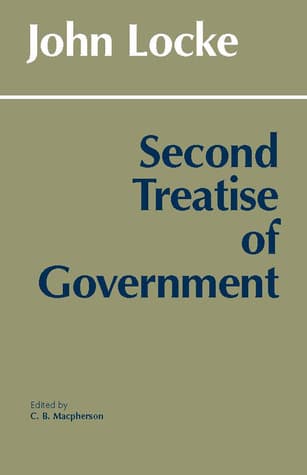
Who was C. B. Macpherson and what is his contribution to this edition?
C. B. Macpherson was an eminent political theorist known for his influential interpretations of Locke. In his 15-page introduction to this edition, Macpherson provides a critical analysis of Locke's arguments for limited government, private property, and the right of revolution, offering insights into their historical appeal and ongoing relevance.
What is the significance of 'limited, conditional government' in Locke's treatise?
Limited, conditional government is central to Locke's philosophy, meaning that governmental power is not absolute but bound by law and the consent of the governed. Its authority is conditional upon its protection of natural rights; if it fails in this duty, its legitimacy is revoked, reinforcing the idea that the people retain ultimate sovereignty.
About the author

John Locke was an English philosopher and political theorist active in the 17th century. He is best known for his works on government and individual rights, particularly in "Two Treatises of Government" and "Second Treatise of Government," which laid foundational ideas for modern democracy and liberal thought.
Similar books
- The Social Contract
Jean-Jacques Rousseau
3.8 (37k) average on GoodreadsPoliticsExplores the concept of the social contract, general will, and popular sovereignty from a different perspective.
- 1984
George Orwell
4.2 (3.1M) average on GoodreadsPoliticsIn a future where surveillance and thought control are absolute, a man's search for truth clashes with the Party, showing that hope can be a form of rebellion.
- Animal Farm
George Orwell
4.0 (2.7M) average on GoodreadsPoliticsA farm animals' rebellion against humans turns into a pig-led dictatorship, showing how power corrupts and revolutionary ideals are betrayed.
- Freakonomics: A Rogue Economist Explores the Hidden Side of Everything
Steven D. Levitt
4.0 (709k) average on GoodreadsBusinessThis book uses economic principles to reveal the surprising incentives behind everything from drug dealing and real estate to cheating teachers and the decline of crime.
- I Am Malala: The Story of the Girl Who Stood Up for Education and Was Shot by the Taliban
Malala Yousafzai
4.1 (419k) average on GoodreadsPoliticsA teenage girl from a Taliban-controlled valley refuses to give up her books, becoming a global voice for education even after an assassination attempt.
- Atlas Shrugged
Ayn Rand
3.7 (354k) average on GoodreadsPoliticsIn a dystopian America where innovators vanish, a brilliant heiress races to uncover the truth behind the disappearing industrialists and the enigmatic John Galt, who vows to stop the world's progress.





Enjoyed the summary?
A summary gives you the shape of the book. The book itself has the detail, the examples and the voice.
Find Second Treatise of Government on AmazonAs an Amazon Associate, BookBrief earns from qualifying purchases. How we're funded