
Core Idea
- Difficulty
- Medium
- Read it if
- you are looking for a logical, systematic approach to understanding and achieving happiness, appreciate a blend of personal narrative and scientific reasoning, or feel overwhelmed by negative thoughts and want actionable strategies to improve your mental well-being.
- Skip it if
- you prefer a purely spiritual or philosophical take on happiness without a structured, algorithmic approach, or are not open to the idea of happiness being a solvable 'problem' through rational analysis.
Key Takeaways from Solve for happy
The Happiness Equation
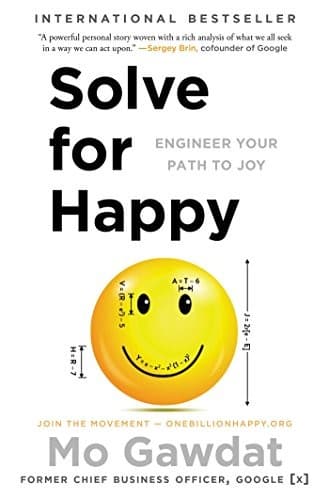
Happiness is not elusive; it's a simple equation: Your Happiness >= Your Events - Your Expectations.
Gawdat introduces a basic equation that changes how we see happiness, making it a measurable result rather than a mysterious feeling. This idea is not about ignoring bad events, but about managing what we expect from them. If we expect life to be perfect, any problem causes unhappiness. By making our expectations more realistic, where we expect challenges, we reduce the gap between what we imagine and what happens. This increases our chances of being happy. This idea is strong because it offers a practical way to check ourselves, helping us see if our unhappiness comes from outside events or from our own, often unrealistic, expectations.
“Happiness is when events of your life meet your expectations.”
In the book: The entire premise of the book is built upon this equation, derived from Gawdat's engineering background and his quest to 'solve' for happiness after personal tragedy.
Try this: Regularly assess your expectations before entering new situations or facing challenges. Ask: 'What is the most realistic outcome, including potential difficulties?' Adjust your mental model to align with this reality to mitigate disappointment.
Related ideas: cognitive-reframing, expectation-management
The Six Grand Illusions
Our minds often create illusions that obscure reality and prevent happiness.
Gawdat points out six main illusions: thought, self, knowledge, time, control, and fear. These are not bad on their own, but they cause suffering when we believe they are absolute truths. For example, the 'illusion of thought' means we often think every thought we have is true, which leads to worrying. The 'illusion of self' makes us too focused on our ego, causing us to be defensive and judgmental. Seeing these as mental ideas, not real facts, is the first step to weakening their power. This look into common mental biases is a strong part of the book, listing many common mental traps.
“Our minds are not designed to make us happy. They are designed to keep us safe.”
In the book: Gawdat dedicates significant chapters to each illusion, providing detailed explanations and examples of how they manifest in daily life, drawing on principles from cognitive psychology and mindfulness.
Try this: Practice mindfulness to observe your thoughts without judgment. When a negative thought arises, ask: 'Is this a fact, or an interpretation?' Challenge the illusion, rather than blindly accepting it.
Related ideas: cognitive-biases, mindfulness, ego-identification
The Power of Now
True happiness resides in the present moment, free from past regrets and future anxieties.
This idea, though not new in self-help, is made stronger by Gawdat's logical, engineering-based approach. He explains how our minds constantly pull us away from the present, making us relive past pains or worry about future problems. This mental time travel is a main cause of unhappiness because it stops us from experiencing and enjoying what is happening now. The book says that by focusing on the 'now,' through being aware and using our senses, we can greatly reduce the effect of the 'illusion of time' and find a more steady state of contentment. This focus on being present is key to many spiritual and psychological practices, and Gawdat explains it clearly.
“The past is gone. The future is not here. The only thing that exists is now.”
In the book: Gawdat recounts personal anecdotes and observations where his own or others' suffering was directly linked to dwelling on past events or worrying about future uncertainties.
Try this: Engage in 'micro-mindfulness' throughout the day. When eating, truly taste your food. When walking, feel your feet on the ground. When talking, listen fully. Consciously bring your attention back to your senses.
Related ideas: present-moment-awareness, mindfulness, anxiety-reduction
The Illusion of Control
Much of our suffering comes from trying to control what is inherently uncontrollable.
Gawdat says that while we want to be in control, most events, people, and results are beyond our direct influence. Our need to control things we cannot control leads to frustration, anger, and worry. This is an important idea because it challenges a deep human habit. The book suggests we stop trying to change outside situations and instead focus on the only area where we have complete power: our own thoughts, attitudes, and reactions. Accepting what cannot be changed, while actively working on what can be, is a foundation of strength and emotional freedom. This argument has limits for people in difficult situations where outside control is a real problem, but for daily worries, it is very useful.
“The only thing we truly control is our response to what happens.”
In the book: Gawdat shares the story of his son Ali's death, an event entirely beyond his control, which forced him to confront the illusion of control and find solace in accepting what he could not change.
Try this: When faced with a challenge, categorize elements into 'controllable' and 'uncontrollable.' Focus your energy solely on what you can control (your effort, attitude, planning), and practice letting go of the rest.
Related ideas: stoicism, acceptance, locus-of-control
The Power of Gratitude
Actively acknowledging what is good in our lives rewires the brain for happiness.
While gratitude is a common self-help topic, Gawdat sees it through his 'engineering' view. He suggests it strongly balances our brain's tendency to focus on negative things. Our minds are wired to spot threats and problems, which often hide the many good things in our lives. By consciously practicing gratitude, we make our brains notice and record the good, effectively 'training' them to look for positive things. This is not about ignoring problems, but about creating a more balanced view that stops us from constantly dwelling on negatives. This is the book's strongest idea for immediate practical use, offering a clear tool for managing mood.
“Gratitude is the quickest path to happiness.”
In the book: Gawdat cites how consistently practicing gratitude, even for small things, shifted his own perspective during his deepest grief, aligning with numerous psychological studies on the benefits of gratitude journaling.
Try this: Keep a daily gratitude journal, listing at least three new things you are grateful for each day. Be specific, and try to feel the emotion of gratitude as you write.
Related ideas: positive-psychology, gratitude-practice, neuroplasticity
The Compassion Principle
Extending compassion to ourselves and others is essential for true well-being.
Gawdat stresses that because we are all connected, hurting others through judgment or unkindness ultimately hurts us. On the other hand, acts of kindness create positive feelings for both the person receiving and the person giving. This idea extends to being kind to ourselves, urging us to treat ourselves with the same understanding and forgiveness we would offer a friend. The book says that many of our negative emotions come from a lack of kindness, either towards our own perceived failures or the perceived flaws of others. By being more understanding, we break down barriers and create a more peaceful internal and external world. This idea connects individual happiness to the well-being of everyone.
“When you are kind to others, you are kind to yourself.”
In the book: Gawdat shares how his perspective on interactions shifted when he consciously chose compassion over judgment, leading to more peaceful and fulfilling relationships.
Try this: When you feel critical of someone, pause and try to imagine their perspective or struggles. For self-criticism, speak to yourself as you would a dear friend facing the same challenge.
Related ideas: empathy, self-compassion, altruism
The Illusion of Knowledge
Believing we know everything prevents us from learning and adapting.
This illusion shows our tendency to stick to old beliefs, even when facts contradict them, and to assume we know everything. This rigidity stops growth, encourages judgment, and can cause much unhappiness when reality does not match our 'known' framework. Gawdat suggests that having a beginner's mind—being open, curious, and willing to learn—is essential for handling life's difficulties. By admitting the limits of our knowledge, we become more flexible, less rigid, and more open to new ideas, which in turn reduces problems and increases our ability to feel joy. This relates to the 'illusion of thought' by questioning how certain our mental models are.
“True wisdom is knowing that you know nothing.”
In the book: Gawdat illustrates how his own prior assumptions about happiness were shattered by his son's death, forcing him to re-examine everything he thought he knew.
Try this: When engaging in discussions, practice 'active listening' with the intent to understand, rather than to respond or refute. Regularly seek out information that challenges your existing viewpoints.
Related ideas: intellectual-humility, beginner's-mind, cognitive-flexibility
The Illusion of Self
Our ego-driven identity often becomes a source of suffering and disconnect.
Gawdat says that much of our suffering comes from identifying too strongly with our ego—the stories we tell ourselves about who we are, our successes, our failures, and our perceived status. This 'self' is a mental idea, not our true nature. When this ego is threatened, criticized, or fails to meet expectations, we feel pain, anger, and defensiveness. By seeing the 'self' as an illusion, we can separate from its demands and find a deeper sense of peace and connection. This is a deep spiritual concept put into a practical framework, encouraging a shift from self-centeredness to a broader awareness.
“You are not your thoughts; you are the one who observes them.”
In the book: Gawdat reflects on how his identity as a successful engineer and executive contributed to his initial resistance to acknowledging his unhappiness, and how letting go of this identity was crucial for healing.
Try this: Practice 'self-observation' – watch your thoughts and emotions without judgment, recognizing that they are transient phenomena, not defining aspects of your core being.
Related ideas: ego-detachment, self-awareness, non-duality
The Power of Choice
We always have the choice to respond to life's events in a way that fosters happiness.
This idea supports all others, emphasizing our ability to choose. Even in bad situations, we can choose how we respond internally. This is not about ignoring pain but about actively choosing how we process and move through it. Gawdat insists that happiness is not automatic but a conscious choice and a skill that can be developed. This view empowers people by shifting responsibility from outside forces to internal will, offering hope and a way forward even in the hardest times. This is likely the book's most empowering message, putting control firmly in the individual's hands.
“You always have a choice. Even when you think you don't, you always have a choice about how you react.”
In the book: Gawdat's entire journey to 'solve for happy' after his son's death is a testament to this choice – he chose to find a way back to joy rather than succumbing to despair.
Try this: When faced with a negative event, pause before reacting. Consciously ask yourself: 'What is the most constructive and happiness-promoting way I can choose to respond right now?'
Related ideas: personal-agency, response-ability, mindset-shift
Solve for happy Quotes
“We are all searching for happiness, but we are looking in the wrong places.”
“The biggest illusion of life is that it is someone else's responsibility.”
“Happiness is a skill, not a destination.”
“The happiness equation is: Happiness = Reality - Expectations.”
“If you want to be happy, you must learn to control your thinking.”
“The past is gone, the future is not yet here. All we have is now.”
“Suffering is not caused by events, but by our interpretation of them.”
“You cannot be happy if you are constantly worried about what others think of you.”
“Gratitude is the most powerful tool for happiness.”
“Fear is a projection of the future that has not happened.”
“We are not our thoughts. We are the observers of our thoughts.”
“The pursuit of happiness is a lifelong journey, not a race to the finish line.”
“Love is the most powerful force in the universe, and it starts with self-love.”
“The greatest tragedy is to live a life without ever truly being happy.”
Quiz
10 questions on the main ideas. Each answer comes with a short explanation.
Question 1
What is the core message Mo Gawdat aims to convey in 'Solve for Happy'?
- That happiness is a mathematical equation that can be solved.
- That happiness is solely dependent on external circumstances.
- That true happiness can only be found through material wealth.
- That happiness is an unattainable state for most people.
Show answer
A. That happiness is a mathematical equation that can be solved. Mo Gawdat proposes that happiness is not about achieving a specific outcome, but rather about a state of being that can be cultivated by understanding and managing our perceptions and expectations.
Question 2
According to Gawdat, what is the 'unhappiness formula'?
- Unhappiness = Reality - Expectations
- Unhappiness = Expectations - Reality
- Unhappiness = Reality + Expectations
- Unhappiness = Expectations / Reality
Show answer
A. Unhappiness = Reality - Expectations Gawdat suggests that unhappiness arises when our expectations of how things should be do not align with the reality of how they are.
Question 3
What does Gawdat mean by 'the illusion of control'?
- The belief that we can control all aspects of our lives.
- The understanding that we have limited control over external events.
- The ability to manipulate others to get what we want.
- The power to change our past experiences.
Show answer
A. The belief that we can control all aspects of our lives. The illusion of control is the cognitive bias that leads us to overestimate our ability to influence events, often leading to disappointment when things don't go as planned.
Question 4
Gawdat uses the analogy of a 'beautiful prison' to describe what?
- A life filled with material possessions but lacking inner peace.
- A physical confinement that limits personal growth.
- A society that stifles creativity and individuality.
- A state of mental illness that prevents one from functioning.
Show answer
A. A life filled with material possessions but lacking inner peace. He uses this term to describe a life that appears successful and comfortable on the outside but is internally restrictive and prevents true happiness due to attachment to external validation and possessions.
Question 5
What role does 'acceptance' play in Gawdat's framework for happiness?
- Acceptance of reality as it is, not as we wish it to be, is crucial.
- Acceptance means giving up on all aspirations and goals.
- Acceptance is only relevant when facing unavoidable negative outcomes.
- Acceptance is a passive state that leads to complacency.
Show answer
A. Acceptance of reality as it is, not as we wish it to be, is crucial. Acceptance, in Gawdat's philosophy, is not about resignation but about acknowledging the present reality without judgment, which frees up mental energy to focus on what can be influenced.
Question 6
Gawdat emphasizes the importance of 'choosing your thoughts'. What does this imply?
- We have the power to select which thoughts to focus on and which to dismiss.
- We can control all the thoughts that enter our minds.
- Our thoughts are predetermined by our genetics and environment.
- We should try to suppress all negative thoughts.
Show answer
A. We have the power to select which thoughts to focus on and which to dismiss. This principle highlights that while we may not be able to prevent thoughts from arising, we can choose how we react to them and which ones we give power to, thereby influencing our emotional state.
Question 7
What is the significance of Gawdat's personal tragedy, the loss of his son Ali, in the context of the book?
- It served as the ultimate test and catalyst for him to refine and apply his happiness principles.
- It led him to believe that happiness is impossible after profound loss.
- It was a private matter that he initially chose not to discuss.
- It proved that his happiness formula was flawed.
Show answer
A. It served as the ultimate test and catalyst for him to refine and apply his happiness principles. The tragic loss of his son was a profound event that deeply challenged Gawdat's own philosophy. His ability to navigate this grief while holding onto his principles of happiness is central to the book's credibility and message.
Question 8
Gawdat suggests that 'enjoying the journey' is more important than reaching the destination. What is a potential pitfall of focusing solely on the destination?
- We can miss out on the joys and lessons of the present moment.
- It guarantees that we will always reach our goals.
- It makes the destination less satisfying when we finally arrive.
- It leads to a lack of ambition and drive.
Show answer
A. We can miss out on the joys and lessons of the present moment. Constantly looking ahead to the destination can lead to dissatisfaction with the present, as we are always waiting for something 'better' to happen, thus negating the possibility of happiness in the here and now.
Question 9
What does Gawdat mean by 'living in the present' as a key to happiness?
- To be fully aware and engaged with what is happening right now, without excessive dwelling on the past or anxiety about the future.
- To disregard all past experiences and future plans.
- To only focus on immediate gratification and pleasure.
- To live impulsively and without consequence.
Show answer
A. To be fully aware and engaged with what is happening right now, without excessive dwelling on the past or anxiety about the future. Living in the present involves mindful awareness of current experiences, recognizing that the past is gone and the future is uncertain, and that true peace is found in the current moment.
Question 10
Gawdat proposes that 'love' is a fundamental component of happiness. How does he define or approach love in the context of his philosophy?
- Love, in its purest form, is about unconditional giving and acceptance, free from expectations.
- Love is primarily about romantic attraction and passion.
- Love is a transactional exchange based on what one receives from others.
- Love is a feeling that is entirely dependent on the other person's behavior.
Show answer
A. Love, in its purest form, is about unconditional giving and acceptance, free from expectations. He suggests that true love is an unconditional force that enriches life and brings happiness when it is offered freely, without the expectation of return or the need for the other person to conform to our desires.
Solve for happy FAQ
What is Solve for Happy about?
Solve for Happy by Mo Gawdat explores the author's personal journey to overcome immense grief and find lasting happiness. It presents a unique algorithm and practical tools to understand and manage your thoughts and emotions, ultimately leading to a state of contentment.
What is Mo Gawdat's happiness formula?
Mo Gawdat's happiness formula is based on the idea that happiness is a choice and can be engineered. It's often summarized as: Happiness = Reality - Expectations. He elaborates on this through his 'unhappiness algorithm' which helps dissect and reframe negative thought patterns.
Is Solve for Happy a self-help book?
Yes, Solve for Happy is very much a self-help book. It offers a structured approach, practical exercises, and philosophical insights to help readers cultivate happiness and resilience in their own lives.
What is the 'unhappiness algorithm' in Solve for Happy?
The unhappiness algorithm is a framework Gawdat developed to identify and challenge the cognitive distortions and faulty beliefs that lead to unhappiness. It involves systematically questioning your thoughts and perceptions to arrive at a more balanced and positive outlook.
How does Solve for Happy differ from other happiness books?
Solve for Happy stands out due to its deeply personal narrative, stemming from Gawdat's own profound loss. The book offers a unique, almost engineering-like approach to happiness, presenting it as a solvable problem with a clear methodology.
Can Solve for Happy help with depression or anxiety?
While Solve for Happy offers valuable tools for managing negative thoughts and cultivating happiness, it is not a substitute for professional medical advice or treatment for clinical depression or anxiety. Readers may find its principles helpful, but professional support is recommended for severe mental health conditions.
What are the key takeaways from Solve for Happy?
Key takeaways include understanding that happiness is an internal state, the importance of managing expectations, the power of reframing negative thoughts, and the idea that we can choose our happiness regardless of external circumstances.
Who is Mo Gawdat?
Mo Gawdat is a former Chief Business Officer at Google X (Alphabet) and a successful entrepreneur. He is also a passionate advocate for happiness, sharing his personal journey and insights through his book and public speaking.
Is Solve for Happy based on science?
While Mo Gawdat draws on his own experiences and logical reasoning, the book also touches upon principles found in cognitive behavioral therapy (CBT) and mindfulness, which have scientific backing. He presents his 'algorithm' as a logical, problem-solving approach to happiness.
How can I apply the principles of Solve for Happy to my daily life?
You can apply the principles by practicing mindfulness, consciously challenging negative thoughts using the 'unhappiness algorithm,' adjusting your expectations, and focusing on gratitude. Regularly reviewing your perceptions and beliefs can help maintain a happier state.
Similar books
- Man's Search for Meaning
Viktor E. Frankl
4.4 (401k) average on GoodreadsBiographyAddresses the human capacity to find meaning and choose one's attitude even in extreme suffering, aligning with Gawdat's idea of happiness as a choice.
- The Power of Now: A Guide to Spiritual Enlightenment
Eckhart Tolle
4.1 (211k) average on GoodreadsPsychologyFocuses on living in the present moment to reduce suffering, a key component of Gawdat's happiness algorithm.
- The Diary of a Young Girl
Anne Frank
4.2 (2.7M) average on GoodreadsBiographyDuring the Nazi occupation, a teenage girl's diary, written from a secret annex, shares observations on humanity, hope, and the wait for freedom.
- Twisted 1. Twisted love
Ana Huang
3.7 (1.7M) average on GoodreadsA quiet billionaire with a difficult past finds his guarded heart opening to the woman he must protect, but their growing passion uncovers dangerous secrets and a shared, traumatic history.
- Eat, Pray, Love
Elizabeth Gilbert
3.6 (1.5M) average on GoodreadsLifestyleA heartbroken writer leaves her conventional life for a year-long global search for pleasure in Italy, spiritual devotion in India, and unexpected love and balance in Bali.
- Night
Elie Wiesel
4.3 (970k) average on GoodreadsBiographyIn the darkness of Auschwitz and Buchenwald, a teenage Elie Wiesel faces the extermination of his family, the loss of his faith, and the lasting scars of humanity's deepest cruelty.





Enjoyed the summary?
A summary gives you the shape of the book. The book itself has the detail, the examples and the voice.
Find Solve for happy on AmazonAs an Amazon Associate, BookBrief earns from qualifying purchases. How we're funded