
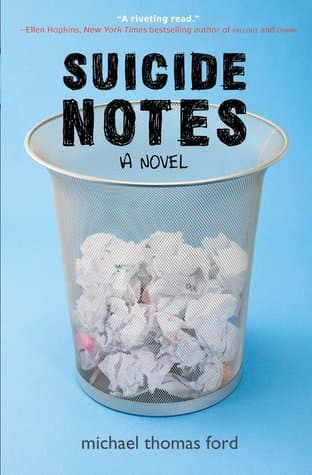
Synopsis
Covers the whole plot, including the ending.
- Difficulty
- Medium
- Pacing
- Moderate
- Mood
- Introspective, Humorous, Thought-provoking, Hopeful
- Read it if
- You enjoy darkly humorous, character-driven stories about mental health, self-discovery, and the complexities of adolescence, with a focus on internal monologue and emotional growth.
- Skip it if
- You prefer fast-paced plots with external conflict, are sensitive to themes of suicide and mental illness, or dislike stories set primarily in a single location.
Suicide Notes Plot Summary
Covers the whole plot, including the ending.
A Confounding Awakening in the Psychiatric Ward
Fifteen-year-old Jeff wakes up on New Year's Day in a hospital bed, confused. He quickly discovers he's in a psychiatric ward, not a regular hospital, and has bandages on his wrists. The staff, including Dr. Banks and Nurse Lydia, inform him he attempted suicide. Jeff, however, has no recollection of the event and denies trying to kill himself, believing it's all a misunderstanding. He's angry at his mother, whom he suspects committed him, and feels completely out of place among the other patients, whom he immediately labels as 'nutjobs.' His stay is for 45 days, which he finds unbearable.
Navigating the Ward and Its Inhabitants
Jeff's first days are marked by resistance to his new environment. He dislikes the forced group therapy sessions, the lack of privacy, and the bland food. He observes his fellow patients with a mix of fear and judgment: Michael, who talks to his dead mother; Sydney, a self-harmer; Rebecca, who is bulimic; Kevin, a withdrawn boy; and Allie, a girl with an eating disorder who seems a bit more 'normal.' He tries to act normal, convinced he doesn't belong. He often tries to contact his best friend, Allie, and her boyfriend, Burke, but his phone privileges are restricted, adding to his frustration and isolation.
A Glimpse of Humanity and Connection
Despite his initial resistance, Jeff slowly starts to relax. He finds a surprising connection with Allie, who shares his dry wit and cynicism. They bond over their shared disbelief in the ward's methods and their desire to escape. Jeff also begins to see the other patients not just as 'crazies' but as people with their own struggles. He sees Michael's grief, Sydney's quiet pain, and Rebecca's desperate need for control. These interactions, along with Nurse Lydia's gentle encouragement, begin to break down Jeff's defenses, making him question the clear line he'd drawn between himself and the 'others.'
Family Visits and Mounting Pressure
Jeff's visits with his mother are strained. She is apologetic and worried, but Jeff remains angry, believing she overreacted. His father is more distant, seemingly uncomfortable with the situation. Dr. Banks continues to push Jeff to remember the events leading up to his hospitalization, saying his recovery depends on acknowledging what happened. Jeff feels pressure, not only from the staff but also from himself, as the blank space in his memory becomes unsettling. He starts to wonder if he truly did try to kill himself, despite his firm denial.
The Weight of Friendship and Betrayal
As Jeff spends more time in the ward, memories of his life outside begin to surface in pieces. He recalls his intense friendship with Allie, his best friend since childhood, and his complicated feelings for Burke, Allie's boyfriend. He remembers a party shortly before his hospitalization, an argument with Allie, and a growing sense of distance from both of them. He feels a deep sense of betrayal about Allie and Burke's relationship, though the specifics remain unclear. These resurfacing memories are painful and confusing, hinting at deeper emotional turmoil than he initially admitted.
A Breakthrough in Therapy
During a group therapy session, prompted by Dr. Banks's questioning and the shared vulnerability of the other patients, Jeff has a partial breakthrough. He remembers being at Burke's house, feeling overwhelmed and upset. He recalls being in the bathroom and seeing a razor blade, but the act itself remains unclear. This memory, though incomplete, is a significant step, shaking his conviction that he had no involvement in his injury. The realization is terrifying, yet it also opens a door for further self-exploration.
Confronting the Truth of His Feelings
Through more therapy and conversations with Nurse Lydia, Jeff finally confronts the underlying emotions that had been buried. He admits that he has been in love with Allie for a long time and that seeing her with Burke caused him immense pain. He felt pushed aside, replaced, and deeply hurt by their relationship, which had begun in secret. This confession is a key moment, allowing him to articulate the jealousy, loneliness, and sense of loss that had consumed him, explaining much of his behavior and suppressed anger.
The Full Memory Returns
The full memory of the night finally returns to Jeff. He recalls being at Burke's house, feeling completely alone and devastated after a fight with Allie about her relationship with Burke. Overwhelmed by despair and a sense of hopelessness, he went into the bathroom, found Burke's razor, and cut his wrists. He remembers the coldness of the blade, the pain, and the overwhelming desire for the pain to stop, for everything to stop. This complete recollection is agonizing but also brings a strange sense of relief, as the missing pieces of his past finally slot into place.
Acceptance and Moving Forward
With the truth revealed, Jeff begins the difficult process of acceptance. He acknowledges that he did try to end his life, not out of a desire to die, but out of an overwhelming inability to cope with his emotional pain. He starts to participate more actively in therapy, sharing his feelings and listening to others. He makes plans for what he will do when he leaves the ward, including repairing his relationships and finding healthier coping mechanisms. He realizes that his time in the ward, initially perceived as a punishment, has been a journey of self-discovery and healing.
Graduation from the Ward
As his 45-day sentence comes to an end, Jeff is discharged from the psychiatric ward. He says his goodbyes to the staff and the patients, recognizing the unexpected bonds he formed. He leaves with a deeper understanding of himself, his emotions, and mental health. He still faces challenges, particularly in mending his relationships with Allie and Burke and reintegrating into his old life, but he is now equipped with the tools and self-awareness to navigate them. He is no longer in denial but has accepted his vulnerability and the need for ongoing self-care.
Principal Figures
Jeff
Protagonist
A fifteen-year-old boy grappling with a suicide attempt and a fractured memory.
Jeff is a sarcastic, initially defensive, and deeply confused fifteen-year-old boy. He wakes up in a psychiatric ward with no memory of his suicide attempt, leading him to believe he's been wrongly committed. He struggles with his identity, his feelings for his best friend Allie, and the perceived betrayal by her and Burke. Throughout his 45-day stay, he slowly sheds his denial and cynicism, confronting his painful memories and the complex emotions that led to his attempt. He is intelligent and witty, using humor as a defense mechanism.
Relationships: Allie (Best friend, unrequited love interest); Burke (Allie's boyfriend, Jeff's rival); Dr. Banks (Psychiatrist, challenging and insightful); Lydia (Nurse, empathetic and supportive); Michael (Fellow patient, friend); Sydney (Fellow patient, friend)
Allie
Supporting
Jeff's best friend and the object of his unrequited affection, also a patient in the ward.
Allie is Jeff's sarcastic and equally witty best friend, who is also a patient in the psychiatric ward, dealing with an eating disorder. She shares a deep history with Jeff, and her relationship with Burke is a major catalyst for Jeff's emotional turmoil. She is perceptive and initially guarded, but forms a strong bond with Jeff during their shared experience. Her presence in the ward helps Jeff feel less alone, and their dynamic is central to Jeff's journey of self-discovery.
Relationships: Jeff (Best friend, object of his love); Burke (Boyfriend)
Burke
Supporting
Allie's boyfriend and a source of jealousy and conflict for Jeff.
Burke is Allie's boyfriend and a significant figure in Jeff's pre-hospitalization life. He is initially portrayed as an antagonist in Jeff's mind, representing the 'betrayal' of Allie's affection. Jeff's jealousy and sense of being replaced by Burke are key drivers of his emotional breakdown. Though he doesn't appear much in the present narrative, his presence in Jeff's memories is crucial to understanding Jeff's feelings of abandonment and unrequited love.
Dr. Banks
Supporting
Jeff's psychiatrist in the ward, who pushes him to confront his truth.
Dr. Banks is the lead psychiatrist at the hospital, responsible for Jeff's care. She is professional, direct, and unyielding in her approach, consistently pushing Jeff to remember and confront the events that led to his hospitalization. While initially seen as an adversary by Jeff, her persistence and insight are ultimately instrumental in helping him break through his denial and begin the healing process. She represents the structured, therapeutic environment that Jeff initially resists.
Relationships: Jeff (Patient-doctor relationship); Lydia (Colleague)
Lydia
Supporting
An empathetic and understanding nurse in the psychiatric ward.
Lydia is a kind and empathetic nurse on the ward who offers Jeff a more gentle and understanding presence compared to Dr. Banks. She provides emotional support, listens without judgment, and helps Jeff navigate the rules and challenges of his stay. Her compassion and ability to connect with the patients on a human level are crucial in helping Jeff feel safe enough to begin opening up and trusting the process. She acts as a bridge between Jeff's resistance and his eventual acceptance.
Relationships: Jeff (Patient-nurse relationship); Dr. Banks (Colleague)
Michael
Supporting
A fellow patient who talks to his deceased mother, providing a poignant contrast to Jeff's denial.
Michael is a fellow patient in the ward who frequently talks to his deceased mother, often in the common room. His grief and vivid hallucinations are initially unsettling to Jeff, but as Jeff's own defenses crumble, he begins to see Michael's vulnerability and pain. Michael's open expression of his struggles, though different from Jeff's, serves as a poignant reminder that everyone in the ward is dealing with deep-seated issues, helping Jeff develop empathy.
Relationships: Jeff (Fellow patient, friend); His deceased mother (Source of comfort and grief)
Sydney
Supporting
A quiet, self-harming patient who embodies silent suffering.
Sydney is another patient in the ward, characterized by her quiet demeanor and history of self-harm. She rarely speaks but her presence and the visible signs of her struggles (bandages, scars) make a profound impact on Jeff. She represents the silent suffering and the various ways individuals cope with overwhelming pain. Her quiet strength and vulnerability contribute to Jeff's growing understanding that the 'crazies' are complex individuals, not just stereotypes.
Relationships: Jeff (Fellow patient, friend)
Rebecca
Supporting
A bulimic patient who struggles with control and body image.
Rebecca is a bulimic patient in the ward, whose struggles with food, body image, and control are evident. Jeff observes her behaviors and her deep-seated insecurities. Her journey highlights the complexities of eating disorders and the emotional pain they mask. Her story contributes to Jeff's understanding of the diverse mental health challenges faced by his fellow patients, reinforcing the idea that everyone is fighting their own battles.
Relationships: Jeff (Fellow patient, friend)
Themes & Insights
Denial and Self-Deception
The novel's central theme is Jeff's denial of his suicide attempt and his initial refusal to acknowledge his emotional pain. He creates a facade of normalcy, convinced he doesn't belong in the psychiatric ward. This theme is clear from the opening pages, where Jeff insists he's 'not crazy' and that his hospitalization is a 'mistake.' His denial is a way to avoid confronting the traumatic event and the underlying feelings of unrequited love, jealousy, and abandonment. The entire plot traces his slow, painful journey from complete denial to acceptance of his truth.
“I'm not crazy. I don't see what the big deal is about what happened. But apparently someone does think it's a big deal because here I am. I bet it was my mother. She always overreacts.”
Identity and Self-Discovery
Jeff's 45-day stay in the ward forces him into a period of self-reflection, leading to a significant re-evaluation of who he is. Stripped of his external life and confronted with his internal turmoil, he grapples with questions of identity. He initially defines himself by his 'normalcy' and his friendships, but the ward challenges these definitions. Through interactions with other patients and therapy sessions, he discovers hidden emotions, particularly his unacknowledged love for Allie and his feelings of betrayal. This journey of self-discovery is painful but ultimately leads to a more authentic understanding of himself.
“Maybe the crazies weren't so crazy after all. Maybe they were just like me, only they remembered what had happened to them.”
The Nature of 'Normalcy' and Mental Illness
The book constantly explores and breaks down the line between 'normal' and 'crazy.' Jeff begins by rigidly categorizing himself as normal and his fellow patients as 'nutjobs,' but his experiences in the ward gradually break down these distinctions. He realizes that mental illness is not a clear-cut state but a range of human experience, often rooted in emotional pain. The diverse stories of Michael, Sydney, Rebecca, and Allie show that everyone struggles, and 'normalcy' is often a facade. The theme challenges readers to reconsider their ideas about mental health and empathy.
“I was starting to realize that the difference between 'normal' and 'crazy' wasn't as big as I'd always thought. Maybe it was just a matter of how well you hid it.”
Unrequited Love and Betrayal
A significant emotional factor driving Jeff's crisis is his unrequited love for his best friend, Allie, and his feelings of betrayal when she starts dating Burke. This theme explores the intense pain of loving someone who doesn't love you back, made worse by the loss of a foundational friendship. Jeff's inability to express these emotions, combined with his feeling of being replaced, leads to isolation and despair. His eventual acknowledgment of these feelings is a key step in understanding what caused his suicide attempt.
“It wasn't just that I loved her. It was that she was my best friend, and she'd chosen him over me. It felt like a punch to the gut, over and over again.”
The Power of Memory and Trauma
The story is structured around Jeff's amnesia regarding his suicide attempt, showing the psychological impact of trauma and the mind's protective mechanisms. His fragmented memories and the slow, painful process of recalling the event show how the brain can suppress overwhelming experiences. The theme explores how confronting traumatic memories, no matter how difficult, is essential for healing and moving forward. The journey of memory retrieval is not just about recalling facts but about putting a fractured self back together.
“It was like trying to grab smoke. The harder I tried to remember, the more it slipped away.”
Plot Devices & Literary Techniques
First-Person Amnesiac Narrator
Jeff's unreliable narration due to memory loss creates suspense and allows for gradual revelation.
The story is told entirely from Jeff's first-person perspective, but he is an amnesiac narrator regarding the central event of his suicide attempt. This device creates immediate suspense and mystery, as the reader is as confused as Jeff about how he ended up in the ward. It allows for a gradual unveiling of the truth, mirroring Jeff's own journey of recovery. His initial denial and sarcastic voice also make him an unreliable narrator, forcing the reader to question his perceptions and anticipate the inevitable reveal of his suppressed memories.
Confined Setting (Psychiatric Ward)
The ward acts as a crucible for Jeff's self-discovery and forces interaction with diverse characters.
The psychiatric ward serves as a literal and metaphorical confined space. Physically, it restricts Jeff's freedom and forces him to confront his situation without external distractions. Metaphorically, it acts as a crucible, stripping away his defenses and forcing him into intense self-reflection and interaction with people he would normally avoid. The diverse group of patients within this confined space provides a microcosm of mental health struggles, challenging Jeff's preconceived notions and fostering empathy.
Flashbacks and Fragmented Memories
Jeff's recurring and incomplete memories gradually piece together the story of his past.
Throughout the novel, Jeff experiences fragmented flashbacks and incomplete memories of the events leading up to his hospitalization. These are not linear or fully formed but come in bursts, often triggered by therapy sessions or interactions with other patients. This device effectively conveys the psychological impact of trauma and the difficulty of memory retrieval. Each fragment adds a layer to the mystery, slowly building towards the complete picture of Jeff's emotional state and the specific details of his suicide attempt.
Dramatic Irony
The reader often suspects Jeff's denial before he does, creating tension.
Dramatic irony is present as the reader, given the book's title and premise, knows from the outset that Jeff likely did attempt suicide, even as Jeff himself vehemently denies it. This creates a constant tension and anticipation, as the reader watches Jeff's struggle with denial, waiting for him to catch up to the truth that seems evident. This device highlights Jeff's self-deception and underscores the psychological barriers he has erected.
Suicide Notes Quotes
“I'm not crazy. I'm just a little unwell. I know, I know, that's a song, but it's true.”
“The worst part about trying to kill yourself is that if you fail, you have to go back to school.”
“Sometimes I wonder if I'm just a character in someone else's story. And if I am, I wish they'd give me some better lines.”
“It's funny how everyone suddenly cares about you when you almost die. Where were they before?”
“Maybe the reason I tried to kill myself wasn't because I wanted to die, but because I wanted to stop living the way I was.”
“Being crazy isn't about seeing things that aren't there. It's about not seeing things that are.”
“Everyone has a dark side. Some just show it more than others.”
“You can't fix everything. Sometimes you just have to let things be broken.”
“It's hard to explain to someone who's never been there what it's like to feel nothing.”
“Maybe the whole point of going through something terrible is to learn how to appreciate the good things.”
“Silence can be louder than any scream when you're the one listening.”
“Sometimes the strongest thing you can do is ask for help.”
“The world doesn't stop just because you want it to.”
“You don't have to be perfect to be loved. You just have to be real.”
Quiz
10 questions on the plot and the characters. Each answer comes with a short explanation.
Question 1
What is the primary reason Jeff finds himself in the psychiatric ward at the beginning of the book?
- He was caught shoplifting and given a choice between juvenile detention or the ward.
- He attempted suicide, waking up with bandages on his wrists.
- His parents committed him after a severe mental breakdown at home.
- He was involved in a car accident and suffered a concussion, leading to psychological evaluation.
Show answer
B. He attempted suicide, waking up with bandages on his wrists. The book opens with Jeff waking up in the hospital, specifically the psychiatric ward, with bandages on his wrists, indicating a suicide attempt. He initially dismisses it as 'not a big deal.'
Question 2
How long is Jeff's initial 'sentence' in the psychiatric ward?
- One week
- Thirty days
- Forty-five days
- Two months
Show answer
C. Forty-five days The synopsis explicitly states, 'But a funny thing happens as his forty-five-day sentence drags on,' indicating the duration of his stay.
Question 3
Which family member does Jeff initially suspect was behind his admission to the psychiatric ward?
- His father
- His older brother
- His mother
- His grandmother
Show answer
C. His mother In the opening lines, Jeff muses, 'I bet it was my mother. She always overreacts.'
Question 4
What is Jeff's initial attitude towards the other patients in the psychiatric ward?
- He feels an immediate sense of kinship and understanding.
- He views them as 'nutjobs' and believes he is perfectly normal and doesn't belong with them.
- He is fearful and tries to avoid all interaction with them.
- He is curious about their stories but maintains a polite distance.
Show answer
B. He views them as 'nutjobs' and believes he is perfectly normal and doesn't belong with them. The text states, 'Clearly, this is all a huge mistake. Forget about the bandages on his wrists and the notes on his chart... Jeff's perfectly fine, perfectly normal, not like the other kids in the hospital with him. Now they've got problems.' This highlights his initial dismissive and superior attitude.
Question 5
What is one of the key themes explored in 'Suicide Notes'?
- The importance of academic achievement for personal happiness.
- The blurred line between 'normal' and mental illness.
- The challenges of space exploration and scientific discovery.
- The historical context of the American Civil War.
Show answer
B. The blurred line between 'normal' and mental illness. The synopsis explicitly states the book 'examines that fuzzy line between 'normal' and the rest of us,' indicating this as a central theme.
Question 6
What is the nature of Jeff's relationship with Allie and Burke mentioned in the synopsis?
- Allie is his sister, and Burke is her new boyfriend, causing family tension.
- Allie is his best friend, and Burke is her boyfriend, implying a complicated love triangle or jealousy on Jeff's part.
- Allie and Burke are his parents' friends who are trying to help him.
- Allie and Burke are fellow patients in the psychiatric ward whom Jeff befriends.
Show answer
B. Allie is his best friend, and Burke is her boyfriend, implying a complicated love triangle or jealousy on Jeff's part. The synopsis mentions, 'Forget about his problems with his best friend, Allie, and her boyfriend, Burke.' This suggests a pre-existing dynamic and potential source of his 'problems' outside the ward, often implying unrequited feelings or jealousy in young adult narratives.
Question 7
What is the narrative style of the book, as suggested by the title and initial lines?
- Third-person omniscient, providing insights into multiple characters' thoughts.
- First-person perspective, from Jeff's point of view, indicated by 'I' statements.
- An epistolary novel, told through a series of letters and documents.
- Second-person, directly addressing the reader as 'you.'
Show answer
B. First-person perspective, from Jeff's point of view, indicated by 'I' statements. The opening lines are clearly in the first person: 'I'm not crazy. I don't see what the big deal is... here I am. I bet it was my mother.' The title 'Suicide Notes' also implies a personal, first-person reflection, though the book is not literally a collection of notes.
Question 8
How does Jeff's perception of the other patients in the ward change over time?
- He becomes increasingly convinced that he is sicker than them.
- He develops a deeper understanding and realizes they are 'less crazy' than he initially thought.
- He remains isolated, never truly connecting with anyone.
- He starts to mimic their behaviors in an attempt to fit in.
Show answer
B. He develops a deeper understanding and realizes they are 'less crazy' than he initially thought. The synopsis states, 'But a funny thing happens as his forty-five-day sentence drags on: the crazies start to seem less crazy.' This indicates a significant shift in his perspective and a development in his character.
Question 9
What does the phrase 'darkly humorous' in the synopsis suggest about the book's tone?
- The book is primarily a comedy with no serious undertones.
- It uses humor to address serious or uncomfortable subjects like mental health and suicide.
- The humor is mostly slapstick and relies on physical comedy.
- The book is entirely depressing with no moments of levity.
Show answer
B. It uses humor to address serious or uncomfortable subjects like mental health and suicide. 'Darkly humorous' implies that the humor is used in the context of serious or even morbid subjects, often as a coping mechanism or to highlight the absurdity of difficult situations. In this case, it's about mental health and a suicide attempt.
Question 10
What is the significance of the New Year's Day setting for Jeff's hospitalization?
- It implies a sense of new beginnings and the potential for change and self-reflection.
- It highlights the irony of a time of celebration coinciding with his personal crisis, making his situation feel worse.
- It is merely a coincidental detail with no deeper thematic meaning.
- It suggests that his issues are specifically related to holiday stress and family gatherings.
Show answer
A. It implies a sense of new beginnings and the potential for change and self-reflection. New Year's Day traditionally symbolizes new beginnings, resolutions, and a fresh start. For Jeff to wake up in a psychiatric ward on this day suggests that his journey there is, in a way, the beginning of a new, albeit difficult, chapter of self-discovery and healing, aligning with the book's themes of change and understanding.
Suicide Notes FAQ
What is 'Suicide Notes' about?
Michael Thomas Ford's 'Suicide Notes' follows fifteen-year-old Jeff, who wakes up in a psychiatric ward on New Year's Day with bandages on his wrists but no memory of how he got there or why. Confident it's a mistake, he narrates his 45-day stay among other 'crazy' patients, slowly piecing together the events that led to his hospitalization and confronting his own mental health struggles.
Why should I read 'Suicide Notes'?
You should read 'Suicide Notes' for its authentic and often darkly humorous portrayal of mental health, particularly from a young adult's perspective. It offers a compelling look at self-discovery, the stigma surrounding psychiatric care, and the nuanced journey of accepting help, all through Jeff's witty and relatable voice.
What is the background/setting of 'Suicide Notes'?
The primary setting of 'Suicide Notes' is a psychiatric ward where 15-year-old Jeff is admitted after a suicide attempt he can't recall. The story unfolds over his mandated 45-day stay, with flashbacks to his life before the incident, including his home, school, and interactions with his best friend Allie and her boyfriend Burke.
What are the most memorable quotes?
Memorable quotes often highlight Jeff's sardonic wit and gradual self-awareness, such as his initial dismissive thoughts about the 'nutjobs' in the ward, or later reflections like, 'Maybe it's not about being normal. Maybe it's about being okay with who you are.' These quotes capture his journey from denial to acceptance.
What writing style does the author use?
Michael Thomas Ford employs a first-person narrative, primarily in a diary-like or journal format from Jeff's perspective, making the tone very intimate and immediate. The style is characterized by dark humor, internal monologue, and a conversational, often sarcastic, voice that reflects Jeff's teenage cynicism and his gradual emotional unraveling.
What minor details add significant meaning?
Minor details, like Jeff's recurring dismissals of his mother's 'overreactions' or his vague recollections of arguments with Allie, subtly build a picture of his escalating emotional distress and denial. The way he initially categorizes and judges his fellow patients, only to later find common ground, highlights his internal shift.
What are some subtle foreshadowing moments?
Subtle foreshadowing includes Jeff's persistent inability to recall the events leading to his hospitalization, hinting at a deeper psychological block rather than simple forgetfulness. His casual mentions of stress with Allie and Burke, or his general feeling of being misunderstood, subtly point towards the underlying pressures that contributed to his breakdown.
What unexpected character connections exist?
An unexpected connection emerges as Jeff realizes that the 'crazy' patients he initially dismisses, like Sadie or even the quiet, withdrawn ones, offer him more genuine understanding and empathy than some people in his 'normal' life. He forms bonds within the ward that challenge his preconceived notions of mental illness and friendship.
What are unspoken character motivations?
Jeff's unspoken motivation for denying his suicide attempt and his mental health issues stems from a deep-seated fear of being perceived as 'crazy' and a strong desire to maintain a facade of normalcy and control, especially in front of his parents and friends. His initial anger at being hospitalized is a manifestation of this denial and fear.
What psychological complexities do characters exhibit?
Jeff exhibits significant psychological complexity through his unreliable narration, denial, and a defense mechanism of humor and sarcasm to cope with his trauma. Other characters in the ward display various mental health struggles, from Sadie's anxiety and self-harm to the quiet despair of others, all illustrating the diverse spectrum of human suffering.
What are the major emotional turning points?
A major emotional turning point for Jeff is when he finally recalls the events of New Year's Eve, particularly the argument with Allie and Burke that escalated into his suicide attempt. Another key moment is his growing empathy for his fellow patients, realizing their struggles are not so different from his own, leading to a breakdown of his emotional walls.
How do relationship dynamics evolve?
Jeff's relationships evolve significantly; his strained relationship with his mother begins to heal as he opens up, and his friendship with Allie is re-evaluated as he understands the pressures he put on her. Crucially, his relationships with the other patients in the ward transform from judgment to genuine connection and mutual support, helping him to feel less alone.
Which parts remain ambiguous or open-ended?
While Jeff's immediate future post-discharge is addressed, the long-term impact of his stay on his mental health journey and his relationships with Allie and Burke remains somewhat open-ended. The book focuses more on the initial acceptance of his condition rather than a definitive 'cure,' reflecting the ongoing nature of mental health recovery.
What are controversial scenes or decisions?
The most controversial aspect could be Jeff's initial, almost flippant, dismissal of his suicide attempt and his harsh judgment of the other patients. While intended to show his denial, some readers might find his early callousness towards serious mental health issues challenging, though it ultimately serves his character arc of growth.
'Suicide Notes' ending explained: how it ends & what it means
The book ends with Jeff completing his 45-day stay, having finally confronted and accepted the reality of his suicide attempt and his need for help. He leaves the ward not 'cured,' but with a newfound understanding of himself, a willingness to continue therapy, and a more empathetic perspective towards others and his own mental health. It signifies the beginning of his recovery journey, emphasizing self-acceptance over a return to a 'normal' that was never healthy for him.
About the author

Michael Thomas Ford is an American author known for his work in fiction. His notable book, "Suicide Notes," explores themes of adolescence and mental health. Ford's writing often reflects his insights into personal struggles and societal issues.
Similar books
- It's Kind of a Funny Story
Ned Vizzini
4.1 (211k) average on GoodreadsPsychologyFeatures a teenager in a psychiatric ward grappling with mental health in a humorous yet poignant way.
- Challenger Deep
Neal Shusterman
4.1 (20k) average on GoodreadsPsychologyExplores the experience of a teenager with mental illness, blending reality and metaphor.
- The Perks of Being a Wallflower
Stephen Chbosky
4.2 (1.3M) average on GoodreadsPsychologyDeals with a sensitive protagonist facing trauma and mental health challenges during adolescence.
- Eleanor Oliphant Is Completely Fine
Gail Honeyman
4.3 (708k) average on GoodreadsLiterary FictionA lonely woman's structured life changes when an IT guy and an elderly man help her learn to open her heart.
- One Flew Over the Cuckoo's Nest
Ken Kesey
4.2 (631k) average on GoodreadsPsychologyIn a mind-bending asylum, the boisterous Randle McMurphy wages a defiant war against the tyrannical Nurse Ratched, inspiring his fellow inmates, including the seemingly catatonic Chief Bromden, to reclaim their lost humanity.
- The Bell Jar
Sylvia Plath
4.0 (591k) average on GoodreadsPsychologyIn the suffocating grip of 1950s expectations, a brilliant young woman's descent into mental illness is painted with such vivid, internal clarity that her 'insanity' feels terrifyingly rational and inevitable.






Enjoyed the summary?
A summary gives you the shape of the book. The book itself has the detail, the examples and the voice.
Find Suicide Notes on AmazonAs an Amazon Associate, BookBrief earns from qualifying purchases. How we're funded