
Core Idea
- Difficulty
- Medium
- Read it if
- You want a profound, harrowing, and intellectually rigorous firsthand account of the Holocaust, focusing on the psychological and moral degradation within a concentration camp.
- Skip it if
- You are looking for a historical overview of WWII or a story with a traditional narrative arc of heroism and triumph.
Key Takeaways from Survival in Auschwitz
The Stripping of Humanity
Auschwitz systematically dismantled identity, reducing individuals to mere numbers.
Levi describes the initial shock and the loss of human dignity upon arrival at Auschwitz. The process began with confiscating belongings, shaving hair, tattooing numbers, and forcing prisoners into ill-fitting uniforms. This was a deliberate psychological attack designed to dehumanize. Stripped of names, clothes, and history, prisoners became an interchangeable mass, easier to control, exploit, and destroy. Replacing names with tattooed numbers symbolized the erasure of individual identity, a key step in the Nazi extermination machinery.
“Then for the first time we became aware that our language lacks words to express this offense, the demolition of a man. In a moment, with almost prophetic intuition, the reality was revealed to us: we had reached the bottom. It is not possible to sink lower than this.”
In the book: Levi's detailed account of the 'selections' upon arrival, the immediate confiscation of all possessions, the shaving of heads and bodies, and the tattooing of prisoner numbers on forearms.
Try this: Recognize the subtle ways systems or institutions can diminish individual identity. Actively resist conformity that suppresses personal expression or unique worth. Advocate for systems that respect and preserve individual dignity, even in challenging circumstances.
Related ideas: dehumanization, identity-erosion, systematic-cruelty
The Language of Survival
Mastering the camp's unwritten rules and pidgin language was crucial for daily existence.
Survival in Auschwitz was not just about physical endurance; it was about understanding and adapting to a new, brutal reality with its own perverse logic. Levi highlights the importance of quickly learning 'Lagerjargon,' a mix of German, Polish, and Yiddish, along with the camp's unspoken rules. Misunderstanding an order, failing to grasp power dynamics, or not knowing how to 'organize' (steal or barter) necessities meant immediate danger. This linguistic and social adaptation was a matter of life and death, showing how even in extreme conditions, humans develop complex, if distorted, social structures and communication methods to navigate their environment.
“The memory of these things is not simple and it is not easy for me to tell them. But I must remember them, and I must tell them.”
In the book: Levi's descriptions of the constant fear of not understanding commands, the need to learn how to 'organize' food or tools, and the complex social hierarchy among prisoners and Kapos.
Try this: When entering a new or challenging environment, prioritize understanding its unique culture, language, and unwritten rules. Observe, listen, and seek guidance to adapt effectively. Recognize that communication barriers can be as dangerous as physical ones.
Related ideas: linguistic-adaptation, social-intelligence, camp-culture
The Privilege of Skill
Specialized knowledge offered a fragile, temporary advantage in the struggle for life.
One of Levi's striking observations is how certain skills, especially scientific or technical ones, could offer a fleeting chance for better conditions or even survival. As a chemist, Levi was assigned to the Buna factory laboratory, a position that, while still dangerous, offered slightly better food, shelter, and some intellectual engagement. This was not a guarantee of survival, but it was an advantage over the 'Musselmänner' (the walking dead). This shows the perverse logic of the camp, where even an inhumane system could find 'utility' in specific human capabilities, inadvertently providing a slender hope for a select few.
“To survive here, you must be a specialist.”
In the book: Levi's own transfer to the chemical laboratory at Buna, which provided him with warmer clothing, less strenuous work, and a sense of purpose that others lacked.
Try this: Cultivate diverse and adaptable skills. In any challenging situation, consider how your unique abilities could provide leverage or offer solutions. Never underestimate the value of expertise, even in unexpected contexts.
Related ideas: skill-utility, technical-expertise, survival-advantage
The Gray Zone of Morality
Auschwitz forced impossible moral compromises, blurring the lines between victim and perpetrator.
Levi addresses the agonizing moral ambiguities of the camp, a concept he later called 'the gray zone.' He describes the prisoner hierarchy, from 'Prominents' (Kapos, block elders) who often brutalized fellow inmates for favor, to desperate acts of 'organizing' that amounted to theft. Survival often demanded acts that would be reprehensible in normal society. This does not excuse collaboration, but helps understand the extreme pressures that distorted moral choices. It explores how oppressive systems force individuals into roles where they inflict suffering on others for their own survival, creating a complex web of victims and victimized victims.
“The Lager was a great machine for reducing us to animals. But we were not animals. We were men, and in that sense, we were still responsible for our actions.”
In the book: The existence of Kapos and other 'Prominents' who were prisoners themselves but wielded power and often inflicted violence. The necessity of 'organizing' (stealing or bartering) to survive, which meant taking from others.
Try this: Reflect on the ethical compromises individuals are forced to make under extreme duress. Cultivate empathy for those caught in impossible situations, recognizing that moral clarity is a luxury not always afforded. Advocate for systems that reduce the 'gray zones' where human dignity is compromised.
Related ideas: moral-dilemma, gray-zone, ethical-compromise
The Fragility of Memory
The trauma of the camp distorted and eroded memories, making accurate recollection a struggle.
Levi is aware that memory can be unreliable, especially after extreme trauma and deprivation. He admits his own recollections might be incomplete or altered by time and the sheer horror. The constant struggle for survival left little room for contemplation or precise observation, and psychological defense mechanisms could also obscure the truth. This self-awareness gives credibility to his account, emphasizing that even eyewitness testimony from survivors is a reconstructed narrative, not a perfect recording, and shows trauma's destructive power on the mind's ability to process and retain information.
“It is a difficult thing to describe, and I do not want to be melodramatic. But the hunger, the cold, the fear, these things warp the memory.”
In the book: Levi's frequent interjections acknowledging the difficulty of remembering details, the blurring of days, and the possibility of his memory being 'corrupted' by the trauma.
Try this: Approach historical accounts, especially those of trauma, with a critical yet empathetic lens, understanding the complexities of memory. Encourage journaling and documentation in challenging times to preserve accurate records. Recognize that personal narratives, while invaluable, are inherently subjective.
Related ideas: trauma-memory, historical-accuracy, narrative-reliability
The Power of Small Resistances
Even minor acts of defiance or humanity offered profound psychological sustenance.
In a place designed to erase individuality, Levi notes the immense psychological importance of small acts of defiance. Whether secretly keeping a button, sharing bread, or trying to maintain cleanliness despite impossible conditions, these actions were vital. They were not grand rebellions, but assertions of self, small victories against the dehumanizing machinery of the camp. These acts affirmed that despite everything, prisoners were still human, capable of agency and compassion, and not entirely reduced to the 'Muselmann' state. They provided a crucial, if fleeting, sense of dignity and resistance against total spiritual annihilation.
“We were not allowed to have any personal possessions, but we tried to keep some small things, a piece of string, a button, a splinter of wood. These were our small treasures, our last connection to our past.”
In the book: Levi's account of sharing a bowl of soup with a friend, the effort to wash one's shirt, or the attempt to explain Dante's 'Canto of Ulysses' to a fellow prisoner, as a way to connect with a lost world of culture and humanity.
Try this: In oppressive or challenging environments, identify and engage in small acts that affirm your values, identity, or humanity. Recognize that seemingly insignificant gestures can have profound psychological impact. Support and acknowledge others' small acts of resistance.
Related ideas: psychological-resilience, human-dignity, passive-resistance
The Indifference of Nature
The natural world remained beautiful and indifferent, a stark contrast to human depravity.
A recurring, poignant detail in Levi's narrative is the contrast between the camp's horrors and the indifferent beauty of nature. He often describes the clear sky, changing seasons, or distant bird sounds. This stark contrast shows the man-made nature of the suffering within Auschwitz. Nature continued its cycles, unconcerned with the human tragedy unfolding. This indifference is not cruel, but a profound comment on humanity's capacity for both immense beauty and unimaginable depravity, and how our actions are confined to our own sphere, leaving the larger cosmos untouched.
“The sky was blue and the air was clear, and it seemed as if the world outside was continuing its normal course, indifferent to our suffering.”
In the book: Levi's descriptions of the clear winter sky, the beauty of a sunset, or the feeling of rain, often observed from within the confines of the camp.
Try this: Cultivate an appreciation for the natural world as a source of perspective and solace. Reflect on humanity's place within the larger cosmos and the importance of our stewardship of both nature and each other. Recognize that human suffering is our responsibility, not nature's.
Related ideas: nature's-indifference, human-depravity, perspective
The Illusion of Freedom
Even liberation brought a new, complex burden of survival and memory.
The end of the war did not immediately bring freedom or peace of mind. Levi details the chaotic, dangerous period after the Germans abandoned the camp, where starvation, disease, and the struggle to return home were still major concerns. The transition from prisoner to free man was not instant; psychological scars remained, and the 'Lager' continued to define their reality for a long time. This shows that survival is not just about escaping a physical threat, but also about the long, difficult process of reclaiming one's life, identity, and mental well-being after profound trauma. 'Freedom' was a new, complex challenge.
“Many things were to happen, good and bad; but in the short space of these ten days, the Lager was still our only reality. We were still prisoners.”
In the book: Levi's account of the period after the Germans fled, the continued struggle for food and shelter, the slow and arduous journey home, and the lingering psychological impact on survivors.
Try this: Understand that recovery from trauma is a long, non-linear process. Provide sustained support to those who have endured extreme hardship, recognizing that 'liberation' is often just the beginning of a new journey. Be patient and empathetic with the complexities of healing.
Related ideas: post-trauma-recovery, psychological-scars, long-term-survival
The Duty to Bear Witness
Levi's writing is an urgent, moral imperative to remember and inform.
Beyond recounting his experiences, Levi felt a moral obligation to bear witness. His writing is clear, precise, and lacks sensationalism, driven by the belief that the world must understand what happened in Auschwitz to prevent its recurrence. He writes not for revenge, but for justice and understanding, emphasizing that the mechanisms leading to the Holocaust are inherent dangers in all societies. This commitment to truth and memory transforms his memoir from a personal story into a universal warning, making it an important document for understanding human cruelty and the fragility of civilization.
“It happened, therefore it can happen again: this is the core of what we have to say. It can happen, and it can happen everywhere.”
In the book: The measured, analytical tone of the book, Levi's explicit statements about the importance of remembering and warning, and his later works like 'The Drowned and the Saved' which further explore the moral implications.
Try this: Recognize the importance of historical memory and education in preventing future atrocities. Actively seek out and support narratives that bear witness to injustice. Engage in critical thinking about societal trends that could lead to dehumanization or oppression.
Related ideas: historical-memory, moral-imperative, prevention-of-atrocities
The Normalization of Evil
The true horror lay in the systematic, bureaucratic nature of the extermination.
Levi's account subtly reveals that the most terrifying aspect of Auschwitz was not just individual acts of cruelty, but the cold, rational, and bureaucratic efficiency with which humans were processed for extermination and exploitation. The camp operated like a perverse factory, with schedules, quotas, and systems for everything from prisoner intake to body disposal. This normalization of evil, where unimaginable atrocities became routine administrative tasks, demonstrates Hannah Arendt's concept of 'the banality of evil.' It shows how ordinary people, within a totalitarian system, can become cogs in a machine of destruction, losing their moral compass through adherence to procedure.
“We were not allowed to have any personal possessions, but we tried to keep some small things, a piece of string, a button, a splinter of wood. These were our small treasures, our last connection to our past.”
In the book: The detailed descriptions of daily routines, the 'selections' as a regular process, the systematic deprivation of food and rest, and the efficient operation of the gas chambers and crematoria.
Try this: Be vigilant against the normalization of injustice or dehumanization in any form. Question authority and resist blind adherence to rules that compromise ethical principles. Understand how bureaucratic systems can enable large-scale harm if unchecked by moral scrutiny.
Related ideas: banality-of-evil, systemic-cruelty, bureaucratic-horror
Survival in Auschwitz Quotes
“It was not possible to think of anything else, to remember anything else. The past was a burden, the future a threat. Only the present existed, and the present was hunger, cold, and a constant, gnawing fear.”
“Then for the first time we became aware that our language is devoid of words to express this offense, the demolition of a man. In a moment, with almost prophetic intuition, the reality was revealed to us: we had reached the bottom. It is not possible to sink lower than this; no human condition is more miserable than this, nor has it ever been.”
“We, the survivors, are not the true witnesses. This is an uncomfortable notion that I have gradually come to accept. The true witnesses, the ones with a story to tell, are those who did not return.”
“The memory of the things we saw, the words we heard, the food we ate, the blows we received, the cold we suffered, the hunger that tormented us, is still alive in us, and it will be as long as we live.”
“Perhaps the most important thing to remember is that there were no 'good' or 'bad' people in the camp, only people trying to survive.”
“To destroy a man is difficult, almost as difficult as to create him.”
“It is not in our power to choose what we remember, but we can choose how we interpret it.”
“I have learned that the world is full of suffering, but it is also full of people who are trying to alleviate it.”
“Man is a creature of habit, and this is true even in the most extreme conditions. We adapted to the camp, not because we wanted to, but because we had to.”
“The Lager was a great experiment on man: an attempt to reduce him to an animal, to strip him of his humanity. And it succeeded, for the most part.”
“Even in the Lager, there were moments of beauty, moments of humanity, moments of grace. They were rare, but they existed, and they were precious.”
“The worst thing about the Lager was not the physical suffering, but the spiritual death that it inflicted.”
“We who survived, carry within us the mark of the Lager. We are different, irrevocably so, from those who did not experience it.”
“And the word 'why' was on everyone's lips, but there was no answer.”
Quiz
10 questions on the main ideas. Each answer comes with a short explanation.
Question 1
Which of the following best describes the initial feeling Levi experiences upon his arrival at Auschwitz, as depicted in the book?
- Overwhelming rage and desire for revenge.
- A profound sense of bewilderment and loss of human dignity.
- Immediate fear of death.
- Hope for eventual liberation.
Show answer
B. A profound sense of bewilderment and loss of human dignity. Levi describes the initial experience as a profound shock, where the prisoners are stripped of their identities and possessions, leading to an overwhelming sense of bewilderment and dehumanization, rather than immediate fear of death or rage.
Question 2
What was Primo Levi's profession before his deportation to Auschwitz?
- Engineer
- Doctor
- Chemist
- Teacher
Show answer
C. Chemist The book explicitly states that Primo Levi was a chemist, a profession that later played a role in his survival within the camp.
Question 3
What is the primary function of the 'Ka-Be' (Krankenbau) in Auschwitz, as described by Levi?
- A place for prisoners to receive adequate medical treatment and recovery.
- A temporary refuge from work, but also a place of anxiety due to the selections.
- A privileged area for Kapos and other trusted prisoners.
- The main administrative office for prisoner records.
Show answer
B. A temporary refuge from work, but also a place of anxiety due to the selections. Levi portrays the Ka-Be not as a place of healing, but as a dangerous limbo where prisoners could avoid hard labor temporarily, but were constantly under threat of 'selection' for extermination if deemed unfit to work.
Question 4
Which term did Levi use to describe the prisoners who adapted exceptionally well to the camp's conditions, often at the expense of others?
- The 'Saved'
- The 'Submerged'
- The 'Prominents'
- The 'Observers'
Show answer
C. The 'Prominents' Levi categorizes prisoners into the 'submerged' (those who succumbed) and the 'saved' (those who survived). Within the 'saved' he identifies 'Prominents' – those who, through various means often involving collaboration or ruthlessness, managed to secure better positions and resources.
Question 5
What is the significance of the 'washing ritual' in the Lager, as described by Levi?
- It was a mandatory hygienic practice enforced by the SS to prevent disease.
- It represented a futile attempt by prisoners to retain a shred of human dignity and self-respect.
- It was a rare opportunity for prisoners to socialize and exchange information.
- It was a punishment for minor infractions of camp rules.
Show answer
B. It represented a futile attempt by prisoners to retain a shred of human dignity and self-respect. Levi emphasizes that the act of washing, despite the lack of proper facilities or soap, was a crucial, almost ritualistic, act for many prisoners to maintain a semblance of their former selves and resist the dehumanizing forces of the camp.
Question 6
What role did Levi's knowledge of German play in his survival, particularly during his time working in the laboratory?
- It allowed him to directly communicate with the SS officers and request better conditions.
- It enabled him to understand orders and avoid misunderstandings, which could be fatal.
- It helped him to translate for other Italian prisoners, making him valuable to the Kapos.
- It gave him access to propaganda materials that boosted his morale.
Show answer
B. It enabled him to understand orders and avoid misunderstandings, which could be fatal. Levi explicitly states that understanding German was a critical survival tool, allowing him to comprehend commands, navigate the complex hierarchy, and ultimately secure a position in the chemical laboratory, which offered relative safety and better conditions.
Question 7
What is the central argument Levi makes about the nature of human memory in the context of the Holocaust?
- Memory is inherently unreliable and constantly distorts past events.
- The memory of suffering fades quickly, allowing survivors to move on easily.
- The memory of the Lager, while painful, is a moral duty to preserve and transmit.
- Only those who experienced the Lager can truly understand it; others cannot comprehend.
Show answer
C. The memory of the Lager, while painful, is a moral duty to preserve and transmit. A core theme of the book is Levi's moral imperative to bear witness and transmit the memory of the Holocaust. He emphasizes the importance of remembering and communicating the experience, even acknowledging the difficulty in conveying its full horror to those who were not there.
Question 8
How does Levi characterize the 'Muselmänner' (Muslims) within the camp hierarchy?
- They were the most resilient and physically strong prisoners.
- They were prisoners who had completely given up, lost all will to live, and were on the verge of death.
- They were a specific group of prisoners assigned to religious duties.
- They were the Kapos who had lost their privileges.
Show answer
B. They were prisoners who had completely given up, lost all will to live, and were on the verge of death. Levi uses the term 'Muselmann' to describe prisoners who had reached the lowest point of physical and mental exhaustion, having lost all hope, dignity, and the will to live, making them prime candidates for selection.
Question 9
What is the significance of the episode where Levi recites Dante's 'Canto of Ulysses' to his friend Pikolo?
- It demonstrates Levi's superior intellectual capacity compared to other prisoners.
- It symbolizes a desperate attempt to reconnect with humanity, culture, and the world outside the camp.
- It was a coded message to Pikolo about an escape plan.
- It was a punishment assigned by a Kapo for a minor infraction.
Show answer
B. It symbolizes a desperate attempt to reconnect with humanity, culture, and the world outside the camp. This poignant scene highlights Levi's profound need to recall and share fragments of his former life and culture. It's an act of resistance against the dehumanization, an attempt to assert intellect and humanity in a place designed to crush both.
Question 10
What event ultimately leads to Levi's liberation from Auschwitz?
- A successful prisoner uprising and mass escape.
- He was selected for a prisoner exchange program.
- He became ill with scarlet fever and was left behind in the Ka-Be during the final evacuation by the Germans.
- He was granted amnesty after the German surrender.
Show answer
C. He became ill with scarlet fever and was left behind in the Ka-Be during the final evacuation by the Germans. Levi's survival was largely due to a stroke of 'luck': he contracted scarlet fever just before the final evacuation of the camp by the retreating Germans, leaving him in the Ka-Be (infirmary) when the Soviets arrived.
Survival in Auschwitz FAQ
What is 'Survival in Auschwitz' about?
'Survival in Auschwitz' is Primo Levi's firsthand memoir detailing his ten months of imprisonment and eventual survival in the Auschwitz concentration camp during World War II. It chronicles the systematic dehumanization and extreme conditions faced by prisoners, offering a powerful testament to human endurance.
Does Primo Levi's account offer hope amidst the horror?
While unflinching in its portrayal of atrocities, Levi's narrative, through its remarkable simplicity, restraint, and compassion, subtly highlights the resilience of the human spirit and the enduring power of observation and memory, offering a profound, albeit somber, form of hope.
What is the significance of the title 'Survival in Auschwitz'?
The title emphasizes not just the physical act of staying alive, but also the struggle to maintain humanity, dignity, and intellect in an environment designed to strip individuals of these very qualities. It underscores the extraordinary feat of endurance against systematic cruelty.
How does 'Survival in Auschwitz' differ from other Holocaust memoirs?
Levi's account is distinguished by his background as a chemist, bringing a unique, almost scientific detachment and analytical precision to his observations of the camp's mechanics and the psychological impact on prisoners. His writing is notable for its clarity, lack of sensationalism, and philosophical depth.
What is a 'Musselman' in the context of Levi's book?
In 'Survival in Auschwitz,' a 'Musselman' refers to a prisoner who has reached the final stage of physical and mental exhaustion, resembling a living corpse, often beyond hope or recovery. This term illustrates the ultimate degradation imposed by the camp's conditions.
How did Primo Levi manage to survive Auschwitz?
Levi's survival was a confluence of factors, including his profession as a chemist which led to his assignment to a laboratory, his intellectual resilience, a degree of luck, and the support of fellow prisoners. His ability to observe and analyze also played a crucial role in maintaining his will to live.
Is 'Survival in Auschwitz' suitable for young readers?
Due to its graphic depiction of suffering and mature themes, 'Survival in Auschwitz' is generally recommended for older teenagers and adults. It is a vital historical document, but its content can be deeply disturbing and requires a certain level of emotional maturity.
What role does memory play in Primo Levi's narrative?
Memory is central to Levi's work, serving as both a burden and a tool for testimony. He meticulously reconstructs his experiences, emphasizing the importance of remembering and bearing witness to prevent future atrocities, even as the memories themselves are a source of profound pain.
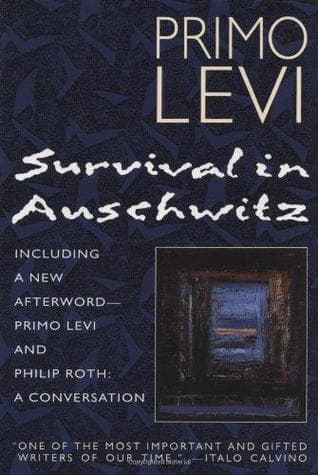
Does 'Survival in Auschwitz' contain any discussions with Philip Roth?
Yes, this specific edition of 'Survival in Auschwitz' includes an exclusive conversation between Primo Levi and renowned author Philip Roth, offering additional insights into Levi's experiences, motivations for writing, and reflections on the Holocaust.
About the author

Primo Michele Levi was an Italian chemist, partisan, writer, and Jewish Holocaust survivor. He was the author of several books, collections of short stories, essays, poems and one novel. His best-known works include If This Is a Man, his account of the year he spent as a prisoner in the Auschwitz concentration camp in Nazi-occupied Poland; and The Periodic Table (1975), linked to qualities of the elements, which the Royal Institution named the best science book ever written.
Similar books
- Man's Search for Meaning
Viktor E. Frankl
4.4 (401k) average on GoodreadsBiographyAnother psychological and philosophical account of Holocaust survival, focusing on the search for meaning amid suffering.
- Night
Elie Wiesel
4.3 (970k) average on GoodreadsBiographyA powerful and concise memoir of a young boy's experience in Auschwitz and Buchenwald, sharing similar themes of dehumanization.
- The Drowned and the Saved
Primo Levi
4.4 (6k) average on GoodreadsBiographyLevi's later work further analyzing the moral and psychological implications of the Holocaust, building on his experiences.
- The Diary of a Young Girl
Anne Frank
4.2 (2.7M) average on GoodreadsBiographyDuring the Nazi occupation, a teenage girl's diary, written from a secret annex, shares observations on humanity, hope, and the wait for freedom.
- Eat, Pray, Love
Elizabeth Gilbert
3.6 (1.5M) average on GoodreadsLifestyleA heartbroken writer leaves her conventional life for a year-long global search for pleasure in Italy, spiritual devotion in India, and unexpected love and balance in Bali.
- Steve Jobs
Walter Isaacson
4.1 (957k) average on GoodreadsBusinessSteve Jobs was a visionary who fused creativity and technology to revolutionize six industries and shape our digital world.






Enjoyed the summary?
A summary gives you the shape of the book. The book itself has the detail, the examples and the voice.
Find Survival in Auschwitz on AmazonAs an Amazon Associate, BookBrief earns from qualifying purchases. How we're funded