
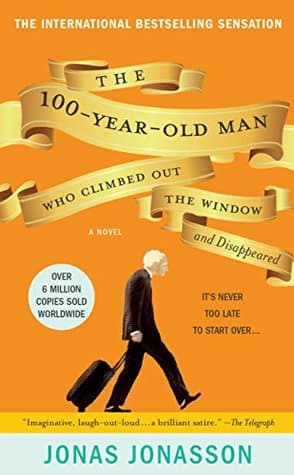
Synopsis
Covers the whole plot, including the ending.
- Difficulty
- Easy
- Pacing
- Moderate
- Mood
- Humorous, Witty, Adventurous, Lighthearted, Quirky
- Read it if
- You enjoy quirky characters, absurd situations, and a humorous, lighthearted take on historical events.
- Skip it if
- You prefer serious historical fiction, fast-paced thrillers, or stories with a deeply emotional core.
The 100-Year-Old Man Who Climbed Out the Window and Disappeared Plot Summary
Covers the whole plot, including the ending.
A Centenarian's Escape and an Unwanted Suitcase
On his 100th birthday, Allan Karlsson, a resident of the Elderly Care Home in Malmköping, decides he has had enough of the planned celebrations and the rules about his alcohol. Slipping out his window in his slippers, he goes to the bus station. There, a young, aggressive man called 'The Young Man' asks Allan to watch a large suitcase for a moment. When the bus arrives, Allan takes the suitcase and gets on the bus to Byringe, leaving The Young Man behind. Allan does not know the suitcase holds 50 million Swedish kronor belonging to a criminal gang called 'Never Again'.
New Companions and a Growing Problem
In Byringe, Allan meets Julius Jonsson, an unemployed and eccentric former hot dog vendor and ex-convict. Allan tells Julius about the suitcase and his accidental theft. Soon, The Young Man finds them at Julius's old house. During a fight, Julius accidentally locks The Young Man in a freezer, where he freezes to death. Realizing what happened, Allan and Julius decide to get rid of the body by feeding it to a badger, then dumping the rest into a lake. This event starts their unexpected partnership and draws the attention of the 'Never Again' gang, who are now looking for their money and their missing member.
Further Escapades and an Elephant
Allan and Julius continue their journey with the suitcase of money and pick up more unusual companions. They meet Gunilla Björklund, an independent woman living in the countryside with her elephant, Sonya. Gunilla, at first suspicious, joins them after they help her get Sonya back from a truck where she was being taken for slaughter. The group, now Allan, Julius, Gunilla, and Sonya, becomes a unique traveling party. They are chased by the remaining members of the 'Never Again' gang, led by Buster, who want their money back and revenge for The Young Man.
The Gang's Pursuit and a Fatal Accident
The 'Never Again' gang, Buster and 'The Scar,' searches harder. They find Allan and his companions in a small town. During a chaotic chase with Sonya the elephant, another gang member, 'The Scar,' dies accidentally when he falls from a moving truck and is run over. The remaining gang leader, Buster, becomes even angrier and more determined. Allan and his group escape and find shelter with Allan's old friend, Benny Ljungberg, a former railway station master and eternal student. Benny has been married many times and knows many random facts. Benny, interested in their story and the money, quickly joins their eccentric group.
Flashback: Allan's Early Life and Explosives
The story mixes Allan's current adventures with long flashbacks to his unusual past. Born in 1905, Allan becomes fascinated with explosives early on, a skill he learns from his father, who was involved in the Russian Revolution. After his parents die, Allan's talent for demolition becomes clear. He accidentally blows up a local railway station, which leads to him being put in a psychiatric institution. This part of his life sets the stage for his future involvement in major global events, showing his natural ability to cause significant, often accidental, disruption with a cheerful lack of concern for the results.
Flashback: The Spanish Civil War and Oppenheimer
After escaping the psychiatric institution, Allan travels to Spain, where he accidentally helps Francisco Franco's Nationalist forces during the Spanish Civil War by blowing up a bridge. His reputation for explosives grows. He later goes to the United States, where he works on the Manhattan Project, becoming an unlikely friend to J. Robert Oppenheimer. Allan's simple, yet effective, way of solving problems, along with his lack of political beliefs, allows him to navigate complex historical events with a unique view, often influencing their outcomes without fully understanding the political implications.
Flashback: Encounters with World Leaders
Allan's journey continues through World War II and the Cold War. He meets President Harry S. Truman, accidentally giving him advice on the atomic bomb, and later gets involved with Chinese Communist leaders, including Mao Zedong, during the Chinese Civil War. He also meets Kim Il-sung in North Korea. His knack for being in the right place at the right time, combined with his lack of interest in political ideas, allows him to cross political lines and talk with opposing world leaders, often leaving a lasting, though subtle, impact on their decisions. He becomes a valuable, though often unwitting, asset to various intelligence agencies.
Flashback: The Cold War and the KGB
During the Cold War, the CIA recruits Allan to spy on Soviet nuclear activities. His mission takes him to Moscow, where he gets involved with the KGB. He escapes Lavrentiy Beria, the head of the NKVD, but is eventually caught and sent to a Gulag in Siberia. Even in the harsh Gulag, Allan stays optimistic and resourceful. He becomes friends with Albert Einstein's fictional, simple-minded brother, Herbert Einstein, and together they plan their escape, showing Allan's lasting ability to find companionship and opportunity in the worst situations.
Flashback: Escaping the Gulag and a Return to the West
Allan and Herbert Einstein successfully escape the Gulag using Allan's explosive skills, blowing a hole in the prison wall. Their escape shows Allan's lasting cleverness and Herbert's surprising, accidental help. They travel across Asia and Europe, eventually returning to the West. Their adventures together further establish Allan's reputation as a man who can survive anything and whose life is a continuous, accidental journey through the most important events of the 20th century, always landing on his feet, often with a drink in hand.
The Present: Confrontation and Resolution
Back in the present, Allan, Julius, Gunilla, Benny, and Sonya the elephant are still running from Buster, the last member of the 'Never Again' gang. They arrange a meeting with Buster to talk. However, Buster's attempt to get his money back goes wrong when he is accidentally trapped in a container and shipped to Estonia, never to be seen again. With the threat gone, the group decides to use the 50 million kronor to start a new life. They move to Bali, where they live a luxurious and peaceful life, enjoying their new wealth and the company of their unusual family, with Allan still enjoying his vodka and good food.
Principal Figures
Allan Karlsson
Protagonist
A centenarian with a penchant for explosives and an accidental knack for influencing history.
Allan is a cheerful, unpretentious man who lives by the philosophy that things are what they are, and what will be, will be. He possesses an innate talent for explosives and a complete indifference to politics or ideology, which ironically makes him an invaluable asset to various world powers. He values good company, good food, and vodka. His decisions are often impulsive and driven by immediate desires rather than long-term planning, leading him into extraordinary circumstances. Despite his age, he remains sharp-witted and resilient, always finding a way to enjoy life.
Relationships: Julius Jonsson (Friend and accomplice in crime); Gunilla Björklund (Friend and companion); Benny Ljungberg (Old friend and new companion); Herbert Einstein (Friend and fellow Gulag escapee)
Julius Jonsson
Supporting
An unemployed ex-convict who becomes Allan's first accomplice.
Julius is a cynical but ultimately loyal man with a criminal past, having spent time in prison for various minor offenses. He is initially wary of Allan but quickly becomes his most trusted companion and co-conspirator. He is resourceful and practical, often taking charge of the more unsavory tasks, such as body disposal. Despite his rough exterior, he develops a strong bond with Allan and the other members of their group, finding a sense of purpose and belonging he lacked before.
Relationships: Allan Karlsson (Close friend and accomplice); Gunilla Björklund (Companion); Benny Ljungberg (Companion)
Gunilla Björklund
Supporting
An independent woman and owner of an elephant, who joins Allan's group.
Gunilla is a strong-willed, pragmatic woman who lives a solitary life in the countryside with her beloved elephant, Sonya. She is fiercely independent and initially suspicious of Allan and Julius, but her heart is won over by their kindness towards Sonya and their general good nature. She brings a grounded, sensible perspective to the group, often serving as the voice of reason. Her love for Sonya is a defining characteristic, and she is willing to go to great lengths to protect her pet.
Relationships: Allan Karlsson (Friend and companion); Julius Jonsson (Companion); Benny Ljungberg (Companion); Sonya (Beloved pet elephant)
Benny Ljungberg
Supporting
An eternal student and Allan's old friend, with a knack for trivia.
Benny is an eccentric, highly educated man who has pursued studies in numerous fields but never settled on a career. He is a former railway station master and possesses an encyclopedic knowledge of trivial facts, which often comes in handy. He's been married multiple times and is always eager for new experiences. He brings intellectual depth and a sense of cheerful adaptability to the group, fitting seamlessly into their chaotic adventures. He is loyal to Allan and quickly embraces the excitement and danger of their journey.
Relationships: Allan Karlsson (Old friend and companion); Julius Jonsson (Companion); Gunilla Björklund (Companion)
Sonya
Supporting
Gunilla's beloved elephant, who becomes an unlikely member of the group.
Sonya is Gunilla's pet elephant, a gentle giant who plays a surprisingly crucial role in the group's adventures. She is loyal to Gunilla and becomes an integral part of their unconventional family. Sonya's presence often provides comedic relief and, at times, unexpected assistance, such as helping to dispose of bodies or deterring pursuers. Her unique status as a traveling elephant adds to the absurdity and charm of the narrative.
Relationships: Gunilla Björklund (Owner and close bond); Allan Karlsson (Friend); Julius Jonsson (Friend); Benny Ljungberg (Friend)
The Young Man
Antagonist
A hot-headed gang member whose suitcase of money sets the plot in motion.
The Young Man is a minor member of the 'Never Again' gang, characterized by his aggression, impatience, and general lack of intelligence. He is the unfortunate individual who entrusts Allan with the suitcase of money, inadvertently initiating Allan's adventure. His quick temper and poor judgment ultimately lead to his demise in Julius's freezer, making him the first casualty of Allan's accidental crime spree. He serves as the initial catalyst for the gang's pursuit.
Relationships: Allan Karlsson (Victim of Allan's accidental theft); Julius Jonsson (His accidental killer); Buster (Gang leader)
Buster
Antagonist
The ruthless leader of the 'Never Again' gang, seeking his stolen money.
Buster is the primary antagonist, the unforgiving and short-tempered leader of the 'Never Again' criminal gang. He is obsessed with recovering his stolen 50 million kronor and avenging his fallen gang members. Buster is portrayed as violent and determined, but ultimately outwitted by Allan's accidental good fortune and the sheer unpredictability of his companions. His pursuit drives much of the present-day plot, providing a constant threat that forces Allan and his friends to remain on the move.
Relationships: Allan Karlsson (His nemesis, the thief of his money); The Young Man (Gang member, whose death he seeks to avenge); The Scar (Gang member)
Herbert Einstein
Supporting
Albert Einstein's fictional, less intelligent brother and Allan's friend in the Gulag.
Herbert Einstein is a fictional character, portrayed as the dim-witted younger brother of the famous physicist Albert Einstein. He meets Allan in a Soviet Gulag, where they form an unlikely friendship. Herbert is amiable and somewhat naive, often misunderstanding situations, but he possesses a surprising strength and resilience. He and Allan escape the Gulag together, and Herbert becomes Allan's companion for a significant portion of his historical travels, providing both comedic relief and genuine companionship.
Relationships: Allan Karlsson (Close friend and fellow escapee)
J. Robert Oppenheimer
Mentioned
The 'father of the atomic bomb' who befriends Allan during the Manhattan Project.
J. Robert Oppenheimer appears in the flashbacks as Allan's friend and colleague during the Manhattan Project. He is depicted as a brilliant but troubled scientist who finds Allan's simple, apolitical perspective refreshing. Allan's direct, almost naive, approach to the mechanics of explosives offers Oppenheimer a different viewpoint, even if Allan doesn't grasp the full moral implications of their work. Their friendship highlights Allan's ability to connect with important historical figures on a personal level.
Relationships: Allan Karlsson (Colleague and friend)
Themes & Insights
The Absurdity of Existence and Serendipity
The novel shows how random life can be and how chance meetings and coincidences can greatly change one's path. Allan Karlsson's life shows this, as he stumbles into important historical events and meets world leaders not because he wants to, but by chance and his simple wish for a drink or an adventure. His escapes and the deaths of his pursuers often happen because of absurd, unforeseen events, showing that life often unfolds in unpredictable and funny ways, not through careful plans. The ease with which he handles global politics despite his lack of interest highlights this theme.
“Things are what they are, and what will be, will be.”
Apolitical Pragmatism vs. Ideology
Allan Karlsson's main trait is his complete lack of interest in political beliefs. He sees all systems, whether communism, capitalism, or fascism, with equal indifference, focusing instead on practical things like food, drink, and explosions. This apolitical stance lets him easily cross international borders and talk with leaders from opposing groups (from Franco to Mao to Truman) without bias. The book often makes fun of the strict beliefs of political figures by comparing them with Allan's simple, practical way, suggesting that ideology often makes human affairs more complicated, not clearer. This theme is clear when world leaders take Allan's advice seriously, even though he does not care about their political goals.
“Politics didn't interest him. There were always far more interesting things to do.”
Friendship and Found Family
Despite Allan's often solitary and wandering life, the story strongly emphasizes how important companionship is. In his old age, Allan quickly forms a new 'family' with Julius, Gunilla, Benny, and even Sonya the elephant. These relationships form through shared experiences, helping each other, and a common bond against outside threats. Similarly, his past includes important friendships, like with Herbert Einstein and J. Robert Oppenheimer. These bonds give Allan comfort, support, and a sense of belonging, showing that even a wandering centenarian needs connections. The ending, with the group settling in Bali, reinforces this theme of chosen family.
“Life would be so much easier if you only had to worry about yourself, but it was so much more fun if you had to worry about others.”
Aging and the Pursuit of Adventure
The novel challenges the usual idea of old age as a time of decline and quiet thought. Allan, at 100, refuses to act as expected, literally climbing out a window to leave his nursing home. His current adventure is as active and dangerous as any of his past experiences, proving that the desire for excitement and new experiences is not limited by age. His resourcefulness, wit, and physical strength show that old age can be a time for new beginnings, rejecting the idea that life's adventures must end at a certain point. His youthful spirit remains, no matter his age.
“It's never too late to stop being stupid.”
Plot Devices & Literary Techniques
Dual Timeline / Interweaving Narratives
Alternates between Allan's present-day escape and his historical flashbacks.
The novel employs a dual timeline structure, alternating chapters between Allan's current adventure and extensive flashbacks to his extraordinary life throughout the 20th century. This device allows the reader to understand Allan's character and skills in the present by revealing his past experiences. The flashbacks provide context for his casual approach to danger and his surprising resourcefulness, while also adding historical depth and satirical commentary on major world events. The interweaving keeps both narratives engaging and builds a complete picture of Allan's eccentric life.
Foreshadowing (Subtle and Ironic)
Hints at future events or Allan's past skills without giving away details.
While not heavy-handed, the narrative often subtly foreshadows events or Allan's capabilities. For instance, early mentions of Allan's past with explosives prepare the reader for later instances of him using this skill. The casual way he handles the suitcase hints at his indifference to consequences, which is a major driver of his historical escapades. The ironic foreshadowing comes from the reader's awareness of Allan's extraordinary past, which makes the present-day events, no matter how absurd, seem almost plausible for him.
Accidental Hero / Unwitting Catalyst
Allan's actions, often accidental, drive the plot and influence historical events.
Allan Karlsson is the quintessential accidental hero. His actions, both in the present and the past, are rarely premeditated or driven by grand ambition. He 'climbs out the window' simply to avoid a birthday party, 'steals' a suitcase by mistake, and 'helps' various world powers through sheer happenstance and his practical skills. This device highlights the theme of serendipity and the absurdity of life, suggesting that significant events can be triggered by the most mundane or unintentional actions of an ordinary man with an extraordinary knack for explosives.
Satire and Black Humor
Uses humor to comment on historical events, politics, and human nature.
The novel heavily relies on satire and black humor to comment on serious historical events, political ideologies, and human foibles. Allan's nonchalant attitude towards death, global conflicts, and powerful figures creates a comedic contrast with the gravity of the situations. The absurd ways in which characters die or are disposed of (e.g., fed to a badger, shipped to Estonia) are examples of black humor. This device allows the author to critique political systems and historical figures in a lighthearted yet pointed manner, making profound observations through an entertaining lens.
The 100-Year-Old Man Who Climbed Out the Window and Disappeared Quotes
“Things are what they are, and whatever will be will be.”
“Most people worry about things that never happen. It's a terrible waste of time.”
“The world is full of idiots, but they are not dangerous until they start to think.”
“You should always be nice to people on the way up because you might meet them again on the way down.”
“It's easier to fool people than to convince them they've been fooled.”
“A person who has nothing to lose is the most dangerous person of all.”
“History is a strange thing. Sometimes it's written by the victors, sometimes by the survivors.”
“The problem with the world is that everyone is a few drinks behind.”
“It's not the crime that's the problem, it's the cover-up.”
“Life is a journey, not a destination. And sometimes you have to climb out a window to start it.”
“The secret to a long life is to keep breathing and avoid dying.”
“When you're old, people stop expecting things from you. That's when you can finally have some fun.”
“Money is like a sixth sense - you can't make use of the other five without it.”
“Sometimes the best way to solve a problem is to pretend it doesn't exist.”
Quiz
10 questions on the plot and the characters. Each answer comes with a short explanation.
Question 1
What does Allan Karlsson do on his 100th birthday instead of attending the celebration planned for him?
- He calls his relatives to apologize
- He climbs out the window of his nursing home in his slippers
- He writes a letter of complaint to the nursing home staff
- He goes to a local bar to celebrate alone
Show answer
B. He climbs out the window of his nursing home in his slippers Allan escapes the nursing home by climbing out the window in his slippers, which sets off the entire adventure. This act of defiance against the planned celebration is the inciting incident of the novel.
Question 2
What is the primary reason Allan decides to escape from the nursing home?
- He wants to find a long-lost treasure
- He is bored and seeks adventure
- He wants more control over his alcohol consumption and isn't interested in the celebration
- He is trying to avoid paying his nursing home bills
Show answer
C. He wants more control over his alcohol consumption and isn't interested in the celebration Allan escapes because he desires autonomy, particularly over his drinking, and has no interest in the fuss of the planned 100th birthday party. This reflects his independent and non-conformist character.
Question 3
What type of journey does Allan embark on after escaping the nursing home?
- A solemn pilgrimage to historical sites
- A hilarious and entirely unexpected adventure
- A dangerous mission to expose government secrets
- A quiet retirement in the countryside
Show answer
B. A hilarious and entirely unexpected adventure The book describes Allan's journey as 'hilarious and entirely unexpected,' filled with absurd and comedic events that contrast with his mundane life in the nursing home.
Question 4
How is Allan Karlsson's backstory described in relation to 20th-century history?
- He was a passive observer of major events
- He wrote detailed diaries about historical periods
- He not only witnessed but played a key role in important events
- He avoided all historical conflicts and lived in isolation
Show answer
C. He not only witnessed but played a key role in important events Allan has a 'larger-than-life backstory' where he actively participated in pivotal 20th-century events, such as influencing world leaders and scientific developments, which adds depth and humor to the narrative.
Question 5
What genre best describes 'The 100-Year-Old Man Who Climbed Out the Window and Disappeared'?
- Science Fiction
- Historical Fiction
- Romance
- Horror
Show answer
B. Historical Fiction The book is categorized as Historical Fiction because it blends fictional elements with real historical events and figures from the 20th century, seen through Allan's absurd adventures.
Question 6
Which of the following themes is central to Allan's character and the story?
- The importance of family loyalty
- The pursuit of wealth and fame
- Independence and non-conformity in the face of societal expectations
- The inevitability of aging and decline
Show answer
C. Independence and non-conformity in the face of societal expectations Allan's escape from the nursing home and his lifelong tendency to avoid conformity highlight themes of independence and resisting societal norms, which drive both his past and present adventures.
Question 7
What makes Allan's journey particularly unique compared to typical adventure stories?
- It involves magical elements and fantasy creatures
- It is set in a dystopian future
- It combines present-day escapades with flashbacks to his improbable historical involvements
- It focuses on intense physical challenges and survival skills
Show answer
C. It combines present-day escapades with flashbacks to his improbable historical involvements The novel intertwines Allan's current misadventures with flashbacks to his absurd yet significant roles in 20th-century history, creating a quirky and layered narrative that blends humor with historical satire.
Question 8
How does the book characterize Allan's health at the start of the story?
- He is frail and requires constant medical attention
- He is in good health, contrary to expectations for his age
- He has a terminal illness but hides it from others
- He suffers from severe memory loss and confusion
Show answer
B. He is in good health, contrary to expectations for his age Despite being 100 years old, Allan is 'still in good health,' which adds irony to his placement in a nursing home and motivates his escape to seek a more active life.
Question 9
What literary tone is primarily used to describe Allan's adventures?
- Tragic and melancholic
- Satirical and humorous
- Suspenseful and thrilling
- Romantic and sentimental
Show answer
B. Satirical and humorous The book employs a satirical and humorous tone, poking fun at historical events and societal norms through Allan's absurd experiences, making it 'quirky and utterly unique' as noted in its description.
Question 10
In what way does Allan's character challenge stereotypes about aging?
- By emphasizing wisdom and patience as virtues of old age
- By showing that elderly people are always dependent on others
- By demonstrating vitality, independence, and a penchant for unexpected adventures despite his age
- By focusing on the regrets and missed opportunities of youth
Show answer
C. By demonstrating vitality, independence, and a penchant for unexpected adventures despite his age Allan defies age-related stereotypes through his good health, decisive escape, and ongoing adventures, highlighting themes of lifelong agency and the potential for excitement at any age.
The 100-Year-Old Man Who Climbed Out the Window and Disappeared FAQ
What is 'The 100-Year-Old Man Who Climbed Out the Window and Disappeared' about?
The novel follows Allan Karlsson, a 100-year-old explosives expert who escapes his nursing home on his birthday and embarks on a chaotic present-day adventure across Sweden. Through flashbacks, it reveals his improbable involvement in major 20th-century events like the Spanish Civil War, the Manhattan Project, and Cold War politics, while his current journey involves accidental theft, a suitcase full of cash, and eccentric companions.
Why should I read 'The 100-Year-Old Man Who Climbed Out the Window and Disappeared'?
It offers a unique blend of absurdist humor, historical satire, and heartwarming adventure. The book's charm lies in Allan's deadpan, apolitical perspective on world events and the contrast between his epic past and his whimsical present-day escapades, making it both entertaining and thought-provoking.
What is the background/setting of the book?
The story alternates between two timelines: the present-day (circa 2005) Swedish countryside where Allan flees with a stolen suitcase, and flashbacks spanning the 20th century across global locations like Spain, the U.S., Iran, and the Soviet Union. These settings frame Allan's accidental intersections with history.
What are the most memorable quotes from the book?
Key quotes include Allan's motto, 'Things are what they are, and whatever will be will be,' reflecting his pragmatic philosophy. Another is, 'The world is full of idiots, but at least they're not all the same kind of idiot,' highlighting the novel's satirical take on human folly.
What writing style does Jonas Jonasson use?
Jonasson employs a dry, understated Scandinavian humor with a matter-of-fact narrative tone. The prose is straightforward and episodic, blending absurd situations with historical details, often using irony to underscore the randomness of Allan's life and world events.
What minor details add significant meaning to the story?
Allan's slippers, which he wears during his escape, symbolize his humble, unassuming nature despite his grand adventures. The recurring motif of vodka represents his simple pleasures and disregard for authority, tying his past and present together through his love of drink.
What are some subtle foreshadowing moments in the book?
Early mentions of Allan's expertise with explosives subtly hint at his later involvement in the Manhattan Project and other historical events. His casual references to world leaders foreshadow the flashbacks revealing his personal interactions with figures like Franco, Truman, and Stalin.
What unexpected character connections exist?
Allan's present-day companion, Julius, unknowingly shares a link through Allan's past: Allan once indirectly influenced Julius's family via historical events. Additionally, the gangster pursuing them, Gäddan, ties back to criminal networks Allan encountered decades earlier in his travels.
What are unspoken character motivations in the story?
Allan's primary motivation is a desire for freedom and autonomy, unspoken but evident in his escape from the nursing home and his lifelong avoidance of commitments. His companion Benny's quiet loyalty stems from a hidden past of loneliness, which Allan inadvertently alleviates through their friendship.
What psychological complexities do characters exhibit?
Allan displays a paradoxical blend of apathy and resilience, remaining emotionally detached yet resourceful in crises. The elephant Sonya, cared for by the group, symbolizes their collective need for purpose and nurturing, revealing deeper emotional layers beneath their quirky exteriors.
What are the major emotional turning points?
Key moments include Allan's decision to escape the nursing home, marking his reclaiming of agency, and the group's bonding over protecting Sonya the elephant, which fosters a sense of family. Another is the climax where they confront their pursuers, solidifying their loyalty and shared fate.
How do relationship dynamics evolve among the characters?
Initially a disparate group of misfits—Allan, Julius, Benny, Gunilla, and Sonya—they evolve into a makeshift family through shared adversity. Their dynamics shift from mutual suspicion to deep camaraderie, driven by Allan's nonchalant leadership and their collective escapades.
Which parts of the book remain ambiguous or open-ended?
The ultimate fate of the stolen money is left ambiguous, as the group uses it whimsically without clear long-term plans. Additionally, Allan's exact feelings about his historical role are never fully resolved, leaving his legacy open to interpretation as either meaningful or accidental.
What are controversial scenes or decisions in the book?
Allan's involvement in the atomic bomb development via the Manhattan Project sparks debate, as his apolitical stance contrasts with the moral weight of the event. His casual interactions with dictators like Stalin and Franco also provoke discussion on historical accountability and satire.
How does the book end and what does it mean?
The ending sees Allan and his friends living freely in Indonesia, having evaded their pursuers and used the money for a peaceful life. It symbolizes the triumph of individuality and serendipity over societal constraints, reinforcing the theme that life's randomness can lead to happiness if embraced.
What is the significance of Allan's apolitical nature throughout the story?
Allan's apolitical stance serves as a satirical lens on 20th-century ideologies, highlighting how personal pragmatism often outweighs grand political narratives. It allows the book to critique historical events without taking sides, emphasizing human simplicity amidst chaos.
How does the book blend historical fiction with comedy?
It juxtaposes real historical events—like the Spanish Civil War or Cold War summits—with absurd, fictionalized interactions where Allan's bumbling involvement changes outcomes. This blend creates a humorous critique of how chance and individual actions shape history.
What role does the elephant Sonya play in the narrative?
Sonya acts as a unifying symbol for the group, representing innocence and the absurdity of their journey. Her care becomes a shared responsibility that deepens their bonds, and her presence adds a layer of whimsy that contrasts with the darker historical flashbacks.
How does Allan's past influence his present-day actions?
Allan's past experiences with explosives, diplomacy, and survival equip him with unconventional skills for his current escapades, such as outsmarting pursuers or solving problems calmly. His historical detachment also shapes his present-day nonchalance and adaptability.
What themes are explored through Allan's character?
Themes include the randomness of fate, the critique of political extremism, and the value of simple pleasures. Allan embodies these through his accidental involvement in history and his pursuit of freedom and vodka, suggesting that meaning often arises from chance rather than design.
About the author

Jonas Jonasson is a Swedish author known for his humorous fiction. He gained international recognition with his debut novel, The 100-Year-Old Man Who Climbed Out the Window and Disappeared, which tells the story of a centenarian's adventurous escape from a nursing home. His works often blend absurdity with historical events, appealing to a wide audience.
Similar books
- A Man Called Ove
Fredrik Backman
4.4 (569k) average on GoodreadsFictionFeatures an eccentric, elderly protagonist who finds unexpected companionship and embarks on a journey of self-discovery.
- The Rosie Project
Graeme Simsion
4.0 (447k) average on GoodreadsRomanceFollows a socially awkward protagonist on an unconventional quest, filled with humor and unexpected turns.
- Major Pettigrew's Last Stand
Helen Simonson
3.9 (132k) average on GoodreadsLiterary FictionExplores the life of an older character navigating societal expectations and finding love and adventure later in life.
- Forrest Gump
Winston Groom
4.1 (60k) average on GoodreadsHistorical FictionThere are strong thematic parallels, as both feature naive, unassuming protagonists who inadvertently find themselves at the nexus of major historical events and interact with prominent figures. However, 'Forrest Gump' often carries a more sentimental and reflective tone, particularly in its exploration of American history and social commentary. Jonasson's work is distinctly European in its historical focus and maintains a consistently more irreverent and purely comedic approach, less concerned with profound social commentary and more with the sheer absurdity of life and history.
- To Kill a Mockingbird
Harper Lee
4.3 (4.5M) average on GoodreadsHistorical FictionIn the 1930s Jim Crow South, Harper Lee writes about racial injustice, moral growth, and the quiet courage of a lawyer father, Atticus Finch, as seen through his young daughter's eyes.
- The Great Gatsby
F. Scott Fitzgerald
3.9 (3.8M) average on GoodreadsHistorical FictionIn the opulent Roaring Twenties, a mysterious millionaire's lavish parties hide his desperate, tragic pursuit of a lost love, exposing the emptiness within the American Dream.



Enjoyed the summary?
A summary gives you the shape of the book. The book itself has the detail, the examples and the voice.
Find The 100-Year-Old Man Who Climbed Out the Window and Disappeared on AmazonAs an Amazon Associate, BookBrief earns from qualifying purchases. How we're funded