
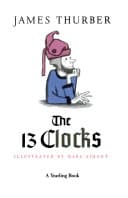
Synopsis
Covers the whole plot, including the ending.
- Difficulty
- Medium
- Pacing
- Moderate
- Mood
- Whimsical, Poetic, Humorous, Magical, Enchanting
- Read it if
- You enjoy whimsical, poetic fairy tales with rich language, clever wordplay, and a blend of humor and philosophical undertones, reminiscent of classic fables with a unique twist.
- Skip it if
- You prefer straightforward narratives, realistic settings, or stories without extensive metaphors and highly stylized prose.
The 13 Clocks Plot Summary
Covers the whole plot, including the ending.
The Gloom of Hagga
The story opens in the bleak, silent land of Hagga, ruled by the cruel Duke of Coffin Castle. The Duke, a man of wealth and power, has frozen time in his castle, stopping all thirteen clocks at ten minutes to five. He enjoys misery and has outlawed happiness, laughter, and even birdsong. His beautiful niece, Princess Saralinda, lives under his oppressive rule, guarded by a monstrous Gurgle and the Duke's own sinister presence. The Duke has vowed that Saralinda will only marry a prince who can perform an impossible task, ensuring she remains his captive and his only heir, as he fears being succeeded.
Enter Xingu, the Minstrel Prince
One day, a young minstrel named Xingu arrives in Hagga, playing a lute and singing a joyous song, much to the Duke's displeasure. Xingu, however, is Prince Zorn of Zorna, disguised. He quickly befriends the castle's despairing servants, especially the invisible Golux, a small, bumbling but insightful man who acts as the Duke's jester and confidante. The Golux, seeing the Prince's courage and affection for Saralinda, decides to help him. Xingu observes Saralinda from afar, falling deeply in love with her beauty and her quiet strength amidst the castle's gloom.
The Impossible Task
Prince Zorn, revealing his true identity to the Duke, declares his intention to marry Princess Saralinda. The Duke, pleased by the prospect of another suitor to torment, presents Zorn with a seemingly impossible task: he must find ten thousand jewels in ninety-nine hours and bring them to the castle. Furthermore, these jewels must be gathered from the 'Thitherward,' a dangerous and distant land. The Duke believes this task is a death sentence, as the Thitherward is known for its dangers and the time limit is impossibly short, ensuring Zorn's failure.
The Golux's Aid and the Todal
The Golux, observing the Duke's malicious joy, secretly approaches Prince Zorn and offers his assistance. He warns Zorn about the Duke's cunning and the true nature of the challenge: the Duke will attempt to kill him upon his return, regardless of success. The Golux also reveals the existence of the Todal, a monstrous creature made of pure gloom and fear that stalks the Thitherward, drawn to the sound of clocks and the scent of human fear. The Todal is the Duke's ultimate weapon, ensuring no one who ventures into its domain returns alive. The Golux's knowledge proves helpful, as he knows the ways of the Thitherward.
The Quest for the Jewels
Prince Zorn and the Golux set off for the Thitherward. Their journey is dangerous, as they encounter various strange and often menacing creatures and landscapes. The Golux, with his quirky wisdom and unexpected insights, guides Zorn through the treacherous paths. They face challenges that test Zorn's courage and resourcefulness, all while the ninety-nine-hour deadline looms. The Golux constantly reminds Zorn of the Duke's treachery, urging him to remain vigilant and to remember that the Duke's true intention is for him to fail.
The Tears of the Princess
As time runs short, Zorn and the Golux are still far from their goal. The Golux, in a moment of inspiration, reveals his plan: they will collect the tears of Princess Saralinda. He explains that Saralinda's tears, born of her deep sorrow and the Duke's cruelty, are the most precious jewels of all. They devise a way to make her weep, not out of further pain, but out of a surge of hope and longing. The Golux's plan is audacious and relies on the emotional power of Saralinda's plight, turning her despair into the means of her liberation.
The Return and the Eleventh Hour
Prince Zorn returns to Coffin Castle at the last possible moment, with the Golux by his side. They present the Duke with a sack containing the 'jewels' – ten thousand teardrops of Princess Saralinda, each shimmering like a precious gem. The Duke is initially furious, believing Zorn has failed. However, the brilliance of the tears is undeniable, and he is forced to acknowledge that Zorn has technically fulfilled the challenge. The Duke, ever the trickster, is already planning his next move, unwilling to let Saralinda go easily.
The Duke's Final Challenge: Winding the Clocks
Enraged by Zorn's success, the Duke quickly devises a new, seemingly impossible task: Zorn must wind all thirteen stopped clocks in the castle, causing them to strike the hour. This is a task that no one has been able to accomplish since the Duke froze time, and the clocks are enchanted to resist any attempt to wind them by ordinary means. The Duke believes this will be Zorn's undoing, as the clocks are linked to the despair of the castle and the Duke's own dark magic. The Golux, however, has anticipated this and has a counter-plan.
The Thaw and the Todal's Doom
Following the Golux's instructions, Prince Zorn uses a special golden key, imbued with the power of hope and love, to wind the clocks. As each clock begins to tick and chime, the Duke's spell over the castle weakens. The sounds of the clocks ringing out across Hagga, a land long silenced, begin to thaw the frozen gloom. This unexpected turn of events also summons the Todal, which, drawn by the sound of the clocks and the sudden influx of emotion, appears in the castle, a terrifying embodiment of the Duke's own despair.
The Duke's Just Desserts
The Todal, a creature of pure fear and gloom, is drawn to the most fearful and gloomy presence in the castle: the Duke himself. As the Duke panics, realizing his ultimate weapon has turned against him, the Todal pursues him relentlessly. The Duke, who had enjoyed the fear of others, now experiences it firsthand. The creature, a manifestation of his own wicked nature, consumes him, leaving behind only the Duke's cold heart, which shatters into a thousand pieces. With the Duke gone, the spell over Hagga is broken, and the land begins to heal.
Hagga Awakens
With the Duke vanquished, the castle and the land of Hagga slowly come back to life. The thirteen clocks, now fully wound, chime in unison, marking the passage of time once more. Birds begin to sing, flowers bloom, and the gray, silent landscape transforms into one of color and sound. Princess Saralinda, no longer a prisoner of her uncle's gloom, experiences true happiness for the first time. The servants, freed from their oppression, rejoice, and the castle is filled with laughter and light, a stark contrast to its former despair.
The Wedding and the Golux's Departure
Prince Zorn and Princess Saralinda are married in a joyous ceremony, ushering in an era of happiness and prosperity for Hagga. The Golux, having fulfilled his purpose, prepares to depart. He offers one last piece of cryptic advice, suggesting that while happy endings are real, life continues to present new riddles and adventures. He then vanishes, as mysteriously as he appeared, leaving the newly wedded couple to rule their revitalized kingdom. Their love and the restoration of joy signify the complete triumph over the Duke's tyranny.
The 13 Clocks Characters
The Duke of Coffin Castle
Antagonist
The cruel, cynical ruler of Hagga who delights in misery and oppresses his niece, Princess Saralinda.
The Duke is a profoundly wicked and miserly man, obsessed with control and the accumulation of wealth. He has a morbid fear of death and being replaced, leading him to keep Princess Saralinda captive and set impossible tasks for her suitors. He is a master of trickery and deceit, delighting in the suffering of others. His heart is said to be 'as cold as a winter stone,' and he embodies the forces of gloom and despair that plague Hagga. He is characterized by his cynicism, his love of silence, and his hatred of anything joyous or beautiful.
Relationships: Princess Saralinda (Captor/niece, oppressive guardian); The Golux (Master/jester, but the Golux secretly works against him); Prince Zorn (Adversary, suitor whom he tries to destroy)
Princess Saralinda
Protagonist
The beautiful, sorrowful niece of the Duke, held captive in Coffin Castle, whose tears become the key to her freedom.
Princess Saralinda is the epitome of gentle beauty and quiet resilience. Trapped in her uncle's gloomy castle, she lives a life devoid of joy, yet she possesses an inner strength and hope that never fully extinguishes. Her sadness is profound, but it is also pure, making her tears precious. She longs for freedom and true love, embodying the innocent victim awaiting rescue. Despite her circumstances, she maintains a certain dignity and grace, inspiring love and loyalty in Prince Zorn.
Relationships: The Duke of Coffin Castle (Captive/niece, oppressed by him); Prince Zorn (Love interest, her rescuer and future husband); The Golux (Secret ally, working for her liberation)
Prince Zorn of Zorna (Xingu)
Protagonist
A brave and resourceful prince who disguises himself as a minstrel to win Princess Saralinda's hand.
Prince Zorn is the archetypal hero: courageous, determined, and deeply in love. He arrives in Hagga disguised as a minstrel, Xingu, demonstrating his cleverness and willingness to circumvent convention. He is not merely a warrior, but also a man of sensitivity, capable of understanding the subtleties of the Duke's cruelty and Saralinda's sorrow. His resourcefulness, combined with the Golux's guidance, allows him to overcome the Duke's impossible challenges. He embodies hope and the power of love to overcome despair.
Relationships: Princess Saralinda (Love interest, future wife); The Golux (Guide, mentor, loyal ally); The Duke of Coffin Castle (Antagonist, rival for Saralinda's hand)
The Golux
Supporting
A small, invisible, and endlessly talkative man who serves as the Duke's jester but secretly aids Prince Zorn.
The Golux is the story's eccentric and indispensable guide. He is described as 'not much to look at' and often invisible, yet he possesses profound wisdom, an unconventional logic, and a deep understanding of the Duke's machinations. He speaks in long, rambling sentences, often contradicting himself, but his advice is always precisely what is needed. He is a master of riddles and wordplay, using his wit to navigate the Duke's traps. He represents the unpredictable forces of good and the power of cleverness over brute force.
Relationships: Prince Zorn (Guide, ally, mentor); Princess Saralinda (Ally, working for her freedom); The Duke of Coffin Castle (Servant/jester, but secretly his adversary)
The Todal
Antagonist
A monstrous creature of gloom and fear, summoned by the Duke to destroy his enemies.
The Todal is a terrifying, shapeless beast, made of pure gloom and the essence of fear. It is the Duke's ultimate weapon, designed to hunt and consume those who venture into the Thitherward or cross the Duke. It is attracted by the sound of clocks and the scent of fear, making it a manifestation of the very despair the Duke cultivates. Its presence brings an intense chill and a sense of impending doom. The Todal represents the ultimate consequence of unchecked wickedness and the destructive power of fear.
Relationships: The Duke of Coffin Castle (Creator/weapon, but ultimately his destroyer)
The Gurgle
Supporting
A monstrous, silent guardian of Princess Saralinda, employed by the Duke.
The Gurgle is a grotesque and silent creature, tasked by the Duke with guarding Princess Saralinda. It is described as having a 'head like a turnip and a body like a sack,' and it moves with a menacing, gurgling sound. Despite its intimidating appearance and its role as a jailer, the Gurgle is ultimately a servant of the Duke's will, lacking true agency or malice of its own. It represents the oppressive forces that keep Saralinda captive, but its presence is more a symbol of the Duke's power than a truly active threat.
Relationships: Princess Saralinda (Guard/captor); The Duke of Coffin Castle (Master/employer)
The 13 Clocks Themes
The Power of Love and Hope
This theme is central to the story, showing how love and hope can overcome even the darkest despair and most formidable evil. Prince Zorn's love for Saralinda drives his impossible quest, and Saralinda's enduring hope, despite her captivity, provides the 'jewels' for his task. The Golux, despite his cynicism, is ultimately driven by a desire for good to prevail. The thawing of Hagga and the restoration of joy after the Duke's defeat directly illustrate the transformative power of these positive emotions.
“For love is a thing of the heart, and not of the head, and it is the heart that will find its way.”
The Nature of Time and Eternity
The Duke's stopped clocks symbolize his attempt to halt time, freeze life, and impose an unnatural, stagnant eternity of gloom. He fears change and the future, hence his desire to prevent Saralinda from marrying and having heirs. The winding of the thirteen clocks by Prince Zorn represents the restoration of natural order, the flow of time, and the inevitability of change. Time is not just a measurement but an active force, and its liberation brings life and joy back to Hagga, proving that true eternity lies in the continuous cycle of life, not in frozen stasis.
“Time is a trick, a game, a riddle. But the clocks are not. The clocks are real.”
The Battle Between Good and Evil (Gloom vs. Joy)
The entire story is an allegory for the eternal struggle between good (represented by Prince Zorn, Saralinda, and the Golux) and evil (the Duke). The Duke embodies gloom, cynicism, and fear, actively suppressing joy and beauty. His castle is a monument to his dark nature. Conversely, Zorn brings music and light, Saralinda embodies innocent sorrow, and the Golux, despite his eccentricities, works for justice. The ultimate defeat of the Duke and the restoration of happiness to Hagga signify the triumph of joy, love, and life over their oppressive counterparts.
“There are some people who can't stand to see a clock run, or a flower bloom, or a bird sing.”
The Importance of Wit and Cleverness
Brute force or conventional heroism alone would not have defeated the Duke. It is the Golux's unconventional wisdom, his mastery of riddles, and his ability to see beyond the obvious that truly guides Prince Zorn to success. The Golux devises a plan that turns Saralinda's sorrow into the 'jewels' and understands the true nature of the Duke's final challenge. This theme highlights that intelligence, cunning, and creative problem-solving are often more powerful than direct confrontation, especially when facing a deceitful and powerful adversary like the Duke.
“A man's wit is his best weapon, when he has no other.”
Plot Devices & Literary Techniques
The Thirteen Clocks
Symbolize the Duke's frozen tyranny and the stagnation of time in Hagga.
The thirteen stopped clocks in Coffin Castle are a central symbolic and narrative device. They represent the Duke's power to halt time and suppress life and joy in his domain. Their frozen state at 'ten minutes to five' signifies an unnatural stasis. The challenge to wind them becomes the ultimate test of Prince Zorn, and their eventual chiming marks the breaking of the Duke's spell, the restoration of natural order, and the return of life and happiness to Hagga. They literally tick the story towards its climax and resolution.
The Golux's Riddles and Contradictions
Provides humorous misdirection and hidden truths, guiding the hero through complex challenges.
The Golux's unique manner of speech, characterized by long, rambling sentences, apparent contradictions, and profound insights disguised as nonsense, serves as a crucial plot device. His riddles and seemingly illogical advice often contain the very truths or solutions that Prince Zorn needs to overcome the Duke's traps. This device emphasizes the theme of wit over conventional wisdom, forcing both the characters and the reader to look beyond the surface to find meaning and direction in a world of deceit.
Princess Saralinda's Tears
Transforms sorrow into a valuable resource, fulfilling an impossible task.
Princess Saralinda's tears are a brilliant plot device that turns her greatest sorrow into the means of her liberation. The Duke's challenge of 'ten thousand jewels' is literally fulfilled by her tears, which shimmer like gems due to their purity and the depth of her suffering. This device highlights the theme that even in despair, there can be something precious and redemptive. It also underscores the Duke's cruelty, as her tears are a direct result of his oppression, making his eventual defeat by them all the more ironic and fitting.
The Todal
Personifies the Duke's inherent evil and serves as an ironic instrument of his downfall.
The Todal functions as an externalized manifestation of the Duke's inner darkness and fear. It is a creature born of gloom and designed to spread terror, perfectly reflecting the Duke's own nature. As a plot device, its role is twofold: it represents a formidable threat to Prince Zorn in the Thitherward, and more significantly, it becomes the ironic instrument of the Duke's demise. By turning on its creator, the Todal ensures that the Duke is consumed by his own evil, a poetic justice that resolves the central conflict.
The 13 Clocks Quotes
“Time is a drug. Too much of it kills you.”
“Ten years it took to make a clock that ran. Then he smashed it.”
“The wind was a torrent of darkness among the trees. The moon was a ghostly galleon tossed upon cloudy seas.”
“If you want to get along, you have to go along.”
“He was a Duke who was afraid of the dark, and also of the light.”
“A good laugh is sunshine in the house.”
“Nothing is impossible, if you only believe.”
“He was a man who had no heart, and so he had no pity.”
“It is not so easy to tell a lie as it is to tell the truth, for the truth is always there, but a lie must be invented.”
“The clock had to be stopped, of course, because the Duke hated clocks.”
“Love is a thing that can be found in the most unlikely places.”
“He wore a cloak of gold and silver, and his boots were of purple leather.”
“The tears of a princess are a terrible thing, for they can melt the hardest heart.”
“Only a fool would try to mend a broken clock without knowing what time it is.”
“He was not afraid to die, for he had already lived a thousand lives.”
Quiz
10 questions on the plot and the characters. Each answer comes with a short explanation.
Question 1
What is the Duke's specific curse upon Princess Saralinda regarding her ability to shed tears?
- She can only cry tears of joy, never sorrow.
- She can only shed tears for others, never for herself.
- She cannot shed a tear until she finds true love.
- She cannot shed a tear until she is kissed by a prince.
Show answer
D. She cannot shed a tear until she is kissed by a prince. The Duke's curse on Saralinda is that she cannot shed a tear until she is kissed by a prince, a detail that becomes important as she remains tearless despite her unhappiness.
Question 2
What is the first seemingly impossible task the Duke sets for Prince Zorn of Zorna (disguised as Xingu) to win Princess Saralinda's hand?
- To find a teardrop from a unicorn.
- To find a thousand rubies the size of pigeons' eggs.
- To find ten thousand jewels from the bottom of the sea.
- To find ten thousand jewels, and bring them to the castle within 99 hours.
Show answer
D. To find ten thousand jewels, and bring them to the castle within 99 hours. The Duke's first impossible task is for the suitor to find ten thousand jewels and bring them to the castle within 99 hours. This sets the stage for the challenges to come.
Question 3
Who is the 'Golux' and what is his primary role in helping Prince Zorn?
- He is the Duke's loyal servant, secretly helping the Prince.
- He is a wandering minstrel who provides cryptic clues and moral support.
- He is a powerful wizard who casts spells to aid the Prince.
- He is a talking animal companion who guides the Prince through the wilderness.
Show answer
B. He is a wandering minstrel who provides cryptic clues and moral support. The Golux is a peculiar, wise, and often contradictory character who acts as a guide and helper to Prince Zorn, offering advice and assistance, though often in an unconventional manner.
Question 4
What is the significance of the 'Thirteen Clocks' in the Duke's castle, and why are they always stopped?
- They were stopped by a curse placed on the Duke by a vengeful witch.
- They represent the Duke's desire to stop time and prevent Saralinda from aging.
- The Duke stopped them himself to prevent anyone from knowing the true time, adding to the castle's gloom.
- They are magical clocks that only start when a true prince arrives at the castle.
Show answer
C. The Duke stopped them himself to prevent anyone from knowing the true time, adding to the castle's gloom. The Duke himself stopped all thirteen clocks in his castle, creating an atmosphere of timeless despair and making it harder for suitors to complete time-sensitive tasks.
Question 5
What specific item must Prince Zorn bring back to the castle as part of the second seemingly impossible task, after the jewels?
- A live griffin's feather.
- A tear from the Princess.
- A piece of the moon.
- A 'Thorn of the Todal'.
Show answer
D. A 'Thorn of the Todal'. After the jewels, the Duke demands that the suitor bring back a 'Thorn of the Todal', a seemingly impossible and terrifying task involving a mythical creature.
Question 6
How does the Golux help Prince Zorn obtain the 'Thorn of the Todal'?
- He creates a magical illusion to trick the Todal.
- He confronts the Todal directly and fights it off.
- He explains that the Todal is a creature of gloom and can be overcome by laughter and light.
- He finds a hidden treasure map that leads to a secret Todal's lair.
Show answer
C. He explains that the Todal is a creature of gloom and can be overcome by laughter and light. The Golux reveals that the Todal is a creature of gloom and can be repelled and overcome by joy and laughter, leading to a clever solution to obtain the 'thorn'.
Question 7
What is the Duke's ultimate fate at the end of the story?
- He is banished from the kingdom, never to return.
- He is transformed into a raven by the Golux's magic.
- He is devoured by the Todal, which he mistakenly believes he controls.
- He is imprisoned in his own dungeon for his wickedness.
Show answer
C. He is devoured by the Todal, which he mistakenly believes he controls. The Duke, overconfident in his control over the Todal, is ultimately devoured by the creature he thought he commanded, a fitting end for his malevolence.
Question 8
What is the final, most specific condition the Duke imposes on Prince Zorn after he brings the jewels and the Thorn, which seems to be the true impossible task?
- To make all thirteen clocks strike the same hour at the same time.
- To make Saralinda shed a tear for him.
- To make all thirteen clocks strike the hour of ten, and then eleven, and then twelve, and then one.
- To bring him a piece of the sun and a piece of the moon.
Show answer
C. To make all thirteen clocks strike the hour of ten, and then eleven, and then twelve, and then one. The final, most specific and seemingly impossible task is to make all thirteen clocks strike the hour of ten, then eleven, then twelve, and then one, a sequence that requires the clocks to run and strike correctly.
Question 9
How do Prince Zorn and the Golux manage to get the thirteen clocks to strike the required hours?
- They use a magical tuning fork that synchronizes all the clocks.
- They bribe the castle's clockmaker to fix them all secretly.
- They use the tears of the Princess, which have magical properties, to restart them.
- They find a hidden mechanism within the castle's foundation that controls all the clocks simultaneously.
Show answer
D. They find a hidden mechanism within the castle's foundation that controls all the clocks simultaneously. The Golux reveals a hidden master mechanism, a giant clockwork heart beneath the castle, which they manage to activate and synchronize to make all thirteen clocks strike the required hours.
Question 10
What thematic element is most strongly represented by the Duke's character and his actions throughout the story?
- The triumph of good over evil through physical strength.
- The corrupting influence of power and the futility of trying to stop time or happiness.
- The importance of strict adherence to rules and tradition.
- The inevitability of fate and destiny.
Show answer
B. The corrupting influence of power and the futility of trying to stop time or happiness. The Duke embodies the theme of the corrupting influence of power, as he uses his authority to create a bleak, timeless world, attempting to thwart happiness and love, ultimately failing.
The 13 Clocks FAQ
What is the central conflict in 'The 13 Clocks'?
The central conflict revolves around Prince Zorn of Zorna, disguised as a minstrel, attempting to win the hand of Princess Saralinda from her tyrannical uncle, the Duke of Coffin Castle. The Duke has imposed an impossible task: Zorn must find 13 clocks that chime and bring 1,000 jewels within 99 hours, knowing all clocks in the castle are frozen.
Who is the main antagonist and what are his defining characteristics?
The main antagonist is the Duke of Coffin Castle, a cruel and cold-hearted ruler who murdered Saralinda's parents and froze time within his domain. He is characterized by his inability to weep, his disdain for all things warm and living, and his constant pronouncements of doom and gloom.
Who helps Prince Zorn in his quest, and what is their role?
Prince Zorn is primarily aided by the Golux, a peculiar, often contradictory, and whimsical wizard-like figure who serves as his guide and provides crucial, albeit convoluted, advice. The Golux's role is to navigate the Duke's traps and help Zorn interpret the seemingly impossible requirements of his task.
What is the significance of the 13 clocks in the story?
The 13 clocks represent the impossible task set by the Duke, as he had all clocks in Coffin Castle stopped and, in some cases, destroyed, because he hated the passage of time. Zorn must find 13 clocks that actually chime, symbolizing the reintroduction of time and life into the Duke's frozen, lifeless domain.
How does Prince Zorn ultimately fulfill the Duke's impossible conditions?
With the Golux's guidance, Zorn brings 13 'clocks' made of common objects (like a pickle jar and a thimble) which the Golux imbues with the ability to chime. He also produces 1,000 jewels by using the tears of the Todal, a monstrous creature, which the Golux had previously collected and solidified.
What is the true nature of the Golux, and is he always truthful?
The Golux is a mysterious and paradoxical being whose true nature is never fully explained, often described as 'not quite a wizard.' He is not always truthful in a literal sense, frequently contradicting himself and speaking in riddles, but his convoluted advice always leads Zorn towards the correct path.
What is the Todal, and what is its connection to the Duke?
The Todal is a grotesque, shapeless monster that 'gobbles and absorbs' sound and light, and whose approach is marked by a chilling 'sniffle.' It is revealed that the Duke, in his despair and coldness, secretly created the Todal from his own frozen tears and malice, making it a manifestation of his inner darkness.
Are there any deeper meanings to the Duke's inability to weep?
The Duke's inability to weep is a key indicator of his profound lack of empathy and humanity. It symbolizes his emotional barrenness and the frozen state of his soul, directly contrasting with the warmth and genuine feeling that Saralinda and Zorn embody. His tears, when finally forced, are deadly, reflecting his corrupt nature.
How does the theme of time manifest throughout the story?
Time is a central theme, with the Duke stopping all clocks to halt the passage of life and love. Zorn's quest to find chiming clocks symbolizes the reawakening of time, hope, and the natural order. The 99-hour deadline creates urgency, emphasizing that life and opportunities are finite.
What psychological aspect does Princess Saralinda represent?
Princess Saralinda represents resilience, warmth, and enduring hope in the face of tyranny. Despite her grim surroundings and her uncle's cruelty, she maintains her gentle nature and a belief in love, symbolizing the human spirit's capacity for goodness even in oppressive conditions.
What is the significance of the Golux's 'mutterings' and self-contradictions?
The Golux's muttering and self-contradictions serve to emphasize the illogical and whimsical nature of the world he inhabits, and perhaps the indirect, non-linear path to truth. They also highlight the idea that wisdom isn't always straightforward, and sometimes one must 'think around corners' to solve problems.
How does the book blend elements of fairy tale, parable, and poem?
It blends fairy tale elements with a prince, princess, and wicked duke; parable through its moral lessons about love, cruelty, and the nature of time; and poetic language through its rich, evocative descriptions, alliteration, and rhythmic prose, creating a unique, lyrical narrative style.
What is the ultimate fate of the Duke of Coffin Castle?
The Duke is ultimately punished for his wickedness. When forced to weep, his tears turn into deadly, glowing jewels that solidify and trap him within a block of ice, fulfilling the prophecy that he would be undone by his own coldness and the very treasures he coveted.
How does Prince Zorn's disguise as a minstrel contribute to the story's themes?
Zorn's disguise as a minstrel highlights the theme that true worth and nobility are not about outward appearance or royal titles, but about courage, wit, and a loving heart. It also allows him to observe the castle and its inhabitants without immediate suspicion from the Duke.
What message about the nature of evil does the Duke's character convey?
The Duke's character conveys that evil is often rooted in a profound lack of emotion, a desire to control, and a fear of life and change. His coldness and inability to feel or express warmth ultimately lead to his self-destruction, suggesting that true evil is self-consuming.
What is the 'happily ever after' in 'The 13 Clocks'?
The 'happily ever after' involves Prince Zorn marrying Princess Saralinda after successfully completing the Duke's task and the Duke's demise. They inherit Coffin Castle, presumably restoring warmth and life to it, and live a life filled with love and the natural flow of time.
What is the symbolic significance of the Duke's castle being named 'Coffin Castle'?
The name 'Coffin Castle' overtly symbolizes death, lifelessness, and the Duke's desire to entomb time and joy. It reflects the grim, frozen atmosphere he cultivates and his own morbid, unfeeling nature, setting the stage for a story about bringing life back to a dead place.
How does Thurber use language and wordplay to create the book's unique atmosphere?
Thurber uses rich, alliterative language, whimsical neologisms, and clever wordplay to create a dreamlike, often humorous atmosphere. His precise yet poetic descriptions, combined with the Golux's convoluted speech, imbue the narrative with a distinct, sophisticated charm that is both engaging and thought-provoking.
About the author
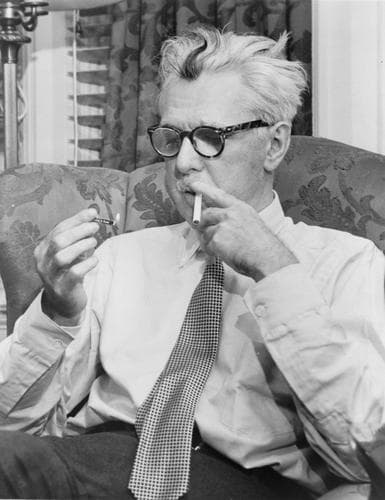
James Grover Thurber was an American cartoonist, writer, humorist, journalist and playwright. He was best known for his cartoons and short stories, published mainly in The New Yorker and collected in his numerous books.
Similar books
- Alice's Adventures in Wonderland
Lewis Carroll
4.0 (245k) average on GoodreadsFantasyFeatures fantastical characters, nonsensical humor, and a journey through a whimsical, dreamlike world.
- The Phantom Tollbooth
Norton Juster
4.2 (242k) average on GoodreadsFantasyExplores the magic of language and abstract concepts through a clever, imaginative quest with memorable characters.
- The Hobbit, or There and Back Again
J.R.R. Tolkien
4.3 (2.9M) average on GoodreadsFantasyThe 13 Clocks offers a stark contrast to The Hobbit (1937) in terms of tone and narrative style. While both are foundational works in children's fantasy, Tolkien's work emphasizes epic scope, detailed world-building (Middle-earth), and a more straightforward heroic quest structure with clear moral lines. Thurber, conversely, prioritizes linguistic play, whimsical absurdity, and a more intimate, almost theatrical setting. The stakes in The 13 Clocks are personal and intellectual, whereas in The Hobbit, they are grand and existential. Thurber's Golux is a trickster figure, a far cry from Gandalf's more conventional wise wizard persona, highlighting a divergence in their approaches to magical aid and wisdom.
- Harry Potter and the Sorcerer's Stone
J.K. Rowling
4.5 (7M) average on GoodreadsFantasyRescued from a miserable life under the stairs, an orphaned boy discovers he's a wizard destined for a magical school, where he uncovers a dangerous secret tied to the dark wizard who murdered his parents.
- The Hunger Games
Suzanne Collins
4.3 (6.4M) average on GoodreadsFantasyIn a future where children fight to the death on live television, Katniss Everdeen volunteers for the arena, turning a death sentence into a fight for survival and a spark of rebellion.
- 1984
George Orwell
4.2 (3.1M) average on GoodreadsPoliticsIn a future where surveillance and thought control are absolute, a man's search for truth clashes with the Party, showing that hope can be a form of rebellion.




Enjoyed the summary?
A summary gives you the shape of the book. The book itself has the detail, the examples and the voice.
Find The 13 Clocks on AmazonAs an Amazon Associate, BookBrief earns from qualifying purchases. How we're funded