
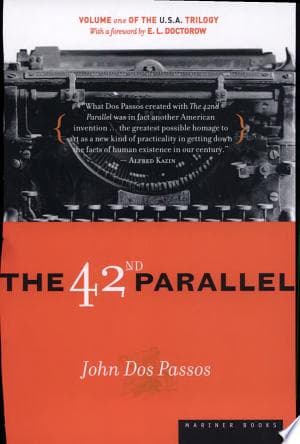
Synopsis
Covers the whole plot, including the ending.
- Difficulty
- Medium
- Pacing
- Variable
- Mood
- Panoramic, Observational, Historical, Socially Conscious
- Read it if
- You enjoy immersive historical fiction with a panoramic scope, experimental narrative structures, and a deep dive into the American socio-political landscape of the early 20th century.
- Skip it if
- You prefer linear narratives with a strong central protagonist, or if you dislike historical fiction that integrates real-world figures and events extensively.
The 42nd Parallel Plot Summary
Covers the whole plot, including the ending.
Mac's Early Wanderings and Socialist Awakening
F.C. Mac McCreary, known as Mac, grows up in Chicago, feeling distant from his family and traditional life. He leaves home young, working various jobs as a printer's assistant, a hobo, and a laborer across the American West. His experiences with poverty and unfairness lead him to socialist ideas. He joins the Industrial Workers of the World (IWW), attending meetings, handing out flyers, and protesting for workers' rights. Mac searches for belonging and a cause, finding it, imperfectly, in the working class's fight against capitalist unfairness. He eventually lives, for a time, in California, working for a socialist newspaper and developing his political views.
Janey's Strict Upbringing and Search for Security
Janey Williams is raised in a strict, conservative home in Washington D.C., controlled by her demanding mother and society's expectations. She works as a stenographer, wanting respect and financial stability. Her life is carefully organized, and she is always aware of social rules and the need to look proper. Janey quietly longs for romance and a more satisfying life, but her shyness and caution stop her from taking chances. She observes the world critically, often judging, wary of anything that disrupts her sense of order. Her story shows the restrictive customs faced by women of her time, especially those in the middle class.
Eleanor Stoddard's Artistic Ambitions and Bohemian Life
Eleanor Stoddard, from a respectable Chicago family, goes against expectations to marry and settle down. She is ambitious and has a good eye for beauty, determined to succeed in interior decoration and design. Eleanor moves to New York City, joining bohemian groups and art movements. She becomes close friends with Eveline Hutchins, a more free-spirited and sexually open woman. Eleanor's story explores her fight for independence, her pursuit of art, and how she handles social rules about women's roles and sexuality in the early 20th century. She is sharp, calculating, and driven, using her intelligence to advance her career.
Ward Moorehouse's Rise in Advertising and Public Relations
Ward Moorehouse, a charming and ambitious young man from a small town, arrives in New York City wanting to succeed. He quickly gets into journalism, using his social skills and ability to promote himself. He understands the power of how things appear and how to influence public opinion, making him a good fit for the new field of public relations. Ward makes connections with important people, always looking for chances to advance his career and get rich. His story shows the American dream of self-made success, but also hints at the moral compromises and superficiality in such a pursuit. He marries a rich woman, Della, mainly for her connections and money, and always looks for new ventures.
Charley Anderson's Mechanical Aptitude and Restlessness
Charley Anderson is a naturally talented mechanic with an intuitive understanding of machines. Growing up in a working-class family, he struggles with school but excels with his hands. He is restless and likes adventure, always moving from one job to another—from working on cars to sailing on ships. Charley is easily swayed by others, especially women, and often makes quick decisions. His story shows the raw talent and potential in the American working class, but also the lack of direction and societal forces that can lead to wasted chances. He is kind-hearted but often naive, living life with curiosity and recklessness.
Intersections in New York: Eleanor and Ward
Eleanor Stoddard, now starting her interior design business with Eveline Hutchins, finds her professional and social circles increasingly crossing paths with Ward Moorehouse. Ward, always networking, recognizes Eleanor's talent and social connections. He sees possible alliances that could help his growing public relations business. They meet at parties, business events, and through mutual friends in the city's sophisticated, often competitive, social scene. While their interactions are mostly professional, there is an underlying tension of ambition and social climbing. Their relationship shows the transactional nature of success in early 20th-century New York, where personal connections often mattered most.
Mac's Political Activism and Personal Struggles
Mac, still committed to the socialist cause, moves around the country, working for various radical publications and labor groups. He experiences the friendship of fellow activists but also the harsh realities of police violence, censorship, and internal political disagreements within the movement. He falls in love with and marries Alice, a fellow socialist, and they have a child. However, their relationship is strained by poverty, Mac's constant travel, and his strong dedication to the cause, which often overshadows his family life. His idealism is tested by the practical difficulties and personal sacrifices his political beliefs demand, leading to moments of doubt and tiredness.
Charley's Adventures and Failed Relationships
Charley Anderson's mechanical skill takes him from working in garages in the Midwest to serving on ships, experiencing different parts of American industry and life at sea. His charm attracts women, but his impulsiveness and lack of commitment often lead to short-lived and unsatisfying relationships. He has a significant affair with Anne, but their relationship is difficult and does not last. Charley's story is marked by a sense of not belonging anywhere, as he constantly seeks new experiences and avoids commitment, showing a wider social unrest and the search for meaning in a quickly changing industrial world. He often gets into situations he does not fully understand, acting on instinct.
Ward's Expanding Influence and Personal Life
Ward Moorehouse successfully expands his public relations firm, becoming more influential in shaping public opinion and company images. His work connects him with powerful industrialists and politicians, further solidifying his status. Despite his professional success, his personal life with his wife, Della, becomes more strained. Della, smart and perceptive, sees through Ward's calculated charm and resents his professional goals taking over their marriage. Ward begins to have affairs, further showing the moral compromises he makes in his pursuit of success and pleasure, even as his public image stays polished and perfect. His life becomes a careful balance of public performance and private manipulation.
Janey's Enduring Conservatism and Observations
Janey Williams continues her life as a stenographer in Washington D.C., a careful and observant person. She remains mostly unchanged by the social changes around her, preferring the safety of routine and established rules. While she occasionally interacts with more progressive people, her ingrained conservatism and shyness stop her from fully accepting new ideas or experiences. She continues to judge the moral failings of others, especially those who defy social rules. Janey's story contrasts with the more adventurous lives of the other characters, representing a part of American society holding onto tradition and order amidst the rapid changes of the early 20th century.
Approaching War and Shifting Tides
As the decade goes on, World War I begins to cast a larger shadow over America. The book shows the growing nationalistic feeling and the coming involvement in the European conflict. Characters like Ward Moorehouse see new business opportunities in the war effort, while Mac and the socialists face growing repression and public hostility for their anti-war stance. Charley Anderson, with his mechanical skills, will likely be drawn into the war's technological needs. Eleanor Stoddard continues her career, adapting to changing tastes and economic conditions. The coming war marks a major turning point, promising to reshape the lives of all characters and the nation itself, setting up the next books of the trilogy.
Principal Figures
F.C. Mac McCreary
Protagonist
A restless printer's devil turned socialist organizer, seeking meaning in the working-class struggle.
Mac is introduced as a rootless young man from Chicago who leaves home early to wander the American West, taking on various manual labor jobs. His experiences with poverty and exploitation lead him to embrace radical socialist politics, becoming a dedicated member of the Industrial Workers of the World (IWW). He works as a printer, journalist, and organizer for socialist publications, often moving from town to town. Mac is idealistic and committed to social justice, but also somewhat naive and prone to romanticizing the working class. His personal life, particularly his marriage to Alice, often takes a backseat to his political activism, leading to strains and sacrifices. He represents the burgeoning labor movement and the intellectual ferment of the era.
Relationships: Alice (wife, fellow socialist, often neglected); IWW Members (comrades and fellow activists)
Janey Williams
Protagonist
A meticulous and conservative stenographer from Washington D.C., seeking security and respectability.
Janey is a quiet, reserved young woman from a respectable but financially strained family in Washington D.C. She works as a stenographer, meticulously performing her duties and adhering strictly to social conventions. Dominated by her demanding mother, Janey is cautious, observant, and often judgmental of others who deviate from her strict moral code. She longs for a stable, respectable life, possibly a marriage, but her shyness and fear of stepping outside established norms prevent her from actively pursuing her desires. Janey embodies the anxieties and aspirations of the early 20th-century middle class, particularly women, who were caught between traditional expectations and emerging freedoms.
Relationships: Mother (dominant and influential figure); Sister (Unnamed) (sibling relationship, sometimes competitive)
Eleanor Stoddard
Protagonist
An ambitious and aesthetically driven interior designer who rebels against conventional expectations.
Eleanor is a sharp, intelligent, and determined young woman from Chicago who rejects the traditional path of marriage and domesticity. She moves to New York to pursue a career in interior decoration and design, driven by her keen aesthetic sense and desire for independence. Eleanor is sophisticated, calculating, and adept at navigating social circles. She forms a complex friendship with Eveline Hutchins, and together they establish a design business. Eleanor represents the 'new woman' of the era, pursuing professional success and personal autonomy, but she is also pragmatic and willing to use social connections to her advantage. She is an astute observer of people and a skilled manipulator of appearances.
Relationships: Eveline Hutchins (close friend and business partner); Ward Moorehouse (professional acquaintance, potential ally)
Ward Moorehouse
Protagonist
A charismatic and opportunistic public relations man, skilled in self-promotion and networking.
Ward is a charming, ambitious, and somewhat superficial man from a small town who comes to New York to make his fortune. He quickly establishes himself in journalism and then in the burgeoning field of public relations, recognizing the power of shaping public opinion. Ward is a master networker, cultivating relationships with influential figures and using his charisma to advance his career. He marries Della, a wealthy woman, primarily for her connections and financial security. Ward embodies the American ideal of the self-made man, but also the moral compromises and superficiality that can accompany the relentless pursuit of success and wealth. He is constantly looking for the next big opportunity.
Relationships: Della (wealthy wife, often neglected and resentful); Eleanor Stoddard (professional acquaintance)
Charley Anderson
Protagonist
A gifted but restless mechanic, drifting through jobs and relationships.
Charley is a naturally talented mechanic with an intuitive understanding of machines, but he lacks direction and formal education. He is restless, impulsive, and easily influenced, particularly by women. Charley drifts through various jobs, from working in garages to serving on ships, always seeking new experiences but rarely finding lasting contentment. He is good-hearted but often naive, prone to making poor decisions in his personal life. Charley represents the raw, untapped potential of the American working class, but also the societal forces that can lead to a lack of focus and squandered opportunities. He is a character driven by instinct and a desire for immediate gratification.
Relationships: Anne (tumultuous romantic partner); Various co-workers (transient friendships)
Eveline Hutchins
Supporting
Eleanor Stoddard's bohemian friend and business partner, more free-spirited and sexually liberated.
Eveline is Eleanor Stoddard's close friend and business partner in their interior design venture. She is more bohemian, free-spirited, and sexually liberated than Eleanor, often serving as a foil to Eleanor's more calculated ambition. Eveline introduces Eleanor to various artistic and intellectual circles in New York, embodying the changing social mores of the era. She represents a different kind of female independence, one less focused on professional achievement and more on personal freedom and experience. Her relationship with Eleanor is a key element in Eleanor's social and professional development.
Relationships: Eleanor Stoddard (close friend and business partner)
Della
Supporting
Ward Moorehouse's wealthy and intelligent wife, increasingly disillusioned with his ambition.
Della is Ward Moorehouse's wife, a woman of wealth and intelligence. She is initially drawn to Ward's charm and ambition, but as his career progresses, she becomes increasingly disillusioned with his superficiality, his calculated social climbing, and his neglect of their marriage. Della is perceptive and sees through Ward's carefully constructed facade, leading to resentment and strain in their relationship. She represents the personal cost of Ward's relentless pursuit of success and the often-unhappy reality behind the glittering surface of New York's elite society.
Relationships: Ward Moorehouse (husband, increasingly estranged)
Alice
Supporting
Mac McCreary's wife, a fellow socialist who struggles with poverty and Mac's dedication to the cause.
Alice is Mac McCreary's wife and a fellow socialist. She shares his political ideals but struggles with the practical realities of their poverty-stricken life and Mac's constant travel and dedication to the movement, which often leaves her and their child neglected. Alice is a resilient but often weary character, representing the personal sacrifices made by those committed to social change. Her relationship with Mac highlights the tension between revolutionary ideals and the demands of family life.
Relationships: F.C. Mac McCreary (husband, often strained relationship)
Eugene Debs
Mentioned
Prominent American socialist, labor organizer, and five-time presidential candidate.
Eugene Debs is a real historical figure who appears in the 'Newsreel' and 'The Camera Eye' sections and is admired by Mac McCreary. He is a central figure in American socialism and the labor movement, known for his powerful speeches and unwavering commitment to workers' rights. Debs serves as an ideological beacon for characters like Mac, representing the hopes and struggles of the working class against capitalist exploitation.
Relationships: F.C. Mac McCreary (ideological inspiration)
Thomas Edison
Mentioned
Famed American inventor and businessman, symbolizing American ingenuity and industrial progress.
Thomas Edison, another real historical figure, is featured in 'Newsreel' and 'The Camera Eye' sections. He represents the inventive spirit and industrial growth of America at the turn of the century. Edison's story, often presented in a hagiographic light, contrasts with the struggles of the working-class characters, embodying the 'rags-to-riches' myth and the power of individual ingenuity within the capitalist system. He symbolizes the technological advancements that are rapidly transforming the nation.
Andrew Carnegie
Mentioned
Scottish-American industrialist and philanthropist, representing immense wealth and corporate power.
Andrew Carnegie, a historical titan of industry, is depicted in 'Newsreel' and 'The Camera Eye' sections. He symbolizes the vast accumulation of wealth and power by industrialists during the Gilded Age, as well as the philanthropic efforts often made by such figures. Carnegie's presence highlights the immense economic disparities in early 20th-century America and the complex relationship between capital, labor, and social responsibility, providing a backdrop against which characters like Mac struggle.
Themes & Insights
The American Dream and Its Discontents
The novel explores different forms of the American Dream—from Ward Moorehouse's pursuit of wealth and influence to Eleanor Stoddard's goal for professional success. However, it also clearly shows the dream's negative side: the exploitation faced by Mac McCreary and the working class, Janey Williams's stifling conformity, and Charley Anderson's aimless travels despite his natural talent. The book questions if the dream is available to everyone, and at what personal and societal cost it is achieved, often revealing an emptiness beneath the shiny surface of success. Ward's strained marriage and Eleanor's calculated relationships show the compromises made.
“U.S.A. is the slice of a continent. U.S.A. is a group of holding companies, some vast machine in motion.”
Individualism vs. Collectivism
This theme is central to the novel, especially through the different paths of the main characters. Mac McCreary dedicates his life to collective action through the socialist movement and the IWW, believing in unity to overcome exploitation. In contrast, Ward Moorehouse represents strong individualism, focused only on personal advancement and getting rich, often at others' expense. Eleanor Stoddard, while working with others professionally, is driven by individual ambition. The story examines the tension between these two forces, showing the ideological struggles of early 20th-century America and the search for belonging in an increasingly disconnected society.
“All right, we are two nations. ... There are the owners and the exploited. There are the rich and there are the poor. And between these two nations there is no peace.”
Social Class and Mobility
Dos Passos details the strict class structures of early 20th-century America and how much social movement was possible. Characters like Ward Moorehouse and Eleanor Stoddard actively climb the social ladder through ambition and smart networking, moving from more modest backgrounds into the elite. Mac McCreary and Charley Anderson mostly stay in the working class, fighting against systemic economic forces. Janey Williams shows the worries of the aspiring middle class, always trying to keep respect. The novel shows how class shapes opportunities, relationships, and worldviews, often deciding one's fate regardless of individual talent or effort.
“The rich man in his castle, The poor man at his gate, God made them high and lowly, And ordered their estate.”
The Changing Role of Women
The novel explores the changing roles and expectations for women in the early 20th century. Eleanor Stoddard represents the 'new woman,' pursuing a professional career and independence, challenging traditional home roles. Eveline Hutchins represents a more bohemian, sexually free woman. In contrast, Janey Williams sticks strictly to traditional female roles, seeking security and respectability within conventional society. Alice, Mac's wife, struggles with family demands and her husband's political activism. The stories reveal the limited choices, societal pressures, and new opportunities faced by women during a time of big social change.
“A woman's place is in the home.”
The Impact of Industrialization and Technology
The rapid industrialization and technological advances of the era are a constant background. Charley Anderson's natural mechanical skills show the human connection to machines, while figures like Thomas Edison symbolize the era's inventive spirit. The novel shows how these changes transform work, create new industries like advertising (Ward Moorehouse), and alter daily life. However, it also shows the human cost of industrialization, especially for the working class who face exploitation and alienation, as Mac experiences. The story illustrates how technology, while offering progress, also adds to social and economic divisions.
“The machine guns spit and sputter. The cannon roar. The cities blaze.”
Plot Devices & Literary Techniques
Newsreel
A montage of headlines, song lyrics, and public figures, reflecting the historical context.
The 'Newsreel' sections are a distinctive stylistic innovation, serving as interchapters that provide a kaleidoscopic snapshot of American society at specific historical moments. They consist of fragments of newspaper headlines, popular song lyrics, advertisements, and brief, often ironic, biographical sketches of public figures (like Eugene Debs, Thomas Edison, Andrew Carnegie). This device immerses the reader in the political, social, and cultural atmosphere of the time, anchoring the individual narratives within a broader historical context and emphasizing the collective consciousness of the nation. It creates a sense of immediacy and documentary realism, highlighting the cacophony of voices and events shaping the era.
The Camera Eye
Stream-of-consciousness autobiographical fragments, offering the author's subjective perspective.
The 'Camera Eye' sections are short, stream-of-consciousness passages written in the first person, providing glimpses into the author's (or a persona's) subjective experiences and thoughts. These highly personal, poetic vignettes often reflect on childhood memories, observations of the urban landscape, or reactions to political events. They offer a counterpoint to the objective, documentary style of the 'Newsreel' and the more conventional third-person narratives of the protagonists. 'The Camera Eye' injects a lyrical, introspective, and often melancholic voice into the novel, suggesting the individual's struggle to find meaning and identity amidst the overwhelming forces of history and society.
Biographies
Brief, satirical biographies of prominent historical figures, providing social commentary.
Interspersed throughout the novel are short, often satirical, biographies of real historical figures, such as Eugene Debs, Thomas Edison, and Andrew Carnegie. These biographies are distinct from the 'Newsreel' fragments, offering more developed (though still concise) narratives of these individuals' lives and achievements. Dos Passos uses this device to provide social commentary, often highlighting the contradictions and ironies of American success, wealth, and power. They serve to contextualize the fictional characters' struggles and aspirations within the lives of real, influential people, showing the forces and ideals that shaped the nation and influenced the characters' worldviews, sometimes serving as aspirational figures or as symbols of oppression.
Multiple Protagonist Narrative
Interweaving the lives of five disparate characters to create a panoramic view of society.
Instead of focusing on a single hero, the novel employs a multiple protagonist narrative, following the lives of five distinct characters: Mac, Janey, Eleanor, Ward, and Charley. Their stories are presented in alternating chapters, creating a complex, polyphonic structure. This device allows Dos Passos to paint a panoramic portrait of American society across different social classes, geographical regions, and ideological perspectives. While their paths occasionally cross, their lives largely unfold independently, emphasizing the vastness and diversity of the nation while subtly hinting at the interconnectedness of their experiences within the larger historical currents. This structure allows for a comprehensive, rather than singular, view of the American experience.
The 42nd Parallel Quotes
“America our nation has been beaten by strangers who have turned our language inside out who have taken the clean words our fathers spoke and made them slimy and foul.”
“The old words are like the labels on old medicine bottles; they don't mean anything any more.”
“All right we are two nations.”
“But mostly U.S.A. is the speech of the people.”
“The streets of heaven are full of the sound of stars.”
“He was a man who had been places and seen things.”
“In every town there's a Main Street and on Main Street there's a drugstore and in the drugstore there's a soda fountain.”
“The world's a hospital and we're all patients.”
“Money is power and power is money.”
“The only thing that matters is what you do.”
“History is the record of what one age finds worthy of note in another.”
“The city is a machine that makes men lonely.”
“We are all part of the big parade.”
“The future is a big black hole.”
Quiz
10 questions on the plot and the characters. Each answer comes with a short explanation.
Question 1
What is the primary narrative structure of 'The 42nd Parallel' that follows five main characters?
- A single continuous storyline focused on one protagonist
- Interwoven stories artfully spliced together
- A series of unrelated short stories
- A chronological historical account with fictional elements
Show answer
B. Interwoven stories artfully spliced together The book uses an innovative narrative technique where the lives of five main characters—Mac, Janey, Eleanor, Ward, and Charley—are presented through interwoven, spliced-together stories, creating a kaleidoscopic portrait of America.
Question 2
Which historical figure makes a cameo appearance in 'The 42nd Parallel'?
- Franklin D. Roosevelt
- Eugene Debs
- Henry Ford
- Woodrow Wilson
Show answer
B. Eugene Debs Eugene Debs, the socialist leader and presidential candidate, appears as a cameo in the novel, reflecting Dos Passos's incorporation of real historical figures into the fictional narrative to ground it in the era's social and political context.
Question 3
What is the overarching setting and time period of 'The 42nd Parallel'?
- The Great Depression in the 1930s
- The dawn of the twentieth century in a young America
- Post-World War II America in the 1950s
- The Civil War era in the 1860s
Show answer
B. The dawn of the twentieth century in a young America The novel is set at the dawn of the twentieth century, capturing a young America on the cusp of modernization and social change, as part of Dos Passos's broader U.S.A. trilogy chronicling the nation's development.
Question 4
Which of the following is NOT one of the five main characters in 'The 42nd Parallel'?
- Mac
- Janey
- Eleanor
- F. Scott Fitzgerald
Show answer
D. F. Scott Fitzgerald F. Scott Fitzgerald is a real-life author and contemporary of Dos Passos, not a character in the novel. The five main characters are Mac, Janey, Eleanor, Ward, and Charley, whose lives intertwine throughout the story.
Question 5
How does John Dos Passos's approach in 'The 42nd Parallel' differ from that of his contemporaries like Fitzgerald and Hemingway, according to the description?
- He focused on intimate personal dramas rather than broad social themes
- He cultivated his own little corner of American life
- He took on the world with a grand, kaleidoscopic portrait of the nation
- He avoided historical references to keep the story timeless
Show answer
C. He took on the world with a grand, kaleidoscopic portrait of the nation While Fitzgerald and Hemingway were known for focusing on specific, personal experiences (what Edmund Wilson called 'their own little corners'), Dos Passos aimed for a broader scope, creating a grand, kaleidoscopic portrait of America that incorporates history, multiple characters, and social commentary.
Question 6
What metaphorical concept is used to describe the trajectory of the characters' lives in 'The 42nd Parallel'?
- A river flowing steadily to the sea
- A storm track blowing them New Yorkward
- A ladder of social climbing
- A maze with no exit
Show answer
B. A storm track blowing them New Yorkward The characters are described as being 'caught on the storm track of this parallel and blown New Yorkward,' using a meteorological metaphor to illustrate how external forces, like social and economic currents, propel their lives toward the urban center of New York.
Question 7
Which literary work is 'The 42nd Parallel' a part of?
- The Great American Novel series
- The U.S.A. trilogy
- The Lost Generation collection
- The Modern Library classics
Show answer
B. The U.S.A. trilogy 'The 42nd Parallel' is the first book in the U.S.A. trilogy, which also includes '1919' and 'The Big Money.' This trilogy is celebrated as a comprehensive portrayal of American society in the early twentieth century.
Question 8
What theme is central to 'The 42nd Parallel' as suggested by its inclusion of figures like Thomas Edison and Andrew Carnegie?
- The romantic ideals of the American West
- The impact of industrialization and capitalism on American life
- The horrors of World War I
- The cultural renaissance of the Harlem Renaissance
Show answer
B. The impact of industrialization and capitalism on American life By featuring industrialists and innovators like Thomas Edison and Andrew Carnegie, the novel explores themes of industrialization, capitalism, and technological progress, reflecting how these forces shape the characters' lives and the nation's trajectory.
Question 9
In what way does 'The 42nd Parallel' contribute to the notion of the 'great American novel' as described?
- By focusing exclusively on the experiences of the wealthy elite
- By presenting a narrow, personal story that resonates universally
- By offering a grand, kaleidoscopic portrait of the nation with historical depth
- By avoiding political commentary to maintain artistic purity
Show answer
C. By offering a grand, kaleidoscopic portrait of the nation with historical depth The book is considered by many to be part of the great American novel due to its ambitious scope: it weaves together multiple narratives, historical figures, and social commentary to create a comprehensive and dynamic portrait of America at a pivotal time, unlike more narrowly focused works of its era.
Question 10
How does the structure of 'The 42nd Parallel' reflect its thematic goal of portraying America?
- Through a linear, chronological plot that simplifies historical events
- By using a single protagonist to symbolize the nation's spirit
- Through fragmented, interlocking stories that mimic the complexity of society
- By excluding fictional elements to focus on factual accuracy
Show answer
C. Through fragmented, interlocking stories that mimic the complexity of society The novel's structure of artfully spliced, interwoven stories mirrors the chaotic and interconnected nature of American society. This technique allows Dos Passos to explore diverse perspectives and social strata, enhancing the theme of a nation in flux.
The 42nd Parallel FAQ
What is 'The 42nd Parallel' about?
The novel follows five interconnected characters—Mac, Janey, Eleanor, Ward, and Charley—as they navigate America in the early 20th century, with their lives intersecting against a backdrop of industrialization, labor movements, and historical figures like Eugene Debs and Andrew Carnegie. It portrays the nation's transformation through their personal struggles and ambitions.
Why should I read 'The 42nd Parallel'?
It offers a panoramic, innovative view of American society through its experimental narrative style, blending fiction with historical vignettes. Readers gain insight into the social and economic forces shaping the U.S. during a pivotal era, making it a foundational work of modernist literature.
What is the background/setting of 'The 42nd Parallel'?
Set in the early 1900s across the United States, the novel moves from rural areas to urban centers like New York, capturing the nation's rapid industrialization, labor unrest, and the dawn of modernity. The 42nd parallel itself symbolizes a geographic and metaphorical line dividing and connecting American experiences.
What are the most memorable quotes?
Key quotes include passages reflecting on American identity, such as Mac's observations on labor: 'The working stiffs are the ones that get it in the neck,' and the recurring motif 'U.S.A. is the world's greatest nation,' which underscores the novel's critical exploration of national myths.
What writing style does the author use?
Dos Passos employs a kaleidoscopic, experimental style combining narrative prose with 'Newsreel' sections (collages of headlines and songs), 'Camera Eye' stream-of-consciousness passages, and biographical sketches of real figures. This creates a fragmented, multi-voiced portrait of America.
What minor details add significant meaning?
Small details like characters' fleeting encounters with historical icons—e.g., Ward brushing past Thomas Edison—highlight how individual lives are dwarfed by larger societal forces. The repeated motif of trains and movement symbolizes the relentless pace of American change.
What are some subtle foreshadowing moments?
Early descriptions of Mac's involvement in labor activism hint at the broader social upheavals to come in the trilogy. Janey's initial idealism about New York foreshadows her later disillusionment, mirroring the nation's shifting fortunes.
What unexpected character connections exist?
Characters like Charley and Eleanor cross paths indirectly through shared spaces or mutual acquaintances, such as political rallies or urban settings, without always realizing it, emphasizing the interconnected yet anonymous nature of modern life.
What are unspoken character motivations?
Mac is driven by a deep-seated desire for social justice rooted in personal hardship, while Ward's ambition masks a fear of obscurity. Eleanor's pursuit of independence often conflicts with unacknowledged yearnings for stability and connection.
What psychological complexities do characters exhibit?
Janey grapples with the tension between her rural upbringing and urban aspirations, leading to identity confusion. Charley's wanderlust reflects a restless avoidance of commitment, showcasing the era's psychological dislocation.
What are the major emotional turning points?
Key moments include Mac's radicalization after witnessing labor exploitation, Janey's heartbreak in New York that shatters her naivete, and Eleanor's decision to break from traditional roles, each marking a loss of innocence and adaptation to harsh realities.
How do relationship dynamics evolve?
Relationships are often transient and instrumental, such as Ward's alliances for social climbing or Charley's fleeting romances, reflecting the novel's theme of impermanence. Bonds like Mac's camaraderie with fellow activists provide rare, fragile stability.
Which parts remain ambiguous or open-ended?
The fates of characters like Charley and Eleanor are left unresolved, with their stories continuing into the trilogy's later books. The novel's ending doesn't provide closure, instead emphasizing the ongoing, chaotic flow of American life.
What are controversial scenes or decisions?
Scenes depicting labor violence and political radicalism, such as Mac's involvement in strikes, sparked debate for their sympathetic portrayal of socialism. The novel's critical stance on capitalism and American exceptionalism was contentious in its time.
'The 42nd Parallel' ending explained: how it ends & what it means
The novel concludes with characters still in motion, heading toward New York or other destinies, symbolizing America's unfinished journey. It suggests that individual stories are threads in a larger national narrative, setting the stage for the trilogy's continuation in '1919'.
How does the novel critique American society?
Through characters' struggles with poverty, inequality, and disillusionment, Dos Passos critiques the American Dream as elusive and often exploitative. The inclusion of real moguls like Carnegie contrasts with fictional laborers, highlighting systemic injustices.
What role do historical figures play in the narrative?
Figures like Eugene Debs and Andrew Carnegie appear in biographical sketches that contextualize the characters' lives, bridging personal and historical scales. They serve as symbols of the era's ideological battles and economic transformations.
How does the structure reflect the book's themes?
The fragmented, multi-perspective structure mirrors the disjointed experience of modernity and the complexity of national identity. It forces readers to piece together a collective portrait from disparate voices and events.
About the author
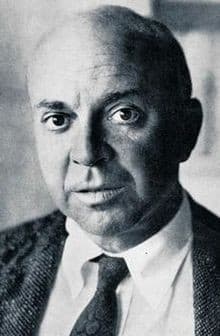
John Roderigo Dos Passos was an American novelist, most notable for his U.S.A. trilogy.
Similar books
- Manhattan Transfer
John Dos Passos
3.7 (5k) average on GoodreadsHistorical FictionExplores urban life and multiple character perspectives in a similar modernist style.
- The Grapes of Wrath
John Steinbeck
4.0 (750k) average on GoodreadsHistorical FictionOffers a broad social commentary on working-class struggles in America with a focus on a specific era.
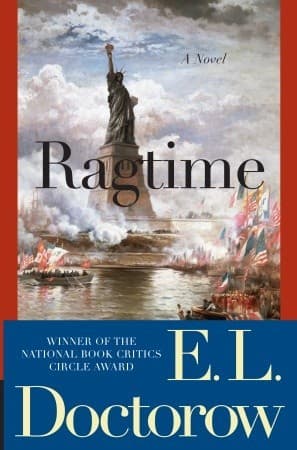
- Ragtime
E.L. Doctorow
3.9 (38k) average on GoodreadsLiterary FictionInterweaves fictional characters with historical figures to depict early 20th-century America.
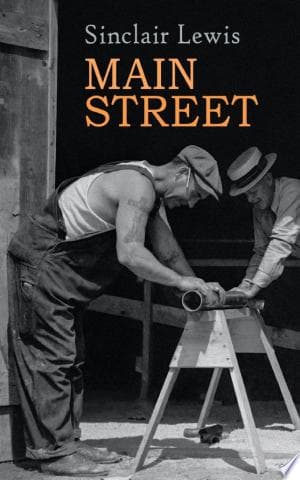
- Main Street
Sinclair Lewis
3.8 (24k) average on GoodreadsLiterary FictionSinclair Lewis's Main Street (1920) also offers a critical look at American society, specifically the provincialism and hypocrisy of small-town life. However, Lewis employs a more conventional, albeit satirical, narrative centered on the experiences of Carol Kennicott. While both authors critique aspects of the American Dream, Lewis's critique is often delivered through a character's disillusionment within a relatively straightforward plot. Dos Passos, in The 42nd Parallel, broadens this critique to a national scale and presents it through a radical formal experimentation that eschews a single protagonist or linear plot, aiming for a more objective, almost documentary, capture of social forces rather than a character's subjective experience of them.
- The Old Man and the Sea
Ernest Hemingway
3.8 (831k) average on GoodreadsLiterary FictionA Cuban fisherman's long struggle with a giant marlin becomes a story of endurance and dignity, now retold for young adults with illustrations, phonetic guides, and writing prompts in Traditional Chinese.
- One Hundred Years of Solitude
Gabriel García Márquez
4.1 (753k) average on GoodreadsLiterary FictionThrough the multi-generational story of the Buendía family, a mythical town deals with the repeating patterns of time, love, and solitude, as the extraordinary mixes with the ordinary.




Enjoyed the summary?
A summary gives you the shape of the book. The book itself has the detail, the examples and the voice.
Find The 42nd Parallel on AmazonAs an Amazon Associate, BookBrief earns from qualifying purchases. How we're funded