
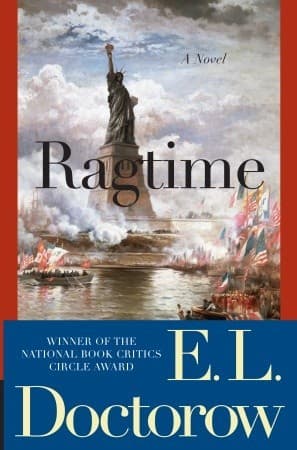
Synopsis
Covers the whole plot, including the ending.
- Difficulty
- Medium
- Pacing
- Moderate
- Mood
- Historical, Reflective, Satirical, Melancholy
- Read it if
- You enjoy historical fiction that blurs the lines between real and imagined characters, offering a unique mosaic of early 20th-century America.
- Skip it if
- You prefer a straightforward, linear plot with a single protagonist and clear genre boundaries.
Ragtime Plot Summary
Covers the whole plot, including the ending.
The Family in New Rochelle
The story begins in 1906, introducing an affluent, unnamed family in New Rochelle, New York: Father, Mother, Mother's Younger Brother, Grandfather, and the Boy. Their comfortable life is subtly changed by the new century. One Sunday, Harry Houdini crashes his car outside their home. Mother later finds a newborn black infant buried in their garden, leading to the discovery of the infant's mother, Sarah, a young black woman who will not speak. Mother, moved by compassion, insists on taking Sarah and the baby into their home, despite Father's initial discomfort and Younger Brother's interest.
Coalhouse Walker Jr. and Sarah
Coalhouse Walker Jr., a skilled ragtime pianist, arrives at the family's home, saying he is Sarah's lover and the baby's father. He is a dignified man, driving a new Model T Ford, a sign of his success. He begins to court Sarah, playing his ragtime music for her, slowly breaking through her silence. They plan to marry. However, Coalhouse's Model T becomes a target for racial prejudice when a volunteer fire company in New Rochelle, led by Willie Conklin, blocks his path and defaces his car. This sparks Coalhouse's firm demand for justice.
Coalhouse's Quest for Justice
Coalhouse Walker Jr. tries to use the legal system to have his car fixed and receive an apology from the firemen, especially Willie Conklin. He tries different ways, from filing police complaints to seeking legal advice, but meets with indifference, bureaucratic delays, and racial bias. The local authorities dismiss his claims, and the firemen refuse to cooperate, increasing Coalhouse's frustration and sense of injustice. The Family, especially Mother and Younger Brother, see his struggle and the systemic racism he faces, which starts to change their views on justice and society. Father, however, remains detached, focused on his business.
Sarah's Death and Coalhouse's Transformation
Desperate for justice for Coalhouse, Sarah tries to appeal to the Vice President, who is visiting New Rochelle. As she approaches his motorcade, guards brutally beat her, mistaking her for a threat. She dies from her injuries, leaving Coalhouse and their baby heartbroken. This event destroys Coalhouse's trust in the system and turns his search for justice into a quest for revenge. He withdraws, gathers a small group of followers, and begins a campaign of violence, targeting and burning down the fire stations responsible for his humiliation and Sarah's death. His actions shock the community.
Younger Brother Joins Coalhouse
Mother's Younger Brother, already feeling lost, finds himself drawn to Coalhouse's actions. He is a talented pyrotechnician, a skill he developed working for Father's company creating patriotic displays. Disillusioned with his conventional life and captivated by Coalhouse's rebellion against injustice, Younger Brother leaves his family and joins Coalhouse's gang. He becomes a part of their operations, using his expertise to create explosives for their attacks. His change shows the era's social unrest and the appeal of revolutionary ideas to those seeking meaning beyond the established order. His involvement further connects the Family to Coalhouse's growing conflict.
The Morgan Library Siege
Coalhouse Walker Jr. and his followers, including Younger Brother, take over the J.P. Morgan Library in New York City. They hold the library's staff hostage, demanding the restoration of Coalhouse's car and the surrender of Willie Conklin. This act brings national attention to Coalhouse's situation and the racial injustices he experienced. Authorities, including Police Commissioner Rhinelander Waldo and later Booker T. Washington, try to negotiate with Coalhouse, but he stays firm in his demands. The siege becomes a small example of the larger societal tensions, with the establishment facing a desperate, radicalized individual seeking correction for deep wrongs.
Negotiations and Coalhouse's End
During the siege, Booker T. Washington is brought in to mediate. He tries to convince Coalhouse to surrender, appealing to his sense of responsibility and the pointlessness of his violent path. Coalhouse, however, remains firm. Eventually, a deal is made: the car will be restored, and Willie Conklin will face justice, in exchange for the hostages' release. As Coalhouse leaves the library, having released the hostages and sent Younger Brother and the others to safety, authorities ambush and kill him. His death is a tragic end to his search for justice, leaving a lasting impact on all involved in his story.
Evelyn Nesbit's Journey
The showgirl Evelyn Nesbit, still dealing with the aftermath of the Stanford White murder trial, moves through various relationships and experiences. She has an affair with Tateh, the Jewish immigrant silhouette artist, and later becomes involved with Emma Goldman, the anarchist. Nesbit eventually finds stability in Hollywood, where she becomes a consultant for silent films, using her past fame to her advantage. Her journey shows celebrity, exploitation, and the search for identity in a changing world, illustrating how public figures were both celebrated and consumed by the media and society of the era. Her path often crosses with other historical and fictional characters.
Tateh's American Dream
Tateh, a Jewish immigrant from Latvia, arrives in America with his young daughter, seeking a new life. He initially struggles as a street artist, creating silhouette portraits, facing poverty and anti-Semitism. After his wife leaves him and their daughter, he and the Girl travel west, working odd jobs and developing his artistic skills. His talent for visual storytelling leads him to the early film industry in Hollywood, where he reinvents himself as the Baron Ashkenazy. He becomes a director and producer of silent films, creating popular 'flickers' for children, achieving success and prosperity, a sharp contrast to his early struggles.
The Family Disperses and Reunites
After the events with Coalhouse and Younger Brother, the original Family changes. Father dies on the Lusitania, a victim of World War I. Mother, having changed significantly, marries Tateh (now the Baron Ashkenazy) and moves to Hollywood, creating a new, blended family with her children, Tateh, and the Girl. The Boy and the Little Girl grow up together, representing a new generation. Mother's Younger Brother, having survived the Coalhouse affair, eventually finds his own purpose, though his ultimate fate is somewhat unclear, hinted at joining revolutionary causes abroad. The novel ends with this new family, symbolizing the merging of different American experiences and the nation's ongoing evolution.
Principal Figures
Mother
Protagonist/Supporting
The moral center of the unnamed family, who evolves from conventionality to compassion.
Mother is initially presented as a conventional, affluent woman, content with her domestic life. However, her inherent empathy and sense of justice are awakened by the discovery of Sarah's baby and the subsequent injustices faced by Sarah and Coalhouse. She challenges Father's conservative views and societal norms, demonstrating a profound capacity for compassion and a growing independence. Her journey reflects the changing roles of women and the awakening social consciousness of the era.
Relationships: Father (Husband; initially a conventional, sometimes strained marriage); Mother's Younger Brother (Brother; close, supportive relationship); Sarah (Protector and caregiver); Coalhouse Walker Jr. (Sympathetic observer and ally in his quest for justice); Tateh (Later husband; forms a new, blended family)
Father
Supporting
The patriarch of the family, representing traditional American values and enterprise.
Father embodies the turn-of-the-century American businessman: industrious, pragmatic, and somewhat rigid in his views. He owns a company that manufactures fireworks and patriotic novelties. He values order, propriety, and the established social hierarchy, often finding himself uncomfortable with the disruptions brought by Sarah, Coalhouse, and his wife's evolving perspectives. His adherence to conventionality makes him resistant to the social changes swirling around him, leading to a growing distance between him and Mother.
Relationships: Mother (Wife; their marriage becomes strained by their differing views); Mother's Younger Brother (Brother-in-law; employs him, but struggles to understand his artistic and radical tendencies); Coalhouse Walker Jr. (A figure of discomfort and a challenge to his sense of order)
Mother's Younger Brother
Protagonist/Supporting
An artistic and restless young man who seeks purpose in radical action.
Younger Brother is a sensitive, artistic, and somewhat adrift young man. He is skilled in pyrotechnics and initially works for Father's company, but feels a profound sense of unfulfillment. He is drawn to the unconventional and the rebellious, fascinated by figures like Evelyn Nesbit and Emma Goldman. His disillusionment with the superficiality of his own life and the injustices he witnesses leads him to embrace Coalhouse Walker Jr.'s cause, becoming a radical and an active participant in the rebellion.
Relationships: Mother (Sister; close and understanding); Father (Brother-in-law; feels misunderstood and constrained by him); Evelyn Nesbit (Obsessed with her, a symbol of beauty and scandal); Emma Goldman (Admires her anarchist philosophy); Coalhouse Walker Jr. (Follower and accomplice; finds purpose in his cause)
Coalhouse Walker Jr.
Protagonist
A dignified ragtime musician whose quest for justice turns into a violent rebellion.
Coalhouse Walker Jr. is a talented black ragtime pianist, a man of immense pride, dignity, and unwavering principles. He represents the aspirations of African Americans in the early 20th century. His meticulous nature and insistence on respect are evident in his brand-new Model T Ford, which becomes the catalyst for his tragic journey. When his car is vandalized and he is denied legal redress, his unwavering demand for justice transforms into a powerful, violent rebellion against systemic racism and the indifferent establishment.
Relationships: Sarah (Lover and fiancée; the mother of his child); The Family (Initially a guest, later a source of both admiration and fear); Willie Conklin (His primary antagonist, the symbol of racial prejudice)
Sarah
Supporting
A young black woman whose tragic fate ignites Coalhouse's rebellion.
Sarah is a young black woman who, early in the novel, buries her newborn baby in the Family's garden due to poverty and despair. She is initially withdrawn and silent, a victim of circumstance and societal neglect. Her relationship with Coalhouse Walker Jr. slowly brings her back to life, and she becomes a symbol of hope and innocent love. Her brutal death, while attempting to seek justice for Coalhouse, is the pivotal event that pushes Coalhouse from peaceful protest to violent retribution, underscoring the severe racial injustices of the era.
Relationships: Coalhouse Walker Jr. (Lover and fiancée; father of her child); Mother (Protector and compassionate caregiver)
Tateh
Protagonist/Supporting
A Jewish immigrant who rises from poverty to become a successful film mogul.
Tateh is a Jewish immigrant from Latvia who arrives in America with his young daughter, seeking the American Dream. He is a talented silhouette artist who faces extreme poverty, anti-Semitism, and personal hardship, including his wife's abandonment. Resourceful and resilient, he reinvents himself, first as a 'moving picture man' creating 'flickers' for children, and eventually as the successful film producer Baron Ashkenazy in Hollywood. His journey is a powerful embodiment of the immigrant experience, showcasing both the struggles and the possibilities of upward mobility in America.
Relationships: The Girl (Daughter; his primary motivation and love); Evelyn Nesbit (Lover for a period); Mother (Later husband; forms a new, blended family)
Evelyn Nesbit
Supporting
The real-life "Girl in the Red Velvet Swing," a symbol of celebrity, beauty, and scandal.
Evelyn Nesbit is a historical figure, a beautiful showgirl famous for her involvement in the "Crime of the Century" – the murder of architect Stanford White by her millionaire husband Harry K. Thaw. In the novel, she is portrayed as a woman grappling with her past, seeking purpose and identity beyond her notorious celebrity. She drifts through various relationships, including one with Tateh, and encounters figures like Emma Goldman. Her journey, ultimately leading to a career in Hollywood, reflects the nascent culture of celebrity and media exploitation, as well as the search for reinvention.
Relationships: Harry K. Thaw (Former husband, murderer of Stanford White); Tateh (Lover for a period); Emma Goldman (Briefly influenced by her anarchist ideas); Mother's Younger Brother (Object of his fascination)
Emma Goldman
Supporting/Mentioned
The real-life anarchist and feminist, representing radical social change.
Emma Goldman is a historical figure, a passionate and outspoken anarchist and feminist. She appears in the novel as a voice of radical social critique, challenging the existing power structures and advocating for individual freedom and social justice. Her presence introduces the intellectual and political currents of the era, influencing characters like Younger Brother and Evelyn Nesbit. She symbolizes the revolutionary spirit and the profound social unrest bubbling beneath the surface of early 20th-century America.
Relationships: Mother's Younger Brother (Influences his political views); Evelyn Nesbit (A brief, influential encounter)
Harry Houdini
Supporting/Mentioned
The famous escape artist, symbolizing the era's fascination with magic and breaking free.
Harry Houdini is a historical figure, the renowned magician and escape artist. His dramatic appearance at the beginning of the novel, crashing his car outside the Family's home, immediately blurs the line between fact and fiction. He serves as a symbol of the era's fascination with spectacle, illusion, and the desire for liberation from constraints. His presence also subtly foreshadows the various forms of 'escape' and transformation undertaken by the novel's characters, both literal and metaphorical, from societal expectations or oppressive circumstances.
Relationships: The Boy (Object of his childhood fascination)
J.P. Morgan
Mentioned
The real-life financier, representing immense wealth and the capitalist establishment.
J.P. Morgan is a historical figure, an immensely powerful and wealthy financier. He represents the pinnacle of American capitalism and the established order. His library becomes the site of Coalhouse Walker Jr.'s final, dramatic stand, making him a symbolic antagonist to Coalhouse's rebellion. Though he has limited direct interaction, his presence underscores the vast disparities in wealth and power that fueled the social tensions of the era, highlighting the systemic forces Coalhouse is up against.
Relationships: Coalhouse Walker Jr. (His library is the target of Coalhouse's siege)
Themes & Insights
The American Dream and Its Discontents
The novel examines different parts of the American Dream, from Tateh's success as an immigrant to Father's established prosperity. However, it also questions the dream's limits and hypocrisies, especially for African Americans like Coalhouse Walker Jr. His search for justice, a basic part of the dream, is denied because of his race, leading to deep disappointment and violence. The dream is shown to be available to some, like Tateh, who adapt to the new world, while others are hurt by its inequalities, as seen in Coalhouse's tragic end and Sarah's death. The theme asks who truly has access to the dream and at what cost.
“There were no Negroes in New Rochelle. There were no immigrants. The only Jews were the German Jews. But it was 1906, and the city was filling up with new arrivals.”
Justice vs. Law
A main conflict is the difference between formal legal systems and true moral justice. Coalhouse Walker Jr. first seeks justice through legal channels after his car is damaged, but the law repeatedly fails him, corrupted by racial prejudice and indifference. This systemic failure pushes him to abandon legal means for a violent, revolutionary pursuit of his own justice. The novel suggests that when the law is unfair or applied inconsistently, people may turn to extralegal ways to right wrongs. Mother's changing understanding of justice, beyond Father's strict rules, further highlights this theme.
“He wanted his car restored to its original condition. He wanted an apology. He was a black man and he meant to have his rights.”
The Blurring of Fact and Fiction
Doctorow mixes real historical figures (Houdini, Emma Goldman, J.P. Morgan, Evelyn Nesbit, Henry Ford) with fictional characters (the Family, Coalhouse, Tateh). This blurs the lines between history and fiction, suggesting that history is a form of storytelling and that ordinary lives are as important as famous ones. The historical figures often represent the era's forces, like industrialization, radicalism, and celebrity, while the fictional characters provide the emotional core and personal experience of these large historical changes. This blend creates a rich picture of America at the turn of the century, emphasizing how all lives are connected.
“There were no Negroes in New Rochelle. There were no immigrants. The only Jews were the German Jews. But it was 1906, and the city was filling up with new arrivals.”
Social Change and Modernity
The novel is set in a time of great social, technological, and cultural change—the 'ragtime' era between the turn of the century and World War I. It shows the shift from a more ordered, Victorian society (represented by Father) to a modern, industrialized, and diverse America. The rise of the automobile (Coalhouse's Model T), the start of cinema (Tateh's career), new music (ragtime), and visible social movements (anarchism, labor rights) all mark this rapid change. The characters' struggles and changes reflect the wider societal shifts, as traditional values are challenged by new ideas, technologies, and demographic changes, leading to both progress and conflict.
“The very air was charged with a new electricity. The world was spinning faster.”
Identity and Reinvention
Many characters in *Ragtime* change and redefine their identities. Tateh, the Jewish immigrant, leaves his past to become the successful film mogul Baron Ashkenazy. Evelyn Nesbit, despite her scandalous past, finds a new role in Hollywood. Mother changes from a traditional housewife to an independent woman who remarries and embraces a blended family. Even Mother's Younger Brother finds a new, radical identity. This theme shows how fluid identity was in a rapidly changing America, where people could shed old selves and create new ones, often in response to societal pressures, personal desires, or historical forces. The ability to reinvent oneself is presented as both a challenge and an opportunity.
“He began to think of himself as a man of the new century. A man of progress. A man of invention.”
Plot Devices & Literary Techniques
Omniscient Narrator
A detached, all-knowing narrator who moves freely between characters and historical events.
The novel employs a highly omniscient, often detached, and somewhat ironic narrator. This narrator has access to the thoughts and feelings of all characters, both fictional and historical, and can seamlessly shift between their individual stories and broader historical contexts. The narrator's voice often adopts a slightly formal, almost journalistic tone, which contributes to the blurring of fact and fiction. This device allows Doctorow to weave together disparate narratives, provide historical background, and comment on the social and political landscape of the era, creating a panoramic view of early 20th-century America.
Historical Figures as Characters
Integrating real historical personages into the fictional narrative as active participants.
Doctorow's use of historical figures like Harry Houdini, Emma Goldman, Evelyn Nesbit, and J.P. Morgan as characters who interact directly with the fictional protagonists is a defining plot device. These figures are not just mentioned; they drive plot points, influence other characters, and participate in the narrative's events. This device blurs the line between historical reality and fictional invention, inviting the reader to reconsider the nature of history and storytelling. It grounds the fictional family's experiences in a tangible historical context while simultaneously humanizing and reinterpreting the famous figures, making the past feel vibrant and immediate.
Interweaving Plotlines
Multiple, initially separate narrative threads that eventually converge and influence each other.
The novel is structured around several distinct plotlines: the unnamed Family's domestic life, Coalhouse Walker Jr.'s quest for justice, and Tateh's immigrant journey, alongside the episodic appearances of historical figures. These plotlines initially unfold independently but gradually begin to intersect and influence one another. For example, Coalhouse's story directly impacts the Family, and Tateh's path crosses with Evelyn Nesbit and later Mother. This interweaving creates a rich tapestry of American life, demonstrating how individual destinies are interconnected and how seemingly disparate lives can converge during periods of significant social change, enhancing the novel's epic scope.
Symbolism of the Automobile
The Model T Ford as a symbol of modernity, social mobility, and racial injustice.
Coalhouse Walker Jr.'s brand-new Model T Ford is a potent symbol. It represents the dawn of the automotive age, technological progress, and the aspirations of social mobility. For Coalhouse, it is a symbol of his hard-earned success, dignity, and a claim to his place in modern America. However, its defacement by racist firemen transforms it into a symbol of racial injustice and the fragility of the American Dream for African Americans. The car becomes the catalyst for his entire tragic journey, highlighting how objects can carry profound social and political meaning, driving the central conflict of the novel.
Ragtime Quotes
“He thought of the United States as a place where people's dreams were given a chance, a place where the human spirit could soar.”
“There were no Negroes. There were no Jews. There were no Irish. There were no Italians. There were no Poles. There were no Germans. There were no Swedes. There were no Chinese. There were only Americans.”
“The very air of the century seemed to crackle with the energy of invention.”
“Ragtime was a music that didn't just entertain, it spoke to something deep in the American soul.”
“The family was an invention of the Victorians, as was the child. For that matter, so was the adult.”
“He understood that the world was an engine, and that the engine ran on money.”
“Every new machine was a dream come true, a promise of a better life.”
“There was a lot of money to be made in the new century, and a lot of ways to lose it.”
“The past was like a foreign country; they did things differently there.”
“He had a sense of the vast, intricate network of human desire and ambition that underlay the apparent order of things.”
“The rich were different. They had more money.”
“History was not a procession of illustrious people but a parade of nobodies.”
“He believed in justice, which was, in the end, only a hope, like belief in God.”
“The future was a dark, unreadable text, but the present was a series of bright, urgent moments.”
Quiz
10 questions on the plot and the characters. Each answer comes with a short explanation.
Question 1
In what year does 'Ragtime' open, and in what New York location?
- 1910, New York City
- 1906, New Rochelle
- 1900, Long Island
- 1914, Harlem
Show answer
B. 1906, New Rochelle The story explicitly opens in 1906 in New Rochelle, NY, at the home of an affluent American family.
Question 2
Which real-life figure crashes his car near the affluent family's home at the beginning of the novel?
- Henry Ford
- J.P. Morgan
- Harry Houdini
- Sigmund Freud
Show answer
C. Harry Houdini The famous escape artist Harry Houdini swerves his car into a telephone pole outside their house in the opening scene.
Question 3
What is the profession of the fictional character from Harlem whose insistence on justice drives him to revolutionary violence?
- A factory worker
- A ragtime musician
- An aspiring inventor
- A newspaper editor
Show answer
B. A ragtime musician The description specifies him as a 'ragtime musician from Harlem whose insistence on a point of justice drives him to revolutionary violence'.
Question 4
Which of the following historical figures is NOT mentioned in the provided description as appearing in the novel?
- Emma Goldman
- Al Capone
- Evelyn Nesbit
- Emiliano Zapata
Show answer
B. Al Capone Henry Ford, Emma Goldman, J.P. Morgan, Evelyn Nesbit, Sigmund Freud & Emiliano Zapata are all listed as historical figures who 'slip in & out of the tale'. Al Capone is not mentioned.
Question 5
What literary characteristic is highlighted as being changed by 'Ragtime'?
- The concept of poetry
- The concept of a novel
- The concept of biography
- The concept of drama
Show answer
B. The concept of a novel The description states, 'Ragtime changed our very concept of what a novel could be.'
Question 6
The novel is described as an 'extraordinary tapestry' capturing the spirit of America during which historical period?
- The Civil War era
- The Roaring Twenties
- The era between the turn of the century & the First World War
- The Great Depression
Show answer
C. The era between the turn of the century & the First World War The text explicitly states 'Ragtime captures the spirit of America in the era between the turn of the century & the First World War.'
Question 7
What is a key thematic element highlighted by the interaction of real and imaginary characters in 'Ragtime'?
- The strict separation of fact and fiction
- The disappearance of the line between fantasy and historical fact
- The triumph of historical accuracy over imagination
- The irrelevance of historical figures in fictional narratives
Show answer
B. The disappearance of the line between fantasy and historical fact The description states that 'the line between fantasy & historical fact, between real & imaginary characters, disappears,' which is a central thematic and structural element of the novel.
Question 8
The fictional family in New Rochelle is characterized as:
- A working-class immigrant family
- An affluent American family
- A family of struggling artists
- A politically active socialist family
Show answer
B. An affluent American family The opening of the story is set 'at the home of an affluent American family' in New Rochelle.
Question 9
The immigrant peddler mentioned in the description is an example of what type of character in 'Ragtime'?
- A historical figure whose identity is revealed later
- One of Doctorow's imagined fictional characters
- A minor character with no significant plot role
- A character representing the upper class of society
Show answer
B. One of Doctorow's imagined fictional characters The text states that historical figures cross paths with 'Doctorow's imagined family & other fictional characters, including an immigrant peddler'.
Question 10
What is the primary motivation for the ragtime musician from Harlem's eventual revolutionary violence?
- A desire for fame and recognition
- Economic hardship due to unemployment
- Insistence on a point of justice
- Rebellion against musical traditions
Show answer
C. Insistence on a point of justice The description explicitly states he is 'whose insistence on a point of justice drives him to revolutionary violence'.
Ragtime FAQ
What is the central premise of 'Ragtime'?
The novel interweaves the lives of a fictional affluent WASP family from New Rochelle, an immigrant Jewish peddler named Tateh, and a Black ragtime musician named Coalhouse Walker Jr., against the backdrop of historical figures and significant events in early 20th-century America. It explores themes of social change, injustice, and the American dream as these disparate narratives collide.
Who are the main fictional characters from the New Rochelle family?
The family consists of Father, a manufacturer of fireworks and flags; Mother, who undergoes a significant personal transformation; Mother's Younger Brother, an eccentric and passionate inventor; and their unnamed son and daughter. Their lives are initially comfortable but are profoundly disrupted by societal changes and their interactions with other characters.
What major conflict drives Coalhouse Walker Jr.'s storyline?
Coalhouse Walker Jr.'s conflict begins when his Model T Ford is vandalized by a racist volunteer fire company in New Rochelle. His pursuit of justice, initially through legal channels, escalates into revolutionary violence after the death of his fiancée, Sarah, and the continued denial of his rights.
How does Tateh's journey reflect the immigrant experience in America?
Tateh, a Jewish immigrant from Latvia, starts as a struggling peddler in New York City, enduring poverty and exploitation. He eventually reinvents himself as a successful film producer, Baron Ashkenazy, demonstrating the American promise of upward mobility and the reinvention of identity, albeit through a challenging path.
Which prominent historical figures make appearances in the novel?
The novel features a wide array of historical figures including Harry Houdini, Emma Goldman, Evelyn Nesbit, Stanford White, J.P. Morgan, Henry Ford, Sigmund Freud, Carl Jung, Booker T. Washington, and Emiliano Zapata. These figures often interact with the fictional characters, blurring the lines between history and fiction.
What is the significance of the character Evelyn Nesbit in the narrative?
Evelyn Nesbit, the 'Girl in the Red Velvet Swing,' represents the sensationalism and celebrity culture of the era. Her affair with Stanford White and the subsequent murder by her husband, Harry K. Thaw, are historical events that intertwine with the fictional Younger Brother's infatuation and his involvement with Emma Goldman's anarchist movement.
How does the novel subtly connect the disparate storylines through shared experiences or themes?
The novel connects storylines through shared themes like injustice, the pursuit of freedom, and the impact of technology. For instance, Younger Brother's fascination with explosives and his eventual joining of Coalhouse's gang links the affluent family's world with the revolutionary struggles, while Tateh's film career reflects the era's changing media landscape.
What role does Harry Houdini play beyond his initial appearance?
Houdini serves as a recurring symbol of escape, illusion, and the individual's struggle against confinement, both literal and metaphorical. His ability to defy gravity and chains mirrors the characters' attempts to break free from societal constraints and personal hardships, particularly Younger Brother's yearning for purpose.
How does Mother's character evolve throughout the novel, particularly in response to social changes?
Mother, initially a conventional wife, undergoes a significant transformation after Father's Arctic expedition. She takes charge of the family business, becomes more independent, and eventually forms a relationship with Tateh, embracing a new, less rigid life that reflects the shifting roles for women in the early 20th century.
What psychological motivations drive Younger Brother's radicalization?
Younger Brother is driven by a profound sense of aimlessness and a yearning for purpose and passion. His infatuation with Evelyn Nesbit, his artistic frustrations, and his attraction to the raw emotion and clear-cut justice of Coalhouse Walker Jr.'s cause provide him with a direction and a sense of belonging he previously lacked.
How does the novel explore the concept of the 'American Dream' from different perspectives?
The novel explores the American Dream through the affluent family's initial comfort, Tateh's rags-to-riches success as a film producer, and Coalhouse Walker Jr.'s tragic pursuit of justice and equality that ultimately leads to violence. It suggests the dream is accessible to some but fraught with systemic barriers and injustice for others.
In what ways does Doctorow challenge traditional historical narratives in 'Ragtime'?
Doctorow challenges traditional historical narratives by blending real historical figures with fictional characters and events, treating them with equal narrative weight. This blurs the line between fact and fiction, suggesting that history is not a static record but a fluid narrative shaped by individual experiences and perspectives, often overlooked by official accounts.
What is the significance of the novel's title, 'Ragtime'?
The title 'Ragtime' refers to the syncopated musical style popular during the era, symbolizing the novel's own narrative structure. Its fragmented, episodic nature, with disparate stories interwoven and clashing, mirrors the 'ragged' rhythm of the music and the social upheaval and rapid changes occurring in America at the time.
How does the ending of the novel, particularly the fates of the main characters, reflect Doctorow's view of early 20th-century America?
The ending sees the affluent family dispersed, Tateh achieving success and a new family with Mother, and Younger Brother dying in revolutionary violence. This reflects Doctorow's view of an America undergoing profound, sometimes violent, transformation, where old orders collapse, new identities are forged, and the pursuit of justice can lead to both personal triumph and tragic sacrifice.
What commentary does the novel offer on racial injustice through Coalhouse Walker Jr.'s story?
Coalhouse Walker Jr.'s story is a stark portrayal of the systemic racial injustice faced by Black Americans in the early 20th century. His dignified pursuit of legal recourse is repeatedly thwarted by prejudice, culminating in the destruction of his property and the murder of Sarah, highlighting the failure of the justice system to protect Black lives and property.
How do technological advancements, like the automobile and film, influence the characters and themes?
The automobile (Coalhouse's Model T, Henry Ford) symbolizes both progress and social friction, while film (Tateh's career) represents a new form of mass media, illusion, and the creation of alternative realities. These technologies drive plot points, reflect societal change, and offer characters new avenues for expression and reinvention.
What is the role of the unnamed narrator in shaping the novel's perspective?
The unnamed narrator, often identified as the son of the New Rochelle family, provides a detached, almost omniscient perspective, recounting events with a sense of historical distance and irony. This narrative voice allows for the seamless blend of historical fact and fiction, creating a tapestry that feels both personal and broadly historical.
About the author

E.L. Doctorow was a celebrated American novelist known for his sweeping historical fiction that explored American identity and myth. His acclaimed works include "Ragtime," "The Book of Daniel," and "The March." Doctorow's writing often blended historical accuracy with fictional narratives, earning him numerous awards and critical recognition throughout his career.
Similar books
- The Water Dancer
Ta-Nehisi Coates
4.1 (64k) average on GoodreadsFantasyExplores American history, race, and freedom with a blend of realism and the fantastical.
- The Grapes of Wrath
John Steinbeck
4.0 (750k) average on GoodreadsHistorical FictionOffers a sweeping social commentary on a specific American era through the lens of a struggling family.
- The Jungle
Upton Sinclair
3.8 (129k) average on GoodreadsPoliticsWhile both novels critique American society, Ragtime offers a broader, less polemical, and more kaleidoscopic view of the era. Sinclair's The Jungle is a direct, reformist exposé of industrial exploitation and capitalist corruption, aiming for specific social change. Doctorow's approach is more observational and artistic, interweaving diverse narratives without a singular, overt political agenda.
- The Old Man and the Sea
Ernest Hemingway
3.8 (831k) average on GoodreadsLiterary FictionA Cuban fisherman's long struggle with a giant marlin becomes a story of endurance and dignity, now retold for young adults with illustrations, phonetic guides, and writing prompts in Traditional Chinese.
- One Hundred Years of Solitude
Gabriel García Márquez
4.1 (753k) average on GoodreadsLiterary FictionThrough the multi-generational story of the Buendía family, a mythical town deals with the repeating patterns of time, love, and solitude, as the extraordinary mixes with the ordinary.
- The Goldfinch
Donna Tartt
3.9 (720k) average on GoodreadsLiterary FictionHaunted by a tragic explosion and clutching a stolen Dutch masterpiece, a young orphan navigates the opulent drawing rooms of New York and the gritty underbelly of the art world, desperately seeking connection and redemption amidst a life spiraling into crime and obsession.





Enjoyed the summary?
A summary gives you the shape of the book. The book itself has the detail, the examples and the voice.
Find Ragtime on AmazonAs an Amazon Associate, BookBrief earns from qualifying purchases. How we're funded