
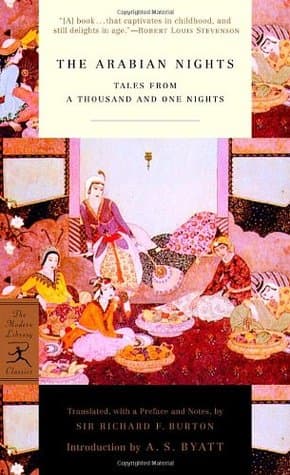
Synopsis
Covers the whole plot, including the ending.
- Difficulty
- Medium
- Pacing
- Variable
- Mood
- Enchanting, Adventurous, Mystical, Philosophical, Humorous
- Read it if
- You enjoy classic epic fantasy, intricate nested narratives, and a blend of adventure, magic, and moral fables.
- Skip it if
- You prefer modern prose, linear storytelling, or are sensitive to historical depictions that may not align with contemporary values.
The Arabian Nights Plot Summary
Covers the whole plot, including the ending.
The Frame Story: Shahrazad's Perilous Task
King Shahriyar, heartbroken by his first wife's infidelity, and further betrayed by his brother's wife, decides to marry a new virgin each night and execute her the next morning to prevent future dishonor. This practice devastates his kingdom until the Vizier's clever and brave daughter, Shahrazad, volunteers to marry the King. Despite her father's warnings, Shahrazad plans. On her wedding night, she starts to tell the King a captivating story, stopping at a suspenseful moment just before dawn. Her younger sister, Dinarzad, whom Shahrazad has instructed to wake her, helps create the impression of an eager audience, ensuring the King's curiosity is strong enough to spare Shahrazad for one more night, eager to hear the story's end.
The Merchant and the Jinni
A wealthy merchant, traveling through a desert, stops to rest and eats dates. Carelessly, he throws the date pits, one of which accidentally hits and kills the invisible son of a powerful Jinni. The Jinni, furious, appears before the terrified merchant and vows to kill him in return. The merchant pleads, explaining it was an accident, but the Jinni is firm. He gives the merchant one year to return home, settle his affairs, and say goodbye to his family, promising to meet him at the same spot for his execution. The merchant, heartbroken, returns home, makes his will, and says farewell to his loved ones before returning to face his fate.
The First Old Man and the Gazelle
As the merchant waits for his execution by the Jinni, an old man approaches with a gazelle. He sits down, and after learning of the merchant's situation, offers to tell his own story. He recounts how his wife, a sorceress, turned his first wife and children into animals out of jealousy. He later discovered her infidelity with a slave, whom she also turned into a bull. The old man, seeking justice, eventually outsmarted the sorceress, saving his family and turning her into the gazelle he now holds. The Jinni, interested by the tale, agrees to spare one-third of the merchant's life if the old man's story is amazing enough.
The Second Old Man and the Two Black Hounds
A second old man arrives with two black hounds. He tells his story of being a wealthy merchant with two envious brothers. They repeatedly tricked him, stealing his fortune and leaving him to die. Each time, he miraculously recovered and rebuilt his wealth. Finally, he discovered that his brothers had been turned into the black hounds by a sorceress, his cousin, whom he had married and who had helped him get his fortune back. He now travels with them, bound by an oath to neither harm nor reveal their true identities for ten years. The Jinni, further impressed by this story of resilience and magic, agrees to spare another third of the merchant's life.
The Third Old Man and the Mule
A third old man approaches with a mule. He shares his story of discovering his wife's affair with a slave. Instead of confronting them immediately, he pretended to be ill. His wife, a sorceress, tried to poison him. He tricked her into drinking the poison herself, which she survived due to her magic. In anger, she turned him into a dog. He eventually found a kind butcher's daughter who recognized him and, with her magical knowledge, turned him back into a man. In return, he had his wife turned into the mule he now leads. This final tale convinces the Jinni to fully pardon the merchant, who is then free to return home.
The Fisherman and the Jinni
A poor fisherman, after several unsuccessful attempts, casts his net for the fourth time and pulls up a sealed copper bottle. Upon opening it, a massive, terrifying Jinni emerges. The Jinni, imprisoned for centuries, declares he will grant the fisherman's wish to choose his method of death. The fisherman, terrified but clever, asks the Jinni how such a large being could have fit into such a small bottle, expressing disbelief. The Jinni, his pride challenged, demonstrates by shrinking himself back into the bottle. The fisherman quickly seals it, threatening to throw it back into the sea and warn others of the treacherous Jinni within. The Jinni, humbled, promises wealth and help if released.
The Tale of Aladdin and the Wonderful Lamp
Aladdin, a lazy youth, is recruited by an African sorcerer posing as his uncle. The sorcerer tricks Aladdin into retrieving an old lamp from a magical cave, but tries to trap him there. Aladdin, accidentally rubbing a magic ring given by the sorcerer, summons a lesser Jinni who helps him escape. Later, rubbing the lamp, he summons a powerful Jinni of the Lamp, who grants his every wish. Aladdin uses the lamp to gain immense wealth, build a magnificent palace, and marry Princess Badroulbadour, the Sultan's daughter. The sorcerer returns, tricks the Princess into exchanging the old lamp for a new one, and transports the palace and Princess to Africa. Aladdin, using the ring's Jinni, travels to Africa to rescue her and recover the lamp, ultimately defeating the sorcerer and his brother.
The Story of Ali Baba and the Forty Thieves
Ali Baba, a poor woodcutter, secretly watches a band of forty thieves use the magic words 'Open Sesame' to enter a hidden cave filled with treasure. After they leave, Ali Baba enters the cave, taking some gold. His rich, greedy brother, Cassim, learns of the cave and goes there, but forgets the magic words and is trapped and killed by the returning thieves. Ali Baba, with the help of his clever slave-girl Morgiana, retrieves Cassim's body and buries it. The thieves, realizing their secret is compromised, relentlessly pursue Ali Baba. Morgiana repeatedly stops their attempts to find and kill Ali Baba, culminating in her identifying and killing their leader, who had infiltrated Ali Baba's house disguised as a merchant. Ali Baba and his family then inherit the thieves' treasure.
The Voyages of Sindbad the Sailor
Sindbad, a wealthy merchant from Baghdad, tells of his seven fantastic voyages across the seas. Each voyage sees him shipwrecked or stranded in exotic, dangerous lands. He encounters giant birds (Roc), monstrous fish, cannibals, serpents, magical islands, and powerful rulers. Through resourcefulness, luck, and divine help, Sindbad repeatedly escapes death and returns home with great riches. His tales are filled with descriptions of strange creatures, precious jewels, and perilous adventures, often beginning with him losing his fortune and then regaining it through extraordinary means. He shares his stories with a poor porter named Hindbad, showing the rewards of perseverance and the wonders of the world.
The Tale of the Hunchback
A tailor, his wife, a Jewish doctor, a Christian broker, and a Muslim steward are all involved in the accidental death of a hunchback, whom they each believe they have killed. The tailor's wife chokes him with food, the doctor throws him down stairs thinking he's dead, the broker accidentally knocks him down with a stone, and the steward, thinking he's a thief, beats him. Each character, trying to dispose of the body secretly, passes it along to the next, leading to a series of escalating accusations and misunderstandings. The story unfolds as a comedic series of confessions before the Sultan, who, finding the whole affair amusing, ultimately pardons them all after hearing the full, complex truth and seeing their genuine remorse and terror.
The Young Woman and Her Five Lovers
A beautiful young woman, secretly entertaining five different lovers in her house, finds herself in a difficult situation when they all arrive at once. Through quick thinking and cunning, she manages to hide each lover from the others. She uses various excuses and disguises, moving them from room to room, under beds, and even in chests. Each time a new lover arrives, she convinces the previous one to hide, sometimes even tricking them into believing they are helping her hide from a fictional threat. Her elaborate scheme shows her intelligence and resourcefulness in navigating a complex and potentially embarrassing social situation, allowing her to escape detection and keep her secrets.
The Conclusion of the Frame Story
After 1001 nights of captivating storytelling, Shahrazad tells King Shahriyar that she has run out of tales. By this point, she has borne him three sons. More importantly, the King has been greatly changed by her stories. The bitterness and rage that drove his murderous decree have gone, replaced by admiration, love, and a renewed sense of humanity. He acknowledges her wisdom, courage, and the impact her narratives have had on him. He revokes his cruel vow, declares his love for her, and makes her his queen permanently. Shahrazad's intelligence and artistry not only saved her own life but also healed a broken king and brought peace back to his kingdom, ensuring a long and prosperous reign for them both.
The Arabian Nights Characters
Shahrazad
Protagonist
The Vizier's daughter who tells stories to save her life and her kingdom.
Shahrazad is the intelligent, courageous, and resourceful daughter of the King's Vizier. Faced with King Shahriyar's brutal decree to execute a new bride each night, she bravely volunteers to marry him. Her primary motivation is to end the cycle of violence and save the women of her kingdom. She possesses an encyclopedic knowledge of history, poetry, and literature, and a remarkable talent for storytelling, using cliffhangers to prolong her life. She is driven by a desire for justice and peace, using her intellect as her primary weapon.
Relationships: King Shahriyar (wife, storyteller, eventual beloved queen); Dinarzad (younger sister, accomplice in the storytelling scheme); The Vizier (father, initially reluctant but proud supporter)
King Shahriyar
Antagonist/Recipient of Transformation
A powerful king, driven by betrayal to a brutal decree, who is ultimately redeemed.
King Shahriyar is the powerful ruler of a vast kingdom, initially portrayed as a cruel and vengeful monarch. His heart is hardened by the discovery of his first wife's infidelity, and further embittered by his brother's similar experience. This profound betrayal leads him to a horrific decree: he will marry a new virgin every night and execute her at dawn to prevent any further dishonor. He is initially cynical and ruthless, but beneath his hardened exterior lies a capacity for change, which Shahrazad's stories gradually awaken. He represents the destructive power of unchecked grief and rage.
Relationships: Shahrazad (husband, captor, eventually beloved husband); King Shahzaman (brother, fellow victim of infidelity); His Wives (prior to Shahrazad) (victims of his decree)
Dinarzad
Supporting
Shahrazad's younger sister and crucial accomplice in the storytelling.
Dinarzad is Shahrazad's devoted younger sister. She plays a vital role in Shahrazad's plan, waking her each morning to request another installment of the previous night's story. Her presence and her apparent eagerness to hear the tales provide Shahrazad with a ready audience and a plausible reason to continue, making the King more inclined to listen. She is a loyal and observant character, essential to maintaining the illusion and the suspense that keeps Shahrazad alive night after night. Her quiet support is a testament to her sisterly bond and shared desire for the King's transformation.
Relationships: Shahrazad (younger sister, accomplice, confidante)
Aladdin
Protagonist
A lazy youth who discovers a magic lamp and rises to royalty, facing magical adversaries.
Aladdin is initially a shiftless and impoverished young man, living with his widowed mother. His life changes dramatically when he encounters an African sorcerer who tricks him into retrieving a magic lamp. Despite his initial naivety, Aladdin proves to be resourceful, brave, and ultimately, a good-hearted individual. He uses the power of the lamp's Jinni to gain wealth, marry a princess, and build a magnificent palace. His journey is one of overcoming adversity, outwitting powerful sorcerers, and proving himself worthy of his newfound status and love. He is driven by love for Princess Badroulbadour and a desire for a better life.
Relationships: Princess Badroulbadour (wife, beloved); The African Sorcerer (antagonist, false uncle); Jinni of the Lamp (servant, source of power); Jinni of the Ring (lesser servant, initial rescuer)
Ali Baba
Protagonist
A poor woodcutter who stumbles upon a thieves' treasure and must defend his family.
Ali Baba is a humble and honest woodcutter who lives a modest life. He is characterized by his cautious nature and good fortune, which leads him to discover the secret of the forty thieves' cave. Unlike his greedy brother Cassim, Ali Baba is content with a reasonable amount of wealth. He is a family man, concerned with the safety and well-being of his household. He is not a warrior, but relies on the cleverness and bravery of his slave-girl Morgiana to protect him from the relentless pursuit of the vengeful thieves, demonstrating a capacity for trust and gratitude.
Relationships: Morgiana (loyal slave-girl, protector); Cassim (greedy elder brother, victim of the thieves); The Forty Thieves (antagonists)
Morgiana
Supporting
Ali Baba's clever and brave slave-girl, who repeatedly saves him from the thieves.
Morgiana is Ali Baba's intelligent, resourceful, and fiercely loyal slave-girl. She is the true hero of 'Ali Baba and the Forty Thieves,' repeatedly outsmarting and defeating the cunning bandits who seek to harm her master. Her quick thinking and bravery are instrumental in identifying the thieves, thwarting their infiltration attempts, and ultimately killing their leader. She is perceptive, strategic, and proactive, demonstrating courage and loyalty far beyond her station. Her actions save Ali Baba's life and secure his fortune, eventually earning her freedom and marriage into the family.
Relationships: Ali Baba (master, later father-in-law, object of her loyalty); The Forty Thieves (adversaries, victims of her cunning)
Sindbad the Sailor
Protagonist
A wealthy Baghdad merchant who recounts his seven epic voyages filled with wonders and perils.
Sindbad is a wealthy merchant from Baghdad, known for his incredible and often harrowing sea voyages. He is a resilient and adventurous character, driven by a thirst for trade and discovery, though he often finds himself in peril through no fault of his own. Despite repeatedly losing his fortune and facing monstrous creatures and supernatural dangers, Sindbad always manages to survive, using his wit, courage, and a good deal of luck. He is a storyteller within the larger frame story, recounting his adventures to illustrate the unpredictable nature of fortune and the vast wonders of the world.
Relationships: Hindbad (poor porter, audience for his tales, recipient of his generosity)
The Jinni (from The Fisherman and the Jinni)
Antagonist/Supporting
A powerful, vengeful spirit imprisoned in a bottle, initially threatening but later benevolent.
This Jinni is a powerful supernatural being, imprisoned in a copper bottle for centuries by King Solomon. Upon his release by the fisherman, he is initially filled with rage and a desire for revenge against humanity, vowing to grant the fisherman's wish to choose his method of death. He is arrogant and boastful, easily tricked by the fisherman's cunning. However, once humbled and released again, he demonstrates a capacity for gratitude, leading the fisherman to a magical lake filled with unique fish, thus bringing him great wealth. He embodies both destructive power and the potential for reward.
Relationships: The Fisherman (imprisoner, later benefactor)
The African Sorcerer
Antagonist
A cunning and evil sorcerer who seeks the magic lamp for himself.
The African Sorcerer is the primary antagonist in 'Aladdin and the Wonderful Lamp.' He is a powerful magician, but also deeply malicious, cunning, and greedy. He poses as Aladdin's uncle to manipulate the boy into retrieving the magic lamp from a dangerous cave, intending to trap and kill him. His motivations are purely self-serving, driven by a desire for ultimate power and wealth. He is relentless in his pursuit of the lamp, even after being thwarted, demonstrating his unwavering ambition and malevolence.
Relationships: Aladdin (rival, intended victim); Princess Badroulbadour (victim of his kidnapping)
The Arabian Nights Themes
The Power of Storytelling and Imagination
The entire collection is framed by Shahrazad's use of storytelling to save her life and ultimately transform King Shahriyar. Her narratives are not just entertainment; they are a means of education, therapy, and social commentary. The stories themselves, such as Aladdin's adventures or Sindbad's voyages, show the boundless human imagination, taking listeners to worlds of magic, jinni, and incredible feats. This theme highlights how stories can shape perceptions, teach moral lessons, provide comfort, and even mend broken hearts, as Shahrazad's tales gradually reduce the King's bitterness and cruelty. The act of listening to and engaging with narrative becomes a transformative experience.
“And Shahrazad perceived the dawn of day and ceased to say her permitted say.”
Justice, Fate, and Divine Intervention
Many tales explore ideas of justice, often delivered by fate or divine intervention rather than human law. Characters like the merchant in 'The Merchant and the Jinni' face seemingly inescapable doom, only to be saved by a series of unexpected encounters and stories. Similarly, Ali Baba's discovery of the thieves' cave seems fated, and Morgiana's repeated successes against the thieves often seem like miraculous timing. Even the Jinni in 'The Fisherman and the Jinni' is initially a force of arbitrary vengeance, but ultimately becomes an agent of fortune. This theme suggests that while human actions have consequences, an overarching cosmic order or divine will often plays a decisive role in outcomes, ensuring that good is eventually rewarded and evil punished, though not always predictably.
“Verily, this is a marvellous thing! What then is the cause of thine weeping?”
The Struggle Between Good and Evil
This is a fundamental theme, seen in countless narratives. From Shahrazad's actions against King Shahriyar's tyranny to Aladdin's fight against the wicked sorcerer, and Ali Baba's struggle against the ruthless forty thieves, the tales consistently pit good characters against evil forces. Evil often appears as greed, jealousy, or vengeful cruelty, while good is characterized by courage, cleverness, loyalty, and compassion. Even supernatural beings like Jinni can embody both extremes. The stories often serve as moral allegories, showing that while evil may win temporarily, good, supported by wit and righteousness, ultimately prevails.
“O thou Jinni, since thou didst promise to me, if I should tell thee a story, that thou wouldst release me a third part of this merchant's blood, I will tell thee the story of myself and this gazelle.”
Social Commentary and Moral Lessons
Beyond entertainment, the tales offer sharp observations on society, human nature, and moral conduct. The 'Tale of the Hunchback' satirizes human flaws and the absurdity of circumstantial evidence, while stories of infidelity and betrayal (like those that fuel Shahriyar's rage or the origins of the three old men's companions) serve as cautionary tales. The narratives often praise virtues like generosity, loyalty (Morgiana), and perseverance (Sindbad), while condemning vices like greed (Cassim), envy, and cruelty. They provide a rich picture of medieval Islamic society, reflecting its customs, values, and ethical dilemmas, often subtly guiding the audience towards virtuous behavior through the consequences faced by characters.
“O King, I have found no pleasure in life since I killed the hunchback.”
Transformation and Redemption
Central to the frame story, Shahriyar's transformation from a vengeful tyrant to a just and loving king is the ultimate example of redemption. This idea is echoed in many other tales, where characters undergo significant changes, often as a result of magical intervention or profound experiences. The Jinni in 'The Fisherman and the Jinni' shifts from malevolence to benevolence. Characters who commit wrongs, like the sorceress wives, are often turned into animals as punishment, showing a physical manifestation of moral change. This theme suggests that individuals are capable of great personal growth and change, and that even the most hardened hearts can be softened by compassion and understanding.
“And the King said, 'I have forgiven thee, O Shahrazad, and grant thee thy life, for I have been changed by thy stories and have learned wisdom.'”
Plot Devices & Literary Techniques
Frame Story
A narrative structure where a main story encloses a series of smaller, independent tales.
The entire collection is contained within the frame story of Shahrazad telling tales to King Shahriyar. This device provides a compelling reason for the existence of the myriad stories and creates a continuous thread that binds them together. The frame story establishes the stakes (Shahrazad's life and the King's redemption) and gives context to the diverse narratives. It allows for a vast array of genres, characters, and settings to be explored while maintaining a central purpose: the transformation of the King through the power of storytelling. Each night's cliffhanger also serves as a mini-frame within the larger one.
Cliffhanger
A narrative technique where a story ends abruptly at a moment of high tension or suspense, leaving the audience eager for the resolution.
Shahrazad masterfully employs the cliffhanger at the end of each night's storytelling. Just as dawn breaks, she stops her narrative at a crucial, suspenseful moment, ensuring King Shahriyar's intense curiosity. This technique is vital to her survival, as it compels the King to spare her life for another day so he can hear the story's conclusion. It builds dramatic tension not only within the individual tales but also within the overarching frame story, demonstrating Shahrazad's narrative skill and her understanding of human psychology.
Magic and the Supernatural
The pervasive presence of supernatural elements, including jinni, sorcerers, magical objects, and transformations.
Magic is a fundamental and ubiquitous plot device throughout 'The Arabian Nights.' Jinni, both benevolent and malevolent, frequently appear to grant wishes, imprison, or punish. Sorcerers and witches wield powerful spells to transform people into animals (as seen with the old men's companions or in Aladdin's story), create illusions, or manipulate events. Magical objects, such as Aladdin's lamp and ring or the flying carpet, serve as catalysts for adventure and solutions to seemingly impossible predicaments. This device enables characters to overcome extraordinary obstacles and creates a sense of wonder and possibility, enriching the fantastical settings.
Deception and Disguise
Characters employing trickery, false identities, or hidden appearances to achieve their goals or escape danger.
Deception is a recurring element, often used by both protagonists and antagonists. Shahrazad's entire strategy is a form of benevolent deception. The African sorcerer uses a false identity as Aladdin's uncle to manipulate him. Morgiana repeatedly uses disguises and cunning ploys to outwit the forty thieves, such as marking houses or hiding in oil jars. Characters feign illness, pretend to be merchants, or hide their true intentions. This device highlights the intelligence and resourcefulness of characters, often serving as a means for the weak to overcome the strong, or for justice to be served through indirect means.
The Arabian Nights Quotes
“Know, O my brother, that I have not been able to sleep since I left you, for my heart is troubled about you.”
“Indeed, the world is a bridge; pass over it, but build no house upon it.”
“Many a small thing has been made large by the telling of it.”
“He who has no need of patience has no need of life.”
“There is no might and no power save in Allah, the High, the Great!”
“Be kind, for everyone you meet is fighting a harder battle.”
“The greatest wealth is contentment with little.”
“The first thing in love is the last thing in wisdom.”
“He who digs a pit for his brother falls into it himself.”
“The world is but a moment; spend it in obedience.”
“The pen is the tongue of the mind.”
“Trust in God, but tie your camel.”
“Sleep is the brother of death.”
“A man's worth is not in his gold, but in his good deeds.”
Quiz
10 questions on the plot and the characters. Each answer comes with a short explanation.
Question 1
What is the primary reason Shahrazad tells stories to King Shahriyar?
- To entertain the king during his leisure time.
- To prove her intelligence and wit to the court.
- To delay her execution and ultimately save her life.
- To educate the king on various moral lessons.
Show answer
C. To delay her execution and ultimately save her life. Shahrazad tells stories over a thousand and one nights, each ending on a cliffhanger, to keep King Shahriyar intrigued and delay her execution, a fate he had imposed on his previous wives.
Question 2
Which specific translation of 'The Arabian Nights' is reproduced in the 1932 Modern Library edition mentioned?
- Edward Lane's translation
- Sir Richard F. Burton's translation
- Antoine Galland's translation
- H. W. Dulcken's translation
Show answer
B. Sir Richard F. Burton's translation The provided text explicitly states that the volume reproduces 'Sir Richard F. Burton's multivolume translation'.
Question 3
Which of the following is NOT listed as a type of character or element found within the tales?
- All-powerful sorcerers
- Knights of the Round Table
- Jinns imprisoned in bottles
- Enchanting princesses
Show answer
B. Knights of the Round Table The description mentions 'all-powerful sorcerers, jinns imprisoned in bottles and enchanting princesses', but makes no mention of 'Knights of the Round Table', which are associated with Arthurian legends.
Question 4
What is the primary thematic tension described as existing within 'The Arabian Nights', despite its imaginative extravagance?
- The conflict between good and evil.
- The balance between fantasy and realism.
- The struggle between love and duty.
- The interplay of fate and free will.
Show answer
B. The balance between fantasy and realism. The text states, 'But despite their imaginative extravagance, the Tales are anchored to everyday life by their realism,' highlighting the blend of fantasy and realism as a key thematic aspect.
Question 5
According to the description, what specific historical period and culture do the Tales provide an intimate record of?
- Ancient Egyptian society.
- Byzantine Empire.
- Medieval Islam.
- Sassanian Persia.
Show answer
C. Medieval Islam. The text explicitly states that the stories provide 'a full and intimate record of medieval Islam.'
Question 6
Who was responsible for selecting the 'most famous and representative stories' for the 1932 Modern Library edition?
- Sir Richard F. Burton
- King Shahriyar
- Bennett A. Cerf
- Shahrazad
Show answer
C. Bennett A. Cerf The description specifies that 'Bennett A. Cerf chose the most famous and representative stories' for this particular edition.
Question 7
What characteristic of King Shahriyar's past actions led to Shahrazad's predicament?
- His insatiable desire for wealth.
- His practice of marrying a new wife each night and executing her the next morning.
- His tyrannical rule over his subjects.
- His constant waging of wars against neighboring kingdoms.
Show answer
B. His practice of marrying a new wife each night and executing her the next morning. The text mentions Shahrazad tells stories 'to delay her execution by the vengeful King Shahriyar,' implying a pattern of executions, which is a well-known plot point of his vengeful nature towards his wives.
Question 8
Beyond simple entertainment, what additional value do Burton's extensive notes provide to the reader of this edition?
- Simplified summaries of the more complex tales.
- Alternative endings for some of the stories.
- Explanatory context and deeper understanding of the tales.
- Biographical information about the original authors.
Show answer
C. Explanatory context and deeper understanding of the tales. The description highlights 'Burton's extensive and acclaimed explanatory notes,' indicating their purpose is to provide context and explanation, enriching the reader's understanding.
Question 9
How does the tale 'The Tale of the Hunchback' specifically contribute to the overall depiction of the fabulous world within 'The Arabian Nights'?
- It showcases the power of all-powerful sorcerers.
- It exemplifies the farcical elements and social criticism present in the collection.
- It features a prominent jinn imprisoned in a bottle.
- It primarily focuses on the romantic adventures of an enchanting princess.
Show answer
B. It exemplifies the farcical elements and social criticism present in the collection. The text specifically mentions 'the farcical 'Young Woman and her Five Lovers' and the social criticism of 'The Tale of the Hunchback'', directly linking this tale to social commentary.
Question 10
What is the implied consequence for Shahrazad if she were to run out of stories or fail to keep King Shahriyar engaged?
- She would be banished from the kingdom.
- She would be forced to marry another king.
- She would face the same fate as the king's previous wives.
- She would lose her position as royal storyteller.
Show answer
C. She would face the same fate as the king's previous wives. Shahrazad tells stories 'to delay her execution by the vengeful King Shahriyar'. The implication is that if her storytelling fails to delay him, she would suffer the execution that his previous wives endured.
The Arabian Nights FAQ
What is the central premise of 'The Arabian Nights' and why does Shahrazad tell these stories?
The central premise revolves around King Shahriyar, who, after discovering his first wife's infidelity, executes a new bride each morning. Shahrazad, the vizier's daughter, volunteers to marry him and begins telling him captivating stories, ending each night on a cliffhanger to delay her execution and ultimately cure the king of his murderous rage.
Who are some of the most famous characters introduced in the stories Shahrazad tells?
Shahrazad's tales introduce an array of iconic characters. These include Aladdin, who discovers a magical lamp with a powerful Jinn; Sindbad the Sailor, known for his seven epic voyages; and Ali Baba, who outsmarts forty thieves to claim their treasure. Each character faces unique challenges and encounters fantastical elements.
How does the framing device of Shahrazad's storytelling contribute to the overall narrative structure?
The framing device of Shahrazad telling stories to King Shahriyar is crucial. It creates a nested narrative, where stories often contain other stories within them, showcasing the depth and complexity of the oral tradition. This structure also highlights the power of storytelling as a tool for persuasion, education, and even survival.
What kind of world do the stories depict, beyond just magic and adventure?
Beyond the magic and adventure, the stories depict a vibrant and detailed world of medieval Islam. They offer insights into daily life, social customs, legal systems, and moral values of the period. This realism, as noted by Sir Richard F. Burton, grounds the imaginative extravagance in relatable human experiences.
How does Sir Richard F. Burton's translation contribute to the understanding and reception of 'The Arabian Nights'?
Sir Richard F. Burton's translation is highly acclaimed for its scholarly depth and extensive explanatory notes. His work not only translated the tales but also provided crucial cultural, historical, and linguistic context, allowing Western readers to gain a more nuanced and intimate understanding of medieval Islamic society and the intricacies of the stories.
What is the significance of the 'one thousand and one nights' in the title?
The 'one thousand and one nights' signifies the immense duration of Shahrazad's storytelling and its cumulative effect. It's a symbolic number representing an indefinite, vast period, emphasizing the relentless effort and patience required to transform King Shahriyar. The number itself has mystical connotations in various cultures.
Are there recurring themes or motifs that connect seemingly disparate stories like 'Aladdin' and 'The Tale of the Hunchback'?
Despite their different plots, many stories share themes of justice, fate, morality, and the consequences of one's actions. For instance, both 'Aladdin' and 'The Tale of the Hunchback' explore how characters overcome adversity and the role of chance or divine intervention in their lives, often with a moral lesson embedded.
How do the 'jinns imprisoned in bottles' or 'all-powerful sorcerers' reflect deeper societal anxieties or beliefs of the time?
The jinns and sorcerers often embody uncontrolled power, both benevolent and malevolent, reflecting societal anxieties about unseen forces and the capriciousness of fate. They also represent external forces that can drastically alter human lives, highlighting the vulnerability of individuals in a world where magic and destiny held significant sway in popular belief.
What role does humor play in the tales, particularly in stories like 'The Young Woman and her Five Lovers'?
Humor, often farcical or satirical, serves as a crucial element, providing comic relief and often as a vehicle for social commentary. In 'The Young Woman and her Five Lovers,' the humor arises from the absurd situations and clever deceptions, subtly critiquing societal norms around love, marriage, and moral conduct, while entertaining the audience.
How does Shahrazad's psychological strategy evolve over the thousand and one nights?
Shahrazad's psychological strategy evolves from merely delaying her execution to actively rehabilitating King Shahriyar. She carefully selects stories that subtly address his trauma, explore themes of fidelity and betrayal from various perspectives, and gradually reintroduce him to compassion and justice, ultimately transforming his character.
What psychological impact does King Shahriyar's initial trauma have on his behavior, and how do the stories address it?
King Shahriyar's initial trauma of discovering his first wife's infidelity leads to extreme paranoia and a pathological need for control, manifesting in his murderous decree. Shahrazad's stories indirectly address this by presenting diverse examples of human nature, loyalty, deception, and forgiveness, slowly eroding his cynicism and fear.
How do the tales explore the psychology of power and its corrupting influence?
Many tales, such as those involving kings, viziers, and sorcerers, explore the psychology of power. They depict how absolute power can corrupt, leading to tyranny, injustice, or isolation, as seen in Shahriyar's initial state. Conversely, they also show how power can be wielded benevolently, leading to prosperity and wisdom, offering contrasting perspectives.
What psychological lessons can be drawn from the resilience and resourcefulness of characters like Sindbad or Ali Baba?
Characters like Sindbad and Ali Baba demonstrate remarkable resilience, resourcefulness, and adaptability in the face of extreme danger and adversity. Their stories highlight the psychological importance of courage, quick thinking, and perseverance, suggesting that ingenuity and a strong will are essential for survival and success in a perilous world.
Is Shahrazad a feminist figure, given her agency and intellectual prowess in a patriarchal society?
Shahrazad can be interpreted as a proto-feminist figure. She uses her intellect, courage, and storytelling skill to challenge a patriarchal system of violence and subjugation. She not only saves herself but also countless other women, demonstrating remarkable agency and transforming a tyrannical ruler through non-violent means.
How does the book balance its fantastical elements with its 'realism' and 'social criticism'?
The book masterfully balances fantasy with realism and social criticism by grounding its magical adventures in relatable human experiences and societal issues. While jinns and flying carpets abound, the characters still grapple with poverty, injustice, love, and betrayal, allowing the fantastical elements to amplify the moral and social critiques rather than overshadow them.
To what extent is 'The Arabian Nights' a collection of moral fables versus pure entertainment?
'The Arabian Nights' serves as both moral fables and pure entertainment. While many stories contain explicit moral lessons about honesty, justice, and piety, others prioritize adventure, humor, and exotic escapism. The dual nature allows the collection to appeal to a broad audience, offering both didacticism and delight.
How might the depiction of 'medieval Islam' in the tales differ from historical reality, and why is this significant?
While the tales provide an 'intimate record' of medieval Islam, they are ultimately works of fiction and may romanticize or idealize certain aspects. The significance lies in how they shaped popular perception and cultural memory, creating a rich, albeit sometimes embellished, tapestry of the era that emphasized its grandeur, wisdom, and moral complexities.
What is the lasting legacy of 'The Arabian Nights' on global literature and popular culture?
The lasting legacy of 'The Arabian Nights' is immense, profoundly influencing global literature, film, and popular culture. Its iconic characters, magical motifs, and narrative structures have been reinterpreted countless times across various media, solidifying its place as a foundational text for fantasy, adventure, and storytelling itself, inspiring generations of creators.
About the author

Anonymous may refer to:Anonymity, the state of an individual's identity, or personally identifiable information, being publicly unknown Anonymous work, a work of art or literature that has an unnamed or unknown creator or author Anonymity, a property of a voting rule, saying that it does not discriminate apriori between voters
Similar books
- One Hundred Years of Solitude
Gabriel García Márquez
4.1 (753k) average on GoodreadsLiterary FictionBoth feature sprawling narratives, magical realism, and a sense of timeless storytelling.
- The Decameron
Giovanni Boccaccio
3.9 (33k) average on GoodreadsHistorical FictionBoth use a frame story where characters tell a series of diverse tales to pass the time.
- Harry Potter and the Sorcerer's Stone
J.K. Rowling
4.5 (7M) average on GoodreadsFantasyRescued from a miserable life under the stairs, an orphaned boy discovers he's a wizard destined for a magical school, where he uncovers a dangerous secret tied to the dark wizard who murdered his parents.
- The Hunger Games
Suzanne Collins
4.3 (6.4M) average on GoodreadsFantasyIn a future where children fight to the death on live television, Katniss Everdeen volunteers for the arena, turning a death sentence into a fight for survival and a spark of rebellion.
- 1984
George Orwell
4.2 (3.1M) average on GoodreadsPoliticsIn a future where surveillance and thought control are absolute, a man's search for truth clashes with the Party, showing that hope can be a form of rebellion.
- Divergent
Veronica Roth
4.2 (2.9M) average on GoodreadsFantasyIn a society divided by virtues, a sixteen-year-old's difference from the norm starts a rebellion that threatens her world.





Enjoyed the summary?
A summary gives you the shape of the book. The book itself has the detail, the examples and the voice.
Find The Arabian Nights on AmazonAs an Amazon Associate, BookBrief earns from qualifying purchases. How we're funded