
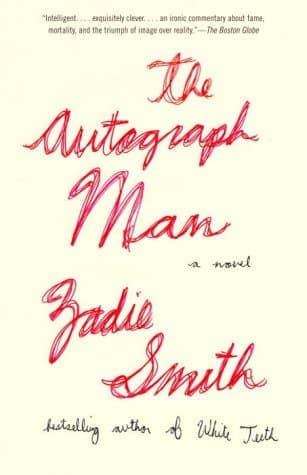
Synopsis
Covers the whole plot, including the ending.
- Difficulty
- Medium
- Pacing
- Variable
- Mood
- Satirical, Philosophical, Witty, Existential, Cynical
- Read it if
- You enjoy satirical literary fiction that explores themes of celebrity, identity, and the search for meaning in modern society, with a witty and philosophical edge.
- Skip it if
- You prefer straightforward plots, clear resolutions, or dislike philosophical meandering and a cynical view of contemporary culture.
The Autograph Man Plot Summary
Covers the whole plot, including the ending.
The Autograph Business and the Search for Kitty Alexander
Alex-Li Tandem, a young Jewish-Chinese man in London, works as an autograph dealer, a trade he inherited from his deceased father. His life shows cynicism, intellectual pretensions, and a deep desire for meaning. He is particularly interested in the reclusive 1940s Hollywood actress, Kitty Alexander, whose autograph he wants. Alex spends his days at autograph conventions, faking signatures, and dealing with his eccentric friends and customers, all while grieving his father's recent death. His girlfriend, Esther, struggles to connect with him due to his emotional distance and focus on the past and celebrity culture.
Alex's Past and the Loss of His Father
The story often goes back to Alex's childhood, especially his relationship with his father, Adam. Adam, a charming but flawed man, gave Alex a love for collecting and a peculiar worldview, often involving obscure philosophical ideas and a flair for the dramatic. The flashbacks show that Adam died from a sudden heart attack while watching a boxing match. This event traumatized Alex and left him with unresolved grief and a feeling of abandonment. These memories explain Alex's current emotional stagnation and his struggle to move beyond his father's influence, fueling his search for external validation through autographs and celebrity.
The Friendship of Alex, Joseph, and Ruben
Alex's closest friends are Joseph, a devout Orthodox Jew who is a rabbi, and Ruben, a more pleasure-seeking and less religious person. Their friendship is a mix of different ideas: Alex's cynical secularism, Joseph's strong faith, and Ruben's pursuit of pleasure. They grew up together in a small, close-knit Jewish community in North London, and their shared history is marked by inside jokes, intellectual arguments, and unspoken tensions. Joseph often tries to guide Alex toward a more spiritual path, while Ruben encourages Alex's more impulsive actions. These interactions show Alex's inner conflict between tradition and modernity, belief and skepticism.
The Quest for Kitty Alexander Intensifies
Driven by his desire to get Kitty Alexander's autograph, Alex decides to travel to New York City, believing she lives there. This trip is prompted by a tip from another autograph dealer and a deep belief that meeting Kitty will solve his existential problems. He sees Kitty not just as a celebrity, but as a symbol of a lost era, a connection to a perceived authenticity that he feels is missing in his own life. His trip to New York becomes a symbolic journey, a desperate attempt to fill the void left by his father's death and his general dissatisfaction.
New York Encounters and Disillusionment
In New York, Alex meets several characters and situations that slowly change his romantic view of celebrity. He meets other autograph hunters, some more ruthless and cynical than he, and experiences the superficiality and commercialism of the autograph world firsthand. He also deals with loneliness and feeling out of place in the busy city. His initial excitement gives way to a growing sense of disappointment as his quest proves more challenging and less fulfilling than he had imagined. The reality of his search begins to conflict with the idealized image he had of Kitty Alexander and the meaning her autograph would bring.
Meeting Kitty Alexander: The Anti-Climax
Through luck and persistence, Alex finally finds Kitty Alexander. However, the encounter is not the transcendent experience he expected. He finds her to be a very old, frail, and somewhat confused woman, living in a modest apartment. She is nothing like the glamorous, enigmatic figure he had imagined. The meeting is brief and awkward, and Kitty seems indifferent to her past fame and the importance Alex places on her. This anti-climax forces Alex to confront the stark difference between his idealized fantasy and the mundane reality of his idol, shattering his illusions.
The Aftermath of the Encounter
After meeting Kitty, Alex feels empty and disoriented. The object of his lifelong obsession is an ordinary, aging woman, and her autograph, which he gets, now feels meaningless. The encounter removes his main source of external validation and forces him to confront the emptiness within himself. He questions the value of celebrity, the nature of authenticity, and the purpose of his own life. This moment marks a turning point, where Alex must look inward rather than outward for answers, beginning a painful process of self-reflection and re-evaluation.
Return to London and Reconnecting with Esther
Alex returns to London, carrying his disappointment. He is at a crossroads, unsure of his future or the direction of his autograph business. He tries to reconnect with Esther, who has grown increasingly frustrated with his emotional unavailability and his obsession with Kitty Alexander. Their relationship is strained, but the experience in New York has softened Alex, making him more open and vulnerable. He starts to realize the importance of genuine human connection over the pursuit of fleeting celebrity and begins to make small efforts to be present in his life and with Esther.
The Search for Meaning Beyond Celebrity
The lessons learned from his search for Kitty Alexander slowly appear in Alex's life. He starts to see the autograph business and the pursuit of fame for what it is: a hollow effort that offers no real spiritual or emotional fulfillment. He thinks about his father's legacy, not just in collecting, but in the deeper philosophical questions his father asked. Alex begins to explore alternative paths, considering how he might find meaning in his own life, perhaps through his relationships, his heritage, or even a new profession, rather than through the reflected glory of others.
Reconciliation and a Glimmer of Hope
As the novel ends, Alex makes progress toward reconciling with his past and embracing a more authentic future. He begins to understand the complexities of his relationship with his father and the role of his Jewish heritage in his identity. While not a complete transformation, there is a clear shift in his perspective. He starts to value the tangible connections in his life, particularly with Esther, over the abstract pursuit of celebrity. The ending suggests a hopeful, if uncertain, future for Alex, where he is more grounded in reality and open to finding meaning in the ordinary rather than the extraordinary.
The Autograph Man Characters
Alex-Li Tandem
Protagonist
A cynical, intellectual, and emotionally stunted autograph dealer obsessed with celebrity.
Alex-Li is a young, mixed-race (Jewish-Chinese) man who inherits his father's autograph business. He is deeply intelligent but uses his intellect to rationalize his emotional detachment and cynicism. Haunted by the death of his father, Adam, Alex seeks meaning and authenticity through the pursuit of celebrity, particularly the reclusive actress Kitty Alexander. He struggles with his identity, his heritage, and his relationships, often retreating into a world of trivia and philosophical musings to avoid confronting his own grief and insecurities.
Relationships: Adam Tandem (Deceased father, a complex figure who shaped Alex's worldview and left him with unresolved grief.); Esther (Girlfriend, a supportive but increasingly frustrated partner who longs for Alex's emotional presence.); Joseph (Childhood friend and rabbi, a moral and spiritual counterpoint to Alex's cynicism.); Ruben (Childhood friend, a more hedonistic and less religious figure who shares Alex's past.); Kitty Alexander (The object of Alex's obsession, a reclusive 1940s Hollywood actress who represents an idealized past.)
Adam Tandem
Supporting/Mentioned
Alex's deceased father, a charismatic and philosophical, yet flawed, figure.
Adam Tandem is Alex's father, who died suddenly from a heart attack. He is presented through Alex's flashbacks as a charismatic, intelligent, and somewhat eccentric man who ran the autograph business before Alex. Adam instilled in Alex a love for collecting, an appreciation for obscure knowledge, and a complex, often cynical, worldview. Despite his charm, he was also emotionally distant and left Alex with a profound sense of loss and unresolved issues, heavily influencing Alex's preoccupation with celebrity and the past.
Relationships: Alex-Li Tandem (Son, whose life is deeply shaped by Adam's presence and absence.)
Esther
Supporting
Alex's patient but increasingly frustrated girlfriend.
Esther is Alex's girlfriend, a grounded and emotionally available woman who struggles to connect with Alex due to his emotional distance and obsession with Kitty Alexander. She represents the possibility of genuine human connection and a normal, fulfilling life, often contrasting with Alex's escapist tendencies. While she loves Alex, her patience wears thin as he remains fixated on external pursuits rather than investing in their relationship.
Relationships: Alex-Li Tandem (Boyfriend, with a strained relationship due to Alex's emotional unavailability.)
Joseph
Supporting
Alex's devout Orthodox Jewish childhood friend and a rabbi.
Joseph is one of Alex's oldest friends, a devout Orthodox Jew who has become a rabbi. He serves as a moral and spiritual counterpoint to Alex's cynicism and secularism, often trying to guide Alex towards faith and tradition. Their friendship is marked by intellectual debates and a deep-seated bond forged in childhood. Joseph represents the pull of religious heritage and community, offering Alex an alternative path to meaning than celebrity culture.
Relationships: Alex-Li Tandem (Childhood friend, intellectual sparring partner, and spiritual guide.)
Ruben
Supporting
Alex's childhood friend, a more hedonistic and less religious figure.
Ruben is Alex's other childhood friend, sharing a similar background to Joseph and Alex but embracing a more hedonistic and less overtly religious lifestyle. He is often seen pursuing pleasure and is less burdened by the existential anxieties that plague Alex and Joseph. Ruben provides a contrast to both Alex's intellectualism and Joseph's piety, representing a more carefree, albeit sometimes superficial, approach to life. He provides comic relief and a different perspective within their trio.
Relationships: Alex-Li Tandem (Childhood friend, a more pleasure-seeking companion.)
Kitty Alexander
Supporting
A reclusive 1940s Hollywood actress, the object of Alex's lifelong obsession.
Kitty Alexander is the legendary, reclusive Hollywood actress whose autograph Alex-Li Tandem obsessively seeks. For Alex, she represents an idealized past, a connection to authenticity, and a symbol of the meaning he believes is missing from his life. Her image is built up through old movies and fan lore, creating an almost mythical figure in Alex's mind. When he finally meets her, she is revealed to be a frail, elderly woman, far removed from her glamorous past, challenging Alex's romanticized notions of celebrity.
Relationships: Alex-Li Tandem (The object of his intense, almost spiritual, quest.)
Ike Stig
Supporting/Mentioned
A rival autograph dealer and a source of information about Kitty Alexander.
Ike Stig is another autograph dealer, often a rival or competitor to Alex. He is a more seasoned and cynical figure in the autograph world, providing Alex with a tip about Kitty Alexander's whereabouts in New York. Ike represents the more cutthroat and commercial aspects of the autograph business, contrasting with Alex's more philosophical, albeit still commercial, approach. He is a minor character but instrumental in propelling Alex's journey.
Relationships: Alex-Li Tandem (Fellow autograph dealer, sometimes a rival, sometimes a source of information.)
Adam's Mother (Alex's Grandmother)
Mentioned
A figure representing the older generation and Jewish tradition.
Alex's grandmother is a recurring presence in flashbacks and Alex's thoughts, embodying the traditional Jewish matriarch. She represents the deep roots of Alex's heritage and the expectations of his community. Her presence often highlights the generational and cultural gaps within Alex's family, particularly concerning his father's more unconventional path and Alex's own struggles with faith and identity. She is a symbol of continuity and tradition.
Relationships: Alex-Li Tandem (Grandmother, a representation of his Jewish heritage and family expectations.)
The Autograph Man Themes
The Cult of Celebrity and Authenticity
The novel examines society's obsession with celebrity and the often-empty pursuit of fame. Alex-Li's life centers on collecting signatures, believing these papers hold a fragment of the 'authentic' individual. His disappointment upon meeting the frail, ordinary Kitty Alexander shatters this illusion, showing that celebrity is a constructed image. True authenticity must be found within oneself rather than through external idols. The novel suggests that the desire for celebrity is often a substitute for deeper spiritual or existential longings, as seen in Alex's quest to fill the void left by his father.
“What does a signature mean? It means 'I was here.'”
Grief, Loss, and the Search for Meaning
Alex's journey is rooted in his unresolved grief over his father's sudden death. His obsession with Kitty Alexander and his intellectual pursuits are partly a coping mechanism and a way to avoid confronting his emotional pain. The novel explores how individuals deal with loss, often seeking external distractions or idealized figures to fill the void. Alex's eventual realization that his search for Kitty was an attempt to find a stand-in for his father, and for a deeper meaning in life, is central to his character development. The book suggests that true healing comes from processing grief and finding meaning in present-day relationships.
“He knew that the dead don't care about the living. But he couldn't help but care about the dead.”
Identity, Heritage, and Belonging
Alex's mixed heritage (Jewish-Chinese) and his upbringing in a specific Jewish community form a significant background to his identity crisis. He deals with the expectations of his heritage, the pull of religious tradition (represented by Joseph), and his own secular, cynical worldview. The novel explores the tension between tradition and modernity, and how individuals form their identities in a fragmented, globalized world. Alex's journey is also about understanding his place within his family's legacy and finding a sense of belonging that does not depend on external validation or the reflected glory of others.
“He was an expert at being somewhere else, at being someone else.”
The Nature of Memory and Nostalgia
Memory and nostalgia are important in shaping Alex's view of the world. He constantly revisits his childhood, especially his relationship with his father, and idealizes the past, symbolized by Kitty Alexander and the golden age of Hollywood. The novel explores how memory can be both a comfort and a trap, preventing individuals from living in the present. Alex's journey forces him to distinguish between authentic memories and idealized nostalgia, leading him to a more realistic understanding of his past and the people in it.
“The past was a foreign country, but he had a visa.”
Plot Devices & Literary Techniques
Flashbacks
Non-linear narrative jumps to Alex's childhood and his father's life.
Flashbacks are extensively used to reveal Alex's past, particularly his relationship with his deceased father, Adam. These non-linear narrative segments illuminate the origins of Alex's obsessions, his intellectual leanings, and his unresolved grief. They provide crucial context for his present-day emotional stagnation and his search for meaning, showing how his father's life and death profoundly shaped his identity and worldview. The flashbacks gradually unfold the complexities of Adam's character and the impact he had on Alex, making his current quest more understandable.
Symbolism of Autographs
Autographs represent authenticity, connection, and the pursuit of fame.
Autographs serve as the central symbolic motif in the novel. Initially, they represent authenticity, a tangible connection to a celebrated individual, and a form of immortality. For Alex, they are a means to access a perceived 'realness' missing in his own life. However, as the story progresses, their symbolic meaning shifts. The act of faking autographs highlights their inherent superficiality, and Alex's disillusionment with Kitty Alexander reveals that these 'symbols' are ultimately empty, failing to provide the genuine connection or meaning he seeks. They become a symbol of hollow consumerism and the illusion of fame.
The Quest/Pilgrimage
Alex's journey to New York to find Kitty Alexander as a spiritual and existential quest.
Alex's journey to New York in pursuit of Kitty Alexander functions as a modern-day quest or pilgrimage. He imbues this physical journey with deep spiritual and existential significance, believing that finding Kitty will somehow provide answers to his life's big questions and fill the void left by his father. The quest narrative allows for a series of encounters and challenges that test Alex's beliefs and ultimately lead to his disillusionment, forcing him to confront the true nature of his desires and the emptiness of his external pursuits. It's a journey of self-discovery disguised as a search for celebrity.
Intertextuality and Allusion
References to philosophy, cinema, literature, and Jewish texts.
The novel is rich with intertextuality and allusions, drawing from a wide range of sources including philosophy (e.g., Martin Buber, Emmanuel Levinas), classic Hollywood cinema, literature, and Jewish religious texts. These allusions serve to deepen the intellectual landscape of the novel, reflecting Alex's own erudition and his tendency to intellectualize his emotional struggles. They also highlight the novel's themes of identity, tradition, and the search for meaning in a world saturated with information and cultural references, often contrasting high culture with popular celebrity culture.
The Autograph Man Quotes
“There are some people who, if they don’t already know, you can’t tell.”
“The past is a foreign country; they do things differently there. But it's also your home.”
“You can't buy happiness, but you can buy a private jet and fly to where it is.”
“Everyone wants to be a legend, but no one wants to do the work.”
“To be truly modern is to know that modernity is a lie.”
“There's nothing more dangerous than a man who knows what he wants and has no idea how to get it.”
“We are all collectors of something, even if it's just regret.”
“Fame is a mirror, not a window.”
“The trick is to want what you get, not to get what you want.”
“Every generation imagines itself to be more intelligent than the one that went before it, and wiser than the one that comes after it.”
“The world is full of people who are trying to find themselves, and they're all looking in the wrong places.”
“Memory is a kind of author, and some authors are more reliable than others.”
“To be truly free, you have to give up the idea of being free.”
“The greatest trick the devil ever pulled was convincing the world he didn't exist. The greatest trick the internet ever pulled was convincing the world it was real.”
Quiz
10 questions on the plot and the characters. Each answer comes with a short explanation.
Question 1
What is Alex-Li Tandem's primary occupation?
- He is a film critic.
- He sells and fakes autographs.
- He works as a private investigator.
- He manages a celebrity fan club.
Show answer
B. He sells and fakes autographs. Alex-Li Tandem's business involves hunting for, collecting, selling, and occasionally faking autographs.
Question 2
Which specific rare autograph is Alex-Li most desperately seeking?
- Marilyn Monroe
- Charlie Chaplin
- Kitty Alexander
- Humphrey Bogart
Show answer
C. Kitty Alexander Alex-Li's ultimate quest is to obtain the rare autograph of forties movie actress Kitty Alexander.
Question 3
What is one of Alex-Li's personal desires, as mentioned in the book description?
- To become a famous actor.
- To end religion.
- To open a restaurant.
- To travel the world.
Show answer
B. To end religion. Among Alex-Li's many desires are 'the return of his father, the end of religion, something for his headache, three different girls, infinite grace, and the rare autograph of forties movie actress Kitty Alexander.'
Question 4
The book's description suggests it explores 'the ugly triumph of symbol over experience.' What does this theme primarily critique?
- The decline of traditional art forms.
- The superficiality of celebrity and modernity.
- The rise of digital communication.
- The power of political propaganda.
Show answer
B. The superficiality of celebrity and modernity. The description states the book is 'an existential tour around the hollow trappings of modernity: celebrity, cinema, and the ugly triumph of symbol over experience,' indicating a critique of superficiality.
Question 5
What is the primary motivation for Alex-Li to engage in his autograph business, beyond personal gain?
- To fund his own acting career.
- To connect people with a 'little piece of Fame'.
- To expose the fakes in the celebrity world.
- To document the history of cinema.
Show answer
B. To connect people with a 'little piece of Fame'. His business is 'to hunt for names on paper, collect them, sell them, and occasionally fake them—all to give the people what they want: a little piece of Fame.'
Question 6
The novel is described as 'a deeply funny existential tour.' What does 'existential' imply about the book's underlying concerns?
- It focuses on the meaninglessness of human existence and the search for purpose.
- It features characters who are philosophers or theologians.
- It primarily explores the history of philosophy.
- It is set in a post-apocalyptic world.
Show answer
A. It focuses on the meaninglessness of human existence and the search for purpose. Existentialism in literature often deals with the nature of human existence, freedom, responsibility, and the search for meaning in a seemingly meaningless world, which aligns with the 'hollow trappings of modernity' theme.
Question 7
What specific item does Alex-Li desire alongside his quest for Kitty Alexander's autograph?
- A new car
- A gourmet meal
- Fries
- A vintage film projector
Show answer
C. Fries The description humorously concludes with Alex-Li's desires: '...and the rare autograph of forties movie actress Kitty Alexander. With fries.'
Question 8
How does Alex-Li's profession of selling autographs relate to the novel's overarching critique of modernity?
- It highlights the economic struggles of small business owners.
- It symbolizes the pursuit of superficial connection and the commodification of identity in a celebrity-obsessed culture.
- It demonstrates the enduring value of historical artifacts.
- It explores the ethical dilemmas of forgery in the art world.
Show answer
B. It symbolizes the pursuit of superficial connection and the commodification of identity in a celebrity-obsessed culture. His business directly ties into the themes of 'celebrity, cinema, and the ugly triumph of symbol over experience,' showing how people seek meaning and connection through the 'hollow trappings' of fame.
Question 9
The phrase 'what does Alex want? Only the return of his father...' suggests a significant underlying motivation. What does this imply about Alex-Li's character beyond his stated desires?
- He is primarily driven by financial insecurity.
- He harbors a deep personal longing for resolution or connection related to his past.
- He is a purely materialistic character, seeking only tangible gains.
- His primary goal is to escape his current life.
Show answer
B. He harbors a deep personal longing for resolution or connection related to his past. The longing for his father's return points to a deeper emotional void or unresolved personal history, suggesting that his more whimsical desires might be a distraction from this fundamental need.
Question 10
How does the author Zadie Smith use the character of Alex-Li Tandem to explore the 'hollow trappings of modernity'?
- Alex-Li is an unwitting victim of modern society, unable to see its flaws.
- Alex-Li embodies and actively participates in these trappings, making him a lens through which their superficiality is revealed.
- Alex-Li serves as a moral guide, leading other characters away from modernity's pitfalls.
- Alex-Li is a historical figure who critiques modernity from a past perspective.
Show answer
B. Alex-Li embodies and actively participates in these trappings, making him a lens through which their superficiality is revealed. Alex-Li is deeply embedded in the world of celebrity and symbols through his autograph business and his personal quest for Kitty Alexander's autograph, making him a prime example of someone seeking meaning within these very 'hollow trappings.'
The Autograph Man FAQ
What is the central premise of 'The Autograph Man'?
'The Autograph Man' follows Alex-Li Tandem, a Jewish-Chinese autograph dealer in London, as he grapples with his identity, his deceased father's legacy, and his obsession with collecting. The narrative revolves around his quest for the elusive autograph of 1940s movie star Kitty Alexander, which he believes holds the key to understanding his past and achieving some form of personal salvation.
Who is Kitty Alexander and why is she so important to Alex-Li?
Kitty Alexander is a reclusive, semi-forgotten Hollywood actress from the 1940s whose autograph becomes Alex-Li's ultimate prize. She represents a bygone era of authentic celebrity and glamour, a stark contrast to the superficial fame Alex-Li usually deals in. For Alex-Li, obtaining her autograph is not just a business transaction but a deeply personal quest, symbolizing a search for authenticity and a connection to something pure and untainted by modernity.
What role does Alex-Li's heritage play in the story?
Alex-Li's dual Jewish and Chinese heritage is a significant element, contributing to his sense of being an outsider and his struggle with identity. He feels disconnected from both cultures, often using humor and cynicism to navigate his confusion. His upbringing in a Jewish community, particularly his relationship with his Rabbi, contrasts with his fascination for Western pop culture and celebrity worship, highlighting his internal conflict.
Who are the key supporting characters in Alex-Li's life?
Key supporting characters include Alex-Li's childhood friends, the devout Joseph and the more worldly Adam, who represent different paths his life could have taken. Esther, his on-again, off-again girlfriend, provides a grounding presence but also highlights his commitment issues. His deceased father, a former wrestler, looms large in his memory, influencing many of Alex-Li's decisions and anxieties.
How does the novel explore the concept of celebrity?
The novel critiques modern celebrity culture, contrasting the manufactured fame Alex-Li traffics in with the more enduring, almost mythical status of figures like Kitty Alexander. It delves into the transactional nature of fame, where symbols and signatures replace genuine connection, and explores the emptiness that can come from pursuing these superficial markers of success and recognition.
What is the significance of the recurring motif of 'the gap' or 'the space between'?
The 'gap' or 'space between' is a recurring motif that symbolizes Alex-Li's existential angst and his inability to connect authentically. It refers to the distance between people, between symbol and experience, and between past and present. Alex-Li often feels this gap in his relationships, his heritage, and his understanding of the world, contributing to his sense of alienation and his constant search for meaning.
Are there any hidden references to Zadie Smith's other works or literary influences?
While not explicitly stated, Zadie Smith's exploration of multicultural London, identity, and the complexities of human connection echoes themes in 'White Teeth.' The novel also subtly references various philosophical and literary ideas, from existentialism to post-modern critiques of consumerism and authenticity, reflecting Smith's broad intellectual engagement.
What is the role of the 'Autograph Man' comic book within the novel?
The 'Autograph Man' comic book, created by Alex-Li's friends, serves as a meta-commentary on Alex-Li's life and the themes of the novel itself. It's a fictionalized, often exaggerated, portrayal of his adventures and obsessions, blurring the lines between reality and fabrication, much like the autographs Alex-Li deals in. It highlights the performative aspect of identity and the way stories are constructed.
How does Alex-Li's relationship with his father, despite his father's death, continue to influence him?
Alex-Li's deceased father, a wrestler named 'The Kid,' is a powerful, almost mythical figure in Alex-Li's memory, representing a lost sense of strength and authenticity. Alex-Li constantly measures himself against his father's perceived masculinity and moral fortitude, leading to feelings of inadequacy. His quest for Kitty Alexander's autograph is, in part, a subconscious attempt to reconcile with his father's memory and find a similar sense of purpose or identity.
What psychological defense mechanisms does Alex-Li employ throughout the novel?
Alex-Li frequently uses humor, cynicism, and intellectualization as defense mechanisms to avoid genuine emotional engagement and confront his anxieties. He often retreats into pop culture references and philosophical musings rather than directly addressing his feelings of loss, inadequacy, and confusion about his identity. His obsession with autographs can also be seen as a form of displacement, focusing on external objects rather than internal turmoil.
How does Alex-Li's search for Kitty Alexander represent a deeper psychological need?
Alex-Li's relentless pursuit of Kitty Alexander's autograph transcends mere collecting; it represents a profound psychological need for authenticity, meaning, and perhaps a surrogate parental figure. He projects onto Kitty a purity and truth that he feels is missing from his own life and the modern world. Obtaining her autograph is an attempt to fill an existential void and find a tangible connection to a more 'real' past.
In what ways does Alex-Li struggle with intimacy and genuine connection?
Alex-Li struggles significantly with intimacy, evident in his on-again, off-again relationship with Esther and his general inability to form deep, lasting bonds. He often prioritizes his obsessions and intellectual pursuits over emotional closeness, and his cynicism acts as a barrier. He seems to prefer the mediated connection of celebrity artifacts to the messy reality of human relationships, highlighting his fear of vulnerability.
Does Alex-Li achieve any form of personal growth or resolution by the end of the novel?
The novel offers a nuanced view of Alex-Li's growth. While he doesn't undergo a dramatic transformation, there are subtle shifts in his perspective and a nascent understanding of the emptiness of his obsessions. His journey with Kitty Alexander, though not providing the answers he sought, forces him to confront his illusions. The ending suggests a tentative step towards self-acceptance and a more grounded existence, rather than a definitive resolution.
How does the novel challenge traditional notions of identity?
'The Autograph Man' challenges traditional notions of identity by presenting Alex-Li as a composite of conflicting cultural heritages, obsessions, and anxieties. His identity is not fixed but constantly in flux, influenced by media, memory, and his search for external validation. The novel suggests that identity in the modern world is often constructed and fragmented, rather than singular and inherent.
What is the book's overall message about authenticity in a celebrity-driven world?
The book suggests that true authenticity is increasingly elusive in a world saturated with celebrity and symbols. It critiques the way modern society prioritizes superficial markers of success and fame over genuine experience and connection. While it doesn't offer easy answers, it implies that authenticity might be found not in external objects or famous names, but in a deeper engagement with one's own life and relationships, however messy.
Is the novel primarily a comedy, a tragedy, or something in between?
'The Autograph Man' deftly blends elements of comedy and tragedy, creating a unique tone. Alex-Li's witty observations and absurd situations provide much humor, but underlying this is a poignant exploration of his existential loneliness and unfulfilled desires. It can be best described as a tragicomedy, reflecting the bittersweet realities of modern life and the human condition.
What philosophical questions does Zadie Smith raise through Alex-Li's journey?
Zadie Smith raises profound philosophical questions about the nature of reality, authenticity, and meaning in a post-modern world. Through Alex-Li, she explores the allure and emptiness of consumerism, the search for spiritual fulfillment outside traditional religion, and the impact of media and celebrity on individual identity. The novel prompts readers to consider what truly holds value in their own lives.
How does the structure of the novel, with its non-linear narrative and frequent digressions, contribute to its themes?
The novel's non-linear structure, characterized by flashbacks, digressions, and stream-of-consciousness narration, mirrors Alex-Li's fragmented mind and his struggle to piece together his identity and past. This disjointed narrative style reflects the chaotic and multi-layered nature of modern life, emphasizing the difficulty of finding a coherent narrative or meaning amidst an overload of information and experience.
About the author

Zadie Smith FRSL is an English novelist, essayist, and short-story writer. Her debut novel, White Teeth (2000), immediately became a best-seller and won a number of awards. She has been a tenured professor in the Creative Writing faculty of New York University since September 2010.
Similar books
- White Teeth
Zadie Smith
3.8 (124k) average on GoodreadsLiterary FictionExplores multicultural London, complex characters, and generational themes with humor and insight.
- Underworld
Don DeLillo
4.1 (2k) average on GoodreadsFantasyDeals with celebrity, consumerism, and the search for meaning in a sprawling, postmodern narrative.
- High Fidelity
Nick Hornby
3.9 (174k) average on GoodreadsRomanceFeatures a relatable, somewhat aimless male protagonist obsessed with collecting and navigating complex relationships.
- A Heartbreaking Work of Staggering Genius
Dave Eggers
3.7 (171k) average on GoodreadsLiterary FictionBoth The Autograph Man and Eggers's A Heartbreaking Work of Staggering Genius (2000) are ambitious, metafictional second novels that grapple with authenticity, media, and the anxieties of early 21st-century life. Eggers's work is explicitly self-referential and experimental in form, playing with the author's persona, while Smith's novel explores similar themes through a fictional character's quest. Both books reflect a postmodern sensibility, but Eggers's approach is more overtly ironic and self-aware of its own construction, whereas Smith's irony is woven more deeply into the character's disillusionment.
- The Corrections
Jonathan Franzen
3.8 (156k) average on GoodreadsLiterary FictionFranzen's The Corrections (2001) also explores the complexities of family life and the search for meaning in contemporary society, but it does so with a more traditional, realist narrative structure focusing on the Lamberts, an Midwestern American family. While both novels offer sharp social commentary, The Autograph Man is more concerned with abstract philosophical questions of celebrity and authenticity, often sacrificing narrative momentum for intellectual exploration. Franzen's novel provides a more detailed psychological realism and a more tightly controlled plot, in contrast to Smith's more sprawling and intellectually driven approach.
- The Old Man and the Sea
Ernest Hemingway
3.8 (831k) average on GoodreadsLiterary FictionA Cuban fisherman's long struggle with a giant marlin becomes a story of endurance and dignity, now retold for young adults with illustrations, phonetic guides, and writing prompts in Traditional Chinese.




Enjoyed the summary?
A summary gives you the shape of the book. The book itself has the detail, the examples and the voice.
Find The Autograph Man on AmazonAs an Amazon Associate, BookBrief earns from qualifying purchases. How we're funded