
Core Idea
- Difficulty
- Hard
- Read it if
- You are interested in the philosophical origins of art, the relationship between culture and tragedy, or a foundational text for Nietzsche's later thought. This book is for those who enjoy challenging conventional views on morality, aesthetics, and the nature of human existence.
- Skip it if
- You prefer straightforward historical accounts, are uncomfortable with dense philosophical arguments, or seek practical self-help. If you dislike highly speculative or polemical writing, this may not be for you.
Key Takeaways from The Birth of Tragedy
The Apollonian and Dionysian Duality
Art as the interplay of order and chaos.
Nietzsche introduces the Apollonian and Dionysian as two basic artistic drives. The Apollonian represents order, individuality, beauty, reason, and form, seen in visual arts like sculpture and painting, and in dreams. It provides structure and calm. The Dionysian embodies primal, chaotic, ecstatic forces of nature, expressed through music, dance, and intoxication. It represents the self dissolving into a collective, primordial unity, a confrontation with existence's raw, terrifying truth. Nietzsche argues that true art, especially Greek tragedy, comes from the tension and eventual blend of these opposing forces.
“These two different tendencies, the Apollonian and the Dionysian, run parallel to each other, for the most part openly at variance, and continually inciting one another to new and more powerful births, until they are finally united, by a metaphysical act of the Hellenic 'will,' in Attic tragedy.”
In the book: Nietzsche uses the Greek deities Apollo and Dionysus as personifications. Apollo, the god of light, reason, and prophecy, embodies the Apollonian. Dionysus, the god of wine, revelry, and ecstasy, embodies the Dionysian. He traces these forces through Greek art, from Homeric epic (Apollonian) to the ecstatic choruses (Dionysian).
Try this: Recognize the interplay of structure and spontaneity in creative endeavors. Embrace both disciplined craft (Apollonian) and uninhibited expression (Dionysian) to achieve profound artistic or personal breakthroughs. Don't shy away from chaos; seek to integrate it into a meaningful form.
Related ideas: apollonian-dionysian, duality, artistic-drives
Tragedy as Life Affirmation
Confronting suffering through aesthetic experience.
Nietzsche believes Greek tragedy's value is not in moral lessons or catharsis, but in its ability to affirm life despite suffering and terror. Through Dionysian immersion in primal unity and Apollonian shaping of this chaos into beautiful form, tragedy lets humanity look into life's abyss—life's fleeting nature, inevitable suffering, and individual striving's meaninglessness—and find it not paralyzing, but beautiful and redemptive. This aesthetic justification of existence creates a necessary illusion that makes life bearable and even desirable.
“It is only as an aesthetic phenomenon that existence and the world are eternally justified.”
In the book: Nietzsche contrasts the 'optimism' of Socratic philosophy, which seeks to explain and rationalize suffering, with the 'pessimism' of Greek tragedy, which embraces suffering as an integral part of life's grandeur. He points to the tragic hero's fate, where individual suffering is shown to be a manifestation of a deeper, cosmic suffering, yet presented with such beauty that it becomes sublime.
Try this: Instead of avoiding pain or seeking rational explanations for every hardship, try to view challenging experiences through an aesthetic lens. Can you find beauty or profound meaning in the struggle itself? This perspective can transform adversity into a source of strength and deeper appreciation for life's complexities.
Related ideas: tragedy, life-affirmation, suffering, aesthetic-justification
The Death of Tragedy by Socratic Rationalism
Reason's triumph over instinct stifles profound art.
Nietzsche argues that Socratic rationalism caused the decline and 'death' of true Greek tragedy. Socrates, with his focus on logic, knowledge, and the belief that 'virtue is knowledge,' brought in an intellectual optimism that sought to explain and control the world through reason. This rational impulse, Nietzsche says, weakened the Dionysian acceptance of chaos and instinct. It replaced it with a demand for intelligibility and moral clarity in art. Euripides, influenced by Socratic thought, started to introduce more realistic characters, logical plots, and moral messages, thus stripping tragedy of its profound, mythic, and aesthetically justifying power, reducing it to mere moral drama.
“Where the Dionysian element in Greek art was destroyed, there perished along with it the deepest and most essential element of the Greek genius.”
In the book: Nietzsche meticulously analyzes the plays of Euripides, arguing that his dramatic innovations—such as the use of prologue to reveal plot, the introduction of 'deus ex machina,' and more 'realistic' character motivations—were direct results of Socratic influence. He sees Euripides as the 'poet of aesthetic Socratism,' who brought the audience onto the stage and made art subservient to moral and intellectual aims.
Try this: Be wary of over-intellectualizing or over-rationalizing creative pursuits. While structure and clarity are important (Apollonian), an excessive reliance on pure logic can stifle the raw, intuitive, and emotionally resonant elements (Dionysian) that give art its deepest impact. Allow for mystery, ambiguity, and the 'unreasonable' in your creative process.
Related ideas: socratic-rationalism, death-of-tragedy, euripides, intellectual-optimism
Music as the Primal Art
The direct language of the Dionysian will.
For Nietzsche, music holds a unique and supreme place among the arts because it is the most direct expression of the Dionysian. Unlike other art forms that rely on Apollonian representation and illusion, music bypasses the world of appearances and directly expresses the primordial Will—the underlying, undifferentiated force of existence that Schopenhauer described. It speaks a universal language, beyond individual forms and concepts, allowing humanity to experience the unity of all things and the raw, unmediated suffering and joy of the cosmos. This makes music the core of tragedy, as the Dionysian chorus originally was, giving voice to fundamental metaphysical truths.
“Music is the direct copy of the will itself.”
In the book: Nietzsche heavily draws on Schopenhauer's metaphysics, particularly the idea of music as the objectification of the Will. He describes the effect of music on the listener as a dissolution of individuality, a feeling of being 'one with the primordial being,' an ecstatic experience that reveals the 'heart of the world.' He contrasts this with the representational nature of visual arts.
Try this: Engage with music not just as entertainment, but as a profound spiritual and emotional experience. Seek out music that transcends mere melody and rhythm, allowing it to transport you to a deeper state of consciousness, connect you with universal feelings, and provide a direct experience of life's raw energy. Use music to access deeper emotional truths.
Related ideas: music, dionysian, will, schopenhauer, primal-art
The Metaphysical Comfort of Tragedy
Finding meaning and solace in universal suffering.
Nietzsche argues that Greek tragedy's greatest achievement was providing 'metaphysical comfort.' This comfort does not come from escaping suffering or finding a happy ending, but from realizing that individual suffering is not isolated or meaningless. Instead, it reflects universal, primordial suffering inherent in existence itself. By watching the tragic hero's fate, the audience briefly unites with this fundamental 'oneness,' experiencing their individual ego dissolving into the cosmic dance of creation and destruction. This experience, framed by Apollonian beauty, transforms the terrifying truth of existence into something bearable, even sublime, offering a deep sense of reconciliation with life's harsh realities.
“The tragic myth… saves the world from the pessimistic despair into which every attempt to contemplate the truth, unadorned and unmitigated, would inevitably plunge it.”
In the book: He explains how the Dionysian chorus, as the 'womb' of tragedy, allowed the audience to experience a collective ecstasy, transcending their individual identities and feeling a unity with the primordial being. The Apollonian element then shaped this raw experience into a beautiful, comprehensible form, making the terrifying truth palatable and even glorious.
Try this: When facing personal hardships, try to contextualize them within the broader human experience. Recognizing that suffering is a universal aspect of life, rather than a personal failing, can alleviate feelings of isolation and despair. Seek out art or narratives that depict universal struggles, allowing them to provide a sense of shared humanity and profound understanding, rather than just escapism.
Related ideas: metaphysical-comfort, universal-suffering, reconciliation, myth
The Primacy of Art over Morality
Life's ultimate justification is aesthetic, not ethical.
Nietzsche radically states that the basic justification for human existence and the world itself is aesthetic, not moral or rational. While Socratic thought and later Western philosophy sought meaning through ethics and and knowledge, Nietzsche argues these are secondary. Through art, especially the fusion of the Apollonian and Dionysian, humanity creates illusions and forms that make existence's terrifying, meaningless chaos bearable and even beautiful. Morality, often from rational thought, tries to impose order and judgment, but art embraces inherent ambiguity and struggle, turning it into a compelling spectacle. This elevates the artist's role to a creator of meaning, not a discoverer of predetermined truths.
“Art, not morality, is the true metaphysical activity of man.”
In the book: He contrasts the Greek tragic vision, which did not shy away from the horrific or the immoral in its dramatic depictions, with the Socratic belief that 'to know is to be good.' For Nietzsche, the Greeks affirmed life *as an aesthetic phenomenon*, even its cruelties, through their myths and tragedies, rather than judging it morally.
Try this: Challenge the assumption that life's meaning must be found solely through moral codes or intellectual understanding. Explore how creative expression, personal aesthetics, and the appreciation of beauty can provide a profound sense of purpose and justification for your experiences, even those that defy conventional morality or reason. Prioritize creating and experiencing art as a fundamental human need.
Related ideas: art-over-morality, aesthetic-justification, meaning-making, artist-as-creator
The Illusion of Individuation
Our separate identities are necessary but ultimately unreal.
Nietzsche, influenced by Schopenhauer, suggests that the Apollonian principle creates the 'principium individuationis'—the principle of individuation that lets us see ourselves as separate individuals. This illusion is vital for daily life and for creating ordered, beautiful art forms. However, the Dionysian reveals a deeper truth: beneath this illusion, all beings are part of a single, undifferentiated primordial unity. The ecstatic Dionysian experience dissolves individual self boundaries, allowing a temporary return to this primal oneness. Tragedy, by framing Dionysian content with Apollonian structure, lets us both experience and transcend this illusion of individuality, affirming both our distinctness and our fundamental interconnectedness.
“Man is no longer an artist, he has become a work of art: the titanic power of the whole of nature is revealed to the rapturous thrill of intoxication.”
In the book: Nietzsche describes the Dionysian reveler losing their sense of self, merging with the crowd and with nature, feeling a dissolution of personal identity. He contrasts this with the Apollonian dream-state, where individuals and objects are clearly delineated, creating a beautiful, ordered world of appearances.
Try this: Reflect on moments when your sense of individual self dissolves – in profound artistic experiences, intense physical activity, or deep connection with nature. Recognize that while your individual identity is vital, there's a deeper, more interconnected reality. Cultivate experiences that allow you to periodically transcend the ego, fostering empathy and a sense of belonging to something larger than yourself.
Related ideas: individuation, principium-individuationis, dionysian-unity, illusion-of-self
The Rebirth of Tragedy in German Music
Wagner's opera as a modern Dionysian-Apollonian synthesis.
Nietzsche saw in Richard Wagner's music dramas the potential for tragedy's rebirth in the modern world. He believed Wagner, by combining music, poetry, drama, and visual arts, was recreating the conditions for a Dionysian-Apollonian art form. Wagner's powerful music directly expressed the Dionysian Will, while the dramatic narrative and visual spectacle offered the Apollonian illusion and form needed to make this primal force understandable and aesthetically compelling. This vision was central to Nietzsche's initial enthusiasm for Wagner, seeing him as a cultural savior who could revive art's profound, life-affirming power in a world increasingly dominated by Socratic rationalism and scientific optimism.
“I see in you, Wagner, the true successor and heir to the spirit of ancient Greek tragedy.”
In the book: The entire book is dedicated to Wagner, whom Nietzsche initially revered. He frequently refers to Wagner's operas (though without explicit examples from specific works, it's more about the theoretical potential of Wagner's 'Gesamtkunstwerk' or total work of art) as the contemporary manifestation of the tragic spirit, particularly in their use of overwhelming music to convey primal forces.
Try this: Seek out art forms that attempt to synthesize multiple mediums (e.g., performance art, immersive theater, multimedia installations) to achieve a more profound and holistic experience. Recognize that innovation often lies in combining seemingly disparate elements to create something entirely new and impactful, aiming for a 'total experience' rather than isolated appreciation.
Related ideas: richard-wagner, gesamtkunstwerk, rebirth-of-tragedy, modern-art
The Role of Myth in Culture
Myths provide essential frameworks for meaning and truth.
Nietzsche emphasizes myth's essential role in a culture's health and vitality. Myths, for him, are not just stories or primitive explanations, but deep narratives that express a culture's deepest truths, values, and understanding of existence. They provide a shared horizon, a unifying framework that gives meaning to individual lives and collective efforts. Tragic myth, in particular, offers a perspective on suffering and the human condition that goes beyond rational explanation, providing metaphysical comfort and aesthetic justification for life. Myth's decline, replaced by Socratic rationalism and historical consciousness, leads to a fragmented, rootless, and ultimately impoverished culture.
“Without myth, every culture loses its healthy creative natural power: it is only a horizon of myths which encloses an entire cultural movement and gives it unity.”
In the book: Nietzsche laments the loss of the 'mythic age' in Greece, where myths were living, evolving truths that informed every aspect of life, from religion to art. He argues that the Socratic drive for clarity and historical accuracy dismantled these myths, leaving a void that science and philosophy could not adequately fill, leading to a shallow, 'alexandrian' culture.
Try this: Recognize the power of narratives and shared stories in shaping your own life and community. Actively engage with myths, legends, and compelling stories (even modern ones) that resonate with universal human experiences. Consider how you can contribute to or cultivate narratives that provide meaning, purpose, and a sense of shared identity within your own circles.
Related ideas: myth, cultural-health, meaning, narrative
Pessimism of Strength vs. Weakness
Embracing life's darkness as a source of power.
Nietzsche distinguishes between a 'pessimism of weakness' (e.g., Schopenhauer's renunciation of the Will) and a 'pessimism of strength' (the tragic worldview). Weakness recoils from suffering and seeks escape or denial. In contrast, the tragic artist, showing a pessimism of strength, directly confronts existence's inherent suffering, chaos, and meaninglessness. The goal is not defeat, but to transform it into something beautiful and affirmative. This is a powerful, brave acceptance of life in its totality, including its darkest aspects, finding in them a source of deep aesthetic justification and vital energy. This perspective is a defiant 'yes' to life, even when facing its most terrifying truths.
“The tragic artist is not a pessimist… He is a man of strength, a man of power, who can afford to play with pessimism.”
In the book: He contrasts the 'Socratic optimism' that believes knowledge can cure all ills with the 'Dionysian pessimism' that acknowledges suffering but finds joy and affirmation within it. The tragic hero's suffering is not a cause for despair but a magnificent spectacle, celebrated and transformed by art.
Try this: Cultivate resilience by facing difficult truths and challenges directly, rather than avoiding them. Instead of letting suffering diminish you, seek to understand and integrate it, transforming it into a source of wisdom, creativity, or strength. This 'pessimism of strength' allows you to derive power and meaning from adversity, rather than being paralyzed by it.
Related ideas: pessimism-of-strength, life-affirmation, resilience, suffering, tragic-artist
The Birth of Tragedy Quotes
“Art and nothing but art! It is the great means of making life possible, the great seduction to life, the great stimulant of life.”
“Only as an aesthetic phenomenon is existence and the world eternally justified.”
“The existence of the world is justified only as an aesthetic phenomenon.”
“The Apollonian and the Dionysian, two art deities of the Greeks, provide the starting point for our recognition that there is a tremendous opposition, in terms of both origin and goals, between the plastic art of Apollo and the non-visual art of music as that of Dionysus.”
“Socrates, the theoretician, is the turning point and vortex of world history.”
“For it is only as a creator that the individual can himself become an object of contemplation, and only as an artist that he can himself become a work of art.”
“Science, with its faith in the explicability and comprehensibility of nature, is the antithesis of the tragic world view.”
“The true meaning of life, which is always hidden, is precisely this Dionysian reality.”
“The aesthetic phenomenon is not only justified by the world, but it is also the world itself.”
“Tragedy died of suicide, because of its own dialectical logic; it was murdered by the spirit of music.”
“The Apollonian state of dream, in which the world of individual forms is created, is the necessary counterpart to the Dionysian rapture.”
“The highest and strongest instincts, when they break out in passion, drive the individual beyond himself, beyond all the limits of reason and measure.”
“Only when the 'spirit of music' is reborn in tragedy can the original meaning of tragic art be restored.”
“The truly creative act is a Dionysian one, a breaking down of boundaries and a merging with the primal unity.”
Quiz
10 questions on the main ideas. Each answer comes with a short explanation.
Question 1
Which two central forces did Nietzsche distinguish in 'The Birth of Tragedy' as fundamental to Greek tragedy?
- The Socratic and the Pre-Socratic
- The Apolline and the Dionysiac
- The Rational and the Empirical
- The Epic and the Lyric
Show answer
B. The Apolline and the Dionysiac Nietzsche's core argument in 'The Birth of Tragedy' revolves around the interplay of the Apolline (beauty, order) and Dionysiac (primal ecstasy) impulses.
Question 2
To whom did Nietzsche dedicate 'The Birth of Tragedy', reflecting a significant influence on his early thought?
- Arthur Schopenhauer
- Socrates
- Richard Wagner
- Johann Wolfgang von Goethe
Show answer
C. Richard Wagner The book was explicitly dedicated to Richard Wagner, whose music and ideas significantly influenced Nietzsche's early work and his concept of the Dionysiac.
Question 3
According to Nietzsche, what did the combination of the Apolline and Dionysiac states produce?
- Scientific progress and enlightenment
- The highest forms of music and tragic drama
- Philosophical treatises and logical arguments
- Political stability and social order
Show answer
B. The highest forms of music and tragic drama Nietzsche believed the synthesis of these two forces was essential for the creation of ancient Greek tragedy and music, which he saw as the highest art forms.
Question 4
How does Nietzsche characterize the Apolline impulse in 'The Birth of Tragedy'?
- As a primal, ecstatic reaction to the sublime
- As representing beauty, order, and individuation
- As the drive towards logical reasoning and scientific inquiry
- As a state of complete dissolution of self into the collective
Show answer
B. As representing beauty, order, and individuation The Apolline is associated with the dream world, sculpture, and the principle of individuation, bringing form, clarity, and beauty.
Question 5
What is the primary function Nietzsche attributes to tragic drama, enabled by the Apolline-Dionysiac synthesis?
- To promote rational thought and critical analysis of society
- To provide a consolation for suffering in life by revealing truth about it
- To establish moral guidelines and ethical principles for the community
- To document historical events and preserve cultural memory
Show answer
B. To provide a consolation for suffering in life by revealing truth about it Nietzsche argues that tragedy, by confronting and aesthetically transforming suffering, offers a profound solace and affirmation of life, despite its inherent pain.
Question 6
Which philosopher's influence is explicitly mentioned as a driving force behind Nietzsche's arguments in 'The Birth of Tragedy'?
- Immanuel Kant
- Georg Wilhelm Friedrich Hegel
- Arthur Schopenhauer
- Plato
Show answer
C. Arthur Schopenhauer The text states that Nietzsche's book is 'fuelled by his enthusiasms for Greek tragedy, for the philosophy of Schopenhauer and for the music of Wagner'.
Question 7
Nietzsche suggests that the 'death' of tragedy in ancient Greece was largely due to the rise of which philosophical figure?
- Homer
- Euripides
- Socrates
- Aeschylus
Show answer
C. Socrates Nietzsche famously blames Socrates and the Socratic pursuit of rational knowledge and moral optimism for undermining the tragic worldview and the Dionysiac element in art.
Question 8
How does 'The Birth of Tragedy' argue for the 'necessity for art in life'?
- By demonstrating art's ability to accurately represent historical facts and scientific truths.
- By positing art, particularly tragic art, as the only means to confront and affirm the suffering inherent in existence, offering solace.
- By asserting that art is crucial for developing moral character and promoting civic virtues.
- By showing how art can serve as a distraction from the harsh realities of life, providing temporary escape.
Show answer
B. By positing art, particularly tragic art, as the only means to confront and affirm the suffering inherent in existence, offering solace. Nietzsche views art, especially tragedy, not as an escape, but as an essential means to confront the terrifying truths of existence (the Dionysiac) and make them bearable and even beautiful (the Apolline), thereby affirming life.
Question 9
Nietzsche suggests that the 'spirit of music' is fundamentally linked to which of the two central forces?
- The Apolline, due to its structured and harmonious nature.
- The Socratic, as it embodies rational arrangement of sound.
- The Dionysiac, as it directly expresses the primordial Will and breaks down individuation.
- The Hellenic, as it represents the balance of all Greek arts.
Show answer
C. The Dionysiac, as it directly expresses the primordial Will and breaks down individuation. Nietzsche saw music, particularly in its pure, pre-linguistic form, as the direct expression of the Dionysiac, the primal, undifferentiated Will, which then finds its manifestation in the Apolline forms of tragedy.
Question 10
What is the primary criticism Nietzsche later leveled against 'The Birth of Tragedy' in his own retrospective prefaces?
- That it was too academic and lacked personal passion.
- That it relied too heavily on the philosophy of Schopenhauer and the influence of Wagner.
- That it did not adequately appreciate the role of comedy in Greek culture.
- That its language was not poetic enough for a work on art.
Show answer
B. That it relied too heavily on the philosophy of Schopenhauer and the influence of Wagner. In later prefaces, particularly 'Attempt at a Self-Criticism,' Nietzsche acknowledged that the book was too much a product of its time and his personal enthusiasms for Schopenhauer and Wagner, which he later outgrew and criticized.
The Birth of Tragedy FAQ
What is the main argument of Nietzsche's 'The Birth of Tragedy'?
Nietzsche argues for the essential role of art, particularly Greek tragic drama and music, in human life. He posits that the combination of Apolline (order, beauty) and Dionysiac (ecstasy, primal force) artistic drives creates the highest forms of art, which reveal truths about suffering and offer consolation.
What is the 'Apolline' in 'The Birth of Tragedy'?
The Apolline represents the principles of order, beauty, individuation, and rational thought, often associated with dream states and visual arts like sculpture. It provides form and structure, creating an illusion of beauty and serenity that shields us from life's chaotic realities.
What is the 'Dionysiac' in 'The Birth of Tragedy'?
The Dionysiac embodies primal chaos, ecstasy, intoxication, and the dissolution of individual boundaries, often linked to music and communal revelry. It represents a direct, overwhelming experience of the sublime and the underlying unity of existence, even in its suffering.
Does Nietzsche believe art can truly provide consolation for suffering?
Yes, Nietzsche strongly believes that art, especially tragic drama and music, offers a profound consolation for the suffering inherent in life. By revealing the beautiful and terrible truths of existence through the interplay of Apolline and Dionysiac forces, art provides a metaphysical solace and affirms life despite its pain.
How does 'The Birth of Tragedy' differ from traditional views of Greek tragedy?
Nietzsche challenges the Socratic-rationalistic interpretation that sees Greek tragedy as primarily moralistic or didactic. Instead, he emphasizes its origins in Dionysiac rituals and its function as a vital, life-affirming art form that embraces rather than shies away from suffering and chaos.
What role did Richard Wagner play in the creation of this book?
'The Birth of Tragedy' was dedicated to Richard Wagner, and his music, particularly his operas, served as a contemporary embodiment of the Dionysiac-Apolline synthesis Nietzsche championed. Nietzsche saw Wagner's work as a potential rebirth of tragic art in modern times.
Is 'The Birth of Tragedy' a historical account of Greek drama?
While drawing heavily on Greek history and culture, 'The Birth of Tragedy' is primarily a philosophical and aesthetic treatise rather than a purely historical one. Nietzsche uses ancient Greek tragedy to articulate his broader theories on art, culture, and the human condition.
How can the concepts of Apolline and Dionysiac be applied to modern art?
The Apolline and Dionysiac can be used as critical lenses to analyze the interplay of form, order, chaos, and ecstasy in various modern art forms, from classical music to contemporary performance art. They help understand how art balances structure with raw emotion and primal experience.
What impact did 'The Birth of Tragedy' have on literary criticism?
The book introduced revolutionary concepts like the Apolline and Dionysiac, profoundly influencing subsequent literary theory and criticism. It shifted focus towards the psychological and mythical dimensions of art, laying groundwork for psychoanalytic and existentialist interpretations of literature.
About the author
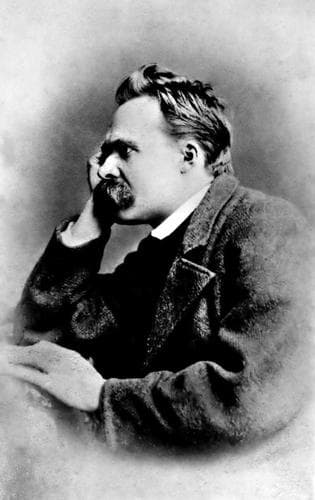
Friedrich Nietzsche was a German philosopher active in the late 19th century, known for his critiques of traditional moral values and religion. His notable works include "Thus Spoke Zarathustra," "Beyond Good and Evil," and "On the Genealogy of Morals," which explore themes of individualism, power, and the nature of existence. Nietzsche's writings have had a profound influence on modern philosophy and literature.
Similar books
- Thus Spoke Zarathustra
Friedrich Nietzsche
4.0 (111k) average on GoodreadsPsychologyExplores themes of overcoming and cultural critique in a poetic, philosophical style.
- Poetics
Aristotle
3.8 (18k) average on GoodreadsCreativityAristotle's Poetics offers a systematic, analytical, and prescriptive account of tragedy, focusing on plot, character, and catharsis as a purging of emotions. Nietzsche, in contrast, approaches tragedy from a metaphysical and cultural perspective, seeing it as a synthesis of primal forces rather than a structured dramatic form. While Aristotle emphasizes the rational and moral dimensions of tragedy, Nietzsche foregrounds its irrational, ecstatic, and life-affirming power. Aristotle's view is focused on the effect of tragedy, whereas Nietzsche delves into its origin and essence.
- The Diary of a Young Girl
Anne Frank
4.2 (2.7M) average on GoodreadsBiographyDuring the Nazi occupation, a teenage girl's diary, written from a secret annex, shares observations on humanity, hope, and the wait for freedom.
- Night
Elie Wiesel
4.3 (970k) average on GoodreadsBiographyIn the darkness of Auschwitz and Buchenwald, a teenage Elie Wiesel faces the extermination of his family, the loss of his faith, and the lasting scars of humanity's deepest cruelty.
- Steve Jobs
Walter Isaacson
4.1 (957k) average on GoodreadsBusinessSteve Jobs was a visionary who fused creativity and technology to revolutionize six industries and shape our digital world.
- Unbroken: A World War II Story of Survival, Resilience and Redemption
Laura Hillenbrand
4.4 (767k) average on GoodreadsBiographyLouis Zamperini's incredible World War II odyssey transforms him from a rebellious youth and Olympic runner into a survivor of a plane crash, shark-infested waters, and brutal Japanese POW camps, only to find redemption through forgiveness.





Enjoyed the summary?
A summary gives you the shape of the book. The book itself has the detail, the examples and the voice.
Find The Birth of Tragedy on AmazonAs an Amazon Associate, BookBrief earns from qualifying purchases. How we're funded