
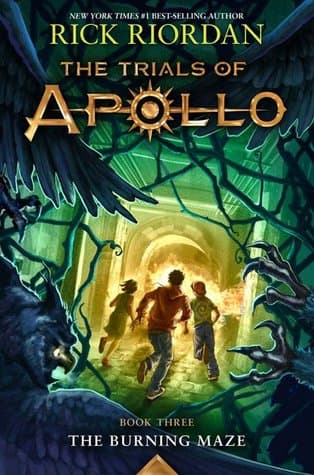
Synopsis
Covers the whole plot, including the ending.
- Difficulty
- Easy
- Pacing
- Fast
- Mood
- Adventurous, Humorous, Emotional, Suspenseful
- Read it if
- You enjoy fast-paced mythological adventures, character-driven quests with high stakes, and a blend of humor and heartfelt moments. Perfect for fans of Percy Jackson and Roman/Greek mythology.
- Skip it if
- You prefer stand-alone novels, dislike series with multiple books, or are not interested in young adult fantasy with a focus on ancient gods and monsters.
The Burning Maze Plot Summary
Covers the whole plot, including the ending.
A Desperate Rescue and a Dire Prophecy
Lester Papadopoulos (the mortal Apollo) and Meg McCaffrey are in the Labyrinth, teleported there by Hecate at the end of the last book. They look for Grover Underwood, who disappeared while checking strange environmental issues. They find Grover in a cavern trying to save demigod Piper McLean from a Manticore. After a fight, they defeat the Manticore and save Piper. Piper says her father, Jason Grace, sent her to find the lost Oracle of Erythraean Sibyl. As they try to leave the Labyrinth, the Erythraean Sibyl, as a dryad named Mellie, appears and gives a new prophecy: 'The burning maze shall be your tomb, unless the cloven guide alone the way does know.'
Finding a Guide and Entering the Maze
The prophecy mentions a 'cloven guide,' meaning a satyr. Meg first thinks of her adoptive father, the god Pan, who is gone, but then realizes it means Grover Underwood. Grover, feeling the prophecy's weight, agrees to lead them. They decide to enter the Labyrinth from a new entrance Mellie showed them, which leads to the Burning Maze in the American Southwest. Before entering, they meet the empousa Kelli, who warns them about the dangers inside. Despite the warnings, the three, with Piper, step into the Labyrinth. It immediately proves to be a dangerous, changing place, with fire traps and monsters.
Encounter with Medea and the Blemmyae
Inside the Burning Maze, the group faces immediate dangers. Fire-breathing scorpions attack them. Grover's knowledge of the Labyrinth and his connection to nature help them find paths and avoid traps. They find a market run by headless Blemmyae, who are friendly and offer supplies. Here, they also meet the sorceress Medea, an old enemy of Jason Grace, now working for the Triumvirate. Medea tries to tempt Piper with power and a cure for her father, but Piper stays loyal to her friends. Medea then attacks, making the group run deeper into the maze.
Jason Grace's Sacrifice
As they go through the maze, Medea's automatons ambush them. As they are about to be defeated, Jason Grace, Piper's father and a demigod son of Jupiter, arrives to help. He says Leo Valdez warned him about the Triumvirate's plans, and he has been looking for them. Together, they fight off Medea's forces. But the battle draws the attention of Emperor Caligula, who appears with his pet, Emperor Commodus's lion. Jason sacrifices himself to hold off Caligula and his forces, giving Apollo, Meg, Grover, and Piper time to escape deeper into the maze. His death affects everyone deeply, especially Piper.
Meeting the Emperor Caligula
Devastated by Jason's death, the remaining group continues, determined to get revenge and stop the Triumvirate. They find Caligula's floating yacht, a luxurious but scary base in the Labyrinth. They get onto the yacht, hoping to stop him. They discover Caligula wants to become a god and plans to use the Erythraean Sibyl's power to become immortal and destroy Camp Jupiter. He reveals his alliance with Commodus and Nero, and his plan to use the Labyrinth itself as a weapon. Apollo, still mortal, feels helpless and angry facing the former emperor, who mocks his past as a god.
The Erythraean Sibyl's Oracle
The group reaches the chamber where the Erythraean Sibyl is, but Caligula has captured her. He is taking her prophetic energy for his own bad plans, weakening her and making her prophecies unclear. The Sibyl, as the dryad Mellie, is barely conscious. Apollo realizes that to free the Oracle, they must defeat Caligula and also restore her power. This is a huge challenge, as Caligula has imperial guards and strong magic, and the Sibyl's spirit is connected to the Labyrinth, making her open to its destructive nature.
The Battle for the Sibyl
A fierce battle starts aboard Caligula's yacht. Apollo, Meg, Grover, and Piper fight Caligula's forces, including his monster pets and automatons. Meg's imperial gold sickles work well, while Grover uses his nature magic to control the environment. Piper's charmspeak helps confuse enemies. Apollo, despite his mortal weakness, uses his intelligence and what little divine energy he has. Their goal is to reach Caligula and stop his control over the Sibyl. The fight is desperate, with many losses for Caligula's side, but the emperor himself is a strong enemy, protected by old magic and cruel cleverness.
Caligula's Defeat and Mellie's Sacrifice
In a final fight, Apollo and Meg corner Caligula. Using Meg's power and Apollo's strategy, they hit the emperor with a critical blow. Caligula is defeated, his plans for godhood stopped. However, the Sibyl's dryad host, Mellie, is badly hurt during the battle and dies. Before she dies, she gives a clear prophecy, guiding Apollo to his next challenge and revealing more about the Triumvirate's main plan. Her death is a sad moment, reminding Apollo of the mortal cost of his quest.
Piper's Grief and a New Path
After Caligula's defeat and Mellie's death, Piper is sad about her father, Jason. She decides she needs to leave the quest to mourn and help her family. She gives Apollo a small item that belonged to Jason, telling him to remember his friend's sacrifice. Apollo, Meg, and Grover, though heartbroken, understand her choice. With the Erythraean Sibyl's Oracle restored, they get clearer guidance for their next steps, realizing they must continue their journey to stop the remaining emperors and save Camp Jupiter.
Aftermath and the Road Ahead
Coming out of the Labyrinth, Apollo, Meg, and Grover regroup, tired but determined. They process the losses and wins, especially Jason's sacrifice. The restored Erythraean Sibyl's final prophecy guides them to their next stop: facing the second emperor, Commodus, in a new and dangerous place. Apollo, still mortal, feels the weight of his duties more than ever, realizing that his personal growth and his friends' sacrifices are most important for his success. They prepare for the next part of their dangerous journey, knowing that the world's fate rests on them.
Principal Figures
Lester Papadopoulos (Apollo)
Protagonist
The formerly glorious sun god, now a mortal teenager on a quest to restore the Oracles.
Lester Papadopoulos is the mortal form of the god Apollo, cast down by Zeus. He is a self-absorbed and often whiny teenager, but throughout the trials, he slowly begins to understand humility, empathy, and the value of mortal life. He struggles with his lack of godly powers, often feeling useless, but learns to rely on his friends and his own wit. His journey is one of profound personal growth, moving from a narcissistic deity to a more compassionate being. He is haunted by the deaths of those he cares about, particularly Jason Grace, which fuels his determination.
Relationships: Meg McCaffrey (Master-servant bond (oath-bound), evolving into deep friendship and mutual reliance); Grover Underwood (Quest companion, trusted guide, and friend); Piper McLean (Ally and friend, sharing grief over Jason's death); Jason Grace (Ally and friend; his death profoundly impacts Apollo)
Meg McCaffrey
Protagonist/Supporting
A demigod daughter of Demeter, bound to Apollo, wielding powerful imperial gold sickles.
Meg McCaffrey is a tough, often volatile demigod with a complicated past. She is fiercely loyal to those she cares about, especially Apollo, despite their initial rocky relationship. She possesses a unique connection to nature as a daughter of Demeter and wields formidable imperial gold sickles that can transform into plants. She struggles with her relationship with her abusive stepfather, Nero, and her past trauma. Her development in this book centers on her growing confidence and her willingness to stand up against the Triumvirate, particularly Caligula, who represents the kind of abuse she despises.
Relationships: Lester Papadopoulos (Apollo) (Master-servant bond, evolving into deep friendship and mutual reliance); Grover Underwood (Friend and fellow quest member); Nero (Abusive stepfather and antagonist); Piper McLean (Ally and friend)
Grover Underwood
Supporting
A satyr, Lord of the Wild, and the 'cloven guide' prophesied to lead the quest.
Grover Underwood is a kind-hearted and brave satyr, deeply connected to nature and the spirit of the wild. He has grown significantly since his earlier appearances, now holding the title of Lord of the Wild. He is the 'cloven guide' of the prophecy, possessing an innate understanding of the Labyrinth and a strong empathy with the natural world, which proves invaluable in navigating the Burning Maze. He is a loyal friend to Apollo and Meg, often providing moral support and practical guidance. His connection to the Labyrinth's ecosystem allows him to sense danger and find hidden paths.
Relationships: Lester Papadopoulos (Apollo) (Quest companion and friend); Meg McCaffrey (Friend and fellow quest member); Mellie (Wife, who tragically dies as the Sibyl's host); Pan (Spiritual predecessor and inspiration)
Piper McLean
Supporting
A demigod daughter of Aphrodite, with powerful charmspeak, seeking her father.
Piper McLean is a demigod daughter of Aphrodite, known for her powerful charmspeak and her grounded, courageous nature. She appears in the Labyrinth searching for her father, Jason Grace, who has gone missing. She is fiercely protective of her friends and family. Piper is deeply affected by the political turmoil and the rise of the Triumvirate, which has impacted her father. Her story in this book is marked by profound grief and a difficult decision about her future after Jason's death. She uses her charmspeak effectively in battles against Medea and Caligula's forces.
Relationships: Jason Grace (Father; his death is a central tragedy for her); Lester Papadopoulos (Apollo) (Ally and friend); Meg McCaffrey (Ally and friend); Leo Valdez (Friend (mentioned))
Jason Grace
Supporting
A demigod son of Jupiter and former praetor of Camp Jupiter, who makes the ultimate sacrifice.
Jason Grace is a powerful demigod son of Jupiter, known for his leadership, bravery, and sense of duty. He arrives in the Labyrinth to aid Apollo and his friends, having been warned by Leo Valdez about the Triumvirate's plans. He is a noble and selfless character, always putting others before himself. His heroic sacrifice to save his friends from Caligula and his forces is a pivotal moment in the book, deeply impacting Apollo, Piper, and the entire quest. His death serves as a stark reminder of the stakes involved and fuels the protagonists' determination.
Relationships: Piper McLean (Daughter; his death devastates her); Lester Papadopoulos (Apollo) (Ally and friend); Leo Valdez (Friend (mentioned)); Reyna Ramírez-Arellano (Former praetor and friend (mentioned))
Caligula
Antagonist
One of the Triumvirate emperors, an insane and power-hungry former Roman emperor.
Caligula is a sadistic and megalomaniacal former Roman emperor, now resurrected and allied with Commodus and Nero. He is obsessed with becoming a god and seeks to harness the power of the Erythraean Sibyl to achieve immortality and destroy Camp Jupiter. He delights in cruelty and manipulation, embodying the worst aspects of unchecked power. He is the primary antagonist of this book, responsible for the creation of the Burning Maze and the death of Jason Grace. His yacht serves as a mobile base within the Labyrinth, showcasing his extravagance and ruthlessness.
Relationships: Commodus (Fellow Triumvirate emperor and ally); Nero (Fellow Triumvirate emperor and ally); Lester Papadopoulos (Apollo) (Mortal enemy); Medea (Sorceress working for him)
Medea
Supporting/Antagonist
An ancient sorceress allied with the Triumvirate, possessing powerful magical abilities.
Medea is a powerful and manipulative sorceress from Greek mythology, a former enemy of Jason Grace. She is now working for the Triumvirate, specifically Caligula, utilizing her magic to create traps and automatons within the Labyrinth. She tries to tempt Piper with promises of power and a cure for her father's suffering, highlighting her manipulative nature. Her presence adds a layer of ancient magical threat to the maze, and her history with Jason makes her a particularly personal foe for Piper.
Relationships: Caligula (Employer/ally); Piper McLean (Target of manipulation); Jason Grace (Ancient enemy)
Mellie (Erythraean Sibyl)
Supporting
A dryad who is the host of the Erythraean Sibyl, providing cryptic prophecies.
Mellie is a gentle dryad and Grover Underwood's wife. In this book, she is revealed to be the current mortal host of the Erythraean Sibyl, one of the Oracles Apollo must restore. She is initially found in a weakened state, her prophetic powers being siphoned by Caligula. She delivers crucial, albeit cryptic, prophecies throughout the story, guiding the heroes. Her connection to Grover adds a personal stake to the quest. Her tragic sacrifice, as she delivers a final clear prophecy before dying, underscores the high cost of the quest and the Triumvirate's cruelty.
Relationships: Grover Underwood (Wife); Lester Papadopoulos (Apollo) (Source of prophecy)
Commodus
Mentioned
One of the Triumvirate emperors, mentioned as an ally of Caligula and Nero.
Commodus is one of the three resurrected Roman emperors forming the Triumvirate, though he does not physically appear in this book. He is mentioned by Caligula as an ally in their grand scheme to destroy Camp Jupiter and seize power. His presence is felt through the actions of Caligula and the overarching threat he represents, setting up the challenges for Apollo in future books. He is known for his cruel and theatrical nature.
Relationships: Caligula (Fellow Triumvirate emperor and ally); Nero (Fellow Triumvirate emperor and ally)
Nero
Mentioned
Meg's abusive stepfather and one of the Triumvirate emperors.
Nero is Meg McCaffrey's abusive stepfather and the third member of the Triumvirate. Although he does not appear in this book, his shadow looms large over Meg's character and motivations. He is frequently mentioned by Meg, highlighting her trauma and her deep-seated desire for justice. His role as the ultimate architect of the Triumvirate's plan is hinted at, establishing him as a major antagonist for the series' conclusion.
Relationships: Meg McCaffrey (Abusive stepfather); Caligula (Fellow Triumvirate emperor and ally); Commodus (Fellow Triumvirate emperor and ally)
Themes & Insights
Sacrifice and Loss
Sacrifice is a main idea in 'The Burning Maze,' especially with Jason Grace's death to save his friends. This act deeply affects Apollo and Piper, making them face the real and often harsh costs of their quest. Mellie's sacrifice as the Sibyl's host also shows this, proving that even small characters can make important, sad contributions. These losses help Apollo mature, removing his godly distance and making him value mortal lives and the sacrifices made for good.
“I’m sorry, Apollo,” Piper said, her voice raw. “But it’s time to go.” Her eyes, red-rimmed but resolute, met his. “Jason bought us that time.”
Humility and Empathy
Apollo's journey from a self-centered god to a more caring mortal is a main idea. Without his powers, he must rely on others and feel fear, pain, and loss directly. His interactions with Meg, Grover, and Piper teach him the value of mortal courage and kindness. He starts to understand the effect of his past godly arrogance and learns to appreciate demigods' strength. The suffering he sees and experiences, especially Jason's death, reduces his self-centeredness, creating a new sense of responsibility and real care for others.
“I had been a god of many things, but never of humility. Now, it was forced upon me like a crown of thorns.”
The Corrupting Nature of Power
The Triumvirate emperors, especially Caligula, show how unchecked power corrupts. Caligula's obsession with godhood, his cruelty, and his willingness to use others (like the Sibyl) for his own gain show how absolute power can lead to madness and tyranny. His actions in the Burning Maze, from creating fire traps to enslaving the Sibyl, show he completely disregards life and morals. This idea contrasts with the heroes' struggles; they, despite their own powers, try to use them for good and protect the innocent.
“Power. It’s what everyone wants, isn’t it? And once you have it, why would you ever give it up?”
Environmentalism and Nature's Resilience
Grover Underwood's role as the Lord of the Wild and the Burning Maze setting highlight environmentalism. Caligula corrupts and weaponizes the Labyrinth itself, showing humanity's harmful effect on nature. Grover's strong connection to the earth lets him navigate the maze and feel its distress, showing the importance of protecting the natural world. Despite the destruction, nature's strength is also shown, with new life finding ways to grow even in the maze's toughest parts, mirroring the heroes' lasting hope.
“The Labyrinth… it’s a living thing. And it’s hurting. I can feel it.”
Friendship and Loyalty
Friendship and loyalty are very important for the heroes to survive and succeed. Apollo, Meg, and Grover, with Piper and Jason, depend on each other's strengths and support. Meg's strong loyalty to Apollo, despite his faults, and Grover's steady commitment as the 'cloven guide' are clear examples. Jason's final sacrifice is a deep act of loyalty to his friends, showing that these connections are strong enough to overcome even the biggest threats. These relationships provide emotional support and practical help throughout their dangerous journey.
“You’re my best friend, Apollo. I’m not leaving you.”
Plot Devices & Literary Techniques
The Labyrinth (Burning Maze)
A sentient, ever-shifting underground maze that serves as the primary setting and a major antagonist.
The Labyrinth functions as both the main setting and a formidable antagonist. In 'The Burning Maze,' it is specifically the 'Burning Maze' section, a fiery, dangerous, and constantly shifting network beneath the American Southwest. It's a sentient entity that reacts to its inhabitants, manifesting new traps and paths. Caligula has amplified its destructive capabilities, turning it into a weapon. Its unpredictable nature forces the characters to rely on improvisation and Grover's unique connection to the wild, constantly challenging their navigation and survival skills.
The Erythraean Sibyl's Oracle
A divine source of prophecy that guides the quest but is exploited by the antagonist.
The Erythraean Sibyl is one of the Oracles Apollo must restore. Its role as a plot device is two-fold: it provides the initial, cryptic prophecy that sets the heroes on their path (the 'cloven guide' prophecy) and serves as the ultimate objective within the Burning Maze. Its capture and exploitation by Caligula create the central conflict, as freeing and restoring the Sibyl is essential for Apollo to gain clearer guidance for his larger quest. The Sibyl's final, clear prophecy after Mellie's sacrifice provides crucial information for the next stage of the journey.
The Triumvirate
An overarching antagonistic force composed of three resurrected Roman emperors.
The Triumvirate serves as the overarching antagonistic force of 'The Trials of Apollo' series. In this book, Caligula represents one-third of this evil alliance. The Triumvirate's goal to destroy Camp Jupiter and regain power drives the entire narrative. While only Caligula is physically present, the constant mention of Commodus and Nero, and the knowledge of their combined power, creates a sense of escalating threat and a clear series-long objective for Apollo. Their existence provides a unified, powerful enemy for Apollo's quest.
Jason Grace's Sacrifice
A pivotal character death that serves as a major turning point and motivator for the protagonists.
Jason Grace's death is a critical plot device that serves as a major turning point in the narrative and for Apollo's character development. It is a moment of profound loss that raises the stakes significantly, demonstrating the real danger of the Triumvirate. His heroic sacrifice directly enables the other heroes to escape, making his death both tragic and necessary. Emotionally, it fuels Piper's grief and Apollo's determination, deepening their resolve to stop the emperors and avenge their friend, pushing them towards greater maturity and responsibility.
The Cloven Guide Prophecy
A specific, cryptic prophecy that dictates the necessary companion for the quest.
The prophecy 'The cloven guide alone the way does know' is a crucial plot device that not only foreshadows Grover's vital role but also dictates the composition of the questing party. It immediately points to a satyr, specifically Grover, as the indispensable leader through the Labyrinth. This prophecy sets up Grover's unique abilities as a guide and validates his importance, ensuring that the heroes seek him out and trust his instincts, which are essential for navigating the treacherous Burning Maze.
The Burning Maze Quotes
“Being a god meant never having to say you’re sorry. Being a god also meant being completely alone.”
“Hope, like a star, doesn't disappear when the sun rises. It's still there, just hidden.”
“Sometimes the greatest power is not in what you can destroy, but what you can protect.”
“The past is a stubborn ghost. It doesn't just haunt you; it tries to rewrite your present.”
“Even a god can be afraid. It’s what you do with that fear that defines you.”
“True friendship isn't about always agreeing, but about always caring.”
“Monsters aren't born. They're made, sometimes by the very people who claim to fight them.”
“The world doesn't owe you anything. You have to earn your place in it, every single day.”
“A hero isn't someone who never falls. A hero is someone who gets back up, every time.”
“Sometimes the greatest victories are the ones where you don't lose yourself in the fight.”
“You can't outrun your destiny, but you can choose how you face it.”
“The greatest prison is not made of bars, but of your own mind.”
“Even in the darkest maze, there's always a way out. You just have to be brave enough to find it.”
“Small acts of kindness can echo louder than the grandest pronouncements.”
Quiz
10 questions on the plot and the characters. Each answer comes with a short explanation.
Question 1
What is Apollo's mortal name after being cast down to Earth?
- Lester Papadopoulos
- Leo Valdez
- Percy Jackson
- Jason Grace
Show answer
A. Lester Papadopoulos The book description explicitly states that the formerly glorious god Apollo is now an awkward mortal teenager named Lester Papadopoulos.
Question 2
What is the primary goal Apollo must achieve to regain his place on Mount Olympus?
- Defeat Zeus in single combat
- Restore five Oracles that have gone dark
- Gather an army of demigods
- Find a new patron god
Show answer
B. Restore five Oracles that have gone dark The introduction states Apollo must 'restore five Oracles that have gone dark' to regain his godly status.
Question 3
Who is Meg McCaffrey, Apollo's companion?
- A daughter of Zeus
- A daughter of Demeter
- A dryad
- A satyr
Show answer
B. A daughter of Demeter The description identifies Meg as a 'confounding young daughter of Demeter'.
Question 4
What significant event happened in Indianapolis during Apollo's second trial?
- They found a lost Olympian artifact.
- Meg received the Dark Prophecy.
- Apollo regained some of his godly powers.
- They defeated the first emperor of the triumvirate.
Show answer
B. Meg received the Dark Prophecy. After the second trial in Indianapolis, 'Meg received the Dark Prophecy' while on the Throne of Memory.
Question 5
What did the Dark Prophecy reveal about the future of Camp Jupiter?
- It would be flooded by a vengeful sea god.
- An evil triumvirate of Roman emperors plans to attack it.
- It would become the new home for all Greek demigods.
- A new Oracle would be established within its borders.
Show answer
B. An evil triumvirate of Roman emperors plans to attack it. The Dark Prophecy revealed 'that an evil triumvirate of Roman emperors plans to attack Camp Jupiter'.
Question 6
Where are Lester and Meg headed next to find the third emperor and an Oracle?
- Mount Olympus
- Through the Labyrinth in the American Southwest
- Back to Camp Half-Blood
- To the Underworld
Show answer
B. Through the Labyrinth in the American Southwest Following the prophecy, 'Lester and Meg must go through the Labyrinth to find the third emperor—and an Oracle who speaks in word puzzles—somewhere in the American Southwest'.
Question 7
Who flies ahead on Festus to warn Camp Jupiter?
- Percy Jackson
- Leo Valdez
- Jason Grace
- Piper McLean
Show answer
B. Leo Valdez The text states, 'While Leo flies ahead on Festus to warn the Roman camp'.
Question 8
What specific characteristic does the Oracle they are seeking in the American Southwest possess?
- It speaks only in riddles.
- It speaks in word puzzles.
- It only communicates telepathically.
- It can only be understood by satyrs.
Show answer
B. It speaks in word puzzles. Lester and Meg are looking for 'an Oracle who speaks in word puzzles' in the American Southwest.
Question 9
What is the 'glimmer of hope' mentioned in the gloom-filled prophecy regarding their next journey?
- They will find a powerful weapon.
- A cloven guide alone the way does know.
- Apollo will regain some of his powers temporarily.
- Zeus will send them direct aid.
Show answer
B. A cloven guide alone the way does know. The prophecy's glimmer of hope is explicitly quoted as: 'The cloven guide alone the way does know'.
Question 10
Who does Meg know to call upon as their 'cloven guide'?
- A centaur
- A cyclops
- A satyr
- A faun
Show answer
C. A satyr The text states, 'They will have a satyr companion, and Meg knows just who to call upon', indicating the cloven guide will be a satyr.
The Burning Maze FAQ
What is "The Burning Maze" about?
"The Burning Maze" is the third installment in Rick Riordan's 'The Trials of Apollo' series. It follows the mortal former god Apollo, now Lester Papadopoulos, and his demigod master Meg McCaffrey as they navigate the Labyrinth in the American Southwest to find the third Roman emperor of the Triumvirate, Caligula, and a new Oracle. Their ultimate goal is to restore the Oracles and save Camp Jupiter from imminent attack, all while Apollo grapples with his newfound mortality and the loss of his powers.
Why should I read "The Burning Maze"?
You should read "The Burning Maze" for its signature blend of humor, mythology, and heartfelt character development. It deepens Apollo's journey of humility and self-discovery, introduces beloved characters like Grover Underwood in a pivotal role, and features high-stakes action within the treacherous Labyrinth. The book also delivers significant emotional weight and a memorable, impactful ending that raises the stakes for the entire series.
What is the background/setting of "The Burning Maze"?
The story is primarily set within the sprawling, ever-shifting Labyrinth, a mythical maze that extends beneath the Earth, specifically in the American Southwest. This allows for diverse environments, from scorching deserts to hidden forests. The overarching background is the threat of the Triumvirate Holdings, a corporation run by three resurrected Roman emperors (Nero, Commodus, and Caligula) who seek to control all Oracles and destroy demigod camps.
What are the most memorable quotes?
One memorable quote is Apollo's internal thought, "Mortality was a constant reminder of how much I had to lose, and how little control I had." Another is Grover's declaration, "My job is to protect the wild. And the wild includes you, Lester." These quotes highlight Apollo's growth and the unwavering loyalty of his friends.
What writing style does the author use?
Rick Riordan employs a first-person narrative from Apollo's perspective, characterized by a sarcastic, self-deprecating, and often humorous tone. His writing is fast-paced, filled with mythological references explained in an accessible way, and balances comedic banter with moments of genuine emotion and peril, making it engaging for young adult readers.
What minor details add significant meaning?
The constant mention of Apollo's haikus, initially a source of comedic frustration, evolves to show his growing self-awareness and even poignant reflection. Also, the fact that Caligula's yachts are powered by enslaved dryads and nature spirits underscores the emperor's cruelty and the environmental devastation he causes, linking his villainy directly to the themes of nature's protection championed by Grover.
What are some subtle foreshadowing moments?
The Dark Prophecy from the previous book, which explicitly states, "The cloven guide alone the way does know," clearly foreshadows Grover Underwood's crucial role in navigating the Labyrinth. Also, the constant, low-level fear Apollo feels regarding the emperors hints at the true extent of their power and ruthlessness, particularly Caligula's, which is fully revealed later.
What unexpected character connections exist?
The most significant unexpected connection is between Meg McCaffrey and her former protector, the satyr Grover Underwood. Grover's deep history and bond with Meg from her childhood, before Nero corrupted her, provides a crucial emotional anchor and strategic advantage, as he understands her better than almost anyone and can guide her through the Labyrinth and her own trauma.
What are unspoken character motivations?
Apollo's unspoken motivation, beneath his complaints, is a desperate desire to prove his worth and regain his godhood, not just for power, but to escape the vulnerability and suffering of mortality. Meg's unspoken motivation is a deep-seated need for a true family and a desire to escape her abusive past with Nero, which drives her loyalty to Apollo and her burgeoning courage.
What psychological complexities do characters exhibit?
Apollo grapples with profound psychological complexity as he confronts his past arrogance, the consequences of his divine actions, and the fear of mortality. He experiences genuine grief and self-doubt, a stark contrast to his former persona. Meg struggles with PTSD from her past with Nero, manifesting in her difficulty trusting others and her occasional outbursts, but also in her fierce protectiveness.
What are the major emotional turning points?
A major emotional turning point is when Apollo witnesses the full extent of Caligula's cruelty and the suffering of the dryads, which solidifies his resolve to fight, not just for himself, but for those he now cares about. Another is Meg's decision to confront her past and actively work against Nero, a significant step in her healing process. The most impactful is the tragic loss of a beloved character, which profoundly affects both Apollo and Meg.
How do relationship dynamics evolve?
Apollo and Meg's relationship evolves from a master-servant dynamic, with Apollo often resentful, to one of genuine friendship and mutual reliance. Apollo begins to see Meg not just as his 'master' but as a courageous, traumatized young woman he genuinely cares for. The reintroduction of Grover Underwood strengthens Meg's support system and adds a new layer of camaraderie and shared history to the group dynamic.
Which parts remain ambiguous or open-ended?
While the immediate threat of Caligula is dealt with, the ultimate fate of the Triumvirate Holdings and the remaining emperors, Nero and Commodus, remains open-ended, setting the stage for future books. The full implications of the Dark Prophecy and how it will affect Camp Jupiter are also left somewhat ambiguous, building suspense for the next adventure.
What are controversial scenes or decisions?
The most controversial and impactful event is the death of Jason Grace. This decision was surprising and emotionally devastating for many readers, as Jason was a long-standing and beloved character from previous Riordan series. It marked a significant shift in the series' tone, demonstrating that even main characters are not safe from fatal consequences in Apollo's trials.
"The Burning Maze" ending explained: how it ends & what it means
The book ends with Apollo, Meg, and Grover successfully defeating Caligula and his forces, but at a devastating cost: Jason Grace sacrifices himself to save Piper and the others. Apollo is profoundly shaken by this loss, realizing the true gravity of his quest and the sacrifices it demands. The ending signifies Apollo's continued growth from a self-absorbed god to a compassionate, albeit still mortal, hero, and underscores that the fight against the Triumvirate is far from over, with the stakes higher than ever for Camp Jupiter and the remaining Oracles.
About the author

Rick Riordan is an American author known for his young adult fiction, particularly in the fantasy genre. He is best known for the "Percy Jackson & the Olympians" series, which includes "The Lightning Thief," "The Sea of Monsters," "The Titan's Curse," "The Battle of the Labyrinth," and "The Last Olympian," as well as "The Lost Hero," part of the subsequent Heroes of Olympus series. His works often blend mythology with contemporary themes, appealing to a wide audience.
Similar books
- The Lightning Thief
Rick Riordan
4.3 (2M) average on GoodreadsFantasyShares the same universe, mythological basis, and similar blend of humor and adventure.
- The Hidden Oracle
Rick Riordan
4.2 (109k) average on GoodreadsFantasyThe first book in 'The Trials of Apollo' series, essential for understanding the ongoing plot and character development.
- The Hunger Games
Suzanne Collins
4.3 (6.4M) average on GoodreadsFantasyCollins' work offers a dystopian backdrop with high stakes and moral dilemmas. Riordan's The Burning Maze, even in peril, maintains a lighter tone and focuses on mythological quests rather than societal critiques.
- Harry Potter and the Sorcerer's Stone
J.K. Rowling
4.5 (7M) average on GoodreadsFantasyRescued from a miserable life under the stairs, an orphaned boy discovers he's a wizard destined for a magical school, where he uncovers a dangerous secret tied to the dark wizard who murdered his parents.
- 1984
George Orwell
4.2 (3.1M) average on GoodreadsPoliticsIn a future where surveillance and thought control are absolute, a man's search for truth clashes with the Party, showing that hope can be a form of rebellion.
- Divergent
Veronica Roth
4.2 (2.9M) average on GoodreadsFantasyIn a society divided by virtues, a sixteen-year-old's difference from the norm starts a rebellion that threatens her world.





Enjoyed the summary?
A summary gives you the shape of the book. The book itself has the detail, the examples and the voice.
Find The Burning Maze on AmazonAs an Amazon Associate, BookBrief earns from qualifying purchases. How we're funded