
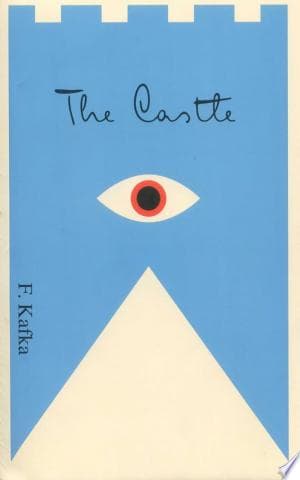
Synopsis
Covers the whole plot, including the ending.
- Difficulty
- Hard
- Read it if
- You are fascinated by existential philosophy, the critique of bureaucracy, and stories that explore the human struggle against an indifferent or illogical world.
- Skip it if
- You prefer straightforward narratives with clear resolutions, or find themes of futility and alienation unappealing.
The Castle Quotes
“The Castle hill was hidden, veiled in mist and darkness, nor was there even a glimmer of light to show that a castle was there.”
“It is not necessary to accept everything as true, one must only accept it as necessary.”
“The official world is vast, and who can survey it all?”
“One must fight against the feeling that one is being watched.”
“The right understanding of any matter and a misunderstanding of the same matter do not wholly exclude each other.”
“I am not a village man, nor am I a castle man, I am something in between, a thing of no account.”
“The castle has granted you the right to settle here, but not the right to stay.”
“Do not be too hasty, do not lose yourself in the vastness.”
“There are no accidental meetings in the castle.”
“The world is full of enigmas, but the castle is the greatest enigma of all.”
“One must not confuse the messenger with the message.”
“In the castle, it is not the law that matters, but the interpretation of the law.”
“The longer one waits, the less one understands.”
“To be admitted is not to be accepted.”
Quiz
10 questions on the plot and the characters. Each answer comes with a short explanation.
Question 1
What is the protagonist K.'s profession, as stated at the beginning of 'The Castle'?
- Teacher
- Land Surveyor
- Clerk
- Architect
Show answer
B. Land Surveyor K. arrives in the village claiming to be a Land Surveyor summoned by the Castle authorities, though this claim is repeatedly questioned and never verified, setting up the central conflict of his identity and purpose.
Question 2
Why is K. unable to leave the village and return home in 'The Castle'?
- He is physically trapped by the villagers
- He has no money or means of transportation
- He is determined to gain access to the Castle to validate his purpose
- The Castle authorities have forbidden him from leaving
Show answer
C. He is determined to gain access to the Castle to validate his purpose Despite being unwanted and unaccepted, K. persists in trying to reach the Castle to confirm his appointment as Land Surveyor, driven by an obsessive need for validation and meaning in the absurd bureaucratic system.
Question 3
What is the primary setting that dominates the landscape and represents authority in Kafka's 'The Castle'?
- The Village Inn
- The Church
- The Castle
- K.'s Home
Show answer
C. The Castle The Castle looms over the village as an inaccessible seat of power and bureaucracy, symbolizing elusive authority, divine-like remoteness, and the unattainable goals that define K.'s existential struggle.
Question 4
Which character serves as K.'s messenger and liaison to the Castle officials, though his information is often unreliable?
- Barnabas
- Frieda
- Klamm
- The Mayor
Show answer
A. Barnabas Barnabas is a messenger from the Castle who contacts K. and becomes his primary connection to the bureaucratic system, but his messages are vague and contradictory, reflecting the novel's themes of communication breakdown and uncertainty.
Question 5
What does K.'s relationship with Frieda, the barmaid, primarily symbolize in the context of his quest?
- A romantic escape from his troubles
- A strategic attempt to gain influence through her connection to Klamm
- A proof of his acceptance into village society
- A distraction from his duties as Land Surveyor
Show answer
B. A strategic attempt to gain influence through her connection to Klamm K. pursues Frieda largely because she is the mistress of Klamm, a high Castle official, hoping this relationship will provide leverage and access to the Castle, illustrating how personal connections become tools in his futile bureaucratic battle.
Question 6
How does the bureaucratic system of the Castle operate, as depicted in Kafka's novel?
- Efficiently and transparently, with clear rules
- Through chaotic, incomprehensible processes that seem designed to frustrate
- By direct physical control over the villagers
- With frequent interventions and explanations to help K.
Show answer
B. Through chaotic, incomprehensible processes that seem designed to frustrate The Castle's bureaucracy is labyrinthine, absurd, and opaque, with endless paperwork, contradictory orders, and inaccessible officials, creating a sense of existential alienation and highlighting themes of modern institutional absurdity.
Question 7
What is a key philosophical insight suggested by K.'s endless struggles in 'The Castle'?
- That perseverance always leads to success
- That human existence involves seeking meaning in an indifferent or absurd universe
- That bureaucracy is a necessary evil for societal order
- That love and relationships provide ultimate fulfillment
Show answer
B. That human existence involves seeking meaning in an indifferent or absurd universe K.'s futile quest mirrors existentialist ideas where individuals confront an irrational world, striving for purpose (like accessing the Castle) despite inherent meaninglessness, revealing truths about the human condition through absurdity.
Question 8
Why is 'The Castle' considered 'strangely complete' despite being unfinished, according to the book description?
- Because Kafka published a revised ending posthumously
- Because the unresolved nature of K.'s quest thematically reflects the novel's existential message
- Because later editors added conclusive chapters
- Because it ties up all plot threads in the existing manuscript
Show answer
B. Because the unresolved nature of K.'s quest thematically reflects the novel's existential message The novel's lack of a traditional ending reinforces its themes of uncertainty and infinite striving; K.'s perpetual failure to reach the Castle embodies the absurd, ongoing search for meaning, making the incompletion artistically fitting.
Question 9
In what way do the villagers' attitudes toward K. reflect the broader themes of 'The Castle'?
- They warmly welcome him as a newcomer, showing community solidarity
- They are indifferent to him, focusing on their own lives
- They oscillate between suspicion and reluctant assistance, mirroring the Castle's ambiguous authority
- They actively conspire with him to overthrow the Castle
Show answer
C. They oscillate between suspicion and reluctant assistance, mirroring the Castle's ambiguous authority The villagers treat K. with a mix of hostility, fear, and occasional help, influenced by their subservience to the Castle's cryptic rules. This duality echoes the novel's exploration of how power structures shape human behavior and create social alienation.
Question 10
Which practical application of Kafka's ideas in 'The Castle' is most relevant to modern readers?
- Learning surveying techniques for career advancement
- Navigating bureaucratic systems with patience and humor in the face of absurdity
- Building strong romantic relationships to achieve personal goals
- Avoiding remote villages to prevent existential crises
Show answer
B. Navigating bureaucratic systems with patience and humor in the face of absurdity The novel offers insights into coping with modern life's irrationalities, such as opaque institutions and futile pursuits, encouraging reflection on how to find meaning despite systemic absurdities—a timeless lesson in resilience and self-awareness.
The Castle FAQ
What is 'The Castle' by Franz Kafka about?
'The Castle' follows K., a land surveyor who arrives in a village to work for the mysterious Castle authorities but is never admitted to the Castle nor accepted by the villagers. His futile attempts to gain recognition and navigate the absurd, bureaucratic world reveal themes of alienation, existential struggle, and the search for meaning in an incomprehensible system.
Does 'The Castle' have a clear ending?
No, 'The Castle' was left unfinished by Kafka and ends abruptly. However, many readers and critics find its unresolved nature fitting for its themes of futility and absurdity, making it feel strangely complete despite the lack of a conventional conclusion.
What is the significance of the Castle in the novel?
The Castle represents an inaccessible, bureaucratic authority that controls the village and K.'s fate. It symbolizes elusive power, divine or societal order, and the human quest for purpose, often interpreted as a metaphor for God, government, or the absurdity of existence.
How is 'The Castle' different from Kafka's 'The Trial'?
While both novels explore bureaucratic absurdity and existential anxiety, 'The Trial' focuses on Joseph K.'s prosecution by an unseen court, whereas 'The Castle' centers on K.'s futile attempts to gain access to a remote authority. 'The Castle' is often seen as more philosophical and less overtly nightmarish than 'The Trial'.
What are the main themes in 'The Castle'?
Key themes include alienation, the absurdity of bureaucracy, the search for identity and meaning, and the duality of hope versus despair. Kafka uses K.'s struggles to critique societal structures and explore existential questions about human existence in an indifferent world.
Does 'The Castle' work as an allegory?
Yes, 'The Castle' is often interpreted as an allegory for various concepts, such as the pursuit of divine grace, the frustrations of bureaucratic systems, or the human condition. Its ambiguous nature allows readers to apply multiple allegorical meanings to K.'s journey and the Castle's symbolism.
How does Kafka use absurdity in 'The Castle'?
Kafka employs absurdity through illogical bureaucratic processes, paradoxical situations, and K.'s futile efforts to rationalize the irrational. This creates a labyrinthine world that mirrors the senselessness of existence, highlighting the conflict between human reason and an incomprehensible reality.
What is existentialism in 'The Castle'?
Existentialism in 'The Castle' is reflected in K.'s isolation, his struggle to find meaning in a meaningless world, and his confrontation with absurdity. The novel explores themes of freedom, anxiety, and the individual's quest for authenticity against oppressive, indifferent forces.
Is 'The Castle' based on Kafka's own life?
While not a direct autobiography, 'The Castle' draws on Kafka's personal experiences with bureaucracy, alienation, and Jewish identity in early 20th-century Europe. His feelings of outsider status and frustration with authority systems influenced the novel's themes and tone.
How should one approach reading 'The Castle'?
Approach 'The Castle' with an openness to ambiguity and multiple interpretations. Focus on its philosophical themes, symbolic elements, and Kafka's unique style rather than expecting a linear plot. Reading it as an exploration of existential and bureaucratic absurdity can enhance understanding.
About the author
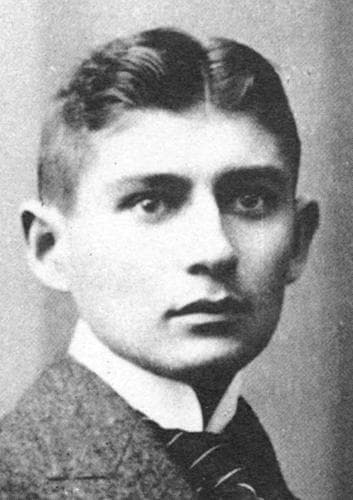
Franz Kafka was a German-speaking Bohemian novelist and short-story writer based in Prague, who is widely regarded as one of the major figures of 20th-century literature. His work fuses elements of realism and the fantastic. It typically features isolated protagonists facing bizarre or surrealistic predicaments and incomprehensible socio-bureaucratic powers. It has been interpreted as exploring themes of alienation, existential anxiety, guilt, and absurdity. His best known works include the novella The Metamorphosis and novels The Trial and The Castle. The term Kafkaesque has entered English to describe absurd situations like those depicted in his writing.
Similar books
- The Trial
Franz Kafka
4.0 (235k) average on GoodreadsLiterary FictionExplores similar themes of an individual caught in an arbitrary and oppressive legal system.
- Waiting for Godot
Samuel Beckett
3.8 (160k) average on GoodreadsPhilosophyA play that similarly delves into the absurdity of human existence and the futility of waiting for an unattainable goal.
- Nineteen Eighty-Four
George Orwell
4.2 (5.5M) average on GoodreadsFictionDepicts a dystopian society with an all-encompassing, oppressive, and bureaucratic power structure.
- The Myth of Sisyphus
Albert Camus
4.2 (25k) average on GoodreadsPhilosophyWhile Camus's The Myth of Sisyphus is an essay, not a novel, it directly addresses the philosophical underpinnings of absurdity and futility that Kafka dramatizes in The Castle. Both works grapple with the individual's struggle against an indifferent universe, but Camus explicitly proposes a defiant acceptance and rebellion against the absurd, whereas Kafka immerses the reader in the very experience of that futility without offering a philosophical escape route. K.'s endless pursuit in The Castle is a literary embodiment of Sisyphus's plight, but without Camus's subsequent call for conscious revolt.
- Brave New World
Aldous Huxley
4.0 (1.4M) average on GoodreadsFantasyIn a future where happiness comes from chemicals and individuality is gone, one man's desire for real experience threatens the calm, controlled society.
- Life of Pi
Yann Martel
3.9 (1.3M) average on GoodreadsFantasyStranded in the vast Pacific, a young Indian boy forms an unlikely bond with a Bengal tiger, questioning belief and survival.





Enjoyed the summary?
A summary gives you the shape of the book. The book itself has the detail, the examples and the voice.
Find The Castle on AmazonAs an Amazon Associate, BookBrief earns from qualifying purchases. How we're funded