
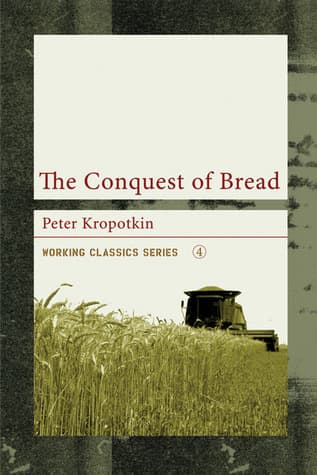
Core Idea
- Difficulty
- Medium
- Read it if
- You are interested in foundational anarchist communist theory, envisioning a society without states or capitalism, and exploring practical arguments for immediate post-revolutionary social organization based on abundance and mutual aid.
- Skip it if
- You are looking for a step-by-step guide to political activism, or prefer reformist approaches to social change over revolutionary expropriation and the immediate abolition of wage labor and private property.
Key Takeaways from The Conquest of Bread
Abolish Wage Slavery
The current system of wages and private property inherently creates poverty and inequality.
Kropotkin argues that the wage system, even when it seems fair, exploits workers. It separates them from the products of their labor and concentrates wealth, causing poverty and economic insecurity. He believes that 'private property' for basic resources like land, housing, and food is an artificial idea that keeps inequality going. Instead, Kropotkin supports communal ownership and management of all resources, so everyone's basic needs are met without the force of wage labor. The revolution's main goal is not just to change rulers, but to dismantle the economic structure that creates want when there is abundance.
“All have a right to well-being: well-being for all! The Revolution must assert this right, on pain of foundering in the same shoals as all preceding revolutions.”
In the book: Kropotkin frequently points to the vast disparity between the productive capacity of industrial societies and the poverty experienced by the working class, illustrating how the wage system fails to distribute wealth equitably.
Try this: Challenge the notion that wage labor is the only or most just way to organize society. Advocate for policies that promote collective ownership, mutual aid, and decommodification of essential services.
Related ideas: wage-slavery, private-property, economic-exploitation
Immediate Expropriation for All
The revolution must immediately seize and redistribute all essential resources to meet universal needs.
Unlike gradualist or state-socialist approaches, Kropotkin says a true social revolution must start with the immediate and complete taking of all accumulated wealth—factories, land, housing, food, and tools. This is not just about nationalization, but about making these resources directly available to the people who need them. He argues that waiting for a new government to make laws or for small changes will cause the revolution to fail, as people will become disappointed if their immediate needs for food and shelter are not met. The goal is to ensure 'bread for all' from day one, building trust and solidarity among revolutionaries.
“When the great Revolution has broken out, there will be but one way of securing its triumph, and that will be to proclaim and to realize, immediately, collectivism in all property, and communism in all consumption.”
In the book: Kropotkin draws on historical lessons from the French Revolution and the Paris Commune, noting how their failures were often linked to a lack of immediate, tangible improvements in the lives of the working class, leading to counter-revolutionary sentiment.
Try this: In any transformative social movement, prioritize immediate, tangible benefits for the most vulnerable. Focus on direct action and mutual aid initiatives that address basic needs outside of existing state or market structures.
Related ideas: expropriation, direct-action, communal-ownership
Decentralized, Voluntary Association
Society should be organized through free agreements and federations of autonomous communes, not a central state.
Kropotkin strongly rejects the idea of a centralized state, even a 'revolutionary' one, for achieving communism. He sees the state as an oppressive institution that centralizes power and suppresses individual freedom and local action. Instead, he proposes a society built on voluntary associations and federations of self-governing communes. These communes would organize themselves to manage local resources, production, and distribution, forming larger federations for wider coordination when needed. This decentralized, bottom-up approach means decisions are made by those directly affected and encourages flexibility, adaptability, and real participation.
“Free agreement is the only way to arrive at an organization which would be really useful to all, and which would make the forces of each individual much more productive.”
In the book: Kropotkin points to the intricate, self-organizing systems found in nature and the historical examples of free cities and guilds as proof of humanity's capacity for voluntary cooperation without state coercion.
Try this: Support local, community-led initiatives and mutual aid networks. Resist top-down solutions and advocate for increased autonomy and self-governance at the local level. Focus on building horizontal networks rather than vertical hierarchies.
Related ideas: anarcho-communism, decentralization, mutual-aid, federation
Abolish the Division of Labor
Specialization is degrading; integrate manual and intellectual labor for human flourishing.
Kropotkin criticizes the strict division of labor, especially separating manual and intellectual work, as something that degrades people in industrial society. He believes it reduces individuals to small parts of a machine, stops creativity, and prevents a full understanding of production. A communist society, he imagines, would encourage people to do both physical and mental work, allowing for a more varied and satisfying life. This integration would make work more enjoyable and also lead to more innovation and problem-solving, as those who produce also understand the needs and challenges of their work from many angles.
“Man is not a machine, and when he works for an hour or two at the production of a thing, he requires variety, he requires to vary his occupations.”
In the book: Kropotkin cites the repetitive, mind-numbing nature of factory work under capitalism as an example of how the division of labor degrades the worker, contrasting it with the more varied and skilled work of artisans in earlier periods.
Try this: Seek opportunities to learn and apply diverse skills, blurring the lines between 'intellectual' and 'manual' tasks in your own life. Advocate for educational and workplace models that promote holistic development and cross-functional collaboration.
Related ideas: division-of-labor, holistic-development, alienation-of-labor
Abundance Through Intelligent Organization
Current productive capacity is sufficient to meet everyone's needs if rationally organized.
Kropotkin rejects the Malthusian idea that scarcity is unavoidable. He argues that modern industrial and agricultural methods, combined with scientific knowledge, have created a huge capacity for abundance. The problem, he says, is not a lack of resources or production ability, but the irrational and wasteful organization of the capitalist system. He details how much labor is spent on non-essential industries, luxury goods, and maintaining the state and commerce, while basic needs go unmet. By directing this labor and resources toward socially useful production, guided by science and communal planning, society can easily provide 'bread for all' and even 'luxury for all.'
“We are rich, far richer than we think; rich in the products of the past and rich in the means of production of the present.”
In the book: Kropotkin extensively details agricultural advances, like intensive market gardening techniques in Parisian suburbs, showing how small plots of land can yield immense amounts of food, far exceeding common assumptions.
Try this: Challenge narratives of scarcity, especially regarding essential resources. Advocate for policies and community projects that prioritize efficient, sustainable production and distribution of necessities over profit motives or luxury consumption.
Related ideas: scarcity-myth, productive-capacity, socially-useful-labor
From Each According to Ability, To Each According to Need
A communist society distributes resources based on need, not labor contributed or merit.
This central idea of Kropotkin's anarcho-communism sets it apart from earlier socialist movements that still suggested payment based on hours worked or labor certificates. Kropotkin argues that such systems would bring back inequality and the very exploitation the revolution aimed to end. Instead, a truly free society would recognize that everyone has a right to their basic needs being met, regardless of their individual ability to work. He also believes that 'needs' are not fixed but change, including not just physical support but also comfort, leisure, and intellectual growth. This principle builds solidarity and removes the fear of want.
“We assert that the only reasonable way of organizing society is to provide for the needs of all, and that the only measure of our wants is the needs themselves.”
In the book: Kropotkin highlights how even in capitalist societies, essential services like roads, public parks, and libraries are often provided 'to each according to need,' demonstrating the feasibility and desirability of this principle on a larger scale.
Try this: Support universal basic services and decommodification efforts. Reject meritocratic arguments that link access to necessities with individual achievement. Advocate for systems that prioritize human well-being over individual contribution metrics.
Related ideas: needs-based-distribution, communist-principle, meritocracy-critique
The Role of Agriculture in Revolution
Urban populations must reconnect with and revolutionize food production for self-sufficiency.
Kropotkin spends much time on food, seeing it as the most immediate and important need during a revolution. He criticizes how large cities depend on distant farming regions, making them vulnerable to blockades and shortages. He advocates for a major change in agriculture, encouraging urban populations to farm, using scientific methods, intensive cultivation, and communal organization to grow food locally. This ensures food security and also blurs the lines between city and country, manual and intellectual work, helping communes become integrated and self-sufficient. It is a key step towards true freedom from outside economic dependencies.
“The great city, it will be said, is doomed to perish if it does not take in hand agriculture.”
In the book: Kropotkin details historical examples of successful intensive gardening, like the 'maraîchers' (market gardeners) of Paris, who could feed vast populations from relatively small, fertile plots using innovative techniques.
Try this: Support urban farming initiatives, community gardens, and local food movements. Learn about and practice permaculture or other sustainable, intensive agricultural methods. Advocate for policies that re-localize food systems and reduce reliance on global supply chains.
Related ideas: urban-agriculture, food-security, self-sufficiency, intensive-cultivation
Beyond the 'Right to Work' – The Right to Live
The revolution must guarantee sustenance, not just the opportunity to labor.
Kropotkin distinguishes between the 'right to work'—a slogan often used by earlier socialist movements—and the more basic 'right to live' or 'right to well-being.' He argues that the 'right to work' still means one's existence depends on being employed, thus continuing wage slavery and the fear of unemployment. A true communist society, however, would guarantee everyone's sustenance and well-being as a baseline, no matter their ability or willingness to do specific work. This basic shift frees individuals from economic pressure, allowing them to contribute to society out of genuine desire and solidarity, rather than out of necessity.
“The right to well-being means the possibility of living like human beings, and of bringing up children to be members of a society better than ours, whilst the 'right to work' only means the right to be always a wage-slave, a drudge, ruled over and exploited by the bourgeoisie of the future.”
In the book: He contrasts the 'right to work' with the more expansive demands for 'bread' and 'housing' that spontaneously arise during revolutionary upheavals, demonstrating the populace's inherent desire for direct provision of needs.
Try this: Advocate for universal basic income (UBI) and universal basic services (UBS) as stepping stones towards decommodification. Prioritize policies that decouple livelihood from employment, fostering true economic freedom and security.
Related ideas: right-to-live, right-to-well-being, decommodification, universal-basic-income
Luxury for All, Not Just Necessities
A communist society aims to provide not just basic needs, but also comfort, leisure, and intellectual enrichment for everyone.
Kropotkin's vision goes beyond just survival. He believes a truly free society should aim to provide 'luxury for all.' By this, he does not mean excessive extravagance, but a life rich in comfort, beauty, leisure, and intellectual pursuits. He thinks that with logical organization of production and the elimination of wasteful labor, society can easily produce enough to meet basic needs and also give everyone plenty of time for personal development, art, science, and recreation. This broad vision contrasts with ascetic forms of communism and shows Kropotkin's belief that human flourishing is the ultimate goal of social change.
“Bread, it is true, is the first object of existence, and bread must be secured. But bread alone is not enough; men must have shelter, clothing, leisure, and art.”
In the book: He meticulously calculates the amount of labor currently wasted on producing luxury goods for the wealthy or on maintaining unnecessary bureaucratic structures, arguing that this labor could be redirected to improve the quality of life for everyone.
Try this: Advocate for policies that prioritize public access to arts, culture, education, and green spaces. Challenge the notion that 'luxuries' are only for the elite. Support initiatives that expand leisure time and opportunities for creative expression for all members of society.
Related ideas: luxury-for-all, human-flourishing, leisure-time, cultural-access
Revolution as Construction, Not Destruction
While revolutionary upheaval is necessary, the focus must quickly shift to building new social structures.
While Kropotkin acknowledges that revolutionary seizure and the dismantling of old institutions are necessary, he stresses that the revolution's success depends on its constructive phase. The initial acts of taking over must quickly be followed by organizing new systems of production, distribution, and social life. This means people immediately taking responsibility for feeding themselves, housing themselves, and organizing their communities through free association. A revolution that only destroys without building workable alternatives will fail and lead to authoritarianism or chaos. Humanity's 'constructive genius,' free from the state and capital, will create the new society.
“The Revolution must be constructive, not merely destructive. It must build up, not merely pull down.”
In the book: Kropotkin implicitly critiques revolutionary movements that get bogged down in internal power struggles or fail to address the immediate needs of the populace, leading to a loss of revolutionary momentum and public support.
Try this: In any social change effort, always pair critiques of existing systems with concrete proposals and actions for building alternatives. Focus on developing practical skills and community infrastructure that can function independently of existing power structures.
Related ideas: constructive-revolution, social-reconstruction, post-revolutionary-organization
The Conquest of Bread Quotes
“All things are for all men, since all men have need of them, are the fruit of the labor of all, and there is no human possibility of determining the share of each in the production of the world's wealth.”
“No society can flourish, no nation can grow, if an immense majority of the population are condemned to a life of misery and want.”
“The first duty of the revolution will be to assure existence for all.”
“Production, with the aid of the machinery which man has already invented, can be so increased as to give abundance to all.”
“The earth is rich; it can nourish its inhabitants, if only they apply to it their intelligence and their labor.”
“What we preach is the free development of each for the free development of all.”
“The worker, who produces all the wealth, receives only a part of the products, and the part which falls to him is the least substantial.”
“Do not seek to establish the Commune by decree, but by the revolutionary spirit of the masses.”
“Before the Revolution, there were kings by the grace of God. After the Revolution, there will be kings by the grace of money.”
“When we say 'bread for all,' we mean also 'shelter for all,' 'clothing for all,' 'leisure for all,' 'education for all.'”
“The individual is not merely a producer, but also a consumer.”
“From each according to his ability, to each according to his needs.”
“The State is merely an instrument for the oppression of the masses by the privileged few.”
“The revolution must be economic before it can be political.”
Quiz
10 questions on the main ideas. Each answer comes with a short explanation.
Question 1
According to Kropotkin in 'The Conquest of Bread', what is the fundamental principle that should guide a post-revolutionary society's economic organization?
- From each according to his ability, to each according to his work.
- From each according to his ability, to each according to his needs.
- A centrally planned economy dictating production and distribution.
- Free market competition with minimal state intervention.
Show answer
B. From each according to his ability, to each according to his needs. Kropotkin explicitly advocates for the principle of 'From each according to his ability, to each according to his needs' as the basis for a communist society, rejecting both wage systems and state-controlled economies.
Question 2
Kropotkin argues that the existing system of private property and wage labor leads to what primary societal problem?
- Overproduction and market saturation.
- Artificial scarcity and widespread poverty amidst potential abundance.
- Excessive governmental bureaucracy.
- A lack of individual innovation and entrepreneurship.
Show answer
B. Artificial scarcity and widespread poverty amidst potential abundance. A core argument in 'The Conquest of Bread' is that the current economic system, by prioritizing profit and private ownership, creates artificial scarcity and prevents the equitable distribution of resources, even when there is enough to satisfy everyone's needs.
Question 3
What role does Kropotkin envision for the state or any centralized governing body in his ideal post-revolutionary society?
- A strong, centralized state to manage all production and distribution.
- A minimal state focused solely on defense and foreign policy.
- The complete abolition of the state, replaced by voluntary associations and federations.
- A transitional workers' state that will eventually wither away.
Show answer
C. The complete abolition of the state, replaced by voluntary associations and federations. As an anarchist communist, Kropotkin explicitly calls for the abolition of the state, seeing it as an oppressive institution that perpetuates inequality. He proposes a society organized through free associations and federations.
Question 4
Kropotkin emphasizes the importance of 'decentralization' in a revolutionary society. What does he mean by this in the context of production and distribution?
- Breaking up large corporations into smaller, privately owned businesses.
- Allowing each commune or region to manage its own production and distribution of necessities, fostering local self-sufficiency.
- Distributing political power from a national government to provincial assemblies.
- Decentralizing military command structures to prevent coups.
Show answer
B. Allowing each commune or region to manage its own production and distribution of necessities, fostering local self-sufficiency. Kropotkin advocates for local autonomy in 'The Conquest of Bread', arguing that communities should organize to produce and distribute their own food, housing, and other necessities, reducing reliance on distant, centralized authorities and fostering direct cooperation.
Question 5
How does Kropotkin propose society should address the issue of 'repugnant' or undesirable labor in a communist society?
- Paying higher wages for such labor to incentivize participation.
- Automating as much of it as possible and sharing the remaining tasks equitably among all able-bodied individuals.
- Assigning these tasks to a specific class of citizens or prisoners.
- Relocating such industries to less developed regions.
Show answer
B. Automating as much of it as possible and sharing the remaining tasks equitably among all able-bodied individuals. Kropotkin argues that with technological advancement and a shift in societal values, undesirable labor can be minimized through automation and, for what remains, shared by all as a collective responsibility, thus eliminating the need for a specific class to perform it.
Question 6
What is Kropotkin's view on intellectual and artistic pursuits in a society that has achieved communism?
- They should be tightly controlled and directed by collective bodies to serve societal goals.
- They will naturally flourish as individuals are freed from the necessity of wage labor and have leisure time.
- They are secondary to the primary task of material production and should be pursued only after all basic needs are met for everyone.
- They are primarily for the benefit of the community and not for individual expression.
Show answer
B. They will naturally flourish as individuals are freed from the necessity of wage labor and have leisure time. Kropotkin believes that once basic needs are met and people are freed from the drudgery of wage labor, their natural creativity and desire for intellectual and artistic expression will blossom, leading to a rich cultural life.
Question 7
Kropotkin dedicates significant attention to the potential for increased agricultural output. What is his main argument regarding food production capabilities?
- Only large-scale industrial farming can feed the population, requiring global trade.
- With intensive, scientific cultivation and local organization, cities and surrounding areas can become largely self-sufficient in food.
- Genetic modification is the key to overcoming food scarcity.
- Humanity must drastically reduce its population to achieve food security.
Show answer
B. With intensive, scientific cultivation and local organization, cities and surrounding areas can become largely self-sufficient in food. Kropotkin provides detailed examples and arguments in 'The Conquest of Bread' for how intensive, localized, and scientific agriculture, including urban gardening and greenhouses, can vastly increase food production to make communities self-sufficient.
Question 8
What historical event does Kropotkin frequently reference as a partial, albeit incomplete, example of revolutionary principles in action, particularly regarding spontaneous organization and the provision of needs?
- The American Revolution.
- The Russian Revolution of 1917.
- The Paris Commune of 1871.
- The English Civil War.
Show answer
C. The Paris Commune of 1871. Kropotkin frequently refers to the Paris Commune of 1871 as a historical instance where people spontaneously organized to meet their needs and manage their affairs, even if it ultimately failed and contained elements he opposed, it provided a glimpse of the revolutionary potential.
Question 9
Kropotkin critiques what specific aspect of prevailing socialist thought of his time, which he believed would hinder true liberation?
- Their reliance on violent revolution over peaceful reform.
- Their focus on agricultural over industrial production.
- The retention of a wage system or a centralized state, even in a transitional phase.
- Their failure to adequately address gender inequality.
Show answer
C. The retention of a wage system or a centralized state, even in a transitional phase. A central point of Kropotkin's argument against other socialist factions (like some Marxists) was his insistence on the immediate abolition of both the state and the wage system, viewing any retention of these as a betrayal of revolutionary principles and a path back to oppression.
Question 10
What does Kropotkin mean by 'expropriation' in the context of a social revolution, and what specific items does he argue should be expropriated?
- The seizure of all private property, including personal belongings and consumer goods, by the state.
- The collective taking over of all means of production, housing, and food stores to be managed by the community for the common good.
- The nationalization of major industries by a new revolutionary government.
- The redistribution of wealth through progressive taxation and welfare programs.
Show answer
B. The collective taking over of all means of production, housing, and food stores to be managed by the community for the common good. Kropotkin's concept of expropriation in 'The Conquest of Bread' is not about individual possessions but about making all means of production (land, factories), housing, and essential resources (food, clothing) common property, directly managed by the people to ensure everyone's needs are met.
The Conquest of Bread FAQ
What is 'The Conquest of Bread' about?
'The Conquest of Bread' by Pyotr Kropotkin is a foundational text in anarchist communism. It explores human needs and outlines a rational and equitable system for their satisfaction, presenting a vision for a society organized around mutual aid and voluntary cooperation without state or capitalist structures.
What is anarchist communism as described by Kropotkin?
Anarchist communism, as detailed by Kropotkin, advocates for a society where all property is commonly owned and managed, and goods are distributed 'to each according to their need,' rather than based on labor. It rejects both capitalism and state socialism, emphasizing decentralized organization, mutual aid, and direct democracy.
Does Kropotkin's vision of social revolution work in practice?
Kropotkin presents 'The Conquest of Bread' as a practical guide to social revolution, outlining concrete steps for achieving a society based on anarchist communist principles. While direct, large-scale implementations of his full vision have not occurred, his ideas have influenced various social movements and experiments in communal living and decentralized organization.
How does 'The Conquest of Bread' differ from Marxism or state socialism?
Unlike Marxism, Kropotkin's 'The Conquest of Bread' rejects the necessity of a transitional 'dictatorship of the proletariat' or a centralized state. Kropotkin advocates for the immediate abolition of the state and private property, emphasizing direct action, voluntary association, and the distribution of resources based on need rather than labor or state planning, which are key differences from state socialism.
What role does 'mutual aid' play in Kropotkin's philosophy?
Mutual aid is a central pillar of Kropotkin's philosophy, arguing that cooperation, not competition, is the primary factor in evolution and social progress. In 'The Conquest of Bread,' he demonstrates how human societies historically and naturally organize through voluntary cooperation to meet collective needs, forming the basis for a stateless, communist society.
What is Kropotkin's view on labor and distribution of goods?
Kropotkin rejects the wage system and the concept of 'payment for labor' in 'The Conquest of Bread.' He advocates for a system where all necessary work is shared, and goods are distributed freely to everyone based on their needs, believing that a society with abundant resources can afford to ensure everyone's well-being.
Is 'The Conquest of Bread' still relevant today?
'The Conquest of Bread' remains highly relevant today, offering critiques of capitalism and state power that resonate with contemporary economic inequalities and political discontents. Its emphasis on decentralized organization, community autonomy, and ecological sustainability provides valuable insights for current social and environmental movements.
What is the 'constructive genius' Kropotkin refers to?
Kropotkin uses 'constructive genius' to describe humanity's innate capacity for innovation, organization, and problem-solving, particularly when freed from the constraints of oppressive social structures. He believes this genius, when unleashed through social revolution, can create a world of abundance and well-being for all.
Who should read 'The Conquest of Bread'?
'The Conquest of Bread' is recommended for anyone interested in political philosophy, economics, history, and social justice. It is particularly valuable for students of anarchism, socialism, and those seeking alternatives to existing capitalist and state-centric systems.
About the author
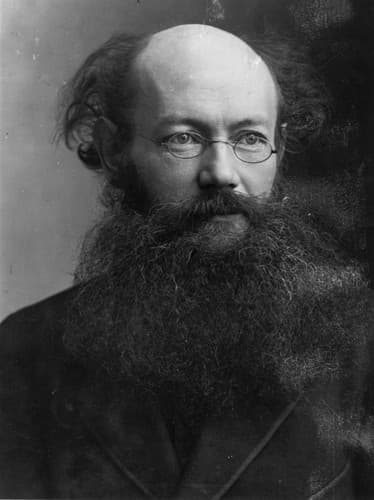
Pyotr Kropotkin was a Russian activist, philosopher, and geographer known for his contributions to anarchist theory. His notable work, The Conquest of Bread, outlines his vision for a decentralized, cooperative society based on mutual aid and communal ownership. Kropotkin's writings primarily focus on social and political philosophy, advocating for a stateless society.
Similar books
- 1984
George Orwell
4.2 (3.1M) average on GoodreadsPoliticsIn a future where surveillance and thought control are absolute, a man's search for truth clashes with the Party, showing that hope can be a form of rebellion.
- Animal Farm
George Orwell
4.0 (2.7M) average on GoodreadsPoliticsA farm animals' rebellion against humans turns into a pig-led dictatorship, showing how power corrupts and revolutionary ideals are betrayed.
- Freakonomics: A Rogue Economist Explores the Hidden Side of Everything
Steven D. Levitt
4.0 (709k) average on GoodreadsBusinessThis book uses economic principles to reveal the surprising incentives behind everything from drug dealing and real estate to cheating teachers and the decline of crime.
- I Am Malala: The Story of the Girl Who Stood Up for Education and Was Shot by the Taliban
Malala Yousafzai
4.1 (419k) average on GoodreadsPoliticsA teenage girl from a Taliban-controlled valley refuses to give up her books, becoming a global voice for education even after an assassination attempt.
- Atlas Shrugged
Ayn Rand
3.7 (354k) average on GoodreadsPoliticsIn a dystopian America where innovators vanish, a brilliant heiress races to uncover the truth behind the disappearing industrialists and the enigmatic John Galt, who vows to stop the world's progress.
- The Art of War
Sun Tzu
4.0 (330k) average on GoodreadsBusinessLearn ancient strategies for outsmarting rivals, whether on the battlefield or in the boardroom.






Enjoyed the summary?
A summary gives you the shape of the book. The book itself has the detail, the examples and the voice.
Find The Conquest of Bread on AmazonAs an Amazon Associate, BookBrief earns from qualifying purchases. How we're funded