
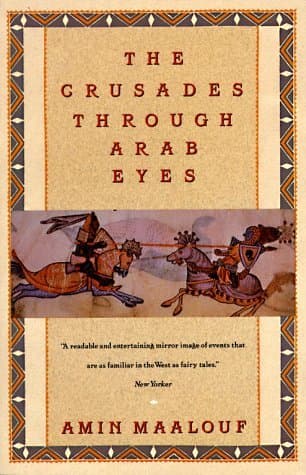
Core Idea
- Difficulty
- Medium
- Read it if
- You want a fresh, non-Western perspective on the Crusades, are interested in medieval Arab history and culture, or seek to understand the historical roots of contemporary East-West tensions.
- Skip it if
- You are looking for a military history of the Crusades, prefer a strictly objective, dry academic account, or are not interested in historical narratives told from a specific cultural viewpoint.
Key Takeaways from The Crusades Through Arab Eyes
A Clashing of Civilizations, Not Just Armies
The Crusades were a profound cultural shock for the Arab world, revealing stark differences in sophistication and values.
Maalouf shows how Arabs first saw the Crusaders with confusion and scorn. They viewed the Franks as rough, dirty, and lacking the intellectual and artistic refinements of their own culture. This was not just snobbery; it was a real cultural clash where the advanced urban societies of the Islamic world met a European society that, from their viewpoint, seemed to be coming out of a 'dark age.' The Franks were seen as barbarians driven by religious extremism, a sharp contrast to the sophisticated, diverse, and often tolerant societies of the Levant. This basic misunderstanding and underestimation of the 'other' had lasting effects, shaping the conflict for centuries.
“For the Arabs, the Frankish invasion was not merely a military one; it was an encounter with a world that was both alien and, in many respects, disturbingly primitive.”
In the book: Maalouf recounts numerous anecdotes from Arab chroniclers describing the Franks' poor hygiene, lack of medical knowledge (compared to Arab physicians), and their often brutal and unsophisticated military tactics, which initially seemed more like a horde than an organized army.
Try this: Recognize how ethnocentrism and cultural bias can lead to dangerous underestimations of adversaries and prevent meaningful dialogue. Seek to understand, rather than merely judge, different cultural perspectives in conflict zones.
Related ideas: ethnocentrism, cultural-clash, orientalism
Disunity: The Arabs' Greatest Foe
Internal squabbles and rivalries among Arab rulers allowed the Frankish invaders to gain a foothold and prolong their presence.
One of the most powerful themes in Maalouf's book is the deep disunity that plagued the Arab world during the early Crusades. While individual Arab leaders were often brave and capable, their collective failure to put aside personal ambitions and religious differences proved disastrous. Leaders were more concerned with outmaneuvering their Muslim neighbors than with facing the foreign invaders. This constant infighting, betrayal, and shifting alliances created a power vacuum and gave the Franks chances to strengthen their positions, often by playing one Arab group against another. It is ironic that a relatively small invading force managed to establish kingdoms in a resource-rich region, simply because its defenders were divided.
“The Franks were able to establish themselves in the Levant not so much because of their strength, but because of Arab weakness and, above all, their chronic disunity.”
In the book: Maalouf details numerous instances of Arab rulers making treaties with Franks against other Arab rulers, or refusing to come to the aid of besieged Muslim cities because of personal vendettas or territorial ambitions. The fall of Jerusalem itself is attributed, in part, to a lack of unified response.
Try this: In any collective endeavor, prioritize unity and common goals over individual rivalries. Understand that internal divisions can be a more potent threat than external adversaries.
Related ideas: political-fragmentation, internal-conflict, strategic-disunity
The Evolution of Arab Response
From initial indifference and contempt, the Arab world gradually awakened to the existential threat posed by the Crusaders.
The Arab response to the Crusades was not uniform but changed significantly over time. Initially, many Arab rulers saw the Franks as a temporary band of robbers, a nuisance rather than a real threat. This complacency contributed to the Crusaders' early successes. However, as the Frankish states solidified their presence and showed they intended to stay, a gradual awakening happened. This shift was largely driven by religious scholars who preached jihad, and by leaders like Zengi, Nur al-Din, and eventually Saladin, who understood the need for pan-Islamic unity against the invaders. The story moves from a period of puzzling indifference to one of determined, though often difficult, resistance, ending with the Franks' eventual expulsion.
“The first generation of Arab leaders failed to grasp the true nature of the Frankish invasion; it took a new generation, forged in the crucible of conflict, to recognize the profound danger.”
In the book: Maalouf traces this evolution through the reigns of various leaders: from the early, detached responses of the Seljuk sultans to the concerted efforts of Zengi and Nur al-Din to unite Syria, and finally to Saladin's successful campaigns to liberate Jerusalem and other key cities.
Try this: Be vigilant against underestimating emerging threats. Adapt strategies and unify resources in response to evolving challenges, recognizing that initial assessments may be flawed.
Related ideas: strategic-adaptation, jihad, leadership-evolution
Saladin: The Unifier and Symbol
Saladin's genius lay not just in military prowess but in his ability to inspire pan-Islamic unity and restore Muslim pride.
Saladin is the main heroic figure in the Arab story of the Crusades, and Maalouf spends much time on his rise and influence. His brilliance was many-sided: he was a clever military strategist, a patient diplomat, and a deeply religious Muslim who skillfully used religious feeling to unite different groups. Unlike those before him, Saladin understood the psychological warfare of the conflict, knowing that freeing Jerusalem was not just a military goal but a deep spiritual and symbolic act that could inspire the entire Islamic world. His generosity after victory, especially at Jerusalem, further cemented his legendary status, showing him as a just and noble leader, in sharp contrast to earlier Frankish cruelties.
“Saladin was more than a conqueror; he was a restorer of faith, a symbol of resurgence, who understood that victory required not just armies, but also the hearts and minds of the Muslim people.”
In the book: Maalouf details Saladin's patient campaigns to unite Egypt and Syria, his strategic victory at Hattin, and his subsequent recapture of Jerusalem, emphasizing his focus on moral authority and religious legitimacy as much as military might. His treatment of the defeated Franks in Jerusalem is highlighted as a key moment.
Try this: Effective leadership requires not only competence but also the ability to inspire, unite, and appeal to higher ideals. Understand the power of symbolism and moral authority in achieving long-term goals.
Related ideas: charismatic-leadership, pan-islamic-unity, symbolic-victory
The Frankish 'Other' and Arab Identity
The Crusades solidified a distinct 'Frankish' identity in Arab consciousness, shaping perceptions of the West for centuries.
For the Arab chroniclers, the 'Franks' were a single group, despite their varied European origins. This collective identity, given by the Arabs, helped define an external enemy and, by contrast, helped solidify an internal Arab-Islamic identity. The Crusades were a defining moment that etched the image of the 'aggressive, religiously zealous Westerner' into the Arab mind. Even after their expulsion, the memory of the Crusades and the 'Frankish invasion' continued to resonate, influencing future interactions and fostering a sense of historical grievance and suspicion towards the West. This historical perspective still shapes current geopolitical views, showing the long shadow cast by these medieval conflicts.
“The memory of the Franks, often distorted and mythologized, became an integral part of the collective Arab memory, a defining 'other' against which their own identity was forged.”
In the book: Maalouf shows how Arab chroniclers consistently refer to all Crusaders as 'Franks' regardless of their origin, creating a singular external enemy. He then traces how this 'Frankish' memory persists in modern Arab discourse, often invoked in relation to contemporary Western interventions.
Try this: Recognize the lasting impact of historical narratives and 'othering' on international relations. Understand how past conflicts contribute to current national and cultural identities and biases.
Related ideas: collective-memory, identity-formation, historical-grievance
A Missed Opportunity for Cultural Exchange
Despite prolonged contact, significant cultural exchange between Franks and Arabs was surprisingly limited, overshadowed by conflict.
While it is often assumed that long contact leads to cultural exchange, Maalouf argues that the Crusades were largely an exception, at least from the Arab perspective. The Franks, despite living in the Levant for generations, mostly kept their distinct cultural practices, often avoiding Arab customs, language, and knowledge. Arab chroniclers note cases of Franks adopting some local foods or building techniques, but a deep, mutual cultural exchange was rare. This limited interaction was a missed chance for mutual understanding and intellectual growth, largely because of the Franks' perceived cultural superiority and the constant state of war. The Arabs, already culturally advanced, had less to gain and more to lose from engaging with what they considered a less refined culture.
“The two cultures lived side-by-side for two centuries, yet the walls between them remained largely intact, fortified by prejudice and the ceaseless drumbeat of war.”
In the book: Maalouf highlights the observations of Usamah ibn Munqidh, an Arab emir, who meticulously documented the strange customs of the Franks, often with a sense of amusement or disdain, but rarely with genuine admiration for their societal norms or intellectual contributions beyond military matters.
Try this: Recognize that proximity does not guarantee understanding or positive interaction, especially when power imbalances and prejudice are at play. Actively seek bridges for cultural exchange rather than assuming it will naturally occur.
Related ideas: cultural-diffusion, intercultural-communication, prejudice
The Enduring Legacy of Resentment
The Crusades fostered a deep-seated resentment and suspicion towards the West that continues to influence Arab political thought.
Beyond the immediate military conflict, Maalouf highlights the deep and lasting psychological impact of the Crusades on the Arab world. The idea of a foreign, aggressive force invading and occupying Muslim lands, justified by religious zeal, created a deep sense of grievance and betrayal. This historical trauma has been brought up and reinterpreted throughout history, especially in response to colonialism and modern Western interventions in the Middle East. The Crusades, therefore, are not just a historical event but a living memory, a powerful story used to frame current conflicts and fuel anti-Western sentiment. Understanding this historical context is important for comprehending current geopolitical dynamics.
“The Crusades left a wound in the collective memory of the Arab world, a scar that has never fully healed, and which continues to be touched by every subsequent Western intervention.”
In the book: Maalouf explicitly connects the historical narrative of the Crusades to modern political discourse, noting how leaders and commentators in the Arab world frequently draw parallels between the medieval Frankish invasions and contemporary Western actions, such as the Iraq War or colonial mandates.
Try this: Acknowledge the weight of historical grievances in international relations. Approach diplomacy and intervention with sensitivity to past traumas and narratives, understanding their power to shape present perceptions.
Related ideas: historical-trauma, post-colonialism, geopolitical-memory
The Fragility of Power and Shifting Alliances
The Crusades highlight how power dynamics are fluid, with alliances constantly shifting based on immediate self-interest rather than fixed loyalties.
Maalouf's account clearly shows a political landscape marked by extreme change and opportunism. Arab rulers often allied with Franks against other Arab rulers, and Franks often formed temporary agreements with Muslim groups against rival Frankish lords or other Muslim enemies. This constant shifting of alliances shows the practical, often harsh, nature of medieval politics, where immediate self-preservation and territorial gain often outweighed religious or ethnic solidarity. It demonstrates that in long conflicts, ideological lines can blur, and survival dictates strange partnerships. This instability ultimately prolonged the conflict and made a united, decisive response from either side very difficult.
“In the Levant of the Crusades, loyalty was a negotiable commodity, and alliances were forged and broken with a speed that would baffle a modern observer.”
In the book: The text details numerous examples: the alliance between the Fatimids of Egypt and the Franks against the Seljuks, or various Syrian emirs making treaties with Crusader states to protect their own territories from Muslim rivals. King Amalric's shifting alliances are also noted.
Try this: Recognize that in complex geopolitical environments, rigid adherence to ideological blocs can be counterproductive. Be prepared for unexpected alliances and understand the underlying motivations driving political actors beyond stated principles.
Related ideas: realpolitik, fluid-alliances, geopolitical-instability
The Double-Edged Sword of Religious Fervor
While religion mobilized both sides, it also fueled brutality and prevented mutual recognition of humanity.
The Crusades were religious wars, with both sides claiming divine approval for their actions. For the Franks, it was a holy journey and a war against infidels; for the Arabs, it was a defense of Dar al-Islam and a call to jihad. Maalouf shows how this religious passion, while creating great courage and solidarity, also dehumanized the enemy. The Franks committed terrible acts, especially in the initial conquest of Jerusalem, driven by apocalyptic visions and a belief in the righteousness of their cause. Conversely, while Arab leaders like Saladin showed generosity, the underlying religious justification for conflict remained. This mutual religious extremism made true reconciliation or even basic human empathy very difficult, turning a territorial dispute into an existential struggle where the 'other' was often seen as less than human.
“Religion, for both Franks and Arabs, was a powerful motivator, capable of inspiring immense courage and sacrifice, but also unspeakable cruelty and dehumanization.”
In the book: Maalouf recounts the brutal massacre of Jerusalem's inhabitants by the Crusaders in 1099, contrasting it with Saladin's much more merciful recapture of the city. He also cites Arab chroniclers' accounts of Frankish religious zealotry and their own calls for jihad.
Try this: Be wary of ideologies, religious or otherwise, that dehumanize opposing groups. Recognize that while conviction can inspire, it can also blind individuals to shared humanity and justify extreme violence.
Related ideas: religious-fanaticism, dehumanization, holy-war
The Enduring Intellectual Silence
The Arab world, despite its initial cultural superiority, did not produce a profound intellectual response to the Crusades.
One of Maalouf's more subtle but poignant observations is the apparent lack of deep intellectual engagement with the Crusades by Arab scholars and thinkers. Unlike the rich philosophical and scientific traditions of earlier Islamic golden ages, the Crusades, despite their deep impact, did not seem to prompt new philosophical writings, scientific advances, or even extensive social analyses of the 'Frankish' phenomenon. The response was mainly military and political. This intellectual silence, according to Maalouf, suggests a certain isolation or perhaps a failure to fully grasp the wider implications of the encounter with the West. It hints at a time when creative intellectual drive may have been weakening, or simply overwhelmed by the immediate demands of conflict and internal strife, contributing to a missed opportunity for deeper self-reflection.
“While the Crusades left deep scars, they did not, surprisingly, provoke a significant intellectual or philosophical introspection within the Arab world concerning the nature of the invaders or their own society's failings.”
In the book: Maalouf notes the absence of major Arab philosophical works or scientific inquiries directly inspired by or responding to the Crusades, in contrast to the rich intellectual output of earlier periods in Islamic history. The chroniclers primarily focused on military and political events.
Try this: In times of crisis, ensure that intellectual and critical reflection are not sidelined by immediate concerns. Encourage diverse perspectives and analyses to fully understand challenges and avoid repeating historical patterns.
Related ideas: intellectual-stagnation, historical-introspection, missed-opportunity
The Crusades Through Arab Eyes Quotes
“The Arabs, who had been the masters of the world for several centuries, were now being invaded and humiliated on their own soil. They were not only losing their lands but also their sense of identity and destiny.”
“The Franks were not a single, unified army, but a collection of warlords, each with his own ambitions and strategies. This was both their strength and their weakness.”
“For the Arabs, the Crusades were not a holy war in the sense of a grand, unified jihad against an infidel invader. They were, for a long time, a series of local skirmishes against a new, troublesome neighbor.”
“The greatest tragedy of the Crusades, from an Arab point of view, was not merely the loss of territory, but the loss of a certain openness, a certain intellectual curiosity that had characterized Arab civilization for centuries.”
“Saladin was not just a military leader; he was a master of propaganda, a unifier of disparate factions, and a symbol of renewed Arab pride.”
“The Franks arrived as barbarians but learned, slowly, to appreciate the comforts and sophistication of Eastern civilization. Yet, they never truly assimilated.”
“The fall of Jerusalem in 1099 was a catastrophe, not just because of the bloodshed, but because it exposed the deep divisions and political paralysis within the Muslim world.”
“To understand the Crusades from the Arab perspective is to understand a history of invasion, resilience, and eventually, recovery, but also a history of missed opportunities and internal strife.”
“The Crusades, more than anything else, revealed the fragility of political power when not backed by a unified religious or cultural vision.”
“For many Arab rulers, the Franks were merely one more problem to deal with, alongside internal rebellions, Byzantine intrigues, and tribal feuds. They were not, at first, seen as an existential threat.”
“The spirituality that eventually fueled the jihad against the Franks was not an initial burst of fervor, but a slow-burning flame ignited by repeated provocations and the emergence of charismatic leaders.”
“The Crusades left an indelible mark on the collective memory of the Arab world, shaping its view of the West for centuries to come.”
“Even as they fought, there were moments of surprising coexistence and even admiration between Franks and Arabs, a testament to shared humanity despite profound religious and cultural divides.”
“The battle for hearts and minds was as crucial as the battle on the field. Saladin understood this perfectly, using poetry, sermons, and example to inspire his people.”
Quiz
10 questions on the main ideas. Each answer comes with a short explanation.
Question 1
According to Maalouf's presentation of Arab chronicles, what was the initial Arab perception of the Frankish invaders when they first arrived in the Levant?
- They were seen as a sophisticated, culturally advanced civilization.
- They were largely dismissed as uncivilized barbarians with no significant military threat.
- They were immediately recognized as a well-organized, religiously motivated conquering force.
- They were welcomed as potential allies against the Seljuk Turks.
Show answer
B. They were largely dismissed as uncivilized barbarians with no significant military threat. Maalouf highlights how early Arab accounts often depicted the Franks as crude and primitive, underestimating their long-term intentions and capabilities, which contributed to the initial lack of unified resistance.
Question 2
Which major Arab leader is depicted by Maalouf as successfully uniting various Muslim factions and eventually recapturing Jerusalem?
- Nur al-Din Zangi
- Saladin (Salah al-Din Yusuf ibn Ayyub)
- Imad ad-Din Zangi
- Baybars
Show answer
B. Saladin (Salah al-Din Yusuf ibn Ayyub) Saladin is a central figure in Maalouf's narrative, portrayed as the leader who managed to overcome internal divisions and mount a successful counter-offensive, culminating in the recapture of Jerusalem in 1187.
Question 3
Maalouf emphasizes the role of the Fatimid Caliphate in Egypt during the early Crusades. How did their political stance generally impact the initial Arab response to the Franks?
- They formed a strong alliance with the Seljuks to repel the Franks.
- Their internal conflicts and often antagonistic relationship with Sunni powers in Syria weakened the overall Muslim defense.
- They offered significant naval support to the coastal cities under Frankish siege.
- They immediately recognized the existential threat and appealed for aid from Baghdad.
Show answer
B. Their internal conflicts and often antagonistic relationship with Sunni powers in Syria weakened the overall Muslim defense. The Fatimids, being Shia, often viewed the Sunni Seljuks and other Sunni leaders as rivals, which prevented a unified front against the Crusaders and frequently led to them prioritizing internal political struggles over the external threat.
Question 4
According to the Arab chroniclers cited by Maalouf, what was a common criticism leveled against the rulers of Damascus and Aleppo in the early years of the Crusades?
- Their excessive reliance on Frankish mercenaries.
- Their preoccupation with internal rivalries and dynastic squabbles rather than presenting a united front against the invaders.
- Their attempts to convert the local Christian populations to Islam.
- Their open trade agreements that benefited the Frankish states.
Show answer
B. Their preoccupation with internal rivalries and dynastic squabbles rather than presenting a united front against the invaders. Maalouf repeatedly highlights how the disunity and infighting among various Muslim potentates, particularly between Damascus and Aleppo, were a critical factor in the Franks' initial successes, as documented by contemporary Arab observers.
Question 5
Maalouf uses the narrative of Usama ibn Munqidh to illustrate what about the relationship between Arabs and Franks?
- The complete absence of any cultural exchange or mutual understanding.
- The existence of complex, often contradictory relationships involving both conflict and occasional pragmatic cooperation or even curiosity.
- The Franks consistently adopting Arab customs and technology.
- The universal Arab belief that all Franks were irredeemably barbaric.
Show answer
B. The existence of complex, often contradictory relationships involving both conflict and occasional pragmatic cooperation or even curiosity. Usama ibn Munqidh's memoirs provide Maalouf with rich material to show that despite ongoing warfare, there were instances of truces, diplomatic exchanges, and even a degree of social interaction and cultural observation between Arabs and Franks, challenging a purely black-and-white portrayal.
Question 6
What significant event, beyond the initial capture of Jerusalem, did Maalouf highlight as a turning point that galvanized Muslim resistance and unity, largely due to Nur al-Din Zangi's efforts?
- The Battle of Harim
- The fall of Edessa to Zangi in 1144
- The siege of Ascalon by Saladin
- The failed Frankish attack on Damascus in 1148
Show answer
B. The fall of Edessa to Zangi in 1144 The fall of Edessa in 1144, expertly chronicled by Maalouf, is presented as the first major Crusader state to be recaptured by Muslim forces, specifically by Imad ad-Din Zangi, and subsequently built upon by his son Nur al-Din, inspiring a new wave of jihad and a sense of possibility for reversing Frankish gains.
Question 7
Maalouf argues that the long-term impact of the Crusades, as seen through Arab eyes, contributed significantly to which modern phenomenon in the Arab world?
- A strong tradition of democratic governance.
- A deep-seated distrust of the West and a sense of historical grievance.
- An embrace of secularism and separation of church and state.
- A greater appreciation for cultural diversity and pluralism.
Show answer
B. A deep-seated distrust of the West and a sense of historical grievance. One of Maalouf's central arguments is that the Crusades left a lasting legacy of resentment and suspicion towards Western intervention, which continues to influence Arab and Islamic consciousness and political discourse today.
Question 8
How does Maalouf characterize the religious motivations of the Arab response to the Crusades, particularly after the initial shock?
- Primarily focused on economic gain from capturing Frankish territories.
- Initially weak and fragmented, but gradually coalescing into a powerful, religiously sanctioned jihad.
- Mainly driven by a desire to protect Christian minorities within Muslim lands.
- Entirely secular, viewing the Franks as merely another political rival.
Show answer
B. Initially weak and fragmented, but gradually coalescing into a powerful, religiously sanctioned jihad. Maalouf details how the concept of jihad, initially dormant or misdirected due to internal divisions, was revived and effectively utilized by leaders like Nur al-Din and Saladin, becoming a potent unifying force against the Frankish invaders.
Question 9
According to Maalouf, what was a key difference in strategic approach between the early Frankish invaders and the later, more unified Muslim forces under Saladin?
- The Franks prioritized naval dominance, while Saladin focused on land battles.
- The Franks aimed for territorial expansion and settlement, whereas Saladin's primary goal was the expulsion of the invaders and the restoration of Islamic rule.
- The Franks relied heavily on diplomacy, while Saladin preferred immediate military confrontation.
- The Franks utilized siege warfare more effectively than the Muslims.
Show answer
B. The Franks aimed for territorial expansion and settlement, whereas Saladin's primary goal was the expulsion of the invaders and the restoration of Islamic rule. Maalouf highlights the Frankish ambition to establish permanent states and integrate into the Levant, contrasting it with Saladin's overarching mission to liberate Muslim lands and restore the pre-Crusade political and religious order.
Question 10
Which of the following best describes the core methodology Maalouf employs in 'The Crusades Through Arab Eyes'?
- A critical analysis of modern Western historiography of the Crusades.
- Synthesizing narratives from contemporary Arab chronicles to present the Crusades from an often-overlooked perspective.
- An archaeological study of Crusader-era sites in the Middle East.
- A comparative study of Christian and Muslim theological texts from the period.
Show answer
B. Synthesizing narratives from contemporary Arab chronicles to present the Crusades from an often-overlooked perspective. Maalouf's unique contribution is his rigorous use of primary source materials from Arab chroniclers, allowing readers to experience the Crusades from the perspective of those who were invaded, rather than solely relying on Western accounts.
The Crusades Through Arab Eyes FAQ
What is the primary focus of 'The Crusades Through Arab Eyes'?
The book retells the history of the Crusades from the perspective of contemporary Arab chroniclers, offering a unique counter-narrative to traditional Western accounts. It aims to reveal how these historical events shaped Arab and Islamic consciousness, even up to the present day.
Does 'The Crusades Through Arab Eyes' offer new historical facts?
While it draws on existing Arab historical sources, the book's novelty lies in its compilation and narrative presentation of these perspectives, which are often overlooked in Western historiography. It provides a fresh interpretation and understanding rather than unearthing entirely new facts.
What is the 'Arab perspective' on the Crusades presented in the book?
The Arab perspective portrays the Crusaders not as liberators or noble warriors, but often as barbaric invaders who caused immense suffering and destruction. It highlights the initial confusion, subsequent resistance, and eventual triumph of Muslim forces, emphasizing themes of unity and resilience.
How does this book differ from traditional Western accounts of the Crusades?
Traditional Western accounts often focus on the religious fervor, chivalry, and military campaigns of European knights, sometimes portraying the Crusades as a defensive war. Maalouf's work, in contrast, centers on the experiences, political machinations, and cultural responses of the Arab world, offering a critical re-evaluation of Western narratives.
Does the book explain the long-term impact of the Crusades on Arab-Western relations?
Yes, a core theme of the book is to illustrate how the Crusades left a lasting legacy of resentment, misunderstanding, and cultural memory within the Arab world. Maalouf argues these historical events continue to influence contemporary political and spiritual consciousness.
Is 'The Crusades Through Arab Eyes' biased towards the Arab viewpoint?
The book explicitly aims to present the Arab viewpoint, which has historically been marginalized. While it doesn't claim to be a neutral, all-encompassing history, it meticulously uses primary Arab sources to provide a necessary counter-balance to predominantly Western-centric narratives, offering a more complete picture.
What role do spirituality and religion play in the Arab narrative of the Crusades?
Spirituality and religion are central to the Arab narrative, often framing the conflict as a defense of Islam and its holy sites against infidel invaders. The book explores how religious leaders galvanized resistance and how Islamic piety influenced the actions and interpretations of the war.
Does the book trace the political fragmentation of the Arab world during the Crusades?
Yes, the book vividly details the political disunity and internal conflicts among various Arab and Muslim rulers, which often hindered a unified response to the Crusader incursions. It highlights how these divisions prolonged the conflict and impacted its outcomes.
About the author

Amin Maalouf is a Lebanese-French author known for his historical novels that explore cultural identity and the intersection of civilizations. His notable works include 'The Gardens of Light,' 'Leo Africanus,' and 'The Crusades Through Arab Eyes,' which offer profound insights into historical events and diverse perspectives. Maalouf's writing is celebrated for its lyrical prose and deep engagement with complex themes.
Similar books
- 1984
George Orwell
4.2 (3.1M) average on GoodreadsPoliticsIn a future where surveillance and thought control are absolute, a man's search for truth clashes with the Party, showing that hope can be a form of rebellion.
- Animal Farm
George Orwell
4.0 (2.7M) average on GoodreadsPoliticsA farm animals' rebellion against humans turns into a pig-led dictatorship, showing how power corrupts and revolutionary ideals are betrayed.
- Freakonomics: A Rogue Economist Explores the Hidden Side of Everything
Steven D. Levitt
4.0 (709k) average on GoodreadsBusinessThis book uses economic principles to reveal the surprising incentives behind everything from drug dealing and real estate to cheating teachers and the decline of crime.
- I Am Malala: The Story of the Girl Who Stood Up for Education and Was Shot by the Taliban
Malala Yousafzai
4.1 (419k) average on GoodreadsPoliticsA teenage girl from a Taliban-controlled valley refuses to give up her books, becoming a global voice for education even after an assassination attempt.
- Atlas Shrugged
Ayn Rand
3.7 (354k) average on GoodreadsPoliticsIn a dystopian America where innovators vanish, a brilliant heiress races to uncover the truth behind the disappearing industrialists and the enigmatic John Galt, who vows to stop the world's progress.
- The Art of War
Sun Tzu
4.0 (330k) average on GoodreadsBusinessLearn ancient strategies for outsmarting rivals, whether on the battlefield or in the boardroom.






Enjoyed the summary?
A summary gives you the shape of the book. The book itself has the detail, the examples and the voice.
Find The Crusades Through Arab Eyes on AmazonAs an Amazon Associate, BookBrief earns from qualifying purchases. How we're funded