

Core Idea
- Difficulty
- Hard
- Read it if
- You are a history enthusiast interested in a monumental, detailed, and influential account of one of history's greatest empires, and you appreciate sophisticated prose and deep historical analysis.
- Skip it if
- You prefer concise, modern historical analyses, are put off by 18th-century literary style, or are looking for a quick overview rather than an exhaustive scholarly work.
Key Takeaways from The Decline and Fall of the Roman Empire
The Peril of Prosperity
Comfort and luxury erode the civic virtue essential for an empire's survival.
Gibbon shows that Rome's greatest successes — long periods of peace and wealth under stable rule — unintentionally caused its downfall. As the empire became rich and secure, its citizens, especially the elite, grew used to luxury. This led to a decline in 'civic virtue' — the readiness to prioritize public duty, military service, and the common good over personal comfort. The tough demands of running a vast empire, both militarily and administratively, became less appealing to a population that had grown soft. This internal decay, he suggests, made the empire weak long before outside threats appeared, creating a hollow core that could not withstand future pressures.
“The long peace, and the uniform government of the Romans, introduced a slow and secret poison into the vitals of the empire.”
In the book: Gibbon frequently contrasts the hardy, disciplined early Romans with their later, more effeminate descendants, pointing to the increasing reliance on foreign mercenaries and the decline in martial spirit among native Romans as a direct consequence of their luxurious lifestyles.
Try this: Modern societies should be wary of the potential for prolonged peace and prosperity to breed complacency and erode the communal spirit. Cultivating a sense of shared responsibility, promoting public service, and encouraging resilience are crucial for long-term societal health, even in times of abundance.
Related ideas: civic-virtue, moral-decay, imperial-overstretch
Mercenaries: A Double-Edged Sword
Outsourcing defense to foreign warriors can lead to internal subjugation.
One of Gibbon's strongest arguments for Rome's decline is its growing reliance on barbarian mercenaries for defense. As Roman citizens became less willing or able to serve in the legions, the empire used Germanic tribes and other foreign groups to fill its ranks. This was a practical solution at first, but it became disastrous. These mercenaries, effective fighters, often lacked loyalty to Rome. They eventually became so numerous and involved in the military that they gained great power, setting terms, demanding land, and ultimately becoming the forces that broke apart the empire from within, taking control of areas they were once paid to defend.
“The Romans, long since disdaining the toils and dangers of military service, had devolved the defence of the empire on the arms of strangers.”
In the book: Gibbon details the rise of figures like Alaric and Odoacer, barbarian leaders who, having served in or alongside Roman armies, ultimately turned against the empire, culminating in Odoacer's deposition of the last Western Roman Emperor, Romulus Augustulus.
Try this: Nations must carefully balance the benefits of alliances and foreign assistance with the imperative of maintaining a strong, internally loyal defense force. Over-reliance on external actors for core security functions can create dangerous dependencies and vulnerabilities.
Related ideas: mercenary-armies, military-outsourcing, barbarian-invasions
Christianity's Dual Impact
A new faith fostered indifference to earthly concerns and diminished martial spirit.
Gibbon controversially states that the rise of Christianity played a role in Rome's decline. He argues that Christian teachings, which focused on an afterlife and spiritual salvation, led to indifference toward earthly matters, including civic duty and patriotism. This shift, he contends, weakened the traditional Roman martial spirit and made citizens less willing to fight for the empire. Also, Christianity's early pacifist views and its focus on universal brotherhood, rather than loyalty to the Roman state, weakened the civic bonds that had sustained the empire. While acknowledging its moral benefits, Gibbon saw its growth as harmful to the pagan Roman values that built the empire.
“The last and most inglorious period of the Roman empire, may be defined as the triumph of barbarism and religion.”
In the book: Gibbon points to the early Christians' reluctance to participate in military service, their prioritization of spiritual over temporal power, and the eventual suppression of pagan festivals and traditions that had reinforced Roman identity and martial values.
Try this: Societies must consider how dominant belief systems interact with civic engagement and national identity. While spiritual growth is vital, an extreme focus on the transcendent at the expense of present-day societal responsibilities can weaken the collective will to address earthly challenges.
Related ideas: christianity-impact, secular-vs-sacred, pacifism-military
The Burden of Size
An empire's vastness can become an insurmountable administrative and defensive challenge.
Though not always directly stated as a main cause, Gibbon's narrative implies the huge challenge of governing and defending an empire as large as Rome. Its vast territory meant stretched resources, slow communication, and a constant fight against internal disagreements and outside threats along long borders. Administering such a varied and spread-out population required a huge bureaucracy, which could become inefficient and corrupt. Defending thousands of miles of borders against many barbarian groups at once became an unsustainable drain on people and money, regardless of the legions' strength. The empire simply grew too large for its administration and military to manage effectively.
“The body of the Roman empire was so overcharged with its own weight, that, by the force of its own expansion, it burst and fell into fragments.”
In the book: Gibbon details the constant frontier wars on the Rhine and Danube, the administrative divisions of the empire (East and West), and the logistical nightmares of moving armies and supplies across vast distances.
Try this: Mega-organizations and nation-states should critically assess the optimal scale for effective governance and defense. Unchecked expansion, without corresponding innovations in administration and resource management, can lead to systemic fragility and eventual collapse.
Related ideas: imperial-overstretch, administrative-burden, geopolitical-scale
Moral Decline and Political Corruption
Erosion of integrity from the top down undermines governmental stability.
Gibbon, influenced by Roman moralists, often describes widespread moral decay and political corruption as factors in the empire's fall. From the unpredictable and often harsh behavior of emperors after Marcus Aurelius to the greed of provincial governors and bribery within the bureaucracy, the integrity of Roman governance declined greatly. This corruption alienated the public, eroded trust in institutions, and diverted resources from public services and defense. When leaders are self-serving and the system is unfair, the collective will to resist outside threats or internal challenges naturally lessens, creating conditions for instability and collapse.
“The decline of the Roman empire was the natural and inevitable effect of immoderate greatness. Prosperity ripened the principle of decay; the causes of destruction multiplied with the extent of conquest; and as soon as time or accident had removed the artificial supports, the stupendous fabric yielded to the pressure of its own weight.”
In the book: Gibbon recounts numerous examples of emperors assassinated, sold the throne to the highest bidder, or engaged in profligate spending. He also describes the oppressive taxation and corrupt administration that burdened the common people.
Try this: Ethical leadership and robust anti-corruption measures are paramount for any enduring society or organization. A continuous commitment to transparency and accountability, from the highest echelons of power to the lowest, is essential to maintain public trust and institutional strength.
Related ideas: political-corruption, moral-degeneration, tyrannical-rule
The Enduring Power of Ideas
Gibbon's methodology shaped historical writing for centuries.
Beyond his specific arguments, Gibbon's most important legacy is his pioneering approach to history. He did not just record events but actively sought to explain their causes, using a critical and mostly objective analysis of primary sources for his time. His careful use of references, his detached irony, and his broad scope set a new standard for historical methods. He moved away from purely flattering or anecdotal accounts, aiming for a more rational, evidence-based understanding of the past. This made his work a foundational text, influencing generations of historians to adopt a more rigorous, analytical, and critical approach in their studies.
“I have described the triumph of barbarism and religion.”
In the book: The multi-volume structure, extensive footnotes (though often in Latin and Greek), and the systematic narrative arc covering over a thousand years, all exemplify Gibbon's commitment to comprehensive, evidence-based history.
Try this: In any field, the methodology used to gather, analyze, and present information is as crucial as the conclusions drawn. Adopting rigorous, critical, and evidence-based approaches ensures greater accuracy, credibility, and lasting impact.
Related ideas: historical-methodology, enlightenment-history, critical-analysis
The 'Dark Ages' Narrative
Enlightenment disdain for the post-Roman era shaped historical perception.
Gibbon, as an Enlightenment thinker, viewed the period after Rome's fall with great disapproval, calling it a 'dark age' marked by superstition, ignorance, and the Church's restrictive influence. He believed that the progress of reason and civilization stopped until the Enlightenment itself. This view, though influential, has largely been revised by modern historians who recognize significant cultural, intellectual, and political developments during the early medieval period. However, Gibbon's powerful narrative solidified a particular view of history, highlighting a sharp contrast between classical antiquity and the following 'barbarous' era. This view lasted for centuries and still subtly influences popular understanding.
“The public hope was not disappointed. The Christian religion, which had been originally received by a few individuals in a remote province of the Roman empire, had spread itself with the most rapid progress over the whole Roman world.”
In the book: Gibbon's narrative consistently portrays the period after 476 AD as one of decline, intellectual stagnation, and religious fanaticism, contrasting it sharply with the perceived rationality and glory of the Roman era.
Try this: It's crucial to critically evaluate historical narratives, especially those from specific ideological periods. Understand that historical interpretations are not static and are often shaped by the prevailing biases and intellectual currents of the historian's own time.
Related ideas: dark-ages-concept, enlightenment-bias, historical-revisionism
The Eastern Empire's Resilience
Strategic location and adaptable governance allowed Byzantium to endure.
While Gibbon is known for chronicling the 'Fall' of the Roman Empire, he spends much time on the Byzantine Empire (the Eastern Roman Empire), which continued for another thousand years after the West's collapse. This longevity, often overlooked, highlights key differences. Byzantium's strategic capital, Constantinople, was very defensible. Its more centralized and adaptable administration, a stronger state-controlled economy, and a more robust military (at least initially) allowed it to withstand barbarian invasions and Islamic expansion for centuries. Gibbon's detailed account shows that the 'fall' was not a single event but a complex, geographically uneven process, with the Eastern half showing remarkable strength against similar pressures that overwhelmed the West.
“The first of these revolutions, which may be styled the death of the Roman empire, was accomplished by the barbarians of the North; the second, by the Saracens of the East.”
In the book: Gibbon details the construction and impregnability of Constantinople's walls, the diplomatic strategies of Byzantine emperors, and their sophisticated legal and administrative systems.
Try this: Understanding why some entities survive while others fail requires a nuanced comparison of their specific conditions, resources, and adaptive strategies. Generalizations about 'decline' can obscure important lessons about resilience.
Related ideas: byzantine-empire, eastern-roman-empire, imperial-resilience
The Long Arc of History
Decline is rarely sudden; it is a gradual accumulation of factors.
Gibbon's major work shows that the fall of a great power is rarely a single event. Instead, it is a long process resulting from a mix of internal weaknesses and outside pressures. His narrative covers over a thousand years, detailing how seemingly small decisions, shifts in cultural values, economic policies, and military strategies, over centuries, slowly weakened the empire's foundations. There was no single 'cause' of the fall, but a complex interaction of moral decay, political instability, economic strain, and military weaknesses that together led to its end. This detailed view highlights how decline is often gradual and hard to notice.
“The decline of Rome was not a sudden catastrophe, but a slow and silent operation.”
In the book: The sheer length of the work, covering from 180 AD to 1590 AD, demonstrates Gibbon's commitment to illustrating the slow, multi-faceted nature of the decline, rather than focusing on a single dramatic collapse.
Try this: Societies and organizations should be vigilant about accumulating small, seemingly insignificant problems. A continuous process of self-assessment, adaptation, and addressing underlying issues is vital to prevent gradual decay from leading to eventual collapse.
Related ideas: gradual-decline, systemic-failure, historical-causality
The Decline and Fall of the Roman Empire Quotes
“The greatest part of the Roman world was included under the sway of a single monarch, and the same laws, and the same manners, were diffused over an immense territory.”
“It was scarcely possible that the eyes of Rome should be opened to the impending danger, till the arrival of the Goths had awakened her from the security of a profound and long peace.”
“The various modes of worship which prevailed in the Roman world were all considered by the people as equally true; by the philosopher as equally false; and by the magistrate as equally useful.”
“Corruption, the most infallible symptom of constitutional liberty, had been the price of its longest existence.”
“The Roman Empire was, in the opinion of the ancients, the most perfect state of civil society.”
“History, which is, in fact, the register of the crimes, follies, and misfortunes of mankind.”
“The barbarians, who had been admitted into the service of Rome, were the most formidable enemies of her peace and safety.”
“The union of the Roman world was dissolved; and its independent parts were at length swallowed up by a deluge of Barbarians.”
“Such is the irresistible force of the Gospel, that it was preached by the Apostles with a divine energy, and received by the people with a divine faith.”
“The decline of Rome was the natural and inevitable effect of immoderate greatness.”
“The power of the emperors was at first an useful, and afterwards a pernicious, innovation.”
“Every principle of freedom was lost, and every art of government was perverted.”
“The Roman legions, which had been so long accustomed to conquer, were at length taught to fly.”
“The memory of the past is the only consolation for the present, and the only hope for the future.”
Quiz
10 questions on the main ideas. Each answer comes with a short explanation.
Question 1
Which Roman emperor's reign marks the starting point for Gibbon's historical account in 'The Decline and Fall of the Roman Empire'?
- Augustus
- Diocletian
- Marcus Aurelius
- Constantine the Great
Show answer
C. Marcus Aurelius Gibbon's work specifically covers the Roman Empire from after the reign of Marcus Aurelius, starting around 180 CE.
Question 2
According to Gibbon, what was one primary reason the Roman Empire succumbed to barbarian invasions?
- Overexpansion of the empire's borders making defense impossible.
- A severe economic depression that crippled military funding.
- Loss of civic virtue and reliance on barbarian mercenaries for defense.
- Widespread natural disasters that decimated the Roman population.
Show answer
C. Loss of civic virtue and reliance on barbarian mercenaries for defense. Gibbon argued that the Romans had lost their civic virtue, becoming 'effeminate' and outsourcing their defense to barbarian mercenaries, who eventually overwhelmed them.
Question 3
Edward Gibbon devoted the majority of his adult life to writing 'The Decline and Fall of the Roman Empire'. For how many years did he primarily focus on this single work?
- 5 years (1776-1781)
- 10 years (1772-1781)
- 17 years (1772-1789)
- 25 years (1764-1789)
Show answer
C. 17 years (1772-1789) Gibbon devoted much of his life from 1772 to 1789, a period of 17 years, to this monumental work.
Question 4
How did Gibbon, echoing other Enlightenment thinkers, view the Middle Ages?
- As a period of intellectual and artistic flourishing.
- As a necessary transitional phase towards modernity.
- As a priest-ridden, superstitious, and dark age.
- As a time of renewed Roman imperial power in the East.
Show answer
C. As a priest-ridden, superstitious, and dark age. Like other Enlightenment thinkers, Gibbon held the Middle Ages in contempt, viewing it as a 'priest-ridden, superstitious, dark age' until the advent of the age of reason.
Question 5
What was a significant impact of 'The Decline and Fall of the Roman Empire' on later historical methodologies?
- It popularized the use of purely anecdotal evidence.
- Its objective approach and accurate use of reference material became a model.
- It established a new genre of fictionalized historical narratives.
- It advocated for a highly subjective and emotional interpretation of history.
Show answer
B. Its objective approach and accurate use of reference material became a model. Gibbon's work was adopted as a model for the methodologies of 19th and 20th-century historians due to its mostly objective approach and accurate use of reference material.
Question 6
Gibbon compared the publication of each succeeding volume of his great work to what personal event?
- Graduating from university.
- Winning a major award.
- A newborn.
- Completing a long journey.
Show answer
C. A newborn. Gibbon's 'Memoirs of My Life & Writings' reveals his deep personal connection to the work, comparing the publication of each volume to a newborn.
Question 7
How did Christianity, according to Gibbon, contribute to the decline of the Roman Empire?
- It caused widespread civil wars over religious doctrine.
- Its emphasis on an afterlife fostered indifference to present life and sapped patriotism.
- It directly funded barbarian invasions to overthrow the pagan empire.
- It led to a massive exodus of skilled Roman citizens to the East.
Show answer
B. Its emphasis on an afterlife fostered indifference to present life and sapped patriotism. Gibbon argued that Christianity fostered indifference to the present life by promising a better afterlife, thereby sapping patriotism and hampering martial spirit due to its comparative pacifism.
Question 8
What was the primary source material Gibbon utilized for his explanations of the Roman Empire's fall, given the scarcity of comprehensive records?
- Archaeological findings from the 1st and 2nd centuries CE.
- Oral traditions passed down through generations.
- Records from Roman moralists of the 4th and 5th centuries.
- Byzantine imperial archives from the 6th century onwards.
Show answer
C. Records from Roman moralists of the 4th and 5th centuries. Gibbon primarily drew his ideas from the limited relevant records available, specifically those of Roman moralists from the 4th and 5th centuries.
Question 9
The time period covered by Gibbon's 'The Decline and Fall of the Roman Empire' extends significantly beyond the traditional fall of the Western Roman Empire. What is the approximate end date of his historical scope?
- 476 CE (fall of the Western Roman Empire)
- 800 CE (coronation of Charlemagne)
- 1453 CE (fall of Constantinople)
- 1590 CE (well after the fall of Constantinople)
Show answer
D. 1590 CE (well after the fall of Constantinople) The books cover the Roman Empire from 180 to an extensive period reaching 1590 CE, encompassing the Eastern Roman (Byzantine) Empire's later history.
Question 10
Which characteristic, common to the historical genre of his era, is attributed to Gibbon's writing style in 'The Decline and Fall of the Roman Empire'?
- Sentimentalism and romanticism.
- Optimism and fervent patriotism.
- Pessimism and detached irony.
- Moralizing and didacticism.
Show answer
C. Pessimism and detached irony. Gibbon's pessimism and detached irony were common to the historical genre of his era, contributing to his distinctive writing style.
The Decline and Fall of the Roman Empire FAQ
What is Edward Gibbon's 'The Decline and Fall of the Roman Empire' about?
Edward Gibbon's monumental work chronicles the history of the Roman Empire from the reign of Marcus Aurelius in 180 AD to the fall of the Eastern Roman (Byzantine) Empire in 1453 AD. It meticulously examines the political, social, and cultural factors that contributed to the empire's eventual decline and collapse.
What are Gibbon's main explanations for the fall of the Roman Empire?
Gibbon primarily attributes the fall to a loss of civic virtue among Romans, leading to reliance on barbarian mercenaries and a decline in military prowess. He also argues that the rise of Christianity fostered indifference to worldly affairs and weakened the martial spirit, contributing to the Empire's internal decay.
Does Gibbon's theory about Christianity causing the fall of Rome still hold true today?
While Gibbon's perspective on Christianity's role was influential, modern historians generally offer more nuanced and multifaceted explanations for the Roman Empire's decline. They often consider a broader range of economic, environmental, and political factors alongside social and religious changes.
How long is 'The Decline and Fall of the Roman Empire'?
The complete work is exceptionally lengthy, with audio versions often exceeding 126 hours. It was originally published in six volumes over several years, reflecting the immense scope of its historical coverage.
How is Gibbon's methodology different from earlier Roman historians?
Gibbon is considered the first modern historian of ancient Rome due to his mostly objective approach and rigorous use of available reference materials. Unlike many predecessors, he strived for accuracy and a critical analysis of sources, setting a new standard for historical scholarship.
Is 'The Decline and Fall of the Roman Empire' still relevant for understanding Roman history?
Despite being written in the 18th century, Gibbon's work remains a foundational text and a literary masterpiece. While some interpretations have been updated by modern scholarship, its comprehensive narrative and insightful analysis continue to be valuable for students and enthusiasts of Roman history.
What is 'civic virtue' as Gibbon understood it in relation to Rome?
For Gibbon, civic virtue encompassed the patriotic dedication, military discipline, and active participation in public life that he believed characterized early Romans. He argued that its decline led to a weakening of the state and made it vulnerable to external threats.
How did Gibbon's view of the Middle Ages influence his perspective on Rome's fall?
Gibbon, like many Enlightenment thinkers, held a contemptuous view of the Middle Ages, seeing it as a 'dark age' dominated by superstition and religious dogma. This perspective reinforced his belief that the rise of Christianity contributed to the decline of classical Roman civilization and rationality.
About the author
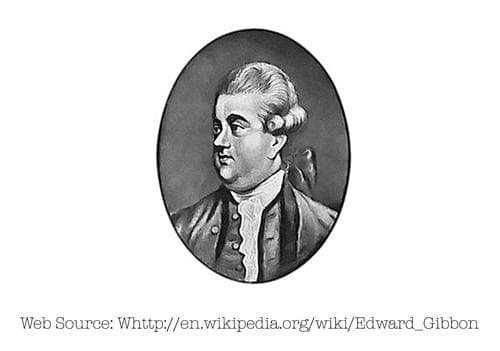
Edward Gibbon was an English historian and writer active in the 18th century, best known for his work "The Decline and Fall of the Roman Empire." This influential historical narrative examines the reasons behind the fall of Rome and has had a lasting impact on the study of history. Gibbon's analytical approach and literary style have made his work a significant contribution to historical literature.
Similar books
- Meditations
Marcus Aurelius
4.2 (124k) average on GoodreadsLeadershipProvides insight into the philosophical and moral landscape of the Roman elite during a period of imperial strength, offering a contrast to Gibbon's focus on decline.
- 1984
George Orwell
4.2 (3.1M) average on GoodreadsPoliticsIn a future where surveillance and thought control are absolute, a man's search for truth clashes with the Party, showing that hope can be a form of rebellion.
- Animal Farm
George Orwell
4.0 (2.7M) average on GoodreadsPoliticsA farm animals' rebellion against humans turns into a pig-led dictatorship, showing how power corrupts and revolutionary ideals are betrayed.
- Freakonomics: A Rogue Economist Explores the Hidden Side of Everything
Steven D. Levitt
4.0 (709k) average on GoodreadsBusinessThis book uses economic principles to reveal the surprising incentives behind everything from drug dealing and real estate to cheating teachers and the decline of crime.
- I Am Malala: The Story of the Girl Who Stood Up for Education and Was Shot by the Taliban
Malala Yousafzai
4.1 (419k) average on GoodreadsPoliticsA teenage girl from a Taliban-controlled valley refuses to give up her books, becoming a global voice for education even after an assassination attempt.
- Atlas Shrugged
Ayn Rand
3.7 (354k) average on GoodreadsPoliticsIn a dystopian America where innovators vanish, a brilliant heiress races to uncover the truth behind the disappearing industrialists and the enigmatic John Galt, who vows to stop the world's progress.





Enjoyed the summary?
A summary gives you the shape of the book. The book itself has the detail, the examples and the voice.
Find The Decline and Fall of the Roman Empire on AmazonAs an Amazon Associate, BookBrief earns from qualifying purchases. How we're funded