
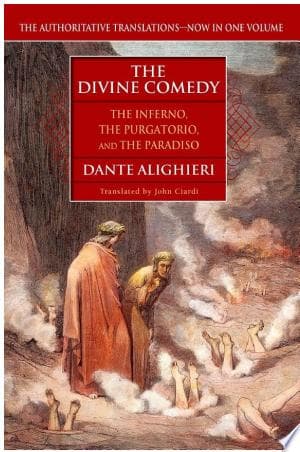
Synopsis
Covers the whole plot, including the ending.
- Difficulty
- Hard
- Pacing
- Moderate
- Mood
- Philosophical, Spiritual, Epic, Reflective, Intense
- Read it if
- You are interested in classic epic poetry, theological allegories, or a foundational text of Western literature that explores sin, redemption, and divine love.
- Skip it if
- You dislike lengthy allegorical narratives, religious themes, or challenging historical texts with extensive allusions.
The Divine Comedy Plot Summary
Covers the whole plot, including the ending.
Lost in the Dark Wood and the Appearance of Virgil
On the night before Good Friday in 1300, Dante Alighieri gets lost in a dark wood, which represents his spiritual confusion and sin. He tries to climb a hill for salvation but is stopped by three beasts: a leopard (lust), a lion (pride), and a she-wolf (avarice). These push him back into the darkness. Just as he gives up hope, the ghost of the Roman poet Virgil appears. Virgil says Beatrice, Dante's beloved, sent him from Heaven to guide Dante. He suggests a journey through Hell and Purgatory. After that, Beatrice will lead Dante through Paradise, since Virgil, a pagan, cannot enter Heaven.
Through the Gates of Hell and Limbo
Dante, at first unsure, accepts Virgil's help. They pass through Hell's gate, which has the words, 'Abandon all hope, ye who enter here.' First, they see the Vestibule, where the 'neutrals' — those who did neither good nor evil — are punished by chasing a banner forever and being stung by wasps and flies. Next, they cross the Acheron River, ferried by Charon, to Limbo, Hell's First Circle. Here live unbaptized infants and good pagans, including philosophers, poets, and heroes like Homer, Ovid, and Virgil. They have no physical pain but feel eternal sorrow, wanting a God they can never know.
The Circles of Incontinence and Violence
As they go deeper, Dante and Virgil meet Minos, who judges the damned by coiling his tail to show the circle of Hell. They go through the Circles of Incontinence: the Second (Lust), where souls are caught in a storm; the Third (Gluttony), where Ciacco talks about Florence's political problems amid icy rain and mud; and the Fourth (Avarice and Prodigality), where misers and spendthrifts push heavy weights forever. They then pass through the muddy Styx, where the wrathful fight and the sullen gurgle under the surface. After a hard trip through the City of Dis, guarded by fallen angels and Furies, they enter the Sixth Circle (Heresy), where heretics lie in flaming tombs. The Seventh Circle (Violence) has three rings: against neighbors (in boiling blood), against self (as trees), and against God, nature, and art (on burning sands).
The Circles of Fraud and Treachery
With Geryon, a monster that represents fraud, they go down to the Eighth Circle, Malebolge ('Evil Pouches'). This is a series of ten ditches for those who committed simple fraud. Here, Dante sees panders and seducers whipped by demons, flatterers in excrement, simoniacs buried headfirst in rock with flaming feet, sorcerers with twisted heads, corrupt politicians in boiling pitch, hypocrites in lead cloaks, thieves tormented by snakes, fraudulent counselors in flames, and schismatics mutilated and healed repeatedly. After this trip, they reach the Ninth Circle, Cocytus, a frozen lake where those who committed treachery are held. This circle has four rings: Caina (traitors to family), Antenora (traitors to country), Ptolomea (traitors to guests), and Judecca (traitors to lords and benefactors).
Satan and the Ascent to Purgatory
At Hell's center, in Judecca's deepest part, Dante and Virgil face Lucifer, a monstrous three-headed devil frozen in ice up to his waist. Lucifer chews on the three greatest traitors: Judas Iscariot, Brutus, and Cassius. His flapping wings create the icy winds that keep Cocytus frozen. To leave Hell, Virgil guides them down Lucifer's hairy side, past Earth's center, where gravity changes. They then climb a long, dark passage, coming out on the other side of the world, just before dawn on Easter Sunday, to see the stars again. This marks their escape from Hell and the start of their journey to Purgatory.
The Shores of Purgatory and Ante-Purgatory
Leaving Hell, Dante and Virgil are on the shores of Mount Purgatory, an island mountain in the southern hemisphere. Cato of Utica, Purgatory's guardian, greets them and tells them how to get ready for the climb. Here, Dante's face is cleaned of Hell's grime, and he is given a rush belt. They then enter Ante-Purgatory, where souls who put off repenting wait to begin purification. These include the excommunicated, the lazy, those who died violent deaths without last rites, and careless rulers. Dante meets people he knows, including Manfred of Sicily and Sordello, who lead them to the valley of negligent princes.
The Seven Terraces of Purgatory
An angel guides Dante and Virgil into Purgatory. Dante has seven 'P's (for 'peccatum' or sin) written on his forehead, one for each deadly sin. They climb the seven terraces, each for one of the seven deadly sins, from most to least severe: Pride, Envy, Wrath, Sloth, Avarice/Prodigality, Gluttony, and Lust. On each terrace, souls do specific penances that counter their sin. For example, the proud carry heavy stones, the envious have their eyes sewn shut, and the gluttonous are always hungry and thirsty. As Dante passes each terrace, an angel removes one 'P' from his forehead, meaning he is purified.
The Earthly Paradise and Beatrice's Arrival
After climbing the seven terraces, Dante and Virgil arrive at the Earthly Paradise, the Garden of Eden, at Mount Purgatory's top. Here, Dante meets Matilda, a woman who explains the garden's beauty and the two rivers, Lethe (which erases sin's memory) and Eunoë (which brings back good deeds' memory). As a procession symbolizing the Church approaches, Virgil, having finished his role as a guide for human reason, quietly leaves. Suddenly, Beatrice comes down from a chariot, veiled and grand. Her arrival marks a change. She strongly scolds Dante for straying from virtue after her death, making him cry and truly repent.
Through the Spheres of Heaven: The Moon to the Sun
Purified by Lethe and strengthened by Eunoë, Dante is ready to go to Paradise. Beatrice, who represents divine revelation and theology, guides him. They go through the nine celestial spheres of Ptolemaic cosmology. In the First Sphere (the Moon), Dante meets souls who broke their vows. In the Second (Mercury), he sees those who sought honor but were just. In the Third (Venus), he sees souls whose love was earthly. In the Fourth (the Sun), he is surrounded by theologians and wise men, including Thomas Aquinas and St. Bonaventure, who discuss divine wisdom and God's creation.
From Mars to the Primum Mobile
Dante and Beatrice continue their climb. In the Fifth Sphere (Mars), Dante sees Christian warriors and martyrs, forming a shining cross. In the Sixth Sphere (Jupiter), he meets just rulers and judges, who form an eagle, symbolizing divine justice. In the Seventh Sphere (Saturn), he finds contemplative souls, going up and down a golden ladder. Beyond the planetary spheres, they reach the Eighth Sphere (the Fixed Stars), where Dante is tested on Faith, Hope, and Charity by St. Peter, St. James, and St. John. Finally, they reach the Ninth Sphere (the Primum Mobile), the outermost sphere that moves all others, where Dante sees the angelic orders moving around a central light.
The Empyrean and the Beatific Vision
Leaving the Primum Mobile, Dante and Beatrice go to the Empyrean, the Tenth and final sphere. This is not a physical place but a realm of pure light and thought, God's true home, with angels and the blessed. Here, Beatrice becomes her most beautiful, then, having brought Dante to the edge of divine vision, she takes her place in the Celestial Rose, a large, multi-layered amphitheater of blessed souls. St. Bernard of Clairvaux becomes Dante's last guide, leading him to see God directly. Dante's mind is overwhelmed by the mystery of the Trinity and the Incarnation, a vision of unity and love that he cannot fully understand. His will finally matches divine love, and his journey ends in peace and spiritual fulfillment.
Principal Figures
Dante Alighieri
Protagonist
The pilgrim and narrator, lost in sin and seeking spiritual redemption.
Dante is the protagonist and first-person narrator of The Divine Comedy. Initially portrayed as a man lost in a 'dark wood' of sin and spiritual confusion, his journey through Hell, Purgatory, and Paradise is a metaphorical representation of his own soul's purification and ascent towards God. He is a deeply emotional and intellectual character, often displaying fear, pity, and wonder. His capacity for learning and questioning drives the narrative, as he seeks understanding of divine justice, love, and the mysteries of faith. He frequently engages in philosophical and theological debates with the souls he encounters, reflecting his own intellectual struggles and growth. His ultimate goal is to achieve the Beatific Vision and reconcile his earthly life with divine truth.
Relationships: Virgil (mentor and guide through Hell and Purgatory, representing human reason); Beatrice Portinari (divine guide through Paradise, representing divine grace and revelation); St. Bernard of Clairvaux (final guide to the Beatific Vision in the Empyrean); Francesca da Rimini (a soul in Hell for lust, evoking Dante's pity); Ugolino della Gherardesca (a soul in Hell for treachery, whose story horrifies Dante)
Virgil
Supporting
Dante's guide through Hell and Purgatory, symbolizing human reason.
Virgil is the revered ancient Roman poet, author of the Aeneid, who serves as Dante's primary guide through the infernal and purgatorial realms. He represents human reason, classical wisdom, and moral philosophy, capable of leading Dante to the limits of human understanding. As a pagan, he resides in Limbo and cannot enter Paradise, symbolizing that reason alone cannot achieve salvation without divine grace. He is patient, protective, and knowledgeable, often explaining the punishments and theological principles to Dante. His departure at the summit of Mount Purgatory, when Beatrice takes over, signifies the point where human reason must yield to divine revelation.
Relationships: Dante Alighieri (student and protégé, whom he guides and protects); Beatrice Portinari (the one who sent him to guide Dante); Sordello (fellow poet and countryman encountered in Purgatory)
Beatrice Portinari
Supporting
Dante's divine guide through Paradise, symbolizing divine grace and revelation.
Beatrice was Dante's beloved in earthly life, inspiring much of his early poetry. In The Divine Comedy, she transcends her historical figure to become a powerful symbol of divine grace, theological knowledge, and revealed truth. It is she who, from Heaven, sends Virgil to rescue Dante from the dark wood. She takes over as Dante's guide at the summit of Mount Purgatory, leading him through the nine spheres of Paradise to the Empyrean. Her presence illuminates Dante's understanding of divine love and the mysteries of faith. She is stern yet loving, rebuking Dante for his past sins before guiding him to ever-greater spiritual enlightenment, eventually taking her place in the Celestial Rose as St. Bernard takes over for the final vision.
Relationships: Dante Alighieri (beloved and spiritual guide); Virgil (the one she sent to guide Dante first)
Lucifer (Satan)
Antagonist
The ultimate embodiment of evil and treachery, imprisoned at the center of Hell.
Lucifer, also known as Dis or Satan, is the ultimate antagonist in The Divine Comedy, though he appears only at the very end of Inferno. He is depicted as a colossal, hideous monster, frozen from the waist down in the ice of Cocytus, the lowest circle of Hell. With three faces, he chews eternally on the three greatest traitors: Judas Iscariot, Brutus, and Cassius. His once-beautiful wings, now bat-like, create the icy wind that freezes Cocytus. He represents the ultimate perversion of God's creation, the embodiment of evil, treachery, and rebellion against divine love. His power is not active torment but rather a passive, grotesque symbol of the consequence of ultimate sin, serving as a pivot point for Dante and Virgil's exit from Hell.
Relationships: Dante Alighieri (the pilgrim who witnesses his punishment); God (the divine being he rebelled against)
Francesca da Rimini
Supporting
A soul in the Second Circle of Hell (Lust), whose tragic story profoundly affects Dante.
Francesca da Rimini is one of the most famous figures Dante encounters in the Second Circle of Hell, where the lustful are swept by an eternal tempest. She was a historical figure who, along with her lover Paolo Malatesta, was murdered by her husband. Her eloquent and sorrowful account of how a shared reading of the Lancelot romance led to their adultery and death deeply moves Dante, causing him to swoon with pity. Her story highlights the destructive power of uncontrolled passion and the complexities of human sin, even eliciting a compassionate response from the pilgrim, who initially struggles to reconcile divine justice with such tragic human circumstances.
Relationships: Paolo Malatesta (her lover, suffering with her in Hell); Dante Alighieri (the pilgrim who listens to her story)
Ugolino della Gherardesca
Supporting
A soul in the Ninth Circle of Hell (Treachery), eternally devouring his betrayer.
Count Ugolino della Gherardesca is a powerful and horrifying figure encountered in Antenora, the second ring of Cocytus, for betraying his country. He is perpetually gnawing on the head of Archbishop Ruggieri, who imprisoned Ugolino and his sons, eventually starving them to death. Ugolino's chilling narrative of his and his children's slow demise from hunger, and the implied act of cannibalism, is one of the most graphic and emotionally disturbing passages in the Inferno. His story exemplifies the extreme suffering and moral degradation found in the lowest depths of Hell, showcasing the brutal justice for treachery and the horrific consequences of political betrayal and revenge.
Relationships: Archbishop Ruggieri (his betrayer and eternal victim in Hell); Dante Alighieri (the pilgrim who listens to his horrific tale)
St. Bernard of Clairvaux
Supporting
Dante's final guide in the Empyrean, interceding for the Beatific Vision.
St. Bernard of Clairvaux, a 12th-century Cistercian abbot and mystic, takes over as Dante's guide in the Empyrean, the highest sphere of Paradise, after Beatrice returns to her place in the Celestial Rose. Bernard represents contemplative prayer, mystical intuition, and devotion to the Virgin Mary, which are necessary for the final approach to God. He guides Dante through the Celestial Rose, explaining its order, and then offers a profound prayer to the Virgin Mary, asking her to intercede on Dante's behalf so that he may receive the Beatific Vision. His role underscores the belief that human reason and even theological knowledge must ultimately yield to grace and spiritual contemplation to fully apprehend the divine.
Relationships: Dante Alighieri (the pilgrim he guides to the Beatific Vision); Virgin Mary (to whom he prays for Dante's sake)
Matilda
Supporting
A mysterious woman in the Earthly Paradise, explaining its rivers and symbolism.
Matilda is a beautiful and enigmatic woman whom Dante encounters in the Earthly Paradise (the Garden of Eden) at the summit of Mount Purgatory. She is often interpreted as a symbol of humanity's original innocence, the active life, or pre-lapsarian perfection. She guides Dante through the garden, explaining the significance of the two rivers, Lethe (which cleanses the memory of sin) and Eunoë (which restores the memory of good deeds), and preparing him for the arrival of Beatrice. Her joyful and serene presence contrasts sharply with the suffering souls of Purgatory, signifying the renewed hope and purity available before ascending to Paradise.
Relationships: Dante Alighieri (the pilgrim she guides through the Earthly Paradise)
Cato of Utica
Supporting
The guardian of the shores of Purgatory, symbolizing moral freedom.
Cato the Younger, a Roman statesman who committed suicide rather than live under Caesar's tyranny, is paradoxically appointed by God as the guardian of the shores of Purgatory. He represents moral freedom, unwavering commitment to virtue, and the pursuit of true liberty. His presence at the entrance to Purgatory, a realm of purification and spiritual freedom, is significant, as he chastises Dante and Virgil for their initial distraction and instructs them on the proper rituals for cleansing before beginning the ascent. His stern but just demeanor sets the tone for the serious work of repentance and spiritual growth that awaits the souls in Purgatory.
Relationships: Dante Alighieri (the pilgrim he instructs); Virgil (the guide he recognizes and respects)
Themes & Insights
Divine Justice and Retribution (Contrapasso)
Divine justice is key in The Divine Comedy, especially in the Inferno. Punishments in Hell are not random; they fit the sin, a concept called 'contrapasso' — 'by suffering you learn.' For example, the lustful are always swept by a storm, like their uncontrolled passions in life. The gluttonous lie in freezing mud, like their indulgence in earthly pleasures. The treacherous are frozen in ice, like their cold betrayal. This idea continues in Purgatory, where penances directly counter the sin (e.g., the proud carry heavy stones to humble them). In Paradise, souls live in spheres according to their virtues, showing God's justice in rewarding goodness.
“Justice moved my high maker; / Divine Power made me, / And Wisdom and Primal Love.”
Redemption and Spiritual Journey
The whole story is an allegory of spiritual redemption. Dante's initial state of being 'lost in a dark wood' means he strayed from righteousness. His trip through Hell makes him face sin and its results, leading to a deeper understanding of evil. Purgatory shows the hard work of purification and repentance, where the soul actively tries to get rid of sinful habits. Paradise means reaching spiritual enlightenment, union with God, and happiness. This journey is a universal comparison for the human soul's ability to repent, grow, and find salvation through divine grace.
“To get out of the dark, into the clear, / I climbed towards the light upon a hill.”
Reason vs. Faith/Revelation
This theme is shown by Dante's two main guides: Virgil and Beatrice. Virgil, who represents human reason and classical philosophy, can guide Dante through Hell and Purgatory's moral and intellectual challenges, up to where human intellect cannot understand divine mysteries. But to go to Paradise and understand God, Dante needs Beatrice, who symbolizes divine grace, revelation, and theology. This difference shows Dante's belief that reason is important for moral guidance and understanding the natural world, but faith and divine help are needed for salvation and true spiritual enlightenment. The change from Virgil to Beatrice marks the shift from earthly to heavenly knowledge.
“But since I am not able to go there, / The Lady who now guides you will prepare / A worthier guide, for she is more than I.”
Love (Human and Divine)
Love is a varied and constant theme. Earthly, often sinful, love is in Hell, like Francesca and Paolo's tragic passion, which led to their damnation. In Purgatory, love drives both sin (misguided or too much love) and repentance (love for God). In Paradise, love becomes the main divine principle. The whole universe moves because of divine love, and blessed souls are united in a perfect, harmonious love for God. Beatrice, as Dante's beloved, becomes a symbol of this divine love, leading him to its source. The journey ends with Dante understanding that 'the Love that moves the sun and other stars' also guides his own will.
“Love, which absolves no loved one from loving, / Seized me so strongly with his charm that, / As you can see, he does not yet desert me.”
The Role of Poetry and Language
Dante's Divine Comedy explores how much language, especially poetry, can and cannot describe the inexpressible. As a poet, Dante often struggles to find words to convey Hell's horrors, Purgatory's beauty, and especially Paradise's glory. He often calls on the Muses and says his own 'fantasy' cannot fully capture his visions. The poem itself shows the poet's goal to use Italian to create a work with epic scope and theological depth, making the language more important and showing its ability for deep expression. Through talking with other poets like Virgil, Statius, and Sordello, Dante also thinks about poetry's history and purpose.
“My mind, which was entirely rapt, / Was now fixed on a single point / Of my desire, and my will was fixed.”
Plot Devices & Literary Techniques
Allegory
The entire poem functions as an extended allegory, where characters, places, and events represent abstract ideas.
The Divine Comedy is a masterwork of allegory. Dante's journey is not just a literal trip through the afterlife but a symbolic representation of the human soul's struggle with sin, repentance, and salvation. The 'dark wood' symbolizes spiritual confusion, the three beasts represent major sins (lust, pride, avarice), and Virgil embodies human reason. Each circle of Hell and terrace of Purgatory allegorically depicts the nature and consequences of specific sins, while Paradise allegorizes the virtues and the journey towards divine knowledge. This layered meaning allows the poem to function as both a literal narrative and a profound theological and moral treatise.
Terza Rima
A specific three-line rhyme scheme that gives the poem a continuous, linked structure.
Dante invented and famously employed 'terza rima' (third rhyme) for The Divine Comedy. This interlocking rhyme scheme follows an ABA BCB CDC pattern, and so on. This structure creates a sense of continuous forward movement, driving the narrative relentlessly onward. The linked nature of the rhymes also reflects the interconnectedness of divine justice, the layers of the afterlife, and the theological arguments within the poem. It is a highly disciplined and challenging form that allowed Dante to achieve both poetic beauty and intellectual rigor, providing a unique musicality and flow to the extensive narrative.
Symbolism of Numbers
The pervasive use of the numbers three and nine, reflecting Christian theology and the structure of the cosmos.
The numbers three and nine are profoundly symbolic throughout the Comedy, reflecting the Christian Trinity and medieval cosmology. The poem is divided into three canticles (Inferno, Purgatorio, Paradiso). Each canticle, with the exception of Inferno having 34 cantos (to make a total of 100 with the introductory canto), has 33 cantos. Hell has nine circles, Purgatory has nine parts (Ante-Purgatory, seven terraces, and Earthly Paradise), and Paradise has nine celestial spheres plus the Empyrean. Dante is blocked by three beasts, guided by three guides (Virgil, Beatrice, St. Bernard), and experiences visions of the Trinity. This numerical symbolism reinforces the poem's theological framework and its intricate, divinely ordered structure.
In Medias Res
The narrative begins in the middle of the protagonist's story, specifically in the middle of his life.
The Divine Comedy begins 'in medias res,' Latin for 'in the midst of things.' Dante states, 'Midway upon the journey of our life / I found myself within a forest dark.' This opening immediately plunges the reader into Dante's spiritual crisis without extensive prologue, mirroring the suddenness of his predicament. This technique creates immediate engagement and mystery, allowing the backstory of how Dante became lost to unfold gradually through his reflections and the revelations of his guides. It also positions the journey as a pivotal turning point in an already established life, rather than a starting point, emphasizing its redemptive purpose.
Allusion and Intertextuality
Extensive references to classical mythology, history, philosophy, and biblical texts.
Dante's work is rich with allusions, drawing heavily on classical literature (especially Virgil, Ovid, and Lucan), Roman history, Greek philosophy (Aristotle), and, most importantly, Christian scripture and theology. These allusions serve multiple purposes: they establish Dante's intellectual authority, enrich the narrative with layers of meaning, and place his spiritual journey within a vast cultural and religious context. For instance, the presence of mythological figures like Charon and Minos in Hell or Cato in Purgatory integrates classical tradition into a Christian worldview, demonstrating Dante's synthesis of ancient wisdom with medieval theology. This intertextuality invites readers to engage with a broad spectrum of human knowledge.
The Divine Comedy Quotes
“Midway upon the journey of our life I found myself within a forest dark, for the straightforward pathway had been lost.”
“Abandon all hope, ye who enter here.”
“The darkest places in hell are reserved for those who maintain their neutrality in times of moral crisis.”
“Love, that absolves no one beloved from loving, seized me so strongly with his charm that, as you see, it has not left me yet.”
“Consider your origin; you were not made to live like brutes, but to follow virtue and knowledge.”
“There is no greater sorrow than to recall a happy time when miserable.”
“He who sees a need and waits to be asked is a poor almsgiver.”
“The more a thing is perfect, the more it feels both good and bad.”
“From a little spark may burst a mighty flame.”
“The love that moves the sun and the other stars.”
“The path to paradise begins in hell.”
“O human race, born to fly upward, why at a little wind dost thou fall down?”
“Beauty awakens the soul to act.”
“Nature is the art of God.”
Quiz
10 questions on the plot and the characters. Each answer comes with a short explanation.
Question 1
Who guides Dante through the circles of Hell and up the mountain of Purgatory?
- Virgil
- Beatrice
- Charon
- St. Bernard
Show answer
A. Virgil Virgil, the Roman poet, is Dante's primary guide through the Inferno and Purgatorio, symbolizing human reason.
Question 2
What is the name of the first river Dante encounters in Hell, which souls must cross?
- Lethe
- Acheron
- Styx
- Phlegethon
Show answer
B. Acheron Souls are ferried across the Acheron by Charon to enter the first circle of Hell, Limbo.
Question 3
Which of the following sins is punished in the lowest circle of Hell, Cocytus?
- Gluttony
- Wrath
- Treachery
- Lust
Show answer
C. Treachery Cocytus is a frozen lake where those guilty of treachery against kin, country, guests, and benefactors are eternally trapped, with Lucifer himself at its center.
Question 4
What does Beatrice symbolize in 'The Divine Comedy'?
- Human reason and philosophy
- Divine love and revelation
- Poetic inspiration and earthly beauty
- Political justice and civic virtue
Show answer
B. Divine love and revelation Beatrice, Dante's idealized love, guides him through Paradise, representing divine love, grace, and theological truth, which human reason (Virgil) cannot fully comprehend.
Question 5
In Purgatory, souls undergo purification for their sins. What is the overall purpose of this process?
- To earn forgiveness for unforgivable sins committed on Earth
- To suffer eternal punishment for lesser transgressions
- To cleanse themselves of the stain of sin before entering Paradise
- To choose between ultimate salvation and damnation
Show answer
C. To cleanse themselves of the stain of sin before entering Paradise Purgatory is a place of temporary suffering and penitence for those who repented their sins before death, allowing them to purify their souls and become worthy of Heaven.
Question 6
Which historical figure is depicted as the ultimate traitor, eternally consumed by Lucifer in the ninth circle of Hell?
- Brutus
- Cassius
- Judas Iscariot
- Ugolino della Gherardesca
Show answer
C. Judas Iscariot Lucifer has three mouths, perpetually chewing on the three greatest traitors: Judas Iscariot (betrayer of Christ), and Brutus and Cassius (betrayers of Caesar, symbolizing betrayal of the Roman Empire).
Question 7
As Dante ascends through the spheres of Paradise, what is the primary change he observes in Beatrice?
- She becomes increasingly silent and withdrawn.
- Her beauty intensifies with each ascent, reflecting increased divine grace.
- She gradually transforms into an angel.
- Her knowledge diminishes, requiring Dante to explain more.
Show answer
B. Her beauty intensifies with each ascent, reflecting increased divine grace. With each higher sphere in Paradise, Beatrice's beauty becomes more dazzling and radiant, overwhelming Dante, which signifies the increasing manifestation of divine love and truth.
Question 8
What is the structure of 'The Divine Comedy' in terms of its poetic form?
- It is written in rhyming couplets.
- It primarily uses blank verse.
- It is composed in terza rima (interlocking three-line stanzas).
- It follows a strict sonnet sequence.
Show answer
C. It is composed in terza rima (interlocking three-line stanzas). Dante invented terza rima (ABA BCB CDC...) for 'The Divine Comedy,' a unique and challenging rhyme scheme that gives the poem its distinctive rhythm and structure.
Question 9
In the final Canto of Paradiso, what ultimate vision is Dante granted that transcends human comprehension?
- A detailed map of the entire cosmos.
- The unified vision of God as three co-equal circles, representing the Holy Trinity.
- A glimpse into the future of humanity.
- The faces of all those destined for salvation.
Show answer
B. The unified vision of God as three co-equal circles, representing the Holy Trinity. At the very end of his journey, Dante is granted a direct, ineffable vision of God as three interlocking circles, representing the Holy Trinity, a moment of profound spiritual illumination.
Question 10
Why is Virgil unable to accompany Dante into Paradise?
- He chose to remain in Limbo, his eternal dwelling.
- As a pagan, he was not baptized and therefore cannot enter Heaven.
- He committed a grievous sin in Purgatory that prevented his ascent.
- Dante requested a different guide for the final leg of the journey.
Show answer
B. As a pagan, he was not baptized and therefore cannot enter Heaven. Virgil, though a virtuous pagan, lived before the time of Christ and was not baptized. Therefore, he is confined to Limbo and cannot enter the celestial spheres of Paradise, symbolizing the limits of human reason without divine grace.
The Divine Comedy FAQ
What is 'The Divine Comedy' about?
The Divine Comedy is an epic poem detailing Dante Alighieri's allegorical journey through the afterlife: Hell (Inferno), Purgatory (Purgatorio), and Heaven (Paradiso). Guided first by the Roman poet Virgil and later by his beloved Beatrice, Dante encounters various souls and learns about divine justice, human sin, and the path to salvation.
Why should I read 'The Divine Comedy'?
You should read 'The Divine Comedy' for its profound exploration of Christian theology, philosophy, and human nature, as well as its immense literary and historical significance. It offers a rich tapestry of vivid imagery, complex characters (both historical and mythical), and a deeply personal quest for understanding divine love and justice, influencing countless works of art and literature since its creation.
What is the background/setting of 'The Divine Comedy'?
The poem is set during Easter Week of 1300, beginning on Maundy Thursday. The journey takes Dante through the nine circles of Hell, up the seven terraces of Mount Purgatory, and finally through the nine celestial spheres of Paradise, culminating in the Empyrean. The setting is a meticulously structured medieval Christian cosmos, reflecting scholastic philosophy and theological understanding of the era.
What are the most memorable quotes?
Some memorable quotes include 'Abandon all hope, ye who enter here' from the gates of Hell, 'The darkest places in hell are reserved for those who maintain their neutrality in times of moral crisis,' and 'Love, that moves the sun and other stars.' These lines encapsulate the poem's themes of divine justice, moral responsibility, and ultimate divine love.
What writing style does the author use?
Dante employs a highly structured and allegorical style, primarily using terza rima (an interlocking three-line rhyme scheme) in hendecasyllabic (eleven-syllable) lines. His language is vivid and descriptive, blending high poetic diction with colloquialisms, making the complex theological concepts accessible through powerful imagery and deeply personal emotional expression.
What minor details add significant meaning?
The specific torments in Hell are meticulously tailored to the sins committed, reflecting a profound understanding of contrapasso, where punishment fits the crime. For instance, the wrathful are eternally immersed in the Styx, fighting each other, while the gluttonous lie in a filthy slush, tormented by Cerberus. These details underscore the precision of divine justice.
What are some subtle foreshadowing moments?
Early in the Inferno, Dante's repeated fainting spells and moments of extreme pity for the damned subtly foreshadow his own spiritual transformation. His initial human reactions to suffering gradually give way to a more detached, divinely informed understanding of justice, preparing him for the ascent through Purgatory and Paradise.
What unexpected character connections exist?
An unexpected connection is Dante's encounter with Brunetto Latini, his former teacher, in the circle of the sodomites. Despite Latini's damnation, Dante expresses profound respect and sorrow, highlighting the complex human relationships that transcend even divine judgment and illustrating the poet's struggle with personal affection versus theological condemnation.
What are unspoken character motivations?
Virgil's unspoken motivation for guiding Dante stems not just from Beatrice's request, but also from a deep, almost paternal compassion for Dante's lost state. His guidance is a journey of redemption not for himself (as he is confined to Limbo) but for the human soul he shepherds, embodying the power of reason to lead one towards faith.
What psychological complexities do characters exhibit?
Francesca da Rimini, damned for carnal lust, exhibits the psychological complexity of self-deception and rationalization, blaming 'Love' for her sin with Paolo. Her eloquent yet unrepentant narrative reveals how human passion can blind individuals to moral truth, even in the face of eternal consequence.
What are the major emotional turning points?
A major emotional turning point is Dante's final encounter with Beatrice in the Earthly Paradise. Her stern rebuke of his past sins and his subsequent confession and purification in the rivers Lethe and Eunoë mark a profound shift from human frailty and sorrow to spiritual renewal and readiness for divine contemplation.
How do relationship dynamics evolve?
The relationship dynamics evolve significantly: Dante's initial reliance on Virgil as a guide of reason transforms into a spiritual dependence on Beatrice, who represents divine revelation and grace. This shift signifies Dante's progression from earthly knowledge to heavenly wisdom, culminating in the ultimate union with God.
Which parts remain ambiguous or open-ended?
While the theological framework is explicit, the ultimate fate of some historical figures not explicitly placed in Hell, Purgatory, or Paradise remains ambiguous. Readers are left to ponder the nuances of divine judgment for individuals whose lives presented moral complexities not easily categorized, reflecting the mystery of God's will.
What are controversial scenes or decisions?
One controversial aspect is the placement of certain historical figures, like Pope Boniface VIII, into Hell even though he was alive at the time of the poem's setting. This strong political statement by Dante, driven by his Florentine exile and Ghibelline sympathies, demonstrates his willingness to condemn powerful figures he deemed corrupt, sparking debate among readers.
'The Divine Comedy' ending explained: how it ends & what it means
The Divine Comedy ends with Dante reaching the Empyrean, the highest heaven, where he experiences a direct, ineffable vision of God, described as three circles of light representing the Holy Trinity. This culminates his spiritual journey, signifying the ultimate union of the aspiring soul with Divine Love, which 'moves the sun and other stars,' achieving eternal salvation and understanding.
About the author
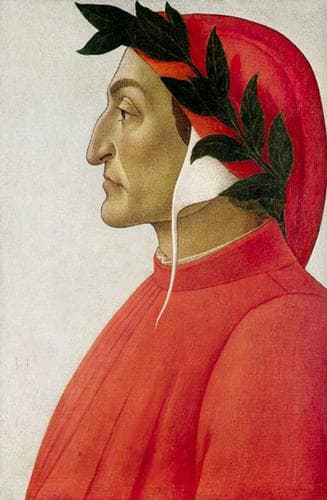
Dante Alighieri, most likely baptized Durante di Alighiero degli Alighieri and often referred to as Dante, was an Italian poet, writer and philosopher. His Divine Comedy, originally called Comedìa and later christened Divina by Giovanni Boccaccio, is widely considered one of the most important poems of the Middle Ages and the greatest literary work in the Italian language.
Similar books
- Paradise Lost
John Milton
4.1 (6k) average on GoodreadsMysteryBoth are epic poems exploring theological themes of good, evil, and the divine.
- The Aeneid
Virgil
3.8 (107k) average on GoodreadsFantasyA foundational epic poem from classical antiquity, featuring the guide Virgil himself.
- Harry Potter and the Sorcerer's Stone
J.K. Rowling
4.5 (7M) average on GoodreadsFantasyRescued from a miserable life under the stairs, an orphaned boy discovers he's a wizard destined for a magical school, where he uncovers a dangerous secret tied to the dark wizard who murdered his parents.
- The Hunger Games
Suzanne Collins
4.3 (6.4M) average on GoodreadsFantasyIn a future where children fight to the death on live television, Katniss Everdeen volunteers for the arena, turning a death sentence into a fight for survival and a spark of rebellion.
- 1984
George Orwell
4.2 (3.1M) average on GoodreadsPoliticsIn a future where surveillance and thought control are absolute, a man's search for truth clashes with the Party, showing that hope can be a form of rebellion.
- Divergent
Veronica Roth
4.2 (2.9M) average on GoodreadsFantasyIn a society divided by virtues, a sixteen-year-old's difference from the norm starts a rebellion that threatens her world.





Enjoyed the summary?
A summary gives you the shape of the book. The book itself has the detail, the examples and the voice.
Find The Divine Comedy on AmazonAs an Amazon Associate, BookBrief earns from qualifying purchases. How we're funded