
Synopsis
Covers the whole plot, including the ending.
- Difficulty
- Medium (for solving the mystery, Easy for reading)
- Pacing
- Variable (Slow for poring over illustrations, Moderate for text)
- Mood
- Playful, Mysterious, Engaging, Whimsical
- Read it if
- You enjoy intricate seek-and-find illustrations, rhyming text, and a delightful mystery that encourages active participation from the reader.
- Skip it if
- You prefer straightforward narratives without interactive elements or puzzles.
The Eleventh Hour Plot Summary
Covers the whole plot, including the ending.
Horace's Eleventh Birthday Invitation
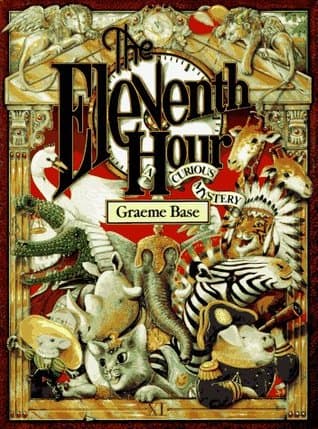
Horace, a magnificent elephant, turns eleven years old. To celebrate, he hosts a lavish costume party at his opulent home. He sends ornate invitations to his diverse animal friends, requesting their presence for a feast and festivities. The invitations mention the eleventh hour as a significant time, and Horace meticulously plans every detail, from the grand decorations to the delectable birthday feast. The stage is set for a joyous celebration with exotic guests from around the world.
Arrival of the Guests
As the eleventh hour approaches, Horace's mansion fills with his distinguished guests, all dressed in spectacular costumes. There is a graceful gazelle as an astronaut, a cunning fox as a pirate, a stately lion as a Roman emperor, and many more. Each arrival is a spectacle, with the animals greeting Horace and admiring the grand setting. The atmosphere is full of excitement and anticipation for the party to fully begin. Horace, in his own regal attire, warmly welcomes each of his friends, ensuring everyone feels comfortable and ready for the celebration.
Games and Merriment
The birthday celebration begins with games and musical performances. Guests play 'Pin the Tail on the Donkey' and 'Musical Chairs,' filling the grand halls with laughter and cheerful shouts. A troupe of monkeys provides lively jazz music, encouraging everyone to dance. Horace circulates among his friends, ensuring everyone has a splendid time. The party is in full swing, creating a festive and joyful atmosphere, completely unaware of the impending mystery.
The Grand Feast Revealed
At the height of the festivities, Horace proudly announces the unveiling of the grand birthday feast. He leads his assembled guests to the dining hall, where a colossal table is laden with an extraordinary array of culinary delights: towering cakes, platters of exotic fruits, savory pies, and numerous other delicacies. The sight is magnificent, designed to impress and satisfy every palate. The guests gasp in admiration at the sheer abundance and artistry of the spread, eagerly anticipating the moment they can begin to partake in the meal.
The Shocking Discovery
Just as Horace prepares to invite his guests to begin eating, a collective gasp of disbelief echoes through the dining hall. To everyone's shock and dismay, the magnificent feast has vanished. Every single dish, every cake, every fruit, and every pie has been completely devoured, leaving only empty platters and crumbs. The grandeur of moments before is replaced by stunned silence and confusion. Horace, initially bewildered, quickly realizes a mystery is afoot: someone has eaten the entire birthday feast before it was meant to be served.
Initial Confusion and Suspicions
Confusion and murmuring sweep through the assembled animals. Each guest looks around, trying to discern who could possibly have committed such an audacious act. Whispers and accusations begin to circulate as friends start to eye each other with suspicion. The festive atmosphere quickly dissipates, replaced by intrigue and a touch of mistrust. Horace, though disappointed, maintains his composure and realizes he must solve this perplexing mystery to salvage his birthday celebration. The party has taken an unexpected turn into a whodunit.
Clues in the Illustrations
As the story progresses, Graeme Base's detailed illustrations become crucial in solving the mystery. Readers are encouraged to meticulously examine each scene, noticing subtle visual discrepancies, changes in character positions, and small details that might point to the culprit. For instance, some animals might appear in different places than expected, or certain clues, like crumbs or tell-tale objects, might be hidden in plain sight. These visual hints work with the rhyming text, providing a non-verbal layer of information for the observant reader.
Clues in the Text
The clever rhyming text of 'The Eleventh Hour' offers another layer of clues for the reader detective. Through carefully crafted verses, the narrator provides indirect hints and observations about the guests and the events leading up to the feast's disappearance. These textual clues might describe a character's unusual behavior, an object they were holding, or a particular trait that, when combined with the visual evidence, helps to narrow down the suspects. The text often uses playful language, making the mystery engaging and accessible for young readers while still challenging them to think critically.
The Reader's Challenge
The narrative explicitly invites the reader to become the detective. After presenting the initial mystery and providing both visual and textual clues, the book poses a direct challenge to its audience: 'Can *you* solve the mystery of who ate the feast?' This interactive element is central to the book's appeal, encouraging active engagement rather than passive consumption. Readers are prompted to re-examine the preceding pages, cross-reference information, and use their deductive reasoning skills to arrive at a conclusion. The book empowers its readers to be part of the story.
The Solution and Revelation
After the reader has had an opportunity to deduce the culprit, the final pages of the book provide the definitive answer to the mystery. It is revealed that the culprit was Joey, a small mouse, who, despite his size, managed to sneakily consume the entire feast by continuously returning to the table throughout the party, unnoticed by the larger guests. The book then meticulously explains how each visual and textual clue, from the slight changes in the illustrations to the subtle hints in the rhymes, pointed towards Joey, validating the efforts of observant readers and providing a satisfying conclusion to the puzzle.
The Eleventh Hour's Significance
Beyond the mystery of the eaten feast, the title 'The Eleventh Hour' holds a deeper, subtle significance that is hinted at throughout the book and confirmed in the solution. While initially seeming to refer to the time of the party, it also alludes to the fact that Joey, the mouse, was the eleventh guest to arrive at the party. This clever double meaning adds another layer of ingenuity to Graeme Base's storytelling, rewarding readers who pay close attention to every detail, from the character introductions to the numbering of guests. It reinforces the book's theme of hidden details and observation.
The Eleventh Hour Characters
Horace
Protagonist
The grand elephant host of the birthday party.
Horace is a magnificent and generous elephant who loves to host elaborate parties. He is meticulous in his planning, ensuring every detail, from the decorations to the food, is perfect for his guests. He possesses a calm demeanor, even when faced with the shocking disappearance of his birthday feast, and is more intrigued by the mystery than outwardly angry. He embodies hospitality and a sense of fair play, trusting his friends despite the unusual circumstances.
Relationships: Joey (Host to guest (unwitting victim of Joey's appetite)); Various Animal Guests (Host to friends and acquaintances)
Joey
Antagonist (The Culprit)
The small mouse who devours the entire birthday feast.
Joey is a seemingly unassuming and small mouse, the eleventh guest to arrive at Horace's party. His diminutive size allows him to move about unnoticed, and his incredible appetite leads him to consume the entirety of the grand feast before anyone else has a chance. He is the master of stealth and opportunism, using the chaos and revelry of the party as a cover for his audacious act. Despite being the 'culprit,' his role is presented with a sense of playful mischievousness rather than malice.
Relationships: Horace (Guest who secretly eats the host's food); Various Animal Guests (Fellow guest, oblivious to his actions)
Sir Alistair
Supporting
A stately lion dressed as a Roman emperor.
Sir Alistair is a proud and regal lion who attends Horace's party dressed in a magnificent Roman emperor costume. He is one of the more prominent guests, often seen in the foreground of illustrations, adding to the visual grandeur of the party. His reactions to the missing feast are typical of the other guests: initially shocked, then suspicious. He serves as an important red herring, due to his imposing presence and the common stereotype of lions being hearty eaters.
Relationships: Horace (Guest and friend); Various Animal Guests (Fellow party-goer)
Lady Ada
Supporting
A graceful gazelle dressed as an astronaut.
Lady Ada is an elegant and graceful gazelle, dressed in a striking astronaut costume. She embodies poise and sophistication, moving delicately through the party scenes. Her presence adds to the exotic and diverse nature of Horace's guest list. Like the other guests, she reacts with surprise and confusion when the feast is discovered missing. Her costume and demeanor make her an unlikely, yet visually interesting, suspect.
Relationships: Horace (Guest and friend); Various Animal Guests (Fellow party-goer)
Professor Featherwing
Supporting
A wise owl dressed as a great explorer.
Professor Featherwing is an owl, depicted with an air of intelligence and observation, dressed as a renowned explorer. His spectacles and scholarly appearance suggest a keen mind, making him a character the reader might initially consider as a potential solver of the mystery. He is observant but ultimately as bewildered as the other guests by the feast's disappearance, serving as another part of the diverse and intriguing guest list.
Relationships: Horace (Guest and friend); Various Animal Guests (Fellow party-goer)
Captain Bluebeard
Supporting
A cunning fox dressed as a pirate.
Captain Bluebeard is a wily fox, perfectly suited to his pirate costume, complete with an eye-patch and a mischievous grin. His character plays into the stereotype of a cunning and potentially sneaky individual, making him a plausible, albeit ultimately incorrect, suspect for the reader. He is depicted enjoying the party's games and music, adding to the lively atmosphere before the mystery unfolds.
Relationships: Horace (Guest and friend); Various Animal Guests (Fellow party-goer)
The Monkeys
Supporting
A troupe of musicians providing entertainment.
A lively group of monkeys forms the jazz band, providing the musical entertainment for Horace's party. They are depicted playing various instruments and adding to the energetic and festive atmosphere. Their presence is crucial for establishing the celebratory mood and for creating some of the visual 'busyness' that helps to distract from Joey's actions. They are not suspects in the mystery but are integral to the party's setting.
Relationships: Horace (Hired entertainers); Various Animal Guests (Entertainers for the party-goers)
The Eleventh Hour Themes
Observation and Deduction
The central theme of the book is the importance of keen observation and logical deduction. Readers are explicitly challenged to scrutinize the detailed illustrations and the nuanced rhyming text to solve the mystery of the missing feast. Every page contains subtle clues—changes in character positions, minute details on costumes, or specific phrases in the verse—that, when pieced together, reveal the culprit. This theme encourages active engagement and critical thinking, as seen in the repeated invitation for the reader to 'look again' at the scenes to find the truth.
“But who could have done it? That's the puzzle, you see! / For the answer, dear reader, depends now on thee!”
Appearances vs. Reality
This theme explores how initial perceptions can be misleading. The grand, imposing figures like Sir Alistair (the lion) or Captain Bluebeard (the fox) are obvious suspects due to their size or 'cunning' nature, yet the true culprit is the smallest and seemingly most innocuous guest, Joey the mouse. The lavishness of the party itself also masks the quiet, unseen act of theft. The book teaches that one should look beyond superficial appearances and examine hidden details to uncover the truth, challenging stereotypes and preconceived notions.
“The smallest of creatures, so quiet and sly, / Was the one who ate everything, beneath every eye.”
The Joy of Celebration
Despite the central mystery, the book portrays the joy and excitement of a grand celebration. Horace's birthday party is a spectacle of costumes, lively music, and games, filled with diverse and exotic characters. The initial scenes emphasize the delight of friendship and festivity, setting a cheerful tone before the mystery unfolds. Even after the feast is discovered missing, the underlying spirit of fun and gathering remains, highlighting the importance of shared experiences and community.
“For the grandest of parties, with friends far and near, / Was the best way to banish all worries and fear.”
Artistic Detail and Engagement
Graeme Base's signature style, characterized by incredibly intricate and detailed illustrations, is a core theme itself. The book is designed to be pored over, with every inch of the page offering new discoveries. Beyond the mystery, the artistic richness—the patterns on the walls, the hidden creatures, the elaborate costumes—encourages readers to engage deeply with the visual narrative. This theme celebrates the power of art to tell a story and to invite prolonged, active interaction from the audience, making the book a visual treasure hunt.
“And the cleverest readers, with eyes sharp and bright, / Will find every detail, a wondrous delight.”
Plot Devices & Literary Techniques
Red Herring
Misleading clues or characters designed to distract the reader.
The book employs several red herrings, primarily through its character portrayals and initial visual cues. Large, imposing animals like Sir Alistair (the lion) or the 'cunning' Captain Bluebeard (the fox) are presented in ways that might lead a reader to suspect them, playing on stereotypes of their species. Their prominent placement in illustrations and certain textual descriptions subtly divert attention from the actual culprit. This device challenges the reader to look beyond obvious suspects and delve deeper into the less conspicuous details.
Hidden Clues in Illustrations
Subtle visual details embedded within the artwork that reveal the truth.
Graeme Base's distinctive artistic style is a key plot device. Each illustration is meticulously detailed and contains numerous subtle clues that, when observed closely, point to the culprit. These clues include changes in character positions between pages, crumbs or food stains appearing near certain characters, the presence of specific objects that relate to the feast, and even the gradual alteration of the feast itself. This device demands active visual engagement from the reader, making the pictures integral to solving the mystery.
Rhyming Narrative as Clue-Giver
The poetic text provides verbal hints and riddles to guide the investigation.
The rhyming text is not just a stylistic choice but a functional plot device that delivers verbal clues. The verses are crafted to offer hints about the events, the characters' behaviors, or specific objects, often in a playful or riddle-like manner. For instance, the text might draw attention to a character's actions without explicitly stating their guilt, or it might subtly emphasize the 'eleventh' aspect, which is critical to the solution. This device works in tandem with the visual clues, requiring careful reading and interpretation.
Interactive Narrative
The story directly addresses and challenges the reader to solve the mystery.
This book uses an interactive narrative device by directly addressing the reader and inviting them to participate in solving the mystery. The narrator explicitly asks questions like 'But who could it be?' and encourages the reader to 'look again.' This breaks the fourth wall, transforming the reader from a passive observer into an active detective. This device enhances engagement, personalization, and provides a sense of accomplishment when the reader successfully deduces the culprit based on the provided clues.
The Eleventh Hour Quotes
“There was once a an elephant, who was called Horace, and Horace was having a birthday party.”
“All sorts of exotic animals had been invited: a leopard, a lion, a tiger, a bear, a gorilla, a pig, a bat, a vulture, a warthog, a rhinoceros, a dromedary, and even a hippopotamus!”
“They ate and they ate, and they ate some more. They ate so much that the table was groaning under the weight of it all.”
“When the clock struck eleven, Horace announced that it was time for the games to begin.”
“But when they went to open the trunk, they found it was empty! The feast was gone!”
“Horace was very upset. 'Who could have done such a thing?' he trumpeted.”
“Each animal had a motive, and each animal had an opportunity.”
“It was a puzzle, a riddle, a mystery waiting to be solved.”
“Look closely at the pictures, and you will find the clues.”
“The answers are there, if you only know where to look.”
“Every page holds a secret, every detail a hint.”
“The truth is often hidden in plain sight.”
“It takes a sharp eye and a clever mind to uncover the culprit.”
“And so, the mystery of the Eleventh Hour feast remained, for those who dared to solve it.”
Quiz
10 questions on the plot and the characters. Each answer comes with a short explanation.
Question 1
What kind of animal is Horace, whose eleventh birthday party is being celebrated?
- A lion
- An elephant
- A bear
- A hippopotamus
Show answer
B. An elephant Horace, the birthday boy, is clearly identified as an elephant both in the book's description and illustrations.
Question 2
What is the central mystery that occurs during Horace's birthday party?
- Someone has stolen Horace's birthday presents.
- Someone has eaten the entire birthday feast.
- Someone has ruined the party games.
- Someone has damaged Horace's house.
Show answer
B. Someone has eaten the entire birthday feast. The core mystery of 'The Eleventh Hour' revolves around the disappearance of the birthday feast, which has been eaten by one of the guests.
Question 3
What specific item is Horace wearing as part of his costume at the party?
- A jester's hat
- A pirate's eye patch
- A knight's helmet
- A wizard's cloak
Show answer
C. A knight's helmet Horace, the elephant, is depicted wearing a knight's helmet as part of his costume for his eleventh birthday party.
Question 4
Which of the following phrases best describes the nature of Horace's party guests?
- All domestic farm animals
- A diverse group of exotic animals in costumes
- Only other elephants
- Humans dressed as animals
Show answer
B. A diverse group of exotic animals in costumes The book explicitly states that Horace invites his 'exotic friends' and the illustrations clearly show a wide variety of animals from different regions, all in elaborate costumes.
Question 5
According to the narrative, at what specific time does Horace discover the feast is gone?
- Just before midnight
- At precisely eleven o'clock
- Early in the morning after the party
- During the first hour of the party
Show answer
B. At precisely eleven o'clock The book's title, 'The Eleventh Hour,' directly refers to the moment the feast is discovered missing, which is at eleven o'clock, corresponding to Horace's eleventh birthday.
Question 6
What unique feature of the book's illustrations is crucial for solving the mystery?
- They contain hidden letters that spell out the culprit's name.
- They include secret messages written in invisible ink.
- They provide visual clues and details that complement the rhyming text.
- They change when viewed under different colored lights.
Show answer
C. They provide visual clues and details that complement the rhyming text. The book is famous for its lavish, detailed illustrations that hide clues, often in the form of specific objects, numbers, or details that point towards the identity of the feast-eater.
Question 7
What is a recurring visual motif or element found in the illustrations that helps the reader track progress or find clues?
- A specific type of flower hidden on each page
- A small clock showing the time advancing on each page
- The culprit's shadow subtly appearing in every scene
- A map of Horace's house with 'X' marks the spot
Show answer
B. A small clock showing the time advancing on each page A key detail in the illustrations is the presence of clocks that subtly advance an hour with each page turn, leading up to 'The Eleventh Hour' when the feast is discovered missing.
Question 8
Beyond the mystery, what overarching theme does the book encourage in its young readers?
- The importance of sharing and generosity.
- Developing observational skills and critical thinking.
- The value of forgiveness and second chances.
- Understanding different animal habitats.
Show answer
B. Developing observational skills and critical thinking. The book is designed to engage readers in solving the mystery by carefully examining the detailed illustrations and text, thereby encouraging observational skills and critical thinking.
Question 9
Which of Horace's guests is strongly implied to be the culprit through a combination of textual and visual clues?
- Sir Alistair the Anteater
- Lady Adelaide the Aardvark
- Hugo the Hippo
- Millicent the Mouse
Show answer
C. Hugo the Hippo Through various clues, including the size of the 'eleven' on a cake, the remnants found, and the general appearance of the guests, Hugo the Hippo is strongly implicated as the feast-eater.
Question 10
What is the significance of the number '11' throughout the book, besides Horace's age and the time of discovery?
- It represents the number of guests at the party.
- It is hidden in various forms within the illustrations as recurring clues.
- It's the number of different dishes served at the feast.
- It indicates the number of pages in the book.
Show answer
B. It is hidden in various forms within the illustrations as recurring clues. The number '11' is a pervasive motif, subtly integrated into many illustrations (e.g., in patterns, shapes, or groups of objects), serving as additional visual clues for the reader.
The Eleventh Hour FAQ
What is the central mystery of 'The Eleventh Hour'?
The central mystery revolves around who ate Horace the elephant's lavish birthday feast during his costume party. All the exotic animal guests are suspects, and the reader must use clues hidden in the text and illustrations to solve the puzzle.
Who is Horace, and what is special about his birthday?
Horace is an elephant, and he is celebrating his eleventh birthday, which is a significant milestone for him. He hosts a grand costume party for his diverse group of animal friends to mark the occasion.
What kind of event does Horace host for his birthday?
Horace hosts a splendid costume party, inviting various exotic animals. The party features games, music, and general revelry, setting the scene for the mysterious disappearance of the birthday feast.
How does the book engage the reader in solving the mystery?
The book engages the reader by presenting clues through both its rhyming text and its highly detailed, lavish illustrations. Readers are encouraged to pore over the pictures and text to piece together the evidence and determine the culprit.
What makes the illustrations in 'The Eleventh Hour' unique and important?
The illustrations are unique for their lavish detail and serve a crucial role beyond aesthetics, as they contain many of the visual clues necessary to solve the mystery. Readers must carefully observe every element, from costumes to background objects, to find the truth.
What is the significance of the 'Eleventh Hour' in the title?
The 'Eleventh Hour' refers directly to Horace's eleventh birthday, marking the specific time of the party and the year of his life. It also subtly hints at the urgency and the 'last moment' aspect of solving the mystery before the truth is fully revealed.
Are there any recurring visual motifs or hidden messages in the illustrations that aren't immediately obvious?
Yes, beyond the direct clues, Graeme Base often includes hidden letters, numbers, and even a small mouse character (Waldo) in his illustrations across his books. In 'The Eleventh Hour,' careful observation of patterns, shadows, and subtle changes in characters' appearances can reveal crucial, often overlooked, details.
How do the character costumes provide clues to their personalities or potential guilt?
Each character's costume is carefully chosen and often reflects an aspect of their personality or a subtle hint towards their actions, whether it's their true nature or a red herring. For example, some costumes might be impractical for eating, while others might suggest a stealthy or gluttonous nature.
What role does the 'rhyming text' play in providing clues, beyond just telling the story?
The rhyming text isn't just for narrative flow; it often includes clever wordplay, subtle misdirections, or direct observations that, when re-read, point towards specific suspects or eliminate others. Key phrases about characters' actions or whereabouts are crucial textual clues.
How might the party games and activities influence who had the opportunity to eat the feast?
The descriptions of the party games and activities, such as 'blind man's bluff' or 'musical chairs,' can provide alibis or opportunities. Knowing who was engaged in what activity, and when, helps narrow down which characters had the freedom or distraction to sneak away and consume the food.
What psychological aspects of deception and blame does the book explore?
The book subtly explores how individuals might attempt to conceal their actions or shift blame onto others. Each character's reaction to the missing feast, their body language, and their alibis can be analyzed for signs of guilt, nervousness, or genuine surprise, reflecting basic human (or animal) psychology of deception.
How does the book encourage critical thinking and observation in young readers?
By requiring readers to actively search for clues in both text and image, the book fosters critical thinking and observational skills. It teaches deductive reasoning, pattern recognition, and the importance of paying attention to detail, making the reader an active participant in the story.
Could the mystery be interpreted as a commentary on gluttony or selfishness?
Yes, the act of one individual consuming an entire feast meant for many can be seen as a commentary on gluttony and selfishness. The resolution often highlights the consequences of such actions, even in a lighthearted children's context, emphasizing consideration for others.
Is there a definitive 'right' answer to who ate the feast, or is it open to interpretation?
Graeme Base books typically provide a definitive 'right' answer, which is usually revealed at the end or through a solution page. However, the joy lies in the process of discovery, and the initial ambiguity allows for various interpretations and debates among readers before the truth is uncovered.
What is the broader message or theme of 'The Eleventh Hour' beyond solving a mystery?
Beyond the mystery, the book celebrates creativity, imagination, and the joy of discovery. It encourages readers to look deeper, question assumptions, and appreciate the intricate details in both art and storytelling, fostering a love for books and problem-solving.
How do the individual animal characters' species influence their potential as suspects?
The species of each animal character can influence their potential as suspects by suggesting certain traits or physical capabilities. For example, a character known for stealth might be a more plausible culprit than one known for being clumsy, adding another layer to the deductive process.
What is the significance of the 'eleven' motif throughout the book?
Beyond Horace's age, the number eleven is subtly integrated into many of the illustrations. Searching for eleven specific objects, patterns, or occurrences on each page often reveals additional layers of detail and can sometimes even provide a meta-clue to the overall mystery, reinforcing the book's intricate design.
How might a child's understanding of fairness or justice be engaged by the book's premise?
A child's sense of fairness is directly engaged by the premise that someone unfairly consumed the feast meant for everyone. The desire to find the culprit and see justice served becomes a strong motivator for solving the mystery, reinforcing concepts of shared resources and accountability.
About the author

Graeme Base is an Australian author and illustrator known for his children's books that often feature intricate illustrations and engaging narratives. His notable work, The Eleventh Hour, combines a mystery with a visual puzzle, inviting readers to solve clues alongside the story. Base's contributions to children's literature have garnered significant recognition in the field.
Similar books
- Harry Potter and the Sorcerer's Stone
J.K. Rowling
4.5 (7M) average on GoodreadsFantasyRescued from a miserable life under the stairs, an orphaned boy discovers he's a wizard destined for a magical school, where he uncovers a dangerous secret tied to the dark wizard who murdered his parents.
- The Hunger Games
Suzanne Collins
4.3 (6.4M) average on GoodreadsFantasyIn a future where children fight to the death on live television, Katniss Everdeen volunteers for the arena, turning a death sentence into a fight for survival and a spark of rebellion.
- 1984
George Orwell
4.2 (3.1M) average on GoodreadsPoliticsIn a future where surveillance and thought control are absolute, a man's search for truth clashes with the Party, showing that hope can be a form of rebellion.
- Divergent
Veronica Roth
4.2 (2.9M) average on GoodreadsFantasyIn a society divided by virtues, a sixteen-year-old's difference from the norm starts a rebellion that threatens her world.
- The Hobbit, or There and Back Again
J.R.R. Tolkien
4.3 (2.9M) average on GoodreadsFantasyA comfort-loving hobbit named Bilbo Baggins is whisked away by a mischievous wizard and a band of dwarves on an unexpected journey to reclaim stolen treasure from a fearsome dragon, discovering courage and a magical ring along the way.
- Animal Farm
George Orwell
4.0 (2.7M) average on GoodreadsPoliticsA farm animals' rebellion against humans turns into a pig-led dictatorship, showing how power corrupts and revolutionary ideals are betrayed.






Enjoyed the summary?
A summary gives you the shape of the book. The book itself has the detail, the examples and the voice.
Find The Eleventh Hour on AmazonAs an Amazon Associate, BookBrief earns from qualifying purchases. How we're funded