
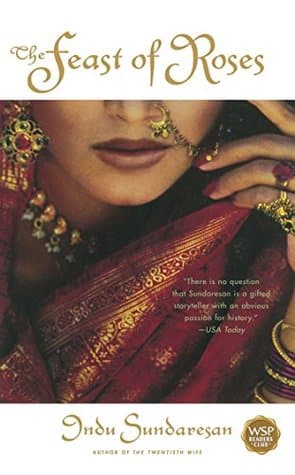
Synopsis
Covers the whole plot, including the ending.
- Difficulty
- Medium
- Pacing
- Moderate
- Mood
- Atmospheric, Grand, Romantic, Intriguing, Dramatic
- Read it if
- You enjoy lush historical fiction set in Mughal India, focusing on powerful female figures and political intrigue.
- Skip it if
- You prefer fast-paced action over detailed historical context and character development, or are not interested in court politics.
The Feast of Roses Plot Summary
Covers the whole plot, including the ending.
The Empress's Ascent
After marrying Emperor Jahangir, Mehrunnisa, now Nur Jahan, quickly establishes herself in the imperial harem. She faces immediate opposition from Empress Jagat Gosini, Jahangir's first wife and mother of Prince Khurram, who sees Nur Jahan as a threat to her son's claim to the throne. Nur Jahan, however, uses her intelligence and Jahangir's devotion to her advantage. She begins to take part in court affairs, at first offering subtle advice to Jahangir, then gradually expanding her role beyond what was traditional for a Mughal empress. Her actions challenge established norms, earning her both admiration and resentment from the court's powerful men.
The Junta's Formation
Understanding the need for a stronger political base, Nur Jahan forms a powerful group with her trusted allies. This inner circle includes her father, Itimad-ud-Daula, who becomes the imperial treasurer; her brother, Asaf Khan, a skilled military commander; and, surprisingly, Prince Khurram, Jahangir's third son. Khurram, though Jagat Gosini's son, sees the benefit of aligning with Nur Jahan, who promises him support for his eventual succession. This alliance allows Nur Jahan to bypass traditional court rules and directly influence state decisions, upsetting established ministers like Mahabat Khan, who resent her growing authority.
The Royal Wedding of Ladli
Nur Jahan arranges the marriage of her daughter, Ladli Begum, to Jahangir's youngest son, Prince Shahryar. This strategic alliance further strengthens Nur Jahan's family's position within the imperial line, as Shahryar is now a potential contender for the throne, backed by Nur Jahan. Ladli, initially hesitant and wanting a different match, eventually agrees to her mother's will, though with personal sadness. The wedding is a grand event, showing Nur Jahan's organizational skills and her family's rising status. The event also subtly highlights the growing distance between Nur Jahan and Prince Khurram, who sees this marriage as a direct threat to his own ambitions.
The Whispers of Rebellion
As Nur Jahan's power continues to grow, so does the resentment among the court's old guard. Ministers like Mahabat Khan openly question her authority and influence over Emperor Jahangir, whom they see as increasingly dependent on her. Rumors of dissent and possible rebellion begin to spread, fueled by those who believe a woman should not hold such power. Prince Khurram, at first an ally, grows more suspicious of Nur Jahan's plans, especially after Ladli's marriage to Shahryar. He fears Nur Jahan is trying to put Shahryar on the throne instead of him, creating clear tension within the imperial family and court.
Jahangir's Declining Health
Emperor Jahangir's health begins to worsen significantly, marked by his increasing opium and alcohol addiction. This decline makes Nur Jahan's direct involvement in governing the empire even more necessary. She takes on more administrative duties, issuing royal decrees and even appearing at the jharokha (balcony) to receive petitions, a privilege usually reserved for the emperor. While this gives her great power, it also makes her more open to criticism and opposition. The empress is now seen as the actual ruler, a position that many, including powerful nobles and members of the royal family, find unacceptable and a usurpation of male authority.
Khurram's Defiance
Feeling his claim to the throne threatened by Nur Jahan's actions and Shahryar's rise, Prince Khurram openly rebels against his father, Emperor Jahangir, and Nur Jahan's influence. He raises an army and marches towards Agra, challenging imperial authority. This rebellion throws the empire into civil war, forcing Nur Jahan to act decisively. She shows remarkable courage and strategic skill, personally directing imperial forces and managing the war effort, even accompanying Jahangir on campaigns. Her leadership during this crisis confirms her reputation as a strong political and military figure, though it strains her relationship with her daughter, Ladli, who is married to Shahryar.
The Capture of Jahangir
During the ongoing rebellion and political unrest, Mahabat Khan, a powerful general and long-time opponent of Nur Jahan, stages a coup. He captures Emperor Jahangir while the imperial camp is moving, effectively holding the emperor hostage. This bold move directly challenges Nur Jahan's authority and tries to dismantle her power. Nur Jahan, showing great determination, refuses to surrender. She gathers her remaining loyal forces, including her brother Asaf Khan, and devises a daring plan to rescue Jahangir, risking her own life. The situation pushes her leadership and courage to their limits.
Nur Jahan's Counter-Coup
With Jahangir held by Mahabat Khan, Nur Jahan plans a brilliant and risky counter-coup. She personally leads a small group of loyal soldiers across a river under enemy fire, trying to free the Emperor. Though her initial direct attack fails, she uses her intelligence and influence to create disunity among Mahabat Khan's forces and communicate secretly with Jahangir. Through clever negotiation, strategic moves, and using the Emperor's authority from his captivity, Nur Jahan manages to turn the situation against Mahabat Khan, eventually securing Jahangir's release and restoring imperial control. This event confirms her legend as a powerful and astute empress.
The Emperor's Final Days
After his release and the end of immediate threats, Emperor Jahangir's health continues to decline. He becomes increasingly frail and dependent on Nur Jahan. The empire remains unstable, with the question of succession looming. Nur Jahan dedicates herself to caring for Jahangir, managing the empire, and trying to secure the future for her chosen successor, Prince Shahryar. However, the political situation remains tense, as Prince Khurram, though defeated, still has significant support and waits for his chance. The love between Jahangir and Nur Jahan remains strong, even amidst the political unrest.
The Succession Crisis
Upon Emperor Jahangir's death, the long-expected succession crisis begins. Nur Jahan, still determined to see her son-in-law Shahryar on the throne, immediately crowns him in Lahore. However, Prince Khurram, who had reconciled with Jahangir shortly before his death and was already moving his forces, quickly asserts his claim. Nur Jahan's brother, Asaf Khan, despite his previous alliance with her, betrays her by aligning with Khurram, seeing him as the stronger and more legitimate heir. This betrayal is a crushing blow to Nur Jahan, as Khurram's forces quickly gain the upper hand, leading to a decisive fight for control of the vast Mughal Empire.
Nur Jahan's Retreat
After a brief but intense struggle, Prince Khurram, now Emperor Shah Jahan, wins. Nur Jahan's chosen successor, Shahryar, is defeated and executed. Facing the new emperor's overwhelming power and her own brother's betrayal, Nur Jahan accepts her fate with dignity. She retires from public life, choosing to live her remaining years in Lahore, focusing on architecture and poetry. Though stripped of her political power, her legacy as the most powerful woman in Mughal history remains. Her story ends with her reflecting on her extraordinary life, her love for Jahangir, and the great power she once held behind the veil.
The Feast of Roses Characters
Mehrunnisa (Nur Jahan)
Protagonist
The ambitious and intelligent twentieth wife of Emperor Jahangir, who rises to become the most powerful woman in the Mughal Empire.
Mehrunnisa, later bestowed the title Nur Jahan ('Light of the World'), is a woman of extraordinary intelligence, beauty, and ambition. Having faced a challenging early life, she enters the imperial harem with a clear understanding of power dynamics. She is fiercely independent, refusing to conform to traditional expectations of an empress. Her sharp political mind, strategic cunning, and unwavering determination allow her to navigate the treacherous Mughal court, influencing state affairs, issuing decrees, and even leading military campaigns. She is deeply devoted to Emperor Jahangir, and their love is the foundation of her power, yet she is also driven by a desire to secure her family's legacy.
Relationships: Emperor Jahangir (Deeply loving and mutually empowering husband and wife); Itimad-ud-Daula (Father) (Supportive and trusted political ally); Asaf Khan (Brother) (Initially a key political ally, later betrays her); Ladli Begum (Daughter) (Devoted but sometimes strained by Nur Jahan's political ambitions); Empress Jagat Gosini (Bitter rival within the harem); Prince Khurram (Shah Jahan) (Complex relationship, initially an ally, later her primary political adversary)
Emperor Jahangir
Supporting
The powerful but increasingly frail Mughal Emperor, deeply in love with Nur Jahan and reliant on her counsel.
Jahangir is the reigning Mughal Emperor, a man of artistic sensibilities and a deep capacity for love, particularly for Nur Jahan. While initially a strong ruler, his health deteriorates due to opium and alcohol addiction, leading him to delegate significant power to his beloved empress. He trusts Nur Jahan implicitly, valuing her political acumen and judgment. His love for her is the catalyst for her unprecedented rise to power, and he consistently defends her against courtly opposition. Despite his weaknesses, he retains the ultimate authority, and his decisions, even when influenced by Nur Jahan, shape the empire's fate.
Relationships: Mehrunnisa (Nur Jahan) (Deeply loving and mutually empowering husband and wife); Empress Jagat Gosini (His first wife, mother of Prince Khurram, a source of political tension); Prince Khurram (Shah Jahan) (His son and heir apparent, whose rebellion causes him great distress); Prince Shahryar (His youngest son, Nur Jahan's chosen successor)
Prince Khurram (Shah Jahan)
Antagonist
Jahangir's ambitious third son and heir apparent, who becomes Nur Jahan's primary rival for power.
Prince Khurram is Jahangir's third son, born to Empress Jagat Gosini, and considered the most capable and likely successor to the throne. He is intelligent, militarily skilled, and deeply ambitious. Initially, he forms a strategic alliance with Nur Jahan, recognizing her growing influence. However, as Nur Jahan maneuvers to secure power for her own family, particularly through the marriage of Ladli to Shahryar, Khurram views her as a direct threat to his birthright. His ambition drives him to rebellion against his father and Nur Jahan, leading to a prolonged power struggle that ultimately results in his ascension as Emperor Shah Jahan.
Relationships: Mehrunnisa (Nur Jahan) (Initially an ally, later his primary political adversary); Emperor Jahangir (His father, whom he rebels against but later reconciles with); Empress Jagat Gosini (Mother) (His mother, who supports his claim to the throne); Asaf Khan (His father-in-law and key ally in the succession struggle)
Asaf Khan
Supporting
Nur Jahan's shrewd brother and a powerful general, who ultimately betrays her for political expediency.
Asaf Khan is Nur Jahan's younger brother, a highly intelligent and capable military commander and administrator. He is a crucial member of Nur Jahan's 'junta,' providing her with strategic advice and military support. He is ambitious and pragmatic, always looking for the most advantageous political alignment. While initially loyal to his sister and instrumental in her rise, his ultimate loyalty lies with securing his own family's position and power. In the final succession crisis, he makes the pragmatic decision to align with Prince Khurram, recognizing Khurram's superior claim and strength, leading to a profound betrayal of Nur Jahan.
Relationships: Mehrunnisa (Nur Jahan) (Brother and key political ally, later betrays her); Itimad-ud-Daula (Father) (Son and fellow member of the junta); Prince Khurram (Shah Jahan) (His son-in-law and ultimate political ally)
Itimad-ud-Daula
Supporting
Nur Jahan's wise and experienced father, who serves as a crucial advisor and imperial treasurer.
Itimad-ud-Daula, Nur Jahan's father, is a man of great wisdom, experience, and integrity. He is a respected figure in the court and serves as the imperial treasurer, bringing stability and financial acumen to the empire. He is a steadfast supporter of his daughter, providing her with invaluable advice and guidance as she navigates the complexities of court politics. His presence in Nur Jahan's 'junta' lends legitimacy and gravitas to her actions. He represents the older generation's wisdom, often tempering Nur Jahan's more impulsive tendencies with cautious counsel.
Relationships: Mehrunnisa (Nur Jahan) (Father and trusted advisor); Asaf Khan (Son) (Son and fellow member of the junta)
Ladli Begum
Supporting
Nur Jahan's daughter, whose marriage becomes a pawn in her mother's political ambitions.
Ladli Begum is Nur Jahan's beloved daughter from her first marriage. She is a gentle and somewhat melancholic character, often caught between her personal desires and her powerful mother's political ambitions. While she loves her mother, she sometimes resents being used as a pawn in the imperial game, particularly when her marriage is arranged for strategic purposes rather than love. Her marriage to Prince Shahryar makes her a central figure in Nur Jahan's succession plans, and she experiences the emotional toll of the ensuing power struggles.
Relationships: Mehrunnisa (Nur Jahan) (Daughter, often a pawn in her mother's political schemes); Prince Shahryar (Her husband, chosen by her mother for political reasons)
Empress Jagat Gosini
Antagonist
Jahangir's first wife and mother of Prince Khurram, a fierce rival to Nur Jahan.
Empress Jagat Gosini is Jahangir's first wife and the powerful mother of Prince Khurram. She represents the traditional power structure within the harem and views Nur Jahan as an unwelcome outsider and a threat to her son's rightful claim to the throne. She is cunning and manipulative, constantly plotting against Nur Jahan and trying to undermine her influence. Her deep-seated resentment and protectiveness of Khurram drive much of the early conflict within the harem and contribute to the larger political tensions at court.
Relationships: Mehrunnisa (Nur Jahan) (Bitter rival); Emperor Jahangir (His first wife, a source of political tension); Prince Khurram (Shah Jahan) (His mother, whom she fiercely supports)
Mahabat Khan
Antagonist
A powerful and respected general who resents Nur Jahan's influence and stages a coup.
Mahabat Khan is a formidable and highly respected general in the Mughal army, loyal to the traditional imperial structure. He deeply resents Nur Jahan's unprecedented political power, viewing her as a mere woman who has usurped male authority and unduly influenced the Emperor. His pride and sense of duty compel him to act against what he perceives as a corrupting influence on the empire. His bold capture of Emperor Jahangir is a desperate attempt to restore the old order and remove Nur Jahan from power, making him a significant antagonist in the latter part of the story.
Relationships: Mehrunnisa (Nur Jahan) (Primary political adversary); Emperor Jahangir (His Emperor, whom he captures out of perceived loyalty to the empire)
Prince Shahryar
Mentioned
Jahangir's youngest son, chosen by Nur Jahan as her preferred successor.
Prince Shahryar is Emperor Jahangir's youngest son and the husband of Nur Jahan's daughter, Ladli Begum. He is a less capable and ambitious prince compared to Khurram, but his marriage to Ladli makes him a pawn in Nur Jahan's succession plans. She actively promotes his claim to the throne, hoping to secure her family's future through him. His role is largely defined by Nur Jahan's ambition for him, and he ultimately becomes a casualty in the fierce succession struggle.
Relationships: Mehrunnisa (Nur Jahan) (His mother-in-law and patron); Ladli Begum (His wife)
The Feast of Roses Themes
Power and Ambition
The novel explores power and the ambition needed to wield it in a patriarchal society. Nur Jahan's journey from commoner to the de facto ruler of the Mughal Empire shows this theme. She wants power not only for personal influence but also to secure her family's legacy, often making difficult political choices. The ambition of other characters, such as Prince Khurram and Mahabat Khan, also drives the main conflicts, showing how seeking power can lead to both alliances and betrayals. The story consistently shows that power is not just inherited but must be strategically gained and fiercely defended.
“Power, she had learned, was not a gift bestowed, but a prize seized from the unwilling hands of others.”
Love and Devotion
At the core of the political dealings is the deep and strong love between Emperor Jahangir and Nur Jahan. Their relationship goes beyond typical royal marriages, built on genuine affection, respect, and shared intellectual interests. Jahangir's devotion to Nur Jahan is what allows her to gain power, as he trusts her judgment completely and defends her against all critics. This love balances the harsh realities of court politics, suggesting that even in a world of ambition and betrayal, a deep personal connection can last and even thrive. It is a love that empowers, rather than diminishes, the people involved.
“His love was not a cage, but a throne upon which she found her true voice.”
Gender and Authority
The novel examines the challenges and opportunities for women seeking authority in 17th-century Mughal India. Nur Jahan constantly defies traditional gender roles, moving beyond the harem to openly participate in and even lead state affairs. Her rise challenges the deep-seated patriarchal beliefs of the court, where powerful ministers like Mahabat Khan cannot accept a woman holding such sway. The story highlights the prejudice and resistance she faces, but also her cleverness in overcoming these barriers, proving that intellect and strategic thinking are not limited by gender. Her story shows a woman's ability to command respect and wield great power in a male-dominated world.
“They saw only a woman, but she knew she was the emperor's will made manifest.”
Betrayal and Loyalty
Shifting loyalties and the certainty of betrayal are central to the political landscape of the Mughal court. Nur Jahan forms a group based on trust with her father and brother, yet her brother Asaf Khan ultimately betrays her to side with Prince Khurram during the succession crisis. This shows the practical and often ruthless nature of imperial politics, where personal ties can be sacrificed for strategic gain. Similarly, Prince Khurram's initial alliance with Nur Jahan dissolves into open rebellion when their ambitions clash. The constant threat of betrayal forces characters to be always alert and often leads to heartbreaking personal costs.
“In the dance of power, loyalty was merely a temporary costume, easily shed for a more advantageous one.”
Legacy and Immortality
The desire to leave a lasting mark on history and achieve a form of immortality through actions and monuments is a subtle but strong theme. Nur Jahan's ambition is not just for immediate power but also to ensure her family's place in history. The construction of the Taj Mahal, though not fully shown in this novel, is hinted at by the deep love between Jahangir and Nur Jahan and her architectural patronage. The characters are very aware of how history will remember them, which drives many of their decisions. Nur Jahan's eventual retirement and reflection on her life show a contemplation of her legacy beyond the temporary nature of political power.
“A name, a deed, a stone carved in memory – these were the only true victories against the relentless march of time.”
Plot Devices & Literary Techniques
The 'Junta'
Nur Jahan's inner circle of trusted family members who help her wield political power.
The 'junta' is a crucial plot device that allows Nur Jahan to circumvent traditional court structures and directly influence imperial decisions. Composed of her father, Itimad-ud-Daula, her brother, Asaf Khan, and initially Prince Khurram, this informal council provides her with legitimate channels to exercise power. It acts as her brain trust and executive arm, enabling her to appoint officials, manage finances, and direct military campaigns. The eventual dissolution of this junta, particularly Asaf Khan's betrayal, signals a major turning point in Nur Jahan's political fortunes and the escalation of the succession crisis.
The Imperial Harem as a Political Arena
The women's quarters serve as a battleground for influence and a source of political maneuvering.
The imperial harem, far from being merely a place of leisure, functions as a sophisticated political arena. It is where initial rivalries, particularly between Nur Jahan and Jagat Gosini, are forged and where subtle power plays begin. Information is exchanged, alliances are formed, and strategies are devised behind its walls. Nur Jahan's ability to dominate the harem and then extend her influence beyond it highlights her extraordinary political acumen. The harem's perceived seclusion also allows for covert plotting and the nurturing of future contenders for the throne, making it a critical backdrop for the novel's power struggles.
Emperor Jahangir's Declining Health
The Emperor's physical and mental deterioration creates a power vacuum that Nur Jahan fills.
Jahangir's increasing reliance on opium and alcohol, coupled with his physical ailments, serves as a primary catalyst for Nur Jahan's ascent to power. His declining health creates a legitimate need for someone to manage the empire's affairs, a role Nur Jahan eagerly and capably assumes. This device allows her to gradually take on more responsibilities, issue decrees, and appear in public in ways unprecedented for an empress. It also heightens the urgency of the succession crisis, as the empire's stability hinges on who will eventually take the throne, intensifying the conflict between Nur Jahan and Prince Khurram.
The Betrayal of Asaf Khan
Nur Jahan's brother's shift of allegiance from her to Prince Khurram.
Asaf Khan's betrayal is a pivotal plot device that dramatically alters the course of the succession crisis. As Nur Jahan's trusted brother and a key member of her junta, his defection to Prince Khurram's side is a devastating blow to her power. It signifies the pragmatic and often ruthless nature of Mughal court politics, where family loyalties can be overridden by strategic calculations of power and self-preservation. This betrayal not only weakens Nur Jahan's position significantly but also highlights the precariousness of even the strongest alliances when a throne is at stake, ultimately leading to her defeat.
The Feast of Roses Quotes
“There are some men who would rather have a beautiful woman and a beautiful life for a short time than a plain woman and a plain life for a long time.”
“A woman's beauty is a weapon, but a man's power is a fortress.”
“The heart, like a garden, can only hold so many flowers before some must wither to make way for new blooms.”
“To be a princess is to be a gilded cage, beautiful to behold, but forever confined.”
“History is not made by the strong alone, but by the subtle weaving of desires and ambitions, both grand and small.”
“Love, true love, is not a gentle breeze but a raging storm that uproots everything in its path.”
“The greatest battles are often fought not on fields of war, but within the chambers of the heart and mind.”
“A secret shared is a burden halved, but a secret kept is a power held.”
“The world remembers the victors, but the defeated often carry the truer stories.”
“Even a king's daughter can yearn for a simple life, a life unburdened by the weight of an empire.”
“Grief is a cloak that never truly leaves you; you merely learn to wear it with less visible pain.”
“Duty is a stern mistress, demanding much, but promising little in return save the hollow satisfaction of obedience.”
“The future is a tapestry woven with threads of choice and chance, and we are but humble weavers.”
Quiz
10 questions on the plot and the characters. Each answer comes with a short explanation.
Question 1
Which of the following best describes Mehrunnisa's relationship with Emperor Jahangir when she enters his harem?
- She was his first wife, married for political alliance.
- She was his twentieth and last wife, married for love at age thirty-four.
- She was a concubine who later gained his affection and became his wife.
- She was a childhood friend who reconnected with him in adulthood.
Show answer
B. She was his twentieth and last wife, married for love at age thirty-four. The text explicitly states Mehrunnisa comes into Jahangir's harem as his twentieth and last wife, and he marries her for love at the 'old' age of thirty-four.
Question 2
What significant power did Emperor Jahangir eventually transfer to Mehrunnisa due to his deep love for her?
- The command of the imperial army.
- The management of the imperial treasury.
- His powers of sovereignty.
- The responsibility of raising his children.
Show answer
C. His powers of sovereignty. The text states, 'He loves her so deeply that he eventually transfers his powers of sovereignty to her.'
Question 3
Who was Mehrunnisa's formidable rival within the imperial harem?
- Empress Mumtaz Mahal
- Empress Jagat Gosini
- Princess Jahanara Begum
- Sultana Ruqaiya Begum
Show answer
B. Empress Jagat Gosini The passage mentions, 'She has a formidable rival in the imperial harem, Empress Jagat Gosini, who has schemed and plotted against Mehrunnisa from early on.'
Question 4
How did Mehrunnisa combat the opposition she faced from powerful ministers at court?
- She secretly poisoned her rivals to eliminate them.
- She formed a 'junta' with her father, brother, and Prince Khurram.
- She appealed directly to the common people for support against the ministers.
- She convinced Emperor Jahangir to dismiss all opposing ministers.
Show answer
B. She formed a 'junta' with her father, brother, and Prince Khurram. The text states, 'Mehrunnisa combats all of this by forming a junta of sorts with three men she can rely on — her father, her brother, and Jahangir's son Prince Khurram.'
Question 5
What is one personal cost Mehrunnisa faced in her pursuit of power and wealth?
- She lost the love of Emperor Jahangir.
- She was exiled from the imperial court for a period.
- She almost lost her daughter's love.
- She was forced to renounce her royal title.
Show answer
C. She almost lost her daughter's love. The passage notes, 'sometimes at a cost of personal sorrow when she almost loses her daughter's love.'
Question 6
How did Mehrunnisa's identity as a woman impact the ministers' perception of her ability to hold power?
- They respected her unique perspective as a woman.
- They believed her womanhood made her inherently incapable of having a voice in the outside world.
- They saw her as a symbol of progress and modernity.
- They were indifferent to her gender, focusing only on her political skills.
Show answer
B. They believed her womanhood made her inherently incapable of having a voice in the outside world. The text states, 'These ministers, who have long had Emperor Jahangir's confidence and trust, consider Mehrunnisa a mere woman who cannot have a voice in the outside world.'
Question 7
The novel 'The Feast of Roses' is presented as the continuation of which critically praised debut novel?
- The Palace of Illusions
- The Twentieth Wife
- Shadow of the Moon
- The Elephant's Dance
Show answer
B. The Twentieth Wife The first sentence of the description explicitly states: 'The love story of Emperor Jahangir and Mehrunnisa, begun in the critically praised debut novel The Twentieth Wife, continues in Indu Sundaresan's The Feast of Roses.'
Question 8
What significant historical monument, one of the seven wonders of the world, is hinted at being the story behind 'The Feast of Roses'?
- The Great Wall of China
- The Pyramids of Giza
- The Taj Mahal
- The Colosseum
Show answer
C. The Taj Mahal The text mentions, 'This lush new novel tells the story behind one of the great tributes to romantic love and one of the seven wonders of the world -- the Taj Mahal.'
Question 9
What central theme is explored through Mehrunnisa's journey in 'The Feast of Roses'?
- The conflict between religious doctrines and royal authority.
- The challenges of maintaining power and love, specifically 'power behind a veil'.
- The importance of military conquest for expanding an empire.
- The struggle for artistic freedom in a restrictive court.
Show answer
B. The challenges of maintaining power and love, specifically 'power behind a veil'. The final sentence of the description explicitly states: 'The Feast of Roses is a tale of this power and love, the story of power behind a veil.'
Question 10
Despite her struggles, what aspect of Mehrunnisa's life did she 'never lose'?
- Her wealth and jewels.
- Her physical beauty.
- The love of Emperor Jahangir.
- Her position as the most influential woman in the empire.
Show answer
C. The love of Emperor Jahangir. The text concludes, 'But she never loses the love of the man who bestows this power upon her -- Emperor Jahangir.'
The Feast of Roses FAQ
What is the central premise of 'The Feast of Roses'?
The Feast of Roses continues the love story of Emperor Jahangir and Mehrunnisa (Empress Nur Jahan), focusing on her rise to unprecedented power within the Mughal Empire and the challenges she faces as she battles for supremacy in a male-dominated court and harem. It details how her influence ultimately inspires the creation of the Taj Mahal, a tribute to romantic love.
Who is Mehrunnisa, and why is she significant in the novel?
Mehrunnisa, also known as Empress Nur Jahan, is Emperor Jahangir's twentieth and last wife, married to him at the 'old' age of thirty-four. She is significant because she defies 17th-century Indian norms for women, becoming the first woman Jahangir marries for love and to whom he eventually transfers his sovereign powers, making her a powerful political figure.
How does Mehrunnisa acquire power, given the societal norms of the time?
Mehrunnisa acquires power through Jahangir's deep love and trust, which leads him to transfer his authority to her. She then strategically forms a 'junta' with her father, brother, and Prince Khurram to navigate court politics and battle powerful ministers, demonstrating immense strength and cunning to secure her influence.
Who is Mehrunnisa's primary rival within the imperial harem?
Mehrunnisa's primary rival within the imperial harem is Empress Jagat Gosini. Jagat Gosini has a long history of scheming and plotting against Mehrunnisa, reflecting the intense competition and power struggles among the wives for influence and the Emperor's favor.
What role does Prince Khurram play in Mehrunnisa's rise to power?
Prince Khurram, Jahangir's son, is a crucial member of the 'junta' Mehrunnisa forms. His alliance with her, alongside her father and brother, provides her with necessary support within the royal family and court, helping her to combat powerful ministers and solidify her position.
How does the novel connect Mehrunnisa's story to the Taj Mahal?
The novel portrays Mehrunnisa's extraordinary love story with Jahangir and her subsequent rise to power as the inspiration behind the Taj Mahal. While not directly building it herself, her unique relationship and influence are presented as the emotional foundation for this 'great tribute to romantic love' and one of the Seven Wonders of the World.
Are there any subtle indications of Jahangir's declining health or increasing dependence on Mehrunnisa?
The synopsis hints at Jahangir's increasing dependence by stating he 'eventually transfers his powers of sovereignty to her.' This transfer suggests a growing reliance, possibly due to his own preference for leisure, or perhaps subtly implying a decline in his capacity or interest in direct rule, making Mehrunnisa's involvement indispensable.
What is the 'cost of personal sorrow' Mehrunnisa experiences in her pursuit of power?
Mehrunnisa's pursuit of power comes at the cost of personal sorrow when she 'almost loses her daughter's love.' This suggests that her political ambitions and strategic maneuvers may have strained her relationship with her daughter, highlighting the sacrifices she made for her influence.
How does Mehrunnisa's age at marriage (thirty-four) contribute to her psychological makeup and approach to power?
Marrying at thirty-four, considered 'old' for the time, likely means Mehrunnisa enters the harem with greater maturity, life experience, and a more developed sense of self than younger brides. This could contribute to her formidable strength of character, cunning, and determination, as she has less time to establish herself and must assert her will more forcefully.
What psychological factors might drive Empress Jagat Gosini's animosity towards Mehrunnisa?
Jagat Gosini's animosity likely stems from a combination of jealousy, fear of losing status, and resentment. As Mehrunnisa gains unprecedented influence and the Emperor's deep affection, Jagat Gosini, who may have been a prominent empress previously, perceives a direct threat to her own power, children's prospects, and position within the rigid harem hierarchy.
How does Jahangir's deep love for Mehrunnisa transform his own character or reign?
Jahangir's deep love for Mehrunnisa significantly transforms his reign by leading him to break centuries of tradition and transfer his sovereign powers to her. This act suggests a profound trust and perhaps a willingness to defy established norms for the woman he loves, altering the very nature of imperial governance during his rule.
What internal conflicts might Mehrunnisa face as she balances her personal relationships with her political ambitions?
Mehrunnisa likely faces significant internal conflict, especially concerning her daughter's love, as mentioned. She must grapple with the ethical implications of her strategic maneuvers, the potential for alienating family and allies, and the emotional toll of prioritizing power and influence over more intimate, personal bonds, all while maintaining Jahangir's affection.
Is 'The Feast of Roses' primarily a feminist narrative, or does it explore the complexities of power within a patriarchal system?
While Mehrunnisa's rise is remarkable and defies patriarchal norms, the novel likely explores the complexities of power within that system rather than being purely a feminist narrative. It highlights her need to 'fight for' power and 'combat' opposition, suggesting that even with Jahangir's support, she operates within and must manipulate existing patriarchal structures, not dismantle them entirely.
How does the phrase 'power behind a veil' reflect the novel's central theme?
The phrase 'power behind a veil' encapsulates the novel's central theme by highlighting Mehrunnisa's unique position. Despite being a woman in a culture where women were often secluded, she wields immense political authority, subtly influencing decisions and governing from a position that is traditionally hidden, thereby challenging conventions while still operating within them.
Does the novel suggest that Mehrunnisa's love for Jahangir is as deep as his for her, or is it more a strategic alliance for power?
The synopsis emphasizes Jahangir's deep love for Mehrunnisa, stating he 'marries her for love' and 'loves her so deeply.' While Mehrunnisa benefits greatly from this, the text doesn't explicitly state her love is equally deep, leaving room for interpretation regarding the extent of her reciprocal affection versus her strategic appreciation for the power it affords her. It's a 'story of this power and love,' implying both are intertwined.
How might the 'powerful ministers' perceive Mehrunnisa's influence, and what does this reveal about societal attitudes?
The powerful ministers perceive Mehrunnisa's influence with disdain, considering her 'a mere woman who cannot have a voice in the outside world.' This reveals deep-seated misogyny and a rigid societal structure where political authority was exclusively male. Their opposition highlights the radical nature of Jahangir's decision and the immense challenge Mehrunnisa faced in asserting her legitimacy.
What is the significance of Mehrunnisa being Jahangir's 'twentieth and last wife'?
Being the 'twentieth and last wife' signifies that Mehrunnisa arrived late into Jahangir's life and harem, yet managed to eclipse all previous wives in influence and affection. It underscores the exceptional nature of their bond and her unique ability to capture his heart and trust beyond all others, despite the established dynamics of a large imperial harem.
Similar books
- The Twentieth Wife
Indu Sundaresan
4.0 (13k) average on GoodreadsHistorical FictionThis is the preceding book in the series, detailing Nur Jahan's early life and ascent.
- The Palace of Illusions
Chitra Banerjee Divakaruni
4.2 (34k) average on GoodreadsFantasyOffers another epic historical narrative from the perspective of a powerful woman in Indian history.
- The Other Boleyn Girl
Philippa Gregory
4.1 (456k) average on GoodreadsHistorical FictionFeatures court intrigue, powerful women, and historical romance in a royal setting.
- To Kill a Mockingbird
Harper Lee
4.3 (4.5M) average on GoodreadsHistorical FictionIn the 1930s Jim Crow South, Harper Lee writes about racial injustice, moral growth, and the quiet courage of a lawyer father, Atticus Finch, as seen through his young daughter's eyes.
- The Great Gatsby
F. Scott Fitzgerald
3.9 (3.8M) average on GoodreadsHistorical FictionIn the opulent Roaring Twenties, a mysterious millionaire's lavish parties hide his desperate, tragic pursuit of a lost love, exposing the emptiness within the American Dream.
- Pride and Prejudice
Jane Austen
4.3 (3M) average on GoodreadsHistorical FictionIn a society focused on status and money, Elizabeth Bennet navigates love and pride, challenging Mr. Darcy and social expectations to find true affection.




Enjoyed the summary?
A summary gives you the shape of the book. The book itself has the detail, the examples and the voice.
Find The Feast of Roses on AmazonAs an Amazon Associate, BookBrief earns from qualifying purchases. How we're funded