
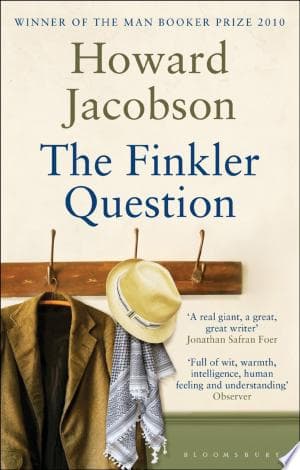
Synopsis
Covers the whole plot, including the ending.
- Difficulty
- Medium
- Pacing
- Moderate
- Mood
- Intellectual, Witty, Melancholy, Reflective, Humorous
- Read it if
- You enjoy intellectual literary fiction that explores themes of identity, belonging, and the complexities of modern Jewish life with a blend of humor and pathos.
- Skip it if
- You prefer fast-paced plots or shy away from extensive philosophical and cultural discussions.
The Finkler Question Plot Summary
Covers the whole plot, including the ending.
A Melancholy Reunion
Julian Treslove, a melancholic former BBC producer, visits his old school friend, Sam Finkler, a renowned Jewish philosopher. Both men are recently widowed, Finkler having lost his wife, Tyler, and Treslove having been left by his wife, Mandy. They are joined by their former history teacher, Libor Sevcik, also recently widowed. The three men spend the evening at Finkler's London home, drinking and reminiscing about their past, their wives, and the nature of love and loss. The conversation mixes intellectual banter, shared grief, and a sense of time passing and happiness being fragile. Treslove, as always, feels envious of Finkler's success and confidence, a feeling that has always marked their friendship.
The Mugging and its Aftermath
After leaving Finkler's house late at night, Julian Treslove walks home through London. Distracted, he is suddenly attacked from behind. His wallet and phone are stolen, and he is left shaken but not seriously injured. Immediately after, Treslove develops a peculiar belief: he thinks he was targeted because he looked Jewish. This belief takes hold despite him not being Jewish and having no outwardly Jewish features. The mugging, rather than being a random act of violence, becomes a personal affront for Treslove and a reason for a deep identity crisis, leading him to obsess over his identity and his relationship with Jewishness.
Embracing a Borrowed Identity
Following the mugging, Julian Treslove's interest in Jewishness grows. He starts reading books on Jewish history and culture, listening to Yiddish music, and tries to learn Hebrew. He begins to see Jewish symbols everywhere, projecting his new obsession onto his surroundings. He often discusses his theories about his mugging and his perceived Jewish identity with Sam Finkler, who finds Treslove's earnest but misguided attempts both amusing and unsettling. Finkler, a secular Jew, struggles to understand Treslove's sudden and intense identification with a heritage that is not his own, seeing it as both a parody and a compliment to his own background.
The Ashworths and the JPS
Treslove's journey into Jewish identity leads him to Helen and Norman Ashworth, a couple in a left-wing anti-Zionist group called 'Jews for Peace in Palestine' (JPS). He attends their meetings, drawn by their intellectual discussions and their passionate, if sometimes extreme, views. Treslove is fascinated by their strong commitment and their blend of Jewish identity and political activism. He is especially drawn to Helen, a strong-willed and intellectual woman, and finds himself increasingly involved in the group's activities, despite his superficial understanding of the complex political situation. His involvement further separates him from Finkler, who views the JPS with skepticism and often disdain.
Libor's Declining Health
As Treslove deals with his identity and new political ties, his former teacher, Libor Sevcik, shows signs of declining health. Libor, a cultured and gentle man, struggles with the loneliness of widowhood and the physical effects of aging. Treslove and Finkler both visit him regularly, offering companionship and support. Libor's fading memory and increasing frailty remind both men of mortality and the passage of time. His condition highlights the shared vulnerability of human experience, regardless of background or belief, and offers a sad contrast to Treslove's more self-absorbed identity quest.
A New Romance for Treslove
Julian Treslove, still adrift in his personal life, finds himself drawn to Helen Ashworth. Their shared intellectual interests and his fascination with her passionate commitment to the JPS turn into a romantic relationship. This further complicates Treslove's strained friendship with Sam Finkler, who strongly disapproves of the JPS and finds Helen's politics harsh. Finkler sees Treslove's involvement with Helen as another misguided attempt to find himself, a superficial engagement with serious issues. Treslove, however, feels a sense of belonging and intellectual stimulation with Helen that he has not experienced in years, even if it comes from a borrowed identity.
Finkler's New Love and a Public Outcry
Sam Finkler, after a period of intense grief, starts a new relationship with a woman named Sarah, bringing renewed happiness to his life. However, Finkler, a prominent public intellectual, becomes involved in controversy due to his nuanced and often critical views on Israel, which some perceive as anti-Semitic. He faces public condemnation and personal attacks, especially from within the Jewish community. This public scrutiny and the accusations against him cause Finkler great distress, forcing him to confront the complexities of his own Jewish identity and the political world he navigates.
Libor's Final Days
Libor Sevcik's health continues to decline rapidly. As he nears the end of his life, he has periods of clarity mixed with confusion. During these clear moments, he shares poignant reflections on his life, his love for his late wife Emmy, and the historical events he witnessed as a Czech Jew. These conversations with Treslove and Finkler offer insights into memory, loss, and the power of human connection. Libor's impending death affects both Treslove and Finkler, forcing them to confront their own mortality and the legacy of their past.
The Funeral and a Revelation
Libor Sevcik eventually dies. At his funeral, attended by Treslove, Finkler, and other friends and family, a surprising revelation comes out. It is revealed that Libor was Treslove's biological father, a secret kept for many years. This news completely changes Treslove's understanding of his own identity and his relationship with Libor. The news, delivered at the funeral, forces Treslove to re-evaluate his entire life, his parentage, and the complex relationships that have shaped him. It adds another layer of complexity to his ongoing quest for self-discovery.
Treslove's Reconciliation and Lingering Questions
Julian Treslove tries to process the revelation of his true parentage. He reflects on his relationship with Libor, now with a new, deep meaning. The discovery of his Jewish heritage through Libor, though late in life, provides a tangible link to the identity he had been seeking after the mugging. However, it also raises new questions and complexities, as he deals with a lifetime of not knowing and the implications for his sense of self. The revelation does not entirely resolve his internal conflicts but offers a new way to understand his past and present. He finds some peace in understanding his roots, though self-acceptance remains an ongoing process.
The End of JPS and a Shift in Perspective
The 'Jews for Peace in Palestine' (JPS) group, which Treslove had been deeply involved with, eventually dissolves due to internal disagreements and waning enthusiasm. This marks a turning point for Treslove. With the group no longer active, his intense political fervor begins to fade, and he starts to view the complexities of the Israeli-Palestinian conflict with a more nuanced and less rigid perspective. His relationship with Helen Ashworth also cools, as the shared political project that bound them together disappears. The experience, while initially a source of identity, proves to be a temporary phase in his search for meaning.
Finkler's Enduring Friendship
Throughout all of Treslove's identity crises, political entanglements, and personal revelations, Sam Finkler remains a constant, though often exasperated, friend. Despite their differing worldviews, Finkler's loyalty to Treslove endures. He offers a steady presence, a sounding board for Treslove's theories, and a critical, yet caring, perspective. Their friendship, rooted in shared history and mutual understanding, proves strong against the various challenges and misunderstandings that arise. The novel concludes with their friendship intact, showing the lasting power of human connection amidst the complexities of identity, grief, and the search for meaning.
The Finkler Question Characters
Julian Treslove
Protagonist
A perpetually melancholic and identity-seeking former BBC producer.
Julian Treslove is a man adrift, marked by a pervasive sense of inadequacy and a lifelong habit of comparing himself unfavorably to others, particularly his friend Sam Finkler. He is a 'gentile Jew' by obsession, a man who, after a random mugging, develops an intense and often misguided conviction that he was targeted for being Jewish. This belief propels him on a quest for identity, leading him to immerse himself in Jewish culture and politics, despite his lack of actual Jewish heritage. He is intelligent but prone to intellectual faddism, seeking meaning and belonging in external affiliations rather than within himself.
Relationships: Sam Finkler (Lifelong best friend, often a rival in Treslove's mind.); Libor Sevcik (Former teacher, later revealed to be his biological father.); Helen Ashworth (Romantic interest and fellow member of the JPS group.); Mandy (Ex-wife who left him for another man.)
Sam Finkler
Supporting
A successful and celebrated Jewish philosopher and media personality.
Sam Finkler is Julian Treslove's intellectual and successful foil. A prominent Jewish writer and television personality, Finkler is confident, articulate, and deeply rooted in his Jewish identity, though he is a secular Jew. He grapples with the complexities of modern Jewish identity, particularly in relation to Israel, and faces public scrutiny for his nuanced views. He is a loyal friend to Treslove, often exasperated by his friend's misguided quests, but always present. Finkler embodies a more grounded and mature approach to identity and belonging, contrasting with Treslove's more volatile search.
Relationships: Julian Treslove (Lifelong best friend, often a source of exasperation.); Tyler (Late beloved wife.); Sarah (New romantic partner.)
Libor Sevcik
Supporting
A gentle, cultured Czech Jewish former history teacher.
Libor Sevcik is the wise and melancholic former history teacher of Treslove and Finkler. A Czech Jew who escaped the Holocaust, he carries the weight of history and personal loss, particularly the recent death of his beloved wife, Emmy. He is a quiet, reflective man, whose gentle demeanor belies a deep well of experience and suffering. His presence serves as a poignant reminder of mortality and the enduring impact of the past. Libor represents a more traditional, historical link to Jewish identity, a stark contrast to Treslove's more performative engagement.
Relationships: Julian Treslove (Former student, later revealed to be his biological son.); Sam Finkler (Former student and friend.); Emmy (Late beloved wife.)
Helen Ashworth
Supporting
A passionate, intellectual member of 'Jews for Peace in Palestine'.
Helen Ashworth is a strong-willed, intellectual woman deeply committed to the 'Jews for Peace in Palestine' (JPS) group. She is articulate and passionate about her anti-Zionist views, which are rooted in her Jewish heritage. She draws Treslove into her world, both politically and romantically, offering him a sense of belonging and purpose, albeit a borrowed one. Helen represents a particular facet of contemporary Jewish identity, one that is politically engaged and often controversial. She challenges Treslove's simplistic understanding of Jewishness and introduces him to complex political discourse.
Relationships: Julian Treslove (Romantic partner and fellow JPS member.); Norman Ashworth (Husband, also a JPS member.)
Tyler
Mentioned
Sam Finkler's beloved late wife.
Tyler is Sam Finkler's late wife, whose death deeply affects him. Though she never appears in the present narrative, her memory and Finkler's grief for her are central to his character and the initial melancholic tone of the novel. She is remembered as a vibrant and cherished partner, her absence highlighting the theme of loss and the enduring impact of love.
Relationships: Sam Finkler (Beloved late wife.)
Emmy
Mentioned
Libor Sevcik's beloved late wife.
Emmy is Libor Sevcik's late wife, whose death leaves him profoundly lonely and contributes to his decline. Like Tyler, she is a powerful presence through her absence, her memory shaping Libor's final days and his reflections on love and loss. She is depicted as a cherished partner, and her memory underscores the theme of enduring love and the pain of bereavement.
Relationships: Libor Sevcik (Beloved late wife.)
The Finkler Question Themes
Identity and Belonging
The novel explores the multifaceted nature of identity, especially Jewish identity, and the human need for belonging. Julian Treslove's journey is a quest for a sense of self, triggered by a mugging he misinterprets as an anti-Semitic attack. His immersion in Jewish culture and his involvement with the JPS are attempts to adopt an identity. This contrasts with Sam Finkler's more secure, though complex, Jewish identity, and Libor Sevcik's historically rooted one. The revelation of Treslove's true parentage at the end provides a deep, if late, answer to his search, showing that identity can be both inherited and constructed, often in surprising ways.
“He wanted to be a Jew, not just to be taken for one. He wanted to belong, to be part of something meaningful.”
Grief and Loss
Grief and loss are core themes, setting the melancholic tone for much of the novel. The initial gathering of Treslove, Finkler, and Libor is a shared moment of mourning for their lost partners. Each character processes grief differently: Finkler with a thoughtful sadness that eventually leads to new love; Libor with a quiet decline that highlights the loneliness of old age and widowhood; and Treslove with a more general sense of personal loss and displacement. The novel suggests that grief is a universal experience that shapes lives deeply, leading to introspection and, sometimes, unexpected paths to healing or self-discovery.
“Grief was not an event, it was a country in which you lived. And sometimes you crossed borders, but you always came back.”
The Nature of Friendship
The enduring and complex friendship between Julian Treslove and Sam Finkler is central to the story. Despite Treslove's constant envy of Finkler's success and Finkler's frequent exasperation with Treslove's misguided efforts, their bond remains strong. Their friendship is a mix of affection, rivalry, intellectual sparring, and loyalty. Finkler acts as a sounding board and a critical mirror for Treslove, while Treslove provides Finkler with a connection to his past and a sign of lasting human connection. The novel explores how friendships evolve over decades, weathering personal changes, differing ideologies, and individual crises, ultimately proving resilient.
“They were like two halves of a single, slightly damaged whole, bound by history and an unspoken understanding.”
The Past and Its Echoes
The past, both personal and historical, affects the characters. Libor Sevcik's experiences as a Czech Jew who escaped the Holocaust directly connect to the historical trauma of the 20th century. Treslove's childhood memories, his long-standing envy of Finkler, and the revelation of his true parentage all show how past events shape present identities and relationships. The characters constantly revisit their shared history, reminiscing about school days and lost loves. The novel suggests that the past is an active, living force that continues to influence individual lives and collective identities, demanding acknowledgment and understanding.
“The past was not a foreign country; it was merely a room you hadn't visited for a while, but it was always there.”
Secularism vs. Religious Identity
The book explores the tension between secular and religious aspects of Jewish identity. Sam Finkler, a secular Jew, embodies intellectual engagement with his heritage without strict religious observance. Treslove, in his adopted identity, focuses on cultural and historical aspects, almost as a performance, lacking a deep spiritual connection. The JPS group further complicates this, representing a politically charged, secular Jewish identity often at odds with more traditional or Zionist perspectives. The novel explores how individuals define and express their Jewishness in a modern, often post-religious, world, highlighting the diversity of experiences within a single heritage.
“You could be Jewish without God, but could you be Jewish without Jews?”
Plot Devices & Literary Techniques
The Mugging
A seemingly random act of violence that acts as a catalyst for Treslove's identity crisis.
The mugging of Julian Treslove is the central inciting incident of the novel. It is not significant for its physical consequences, which are minor, but for Treslove's peculiar interpretation of it. He believes he was targeted specifically for being Jewish, despite not being Jewish himself. This misinterpretation propels him into his intense, often misguided, quest for Jewish identity. The mugging serves as a symbolic act, externalizing Treslove's internal sense of alienation and his yearning for belonging, transforming a mundane crime into a profound existential turning point.
The Secret Parentage
The delayed revelation of Treslove's true father, Libor Sevcik.
The revelation that Libor Sevcik is Julian Treslove's biological father is a major plot twist that occurs late in the novel, at Libor's funeral. This device serves to retroactively reframe Treslove's entire life and his relationship with Libor, imbuing their past interactions with new meaning. It provides a tangible, if belated, answer to Treslove's lifelong search for identity and belonging, confirming a Jewish heritage he had only imagined. It also highlights the theme of the past's enduring influence and the unexpected ways in which truth can emerge, fundamentally altering one's self-perception.
The 'Gentile Jew' Motif
Treslove's self-identification as a 'gentile Jew' after his mugging.
The concept of the 'gentile Jew' is a recurring motif that encapsulates Julian Treslove's central dilemma. It refers to his profound desire to be Jewish, despite lacking the heritage, and his belief that he was perceived as such during his mugging. This motif drives his actions, from his reading of Jewish history to his involvement with the JPS. It explores the complexities of identity, challenging the notion that identity is solely determined by birth or religion, and instead suggests it can be a deeply personal, psychological construct, even if based on a delusion. It highlights his yearning for a sense of 'otherness' and belonging.
The Absent Wives
The strong presence of the deceased wives (Tyler and Emmy) through the grief of their husbands.
The deceased wives, Tyler (Finkler's wife) and Emmy (Libor's wife), are powerful presences in the novel despite their physical absence. Their deaths are the catalysts for the initial gathering of the three men and drive much of the emotional landscape of the early chapters. Their memory allows the novel to explore themes of grief, enduring love, and the impact of loss on the living. They serve as touchstones for the characters' emotional states and their reflections on the past, demonstrating how the departed continue to shape the lives of those left behind.
The Finkler Question Quotes
“Being a Jew is not a matter of how you feel but how you are perceived.”
“The problem with being Jewish, he thought, was that you had to keep proving you were.”
“He didn’t want to be Jewish, he wanted to be loved.”
“The world was full of Jews who were not Jewish enough, and Jews who were too Jewish.”
“Grief, he had learned, was not a single, sharp pain, but a multitude of little cuts.”
“Nostalgia, he decided, was the Jewish condition.”
“You can be a Jew without believing in God, but you can’t be a Jew without believing in Jews.”
“To be Jewish was to be an argument.”
“The greatest freedom, he thought, was the freedom to be ordinary.”
“He understood now that sometimes, the only way to hold onto something was to let it go.”
“What was the point of being a Jew if it didn't make you better?”
“He was a connoisseur of sadness, a collector of regrets.”
“The past was not a foreign country; it was a room he visited every day.”
“Love, he discovered, was less about finding the right person and more about being the right person.”
Quiz
10 questions on the plot and the characters. Each answer comes with a short explanation.
Question 1
What is Julian Treslove's former profession before his life changes?
- University lecturer
- BBC radio producer
- Newspaper journalist
- Television director
Show answer
B. BBC radio producer Julian Treslove is described as a 'professionally unspectacular former BBC radio producer'.
Question 2
Who are the three old school friends who meet for an evening together?
- Julian Treslove, Sam Finkler, and Manny Levy
- Julian Treslove, Sam Finkler, and Libor Sevcik
- Sam Finkler, Libor Sevcik, and Gustav Klein
- Libor Sevcik, Julian Treslove, and Jeremy Fink
Show answer
B. Julian Treslove, Sam Finkler, and Libor Sevcik The text states that Julian Treslove, Sam Finkler, and their former teacher Libor Sevcik share an evening together.
Question 3
What significant event happens to Julian Treslove on his way home after the evening with his friends?
- He witnesses a car accident.
- He gets lost in an unfamiliar part of the city.
- He is attacked.
- He has a profound philosophical revelation.
Show answer
C. He is attacked. The text explicitly states: 'It is that very evening, when Treslove hesitates a moment as he walks home, that he is attacked'.
Question 4
What is Sam Finkler's public persona described as?
- A reclusive poet
- A controversial political commentator
- A popular Jewish philosopher, writer and television personality
- An eccentric art critic
Show answer
C. A popular Jewish philosopher, writer and television personality Sam Finkler is identified as 'a popular Jewish philosopher, writer and television personality'.
Question 5
What shared experience brings Libor Sevcik and Sam Finkler closer together at the time of their reunion with Treslove?
- They have both recently retired from their professions.
- They have both recently published successful books.
- They are both recently widowed.
- They are both experiencing financial difficulties.
Show answer
C. They are both recently widowed. The text states, 'Both Libor and Finkler are recently widowed'.
Question 6
How does the attack on Julian Treslove affect him, according to the description?
- It makes him decide to move to a new city immediately.
- It causes him to retreat from all social interaction.
- His whole sense of who and what he is slowly and ineluctably changes.
- He becomes obsessed with revenge against his attacker.
Show answer
C. His whole sense of who and what he is slowly and ineluctably changes. The description states that after the attack, 'his whole sense of who and what he is slowly and ineluctably changes'.
Question 7
What is the general tone of the evening shared by Treslove, Finkler, and Sevcik?
- A raucous and celebratory gathering.
- A tense and argumentative discussion.
- A sweetly painful evening revisiting a time before they had loved and lost.
- A nostalgic but ultimately uneventful meeting.
Show answer
C. A sweetly painful evening revisiting a time before they had loved and lost. The text describes the evening as 'a sweetly painful evening revisiting a time before they had loved and lost'.
Question 8
What is the implied significance of Julian Treslove's 'hesitation' before he is attacked?
- It suggests he was waiting for someone.
- It implies a moment of vulnerability or distraction that leads to the attack.
- It indicates he was contemplating a different route home.
- It shows he was already feeling unwell.
Show answer
B. It implies a moment of vulnerability or distraction that leads to the attack. The phrase 'when Treslove hesitates a moment as he walks home, that he is attacked' suggests a crucial, perhaps fateful, pause that makes him susceptible, highlighting the randomness or suddenness of the event.
Question 9
The title 'The Finkler Question' suggests a focus on Sam Finkler. Given the plot summary, what might 'The Finkler Question' broadly refer to?
- Sam Finkler's specific philosophical theories.
- The impact of Sam Finkler's public persona on society.
- A broader inquiry into Jewish identity, belonging, and how it is perceived, potentially through the lens of Finkler's life and Treslove's subsequent experiences.
- The mystery surrounding Finkler's late wife.
Show answer
C. A broader inquiry into Jewish identity, belonging, and how it is perceived, potentially through the lens of Finkler's life and Treslove's subsequent experiences. While Finkler is a character, the title often points to a central theme. Given Finkler's identity as a 'popular Jewish philosopher' and the subsequent changes in Treslove's 'sense of who and what he is' after a significant event, 'The Finkler Question' likely broadens to encompass themes of Jewish identity, self-perception, and societal roles, possibly explored through their interactions and Treslove's awakening.
Question 10
What does the word 'ineluctably' imply about the changes Julian Treslove undergoes after the attack?
- The changes are easily reversible if he chooses.
- The changes are primarily physical and temporary.
- The changes are unavoidable and cannot be escaped or prevented.
- The changes are self-imposed and a result of his own choices.
Show answer
C. The changes are unavoidable and cannot be escaped or prevented. 'Ineluctably' means unable to be resisted or avoided; inescapable. This suggests that the changes to Treslove's sense of self are profound and irreversible, a direct consequence of the attack.
The Finkler Question FAQ
What is the central premise of 'The Finkler Question'?
The novel explores the themes of Jewish identity, belonging, and the nature of self through the intertwined lives of Julian Treslove, a non-Jewish man obsessed with Jewishness, and his Jewish friends, the philosopher Sam Finkler and their former teacher Libor Sevcik. Following an attack on Treslove, his perception of his own identity and connection to Jewishness undergoes a profound and unsettling transformation, challenging his prior assumptions about himself and his friends.
Who are the main characters and what is their relationship?
The main characters are Julian Treslove, a gentile former radio producer; Sam Finkler, a prominent Jewish philosopher and old school friend of Treslove; and Libor Sevcik, their former teacher, also Jewish. Their relationship is a complex tapestry of shared history, intellectual sparring, and a deep, if sometimes fraught, friendship, particularly as Treslove navigates his fascination with Jewish culture and identity.
What significant event triggers Julian Treslove's existential crisis?
Julian Treslove's crisis is triggered by a seemingly random street mugging where he is hit on the head and robbed of his wallet and phone. This violent, unexpected encounter, particularly his initial belief that he was targeted for being Jewish (despite not being Jewish), profoundly destabilizes his sense of self and initiates his deep dive into questions of identity and belonging.
How does the novel explore the concept of Jewish identity?
The novel explores Jewish identity through various lenses: Sam Finkler represents a public, intellectual, and often secular Jewishness; Libor Sevcik embodies a more melancholic, historical Jewishness rooted in European experience; and Julian Treslove's gentile fascination with Jewishness, often bordering on appropriation, highlights the complexities of external perception and internal experience. It delves into the burdens, joys, and public expectations associated with being Jewish in contemporary society.
What role does the 'Ashkenazi' group play in the story?
The 'Ashkenazi' is a fictional, somewhat satirically portrayed group of Jewish women, including Sam Finkler's ex-wife, who are fiercely vocal and often aggressively critical of perceived anti-Semitism and those they deem insufficiently supportive of Israel. They represent a particular, often strident, public face of Jewish activism, and their interactions, particularly with Treslove, add a layer of comedic and critical commentary on contemporary Jewish discourse.
How does the novel use humor, particularly self-deprecating humor?
Jacobson employs a distinctive, often biting and self-deprecating humor, particularly through Julian Treslove's internal monologues and his interactions with others. This humor frequently arises from the characters' anxieties, their intellectual pretensions, and the absurdities of their situations, serving to both entertain and underscore the deeper existential questions being explored, especially regarding the awkwardness of identity.
What is the significance of the widows in the story, particularly Libor and Finkler's wives?
The recent widowhood of both Libor and Sam Finkler at the story's outset sets a tone of loss and reflection, prompting the characters to revisit their past and confront mortality. The absence of their wives, particularly Libor's wife, provides a backdrop for their shared grief and the lingering presence of loved ones who shaped their lives, influencing their current perspectives and emotional states.
How does Julian Treslove's 'Jewishness' evolve throughout the book?
Julian Treslove's 'Jewishness' begins as a romanticized, almost fetishistic admiration for Jewish culture and intellect, a longing to belong to something he perceives as profound. After his attack, he mistakenly believes he was targeted for being Jewish, which intensifies his identification, leading him to adopt certain mannerisms and even wear a kippah. This evolution highlights his yearning for identity and the blurred lines between genuine connection and performative assimilation.
What psychological impact does the mugging have on Treslove?
The mugging shatters Treslove's complacent sense of self, leading to a profound identity crisis, paranoia, and a distorted perception of his place in the world. He develops an obsessive focus on Jewishness, misinterpreting the attack as an antisemitic act against himself, a gentile, which ironically fuels his desire to be perceived as Jewish. This psychological shift reveals his deep-seated insecurities and longing for a defined identity.
How do the characters grapple with loneliness and mortality?
The characters, particularly Libor and Sam Finkler as recent widowers, grapple profoundly with loneliness and mortality. Their shared grief and the passage of time force them to confront their own aging, the loss of companionship, and the existential emptiness that can accompany it. Treslove, too, experiences a form of existential loneliness, feeling adrift and searching for meaning in the wake of his attack and his unfulfilled life.
What is the 'Finkler Question' itself, as implied by the title?
The 'Finkler Question' is not a single explicit question but rather an overarching inquiry into the nature of Jewish identity, its meaning in the modern world, and who has the right to claim or interpret it. It encompasses questions about assimilation, antisemitism, self-definition, and the often-contentious public discourse surrounding Jewishness, particularly as embodied by Sam Finkler's public persona.
Does the novel offer a definitive answer to what Jewish identity means?
No, the novel deliberately refrains from offering a definitive answer to what Jewish identity means. Instead, it presents a multifaceted and often contradictory exploration through its diverse characters and their experiences, highlighting the complexities, ambiguities, and internal debates within Jewishness itself. It suggests that identity is fluid, personal, and subject to constant re-evaluation.
How does the book satirize intellectual and cultural debates?
The book satirizes intellectual and cultural debates through the often-pompous pronouncements of Sam Finkler, the passionate but sometimes absurd arguments of the 'Ashkenazi' women, and Julian Treslove's fumbling attempts to engage with profound ideas. It pokes fun at the self-seriousness, performativity, and occasional hypocrisy found in academic and public discourse, particularly concerning sensitive topics like identity and politics.
What is the significance of Julian Treslove's attraction to Jewish women?
Julian Treslove's attraction to Jewish women is a significant manifestation of his broader fascination with Jewishness, often interpreted as a desire to absorb or connect with the culture through intimacy. It represents his yearning for a belonging he lacks, and his relationships with Jewish women, particularly with the Finkler family, are often tinged with his projections and the complexities of his own identity search.
Is the ending of the novel optimistic or pessimistic regarding Treslove's future?
The ending of the novel is arguably ambiguous, leaning towards a qualified pessimism or perhaps a sober realism regarding Treslove's future. While he may find a measure of peace or acceptance in his chosen path, his journey is marked by delusion and a persistent inability to fully grasp authentic identity. His final state suggests a continuation of his self-imposed 'Jewishness,' rather than a genuine resolution or liberation from his earlier neuroses, leaving his future contentment uncertain.
How does the setting of London contribute to the novel's themes?
The setting of contemporary London provides a backdrop for the characters' lives, reflecting a multicultural society where diverse identities intersect and sometimes clash. The city's intellectual and media circles are crucial for Sam Finkler's public persona, while its streets become the site of Treslove's transformative attack, grounding the abstract debates about identity in a tangible, modern urban environment.
What role do the characters' professional lives play in their identities?
The characters' professional lives significantly shape their identities. Sam Finkler's career as a public intellectual and media personality intertwines his Jewishness with his public image, making him a figurehead. Julian Treslove's less distinguished career as a former BBC radio producer contributes to his sense of inadequacy and his longing for a more meaningful identity, contrasting sharply with Finkler's prominence.
How does the novel address the concept of 'the other'?
The novel addresses 'the other' primarily through Julian Treslove's perspective as a gentile observing and attempting to assimilate into Jewish culture, making Jewishness 'the other' he yearns to understand and embody. It also explores how Jewish characters perceive gentiles and how different factions within Jewishness view each other, highlighting the complexities of belonging, exclusion, and difference.
About the author

Howard Eric Jacobson is a British novelist and journalist. He is known for writing comic novels that often revolve around the dilemmas of British Jewish characters. He is a Man Booker Prize winner.
Similar books
- Portnoy's Complaint
Philip Roth
3.7 (59k) average on GoodreadsLiterary FictionExplores Jewish identity and neuroses with sharp wit and introspection.
- Herzog
Saul Bellow
3.8 (19k) average on GoodreadsLiterary FictionFeatures an intellectual protagonist grappling with existential and personal crises.
- The History of Love
Nicole Krauss
3.9 (121k) average on GoodreadsLiterary FictionWeaves together multiple narratives and explores themes of love, loss, and Jewish heritage.
- The Old Man and the Sea
Ernest Hemingway
3.8 (831k) average on GoodreadsLiterary FictionA Cuban fisherman's long struggle with a giant marlin becomes a story of endurance and dignity, now retold for young adults with illustrations, phonetic guides, and writing prompts in Traditional Chinese.
- One Hundred Years of Solitude
Gabriel García Márquez
4.1 (753k) average on GoodreadsLiterary FictionThrough the multi-generational story of the Buendía family, a mythical town deals with the repeating patterns of time, love, and solitude, as the extraordinary mixes with the ordinary.
- The Goldfinch
Donna Tartt
3.9 (720k) average on GoodreadsLiterary FictionHaunted by a tragic explosion and clutching a stolen Dutch masterpiece, a young orphan navigates the opulent drawing rooms of New York and the gritty underbelly of the art world, desperately seeking connection and redemption amidst a life spiraling into crime and obsession.



Enjoyed the summary?
A summary gives you the shape of the book. The book itself has the detail, the examples and the voice.
Find The Finkler Question on AmazonAs an Amazon Associate, BookBrief earns from qualifying purchases. How we're funded