
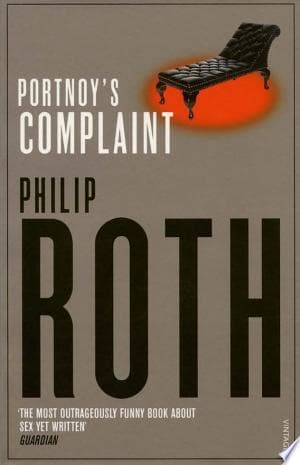
Synopsis
Covers the whole plot, including the ending.
- Difficulty
- Medium
- Pacing
- Fast
- Mood
- Confessional, Anxious, Humorous, Provocative, Obsessive
- Read it if
- You enjoy confessional, stream-of-consciousness narratives, dark humor, and incisive explorations of identity, guilt, and the American Jewish experience.
- Skip it if
- You are easily offended by explicit sexual content, misogynistic undertones, or a protagonist who is self-absorbed and often unlikeable.
Portnoy's Complaint Plot Summary
Covers the whole plot, including the ending.
The Opening Confession and Early Childhood Torments
Alexander Portnoy, a successful Assistant Commissioner of Human Opportunity for the City of New York, begins his psychoanalytic monologue. He talks about his 'complaint' – a constant internal battle between his strong sexual urges and the moral rules from his Jewish upbringing. He immediately goes into his childhood in Newark, New Jersey, describing his overbearing, doting mother, Sophie, and his constipated, anxious father, Jack. From a young age, Alexander feels trapped by his parents' expectations and the constant scrutiny of his family and community. He recalls early instances of sexual curiosity and self-exploration, especially masturbation, which becomes a main theme. It is fueled by intense guilt and fear of discovery and punishment.
Adolescent Obsessions and the Quest for Sexual Liberation
As Alexander gets older, his sexual urges grow stronger, showing up in different 'perversities' that he obsessively details to Dr. Spielvogel. He describes his elaborate masturbatory fantasies, often involving non-Jewish girls, and his increasingly bold attempts to explore his sexuality. This includes looking into neighbors' windows, experimenting with food as sexual props (most famously, a liver sandwich), and his first awkward encounters with girls. His growing sexuality constantly clashes with the strict moral code his parents instilled, especially his mother, who he sees as a suffocating presence, always watching him and causing deep guilt about his desires.
College Years and the Struggle for Identity
Alexander goes to college, believing that being away from his family will free him from his neuroses. However, he quickly finds that his 'complaint' is deeply ingrained. He continues his relentless pursuit of sexual experiences, often with Gentile girls, seeing them as symbols of forbidden freedom and rebellion against his Jewish heritage. He has many affairs, but each one is affected by his internal conflict, his inability to fully enjoy intimacy without feelings of shame, performance anxiety, or a perverse need to shock or degrade his partners. He struggles with his identity as a 'nice Jewish boy' trying to break free from perceived limits.
The Age of Anxiety: New York and Professional Success
After college, Alexander moves to New York City, where he achieves professional success as a public servant. Despite his outward achievements, his inner turmoil remains. He continues his pattern of seeking out women, often non-Jewish, and having intense, often short-lived, relationships marked by his sexual demands, emotional distance, and constant self-analysis. He recounts specific encounters, detailing his sexual acts with clinical, yet tormented, precision. His desire to shock, to transgress, and to prove his own 'freedom' often overrides any real connection, leaving him feeling empty and unfulfilled after each conquest.
The Monkey and Her Majesty: Portnoy's Relationships with Non-Jewish Women
Portnoy spends much of his monologue on two non-Jewish women: Mary Jane Reed, whom he calls 'The Monkey,' and Sarah Abbott, 'Her Majesty.' The Monkey is a free-spirited, sexually adventurous woman with whom Portnoy has a wild, uninhibited affair across Europe. He is drawn to her lack of inhibitions, seeing her as a way for his own sexual liberation, yet he constantly judges her and feels superior. Her Majesty is an elegant, sophisticated older woman with whom Portnoy has a more intellectual and less purely physical relationship, but still one filled with his anxieties about performance and his inability to fully commit or be emotionally present. Both relationships fail due to his neuroses.
The European Odyssey and the Search for Release
Hoping a change of scenery will help, Portnoy travels to Europe, first with The Monkey and later alone. He describes his sexual experiences across various European cities, engaging in what he sees as increasingly 'perverse' acts, including public exhibitionism. Despite the exotic places and the apparent freedom of his actions, he finds no lasting relief. His internal monologue of guilt, self-loathing, and his parents' influence follows him everywhere. The European journey becomes another stage for his compulsive sexual acting out, not a path to self-discovery or peace.
The Breakdown in Israel
Portnoy's European travels eventually take him to Israel, a place he initially hopes will offer some spiritual or cultural grounding, given his Jewish heritage. However, the experience only makes his anxieties worse. He feels intense pressure to connect with his roots and to find a 'normal' Jewish wife, but his ingrained sexual neuroses and his inability to reconcile his desires with his identity make this impossible. His attempts to engage with Israeli women are marked by his usual anxieties and ultimately lead to a breakdown, leaving him feeling isolated and lost, prompting his return for therapy.
The Shadow of the Parents: A Lifelong Grip
Throughout his entire monologue, Portnoy constantly returns to his parents, Sophie and Jack, as the main cause of his psychological torment. He describes his mother's overbearing love, her constant watch over his health and morals, and her incessant questioning as suffocating. His father, Jack, is portrayed as a perpetually constipated, anxious figure, whose physical ailments and emotional inhibitions cast a long shadow. Portnoy feels an immense burden of expectation from them, particularly to be a 'good Jewish boy' and to achieve success, which ironically fuels his rebellion and his 'complaint.' He believes their influence has warped his ability to experience genuine pleasure or intimacy without guilt.
The Unattainable Ideal and the Cycle of Self-Sabotage
Portnoy realizes that despite his pursuit of sexual gratification and his rebellion against his upbringing, he remains deeply unsatisfied. Each sexual conquest, each act of transgression, ultimately leads back to feelings of emptiness, shame, and the fear of punishment. He wants an impossible ideal – a woman who can be both sexually liberated and like a 'nice Jewish girl,' or perhaps a complete escape from his heritage altogether. This internal conflict creates a cycle of self-sabotage, keeping him from forming meaningful, stable relationships and leaving him always wanting something just out of reach.
The Climax of Confession and the Doctor's Final Word
After hours, days, perhaps years, of relentless confession, Alexander Portnoy finally finishes his story. He has revealed every sexual fantasy, every act of 'perversity,' every childhood trauma, and every adult neurosis to Dr. Spielvogel, hoping for a definitive answer or a magical cure. He has analyzed his life with self-pity, self-loathing, and desperate humor. The monologue abruptly ends with the long-awaited voice of Dr. Spielvogel, giving the famous, understated, and perhaps anticlimactic, diagnosis: 'So. Now vee may perhaps to begin. Yes?' This final line suggests that Portnoy's extensive confession is just the start of actual therapy, showing the depth of his psychological issues and the long road ahead.
Principal Figures
Alexander Portnoy
Protagonist
A lust-ridden Jewish bachelor tormented by his conscience and upbringing.
Alexander Portnoy is the novel's sole narrator and protagonist, a successful Assistant Commissioner of Human Opportunity for the City of New York, who is undergoing psychoanalysis. He is intelligent, articulate, and deeply neurotic, consumed by an internal conflict between his overwhelming sexual desires and the crushing guilt instilled by his overprotective Jewish parents and community. His monologue reveals a man obsessed with his penis, masturbation, and transgressive sexual acts, particularly with non-Jewish women, which he sees as acts of rebellion. Despite his outward success, he is emotionally stunted, unable to form lasting, healthy relationships, and perpetually searching for a release from his 'complaint.'
Relationships: Sophie Portnoy (Overbearing, doting mother; object of love, resentment, and a source of guilt.); Jack Portnoy (Constipated, anxious father; object of pity and a source of anxiety.); Dr. Spielvogel (Silent psychoanalyst; the recipient of Portnoy's monologue.); The Monkey (Mary Jane Reed) (American girlfriend in Europe; a symbol of uninhibited sexuality and rebellion.); Her Majesty (Sarah Abbott) (Older, sophisticated American girlfriend; a symbol of intellectual and sensual freedom, but still subject to Portnoy's neuroses.)
Sophie Portnoy
Supporting
Alexander's overbearing, doting, and guilt-inducing mother.
Sophie Portnoy is Alexander's mother, a formidable figure who dominates his childhood and continues to haunt his adult psyche. She is portrayed as a stereotypical Jewish mother: fiercely loving, intensely overprotective, constantly worried about her son's health and morals, and perpetually cooking. Her incessant questioning, her demands for perfection, and her ability to induce guilt ('I suffered for you!') are central to Portnoy's 'complaint.' Alexander both loves and resents her, seeing her as the primary architect of his neuroses and his inability to enjoy life without shame. She represents the suffocating 'Jewishness' he tries to escape.
Relationships: Alexander Portnoy (Son; intensely complex relationship of love, resentment, and psychological entanglement.); Jack Portnoy (Husband; she often overshadows him and is the dominant force in the household.)
Jack Portnoy
Supporting
Alexander's constipated, anxious, and emotionally distant father.
Jack Portnoy is Alexander's father, a quiet, anxious man who works as an insurance salesman. He is frequently depicted as suffering from chronic constipation and stomach ailments, symbolizing his emotional repression and the general anxieties of the household. Unlike Sophie, Jack is less overtly demanding but still contributes to Alexander's neuroses through his own anxieties and his perceived inability to stand up to Sophie. Alexander feels a mixture of pity and resentment towards his father, seeing him as a victim of life's circumstances and a representation of the 'suffering' Jewish male he fears becoming.
Relationships: Alexander Portnoy (Son; a source of anxiety and pity for Alexander.); Sophie Portnoy (Wife; often overshadowed by her more forceful personality.)
Dr. Spielvogel
Supporting
Alexander Portnoy's silent psychoanalyst.
Dr. Spielvogel is Alexander Portnoy's psychoanalyst and the silent recipient of his entire monologue. His presence is felt throughout the novel as the implied listener, the professional to whom Portnoy directs his most intimate and often outrageous confessions. He embodies the 'blank slate' of Freudian analysis, offering no interjections or judgments until the very end. His role is crucial as the catalyst for Portnoy's outpouring, representing the hope for understanding and relief, even if that hope remains largely unfulfilled by the monologue's conclusion. His final line is famously understated and profound.
Relationships: Alexander Portnoy (Patient; the sole recipient of Portnoy's confession.)
The Monkey (Mary Jane Reed)
Supporting
Alexander's sexually uninhibited girlfriend during his European travels.
Mary Jane Reed, nicknamed 'The Monkey' by Portnoy, is an American woman he meets and has a tumultuous affair with in Europe. She is portrayed as sexually free, uninhibited, and somewhat bohemian, a stark contrast to the 'nice Jewish girls' Portnoy grew up with. Portnoy is drawn to her as a symbol of liberation and a vehicle for his own sexual experimentation and rebellion against his upbringing. However, he also views her with a mixture of fascination and disdain, often judging her and feeling superior. Their relationship is marked by intense sexual activity but little genuine emotional connection, ultimately failing due to Portnoy's neuroses.
Relationships: Alexander Portnoy (Girlfriend; a passionate but ultimately unstable sexual relationship.)
Her Majesty (Sarah Abbott)
Supporting
Alexander's sophisticated older girlfriend in New York.
Sarah Abbott, whom Portnoy dubs 'Her Majesty,' is an elegant, sophisticated, and somewhat older woman with whom Alexander has a relationship in New York. She represents a different kind of forbidden fruit than The Monkey, embodying intellectualism, refinement, and a certain WASPish allure that Portnoy finds both attractive and intimidating. Their relationship is more cerebral, but still deeply affected by Portnoy's anxieties about performance, his incessant self-analysis, and his inability to fully commit. She, too, becomes a projection of his desires and his need to transgress, rather than a partner with whom he can form a healthy bond.
Relationships: Alexander Portnoy (Girlfriend; a relationship marked by intellectual and sexual tension, and Portnoy's neuroses.)
Bubbles Girardi
Mentioned
A childhood crush and early sexual fantasy figure.
Bubbles Girardi is one of Alexander's earliest childhood crushes and a significant figure in his masturbatory fantasies. She is a Gentile girl from his neighborhood, symbolizing the forbidden and the 'other' that Portnoy yearns for as a rebellion against his Jewish upbringing. She appears in his detailed accounts of early sexual curiosity and exploration, particularly his voyeuristic tendencies and his first attempts at sexual contact. Bubbles represents the initial spark of his lifelong 'complaint' and his attraction to what is considered taboo within his strict moral framework.
Relationships: Alexander Portnoy (Childhood crush and fantasy object.)
Smolka
Mentioned
A childhood friend and accomplice in early sexual explorations.
Smolka is a childhood friend of Alexander Portnoy, often mentioned in the context of their early sexual explorations and shared acts of 'perversity.' He serves as a companion in mischief, a witness to some of Portnoy's earliest transgressions, such as peeping into windows or discussing sexual topics. Smolka represents the shared, sometimes illicit, curiosity of boyhood, providing a contrast to Portnoy's more isolated and guilt-ridden experiences. His presence underscores the universality of adolescent sexual awakening, even as Portnoy's reaction to it is uniquely neurotic.
Relationships: Alexander Portnoy (Childhood friend and accomplice.)
Themes & Insights
Identity and Self-Discovery
Portnoy's Complaint is a quest for identity, or rather, a struggle against a given identity. Alexander Portnoy deals with what it means to be a 'nice Jewish boy' and the expectations that come with it, constantly rebelling through his sexual acts. His pursuit of non-Jewish women, his 'perversions,' and his professional success are all attempts to define himself outside the limits of his family and heritage. However, he finds that he cannot escape his ingrained neuroses, suggesting that true self-discovery is hard when one is so deep in self-loathing and guilt. The novel explores the conflict between who one is expected to be and who one wants to be.
“What was it with these Jewish mothers and their sons? The guilt! The guilt! It was a wonder anybody ever got laid.”
Guilt and Shame
Guilt and shame are at the core of Portnoy's 'complaint.' Every sexual act, every desire, every transgression is immediately followed by crushing guilt, mainly from his mother's moral rules and the perceived judgment of his Jewish community and God. His masturbation, his affairs with Gentile women, and his 'perversions' are all done under the shadow of impending punishment. This pervasive guilt keeps him from experiencing genuine pleasure or emotional intimacy, turning his sexual life into a compulsive, self-punishing cycle. The novel details the psychological cost of such deeply ingrained shame.
“I am the son in the Jewish joke, only it's no joke!”
Sexual Repression and Liberation
The novel explores the tension between sexual repression and the desire for liberation. Portnoy's strict upbringing and the moral codes of his community lead to deep sexual repression, which shows as obsessive fantasies and compulsive sexual behavior. His pursuit of sexual encounters, especially with non-Jewish women, is an attempt to break free from these chains. However, his 'liberation' is always incomplete, as his ingrained guilt and neuroses keep him from truly enjoying his freedom. His sexual acts become more about transgression and rebellion than genuine pleasure, showing the paradox of trying to achieve liberation through self-punishing means.
“My life has been one long, uninterrupted struggle to get my end in and keep my conscience clean.”
The Jewish Mother Archetype
The 'Jewish mother' archetype is central to the novel, shown by Sophie Portnoy. She is portrayed as overbearing, doting, guilt-inducing, and devoted to her son, yet also suffocating. This archetype represents the cultural and familial pressures Portnoy feels, especially the expectation to be successful, moral, and to marry a 'nice Jewish girl.' Sophie's constant presence in Portnoy's thoughts, even as an adult, shows the lasting power of parental influence and how cultural stereotypes can both define and limit an individual. The novel critiques this archetype while acknowledging its impact on Portnoy's mind.
“A mother who has made a man of you, who has suffered for you, and who expects nothing in return!”
The American Dream and Disillusionment
Portnoy's Complaint touches on the American Dream and its disappointment. Alexander Portnoy achieves outward success as a public servant in New York, embodying a part of the dream. However, this success is contrasted with his deep inner turmoil and unhappiness. He has moved up socially and gained professional recognition, but he remains unfulfilled and neurotic. This shows that material success does not mean personal happiness or well-being, suggesting a disappointment with the superficial promises of the American Dream when one's inner life is chaotic.
“I, Alexander Portnoy, the Assistant Commissioner of Human Opportunity for the City of New York, am a walking advertisement for the benefits of a Jewish upbringing!”
Plot Devices & Literary Techniques
Stream of Consciousness Monologue
The entire novel is presented as Portnoy's unfiltered confession to his psychoanalyst.
The novel is written entirely as a continuous, unpunctuated stream of consciousness monologue delivered by Alexander Portnoy to his silent psychoanalyst, Dr. Spielvogel. This device allows the reader direct access to Portnoy's chaotic, obsessive, and guilt-ridden mind. It creates an intimate, confessional tone, blurring the lines between internal thought and spoken word. The lack of external narration or dialogue (until the very end) immerses the reader in Portnoy's subjective reality, making his neuroses palpable and his voice utterly distinctive. It emphasizes the isolating nature of his 'complaint' and his desperate need for an outlet.
The Unreliable Narrator
Portnoy's perspective is subjective, exaggerated, and filtered through his neuroses.
Alexander Portnoy is an intensely unreliable narrator. His entire account is filtered through his own neuroses, guilt, and self-aggrandizing or self-pitying tendencies. He exaggerates, dramatizes, and often projects his own anxieties onto others, particularly his parents and his sexual partners. The reader is constantly aware that they are hearing only one highly subjective side of the story, making it difficult to discern objective truth from Portnoy's distorted perceptions. This device highlights the subjective nature of memory and the way psychological states can warp one's understanding of reality and relationships.
The 'Complaint' as a Medical/Psychological Diagnosis
The framing of Portnoy's issues as a clinical 'complaint' from a fictional psychoanalytic text.
The novel is framed by a fictional psychoanalytic definition of 'Portnoy's Complaint' by 'O. Spielvogel,' lending a pseudo-clinical authority to Portnoy's narrative. This device immediately establishes the protagonist's issues as a recognized (albeit fictional) psychological disorder, setting a satirical tone. It provides a lens through which to understand Portnoy's seemingly disparate obsessions – the warring impulses, the perversions, the shame – as symptoms of a defined condition. This framing also reinforces the idea that the entire novel is a patient's case study, elevating his personal neuroses to a broader, almost academic, level of analysis.
Symbolism of Food and Digestion
Food, particularly the liver sandwich, and issues of digestion symbolize Portnoy's inner turmoil.
Food and digestion are recurring symbolic motifs throughout the novel. Portnoy's famous 'liver sandwich' masturbation incident is a prime example, where food becomes intertwined with sexual transgression and guilt. His father's chronic constipation symbolizes his emotional repression and the general anxieties of the household. His mother's incessant cooking and force-feeding represent her overbearing love and the suffocating nature of his upbringing. These digestive metaphors reflect Portnoy's inability to 'process' his experiences, his constant struggle with consumption (both literal and metaphorical), and his general state of psychological blockage and discomfort.
Portnoy's Complaint Quotes
“Doctor, what do you call this sickness I have? Is this the Jewish suffering I used to hear so much about? Is this what has come down to me from the pogroms and the persecution? from the mockery and abuse bestowed by the goyim over these two thousand lovely years?”
“Let's put the id back in Yid!”
“I am the Raskolnikov of jerking off—the sticky evidence is everywhere!”
“A Jewish man with parents alive is a fifteen-year-old boy, and will remain a fifteen-year-old boy until they die!”
“The very first distinction I learned from my father was not between good and bad, but between goyische and Jewish.”
“I'm living in the middle of a Jewish joke! I am the son in the Jewish joke—only it ain't no joke!”
“What was it with these Jewish parents—what did they want from us?”
“To be or not to be a good boy—that is the question.”
“I don't seem to stick my dick up these girls, I stick it up their backgrounds—as though through fucking I will discover America.”
“The guilt, the guilt, the guilt—it's like a second skin!”
“Oh, to be a center fielder, a center fielder—and nothing more!”
“My mother polished the furniture until it shone like her conscience.”
“I am a nice Jewish boy from a nice Jewish home—and I am going to pieces.”
“The only thing that makes me come is the idea of being bad.”
Quiz
10 questions on the plot and the characters. Each answer comes with a short explanation.
Question 1
What is the narrative structure of 'Portnoy's Complaint'?
- A series of letters between Portnoy and his family
- A continuous monologue from patient to psychoanalyst
- A third-person omniscient narration of Portnoy's life
- A collection of diary entries spanning Portnoy's adulthood
Show answer
B. A continuous monologue from patient to psychoanalyst The novel is structured as a single, extended monologue delivered by Alexander Portnoy to his psychoanalyst, Dr. Spielvogel, which creates an intimate and confessional tone throughout the book.
Question 2
According to the fictional definition in the book, what is 'Portnoy's Complaint'?
- A physical ailment causing chronic fatigue and anxiety
- A disorder where ethical impulses conflict with extreme sexual longings
- A psychological condition marked by obsessive-compulsive behaviors
- A social anxiety disorder stemming from Portnoy's Jewish upbringing
Show answer
B. A disorder where ethical impulses conflict with extreme sexual longings The book defines 'Portnoy's Complaint' as a disorder in which strong ethical and altruistic impulses are perpetually at war with extreme sexual desires, often of a perverse nature, leading to shame and dread rather than gratification.
Question 3
Who is Dr. Spielvogel in the context of the novel?
- Portnoy's childhood friend who becomes a psychiatrist
- Portnoy's father, who disapproves of his son's behavior
- The psychoanalyst to whom Portnoy delivers his monologue
- A fictional author cited in the book's epigraph
Show answer
C. The psychoanalyst to whom Portnoy delivers his monologue Dr. Spielvogel is the psychoanalyst listening to Alexander Portnoy's monologue throughout the novel. He is also the fictional author of 'The Puzzled Penis,' a paper referenced in the epigraph that diagnoses Portnoy's condition.
Question 4
What does Dr. Spielvogel believe is a primary cause of Portnoy's symptoms?
- Portnoy's excessive wealth and privilege
- The bonds in the mother-child relationship
- Portnoy's failure in his professional career
- Genetic predispositions to mental illness
Show answer
B. The bonds in the mother-child relationship In the fictional psychoanalytic paper cited in the epigraph, Spielvogel traces many of Portnoy's symptoms to the bonds in the mother-child relationship, highlighting the novel's exploration of Oedipal conflicts and Jewish maternal influence.
Question 5
Which of the following sexual behaviors is NOT listed in Spielvogel's description of Portnoy's symptoms?
- Exhibitionism
- Voyeurism
- Necrophilia
- Auto-eroticism
Show answer
C. Necrophilia Spielvogel's description includes exhibitionism, voyeurism, fetishism, auto-eroticism, and oral coitus, but necrophilia is not mentioned. This reflects the novel's focus on Portnoy's conflicted sexuality within societal and familial norms.
Question 6
How does Portnoy's 'morality' affect his sexual experiences according to the book?
- It enhances his gratification by adding a sense of virtue
- It leads to feelings of shame and dread rather than genuine gratification
- It causes him to avoid sexual encounters altogether
- It makes him pursue exclusively monogamous relationships
Show answer
B. It leads to feelings of shame and dread rather than genuine gratification Portnoy's strong ethical impulses, rooted in his Jewish upbringing, conflict with his extreme sexual longings. This results in shame and dread of retribution (like castration) instead of genuine sexual gratification, central to his 'complaint.'
Question 7
What is the fictional source cited for the definition of 'Portnoy's Complaint' in the epigraph?
- 'The Neurotic Personality' by Sigmund Freud
- 'Internationale Zeitschrift für Psychoanalyse' by Spielvogel
- 'The Journal of Abnormal Psychology' by an anonymous author
- 'Modern Psychosexual Disorders' by a fictional committee
Show answer
B. 'Internationale Zeitschrift für Psychoanalyse' by Spielvogel The epigraph cites 'Internationale Zeitschrift für Psychoanalyse, Vol. XXIV, p. 909' as the source for Spielvogel's paper 'The Puzzled Penis,' which defines Portnoy's Complaint. This adds a pseudo-scientific, humorous layer to the novel's exploration of sexuality.
Question 8
In what year was Alexander Portnoy born according to the book's fictional definition?
- 1933
- 1945
- 1920
- 1950
Show answer
A. 1933 The definition in the epigraph lists Alexander Portnoy's birth year as 1933, placing him in a specific generational context that influences his experiences with Jewish identity, sexuality, and post-war American society.
Question 9
Which theme is most directly highlighted by the conflict between Portnoy's ethical impulses and sexual longings?
- The absurdity of modern urban life
- The tension between individual desire and societal/religious constraints
- The inevitability of aging and mortality
- The corruption of political power
Show answer
B. The tension between individual desire and societal/religious constraints The core of Portnoy's Complaint revolves around the tension between his intense sexual desires and the ethical constraints imposed by his Jewish upbringing and societal norms, making this a central theme of the novel.
Question 10
What literary technique is primarily used to convey Portnoy's inner turmoil throughout the novel?
- Stream of consciousness in a monologue format
- Epistolary exchanges with multiple characters
- Third-person limited narration with flashbacks
- Dialogue-heavy scenes set in real time
Show answer
A. Stream of consciousness in a monologue format The novel employs a stream-of-consciousness technique through Portnoy's continuous monologue to his psychoanalyst, allowing readers direct access to his chaotic thoughts, memories, and conflicts without narrative interruption.
Portnoy's Complaint FAQ
What is 'Portnoy's Complaint' about?
The novel follows Alexander Portnoy, a 33-year-old Jewish man from New Jersey, as he delivers an extended monologue to his psychoanalyst Dr. Spielvogel. Through this confessional narrative, Portnoy recounts his obsessive sexual fantasies and encounters, his fraught relationships with his overbearing mother Sophie and distant father Jack, and his struggle to reconcile his Jewish upbringing with his libertine desires.
Why should I read 'Portnoy's Complaint'?
This groundbreaking 1969 novel revolutionized American literature with its frank, hilarious, and psychologically complex exploration of sexuality, Jewish identity, and family dynamics. Roth's masterful use of the confessional monologue form creates an intimate, compelling narrative voice that remains influential and controversial decades later.
What is the background/setting of 'Portnoy's Complaint'?
The novel unfolds primarily through Portnoy's memories of his childhood in Jewish Newark, New Jersey during the 1940s, contrasted with his adult life as an Assistant Commissioner of Human Opportunity in 1960s New York City. The physical setting is Dr. Spielvogel's psychoanalytic office where Portnoy delivers his monologue.
What are the most memorable quotes?
Key quotes include Portnoy's opening line 'Doctor, my doctor, what do you say, let's put the id back in Yid!' and his lament 'Because to be bad, Mother, that is the real struggle: to be bad—and to enjoy it! That is what makes men of us boys, Mother.' The novel's clinical definition of 'Portnoy's Complaint' itself has become iconic in literary history.
What writing style does the author use?
Roth employs a continuous, stream-of-consciousness monologue delivered entirely from Portnoy's perspective to Dr. Spielvogel. The prose is energetic, confessional, and filled with comic exaggeration, shifting rapidly between childhood memories, sexual escapades, and philosophical rants about Jewish identity and American assimilation.
What minor details add significant meaning?
Portnoy's obsession with his mother's liver dinner represents his conflicted relationship with Jewish domesticity, while his detailed descriptions of masturbation locations (the family bathroom, public buses) illustrate how his sexuality permeates every aspect of his life. The recurring image of his father's constipation symbolizes emotional repression in their household.
What are some subtle foreshadowing moments?
Early descriptions of Portnoy's childhood guilt over minor transgressions foreshadow his adult inability to enjoy sexual pleasure without shame. His mother's warning 'Don't marry a shiksa' anticipates his doomed relationships with non-Jewish women like 'The Monkey' and 'The Pilgrim' who represent sexual freedom but cultural alienation.
What unexpected character connections exist?
Portnoy's various lovers—including the sexually adventurous 'Monkey,' the idealized 'Pilgrim,' and Israeli soldier Naomi—all represent different aspects of his struggle between desire and morality. His professional identity as a civil rights lawyer ironically mirrors his personal failure to liberate himself from psychological constraints.
What are unspoken character motivations?
Beneath Portnoy's explicit sexual obsessions lies a deeper desire for his father's approval and a wish to escape his mother's smothering influence without fully rejecting his Jewish identity. His compulsive confession to Spielvogel suggests an unacknowledged hope for absolution he cannot grant himself.
What psychological complexities do characters exhibit?
Portnoy exhibits textbook neurotic conflict between superego (represented by his Jewish conscience and mother's voice) and id (his unrestrained sexual desires). His mother Sophie displays what would now be recognized as emotional incest, while his father Jack manifests depression through physical symptoms like chronic constipation.
What are the major emotional turning points?
Key turning points include Portnoy's adolescent discovery of masturbation as both pleasure and guilt, his first sexual experience with Bubbles Girardi, his mother discovering his adolescent pornography, and his impotence with Israeli soldier Naomi—which represents his ultimate failure to reconcile sexuality with cultural identity.
How do relationship dynamics evolve?
Portnoy's relationships with women progress from adolescent fantasy objects to adult partners he simultaneously desires and resents. His dynamic with his mother evolves from childhood dependence to adult rebellion that remains psychologically entangled, while his relationship with his father shifts from childhood alienation to adult sympathy for his quiet suffering.
Which parts remain ambiguous or open-ended?
The novel's conclusion is famously ambiguous—Dr. Spielvogel's single line 'Now vee may perhaps to begin. Yes?' leaves unresolved whether Portnoy will achieve psychological breakthrough or remain trapped in his patterns. The reliability of Portnoy's narration throughout remains questionable, as he may be exaggerating or distorting his memories.
What are controversial scenes or decisions?
The novel's explicit sexual content—including detailed masturbation scenes, Portnoy's use of a piece of liver for sexual gratification, and his affair with 'The Monkey'—caused widespread controversy upon publication. Portnoy's stereotypical depictions of Jewish mothers and shiksa fantasies also generated debate about anti-Semitism and misogyny.
'Portnoy's Complaint' ending explained: how it ends & what it means
The novel ends with Dr. Spielvogel's enigmatic statement 'Now vee may perhaps to begin. Yes?' after Portnoy's exhaustive confession. This suggests the monologue we've read represents only preliminary groundwork before actual analysis can start, implying Portnoy's complaint may be endless—his talking cure has merely begun the process of understanding his condition.
How does the novel's structure reflect its themes?
The uninterrupted monologue form mirrors psychoanalytic free association while creating a claustrophobic, confessional atmosphere that traps readers in Portnoy's obsessive mind. The lack of chapter breaks or scene transitions reflects how Portnoy's past and present, desire and guilt, remain psychologically inseparable throughout his narrative.
What is the significance of the clinical definition that opens the novel?
The mock-psychoanalytic definition establishes the novel's central tension between clinical observation and subjective experience. By framing Portnoy's story as a medical case study, Roth both distances readers through irony and invites them to diagnose Portnoy's condition alongside Dr. Spielvogel, blurring lines between pathology and human complexity.
How does Jewish identity function in the novel?
Jewishness represents both moral conscience and cultural constraint for Portnoy—his mother's kosher kitchen symbolizes domestic repression while his father's immigrant experience represents burdensome history. Portnoy's attraction to non-Jewish women ('shiksas') represents both sexual liberation and cultural betrayal, creating his central conflict between tribal loyalty and individual desire.
About the author
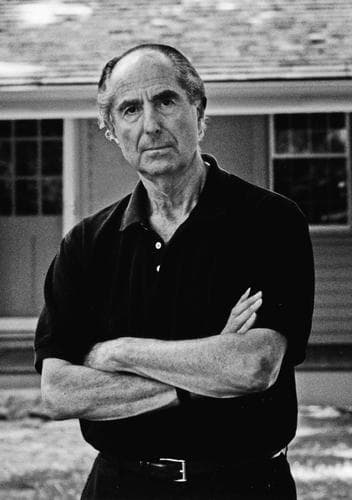
Philip Milton Roth was an American novelist and short story writer. Roth's fiction—often set in his birthplace of Newark, New Jersey—is known for its intensely autobiographical character, for philosophically and formally blurring the distinction between reality and fiction, for its "sensual, ingenious style" and for its provocative explorations of American identity. He first gained attention with the 1959 short story collection Goodbye, Columbus, which won the U.S. National Book Award for Fiction. Ten years later, he published the bestseller Portnoy's Complaint. Nathan Zuckerman, Roth's literary alter ego, narrates several of his books. A fictionalized Philip Roth narrates some of his others, such as the alternate history The Plot Against America.
Similar books
- Herzog
Saul Bellow
3.8 (19k) average on GoodreadsLiterary FictionExplores the intellectual and emotional turmoil of a Jewish protagonist through a confessional, epistolary style.
- The Catcher in the Rye
J.D. Salinger
3.8 (2.7M) average on GoodreadsYoung AdultShowcases a young male protagonist's stream-of-consciousness complaints about society and his personal struggles with identity and alienation.
- The Old Man and the Sea
Ernest Hemingway
3.8 (831k) average on GoodreadsLiterary FictionA Cuban fisherman's long struggle with a giant marlin becomes a story of endurance and dignity, now retold for young adults with illustrations, phonetic guides, and writing prompts in Traditional Chinese.
- One Hundred Years of Solitude
Gabriel García Márquez
4.1 (753k) average on GoodreadsLiterary FictionThrough the multi-generational story of the Buendía family, a mythical town deals with the repeating patterns of time, love, and solitude, as the extraordinary mixes with the ordinary.
- The Goldfinch
Donna Tartt
3.9 (720k) average on GoodreadsLiterary FictionHaunted by a tragic explosion and clutching a stolen Dutch masterpiece, a young orphan navigates the opulent drawing rooms of New York and the gritty underbelly of the art world, desperately seeking connection and redemption amidst a life spiraling into crime and obsession.
- Little Fires Everywhere
Celeste Ng
4.1 (713k) average on GoodreadsLiterary FictionIn Shaker Heights, an artist and her daughter move in, and their free-spirited lives clash with a rule-bound matriarch, revealing hidden conflicts beneath a perfect surface.





Enjoyed the summary?
A summary gives you the shape of the book. The book itself has the detail, the examples and the voice.
Find Portnoy's Complaint on AmazonAs an Amazon Associate, BookBrief earns from qualifying purchases. How we're funded