
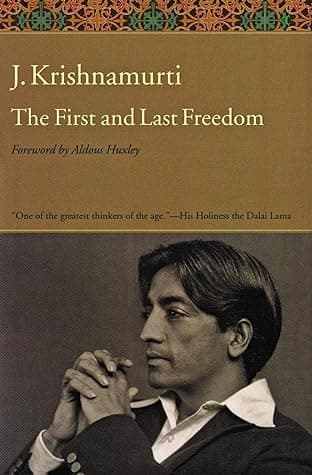
Core Idea
- Difficulty
- Hard
- Read it if
- You are seeking a profound philosophical challenge to your understanding of self, thought, and freedom, and are open to a radical, non-traditional approach to spirituality and psychology.
- Skip it if
- You prefer practical, step-by-step self-help advice, are looking for a new belief system to adopt, or find highly abstract, repetitive philosophical inquiry frustrating.
Key Takeaways from The First and Last Freedom
The Trap of Thought
Thought, as memory and experience, inherently limits our perception of reality and freedom.
Krishnamurti states that our entire psychological makeup comes from thought, which is a result of memory and past experiences. This creates a cycle where we see the present through the past, stopping us from experiencing anything truly new. Freedom, then, cannot exist within this thought-bound life, because thought itself is never free. It is always conditioned, always a reaction. To understand ourselves and the world, we must observe thought without judging it, seeing its limits and how it builds our sense of self and reality. This observation is not about stopping thought, but about being aware of what the mind is doing without getting in the way. This creates space for something new to appear.
“Thought is never new; it is always the old. The new is beyond the field of thought.”
In the book: Krishnamurti repeatedly uses the example of accumulated knowledge and experience, stating that while knowledge is necessary for practical survival, it becomes a hindrance in understanding psychological truth. He challenges the listener to observe their own reactive patterns.
Try this: Practice choiceless awareness: observe your thoughts, feelings, and reactions throughout the day without labeling, judging, or trying to change them. Simply notice the flow of consciousness. This cultivates a space of observation distinct from the observed.
Related ideas: choiceless-awareness, conditioning, self-as-thought
The Illusion of the 'I'
The 'I' or the ego is not a fixed entity but a constantly shifting collection of memories, ideas, and experiences.
Krishnamurti breaks down the usual idea of the self. He says the 'I' is not a stable, lasting thing but a changing collection of psychological conditioning. This 'self' comes from thought, built from our past experiences, beliefs, desires, fears, and constantly identifying with these passing things. We hold onto this imagined self, believing it is real, and this holding on causes much suffering. By understanding that the 'I' is just a mental construct, a collection of memories and reactions, we can start to loosen its grip and find a freedom beyond this limited, broken identity. The key is to watch this process of self-creation without adding more thought or judgment.
“The 'I' is the bundle of memories, experiences, words, the whole background that we have acquired.”
In the book: Krishnamurti frequently uses the analogy of a river, where the 'I' is not a fixed bank but the ever-flowing water, constantly changing and identifying with its contents. He asks listeners to examine what constitutes their 'I' when stripped of possessions, relationships, and ideas.
Try this: When you catch yourself saying 'I am angry' or 'I want this,' pause and ask: 'Who is the 'I' that is angry? What is the nature of this 'I' that wants?' This challenges the automatic identification with passing states.
Related ideas: ego, self-identity, conditioning
Freedom from Authority
True freedom arises from rejecting all external and internal authority, including spiritual gurus and self-imposed ideals.
Krishnamurti's most radical claim is that we absolutely need freedom from all authority, both outside and inside ourselves. He strongly rejects spiritual teachers, gurus, scriptures, and even self-help systems, saying that relying on any outside authority stops real self-discovery. He also criticizes internal authorities: our own ideals, beliefs, and the images we have made for ourselves. These inner structures, born from thought and conditioning, are just as restrictive as outside ones. To be truly free, one must break free from the psychological need to be led, to follow, or to reach a set state. This requires deep self-reliance and a strong commitment to finding truth directly, without guides or plans.
“When you follow somebody, you cease to follow truth.”
In the book: Krishnamurti's own dissolution of the Order of the Star in the East, where he was proclaimed the World Teacher, is the ultimate testament to this principle. He stated, 'I desire no disciples.'
Try this: Identify one area where you rely on external authority (a guru, a political party, a specific ideology) or internal authority (a rigid moral code, an unexamined ideal). Consciously question its validity and explore if you can approach that area with a fresh, unconditioned mind.
Related ideas: authority, self-reliance, truth
The Nature of Fear
Fear is fundamentally a product of thought about the future or the past, not a direct response to the present moment.
Krishnamurti examines fear, showing it not as a basic, unchanging human trait, but as a psychological construct from thought. He argues that fear appears when the mind imagines future dangers or losses, or when it dwells on past hurts and failures. This imagining, this dwelling, is what fear is. In the immediate present, when one is fully aware, fear often disappears because the mind has no room to think 'what if.' The fear of death, for example, is not the fear of dying itself, but the fear of losing what we know, of the unknown, which is a worry created by thought. Understanding fear means watching where it comes from in thought, without trying to escape or stop it, letting its true nature be seen and fade away.
“Fear is not something actual, it is the projection of the mind.”
In the book: He uses the example of fearing death: it's not the actual moment of dying that is feared, but the thought of losing life, relationships, experiences, or the unknown state after death. This is all an operation of thought.
Try this: When you feel fear, pause and identify what specific thoughts are generating that fear. Are you thinking about a past failure or a potential future threat? Bring your attention back to the immediate sensory experience of the present moment.
Related ideas: fear, present-moment, thought-projection
Suffering and Escape
Suffering persists because we constantly try to escape it rather than truly understanding its origin.
Krishnamurti offers a challenging view on suffering: it's not the suffering itself that traps us, but our constant attempts to escape it. Whether through distraction, belief systems, entertainment, or spiritual practices meant to numb pain, these escapes stop us from directly facing the cause of our sadness. By running away, we keep the cycle going, never truly understanding suffering. Real freedom from suffering comes not from avoiding it, but from facing it with full attention, observing it without judgment or wanting to change it. This direct, open observation shows how suffering works, often revealing it to be rooted in our attachment to the 'I' and its desires and fears. Only through this complete acceptance and understanding can suffering end.
“The very desire to escape from sorrow creates further sorrow.”
In the book: He points out that people turn to religion, alcohol, relationships, or intellectual pursuits as means of escape from inner turmoil, yet these only offer temporary relief, never a resolution.
Try this: The next time you experience an unpleasant emotion (sadness, anger, frustration), resist the urge to immediately distract yourself. Instead, sit with the feeling, observe its sensations, and notice the thoughts associated with it without trying to push it away.
Related ideas: suffering, escape, acceptance
The Problem of Comparison
Comparison is a destructive mental habit that fuels envy, ambition, and the constant striving for 'more' or 'better.'
Krishnamurti identifies comparison as a basic psychological barrier to peace and self-understanding. From childhood, we are taught to compare ourselves to others—in intelligence, beauty, wealth, success, or spiritual progress. This constant measuring creates envy, competition, and a lasting feeling of not being enough or being better. It fuels ambition, which he sees not as a positive drive, but as a destructive force that creates division and conflict, both inside and out. Comparison stops us from truly seeing ourselves as we are, because our view is always filtered through 'how I measure up against someone else.' To be free, one must stop this comparison, not through effort, but by deeply understanding its divisive and painful nature. Only then can real self-acceptance and a direct relationship with reality appear.
“The moment you compare, you are in conflict.”
In the book: He often refers to the societal pressure on children to excel, to be 'better' than their peers, which conditions the mind for a lifetime of comparison and dissatisfaction. The pursuit of status and recognition is a direct outcome of this habit.
Try this: For one day, consciously try to observe every instance where you compare yourself to another person, a past version of yourself, or an ideal. Notice the feeling that arises from this comparison. The goal is just to observe, not to stop, to understand its mechanism.
Related ideas: comparison, ambition, envy, self-acceptance
Meditation as Choiceless Awareness
True meditation is not a technique or a practice to achieve a state, but a state of choiceless, effortless awareness.
Krishnamurti radically redefines meditation, removing all ritual, technique, and goal-focused effort. For him, meditation is not something you 'do' for a set time to reach a certain state (like peace or enlightenment). Instead, it is a state of being: a continuous, open awareness of 'what is' in every moment. It is observing thoughts, feelings, sensations, and the outside world completely, without judgment, interpretation, or wanting to change anything. This means there is no 'right' way to meditate, no postures, no mantras, no breath control to master. These are all products of thought and effort, which stop insight from appearing on its own. True meditation is a passive yet very alert openness, letting the mind quiet itself as it understands how it works, leading to a deep change in consciousness.
“Meditation is not a means to an end. It is the understanding of the whole process of life.”
In the book: He critiques all established meditative practices, arguing that any technique, by its very nature, is a product of will and desire, thus reinforcing the 'I' that seeks to achieve something. He contrasts this with simply observing a bird, a flower, or a thought without interference.
Try this: Instead of setting aside time for formal meditation, try to bring a quality of choiceless awareness to mundane activities: washing dishes, walking, or listening to someone speak. Observe everything without trying to categorize or analyze.
Related ideas: meditation, awareness, present-moment, mindfulness
The Urgency of Now
Transformation cannot be gradual or postponed; it must happen instantaneously in the present moment.
Krishnamurti challenges the common idea that psychological change is a slow, gradual process needing time and effort. He argues that this idea of gradual change itself comes from thought, a way for the mind to delay radical change and keep things as they are. Real insight and freedom, he insists, happen instantly, in the 'now.' If we understand something fully, deeply, and without resistance, that understanding itself immediately ends the old pattern. The idea of 'becoming'—becoming better, more spiritual, more enlightened—is a psychological illusion that stops us from seeing truth in the present. This requires a strong sense of urgency, an immediate and complete attention to 'what is,' without hoping for future improvement or being weighed down by past failures. Only then can the mind truly be free from its conditioning.
“There is no gradual understanding. Understanding is immediate or it is not.”
In the book: He often uses the analogy of seeing a snake: the recognition is instant, and the reaction (jumping back) is immediate, not a gradual process of deciding it's a snake. Similarly, psychological insight should be immediate.
Try this: When a negative pattern of thought or behavior arises, instead of thinking, 'I need to work on this over time,' try to bring complete, immediate attention to the pattern in that very moment. Can you see its entire mechanism instantly?
Related ideas: transformation, present-moment, gradualism, understanding
Love Beyond Thought
Love, true compassion, is not a sentiment or an idea, but a state of being free from the 'I' and its demands.
Krishnamurti suggests that our usual idea of love is flawed. It is often confused with desire, attachment, possession, or sentimentality—all products of thought and the 'I.' This kind of 'love' is conditional, based on expectations and fears, and always leads to conflict and sadness. True love, he argues, is something completely different: it is a state of being that comes only when the 'self,' with its demands, comparisons, and divisions, is gone. It is not an emotion that can be grown or practiced, but a natural blossoming that happens when the mind is free from its conditioning. This deep sense of compassion and connection is naturally intelligent and creates a different kind of relationship with the world, free from the psychological burdens of the past and the projections of the future. It is a state of openness and complete attention.
“Love is not a thought. Love is not a memory. Love is a state of being when the 'me' is not.”
In the book: He distinguishes between the 'love' that seeks gratification, possession, or security (which he associates with fear and desire) and a love that is without motive, which he describes as a state of being.
Try this: Observe your relationships. Are your expressions of love or affection tied to expectations, demands, or fears? Can you interact with someone, even for a brief moment, without the 'me' intervening with its judgments or desires?
Related ideas: love, compassion, attachment, desire, selflessness
The First and Last Freedom Quotes
“It is no measure of health to be well adjusted to a profoundly sick society.”
“Truth is a pathless land.”
“Freedom is not a reaction; freedom is not a choice. It is man's 'pretence' that because he has choice he is free.”
“The greater the will to be free, the less the freedom.”
“When you are listening to something, if you are listening with a purpose, you are not listening.”
“To understand the world, we must understand ourselves.”
“Observation without evaluation is the highest form of intelligence.”
“The man who is not afraid of the word 'nothing' is on the way to the discovery of himself.”
“What we are, the world is. If we are greedy, envious, competitive, our society is based on greed, envy, competitiveness.”
“There is no end to becoming, and therefore no freedom. Becoming is the continuity of the 'me'.”
“Meditation is not the pursuit of an end. It is the understanding of every thought, every feeling, every mood, every movement of the mind.”
“Tradition becomes our security, and when the mind is secure it is in decay.”
“To live completely, wholly, every day as if it were a new day, is to die to yesterday.”
“Thought is time. Thought is born of experience and knowledge, which are inseparable from time.”
“The greatest fear in the world is the opinion of others, and the moment you are unafraid of the crowd you are no longer a sheep, you become a lion roaring.”
Quiz
10 questions on the main ideas. Each answer comes with a short explanation.
Question 1
According to Krishnamurti, what is the primary obstacle to understanding truth and achieving freedom?
- Lack of formal education
- The accumulation of knowledge and tradition
- Insufficient meditation practice
- The influence of other spiritual teachers
Show answer
B. The accumulation of knowledge and tradition Krishnamurti repeatedly emphasizes that accumulated knowledge, beliefs, and traditions form a screen that prevents direct perception of truth.
Question 2
Krishnamurti argues that true freedom comes from:
- Adhering to a specific spiritual discipline or guru
- Escaping from society's demands
- Understanding the self and its conditioning without choice
- Achieving a state of permanent happiness
Show answer
C. Understanding the self and its conditioning without choice He states that freedom is not a goal to be achieved through effort, but a state that arises from understanding the totality of the self, including its conditioning, through choiceless awareness.
Question 3
What does Krishnamurti mean by 'choiceless awareness'?
- A state of mind where one is indifferent to all experiences
- Observing thoughts and feelings as they arise without judgment or intervention
- Choosing to ignore negative emotions
- A method of decision-making based on intuition alone
Show answer
B. Observing thoughts and feelings as they arise without judgment or intervention Choiceless awareness is the core of his teaching: to observe 'what is' without the interference of the observer, which includes judgment, comparison, or desire to alter it.
Question 4
Regarding fear, Krishnamurti suggests that it largely stems from:
- Genetic predisposition to anxiety
- The constant dwelling on the past and future by thought
- External threats and dangers
- A lack of spiritual faith
Show answer
B. The constant dwelling on the past and future by thought He discusses how fear is often generated by thought projecting itself into the future (fear of what might happen) or clinging to the past (fear of losing what one has).
Question 5
Krishnamurti views the search for security as:
- A natural and necessary human endeavor
- A fundamental cause of conflict and suffering
- Achievable through financial independence
- A spiritual practice leading to inner peace
Show answer
B. A fundamental cause of conflict and suffering He argues that the psychological search for security, whether in relationships, beliefs, or possessions, inevitably leads to insecurity, fear, and conflict.
Question 6
What is Krishnamurti's stance on authority in spiritual matters?
- It is essential to follow a spiritual authority to find truth
- All forms of external and internal authority are detrimental to self-discovery
- One should question authority, but ultimately choose one to follow
- Authority in spiritual matters is only acceptable if it comes from ancient texts
Show answer
B. All forms of external and internal authority are detrimental to self-discovery A cornerstone of his teaching is the rejection of all authority, including that of gurus, scriptures, or even one's own past experiences, as it hinders direct perception.
Question 7
When discussing suffering, Krishnamurti suggests that trying to escape or explain away suffering:
- Is a healthy coping mechanism
- Is necessary for spiritual growth
- Prevents its full understanding and dissolution
- Is an act of self-compassion
Show answer
C. Prevents its full understanding and dissolution He argues that instead of escaping or rationalizing suffering, one must observe it completely and choicelessly to understand its root and transcend it.
Question 8
How does Krishnamurti differentiate between 'thought' and 'intelligence'?
- Thought is always superior to intelligence
- Thought is the accumulation of memory and knowledge, while intelligence is a state of direct perception free from thought's conditioning
- They are synonymous terms for the same mental faculty
- Intelligence is a product of highly developed thought processes
Show answer
B. Thought is the accumulation of memory and knowledge, while intelligence is a state of direct perception free from thought's conditioning Krishnamurti distinguishes thought as a mechanical process based on memory and past experiences, while intelligence is a fresh, immediate understanding that arises when the mind is free from the limitations of thought.
Question 9
What is Krishnamurti's perspective on the 'observer' and the 'observed'?
- The observer is always distinct and separate from the observed object or feeling
- The observer is the observed; the division is an illusion created by thought
- The observer controls the observed through willpower
- The observed is merely a reflection of the observer's desires
Show answer
B. The observer is the observed; the division is an illusion created by thought A profound insight in the book is the idea that the 'I' (the observer) that observes a feeling or thought is not separate from that feeling or thought. The division creates conflict; realizing 'the observer is the observed' is key to ending it.
Question 10
How does Krishnamurti propose one can bring about a radical transformation in oneself?
- Through gradual self-improvement and disciplined practice over many years
- By following a specific set of spiritual exercises and rituals
- Through immediate, total insight into the nature of one's conditioning, without effort
- By retreating from the world to live a monastic life
Show answer
C. Through immediate, total insight into the nature of one's conditioning, without effort He consistently rejects gradualism and effort in psychological transformation. Instead, he advocates for an immediate, total seeing or insight into the truth of 'what is' as the only way radical transformation can occur.
The First and Last Freedom FAQ
What is the core message of Jiddu Krishnamurti's 'The First and Last Freedom'?
The book's core message is that true freedom and understanding arise not from external authority, belief systems, or accumulated knowledge, but from direct self-observation and an awareness of one's own conditioning. It emphasizes the importance of individual inquiry into truth.
Does 'The First and Last Freedom' offer practical steps for self-improvement?
While not a step-by-step guide in the conventional self-help sense, the book offers a profound framework for understanding the self and the nature of thought. It encourages direct observation of one's own mind and emotions as the primary 'practice' for transformation.
What is 'conditioning' in Krishnamurti's philosophy?
In Krishnamurti's philosophy, 'conditioning' refers to the accumulated beliefs, traditions, experiences, knowledge, and cultural influences that shape our perception and thought processes. He argues that this conditioning prevents us from seeing reality directly and experiencing true freedom.
How does Krishnamurti's approach differ from traditional spiritual practices like meditation or yoga?
Krishnamurti often critiqued structured spiritual practices, gurus, and organized religions, viewing them as further forms of conditioning and authority. He advocates for a choiceless awareness and observation of the mind without technique or pursuit of a specific goal, which sets him apart from many traditional methods.
Does 'The First and Last Freedom' suggest that suffering can be eliminated?
Krishnamurti explores the roots of suffering in attachment, fear, and the fragmented nature of thought. He suggests that by understanding and directly observing these psychological structures, one can move beyond the creation of suffering, rather than merely coping with it.
Is 'The First and Last Freedom' suitable for beginners in philosophy or spirituality?
While profound, Krishnamurti's language is generally clear and direct, making it accessible to those new to his ideas, provided they are willing to engage in deep self-reflection. It's an excellent starting point for understanding his unique perspective.
What does Krishnamurti mean by 'freedom from the known'?
'Freedom from the known' refers to the liberation from the burden of past experiences, memories, and accumulated knowledge that continuously shape our present perception. He suggests that only by emptying the mind of the known can one truly perceive and live in the present moment without distortion.
How different is Krishnamurti's view on self-help from contemporary self-help books?
Krishnamurti's approach fundamentally differs by rejecting external methods, techniques, or gurus often found in contemporary self-help. He emphasizes that true transformation comes from within, through direct, moment-to-moment observation and understanding of the self, rather than following prescriptive advice.
Does 'The First and Last Freedom' address the role of relationships in personal growth?
Yes, Krishnamurti frequently discusses relationships as a mirror through which we can observe our own conditioning, fears, and attachments. He sees relationships as a crucial field for self-discovery and understanding the nature of the self in connection with others.
About the author
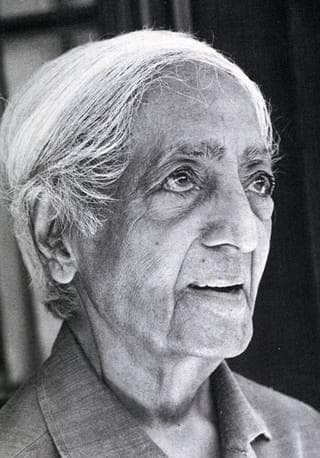
Jiddu Krishnamurti was an Indian philosopher and spiritual teacher known for his exploration of psychological transformation and the nature of thought. His notable works include "Freedom from the Known," which examines the limitations of conditioned thinking, "The First and Last Freedom," a discussion on freedom and self-awareness, and "On Fear," which delves into the nature of fear and its impact on human life.
Similar books
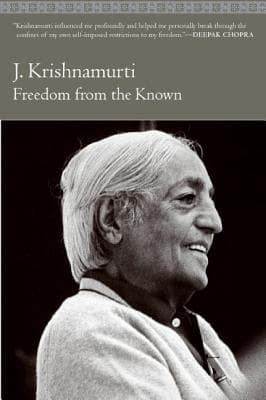
- Freedom from the Known
Jiddu Krishnamurti
4.3 (8k) average on GoodreadsPsychologyAnother core text by Krishnamurti, expanding on similar themes of liberation from conditioning.
- The Power of Now: A Guide to Spiritual Enlightenment
Eckhart Tolle
4.1 (211k) average on GoodreadsPsychologyEmphasizes living in the present moment and transcending the ego, echoing Krishnamurti's focus on 'now' and the illusion of the 'I'.
- The 7 Habits of Highly Effective People: Powerful Lessons in Personal Change
Stephen R. Covey
4.1 (524k) average on GoodreadsBusinessThe contrast is stark. Covey provides actionable strategies for personal effectiveness, goal achievement, and character development, rooted in ethical principles. Krishnamurti, conversely, would likely view such goal-oriented frameworks as further entanglements of thought and the 'I,' advocating for a complete cessation of striving and a radical dismantling of the self-improvement paradigm itself.
- The Perks of Being a Wallflower
Stephen Chbosky
4.2 (1.3M) average on GoodreadsPsychologyThrough letters, a shy high school freshman learns to navigate first love, trauma, and self-discovery, stepping off the sidelines and into life.
- Eleanor Oliphant Is Completely Fine
Gail Honeyman
4.3 (708k) average on GoodreadsLiterary FictionA lonely woman's structured life changes when an IT guy and an elderly man help her learn to open her heart.
- One Flew Over the Cuckoo's Nest
Ken Kesey
4.2 (631k) average on GoodreadsPsychologyIn a mind-bending asylum, the boisterous Randle McMurphy wages a defiant war against the tyrannical Nurse Ratched, inspiring his fellow inmates, including the seemingly catatonic Chief Bromden, to reclaim their lost humanity.




Enjoyed the summary?
A summary gives you the shape of the book. The book itself has the detail, the examples and the voice.
Find The First and Last Freedom on AmazonAs an Amazon Associate, BookBrief earns from qualifying purchases. How we're funded