
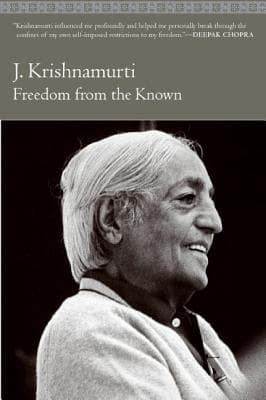
Core Idea
- Difficulty
- Hard
- Read it if
- You are seeking a radical, non-traditional approach to self-understanding and psychological liberation, questioning the very foundations of thought, memory, and societal conditioning.
- Skip it if
- You prefer practical, step-by-step self-help techniques or are looking for a gentle introduction to mindfulness or spiritual practices that involve building upon existing knowledge.
Key Takeaways from Freedom from the Known
The Tyranny of the Known
Our past experiences and accumulated knowledge hinder true understanding.
Krishnamurti states that humans are trapped by the 'known' – all our experiences, memories, traditions, beliefs, and learned information. This known creates a psychological prison, stopping us from seeing reality freshly. Every new experience is filtered through the past, which prevents real understanding. The mind, shaped by centuries of thought, constantly seeks safety and familiarity within this known, even when it causes pain. To truly understand, one must be free from the past, observing without old conclusions or expectations. This is not just an intellectual exercise but a fundamental change in how we see things.
“You must understand the whole structure and nature of the known, and only then is it possible for the mind to be free from the known.”
In the book: Krishnamurti repeatedly refers to the mind as a 'bundle of memories,' 'conditioned by tradition,' and 'the result of the past,' emphasizing how this historical baggage prevents us from seeing 'what is' directly.
Try this: When facing a new situation or conflict, consciously observe your immediate reactions and assumptions. Ask yourself if these reactions are truly based on the present moment or if they are echoes of past experiences and conditioning. Practice observing without judgment or interpretation based on prior knowledge.
Related ideas: conditioning, memory, listened-knowledge
Observation Without the Observer
True seeing occurs when the 'I' and its judgments are absent.
This is a main point of Krishnamurti's philosophy: the insight that the 'observer' (the 'I,' the ego, the thinker) is not separate from the 'observed' (the thought, the feeling, the problem). We usually create a division, believing there's a 'me' watching 'my' anger, 'my' fear, or 'my' thoughts. This division causes conflict and stops solutions. When the observer identifies with what is observed, it creates a cycle of judgment, comparison, and resistance. True observation, then, is a state where the 'I' disappears, and there is only pure awareness of what is, without a separate entity trying to analyze or change it. This unified perception is vital for freedom.
“The observer is the observed. There is no division between the two.”
In the book: He uses the example of fear: 'When you are afraid, you say, 'I am afraid.' Is that 'I' different from fear?' He argues that the 'I' is fear itself, not an entity experiencing it.
Try this: When experiencing a strong emotion like anger or sadness, try to observe it without labeling it as 'my anger' or 'I am sad.' Instead, simply acknowledge the sensation or thought as it arises, without the 'I' stepping in to judge, suppress, or enhance it. Allow the emotion to be, without the subject-object split.
Related ideas: ego, self, duality, awareness
The Illusion of Time as a Means
Psychological change cannot be achieved through gradual effort over time.
Krishnamurti strongly questions the idea that psychological change, like overcoming fear or reaching enlightenment, can be a slow process. He says that 'time' is a psychological invention that keeps suffering going. We believe we need time to change, to improve, to become 'better.' This belief in 'becoming' is a mistake, as it suggests a future state that is always out of reach and distracts us from the present moment. Real change, he argues, is an immediate end to the old, a direct perception in the present, not a slow progression. The idea of 'taking time' to change strengthens the known and prevents true freedom.
“Time is a movement, and as long as you think in terms of time to achieve a psychological result, you are caught in the trap of becoming.”
In the book: He often criticizes the idea of 'evolution' in a psychological sense, stating, 'You cannot evolve into freedom. Freedom is not an end product of time.' He also speaks against practices that promise gradual self-improvement.
Try this: Instead of setting a long-term goal to 'overcome anxiety,' try to directly observe anxiety *in the present moment* without projecting it into the future or thinking about how long it will take to dissipate. Focus on the immediate perception, not on a desired future state.
Related ideas: becoming, psychological-time, transformation, instantaneous-change
The Danger of Authority and Ideals
External authority and internal ideals prevent self-discovery.
Krishnamurti strongly rejects all forms of authority, whether religious, spiritual, political, or even a guru's authority. He states that truth cannot be found by following someone else's path or taking on another's ideas. Outside authority stops individual inquiry and creates dependence. Similarly, internal ideals – what we 'should be' or 'ought to do' – create a conflict with 'what is,' leading to hypocrisy and internal struggle. These ideals often come from conditioning and stop direct perception. Freedom means letting go of both outside authorities and internal idealized images, daring to stand alone and discover truth for oneself, without guidance or burdens.
“To be free, you must be free of all authority, including that of the speaker.”
In the book: He consistently urged his listeners not to follow him or any other teacher, emphasizing that 'truth is a pathless land.' He also critiques the 'guru system' and organized religions for creating dependence.
Try this: When seeking answers or guidance, critically examine the source of the information. Instead of blindly accepting, engage in your own direct observation and questioning. For personal ideals, instead of striving to 'be more patient,' observe your impatience directly without judgment or the pressure to conform to an ideal.
Related ideas: authority, ideals, guru, self-discovery
Thought as the Origin of Suffering
Our thought processes, not external events, are the root of psychological pain.
This is a deep and often challenging statement. Krishnamurti argues that thought, while useful for practical tasks, is the main cause of psychological suffering. Thought creates the 'me,' the ego, and then builds walls around it, causing fear, attachment, comparison, and the search for security. It invents the past and future, leading to regret and worry. Thought divides, judges, and idealizes, stopping us from experiencing life directly. The solution is not to stop thinking completely, but to understand thought's movement and limits, to observe it without identifying with it, and to see its destructive psychological patterns. Freedom comes from seeing thought for what it is.
“Thought is the origin of our problems, of our misery, of our chaos.”
In the book: He often connects fear, loneliness, and sorrow directly to the activity of thought, stating that 'fear is the product of thought.' He also explains how thought creates the image of the 'self' that it then seeks to protect.
Try this: When experiencing emotional pain, trace it back to the thoughts that are generating or sustaining it. Observe the narrative your mind is creating around the event. Can you distinguish the raw sensation from the interpretation and judgment of thought? This practice helps to disidentify from the suffering generated by the mind.
Related ideas: thought-process, ego, suffering, psychological-pain
Meditation is Not a Technique
True meditation is a state of choiceless awareness, not a practiced ritual.
Krishnamurti distinguishes real meditation from common practices. He argues that most meditation techniques are still within the 'known' – they are efforts of the ego to reach a desired state, using methods and systems. This, he says, only makes the division between the meditator and the object of meditation stronger. Real meditation is not something you 'do' for a period; it is a state of being, an awareness that comes when the mind is free from thought, desire, and effort. It is a state of intense observation, where the mind is quiet and open, without any agenda. This state of deep stillness is where insight and change happen.
“Meditation is not a search, it is not a seeking, it is not a cultivation. It is a state of mind.”
In the book: He criticizes specific techniques like mantra repetition or controlled breathing if they are used as a means to an end, emphasizing that 'truth is not a thing to be cultivated.'
Try this: Instead of approaching meditation as a task, try to cultivate a state of choiceless awareness throughout your day. Observe sounds, sights, and thoughts as they arise without choosing to focus on one or push another away. Let your mind be receptive, without effort or struggle, even for brief moments.
Related ideas: choiceless-awareness, stillness, mindfulness, observation
The Nature of Fear and How to End It
Fear is a product of thought about the past or future, not the present.
Krishnamurti states that fear is not a natural part of us but is created by thought. We are afraid of past events repeating, or of what might happen in the future. The 'present' moment, when seen directly, has no fear. Fear appears when thought projects itself into time, creating images of danger, loss, or pain. To end fear, one must observe it without thought getting in the way – without trying to escape it, justify it, or analyze it through the past. When fear is met with complete attention in the immediate present, its power fades because the thought-structure that supports it loses its fuel.
“Fear is the product of thought. If there is no thought, there is no fear.”
In the book: He challenges listeners to observe fear directly, asking, 'Can the mind look at fear without any word, without any image?' He emphasizes that the 'word' fear itself creates the continuity of fear.
Try this: When you feel fear, pause and notice if your mind is projecting into the future or recalling a past event. Bring your attention fully to the physical sensations of fear in your body, without labeling them or creating a story around them. Observe the fear as a raw energy in the present moment, without resistance or identification.
Related ideas: fear, thought, present-moment, psychological-security
Love is Not Thought or Memory
True love is a state of being, free from attachment and image-making.
Krishnamurti differentiates true love from what we often call love, which he argues is usually a mix of desire, attachment, memory, and projected images. When we say 'I love you,' we often mean 'I love the image I have of you,' or 'I love what you give me,' or 'I love the security you provide.' This is not love but a product of thought and self-interest. True love, for Krishnamurti, is a state of being that appears when the self, the ego, and its demands are absent. It is a state of deep attention, compassion, and sensitivity, without possessiveness, jealousy, or the need for return. It is a limitless state, not restricted to one relationship, and it can only exist when free from the known.
“Love is not a memory. Love is not thought. Love is not desire.”
In the book: He often probes the nature of relationships, asking if 'love' is conditional or based on gratification, and if jealousy and possessiveness can coexist with real love. He states that 'love can only exist in freedom.'
Try this: In your relationships, observe if your 'love' is based on expectations, demands, or images you've created of the other person. Try to interact without these projections, seeing the other person afresh, without the burden of past memories or future desires. Practice a non-demanding attention towards others.
Related ideas: attachment, desire, compassion, relationship
The Ending is the Beginning
True creation and renewal arise from the complete cessation of the old.
This idea shows the radical nature of Krishnamurti's teachings. For psychological change to happen, there must be a complete and immediate end to the known, the old patterns, the learned conditioning. This is not a change or a reform but a total stopping. Only when the mind is completely empty of the past, free from its burdens and distortions, can it truly see 'what is' and be open to the new, the unconditioned, the creative. This ending is not an act of will but a natural result of clear observation and understanding. It means a 'death' to the old self, leading to deep psychological renewal and the chance to live without conflict.
“It is only when there is an ending that there is a new beginning.”
In the book: He often speaks of the 'death to the past' as essential for living in the present, and how 'the freedom from the known is the death to the known.'
Try this: When you recognize a habitual, unhelpful pattern of thought or behavior, instead of trying to modify it or gradually change it, try to see if you can allow that pattern to cease entirely in that moment. It's not about effort but about a complete, non-resistant observation that allows the old to fall away.
Related ideas: renewal, cessation, transformation, radical-change
Intelligence is Beyond Thought
True intelligence is a state of direct perception, not accumulated knowledge.
Krishnamurti distinguishes between mere intellect (which is the faculty of thought, memory, and learned knowledge) and true intelligence. Intellect, while useful for practical matters, is limited by the known and cannot bring psychological freedom. True intelligence is a much wider, deeper ability – it is the ability to see 'what is' directly, without distortion, interpretation, or the known getting in the way. It is a state of clarity, insight, and sharp sensitivity that comes when the mind is quiet, free from constant thought and the past. This intelligence is not learned; it is a natural result of self-knowledge and freedom from conditioning, helping one respond well to life's challenges.
“Intelligence is not knowledge. Intelligence is the capacity to see what is.”
In the book: He often contrasts the 'cleverness of the mind' with 'intelligence,' highlighting how knowledge can make us clever but not necessarily intelligent in a deeper sense. He relates intelligence to 'seeing the truth instantaneously.'
Try this: When faced with a complex problem, instead of immediately jumping to solutions based on past experiences or learned information, try to quiet your mind and observe the problem itself with fresh, open attention. Allow insight to emerge from this quiet observation, rather than forcing a solution through intellectual effort.
Related ideas: insight, clarity, direct-perception, wisdom
Freedom from the Known Quotes
“You are accustomed to being told what to do, or to telling yourself what to do, and your mind is the result of all that. You have never been free to find out.”
“The observer is the observed.”
“Truth is a pathless land.”
“Can the mind be free from the known?”
“Security is a terrible thing.”
“To understand anything, you must live with it, you must observe it, you must know all its content, its nature, its structure, its movement.”
“Comparison is a form of violence.”
“When you are free from all authority, from all tradition, from all dogma, from all gurus, then you are a light to yourself.”
“Sorrow is not separate from the observer.”
“There is no end to sorrow if you are seeking comfort.”
“Meditation is not a means to an end. It is both the means and the end.”
“To look without the word is to be in a state of choiceless awareness.”
“What is important is to be free of all psychological accumulation.”
“Can the mind be quiet, without any movement, without any image, without any thought?”
Quiz
10 questions on the main ideas. Each answer comes with a short explanation.
Question 1
According to Krishnamurti, what is the fundamental barrier to true freedom and understanding?
- Lack of education
- Accumulated knowledge and conditioning
- Societal rules and regulations
- Physical limitations
Show answer
B. Accumulated knowledge and conditioning Krishnamurti repeatedly emphasizes that our past experiences, memories, and the conditioning of our minds, which constitute 'the known,' prevent us from perceiving reality directly and living freely. He argues that true freedom comes from breaking away from this accumulated knowledge.
Question 2
Krishnamurti argues that 'thought' itself, while seemingly beneficial, is a major source of:
- Technological advancement
- Human connection
- Fear and suffering
- Artistic expression
Show answer
C. Fear and suffering In 'Freedom from the Known,' Krishnamurti critically examines thought, stating that it is always old, derived from memory, and therefore incapable of creating anything new or truly free. He links thought directly to the creation of fear, conflict, and the perpetuation of suffering.
Question 3
What does Krishnamurti mean by 'choiceless awareness'?
- A state of indifference to life's events
- Observing what 'is' without judgment, comparison, or the intervention of choice
- Following a specific spiritual guru without questioning
- Making decisions quickly without overthinking
Show answer
B. Observing what 'is' without judgment, comparison, or the intervention of choice Choiceless awareness is a core concept where one observes reality—both internal and external—as it is, without the mind's usual habit of judging, comparing, or trying to alter it. It is about passive, non-interfering observation, which Krishnamurti posits is essential for insight.
Question 4
Krishnamurti asserts that true freedom cannot be achieved through:
- Meditation and self-reflection
- Following a specific method, system, or authority
- Engaging in genuine inquiry
- Direct observation of one's own mind
Show answer
B. Following a specific method, system, or authority A central theme in the book is the rejection of all external authority, including spiritual teachers, scriptures, and prescribed methods. Krishnamurti argues that relying on systems or gurus only perpetuates dependence and prevents direct, individual discovery of truth.
Question 5
How does Krishnamurti suggest one can understand and dissolve fear?
- By suppressing it or distracting oneself from it
- By confronting its root causes through direct, non-judgmental observation in the present moment
- By developing courage through challenging experiences
- By intellectual analysis of past traumas
Show answer
B. By confronting its root causes through direct, non-judgmental observation in the present moment Krishnamurti advocates for directly facing fear, not running from it or analyzing it intellectually, but observing it completely and choicelessly as it arises. He believes that this intense, direct observation, without the intervention of thought or desire to change it, leads to its dissolution.
Question 6
What is Krishnamurti's view on the pursuit of happiness?
- It is a noble and achievable goal through consistent effort.
- It is a byproduct of understanding oneself and living without conflict.
- It is a futile endeavor, as happiness is merely the other side of sorrow, created by thought.
- It requires the elimination of all negative emotions.
Show answer
C. It is a futile endeavor, as happiness is merely the other side of sorrow, created by thought. Krishnamurti views the pursuit of happiness as inherently problematic because happiness, like sorrow, is a movement of thought, a reaction. He suggests that when one truly understands the nature of sorrow, the search for its opposite ceases, leading to a state beyond both.
Question 7
According to the book, what is the role of the 'observer' in understanding oneself?
- The observer is a distinct entity that can objectively analyze the observed.
- The observer is the observed; they are not separate entities.
- The observer is a tool to control and modify one's thoughts and emotions.
- The observer is the conscience guiding one's actions.
Show answer
B. The observer is the observed; they are not separate entities. This is a crucial and often challenging concept in Krishnamurti's teachings. He argues that the 'observer' (the 'I,' the ego, the thinker) is not separate from the 'observed' (the thought, the emotion, the experience). The division creates conflict; realizing 'the observer is the observed' leads to a unified perception and the dissolution of conflict.
Question 8
Krishnamurti consistently rejects the idea of a gradual, progressive path to enlightenment or freedom. Why?
- He believes only a select few are capable of such a transformation.
- He argues that time and effort imply continuity of the 'known,' preventing radical transformation.
- He thinks that true freedom can only be inherited.
- He believes that societal structures prevent individual freedom.
Show answer
B. He argues that time and effort imply continuity of the 'known,' preventing radical transformation. Krishnamurti frequently states that freedom is 'now or never.' He argues that any process involving time, effort, or gradual progression is still a movement within the realm of thought and the known, thereby reinforcing the very conditioning one seeks to escape. True transformation, he asserts, is immediate and radical.
Question 9
What is the primary function of 'knowledge' as discussed in 'Freedom from the Known'?
- To solve all human problems
- To enable technological and scientific progress
- To create the 'me' or the ego, and perpetuate conditioning
- To provide a foundation for moral living
Show answer
C. To create the 'me' or the ego, and perpetuate conditioning While acknowledging the practical utility of knowledge, Krishnamurti's focus in this book is on how psychological knowledge—our memories, experiences, beliefs—forms the structure of the 'me' (the ego) and creates the psychological barrier to freedom. It is the known that prevents the new.
Question 10
Krishnamurti suggests that true love emerges when:
- One finds a perfect partner who fulfills all desires.
- One transcends the self, fear, and the demands of the 'me'.
- One actively practices compassion and kindness daily.
- One understands the psychological theories of attachment.
Show answer
B. One transcends the self, fear, and the demands of the 'me'. For Krishnamurti, love is not a product of thought or desire, nor is it merely an emotion. He argues that love can only exist when there is no fear, no self-pity, no demand, no jealousy, and no division—essentially, when the 'me' (the ego) is absent. It is a state of being that arises from self-transcendence.
Freedom from the Known FAQ
What is the core message of Jiddu Krishnamurti's 'Freedom from the Known'?
'Freedom from the Known' emphasizes the urgent need for individuals to liberate themselves from all forms of psychological conditioning, including beliefs, traditions, and societal expectations. Krishnamurti argues that true freedom and understanding emerge only when the mind is unburdened by the past and the known.
Does 'Freedom from the Known' offer practical steps for immediate transformation?
While the book doesn't provide step-by-step exercises in a conventional self-help sense, it encourages deep self-observation and inquiry into one's own thought processes and motivations. Krishnamurti suggests that radical transformation is possible in the present moment through direct awareness, rather than gradual effort.
What does Krishnamurti mean by 'the known'?
'The known' refers to everything accumulated through experience, memory, knowledge, traditions, and psychological conditioning. Krishnamurti posits that this accumulation, while useful for practical living, becomes a barrier to true understanding and freedom when it dictates our perception of the present.
How does Krishnamurti's approach differ from traditional meditation or mindfulness practices?
Krishnamurti often critiqued structured meditation or mindfulness if they became another form of conditioning or a means to an end. He advocated for a choiceless awareness that is spontaneous and immediate, without technique or the intervention of a 'meditator' trying to achieve a state.
Is 'Freedom from the Known' a religious or spiritual book?
While it delves into profound questions traditionally associated with spirituality, Krishnamurti explicitly rejected all organized religions, gurus, and spiritual systems. The book is non-denominational and focuses on individual psychological liberation rather than adherence to any specific dogma or belief system.
Does the book suggest abandoning all knowledge and memory?
Krishnamurti distinguishes between functional knowledge (like knowing how to drive or speak a language) and psychological knowledge (like beliefs, prejudices, and identity). He does not advocate abandoning practical knowledge, but rather freeing the mind from the psychological burden and conditioning of the latter.
How is 'Freedom from the Known' different from typical self-help books?
Unlike many self-help books that offer prescriptive solutions, techniques, or goal-setting strategies, Krishnamurti's work challenges the very structure of the 'self' that seeks help. It encourages a radical questioning of all authority, including one's own psychological authority, rather than providing external solutions.
Can 'Freedom from the Known' help with anxiety and fear?
Krishnamurti's teachings directly address the roots of fear and anxiety by exploring the nature of thought itself and its relationship to time and the self. By understanding how the mind creates and sustains fear through clinging to the known and projecting into the future, one can potentially find release from these states.
What is 'choiceless awareness' as described in the book?
Choiceless awareness is a state of simply observing what is, without judgment, comparison, or the intervention of choice. It means being fully present with whatever arises, without trying to alter it, escape it, or interpret it through the lens of past knowledge or future desire.
About the author
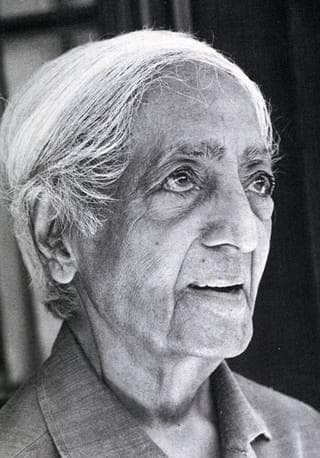
Jiddu Krishnamurti was an Indian philosopher and spiritual teacher known for his exploration of psychological transformation and the nature of thought. His notable works include "Freedom from the Known," which examines the limitations of conditioned thinking, "The First and Last Freedom," a discussion on freedom and self-awareness, and "On Fear," which delves into the nature of fear and its impact on human life.
Similar books
- The Power of Now: A Guide to Spiritual Enlightenment
Eckhart Tolle
4.1 (211k) average on GoodreadsPsychologyExplores the importance of present moment awareness and detachment from the thinking mind, though with a different stylistic approach.
- The Myth of Sisyphus
Albert Camus
4.2 (25k) average on GoodreadsPhilosophyExamines the human condition, meaning, and freedom from a philosophical perspective, challenging conventional comfort zones.
- Man's Search for Meaning
Viktor E. Frankl
4.4 (401k) average on GoodreadsBiographyWhile both books delve into suffering and the human condition, their approaches are fundamentally different. Frankl's "Man's Search for Meaning" emphasizes finding purpose and meaning within suffering, often through external circumstances, relationships, or a 'will to meaning.' He posits that meaning can be discovered and is crucial for psychological resilience. Krishnamurti, conversely, argues for the ending of suffering through the cessation of thought and the 'known.' He wouldn't advocate for finding meaning in suffering but rather understanding its root cause (thought) to transcend it entirely. Frankl offers a therapeutic framework (Logotherapy) that operates within the known world of human experience, whereas Krishnamurti seeks to move beyond it entirely.
- The Perks of Being a Wallflower
Stephen Chbosky
4.2 (1.3M) average on GoodreadsPsychologyThrough letters, a shy high school freshman learns to navigate first love, trauma, and self-discovery, stepping off the sidelines and into life.
- Eleanor Oliphant Is Completely Fine
Gail Honeyman
4.3 (708k) average on GoodreadsLiterary FictionA lonely woman's structured life changes when an IT guy and an elderly man help her learn to open her heart.
- One Flew Over the Cuckoo's Nest
Ken Kesey
4.2 (631k) average on GoodreadsPsychologyIn a mind-bending asylum, the boisterous Randle McMurphy wages a defiant war against the tyrannical Nurse Ratched, inspiring his fellow inmates, including the seemingly catatonic Chief Bromden, to reclaim their lost humanity.





Enjoyed the summary?
A summary gives you the shape of the book. The book itself has the detail, the examples and the voice.
Find Freedom from the Known on AmazonAs an Amazon Associate, BookBrief earns from qualifying purchases. How we're funded