
Core Idea
- Difficulty
- Medium
- Read it if
- You want an unvarnished, first-person account of the Eastern Front from the German perspective, focusing on the sheer brutality and psychological toll of infantry combat.
- Skip it if
- You are looking for a strategic overview of WWII, a politically motivated analysis, or a narrative that romanticizes military service.
Key Takeaways from The Forgotten Soldier
The Illusion of Glory
War's initial allure quickly gives way to brutal, dehumanizing reality.
Sajer's memoir shows how appealing early war propaganda and the initial romantic view of military service were, especially for a young man. He volunteers, drawn by adventure and duty, believing his cause is right. But this idealism quickly breaks under the harsh realities of the Eastern Front. The initial excitement of joining the Wehrmacht and the camaraderie soon turn into a desperate daily fight for survival. The 'glory' of war, seen in recruitment posters and early victories, is replaced by constant death threats, starvation, and cold. War becomes an existential nightmare. Sajer's path from eager recruit to broken, traumatized survivor shows this deep disappointment.
“War is a matter of life or death, a road either to safety or to ruin. Hence it is a subject of inquiry which can on no account be neglected.”
In the book: Sajer's initial enthusiasm upon volunteering and joining the Gross Deutschland Division, contrasted with his later descriptions of the relentless suffering and psychological breakdown of his comrades, and his own increasing detachment.
Try this: Reflect on how easily narratives of 'glory' or 'necessity' can mask the true costs of conflict. Seek out diverse perspectives, especially from those directly impacted, before forming opinions on military engagements.
Related ideas: war-propaganda, disillusionment, military-psychology
The Eastern Front's Unrelenting Cruelty
The sheer scale of suffering and the indifference of nature defined the German-Soviet conflict.
Sajer's book is a raw depiction of the Eastern Front as a place of unmatched brutality. Unlike other fronts, the German-Soviet war had extreme ideological hatred, a scorched-earth strategy, and environmental extremes that caused as much damage as the enemy. Sajer emphasizes the ever-present cold, the vast, unforgiving landscapes, and the constant threat of starvation and disease, which added to the horrors of combat. The sheer number of casualties and the merciless fighting created an environment where human life had little value. Survival often came down to luck or an animalistic will to endure. This front was a grinder of men, physically and psychologically, leaving lasting scars on all who fought there.
“The cold was a living thing, a predator that gnawed at our bones and stole our will.”
In the book: Detailed descriptions of frostbite, the endless marches through snow and mud, the scarcity of food, and the overwhelming power of Soviet artillery and human wave attacks, particularly during the retreats from Kursk and Kharkov.
Try this: Understand the unique historical context and extreme conditions of the Eastern Front, recognizing it as distinct from other WWII theaters in its intensity and human cost. Appreciate the resilience of those who endured such conditions.
Related ideas: eastern-front, world-war-ii, military-history, survival
Dehumanization as a Survival Mechanism
To endure, soldiers shed their humanity, becoming instruments of war and survival.
One of the most impactful parts of Sajer's memoir is the slow dehumanization soldiers experienced. Constant exposure to death, the need to kill, and extreme hardship forced men to lose their moral sense and empathy. Sajer describes how he and his comrades lost their individuality, becoming mere parts of a war machine, focused only on immediate survival. Brutal acts, both towards the enemy and sometimes each other, became normal. This dehumanization was not a choice but a psychological need, a defense against overwhelming horror, allowing them to do terrible things and see unimaginable suffering without completely breaking. The cost, however, was a deep and lasting loss of self.
“We were no longer men, but beasts, driven by instinct and fear.”
In the book: Sajer's accounts of his own changing perceptions, his increasing indifference to death, and the brutal treatment of prisoners or civilians, which he describes with a chilling, detached tone reflecting his psychological state.
Try this: Consider the psychological toll of war beyond physical injury. Recognize how extreme environments can warp human behavior and morality, and the importance of understanding these processes in post-conflict rehabilitation.
Related ideas: psychological-trauma, dehumanization, military-ethics, coping-mechanisms
The Arbitrariness of Death
Survival on the front was less about skill and more about sheer, brutal luck.
Sajer repeatedly highlights the random nature of death on the Eastern Front. In the chaos of battle, men died from stray bullets, unseen artillery shells, or even friendly fire, with no clear pattern or fairness. Skill, bravery, or fear often mattered little when a mortar round landed exactly in one's foxhole. This randomness created a deep sense of fatalism among soldiers. They lived knowing their time could be up at any moment, leading them to focus on immediate survival and detach from the future. This lack of control over one's fate is a main theme, showing the individual soldier's powerlessness against the vast machinery of war.
“Death was everywhere, a constant companion, and its hand was often dealt by chance.”
In the book: Numerous anecdotes where comrades are killed suddenly and without warning, often in absurd or mundane circumstances, while others survive seemingly impossible odds, reinforcing the idea of 'luck' as the primary determinant of survival.
Try this: Challenge narratives that overemphasize individual heroism or skill in combat, recognizing the significant role of chance and external factors. This perspective fosters empathy for all involved, regardless of their 'performance' in battle.
Related ideas: fatalism, combat-psychology, randomness, mortality
Camaraderie as a Double-Edged Sword
Bonds forged in hell provided solace but amplified the pain of loss.
Amid the desolation, Sajer vividly portrays the deep bonds of friendship that formed among soldiers. These relationships, born from shared suffering and mutual reliance, were often the only source of comfort and meaning. Soldiers depended on each other for physical survival, psychological support, and a brief sense of humanity. However, this intense connection came with a terrible cost. Every comrade's death was a personal blow, deeply felt in an environment where grief was a luxury no one could afford. The constant loss wore away at the survivors, leaving them more isolated and numb. Friendship, a source of strength, became an amplifier of trauma.
“The only thing that kept us human was each other, and losing a comrade was like losing a part of yourself.”
In the book: Sajer's detailed descriptions of shared jokes, small acts of kindness, and the collective mourning (or suppression of mourning) for fallen friends, contrasting with the increasing emotional distance he observes in himself and others.
Try this: Understand the complex role of social bonds in extreme environments. Recognize that while human connection is vital, it also creates vulnerabilities, especially in situations of pervasive loss and trauma.
Related ideas: camaraderie, trauma-bonding, grief, social-support
The War's Psychological Scars
The mental wounds of combat proved more enduring than the physical ones.
While Sajer recounts many physical injuries, his memoir ultimately shows war's devastating psychological toll. He describes the slow loss of sanity, the start of hallucinations, the crushing weight of fear, and the deep sense of detachment that fills soldiers' experiences. Constant stress, sleep deprivation, and exposure to extreme violence fundamentally change their minds, leaving them with invisible wounds much harder to heal than any physical ailment. Sajer's own fragmented memories and his struggles after the war show that for many, the war continues long after the fighting stops, appearing as deep trauma and a permanent change in their worldview.
“The war never really ended for us; it lived on inside our heads, a constant echo.”
In the book: Sajer's vivid descriptions of his own mental state, including moments of hallucination, panic attacks, and the pervasive feeling of unreality, especially towards the end of the war when his division is constantly retreating and disintegrating.
Try this: Advocate for comprehensive mental health support for veterans, recognizing that psychological trauma is a legitimate and often debilitating consequence of combat. Challenge stigmas surrounding mental health in military contexts.
Related ideas: PTSD, combat-stress, mental-health, veteran-support
The German Soldier's Perspective
A rare, intimate look at the Eastern Front from the 'enemy's' side.
What makes 'The Forgotten Soldier' unique and valuable is its German perspective on the Eastern Front. Sajer, a Frenchman serving in the Wehrmacht, offers a rare, non-ideological account of the conflict. His story focuses almost entirely on the common soldier's raw experience — the fight for survival, the friendship, the fear, and the brutal conditions — rather than political reasons or grand strategy. This perspective helps readers understand the universal human experience of war, even when fought on the 'wrong' side of history. It humanizes the individual German soldier without excusing the Nazi regime's actions or ideology, providing a nuanced view of a very complex historical period.
“We were fighting for our lives, not for an ideology we barely understood.”
In the book: Sajer's consistent focus on the day-to-day realities of soldiering, his lack of engagement with Nazi ideology, and his emotional responses to the suffering of his comrades, regardless of their nationality, as well as the initial excitement of joining the Wehrmacht.
Try this: Seek out diverse historical narratives, even those from 'unpopular' perspectives, to gain a more complete and nuanced understanding of historical events. Differentiate between individual experiences and the ideologies they may have been forced to serve.
Related ideas: historical-perspective, german-wehrmacht, eastern-front-history, memoir-analysis
War as an Absurdist Nightmare
The logical order of life dissolves into a chaotic, senseless struggle.
Sajer's depiction of war often leans towards the absurd. Constant shifting front lines, illogical orders, senseless deaths, and massive destruction create an environment where reason and meaning break down. Soldiers are caught in a relentless, seemingly pointless cycle of advance and retreat, killing and being killed, driven by forces they do not understand or control. This pervasive absurdity strips war of any heroic or glorious meaning, presenting it instead as a chaotic, terrifying, and ultimately pointless effort that consumes human lives without reason. The story highlights the deep disconnect between an individual's experience and any larger strategic or ideological purpose.
“Logic had no place here; only the absurd ruled.”
In the book: Episodes where soldiers are sent on futile missions, witness bizarre or contradictory events, or where the landscape itself becomes a surreal, nightmarish tableau of destruction and death, such as the burned villages and endless rubble.
Try this: Question the justifications for war and critically examine narratives that attempt to rationalize or glorify conflict. Recognize that the lived experience of war is often one of profound disorder and lack of meaning.
Related ideas: absurdism, meaninglessness, anti-war-literature, existentialism
The Enduring Power of Memory
Even fragmented, traumatic memories shape and haunt the survivor.
Sajer himself admits his memories are fragmented and sometimes unreliable, acknowledging that trauma can twist and hide the past. Yet, this struggle to recall and articulate the horrors he saw gives the memoir its raw power. The act of remembering, even imperfectly, is a vital, though painful, process for the survivor. These lasting memories, whether clear or hazy, continue to shape his post-war identity, showing that the war experience is not something one simply 'gets over.' The book itself tries to deal with these permanent marks, to make sense of an experience that defies easy understanding, and to bear witness to what was lost and endured.
“The past is never dead. It's not even past.”
In the book: Sajer's frequent prefacing of events with phrases like 'if my memory serves me right' or 'it seems to me,' highlighting the subjective and fragmented nature of his recollections, yet still providing profound detail and emotional resonance.
Try this: Appreciate the power and fragility of memory, especially in the context of trauma. Understand that historical accounts, particularly memoirs, offer subjective truths that are valuable in their own right, even if not strictly objective.
Related ideas: memory-and-trauma, memoir-writing, historical-memory, post-war-identity
The Unbearable Weight of the Infantryman
The foot soldier bears the ultimate burden of war, often without understanding its purpose.
Sajer's memoir strongly argues for the unique and often unacknowledged burden of the infantryman. Far from strategic decisions or grand narratives, the foot soldier faces the most direct and brutal consequences of conflict. They are the ones who confront the enemy directly, who march for endless miles, who starve, freeze, and die anonymously. Sajer emphasizes the physical exhaustion, constant fear, and psychological breakdown that is the infantryman's lot. His account removes any romantic notions of combat, showing it as a relentless, grinding experience of suffering, endured by individuals who are often mere pawns in a much larger, incomprehensible game. The title itself, 'The Forgotten Soldier,' speaks to this core theme of the infantryman's ultimate expendability and lack of recognition.
“We were the forgotten, the ones who did the dying, while the generals moved their pins on maps.”
In the book: Sajer's detailed descriptions of the physical demands of marching, carrying heavy equipment, digging foxholes, and enduring direct enemy fire, contrasted with his complete lack of insight into the broader strategic objectives or political aims of the war.
Try this: Cultivate a profound respect for the sacrifices and experiences of infantry soldiers in any conflict. Recognize the immense physical and psychological demands placed upon them, and the often thankless nature of their role.
Related ideas: infantry-experience, grunt-life, military-burden, soldier's-perspective
The Forgotten Soldier Quotes
“War is a matter of enduring.”
“I was a soldier. I had no other identity, no other hope, no other thought.”
“The feeling of cold was a constant companion, a dull ache that never left.”
“Death was everywhere, a familiar face, sometimes a friend, sometimes an enemy.”
“We were fighting for nothing, against nothing, just fighting.”
“The fear, it was not just of dying, but of living in such a way.”
“There were no heroes, only survivors.”
“The silence was sometimes more terrifying than the noise.”
“We clung to each other, not out of friendship, but out of necessity, like drowning men.”
“Memory is a strange thing. It can save you or destroy you.”
“The earth was soaked with blood, so much blood that it seemed to belong to the earth itself.”
“We were rats, scurrying in the ruins of a collapsing world.”
“Even hope became a burden, because it meant there was something to lose.”
“The war had taken everything, even the memory of who I once was.”
Quiz
10 questions on the main ideas. Each answer comes with a short explanation.
Question 1
What was Guy Sajer's initial perception of joining the German war effort, as depicted in 'The Forgotten Soldier'?
- He was filled with dread and fear.
- He saw it as an exciting adventure.
- He was indifferent to the prospect.
- He was forced against his will.
Show answer
B. He saw it as an exciting adventure. The book description states that 'At first an exciting adventure, young Guy Sajer’s war becomes...' indicating his initial perspective.
Question 2
Which elite German division did Guy Sajer become a member of, fighting in major Eastern Front battles?
- Leibstandarte SS Adolf Hitler
- Waffen-SS Totenkopf
- Gross Deutschland Division
- Fallschirm-Panzer Division Hermann Göring
Show answer
C. Gross Deutschland Division The description explicitly mentions, 'As a member of the elite Gross Deutschland Division, he fought in all the great battles...'
Question 3
What did Guy Sajer's war primarily devolve into as the German invasion faltered in the Ukraine?
- A strategic chess match against Soviet generals.
- A simple, desperate struggle for survival.
- A quest for personal glory and promotion.
- A diplomatic mission to negotiate peace.
Show answer
B. A simple, desperate struggle for survival. The synopsis states, 'young Guy Sajer’s war becomes... a simple, desperate struggle for survival against cold, hunger, and above all the terrifying Soviet artillery.'
Question 4
Besides cold and hunger, what was highlighted as the 'terrifying' primary threat to Guy Sajer's survival on the Eastern Front?
- German officer brutality
- Partisan attacks
- Soviet artillery
- Friendly fire incidents
Show answer
C. Soviet artillery The text explicitly states: 'a simple, desperate struggle for survival against cold, hunger, and above all the terrifying Soviet artillery.'
Question 5
Which two major battles on the Eastern Front are specifically mentioned as ones Guy Sajer fought in?
- Stalingrad and Berlin
- Kursk and Kharkov
- Leningrad and Moscow
- D-Day and Battle of the Bulge
Show answer
B. Kursk and Kharkov The description notes, 'he fought in all the great battles from Kursk to Kharkov.'
Question 6
What unique perspective does 'The Forgotten Soldier' offer that distinguishes it from many other World War II memoirs?
- It focuses solely on the naval war in the Pacific.
- It presents the war from a German footsoldier’s perspective on the Eastern Front.
- It details the experiences of an Allied spy behind enemy lines.
- It is written from the viewpoint of a high-ranking German general.
Show answer
B. It presents the war from a German footsoldier’s perspective on the Eastern Front. The text highlights, 'Sajer's German footsoldier’s perspective makes The Forgotten Soldier a unique war memoir...'
Question 7
According to the Christian Science Monitor, what significant status did 'The Forgotten Soldier' achieve regarding World War II literature?
- It was considered too controversial to be widely published.
- It was praised as the definitive historical account of the Western Front.
- It 'may well be the book about World War II which has been so long awaited.'
- It was primarily recognized for its fictional narrative elements.
Show answer
C. It 'may well be the book about World War II which has been so long awaited.' The description quotes the Christian Science Monitor stating it 'may well be the book about World War II which has been so long awaited.'
Question 8
What is a notable feature of the republished deluxe edition of 'The Forgotten Soldier'?
- It includes a foreword by a modern-day military historian.
- It contains fifty rare German combat photos, many from private collections and never before published.
- It features newly discovered letters from Guy Sajer to his family.
- It includes an updated epilogue detailing Sajer's post-war life.
Show answer
B. It contains fifty rare German combat photos, many from private collections and never before published. The text states: 'Now it has been handsomely republished containing fifty rare German combat photos of life and death at the eastern front. Many are originally from the private collections of German soldiers and have never been published before.'
Question 9
The photos in the deluxe edition primarily depict which aspects of war, according to the description?
- Strategic maps and battle plans.
- Propaganda posters and political rallies.
- The hardships and destructiveness of war, such as troops battling through snow, mud, and rubble.
- Portraits of high-ranking officers and military parades.
Show answer
C. The hardships and destructiveness of war, such as troops battling through snow, mud, and rubble. The description notes, 'The photos of troops battling through snow, mud, burned villages, and rubble-strewn cities depict the hardships and destructiveness of war.'
Question 10
What overarching theme does 'The Forgotten Soldier' emphasize about the Eastern Front experience, particularly as the invasion faltered?
- The triumph of German military strategy.
- The overwhelming psychological toll and physical struggle for sheer survival.
- The camaraderie among all combatants, regardless of nationality.
- The ultimate justification of the war's objectives.
Show answer
B. The overwhelming psychological toll and physical struggle for sheer survival. The description highlights 'a simple, desperate struggle for survival against cold, hunger, and above all the terrifying Soviet artillery,' which points to the overwhelming psychological and physical struggle.
The Forgotten Soldier FAQ
What is 'The Forgotten Soldier' about?
'The Forgotten Soldier' is a powerful memoir by Guy Sajer, detailing his experiences as a teenage German soldier on the Eastern Front during World War II. It vividly portrays the brutal realities of combat, the extreme conditions, and the desperate struggle for survival against the Soviet forces.
Does 'The Forgotten Soldier' provide an accurate historical account of the Eastern Front?
While 'The Forgotten Soldier' is a memoir, offering a personal perspective, it is widely praised for its raw and visceral depiction of the Eastern Front's horrors. Historians generally acknowledge its value in conveying the human experience of the war, though some details have been debated due to the nature of memory.
What makes 'The Forgotten Soldier' different from other World War II memoirs?
Unlike many Western Front or Allied accounts, 'The Forgotten Soldier' offers a rare and intimate look at the Eastern Front from the perspective of a German footsoldier. Sajer's focus on the psychological and physical toll of combat, alongside the unique challenges of fighting in the Ukraine, sets it apart.
What is the significance of the Gross Deutschland Division in the book?
Guy Sajer served in the elite Gross Deutschland Division, one of Germany's premier combat units. His experiences within this division provide insights into the training, camaraderie, and desperate fighting that characterized these highly regarded, yet ultimately overwhelmed, forces.
Are the photographs in the new edition of 'The Forgotten Soldier' historically significant?
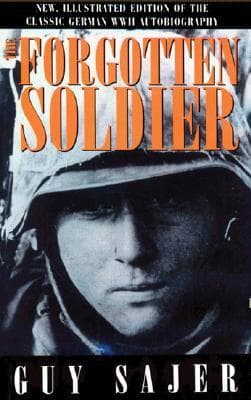
Yes, the republished edition includes fifty rare German combat photos, many from private collections and never before published. These photos offer a stark visual complement to Sajer's narrative, depicting the hardships, landscapes, and destructiveness of war on the Eastern Front.
Does 'The Forgotten Soldier' glorify war?
Absolutely not. Sajer's memoir is a stark anti-war testament, portraying the profound suffering, dehumanization, and futility of conflict through his personal ordeal. It emphasizes the struggle for survival against cold, hunger, and overwhelming enemy fire, rather than any sense of glory.
How does 'The Forgotten Soldier' depict the Soviet artillery?
The Soviet artillery is a constant and terrifying presence throughout 'The Forgotten Soldier.' Sajer frequently describes the devastating impact of Soviet bombardments, highlighting their psychological toll and their capacity to inflict immense casualties and destruction, making it a primary fear for the German soldiers.
Is 'The Forgotten Soldier' suitable for readers interested in military strategy?
While the book touches upon major battles like Kursk and Kharkov, its primary focus is on the individual soldier's experience rather than grand military strategy. Readers seeking detailed strategic analysis might find it less fulfilling than those interested in the human element of warfare.
What kind of challenges did Guy Sajer face on the Eastern Front?
Guy Sajer faced immense challenges including extreme cold, relentless hunger, constant fear of Soviet artillery and attacks, the psychological trauma of combat, and the physical exhaustion of continuous fighting and retreats. His narrative is a testament to the sheer will to survive under unimaginable conditions.
Similar books
- All Quiet on the Western Front
Erich Maria Remarque
4.0 (355k) average on GoodreadsHistorical FictionDepicts the dehumanizing and brutal reality of trench warfare from the perspective of an ordinary soldier.
- The Diary of a Young Girl
Anne Frank
4.2 (2.7M) average on GoodreadsBiographyDuring the Nazi occupation, a teenage girl's diary, written from a secret annex, shares observations on humanity, hope, and the wait for freedom.
- Eat, Pray, Love
Elizabeth Gilbert
3.6 (1.5M) average on GoodreadsLifestyleA heartbroken writer leaves her conventional life for a year-long global search for pleasure in Italy, spiritual devotion in India, and unexpected love and balance in Bali.
- Night
Elie Wiesel
4.3 (970k) average on GoodreadsBiographyIn the darkness of Auschwitz and Buchenwald, a teenage Elie Wiesel faces the extermination of his family, the loss of his faith, and the lasting scars of humanity's deepest cruelty.
- Steve Jobs
Walter Isaacson
4.1 (957k) average on GoodreadsBusinessSteve Jobs was a visionary who fused creativity and technology to revolutionize six industries and shape our digital world.
- The Glass Castle
Jeannette Walls
4.3 (903k) average on GoodreadsBiographyJeannette Walls's memoir describes her unusual childhood with brilliant, free-spirited parents whose poverty-stricken life shaped her independence and love despite family problems.






Enjoyed the summary?
A summary gives you the shape of the book. The book itself has the detail, the examples and the voice.
Find The Forgotten Soldier on AmazonAs an Amazon Associate, BookBrief earns from qualifying purchases. How we're funded