
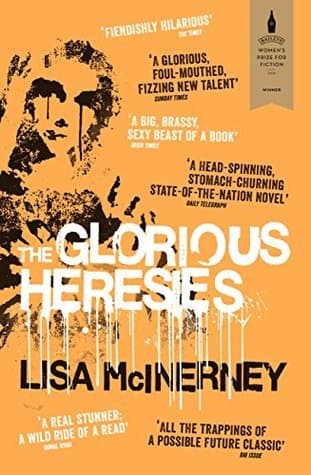
Synopsis
Covers the whole plot, including the ending.
- Difficulty
- Medium
- Pacing
- Variable
- Mood
- Darkly humorous, Gritty, Atmospheric, Tragic, Suspenseful
- Read it if
- You enjoy dark, gritty literary fiction with a strong sense of place, complex characters, and a blend of humor and tragedy.
- Skip it if
- You prefer lighthearted stories, are sensitive to strong language and violence, or dislike morally ambiguous characters.
The Glorious Heresies Plot Summary
Covers the whole plot, including the ending.
The Accidental Murder
Maureen Phelan, an older woman recently back in Cork after forty years, faces a difficult situation when Robbie breaks into her house. Startled, Maureen instinctively hits the intruder with a holy stone, killing him. Panicked, she calls her son, Jimmy Phelan, a known Cork gangster, for help. Jimmy quickly disposes of the body, burying it in an unmarked grave. This act immediately pulls Maureen into the criminal world she tried to leave, and it starts a chain of events that reveals hidden connections in Cork's society. Maureen feels guilty and wants to make amends, believing she has committed a grave sin.
Ryan's World
Ryan Cusack, a fifteen-year-old living in the Cork flats, deals drugs for his uncle, Jimmy Phelan. He is ambitious and smart but constantly lives under the shadow of his alcoholic father, Tony, and the poor conditions at home. Ryan sees his mother, Bridie, and younger siblings struggle daily. He is determined to escape the cycle of poverty and addiction that defines his family. He questions the morality of his actions, trying to keep his identity amidst the violence and despair of his surroundings. His interactions with other dealers and customers show the harsh economic realities of post-crash Ireland and his limited options.
Tony's Obsession
Tony Cusack, Ryan's father, is an unemployed alcoholic whose life centers on drinking and his growing obsession with his neighbor, Georgie. Georgie, a prostitute who sometimes pretends to convert to religion for clients, represents a forbidden attraction for Tony. He spends his days watching her, fantasizing, and neglecting his family. This obsession creates constant tension in the Cusack household, increasing Bridie's despair and fueling Ryan's anger. Tony's erratic behavior and inability to support his family highlight common issues of addiction and poverty. His actions unintentionally pull the family deeper into the world of Jimmy Phelan, Georgie's pimp.
Georgie's Predicament
Georgie, a young prostitute, lives next door to the Cusack family. Jimmy Phelan manages her, offering her some protection and stability in exchange for her earnings. Georgie is practical and resourceful, often using her wit and charm to navigate her dangerous job. She sometimes fakes religious conversions for specific clients, which ironically comments on faith and desperation. Tony Cusack's obsessive behavior becomes a nuisance and a threat, forcing Georgie to ask for Jimmy's help. Her daily life involves constant negotiations of power, personal safety, and the moral compromises needed to survive on the edge of society.
Jimmy's Empire
Jimmy Phelan is Cork's crime boss, a ruthless and calculating figure who controls much of the city's drug trade and prostitution. He is also Maureen's son, which complicates and grounds his life. Jimmy maintains a respectable image through various businesses, but his real power comes from his loyal enforcers and his willingness to use violence. He is fiercely protective of his mother, despite her past abandonment, and readily handles the body she accidentally creates. Jimmy's life balances his brutal business and his attempts to maintain order and loyalty within his family and criminal enterprise.
The Search for Atonement
Haunted by Robbie's accidental killing, Maureen is consumed by guilt and a strong need for forgiveness. She believes she has committed a serious sin and seeks spiritual comfort, visiting churches and confessing her perceived wrongdoings. Her search for absolution connects with her desire to reconnect with her son, Jimmy, and understand the life he has built. Maureen's actions are often clumsy and ill-advised, threatening to expose Jimmy's criminal activities and disrupt his empire. Her attempts to 'do good' often have unintended and dangerous results, drawing more attention to the secrets she and Jimmy try to bury.
Unraveling the Truth
As Maureen continues her quest for forgiveness, details about Robbie, the man she killed, slowly emerge. It is revealed that Robbie was not a random intruder but had a connection to Jimmy Phelan and his past. This discovery adds another layer to the murder, suggesting Maureen's accidental act might have had deeper effects within Cork's criminal underworld. The informal investigation into Robbie's disappearance begins to stir up old secrets and rivalries, threatening to expose Jimmy's illegal activities and his network of corruption. The truth about Robbie's past further links the lives of Maureen, Jimmy, and the Cusack family.
Escalating Tensions
Ryan's involvement in Jimmy's drug dealing grows, and he becomes more skilled at navigating the dangerous Cork underworld. He sees firsthand the violence and ruthlessness needed to survive, strengthening his resolve to escape. Meanwhile, Tony's obsession with Georgie intensifies, leading to more erratic and confrontational behavior that puts both his family and Georgie at risk. Bridie, tired and disappointed, struggles to keep her family together amidst the chaos. The rising tensions within the Cusack household and the growing pressures on Ryan reflect the instability of their lives and Jimmy Phelan's criminal empire's widespread influence.
Confrontations and Consequences
Maureen's persistent attempts to atone and her naive interference in Jimmy's life lead to a direct confrontation between mother and son. Jimmy, frustrated by her meddling and afraid she will expose his operations, tries to control her, but Maureen remains committed to her spiritual quest. During these confrontations, old resentments and the painful history of their relationship resurface, especially Maureen's abandonment of Jimmy as a child. These emotional exchanges reveal the deep pain and complex love that binds them, despite their different lives. The effects of Maureen's actions begin to spread through Jimmy's organization, causing instability and attracting unwanted attention.
The Climax and Aftermath
The various plot threads come together in a violent climax. The truths about Robbie's past, Jimmy's operations, and Maureen's accidental murder are fully revealed, leading to a brutal confrontation that affects all main characters. Ryan must make difficult choices about his future, seeing the full extent of violence in his uncle's world. Tony's obsession reaches a breaking point, with tragic results. Maureen, despite her good intentions, finds herself caught in the crossfire of the criminal world she stumbled into. The aftermath leaves Cork's underworld shaken, and the lives of the Phelan and Cusack families are permanently changed, forcing them to face the results of their choices and the societal forces that shaped them.
The Glorious Heresies Characters
Maureen Phelan
Protagonist
An elderly woman haunted by past sins and an accidental murder, seeking atonement.
Maureen Phelan is an elderly woman who returns to Cork after forty years in exile, having been forced to give up her son, Jimmy, as a baby. She is deeply religious, carrying a profound sense of guilt and shame for her past choices and for the accidental murder of Robbie. Maureen is naive and often clumsy in her attempts to navigate the modern world and the criminal underworld her son inhabits. Her desire for spiritual absolution and to make amends drives her actions, often with unintended and dangerous consequences for those around her, particularly Jimmy. She is a symbol of Ireland's repressive past and its lasting impact on individuals.
Relationships: Jimmy Phelan (Son she gave up, now a gangster; complex, strained, yet loving.); Robbie (Man she accidentally killed; his death triggers her quest for atonement.)
Jimmy Phelan
Antagonist/Supporting
Cork's ruthless crime boss, Maureen's estranged son, fiercely protective but morally ambiguous.
Jimmy Phelan is the powerful and feared crime lord of Cork, controlling drug dealing and prostitution. He is Maureen's son, whom she was forced to give up, and this abandonment has shaped his hardened exterior and his drive for power. Despite his brutal profession, he exhibits a complex loyalty and protectiveness towards his mother, immediately disposing of the body she creates. Jimmy is pragmatic, intelligent, and ruthless, always seeking to maintain control and avoid exposure. He represents the darker underbelly of modern Ireland, a product of both societal neglect and his own ambition, trying to reconcile his criminal life with his personal obligations.
Relationships: Maureen Phelan (Mother he resents for abandoning him, but fiercely protects.); Ryan Cusack (Nephew he employs in his drug trade, a potential successor or victim.); Georgie (Prostitute under his protection and control.)
Ryan Cusack
Protagonist
A fifteen-year-old drug dealer desperate to escape his impoverished, dysfunctional family life.
Ryan Cusack is a sharp and ambitious fifteen-year-old living in the Cork flats, dealing drugs for his uncle, Jimmy Phelan. He is determined not to follow in the footsteps of his alcoholic father, Tony, and dreams of a better life for himself and his younger siblings. Ryan is intelligent and observant, keenly aware of the injustices and limitations of his environment. He grapples with the morality of his actions, trying to maintain a sense of integrity while operating within a brutal criminal world. His journey is one of survival, self-discovery, and a yearning for escape from the cycle of poverty and violence.
Relationships: Tony Cusack (Alcoholic father, source of shame and a negative example.); Bridie Cusack (Mother, whom he loves and feels responsible for.); Jimmy Phelan (Uncle and boss, a complex figure of power and danger.)
Tony Cusack
Supporting
Ryan's alcoholic father, consumed by an unhealthy obsession with his neighbor, Georgie.
Tony Cusack is Ryan's unemployed, alcoholic father, whose life is characterized by drinking and an escalating obsession with his next-door neighbor, Georgie. He is a source of shame and despair for his family, unable to provide stability or support. Tony's fixation on Georgie is a destructive force, leading to erratic behavior, domestic strife, and ultimately, dangerous consequences. He embodies the tragic figure of a man trapped by addiction and unfulfilled desires, his actions inadvertently drawing his family deeper into the criminal underbelly of Cork. His character highlights the struggles of unemployment and addiction in post-crash Ireland.
Relationships: Ryan Cusack (Son, whom he neglects and disappoints.); Bridie Cusack (Wife, whose life he makes miserable.); Georgie (Neighbor and object of his dangerous obsession.)
Georgie
Supporting
A resourceful prostitute managed by Jimmy Phelan, navigating a dangerous life.
Georgie is a young woman working as a prostitute under the protection and control of Jimmy Phelan. She is pragmatic, resilient, and intelligent, using her wit and charm to survive in a harsh world. Georgie occasionally feigns religious conversion for specific clients, a practice that adds a layer of dark humor and commentary on faith and desperation. She is constantly negotiating power dynamics and personal safety, especially with clients and with Tony Cusack, whose obsession becomes a persistent threat. Georgie represents the marginalized and exploited, yet she possesses an inner strength and resourcefulness that allows her to endure.
Relationships: Jimmy Phelan (Her pimp and protector, a complex figure in her life.); Tony Cusack (Obsessive neighbor, a constant source of unwanted attention and threat.)
Bridie Cusack
Supporting
Ryan's weary mother, struggling to hold her family together amidst poverty and her husband's alcoholism.
Bridie Cusack is Ryan's long-suffering mother, trapped in a cycle of poverty and domestic strife. She is exhausted, worn down by her husband Tony's alcoholism and unemployment, and the constant struggle to provide for her children. Bridie represents the resilience and despair of women facing systemic challenges in disadvantaged communities. She loves her children fiercely and tries her best to protect them, but often feels powerless against the forces that conspire against her family. Her character highlights the social cost of addiction and economic hardship on families.
Relationships: Tony Cusack (Husband, source of her despair and the family's instability.); Ryan Cusack (Son, for whom she holds hopes and fears.)
Robbie
Mentioned
The man accidentally killed by Maureen, whose death unravels deeper secrets.
Robbie is the man Maureen Phelan accidentally kills with a holy stone at the beginning of the novel. Initially presented as a random intruder, his true identity and connection to Jimmy Phelan and the Cork underworld are gradually revealed. Robbie's death is the catalyst for the entire plot, setting Maureen on her quest for atonement and exposing the intricate web of relationships and secrets within the city. Though he is dead for most of the story, his presence is felt through the ripple effects of his demise, revealing past betrayals and the brutal realities of Jimmy's criminal empire.
Relationships: Maureen Phelan (His accidental killer.); Jimmy Phelan (Had a past connection to Jimmy, the nature of which is a key mystery.)
The Glorious Heresies Themes
Salvation and Atonement
The novel explores the human need for salvation and forgiveness, especially through Maureen Phelan's actions. After accidentally killing Robbie, Maureen feels guilty and starts a desperate search for spiritual absolution, seeking comfort in confession and good deeds. Her journey questions traditional ideas of sin and redemption, suggesting that true atonement might come not just from religious rituals, but from facing one's past and building real connections. This theme contrasts with Jimmy Phelan's practical, almost amoral world, where power and control offer a different kind of 'salvation.' It also contrasts with Ryan's struggle to find moral clarity in his criminal activities. Maureen's attempts to atone often cause more trouble, showing the complexities of 'doing good' in a morally unclear world, as when her meddling threatens Jimmy's empire.
“She hadn't gotten a look at his face before she flaked him with the Holy Stone and she couldn't bring herself to turn him over.”
Legacy of Shame and Repression
The Glorious Heresies examines the lasting effects of Ireland's twentieth-century views on sex, family, and social norms. Maureen's past, particularly her forced relinquishment of Jimmy as a child due to society's judgment of unmarried mothers, is a key example of this theme. This historical repression directly shapes Jimmy's hardened character and his rise to power. The shame linked to illegitimacy and sexual transgression continues to affect the characters, influencing their choices and relationships. Georgie's act of faking religious conversion for clients further highlights the hypocrisy and strong influence of religious dogma on personal lives, even in a supposedly more modern Ireland. The novel suggests that the 'heresies' are not just personal acts of defiance, but also the hidden truths that challenge a sanitized version of Irish history.
“Ireland had been a peculiar place for a woman of her appetites, and she’d been a peculiar woman for Ireland.”
Poverty and Social Mobility
The novel shows the harsh realities of poverty and limited social mobility in post-crash Ireland, especially through Ryan Cusack and his family. Ryan's desire to escape the cycle of addiction, unemployment, and squalor that defines his father, Tony, drives much of his ambition. Dealing drugs for Jimmy Phelan, though dangerous, is one of the few perceived paths to advancement or even survival in his environment. The dilapidated Cork flats, the widespread alcoholism, and the lack of legitimate opportunities highlight the systemic issues that trap individuals in a cycle of desperation. The characters' struggles are not just personal failures but reflect broader societal neglect and economic inequality, where criminal enterprises often fill the gap left by legitimate opportunities.
“He wanted out of this, out of the smell of piss and stale beer and the grey light that never quite reached the corners of their flat.”
Family and Dislocation
Family relationships, often broken and dysfunctional, form the novel's emotional core. The complex dynamic between Maureen and her estranged son, Jimmy, is central, exploring the pain of abandonment, the weight of unspoken history, and the lasting, if complicated, bonds of kinship. The Cusack family, plagued by Tony's alcoholism and Ryan's involvement in crime, shows the destructive potential of domestic dysfunction and Bridie and Ryan's desperate attempts to maintain some family unit. The idea of 'family' extends beyond blood, including the loyalty within Jimmy's criminal network, which acts as a twisted support system. The characters often feel dislocated, either physically (like Maureen's exile) or emotionally, struggling to find their place within their families and society.
“He didn’t know what a son was supposed to feel for a mother who had abandoned him, but he knew he’d kill for her.”
Plot Devices & Literary Techniques
The Holy Stone
A seemingly innocuous object that becomes a weapon and a symbol of misplaced faith.
The holy stone is the literal murder weapon, used by Maureen to accidentally kill Robbie. Beyond its function as a plot catalyst, it symbolizes Maureen's misplaced or misunderstood faith and her desire for protection. It's an ironic object – meant for spiritual solace or defense against evil, it instead becomes an instrument of death, directly leading to her profound guilt and quest for atonement. The stone underscores the novel's exploration of the complexities of religion, morality, and the unpredictable consequences of human actions, especially when driven by fear or a distorted sense of righteousness.
The Accidental Murder
A chance event that triggers the entire narrative and exposes deep-seated connections.
The accidental murder of Robbie by Maureen serves as the inciting incident for the entire novel. This chance event immediately throws Maureen into Jimmy Phelan's criminal world and sets off a chain reaction that unravels long-buried secrets and connects the seemingly disparate lives of the main characters. The accidental nature of the murder highlights themes of fate, unintended consequences, and the butterfly effect. It is not a premeditated act, which emphasizes Maureen's moral dilemma and her journey for atonement, while also providing a natural, organic way to pull the various narrative threads together.
Intertwined Narratives
Multiple character perspectives that gradually reveal a connected, complex world.
The novel employs multiple, shifting perspectives, primarily focusing on Maureen, Ryan, Jimmy, Tony, and Georgie. Each character's storyline initially appears distinct but gradually reveals intricate connections to the others, often through Jimmy Phelan's influence or the ripple effects of Maureen's murder. This device allows the author to build a comprehensive picture of Cork's social strata, from the criminal underworld to the impoverished flats, and to explore how individual lives are shaped by shared circumstances and historical legacies. The converging narratives emphasize the interconnectedness of society, where even seemingly isolated acts have far-reaching consequences, creating a rich tapestry of human experience.
Dark Humor and Satire
The use of wit and irony to highlight the absurdities and harsh realities of life in Cork.
Dark humor and biting satire are woven throughout the narrative, particularly in the dialogue and character observations. This device serves to lighten the tone of an otherwise grim story, making the harsh realities of poverty, crime, and moral decay more palatable, while also emphasizing their absurdity. For example, Georgie's practice of feigning religious conversions for clients, or Maureen's naive attempts at atonement, inject a layer of ironic commentary on faith and desperation. The humor often arises from the characters' resilience, their unique ways of coping, and the stark contrast between their internal lives and the external circumstances they face. It allows the novel to critique societal issues without becoming overly didactic.
The Glorious Heresies Quotes
“All children are born wild, but some are born wilder than others.”
“The past is a country you can never really leave, even if you burn all the bridges behind you.”
“There's a certain kind of freedom in having nothing left to lose.”
“God forgive us for the sins we commit in the name of love.”
“Some secrets are like stones; the longer you carry them, the heavier they become.”
“You can't outrun your own shadow, no matter how fast you go.”
“The city has a way of swallowing you whole if you're not careful.”
“It's a strange thing, how the dead can still hold so much power over the living.”
“Sometimes the only way to get through it is to pretend you're someone else.”
“Every family has its ghosts, some just hide them better than others.”
“Justice is a luxury few can afford, and even fewer receive.”
“There's a fine line between a miracle and a catastrophe, and sometimes it's hard to tell the difference.”
“The things we do to protect our own, even when they don't deserve it.”
“Forgiveness is a tricky business. Sometimes you give it, sometimes you take it, and sometimes it just happens.”
Quiz
10 questions on the plot and the characters. Each answer comes with a short explanation.
Question 1
Who is the character who accidentally commits a murder with a 'Holy Stone' at the beginning of the novel?
- Georgie
- Maureen
- Ryan
- Tony
Show answer
B. Maureen The opening lines of the book describe Maureen's accidental murder, stating 'She hadn't gotten a look at his face before she flaked him with the Holy Stone'.
Question 2
What is Ryan's occupation at the age of fifteen?
- School student
- Drug dealer
- Shop assistant
- Mechanic's apprentice
Show answer
B. Drug dealer The description states, 'Ryan is a fifteen-year-old drug dealer desperate not to turn out like his alcoholic father Tony'.
Question 3
Which city does Maureen return to after forty years in exile?
- Dublin
- Galway
- Limerick
- Cork
Show answer
D. Cork The synopsis explicitly states that Maureen 'has returned to Cork after forty years in exile'.
Question 4
Who is described as 'the most fearsome gangster in the city' and is Maureen's estranged son?
- Tony
- Ryan
- Jimmy
- The unidentified murder victim
Show answer
C. Jimmy Maureen discovers that 'Jimmy, the son she was forced to give up years before, has grown into the most fearsome gangster in the city'.
Question 5
What is the primary motivation for Maureen's actions after the murder?
- To escape the city and avoid capture
- To seek revenge on the deceased's associates
- To atone for the murder and other perceived sins
- To reconnect with her estranged family without drawing attention
Show answer
C. To atone for the murder and other perceived sins The synopsis states, 'In seeking atonement for the murder and a multitude of other perceived sins, Maureen threatens to destroy everything her son has worked so hard for'.
Question 6
How does Georgie, the prostitute, become entangled in dangerous repercussions?
- By witnessing the initial murder
- By forming a relationship with Jimmy, the gangster
- Through her willingness to feign a religious conversion
- By stealing from one of her clients
Show answer
C. Through her willingness to feign a religious conversion The character description for Georgie states, 'Georgie is a prostitute whose willingness to feign a religious conversion has dangerous repercussions'.
Question 7
What societal issues from Ireland's past does the novel primarily explore through its characters and plot?
- The impact of the Celtic Tiger economic boom
- Twentieth-century attitudes to sex and family
- The legacy of the Troubles in Northern Ireland
- Historical emigration patterns from rural Ireland
Show answer
B. Twentieth-century attitudes to sex and family The synopsis concludes by stating, 'The Glorious Heresies explores salvation, shame and the legacy of Ireland's twentieth-century attitudes to sex and family.'
Question 8
What is the consequence of Maureen's atonement-seeking actions on her son Jimmy's criminal empire?
- It strengthens his control over the underworld
- It forces him to expand his operations internationally
- It threatens to destroy everything he has worked for and bring the underworld into the spotlight
- It leads him to abandon his criminal life for legitimate business
Show answer
C. It threatens to destroy everything he has worked for and bring the underworld into the spotlight The text states, 'Maureen threatens to destroy everything her son has worked so hard for, while her actions risk bringing the intertwined lives of the Irish underworld into the spotlight'.
Question 9
Besides Ryan, what other character's family life is threatened by an 'unhinged next-door neighbour'?
- Georgie's
- Jimmy's
- Tony's
- Maureen's
Show answer
C. Tony's Ryan's father, Tony, is described as having 'obsession with his unhinged next-door neighbour threatens to ruin him and his family'.
Question 10
The novel is set in 'Ireland's post-crash society'. What does this context suggest about the economic and social environment depicted?
- A period of rapid economic growth and prosperity
- A time of economic hardship, social disruption, and vulnerability
- A return to traditional rural lifestyles
- An era of political stability and decreasing crime rates
Show answer
B. A time of economic hardship, social disruption, and vulnerability The term 'post-crash society' refers to the aftermath of an economic downturn, implying difficulties, unemployment, and social strain, which often lead to increased desperation and crime among those 'on the fringes'.
The Glorious Heresies FAQ
What is the central inciting incident that sets the plot in motion?
The central inciting incident is Maureen's accidental murder of a man in her kitchen with a Holy Stone. This seemingly random act of violence, driven by her paranoia and a mistaken assumption about the man's intentions, triggers a chain of events that connects her to the criminal underworld and her estranged son, Jimmy.
Who are the five main 'misfits' whose lives intertwine in the story?
The five main misfits are Maureen, the accidental murderer; her estranged son, Jimmy, a powerful gangster; Ryan, a young drug dealer; Tony, Ryan's alcoholic father; and Georgie, a prostitute. Their individual struggles and connections form the intricate web of the narrative.
What is Maureen's primary motivation for returning to Cork after forty years?
Maureen returns to Cork primarily to confront her past and seek atonement, particularly for the sin of giving up her son, Jimmy, at birth. Her return is also prompted by a sense of spiritual crisis and a desire to find some form of redemption before she dies, which ironically leads her to commit another sin.
How does Ryan, the teenage drug dealer, connect to the larger criminal network?
Ryan is a small-time drug dealer working for Jimmy, Maureen's son. His involvement in the drug trade puts him in direct contact with the city's criminal underbelly and inadvertently links him to the fallout from Maureen's actions and Jimmy's efforts to cover up the murder.
What role does Georgie, the prostitute, play in the narrative, and what are her specific challenges?
Georgie is a sex worker struggling for survival and stability. She becomes entangled with Tony, Ryan's father, and later tries to feign a religious conversion to gain favor, which leads to dangerous repercussions and highlights her vulnerability in the harsh societal landscape.
What is the significance of the 'Holy Stone' used by Maureen in the murder?
The Holy Stone is a physical manifestation of Maureen's warped sense of religious devotion and her internal conflict between piety and violence. Its use in the murder ironically highlights the 'heresies' of her actions, as she uses a sacred object for a profane purpose, blurring the lines of her perceived atonement.
How does the legacy of Ireland's Magdalene Laundries subtly influence Maureen's character and past?
While not explicitly stated that Maureen was in a Magdalene Laundry, her forced exile, the shame surrounding her pregnancy, and the societal pressures that led her to give up Jimmy strongly echo the experiences of women who suffered under such institutions. This historical context informs her deep-seated guilt and desire for atonement.
What is the underlying connection between Tony's obsession with his neighbor and the broader themes of the book?
Tony's obsession with his unhinged neighbor, eventually revealed to be Maureen, serves as a microcosm of the book's themes of secrets, hidden pasts, and the destructive nature of unresolved issues. His fixation mirrors the way past traumas and unspoken truths continue to haunt and influence the characters' present lives.
How does the book use the character of Jimmy to explore the complexities of family and loyalty within a criminal context?
Jimmy, as the powerful gangster, is forced to confront his estranged mother's disruptive presence. His efforts to protect his criminal empire while dealing with Maureen's erratic behavior reveal the conflicting pulls of familial loyalty and the ruthless pragmatism required to survive in his world, blurring the lines between duty and self-preservation.
Discuss the psychological impact of poverty and societal neglect on characters like Ryan and Georgie.
Poverty and neglect profoundly shape Ryan and Georgie's choices and psychological states. Ryan's drug dealing is a desperate attempt to avoid his father's fate, while Georgie's vulnerability and willingness to manipulate situations for survival reflect the extreme pressures they face on the fringes of society, leading to a constant state of anxiety and moral compromise.
How does Maureen's 'atonement' manifest, and is it a genuine path to redemption?
Maureen's 'atonement' is a complex and often contradictory process, marked by further acts of violence and manipulation under the guise of piety. Her actions are less about genuine redemption and more about a desperate, misguided attempt to purge her guilt, ultimately causing more chaos than peace, and raising questions about the true nature of forgiveness.
Explore the theme of 'masculinity in crisis' as depicted through Tony and Ryan's relationship.
Tony's alcoholism and inability to provide for his family represent a crisis of traditional masculinity, leading to neglect and emotional abuse. Ryan, in turn, grapples with the fear of inheriting his father's weaknesses, attempting to forge his own path, albeit through crime, as a desperate assertion of identity and control.
Is Maureen a sympathetic character, despite her violent actions and manipulation?
Maureen is a deeply complex character, and whether she is sympathetic is debatable. Her traumatic past, the societal pressures she faced, and her genuine albeit misguided desire for atonement can evoke empathy. However, her violent acts, self-serving piety, and lack of true remorse for the murder make her difficult to fully sympathize with, presenting a morally ambiguous figure.
How does the novel critique Ireland's post-crash society and its lingering social issues?
The novel sharply critiques post-crash Ireland by exposing the deep-seated social inequalities, the prevalence of crime, addiction, and prostitution, and the lingering legacy of its conservative past. It shows how economic hardship exacerbates existing vulnerabilities, pushing marginalized individuals further to the fringes and fostering a sense of desperation and moral decay.
What does the title 'The Glorious Heresies' signify in the context of the book's themes?
The title 'The Glorious Heresies' suggests the beauty and rebellion found in characters who defy conventional morality and religious dogma. It refers to the unconventional, often violent, and morally ambiguous paths the characters take in their pursuit of salvation, power, or survival, challenging traditional notions of sin and redemption in a 'glorious' yet unorthodox manner.
How does the novel balance its dark, gritty realism with moments of dark humor?
The novel masterfully weaves dark humor into its grim narrative through sharp dialogue, eccentric character observations, and absurd situations. This humor serves as a coping mechanism for the characters and the reader, providing momentary relief from the bleak realities while simultaneously highlighting the tragicomic absurdity of their lives and struggles.
Does the book offer any definitive sense of justice or resolution for its characters?
The book largely avoids offering a definitive sense of justice or neat resolution. Instead, it presents a more realistic, messy conclusion where characters face ongoing consequences, some find a fragile peace, and others remain trapped by their circumstances. This ambiguity reflects the complexities of life on the fringes and the elusive nature of true redemption.
About the author

Lisa McInerney is an Irish author known for her fiction, particularly her novel "The Glorious Heresies." This work explores themes of crime and family dynamics in contemporary Ireland and has garnered significant recognition, including the Baileys Women's Prize for Fiction. McInerney's writing often delves into the complexities of modern life and societal issues.
Similar books
- Milkman
Anna Burns
3.6 (41k) average on GoodreadsLiterary FictionExplores the lives of marginalized characters in a specific Irish setting with a distinct narrative voice and dark undertones.
- Grief is the Thing with Feathers
Max Porter
3.9 (26k) average on GoodreadsLiterary FictionFeatures unconventional narrative structure and explores grief and the human condition with dark humor and literary flair.
- The Lesser Bohemians
Eimear McBride
3.9 (3k) average on GoodreadsLiterary FictionShowcases experimental prose and delves into the complexities of relationships and identity in an Irish context.
- The Old Man and the Sea
Ernest Hemingway
3.8 (831k) average on GoodreadsLiterary FictionA Cuban fisherman's long struggle with a giant marlin becomes a story of endurance and dignity, now retold for young adults with illustrations, phonetic guides, and writing prompts in Traditional Chinese.
- One Hundred Years of Solitude
Gabriel García Márquez
4.1 (753k) average on GoodreadsLiterary FictionThrough the multi-generational story of the Buendía family, a mythical town deals with the repeating patterns of time, love, and solitude, as the extraordinary mixes with the ordinary.
- The Goldfinch
Donna Tartt
3.9 (720k) average on GoodreadsLiterary FictionHaunted by a tragic explosion and clutching a stolen Dutch masterpiece, a young orphan navigates the opulent drawing rooms of New York and the gritty underbelly of the art world, desperately seeking connection and redemption amidst a life spiraling into crime and obsession.




Enjoyed the summary?
A summary gives you the shape of the book. The book itself has the detail, the examples and the voice.
Find The Glorious Heresies on AmazonAs an Amazon Associate, BookBrief earns from qualifying purchases. How we're funded