

Core Idea
- Difficulty
- Hard
- Read it if
- You are interested in a rigorous, yet practical, philosophical framework for understanding and achieving justice in the real world, moving beyond abstract ideals to focus on actual human lives and reducing manifest injustices. You appreciate arguments rooted in economics, politics, and philosophy.
- Skip it if
- You prefer a purely theoretical or prescriptive guide to establishing a perfectly just society, or if you are looking for a quick, introductory overview of justice concepts without engaging in deep philosophical and economic reasoning.
Key Takeaways from The Idea of Justice
Justice as 'Niti' vs. 'Nyaya'
Distinguishing between institutional justice and realized justice
Sen introduces a key distinction from ancient Sanskrit law: 'niti' refers to rules and institutions, while 'nyaya' means justice as actually lived, covering real lives and outcomes. Western philosophy, especially ideal theories, has often focused too much on 'niti'—on perfect institutions and rules—often ignoring 'nyaya'. Sen argues that simply creating 'perfect' institutions (niti) does not guarantee a just society if the real-world outcomes (nyaya) are unfair. His work shifts the focus from finding ideal institutional setups to comparing the justice of actual societal conditions. This distinction helps move from abstract theories to practical improvements in people's lives.
“The distinction between 'niti' and 'nyaya' is central to understanding the different approaches to justice.”
In the book: Sen frequently references the ancient Indian legal and philosophical texts, particularly the Arthashastra and the writings of Ashoka, to illustrate the inherent focus on 'nyaya' (realized justice) in these traditions, contrasting it with modern Western philosophy's 'niti' (institutional justice) obsession.
Try this: When evaluating social policies or legal reforms, don't just consider the formal correctness of the rules (niti). Prioritize the actual impact on people's lives and well-being (nyaya). For instance, a law might seem fair on paper, but if its implementation disproportionately harms a specific group, it fails the 'nyaya' test.
Related ideas: niti, nyaya, realized-justice, institutional-justice
The Folly of Transcendental Institutionalism
Why searching for a perfectly just society is a misguided pursuit
Sen criticizes 'transcendental institutionalism,' a common approach in Western political philosophy, seen in John Rawls's 'theory of justice.' This approach tries to find a perfectly just societal arrangement, often through hypothetical social contracts or ideal principles. Sen argues this search is pointless and unnecessary for practical justice. We do not need to agree on the 'best' society to identify and fix clear injustices. Just as we can agree one mountain is taller than another without knowing the world's tallest, we can agree one society is more unjust than another without a blueprint for a perfect one. This shift from ideal to comparative justice is central to his argument.
“The search for perfectly just institutions is neither necessary nor sufficient for the diagnosis of injustice or for the comparative assessment of justice.”
In the book: Sen extensively analyzes John Rawls's 'Theory of Justice,' appreciating its contribution but fundamentally disagreeing with its transcendental approach. He uses the example of choosing between a Rembrandt and a Picasso – both masterpieces, but different – to illustrate that even if we could identify a 'perfectly just' society, there might be multiple, equally plausible, perfect societies, making the choice impossible.
Try this: Instead of aiming for an unattainable ideal, focus efforts on identifying and rectifying existing, tangible injustices. Prioritize actionable steps that make society 'less unjust' rather than endlessly debating the characteristics of a 'perfectly just' society. This means identifying concrete deprivations, inequalities, and unfreedoms.
Related ideas: transcendental-justice, rawls, comparative-justice, ideal-theory
Plurality of Reasonable Judgments
Justice is not a single, universally discoverable truth
A main idea in Sen's work is that reasonable people, even with the same information, can reach different but equally valid conclusions about justice. This 'plurality of reasonable judgments' comes from different values, priorities, and viewpoints. For example, a utilitarian might prioritize overall happiness, an egalitarian might focus on equal distribution, and a libertarian on individual freedoms. Each reasoned perspective offers a legitimate view on justice. This variety means we cannot find a single, universally agreed-upon perfect justice, and it requires a comparative approach that acknowledges and works through these differences using public reasoning.
“There can be different reasoned conclusions about what a just society is, and these differences need not indicate confusion or error.”
In the book: Sen uses the vivid example of three children disputing a flute: Anne, who made it; Bob, who is the poorest; and Carla, who is the only one who knows how to play it. Each child's claim, based on desert, need, or utility, is perfectly reasonable, yet they lead to different conclusions about who should get the flute. This illustrates the fundamental challenge of reconciling competing claims.
Try this: When addressing social problems, acknowledge and engage with diverse perspectives on justice. Instead of seeking a single 'right' answer, facilitate public reasoning and deliberation to find solutions that are broadly acceptable and address the most pressing injustices, even if they don't satisfy all 'ideal' criteria.
Related ideas: pluralism, public-reasoning, reasoned-differences, impartial-spectator
The Role of Public Reasoning
Achieving justice through open deliberation and engagement
Given the variety of reasonable judgments, Sen stresses the essential role of 'public reasoning' in seeking justice. Public reasoning involves open, informed, and inclusive discussion where different viewpoints are heard, examined, and weighed. Through this process, rather than a hypothetical social contract, societies can agree on what constitutes unacceptable injustice and how to lessen it. This process makes judgments more objective by putting individual views up for wider scrutiny and helps find solutions that hold up against different criticisms, moving toward a 'less unjust' state.
“The demands of justice include the requirement that public reasoning should play a basic role in the choice of principles as well as in the assessment of policies.”
In the book: Sen draws on Adam Smith's concept of the 'impartial spectator' – an imagined observer from distant lands – to illustrate how external scrutiny and diverse viewpoints can help us overcome parochial biases and reach more objective conclusions in public reasoning. He argues that this broader perspective is crucial for identifying universally condemnable injustices.
Try this: Actively promote and participate in public discourse on social issues. Support institutions and platforms that encourage informed debate, critical scrutiny, and the inclusion of diverse voices, especially those marginalized. This includes robust media, accessible education, and democratic processes.
Related ideas: public-reasoning, impartial-spectator, deliberation, objectivity
Focus on Capability Deprivation
Measuring injustice by what people are actually able to do and be
Instead of focusing only on resources or utility, Sen champions the 'capability approach' as a better way to assess justice. This approach asks not just what resources people have, but what they can actually 'do and be' (their 'functionings')—like being well-fed, educated, healthy, or taking part in community life. A just society maximizes people's capabilities, removing barriers that stop them from turning resources into valuable functionings. Injustice, then, is mainly 'capability deprivation'—when individuals lack the real freedom to live a life they value, regardless of their income or formal rights.
“The focus should be on the actual opportunities that people have to achieve valuable functionings – their capabilities.”
In the book: Sen frequently contrasts the capability approach with purely income-based poverty measures. He points out that someone with a disability might have the same income as an able-bodied person but faces significantly greater challenges in converting that income into basic functionings like mobility or social participation, thus experiencing greater capability deprivation.
Try this: When designing social policies, move beyond simple income transfers or formal rights. Consider how policies affect people's actual abilities to live fulfilling lives. Invest in education, healthcare, infrastructure, and social support systems that expand capabilities for all, especially the most vulnerable, addressing the specific barriers they face.
Related ideas: capability-approach, functionings, capability-deprivation, human-development
Justice as Comparative, Not Transcendental
Practical justice involves choosing between feasible alternatives
Sen strongly argues that justice is a comparative task, not an ideal one. We rarely, if ever, choose between a perfectly just society and an imperfect one. Instead, we constantly choose among various imperfect, yet possible, options. The purpose of a theory of justice, therefore, should be to help us identify which of these options is 'more just' or 'less unjust' than others, and to provide ways to reduce clear injustices. This practical, comparative approach contrasts sharply with philosophical efforts that aim to define an ideal, often unattainable, state.
“The primary task of a theory of justice is to diagnose injustice and to propose ways of enhancing justice, rather than to identify perfectly just arrangements.”
In the book: Sen uses the analogy of choosing between different versions of an imperfect world. For example, when faced with the choice between two health policies, neither of which achieves perfect health for all, a comparative approach helps us identify which policy leads to better health outcomes for more people or reduces the most severe health deprivations.
Try this: When making decisions about policy or social change, focus on incremental improvements. Don't let the 'perfect be the enemy of the good.' Identify the most egregious injustices and work towards practical, implementable solutions that demonstrably improve conditions, even if they don't create an ideal society.
Related ideas: comparative-justice, practical-justice, piecemeal-engineering, social-choice
Global Justice and Interconnectedness
Justice extends beyond national borders, demanding global scrutiny
Sen extends his framework of comparative justice and public reasoning to the global level. He argues that injustices, especially capability deprivations, are often linked across national borders because of globalization, trade, and shared environmental issues. Therefore, the 'impartial spectator' must be global, including views from beyond one's own nation or culture. This global public reasoning is essential for identifying and addressing injustices that go beyond national borders, such as poverty, climate change, and human rights abuses, recognizing our shared humanity and responsibilities.
“The reach of justice cannot be limited by national boundaries, especially in a world of pervasive interdependence.”
In the book: Sen discusses global issues like famine and epidemics, arguing that the responsibility for addressing them is not solely national but global. He points to the interconnectedness of economies and cultures, making it impossible to address justice issues in isolation within national borders. The lack of global institutions for justice doesn't negate the need for global public reasoning.
Try this: Advocate for international cooperation and policies that address global injustices. Support organizations working on issues like poverty alleviation, human rights, and climate action on a global scale. Engage in discussions that consider the perspectives of people from different countries and cultures when forming opinions on global issues.
Related ideas: global-justice, interdependence, cosmopolitanism, human-rights
Democracy as 'Government by Discussion'
The intrinsic value of open discourse in achieving justice
For Sen, democracy is more than just elections; it is mainly about 'government by discussion' and actively using public reasoning. The freedom to discuss, debate, disagree, and participate in public life is not just a tool for justice but is part of a just society itself. This focus on process and dialogue ensures that diverse views are heard, injustices are revealed, and policies are closely examined, making governance more responsive and legitimate. Limiting public discussion is, therefore, an injustice in itself, regardless of the outcomes.
“Democracy is not just about voting; it is about government by discussion.”
In the book: Sen often cites the relative absence of famines in democratic countries with a free press, arguing that the ability of the media to report on impending food shortages and for the public to voice concerns compels governments to act, demonstrating the instrumental value of public reasoning in preventing severe injustices.
Try this: Actively participate in democratic processes beyond just voting. Support and defend freedom of speech, a free press, and the right to protest. Engage in respectful but robust public debate on important issues. Recognize that a healthy democracy requires continuous engagement and discussion, not just periodic elections.
Related ideas: democracy, public-reasoning, free-speech, deliberative-democracy
Overcoming Parochialism and Local Biases
Expanding our moral imagination through impartial scrutiny
A significant barrier to justice is 'parochialism'—the tendency to see justice through a narrow, local view, ignoring the valid concerns and views of those outside our immediate community. Sen argues that overcoming this requires actively engaging with the 'impartial spectator'—not a real person, but a thought exercise where we consider how our judgments would appear to someone from a distant land, with different experiences and values. This mental exercise broadens our moral understanding, helps us identify and challenge local biases, and allows for a more objective assessment of injustices, both local and global.
“The relevance of the impartial spectator is to introduce the contingent perspective of others into our understanding of justice.”
In the book: Sen draws directly from Adam Smith's concept of the 'impartial spectator' from *The Theory of Moral Sentiments*. He uses this to explain how engaging with diverse perspectives, even imagined ones, helps us overcome the limitations of our own experiences and cultural norms when assessing fairness and justice.
Try this: Actively seek out and engage with diverse perspectives, especially from those with different cultural, socio-economic, or national backgrounds. Read widely, travel, and listen to voices that challenge your assumptions. Before forming a strong opinion on a social issue, consider how it might be viewed by someone with a completely different life experience.
Related ideas: parochialism, impartial-spectator, moral-imagination, objectivity
Justice as an Ongoing Pursuit
A dynamic process of reducing injustice, not a static destination
Ultimately, Sen describes justice not as a fixed plan or a final point, but as an ongoing, active process of identifying and reducing injustice. There is no single 'moment' when a society becomes perfectly just; instead, it is a continuous effort of comparative assessment, public reasoning, and practical action. This view offers a more hopeful and practical vision than chasing an unattainable ideal. It enables individuals and societies to make real improvements, recognizing that even small steps toward reducing injustice contribute greatly to a more just world.
“Justice is not a matter of perfectly just institutions, but of enhancing justice and removing injustice.”
In the book: Throughout the book, Sen consistently contrasts his 'realization-focused' approach with 'arrangement-focused' theories. He emphasizes that the 'idea of justice' is not just intellectual contemplation but a call to active engagement in improving the world, much like a doctor's role is to reduce illness, not to define perfect health.
Try this: Embrace a continuous mindset of improvement and vigilance regarding justice. Don't be discouraged by the impossibility of achieving perfect justice. Focus on identifying and challenging specific injustices in your community and beyond, knowing that every effort to reduce suffering and expand freedoms contributes to a more just society.
Related ideas: ongoing-justice, process-oriented, realization-focused, continuous-improvement
The Idea of Justice Quotes
“Justice is not a matter of identifying perfectly just institutions but rather of removing patent injustices.”
“It is not sufficient for a theory of justice to be able to identify perfectly just societies. We also need a framework for judging how to reduce injustice and advance justice.”
“What moves us, reasonably enough, is not the realization that the world is not pefectly just—few of us expect that—but that there are clearly remediable injustices that we want to eliminate.”
“A theory of justice has to have room for serious and sustained public reasoning.”
“The relevant comparison is not between a perfectly just world and a perfectly unjust one, but between different possible worlds that are not perfectly just.”
“The demanding requirements of a transcendental theory of justice can be a source of practical difficulty.”
“The focus on capabilities offers a different way of understanding and assessing equality and inequality.”
“The question is not 'what is the perfectly just society?' but 'how can we reduce injustice?'”
“The world is full of different kinds of injustice, and they are not always easy to rank or weigh against each other.”
“Impartiality is not merely a matter of avoiding personal bias, but of taking into account the perspectives of others, including those far removed.”
“Freedom is not just about the absence of constraint, but also about the actual ability to achieve what one values.”
“The removal of manifest injustice, rather than the search for perfect justice, is the driving force of the theory.”
“Public reasoning is central to the formation of values and the understanding of what justice requires.”
“The ability to choose a life one has reason to value is central to the idea of justice.”
Quiz
10 questions on the main ideas. Each answer comes with a short explanation.
Question 1
Amartya Sen's 'The Idea of Justice' primarily critiques which traditional approach to social justice?
- Procedural justice, focusing on fair processes.
- Distributive justice, emphasizing resource allocation.
- Transcendental institutionalism, seeking perfectly just social arrangements.
- Retributive justice, concerned with punishment for wrongs.
Show answer
C. Transcendental institutionalism, seeking perfectly just social arrangements. Sen's book critiques the transcendental theory of justice, which aims to identify perfectly just social arrangements, as opposed to his comparative approach.
Question 2
What is the core focus of the approach to justice that Amartya Sen favors in 'The Idea of Justice'?
- Identifying the single, ultimate definition of a perfectly just society.
- Comparative judgments of what is 'more' or 'less' just among existing alternatives.
- Developing a universally accepted set of moral principles for justice.
- Analyzing the historical evolution of justice concepts across civilizations.
Show answer
B. Comparative judgments of what is 'more' or 'less' just among existing alternatives. Sen favors an approach that focuses on comparative judgments of what is 'more' or 'less' just, and on the comparative merits of actual societies.
Question 3
According to Sen, what role does the 'idea of justice' play beyond intellectual discourse?
- It serves primarily as a philosophical exercise for academic debate.
- It influences how—and how well—people actually live.
- It is an ideal that is forever beyond our practical grasp.
- It is confined to the realm of legal theory and judicial practice.
Show answer
B. It influences how—and how well—people actually live. The text states that 'the idea of justice plays a real role in how—and how well—people live,' emphasizing its practical significance.
Question 4
Sen argues that different persuasions, such as utilitarians and libertarians, might each reasonably see different 'clear and straightforward resolutions' to questions of justice. What does this observation lead him to advocate for?
- A universal consensus on a single definition of justice.
- The abandonment of the pursuit of justice due to irreconcilable differences.
- A comparative perspective on justice to guide choices between alternatives.
- The establishment of a global authority to impose a singular vision of justice.
Show answer
C. A comparative perspective on justice to guide choices between alternatives. Given the reasonable differences in understanding what a 'just society' is, Sen argues for a comparative perspective to guide choices between alternatives.
Question 5
The transcendental theory of justice, critiqued by Sen, is described as being concerned with:
- The historical development of unjust practices.
- Identifying perfectly just social arrangements and the nature of a perfectly just society.
- Analyzing the psychological impact of perceived injustice.
- Establishing a process for resolving conflicts over resource distribution.
Show answer
B. Identifying perfectly just social arrangements and the nature of a perfectly just society. The text explicitly states the transcendental theory 'is concerned with identifying perfectly just social arrangements, defining the nature of the perfectly just society.'
Question 6
Which historical period is associated with the flourishing of the transcendental theory of justice, according to the text?
- The Renaissance.
- The Industrial Revolution.
- The Enlightenment.
- The Post-Modern era.
Show answer
C. The Enlightenment. The transcendental theory of justice 'flourished in the Enlightenment' and has proponents today.
Question 7
Sen's critique suggests that the transcendental theory of justice has primarily done what to practical realities?
- It has provided clear guidance for immediate practical implementation.
- It has left practical realities far behind in its grip on thinking.
- It has successfully integrated practical considerations into its framework.
- It has primarily focused on practical applications rather than abstract ideals.
Show answer
B. It has left practical realities far behind in its grip on thinking. Sen offers a critique of the theory of social justice that 'has long left practical realities far behind.'
Question 8
What does Sen's argument imply about the possibility of achieving a single, universally agreed-upon definition of a 'just society'?
- It is an achievable goal through rational discourse.
- It is unlikely given the 'reasoned differences in our understanding' of justice.
- It is necessary for any progress in social justice.
- It can be reached through a democratic vote.
Show answer
B. It is unlikely given the 'reasoned differences in our understanding' of justice. At the heart of Sen's argument is a 'respect for reasoned differences in our understanding of what a 'just society' really is,' implying that a single universal definition is improbable.
Question 9
Instead of defining a perfectly just society, Sen's favored approach is most concerned with:
- Developing a historical account of past injustices.
- Identifying the ideal institutions for a utopian society.
- Evaluating the comparative merits of societies that actually emerge from institutions and interactions.
- Establishing a philosophical foundation for absolute moral truths.
Show answer
C. Evaluating the comparative merits of societies that actually emerge from institutions and interactions. Sen's approach focuses 'on the comparative judgments of what is 'more' or 'less' just, and on the comparative merits of the different societies that actually emerge from certain institutions and social interactions.'
Question 10
What is the practical implication of Sen's comparative perspective on justice, given that different persuasions have different 'clear and straightforward resolutions'?
- It compels societies to choose one dominant theory of justice over others.
- It provides a framework for making choices between the practical alternatives society inevitably faces.
- It suggests that justice is entirely subjective and cannot be objectively pursued.
- It advocates for the indefinite postponement of justice-related decisions.
Show answer
B. It provides a framework for making choices between the practical alternatives society inevitably faces. Sen argues that his comparative perspective 'can guide us in the choice between alternatives that we inevitably face,' providing practical guidance despite diverse viewpoints.
The Idea of Justice FAQ
What is the main argument of Amartya Sen's 'The Idea of Justice'?
Sen argues against the traditional 'transcendental' approach to justice, which seeks to define a perfectly just society. Instead, he advocates for a 'comparative' approach that focuses on reducing actual injustices and making societies 'more' or 'less' just in practice.
Does Amartya Sen believe that perfect social justice is achievable?
Sen suggests that striving for a perfect, 'transcendentally' just society is a misguided and often impractical endeavor. His focus is on practical possibilities and comparative judgments to move towards greater justice, rather than reaching an ultimate ideal.
What is the 'transcendental theory of justice' that Sen critiques?
The transcendental theory of justice, rooted in Enlightenment thought, aims to identify perfectly just social arrangements and define the nature of an ideally just society. Sen argues this approach often overlooks the practical realities and diverse perspectives on justice.
How is Sen's comparative approach to justice different from traditional theories?
Unlike traditional theories that seek a singular, ideal blueprint for justice, Sen's comparative approach focuses on evaluating existing societies and institutions to determine which are 'more' or 'less' just. It prioritizes practical steps to reduce injustice over defining a perfect state.
Does 'The Idea of Justice' offer a new definition of justice?
Rather than offering a new definitive concept of justice, Sen emphasizes the importance of reasoned public deliberation and acknowledging diverse, yet reasonable, perspectives on what constitutes justice. He provides a framework for evaluating and choosing among different paths to improve justice.
How does Amartya Sen's view on justice relate to practical policy-making?
Sen's comparative framework is highly relevant for practical policy-making as it encourages evaluating policies based on their real-world impact on reducing injustice and making societies better. It shifts the focus from theoretical ideals to actionable improvements.
What role do different perspectives play in Sen's understanding of justice?
Sen places great importance on respecting reasoned differences in understanding justice. He acknowledges that various philosophical persuasions, like utilitarianism or libertarianism, can each offer a valid, yet distinct, resolution to questions of justice, necessitating a comparative approach.
Is 'The Idea of Justice' relevant for understanding global justice issues?
Yes, Sen's comparative approach is particularly relevant for global justice, as it provides a framework for evaluating the justice of international arrangements and policies without needing to agree on a single, perfect global ideal. It facilitates identifying and addressing global injustices.
About the author
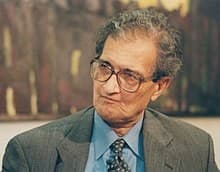
Amartya Sen is a Nobel laureate in Economics, renowned for his contributions to welfare economics, social choice theory, and development economics. His influential books, including 'Development as Freedom' and 'The Idea of Justice,' challenge conventional economic thinking and advocate for a broader understanding of human capabilities and freedoms.
Similar books
- A Theory of Justice
John Rawls
3.9 (11k) average on GoodreadsPoliticsSen's book is a direct response to and critique of Rawls's transcendental institutionalism.
- Development as Freedom
Amartya Sen
4.1 (6k) average on GoodreadsPoliticsFurther elaborates on the capability approach, which is central to Sen's idea of justice.
- 1984
George Orwell
4.2 (3.1M) average on GoodreadsPoliticsIn a future where surveillance and thought control are absolute, a man's search for truth clashes with the Party, showing that hope can be a form of rebellion.
- Animal Farm
George Orwell
4.0 (2.7M) average on GoodreadsPoliticsA farm animals' rebellion against humans turns into a pig-led dictatorship, showing how power corrupts and revolutionary ideals are betrayed.
- Freakonomics: A Rogue Economist Explores the Hidden Side of Everything
Steven D. Levitt
4.0 (709k) average on GoodreadsBusinessThis book uses economic principles to reveal the surprising incentives behind everything from drug dealing and real estate to cheating teachers and the decline of crime.
- I Am Malala: The Story of the Girl Who Stood Up for Education and Was Shot by the Taliban
Malala Yousafzai
4.1 (419k) average on GoodreadsPoliticsA teenage girl from a Taliban-controlled valley refuses to give up her books, becoming a global voice for education even after an assassination attempt.




Enjoyed the summary?
A summary gives you the shape of the book. The book itself has the detail, the examples and the voice.
Find The Idea of Justice on AmazonAs an Amazon Associate, BookBrief earns from qualifying purchases. How we're funded