
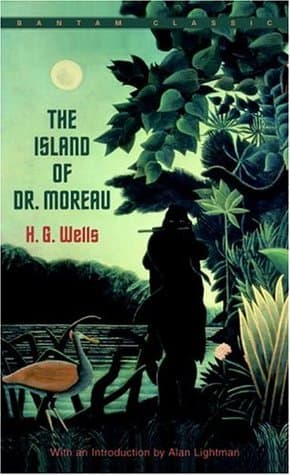
Synopsis
Covers the whole plot, including the ending.
- Difficulty
- Medium
- Pacing
- Moderate
- Mood
- Dark, Suspenseful, Philosophical, Horrifying
- Read it if
- You enjoy classic science fiction exploring ethical dilemmas, the dark side of scientific ambition, and the line between humanity and animality.
- Skip it if
- You are sensitive to themes of vivisection, body horror, and the suffering of animals.
The Island of Doctor Moreau Plot Summary
Covers the whole plot, including the ending.
Shipwreck and Rescue
Edward Prendick, a man with scientific interests, is the only survivor of a shipwreck in the Pacific Ocean. After days adrift, he is rescued by a schooner, the *Ipecacuanha*. On board, he meets Montgomery, the first mate and a former medical student, who is rough and ape-like. Prendick also sees a strange crew and many caged animals, including a puma. He overhears troubling talks and sees Montgomery treat the animals cruelly. After Prendick recovers, Montgomery offers him alcohol, and they talk about the island they are nearing, which Montgomery calls 'the island of Dr. Moreau'.
Arrival on Moreau's Island
When they reach the island, the *Ipecacuanha*'s captain refuses to take Prendick further, saying Montgomery wants privacy. Montgomery tries to bring Prendick ashore, but Dr. Moreau, from the island, strongly denies Prendick permission to land. After a heated argument between Montgomery and Moreau, Prendick is thrown back into the dinghy. Montgomery, feeling some pity, returns for Prendick and brings him to the island's compound, a fenced area housing Moreau, Montgomery, and others. Prendick gets a room and is told not to go outside the compound.
Mysterious Screams and First Encounters
Soon after arriving, Prendick hears terrible screams from a locked building in the compound, which Montgomery says is Moreau's laboratory. Montgomery dismisses Prendick's worry, saying the sounds are from a puma Moreau is experimenting on. Later, Prendick starts meeting the island's other residents: grotesque, half-human, half-animal creatures. He sees a Satyr-like being, a Swine-man, and others, all following strict rules. These meetings deeply disturb Prendick, making him question the island and its inhabitants.
The House of Pain
Curiosity and fear drive Prendick to leave the compound. He sees Moreau and Montgomery chasing a rabbit, which makes him more uneasy. He then finds Moreau's laboratory, which he calls 'The House of Pain,' and through a half-open door, he sees Moreau vivisecting what looks like a man. Horrified, Prendick runs into the jungle, believing Moreau tortures humans. He is eventually cornered by the puma-like creature, which Moreau and Montgomery capture and return to the laboratory.
Moreau's Revelation
Prendick, sure he will be vivisected next, tries to escape Moreau's compound. Moreau and Montgomery pursue him and eventually corner him. Moreau, frustrated by Prendick's misunderstanding, explains his work. He says he is a disgraced physiologist who fled England after his vivisection experiments became too controversial. On the island, he continues his work, changing animals into grotesque, bipedal 'Beast Folk' through surgery, grafting, and intense pain. His goal is to perfect the human form, driven by scientific curiosity and no regard for suffering.
The Law and the Beast Folk
Moreau introduces Prendick to 'the Law,' rules and rituals taught to the Beast Folk through hypnosis and pain. The Law forbids them from walking on all fours, eating flesh, or hunting, and orders them to worship Moreau and obey him. Prendick sees a gathering where the Beast Folk chant the Law, led by the Sayer of the Law, a grey, ape-like creature. He observes their struggle to keep their human-like appearance, constantly fighting their animal instincts. Prendick is horrified by their existence, caught between humanity and animality, and fears their animal nature returning.
The Leopard-Man's Transgression
The island's fragile order breaks when a Leopard-Man, one of Moreau's creations, breaks the Law by killing and eating a rabbit. This act causes panic among the Beast Folk, and Moreau, with Montgomery and Prendick, hunts the renegade. Moreau sees this as a challenge to his authority and his 'society's' stability. After a long chase, the Leopard-Man is cornered and brutally killed, not by Moreau, but by other Beast Folk who fear Moreau's anger and the collapse of their enforced 'humanity.' This event shows how precarious Moreau's control is.
Moreau's Demise
One day, a puma, one of Moreau's recent subjects, escapes the laboratory. Moreau, proud of his science and wanting to recapture his creation, chases it alone. Prendick and Montgomery hear a terrible fight and find Moreau's mangled body, killed by the escaped puma. The puma is also found dead nearby, fatally wounded by Moreau. Moreau's death shocks the island. Without their 'god' and enforcer, the Beast Folk start to show signs of returning to their animal instincts, and Moreau's fragile society begins to fall apart.
Montgomery's Despair and Death
Moreau's death makes Montgomery deeply sad. He had found purpose on the island, helping Moreau and guiding the Beast Folk. Without Moreau, Montgomery loses hope and starts drinking heavily. He tries to win the Beast Folk's loyalty by giving them alcohol, but this only makes them regress more. In a drunken rage, Montgomery confronts some Beast Folk and, in an accident, is killed when a fire he started detonates the compound's explosives. Prendick is left alone, the only human survivor.
Prendick's Solitude and Escape
Prendick is now the only human on the island, surrounded by the increasingly wild Beast Folk. He tries to assert some authority, but their regression speeds up. The Beast Folk abandon the Law, their language worsens, and their bodies become more animalistic. Prendick lives in constant fear, struggling to survive and stay sane amidst the growing savagery. After several months, he finds a derelict boat with two dead sailors. He repairs it and, after a difficult journey, is picked up by a passing ship. He is rescued, but the trauma of his experience changes him deeply.
Return to Civilization
Prendick is eventually rescued and returns to England. However, his experiences on Moreau's island have left him deeply scarred. He finds it hard to rejoin human society, seeing animalistic traits and potential savagery in everyone. He avoids crowds and finds peace in solitude, observing stars and pursuing abstract scientific studies. He is haunted by the Beast Folk and the dark implications of Moreau's experiments, forever changed by his encounter with raw human and animal nature.
Principal Figures
Edward Prendick
Protagonist
A gentleman and former student of science, shipwrecked and stranded on Moreau's island.
Prendick is initially presented as an educated, rational man with an interest in natural history, though not a scientist himself. He is sensitive and prone to bouts of terror and despair when confronted with the horrors of Moreau's work. His humanity and moral compass are central to the story, as he grapples with the ethical implications of Moreau's vivisections and the suffering of the Beast Folk. He struggles to maintain his sanity and identity in the face of extreme degradation and violence.
Relationships: Dr. Moreau (antagonistic, as Prendick is horrified by Moreau's work); Montgomery (complex; initially a rescuer, later a tragic companion); Beast Folk (fearful and pitying, seeing them as victims and later a threat)
Dr. Moreau
Antagonist
A brilliant but morally bankrupt physiologist who performs vivisection experiments.
Dr. Moreau is a driven, amoral scientist, exiled from England for his controversial vivisection experiments. He is a man of immense intellect and unwavering focus, completely devoid of empathy or ethical considerations regarding his work. He sees suffering as merely a means to an end in his pursuit of transforming animals into human-like beings. His scientific curiosity overrides any sense of morality, making him a chilling representation of science unchecked by ethics. He views his creations as mere experiments, not living beings worthy of compassion.
Relationships: Edward Prendick (initially dismissive, then explanatory, then an obstacle); Montgomery (master-apprentice, with Montgomery as his loyal but despairing assistant); Beast Folk (creator-god figure, demanding absolute obedience through fear)
Montgomery
Supporting
Moreau's assistant, a former medical student with a troubled past.
Montgomery is a complex character – a former medical student who has fallen from grace and found a grim sanctuary on Moreau's island. He serves as Moreau's loyal assistant, helping with the vivisections, but he also possesses a degree of lingering humanity and a cynical weariness. He is often drunk, using alcohol to cope with the horrors of his existence. He shows moments of compassion towards Prendick and the Beast Folk, particularly the Sayer of the Law, but his moral compass is largely blunted by his circumstances and dependence on Moreau.
Relationships: Dr. Moreau (loyal assistant and friend, but also Moreau's only human confidant); Edward Prendick (initially a rescuer, then a reluctant companion and fellow human survivor); Beast Folk (a supervisor, but also shows a paternalistic affection for some)
The Sayer of the Law
Supporting
An old, grey ape-like Beast Man who leads the chanting of the Law.
The Sayer of the Law is one of the oldest and most vocal of the Beast Folk. He is an ape-like creature with a deep, resonant voice, and he acts as the primary enforcer and catechist of the Law among the other Beast Folk. He represents the precarious hold of Moreau's enforced 'humanity' over the creatures, constantly reminding them of the prohibitions and their worship of Moreau. He embodies the struggle of the Beast Folk to adhere to human concepts while their animalistic instincts constantly pull them back.
Relationships: Dr. Moreau (devout worshipper and enforcer of his will); Beast Folk (leader and spiritual guide, though his authority wanes); Edward Prendick (a source of both fear and fascination)
The Leopard-Man
Mentioned
A Beast Man who breaks the Law and is hunted down.
The Leopard-Man is a significant, albeit briefly appearing, Beast Man who embodies the inherent instability of Moreau's creations. His transgression – killing and eating a rabbit – directly challenges Moreau's Law and triggers a crisis on the island. He represents the animalistic instincts that Moreau constantly tries to suppress, and his eventual brutal death at the hands of the other Beast Folk highlights the terror Moreau inspires and the fragile nature of their enforced 'humanity.' His actions are a catalyst for Prendick's deeper understanding of the island's horrors.
Relationships: Dr. Moreau (a defiant subject, punished for breaking the Law); Beast Folk (a transgressor, hunted and killed by his peers); Edward Prendick (a symbol of the Beast Folk's struggle and tragic fate)
M'ling
Supporting
Montgomery's loyal, dog-like Beast Man servant.
M'ling is a dog-like Beast Man, characterized by his extreme loyalty and devotion to Montgomery. He is one of the more 'successful' of Moreau's creations in terms of maintaining human-like behavior, primarily due to his ingrained obedience and personal attachment. He is a pathetic figure, often suffering silently and reflecting the tragic fate of the Beast Folk. His unwavering service to Montgomery provides a glimpse of the potential for affection and loyalty, even in these distorted beings, but also underscores their subjugation.
Relationships: Montgomery (devoted servant and companion); Edward Prendick (a neutral presence, serving Montgomery); Beast Folk (one of them, but distinct in his loyalty)
Themes & Insights
The Dangers of Unchecked Scientific Hubris
Moreau's endless pursuit of science without moral limits is a main idea. He represents the Victorian fear of out-of-control science, creating life without respect for its nature or suffering. His experiments come from intellectual curiosity, without compassion, leading to grotesque, tormented creations. This theme is clear in Moreau's 'House of Pain,' where he vivisects animals into human-like forms, and his dismissal of the Beast Folk's pain as just 'pain' instead of suffering. The island itself shows scientific ambition unchecked, leading to chaos and destruction.
“'The study of animal psychology was my province, but I had made a step in the wrong direction; I had gone too far; I had lost my way. I found myself in a blind alley, and I could not turn back. I had to go on.”
The Nature of Humanity and Bestiality
The novel constantly blurs the lines between human and animal, asking what truly makes someone human. The Beast Folk, despite their changes and forced rules, constantly fight their animal instincts, showing how thin civilization is. Prendick's own return to primal fear and suspicion on the island, and his later inability to fully rejoin human society, suggests that humanity is always close to animality. The Beast Folk's eventual regression shows that human traits are not easily forced or kept.
“'You see, Prendick, this island is a laboratory, a physiological laboratory. I am trying to make a man.”
Colonialism and Power Dynamics
Moreau's island can be seen as a symbol for colonial power. Moreau, the European scientist, imposes his 'civilization' (the Law) on the 'savages' (the Beast Folk), making them abandon their natural ways and adopt his rules. He acts as their 'god' and 'creator,' holding absolute power and enforcing obedience through fear and pain. The Beast Folk's struggle to maintain this imposed order, and their eventual rebellion and regression, reflect the often unstable nature of colonial rule when the dominant power leaves. Prendick's initial disgust and later fear of the Beast Folk also mirror common colonial views of indigenous people.
“'They have to fear me. I am God to them. I have to be God to them.”
Pain and Suffering
Pain is a constant and central theme, both physical and mental. Moreau's vivisection experiments cause immense physical pain to his subjects, which he sees as a necessary part of his science. The Beast Folk live in constant mental suffering, trapped between their animal instincts and the human mind forced upon them, enduring the agony of ongoing change. Prendick himself experiences intense fear and mental distress, especially when alone on the island. The novel explores the ethics of causing pain for science and the deep, lasting effect of suffering on identity and existence.
“'The study of Nature is the study of pain.”
Isolation and Alienation
Prendick's journey begins with isolation after a shipwreck and ends with a deep feeling of being disconnected from humanity. On the island, he is cut off from civilization and faces unimaginable horrors, causing deep psychological trauma. Even after his rescue, he struggles to connect with society, seeing animalistic tendencies in everyone. This theme shows how extreme experiences can permanently change how someone sees the world and their place in it, leading to a lasting feeling of being an outsider.
“'I was a man, an intellectual man, and I was alone on a jungle island surrounded by half-human beasts.”
Plot Devices & Literary Techniques
First-Person Narration
The story is told entirely from Edward Prendick's perspective.
The use of first-person narration places the reader directly into Prendick's terrifying experience, allowing for immediate access to his thoughts, fears, and observations. This subjective viewpoint heightens the sense of suspense and horror, as the reader discovers the island's secrets alongside Prendick. It also emphasizes his psychological journey and the profound impact of the events on his sanity, making his alienation upon returning to society more poignant and believable. The reader experiences his confusion, disbelief, and eventual trauma firsthand.
The Law
A set of strict, ritualistic prohibitions and commands imposed on the Beast Folk.
The Law functions as a central plot device for exploring themes of control, civilization, and the struggle between instinct and imposed order. It is Moreau's attempt to instill a rudimentary 'humanity' and social structure in his creations. The chanting of the Law by the Sayer of the Law and the Beast Folk underscores their forced obedience and the precariousness of their 'humanity.' The breaking of the Law, as demonstrated by the Leopard-Man, serves as a catalyst for conflict and highlights the inherent failure of Moreau's experiments to truly transform his subjects.
The House of Pain
Moreau's laboratory, where vivisection experiments are conducted.
The 'House of Pain' is a symbolic and literal plot device representing the horrific core of Moreau's scientific hubris and the suffering he inflicts. It is the source of the screams that initially terrify Prendick and the place where the Beast Folk are created and 'educated' through torment. Its name itself encapsulates the novel's pervasive theme of pain and its role in Moreau's amoral pursuit of knowledge. It serves as a constant, looming threat and a reminder of the island's dark secrets.
Isolation of the Island
The remote, uncharted nature of Moreau's island.
The island's extreme isolation is crucial. It allows Moreau to conduct his unethical experiments without interference from society or legal repercussions. This physical isolation mirrors the moral and ethical isolation of Moreau himself. For Prendick, the island's remoteness amplifies his terror and helplessness, cutting him off from any hope of rescue or justice. The confined setting intensifies the psychological horror, as there is no escape from the grotesque reality Moreau has created, emphasizing the vulnerability of human morality when removed from societal constraints.
The Island of Doctor Moreau Quotes
“He was a pale, flaxen-haired man, with a slight stoop, and a restless, furtive eye. I remember him as a man of great nervous energy and quick, precise gestures.”
“The study of nature is the study of the devil. The world is a graveyard.”
“To this day I have a peculiarly vivid memory of my first glimpse of Doctor Moreau. He was a powerfully built man, with a large, square head, and a face of a singularly intellectual cast. His eyes were deep-set and piercing, and his mouth was thin-set and cruel.”
“The Law is a memory. The Law is a memory. The Law is a memory.”
“Are we not men?”
“I was a scientific investigator, as I am still. My aim was to discover the secrets of life, to probe into the very structure of being. I had no other motive.”
“The thing is to be a man, and not a beast.”
“Pain and fear. They are the only spurs to action, the only teachers.”
“It is not the Law to go on all-fours.”
“I felt a peculiar sense of revulsion, as if I were in the presence of something unclean.”
“The world is not for you. You are a beast.”
“He was a man of science, a man of power, a man of intellect. But he had forgotten the meaning of humanity.”
“I have been through a trauma. I have seen things that no human being should ever see.”
“The Law has been broken! The Law has been broken!”
Quiz
10 questions on the plot and the characters. Each answer comes with a short explanation.
Question 1
What is the name of the protagonist who becomes shipwrecked on Dr. Moreau's island?
- Montgomery
- Edward Prendick
- M'ling
- Dr. Moreau
Show answer
B. Edward Prendick Edward Prendick is the shipwrecked gentleman who narrates the story and finds himself on the island.
Question 2
What is the primary scientific pursuit that Dr. Moreau is engaged in on his island?
- Developing a cure for all diseases
- Breeding extinct species back to life
- Vivisection and surgical alteration of animals into human-like beings
- Creating a utopian society for outcasts
Show answer
C. Vivisection and surgical alteration of animals into human-like beings Dr. Moreau's horrifying experiments involve vivisection, where he surgically transforms animals into 'Beast Folk'.
Question 3
What is the 'Law' that the Beast Folk are compelled to follow?
- The Law of the Jungle
- The Law that Moreau Imposed
- The Law of Nature
- The Law of the Strongest
Show answer
B. The Law that Moreau Imposed The Beast Folk chant the 'Law' which outlines prohibitions against reverting to animalistic behaviors, imposed by Moreau.
Question 4
Which character serves as Dr. Moreau's assistant and is initially Prendick's only human contact on the island?
- The Sayer of the Law
- M'ling
- Montgomery
- The Ape-man
Show answer
C. Montgomery Montgomery is Moreau's cynical and alcoholic assistant, who initially helps Prendick.
Question 5
What is the primary reason Dr. Moreau gives for his experiments, despite their cruelty?
- To create a new, superior human race
- To satisfy his intellectual curiosity and the pursuit of knowledge
- To provide companionship for himself on the isolated island
- To prove the existence of God through creation
Show answer
B. To satisfy his intellectual curiosity and the pursuit of knowledge Moreau famously states that he pursues his experiments for the sake of scientific curiosity, regarding the pain of his subjects as irrelevant.
Question 6
What animal was the 'Sayer of the Law' originally?
- A puma
- A dog
- An ape
- A pig
Show answer
C. An ape The Sayer of the Law is an Ape-man, one of Moreau's earliest and most articulate creations, who leads the chanting of the Law.
Question 7
What specific incident ultimately leads to the complete breakdown of order among the Beast Folk and Moreau's demise?
- Prendick accidentally shoots one of the Beast Folk.
- Moreau is attacked and killed by a Puma-man he was vivisecting.
- Montgomery poisons Moreau in a fit of rage.
- A ship arrives and the crew discovers Moreau's experiments.
Show answer
B. Moreau is attacked and killed by a Puma-man he was vivisecting. Moreau is killed when the Puma-man he was working on escapes its restraints and attacks him, leading to chaos.
Question 8
Upon returning to civilization, what is Prendick's lasting psychological affliction?
- He becomes a reclusive hermit, fearing all human contact.
- He perceives human beings as barely disguised animals, leading to profound alienation.
- He dedicates his life to exposing scientific unethical practices.
- He is unable to speak or communicate effectively.
Show answer
B. He perceives human beings as barely disguised animals, leading to profound alienation. Prendick's time on the island leaves him with a deep-seated paranoia, seeing the beast in every human face, alienating him from society.
Question 9
The novel can be interpreted as a commentary on which of the following scientific theories prevalent at the time?
- The theory of relativity
- The germ theory of disease
- Darwin's theory of evolution and the nature of humanity
- The Big Bang theory
Show answer
C. Darwin's theory of evolution and the nature of humanity The novel directly engages with themes of evolution, human nature, and the animalistic instincts that lie beneath human civilization, reflecting contemporary debates around Darwinism.
Question 10
What is the ultimate fate of the Beast Folk after Moreau and Montgomery's deaths?
- They establish their own functional society.
- They are rescued by a passing ship.
- They gradually revert entirely to their original animal forms and instincts.
- They all die from disease or starvation.
Show answer
C. They gradually revert entirely to their original animal forms and instincts. Without Moreau's terrifying authority and constant conditioning, the Beast Folk slowly but inevitably regress to their animalistic natures, breaking the Law.
The Island of Doctor Moreau FAQ
What is the basic premise of 'The Island of Doctor Moreau'?
Edward Prendick, a shipwrecked gentleman, finds himself stranded on a remote Pacific island inhabited by the infamous Dr. Moreau and his assistant, Montgomery. Prendick soon discovers Moreau is conducting horrifying vivisection experiments, transforming animals into grotesque, bipedal 'Beast Folk' with human-like characteristics and an enforced Law.
Who is Edward Prendick and what is his role in the story?
Edward Prendick is the protagonist and narrator, a former student of natural history who is shipwrecked and rescued by Montgomery. He serves as the reader's eyes and ears on Moreau's island, initially bewildered and terrified by the Beast Folk before gradually understanding the full horror of Moreau's experiments and their implications.
Who is Dr. Moreau and what is his scientific background?
Dr. Moreau is a brilliant but disgraced physiologist from London, exiled due to his cruel vivisection experiments. On his isolated island, he relentlessly pursues his goal of surgically and biologically transforming animals into human-like beings, driven by a cold, detached scientific curiosity rather than malice.
What are the 'Beast Folk' and how are they created?
The Beast Folk are the result of Dr. Moreau's vivisection experiments, animals surgically and physiologically altered to walk upright, speak rudimentary English, and follow a strict 'Law'. They retain many animalistic instincts and appearances, constantly struggling with their forced humanity and the pain of their transformation.
What is 'The Law' and who enforces it among the Beast Folk?
The Law is a set of commandments, chanted by the Sayer of the Law, that prohibits the Beast Folk from reverting to their animalistic natures, such as walking on all fours, eating flesh, or hunting. It is enforced primarily through the fear of Moreau and his surgical 'House of Pain,' acting as a moral code imposed upon them.
What specific physiological changes does Moreau inflict on the animals?
Moreau performs extensive surgical alterations, including restructuring skeletal frames, reshaping features, and manipulating brains to encourage human-like thought and speech. He also uses blood transfusions and other biological interventions to try and stabilize their new forms, though the pain and instability are constant.
What is the significance of the Puma-man and his eventual escape?
The Puma-man is one of Moreau's most recent and seemingly 'successful' creations, but his repeated escapes and eventual violent death highlight the inherent instability and ultimate failure of Moreau's experiments. His rebellion foreshadows the eventual breakdown of order among the Beast Folk after Moreau's demise.
How does Montgomery contribute to Moreau's work and what is his character arc?
Montgomery, Moreau's assistant, is a former medical student who became an alcoholic and outcast. He is complicit in Moreau's experiments, providing assistance and managing the compound, but he also shows moments of pity for the Beast Folk and struggles with his own moral degradation, culminating in a drunken, self-destructive rampage.
What is the underlying psychological motivation for Dr. Moreau's experiments?
Moreau is driven by a cold, intellectual curiosity and a desire to impose his will upon nature, viewing his vivisections as a purely scientific endeavor devoid of moral considerations. He sees the pain of his subjects as merely a 'consequence' and himself as an 'artist' perfecting his craft, a chilling detachment from suffering.
How does Prendick's psychological state evolve throughout his time on the island?
Prendick initially experiences extreme fear and revulsion, believing he is next to be vivisected. He then descends into a state of paranoia and disgust, struggling to differentiate between humans and Beast Folk, and ultimately returns to civilization deeply traumatized and alienated from humanity.
What psychological impact does 'The Law' have on the Beast Folk?
The Law creates a constant internal conflict for the Beast Folk, forcing them to suppress their natural instincts and live in perpetual fear of Moreau's punishment. This suppression leads to psychological instability, a fragile adherence to rules, and an inevitable regression once the external authority is removed.
How does the novel explore the concept of 'humanity' and its boundaries?
The novel directly challenges the definition of humanity by presenting creatures that are physically and mentally altered to resemble humans, yet still retain animalistic traits. It suggests that humanity is not just a physical form but also a complex interplay of learned behavior, morality, and the suppression of primal urges.
In what ways can the novel be interpreted as a commentary on evolution and divine creation?
Wells uses Moreau's forced 'evolution' as a dark mirror to natural selection, questioning the inherent goodness or purpose of creation itself. The Beast Folk's struggle with their imposed form and 'The Law' can be seen as an allegory for humanity's own struggle with its animalistic nature versus moral codes and religious doctrine.
How does the ending of the novel reflect Prendick's transformation and Wells's message?
Prendick's return to London finds him unable to reconcile with human society, perceiving an underlying bestiality in everyone. This ending emphasizes the novel's pessimistic view of human nature, suggesting that beneath a thin veneer of civilization, primal instincts and the potential for cruelty always lurk, mirroring the Beast Folk's regression.
What ethical questions does the novel raise regarding scientific experimentation and genetic engineering?
The novel presciently explores the ethical perils of unchecked scientific ambition, particularly the creation of sentient beings for experimentation and the violation of natural forms. It questions the moral responsibility of scientists to their creations and the potential for suffering when science ignores ethical boundaries, echoing modern debates around genetic engineering.
What is the significance of the Leopard-man's death and Prendick's involvement?
The Leopard-man's death is a pivotal moment as Prendick, in a moment of panic and self-preservation, shoots him, mistaking him for a threat. This act forces Prendick to confront his own capacity for violence and blurs the line between hunter and hunted, further eroding his sense of moral clarity on the island.
How does Moreau's death impact the Beast Folk and the island's order?
Moreau's death, at the hands of the escaped Puma-man, instantly removes the primary source of fear and enforcement of 'The Law'. This leads to a rapid and inevitable breakdown of order among the Beast Folk, who gradually revert to their animalistic instincts and behaviors, highlighting the fragility of their imposed humanity.
What role does the Sayer of the Law play among the Beast Folk?
The Sayer of the Law, a grey, ape-like creature, acts as the primary orator and enforcer of 'The Law' through ritualistic chanting and intimidation. He represents the Beast Folk's attempt to internalize and maintain Moreau's imposed morality, but his authority wanes significantly after Moreau's death.
About the author

Herbert George Wells was an English writer. Prolific in many genres, he wrote more than fifty novels and dozens of short stories. His non-fiction output included works of social commentary, politics, history, popular science, satire, biography, and autobiography. Wells' science fiction novels are so well regarded that he has been called the "father of science fiction".
Similar books
- Frankenstein: The 1818 Text
Mary Shelley
3.8 (1.2M) average on GoodreadsFantasyExplores the ethical consequences of scientific creation and the monstrous nature of man's ambition.
- Heart of Darkness
Joseph Conrad
3.4 (415k) average on GoodreadsHistorical FictionFeatures a journey into a remote, 'uncivilized' place that reveals the primal darkness of humanity.
- Brave New World
Aldous Huxley
4.0 (1.4M) average on GoodreadsFantasyA classic dystopian novel that critically examines the potential misuses of science and social engineering.
- Lord of the Flies
William Golding
3.7 (2.3M) average on GoodreadsYoung AdultWhile Lord of the Flies (1954) is set much later, it shares thematic resonance with Moreau in its examination of humanity's inherent savagery when removed from the constraints of civilization. Both novels feature isolated groups (children in Golding's, Beast Folk and a few humans in Wells') who descend into barbarism. However, Golding's work posits that the 'beast' is entirely internal, an innate human capacity for evil, whereas Wells' novel introduces an external, scientific catalyst (Moreau's vivisection) that physically manifests this bestiality. Moreau questions the effectiveness of imposed law and order on a fundamentally wild nature, a theme Golding explores through the boys' failed attempts at self-governance. (See: Kinkead-Weekes, Mark. William Golding: A Critical Study. Faber & Faber, 1984)
- Harry Potter and the Sorcerer's Stone
J.K. Rowling
4.5 (7M) average on GoodreadsFantasyRescued from a miserable life under the stairs, an orphaned boy discovers he's a wizard destined for a magical school, where he uncovers a dangerous secret tied to the dark wizard who murdered his parents.
- The Hunger Games
Suzanne Collins
4.3 (6.4M) average on GoodreadsFantasyIn a future where children fight to the death on live television, Katniss Everdeen volunteers for the arena, turning a death sentence into a fight for survival and a spark of rebellion.





Enjoyed the summary?
A summary gives you the shape of the book. The book itself has the detail, the examples and the voice.
Find The Island of Doctor Moreau on AmazonAs an Amazon Associate, BookBrief earns from qualifying purchases. How we're funded