

Synopsis
Covers the whole plot, including the ending.
- Difficulty
- Hard
- Pacing
- Slow
- Mood
- Dark, Atmospheric, Haunting, Reflective, Suspenseful
- Read it if
- You are interested in exploring themes of colonialism, human nature, madness, and the corrupting influence of power, presented through a dense, symbolic narrative.
- Skip it if
- You prefer fast-paced plots with clear moral distinctions, or find dense, allegorical prose challenging.
Heart of Darkness Plot Summary
Covers the whole plot, including the ending.
The Nellie and Marlow's Introduction
The story begins on the deck of the Nellie, a boat on the River Thames. Charles Marlow, an experienced sailor, is with four other men. As evening comes, Marlow starts to tell about a past journey. He talks about England's history as a place once dark before the Romans. He then moves to his own story, driven by his interest in maps and the Congo River. This led him to a job as a steamboat captain for a Belgian trading company in Africa. His aunt, who had connections in European charity groups, helped him get the job. She thought he would be an 'emissary of light.'
Journey to the Outer Station
Marlow goes to the Company's offices in Brussels, a 'whited sepulchre' of a city. He has a quick medical exam and signs contracts. He then takes a French steamer. He sees the empty African coast and a warship senselessly shelling the jungle. When he arrives at the Company's Outer Station, he immediately sees the harsh reality of colonialism: broken machines, exploited native workers dying from overwork, and a general feeling of inefficiency and cruelty. He sees a 'grove of death' where sick natives are left to die. This scene disturbs him and hints at the darkness he will soon encounter.
The Central Station and the Manager
At the Central Station, Marlow finds his steamboat is wrecked and needs many repairs. He meets the Company Manager, an average man who keeps his job because he is healthy and makes people feel uneasy. The Manager worries about delays in getting ivory from the interior, especially from the very successful agent, Mr. Kurtz. Marlow watches the 'pilgrims' – other Company agents – who only care about ivory and show no empathy or purpose beyond getting rich. He hears talk about Kurtz's great success and the Manager's quiet dislike of him.
Encountering the Brickmaker and Kurtz's Reputation
While waiting for parts to fix his steamboat, Marlow meets the 'brickmaker,' a Company agent who makes no bricks but spies for the Manager. The brickmaker tries to get information from Marlow, thinking Marlow has influence in Europe because of his aunt. Marlow learns that Kurtz collects a lot of ivory and is a talented man. The Company sent him to civilize the natives. He is an important person, seen as an 'emissary of pity and science and progress,' who wrote a report for the International Society for the Suppression of Savage Customs. Marlow becomes more interested in this mysterious person.
The Journey Upriver
After three months, the parts arrive, and the steamboat is fixed. Marlow, the Manager, and a group of 'pilgrims' start the journey upriver to Kurtz's Inner Station. The river is dangerous, and the jungle is stifling. This creates a feeling of dread and isolation. Marlow feels a connection to the wild, sensing its ancient power. The journey is slow and full of danger. The pilgrims' greed and incompetence become more obvious. Marlow focuses on navigating the river, finding comfort in his work amid the surrounding chaos.
The Attack and the Russian Trader
Fifty miles from the Inner Station, unseen natives ambush the steamboat with arrows. The helmsman dies, and Marlow is affected by the loss, especially because the helmsman was a good pilot. After the attack, they find a hut with firewood and a note: 'Wood for you. Hurry up. Approach cautiously.' When they reach the Inner Station, they are met by a young, unusual Russian trader, a former sailor who admires Kurtz. The Russian explains he cared for Kurtz when he was sick and learned much from him. This shows Kurtz's strong influence over the natives and his decline into savagery.
Kurtz's Domain and the Harlequin
The Russian, called the 'harlequin' because of his patched clothes, says Kurtz has gone 'mad' by Company standards but is worshipped by the local tribes. He explains that the heads on the fence posts around the station are warnings. Marlow also sees a beautiful, decorated native woman, who is Kurtz's lover and shows his full involvement in the local culture. The Manager and the pilgrims mainly want the ivory and dislike Kurtz's methods. Marlow, however, is more drawn to Kurtz himself and the terrifying extent of his change.
Meeting Kurtz
Marlow finds Kurtz on a stretcher, very sick and thin, but still having a strong, captivating voice. Despite his physical weakness, Kurtz has a commanding presence. His native followers, who do not want him to go, carry him out of the station. Marlow understands how deep Kurtz's influence is and how much he has left behind European rules. Kurtz's first report for the International Society, which Marlow now has, ends with a chilling handwritten note: 'Exterminate all the brutes!' This command shows how corrupt his idealistic mission became.
The Retreat and Kurtz's Death
The Manager and the pilgrims try to take Kurtz, but his native followers resist. They are scattered by a blast from the steamboat's whistle. Kurtz is brought aboard, and the journey downriver begins. During the return trip, Kurtz gets sicker quickly. He talks constantly, often confused, showing his extreme self-importance and the terrible things he has seen and done. Just before he dies, with Marlow nearby, Kurtz says his famous last words: 'The horror! The horror!' Marlow is deeply affected by this, seeing it as a moment of self-awareness.
Marlow's Return and the Intended
Marlow himself gets sick after Kurtz's death and almost dies. When he returns to Europe, he finds the civilized world jarring and fake after his experiences in the Congo. Various Company representatives visit him, looking for Kurtz's papers and information, but Marlow gives them nothing important. Finally, he visits Kurtz's 'Intended' (fiancée), a grieving woman who still sees Kurtz as a brilliant, kind man. Marlow cannot tell her the terrible truth of Kurtz's last words. He lies, telling her that Kurtz's last word was her name. This keeps her comforting illusion and protects her from the 'horror' he saw.
Heart of Darkness Characters
Charles Marlow
Protagonist/Narrator
An experienced seaman who recounts his journey into the Congo and the human psyche.
Marlow is a thoughtful and introspective sailor, initially drawn to the 'blank spaces' on maps. His journey up the Congo River is both a physical expedition and a psychological descent into the 'heart of darkness.' He is a keen observer of human nature, particularly the hypocrisy and depravity of the colonial enterprise. Despite his cynicism, he maintains a certain moral compass, evidenced by his disgust at the treatment of the natives and his ultimate decision to lie to Kurtz's Intended. He is fascinated and repulsed by Kurtz, seeing in him a terrifying reflection of humanity's potential for both greatness and utter depravity.
Relationships: Kurtz (Obsessive fascination, a complex blend of admiration, horror, and identification); The Manager (Antagonism, mutual distrust and contempt); The Russian Trader (A mix of curiosity and pity for his naive devotion to Kurtz); Kurtz's Intended (Protective, choosing to preserve her idealized image of Kurtz through a lie)
Kurtz
Antagonist/Central Figure
A brilliant but corrupted ivory agent who descends into madness and becomes a demigod.
Kurtz is the enigmatic figure at the heart of Marlow's journey. Initially presented as a highly successful ivory agent and an 'emissary of progress' with idealistic intentions, he succumbs entirely to the temptations of absolute power and the primitive environment of the jungle. He is a man of immense eloquence and charisma, capable of inspiring both devotion and terror. His 'report' for the International Society, with its chilling postscript 'Exterminate all the brutes!', encapsulates his tragic fall from idealism to savage megalomania. He represents the ultimate corruption of European colonialism and the darkest potential of the human psyche when unchecked by external constraints.
Relationships: Marlow (Object of Marlow's fascination and horror); The Manager (Rivalry and resentment, as Kurtz's success threatens the Manager's position); The Russian Trader (Object of the Russian's unwavering devotion and admiration); Kurtz's Intended (Her idealized fiancé, whose true nature she never discovers); Native Tribes (Worshipped as a god, ruler, and exploiter)
The Manager
Supporting/Antagonist
The Company's manager at the Central Station, a man of mediocre abilities.
The Manager is a dull, uninspired man who maintains his position through his ability to inspire 'vague uneasiness' and his robust health, which allows him to survive the harsh African climate. He is cunning and manipulative, resentful of Kurtz's success and eager to see him replaced. He represents the petty, bureaucratic evil of colonialism, driven by greed and a desire to maintain his own power rather than any grander vision. He lacks the intellectual depth or moral struggle of Kurtz, embodying a more mundane, yet equally destructive, form of corruption.
Relationships: Marlow (Mutual distrust and thinly veiled contempt); Kurtz (Rivalry, jealousy, and a desire to undermine him)
The Russian Trader (Harlequin)
Supporting
A naive and devoted disciple of Kurtz, clad in patched clothing.
The Russian is a young, eccentric adventurer who has wandered into the Congo and become utterly devoted to Kurtz. Clad in brightly patched clothes (earning him the nickname 'harlequin' from Marlow), he is a symbol of innocent, almost childlike fascination with Kurtz's power and intellect. He seems oblivious to the moral implications of Kurtz's actions, seeing only his brilliance. He provides Marlow with crucial information about Kurtz's methods and his god-like status among the natives, serving as a foil to Marlow's more cynical perspective and highlighting Kurtz's charismatic appeal.
Relationships: Kurtz (Unwavering adoration, discipleship, and a deep sense of loyalty); Marlow (Informative but ultimately fleeting acquaintance)
Kurtz's Intended
Supporting
Kurtz's fiancée in Europe, who holds an idealized image of him.
Kurtz's Intended is a young, grieving woman in Europe who embodies the naive idealism and ignorance of the 'civilized' world regarding the realities of colonialism. She views Kurtz as a noble, brilliant, and benevolent man, a beacon of progress. Her unwavering faith in his goodness serves as a stark contrast to the horrific truth of his actions in the Congo. Marlow's decision to lie to her about Kurtz's last words highlights the moral dilemma of confronting innocence with brutal truth and the protective instinct to preserve comforting illusions.
Relationships: Kurtz (Fiancée, holding an idealized and deeply loving memory); Marlow (Seeks comfort and confirmation of Kurtz's goodness from him)
The Chief Accountant
Supporting
A fastidious and impeccably dressed Company employee at the Outer Station.
The Chief Accountant is a minor character Marlow encounters at the Outer Station. He is notable for his immaculate appearance, which he meticulously maintains despite the squalor and chaos around him. He represents the superficiality and detachment of some colonial administrators, more concerned with ledger books and appearances than the suffering of the natives. He is the first person to mention Kurtz by name, praising his efficiency in sending out ivory, yet also hinting at his unusual methods and the 'trouble' he causes.
Relationships: Marlow (Brief, formal interaction); Kurtz (Admiration for his efficiency, despite his 'unsound' methods)
The Helmsman
Supporting
A native crew member who is killed during the steamboat attack.
The Helmsman is a native African employed by Marlow on the steamboat. He is a competent and reliable pilot, and Marlow develops a grudging respect for his skill. His death during the native ambush deeply affects Marlow, who sees it as a tragic and senseless loss amidst the general absurdity of the journey. His death serves as a reminder of the constant danger and the human cost of the colonial enterprise, and Marlow's reaction highlights his own developing empathy.
Relationships: Marlow (Employer-employee, with a developing sense of mutual reliance and respect)
The Director of Companies
Mentioned
The captain of the Nellie and Marlow's host.
The Director of Companies is one of the men on the Nellie listening to Marlow's story. He is the captain of the yawl and represents the established, conventional world of commerce and industry. He provides the initial framework for Marlow's narrative, but his primary role is as a member of the audience, representing the 'civilized' world that is largely oblivious to the 'heart of darkness' Marlow describes.
Relationships: Marlow (Friend and fellow seaman, host of the storytelling session)
The Native Mistress
Supporting
A powerful and fiercely adorned African woman, Kurtz's lover.
Kurtz's native mistress is a striking and regal figure, adorned with brass ornaments, who appears briefly but makes a powerful impression on Marlow. She symbolizes Kurtz's complete abandonment of European norms and his immersion into the primitive, representing the allure and danger of the 'other.' Her silent, commanding presence and her fierce loyalty to Kurtz highlight the depth of his influence over the native population and the untamed power of the wilderness.
Relationships: Kurtz (Lover and powerful figure within his native domain)
Heart of Darkness Themes
Colonialism and Imperialism
The novel criticizes European colonialism, showing its harsh realities beneath the idea of 'civilizing' missions. Marlow sees the exploitation, enslavement, and death of native people by the Company, which only wants ivory. The 'whited sepulchre' of Brussels and the broken machines at the Outer Station show the hypocrisy and inefficiency of colonialism. The story removes the romantic view of imperialism, showing it as a destructive force that corrupts both the colonizer and the colonized, as seen in Kurtz's decline into savagery.
“The word 'ivory' rang in the air, was whispered, was sighed. You would think they were praying to it. A taint of imbecile rapacity blew through it all, like a whiff from some corpse.”
Identity and Self-Discovery
Marlow's journey into the Congo is a journey into himself. It makes him face the darker parts of human nature. As he goes deeper into the wilderness, European society's artificial rules fall apart, challenging his ideas about civilization and savagery. Kurtz acts as a distorted mirror for Marlow, showing him the potential for corruption in everyone when there are no outside controls. Marlow's survival and his moral choices, especially his lie to Kurtz's Intended, define his understanding of himself when faced with great darkness.
“The horror! The horror!”
The Darkness Within (The Primitive Self)
The 'heart of darkness' refers to the geographical center of Africa and the savagery and primitive instincts within the human soul. The jungle removes the thin layer of civilization, exposing raw, uncontrolled desires and brutality. Kurtz's complete change into a self-important tyrant, worshipped by natives and surrounded by severed heads, shows this theme fully. Marlow himself feels drawn to the wilderness, seeing the basic connection that exists in all people, which suggests that civilization is a fragile idea.
“He had kicked himself loose of the earth. Confound the man! he had kicked the very earth to pieces. He was alone, and so he had looked into himself, and that was the horror.”
Truth and Illusion
The novel looks at the relationship between truth and the comforting ideas people create. The European public has a romantic view of colonialism, believing it is a noble mission. Marlow refuses to break this illusion when he returns. Kurtz's Intended shows this theme, holding onto an idealized image of her fiancé. Marlow's lie to her, saying Kurtz's last word was her name instead of 'The horror!', is an act to preserve her illusion. It suggests that some truths are too painful to be told and that illusions can protect people from unbearable reality.
“It would have been too dark—too dark altogether...”
The Absurdity of Existence
Marlow often sees irrational and meaningless events in the Congo. From the French warship pointlessly shelling the jungle to the broken machines at the Outer Station and the 'pilgrims' who care about small things while surrounded by death, colonialism is shown as absurd. This absurdity highlights the lack of meaning in the colonizers' actions, who cause great suffering for no clear, rational benefit beyond personal gain. The chaotic and often strange events create a strong feeling of meaninglessness.
“It was like a weary pilgrimage amongst hints for nightmares.”
Plot Devices & Literary Techniques
Frame Narrative
A story within a story, told by Marlow to an audience on the Thames.
The novel employs a frame narrative, where an unnamed narrator introduces Marlow, who then recounts his journey into the Congo to a group of men on the Nellie. This device creates distance, allowing the reader to experience Marlow's story through a filter. It also establishes a contemplative tone, as Marlow reflects on his past experiences from a removed perspective. The frame allows for a contrast between the 'civilized' setting of the Thames and the 'darkness' of the Congo, emphasizing the universality of the themes explored.
Symbolism (Light and Darkness)
The pervasive use of light and dark imagery to represent moral and psychological states.
Conrad heavily uses light and darkness as central symbols. 'Darkness' represents not only the literal African jungle but also the moral corruption of colonialism, the primitive instincts within humanity, and the unknown depths of the psyche. 'Light' is often associated with the superficiality of European civilization, the 'whited sepulchre' of Brussels, or the fleeting moments of clarity amidst the chaos. The contrast between these elements underscores the novel's thematic concerns about good and evil, civilization and savagery, and the hidden truths of the human condition.
Psychological Journey
Marlow's internal exploration of his own psyche and the human condition.
Beyond the physical journey up the Congo River, the narrative is fundamentally a psychological journey for Marlow. The external landscape mirrors his internal state, as he descends into a deeper understanding of human depravity and the fragility of civilization. The encounters with characters like Kurtz and the 'pilgrims' force Marlow to confront uncomfortable truths about himself and humanity, making the novel an exploration of the unconscious and the moral complexities of the human mind.
Foreshadowing and Irony
Hints of future events and contrasts between expectation and reality.
Conrad frequently uses foreshadowing, such as the doctor in Brussels warning Marlow about changes in personality, to build suspense and hint at Kurtz's eventual madness. Irony is also pervasive, particularly in the contrast between the stated 'civilizing mission' of the Company and the brutal reality of its operations. Kurtz's initial idealism versus his final 'Exterminate all the brutes!' is a prime example of tragic irony, highlighting the gap between noble intentions and corrupt outcomes.
Impressionistic Prose
A narrative style that emphasizes subjective experience and sensory details.
Conrad's prose is highly impressionistic, focusing on Marlow's subjective perceptions, feelings, and the ambiguities of his experiences rather than objective descriptions. This style creates a dreamlike, often unsettling atmosphere, reflecting the disorienting nature of Marlow's journey. Sensory details, particularly those related to the jungle's sounds and smells, contribute to the immersive and often claustrophobic feeling, drawing the reader into Marlow's psychological state and the 'heart of darkness' itself.
Heart of Darkness Quotes
“The horror! The horror!”
“I was within a hair's-breadth of calling out, and I remember my mouth was full of some bitter dust.”
“It was like a weary pilgrimage amongst hints for nightmares.”
“All Europe contributed to the making of Kurtz.”
“He was a prodigy of labour—and what is more, of inspirations!”
“The mind of man is capable of anything—because everything is in it, all the past as well as all the future.”
“The air was thick with malaria and the smell of decaying elephant tusks.”
“He had kicked himself loose of the earth. Confound the man! He had kicked the very earth to pieces.”
“The reaches opened before us and closed behind, as if the forest had stepped leisurely across the water to bar the way for our return.”
“His was an impenetrable darkness. I looked at him as you would look at a thing that can't be helped, a disaster, a deluge, a visitation of wrath upon the earth.”
“I was not prepared for a madhouse.”
“He inspired fear, of course, but it was a moral fear, a fear of the wilderness that had swallowed him whole.”
“We live as we dream—alone.”
“And the river was there—fascinating—deadly—like a snake.”
“The last word he pronounced was—your name.”
Quiz
10 questions on the plot and the characters. Each answer comes with a short explanation.
Question 1
Who is the primary narrator of the story within a story in 'Heart of Darkness'?
- Kurtz
- Charlie Marlow
- The unnamed frame narrator
- The Director of Companies
Show answer
B. Charlie Marlow Charlie Marlow is the character who recounts his adventures in the Congo to a group of men on the Nellie, making him the narrator of the main story.
Question 2
What is Marlow's initial job when he travels to the Congo?
- An ivory procurement agent
- A government emissary
- A ferry boat captain
- A medical doctor
Show answer
C. A ferry boat captain Marlow's primary role upon arriving in Africa is to captain a steamboat, which he uses to transport ivory and eventually to find Kurtz.
Question 3
What commodity is Marlow primarily tasked with transporting downriver?
- Gold
- Rubber
- Diamonds
- Ivory
Show answer
D. Ivory The entire European enterprise in the Congo, including Marlow's role, revolves around the extraction and transport of ivory.
Question 4
Kurtz is initially described as a brilliant emissary of what concept?
- Colonial expansion
- Progress
- Religious conversion
- Economic development
Show answer
B. Progress Kurtz is highly regarded by the company for his ability to procure vast amounts of ivory, framed as bringing 'progress' and civilization to the natives.
Question 5
What does Marlow ultimately suspect has happened to Kurtz in the heart of Africa?
- He has been murdered by rivals.
- He has gone mad.
- He has started a rebellion against the company.
- He has discovered a hidden treasure.
Show answer
B. He has gone mad. Marlow's journey becomes increasingly focused on understanding the psychological transformation of Kurtz, suspecting that the isolation and power have driven him to madness.
Question 6
The novel is described as a reflection on what corruptive historical practice?
- Industrialization
- European colonialism
- Slavery in the Americas
- Feudalism
Show answer
B. European colonialism The text explicitly states that 'Heart of Darkness' is a reflection on 'corruptive European colonialism,' highlighting its brutal impact.
Question 7
How is Kurtz described in relation to the native population he governs?
- As a benevolent leader
- As a god among the natives
- As a respected trader
- As an indifferent observer
Show answer
B. As a god among the natives Kurtz, having succumbed to the unchecked power and isolation, establishes himself as a deity figure among the local tribes, demonstrating his profound corruption.
Question 8
What literary device is used by having Marlow tell his story to a group of men on a ship?
- Flashback
- Foreshadowing
- Stream of consciousness
- Story within a story (frame narrative)
Show answer
D. Story within a story (frame narrative) The structure of the novel, with an unnamed narrator introducing Marlow, who then tells his own extensive story, is a classic example of a frame narrative or a story within a story.
Question 9
The phrase 'one of the darkest places on earth' primarily refers to what aspect of the novel's setting and themes?
- The literal lack of sunlight in the dense jungle
- The moral and psychological corruption found in the Congo
- The unknown and unexplored geography of Africa
- The oppressive heat and humidity of the tropics
Show answer
B. The moral and psychological corruption found in the Congo While it refers to the physical setting, 'darkest places on earth' more profoundly symbolizes the moral decay, brutality, and psychological descent experienced by characters like Kurtz and the colonial enterprise itself.
Question 10
In what publication and year did 'Heart of Darkness' originally appear as a three-part series?
- The Atlantic, 1902
- Blackwood's Magazine, 1899
- Harper's Monthly, 1898
- The Strand Magazine, 1900
Show answer
B. Blackwood's Magazine, 1899 The book description explicitly states that the novel was originally published as a three-part series in 'Blackwood's Magazine in 1899'.
Heart of Darkness FAQ
What is 'Heart of Darkness' about?
'Heart of Darkness' is a novella by Joseph Conrad, presented as a story within a story. It follows Charles Marlow, a steamboat captain, as he recounts his journey up the Congo River into the African interior to a group of men on a ship. His mission is to retrieve a brilliant but enigmatic ivory trader named Kurtz, who has reportedly gone rogue and established himself as a god-like figure among the native population, embodying the corrupting influence of European colonialism.
Why should I read 'Heart of Darkness'?
You should read 'Heart of Darkness' for its profound exploration of the human psyche, the corrupting nature of power, and the brutal realities of colonialism. Conrad's masterful prose creates an atmospheric and unsettling journey, forcing readers to confront uncomfortable truths about civilization, savagery, and the 'heart of darkness' that resides within humanity. It's a foundational text for understanding literary modernism and post-colonial studies.
What is the background/setting of 'Heart of Darkness'?
The story is primarily set in the late 19th-century Belgian Congo, during the height of European colonialism. Marlow's journey takes him deep into the 'heart of darkness'—the dense, untamed African jungle, which serves as both a literal and metaphorical backdrop for the moral and psychological decay he witnesses. The initial framing story occurs on the Thames River in England.
What are the most memorable quotes?
Some memorable quotes include Kurtz's dying words, 'The horror! The horror!' which encapsulate his ultimate realization of his own depravity. Another is Marlow's reflection, 'The air was warm, thick, heavy, sluggish. There was no joy in the brilliance of sunshine. The long stretches of the waterway ran on, gloomy and monotonous.' These quotes highlight the pervasive sense of dread and the psychological toll of the journey.
What writing style does the author use?
Joseph Conrad employs a complex, evocative, and often symbolic writing style. He uses rich, descriptive language to create a dense atmosphere, often blurring the lines between reality and hallucination. The narrative is primarily first-person through Marlow, who uses an introspective and philosophical tone, frequently employing irony and rhetorical questions to engage the reader in his moral dilemmas.
What minor details add significant meaning?
The constant references to 'darkness' – the 'dark continent,' the 'heart of darkness,' the dark river – are not merely descriptive but symbolic of moral ambiguity and the unknown depths of human nature. The recurring motif of the 'whited sepulchre' company office in Brussels subtly hints at the hypocrisy and moral corruption masked by a veneer of 'civilization' and 'progress' that drives the colonial enterprise.
What are some subtle foreshadowing moments?
Early in the narrative, the doctor who examines Marlow before his departure makes a chilling joke about measuring heads after men return from Africa, hinting at the psychological toll and madness that awaits. Furthermore, the initial descriptions of the 'godlike' reputation of Kurtz, despite never having met him, subtly foreshadow his descent into megalomania and the cult of personality he creates.
What unexpected character connections exist?
While not a direct connection, the unexpected bond that develops between Marlow and Kurtz, despite their never truly meeting until Kurtz is dying, is profound. Marlow becomes obsessed with Kurtz, sees him as a terrifying mirror, and ultimately protects his reputation by lying to Kurtz's Intended. This psychological connection is far deeper than any physical interaction.
What are unspoken character motivations?
Kurtz's unspoken motivation, beyond ivory and 'progress,' seems to be an insatiable desire for absolute power and recognition, coupled with a deep-seated nihilism that emerges once he is freed from societal constraints. Marlow's unspoken motivation for pursuing Kurtz is not just duty, but a morbid curiosity and a desire to understand the 'horror' that has consumed Kurtz, perhaps to test his own moral boundaries.
What psychological complexities do characters exhibit?
Marlow exhibits a complex struggle with moral relativism and the erosion of his own principles as he witnesses the horrors of colonialism. Kurtz, on the other hand, embodies the psychological complexity of a man who initially set out with noble intentions ('moral ideas') but succumbed entirely to his primal instincts and the corrupting influence of unchecked power, leading to a complete moral breakdown.
What are the major emotional turning points?
A major emotional turning point for Marlow is his discovery of Kurtz's 'Exterminate all the brutes!' postscript on his report, revealing the true depths of his savagery. Another is Marlow's final encounter with Kurtz, where he witnesses Kurtz's 'horror' and is forced to confront the ultimate truth of the man's moral collapse, profoundly affecting his own worldview.
How do relationship dynamics evolve?
The relationship dynamics between Marlow and the company agents evolve from initial skepticism to outright disdain, as he witnesses their greed and ineptitude. Most significantly, the dynamic between Marlow and Kurtz, though largely indirect, evolves from Marlow's initial admiration of Kurtz's reputation to a terrifying identification with his 'darkness,' culminating in Marlow's complex decision to protect Kurtz's image.
Which parts remain ambiguous or open-ended?
The precise nature of Kurtz's 'horror' remains ambiguous; is it the horror of his own actions, the horror of what humanity is capable of, or the horror of the 'darkness' itself? Similarly, the extent to which Marlow himself is corrupted by his experiences, despite his attempts to maintain his moral compass, is left open to interpretation, particularly given his final lie.
What are controversial scenes or decisions?
Marlow's decision to lie to Kurtz's Intended about his last words, telling her he died speaking her name instead of 'The horror! The horror!', is highly controversial. It raises questions about the nature of truth, the protection of illusions, and whether some truths are too brutal to be told, especially to those who represent 'civilized' innocence.
'Heart of Darkness' ending explained: how it ends & what it means
The story ends with Marlow recounting his return to Europe and his visit to Kurtz's fiancée, 'the Intended.' To spare her the brutal truth and preserve her idealized image of Kurtz, Marlow lies, telling her Kurtz's last word was her name. This ending signifies Marlow's profound disillusionment with 'civilized' society, his recognition of the fragility of truth, and his decision to protect an illusion, suggesting that the 'heart of darkness' is not just in the jungle, but also in the lies we tell to maintain our perceived order.
About the author
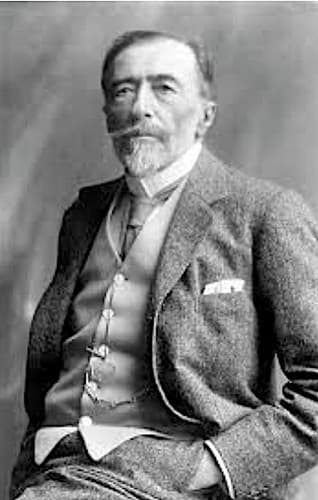
Joseph Conrad was a Polish-British novelist and short story writer. He is regarded as one of the greatest writers in the English language; though he did not speak English fluently until his twenties, he came to be regarded a master prose stylist who brought a non-English sensibility into English literature. He wrote novels and stories, many in nautical settings, that depict crises of human individuality in the midst of what he saw as an indifferent, inscrutable and amoral world.
Similar books
- Lord of the Flies
William Golding
3.7 (2.3M) average on GoodreadsYoung AdultExplores the descent into savagery when civilization's rules are removed.
- Things Fall Apart
Chinua Achebe
3.7 (288k) average on GoodreadsHistorical FictionOffers an African perspective on the impact of European colonialism.
- A Passage to India
E.M. Forster
3.7 (70k) average on GoodreadsHistorical FictionForster's work also critiques colonialism but focuses more broadly on the social and cultural clashes between the British and Indians, exploring themes of friendship, misunderstanding, and justice within the Raj. It offers a wider array of character perspectives compared to Conrad's intense, singular psychological journey.
- To Kill a Mockingbird
Harper Lee
4.3 (4.5M) average on GoodreadsHistorical FictionIn the 1930s Jim Crow South, Harper Lee writes about racial injustice, moral growth, and the quiet courage of a lawyer father, Atticus Finch, as seen through his young daughter's eyes.
- The Great Gatsby
F. Scott Fitzgerald
3.9 (3.8M) average on GoodreadsHistorical FictionIn the opulent Roaring Twenties, a mysterious millionaire's lavish parties hide his desperate, tragic pursuit of a lost love, exposing the emptiness within the American Dream.
- Pride and Prejudice
Jane Austen
4.3 (3M) average on GoodreadsHistorical FictionIn a society focused on status and money, Elizabeth Bennet navigates love and pride, challenging Mr. Darcy and social expectations to find true affection.




Enjoyed the summary?
A summary gives you the shape of the book. The book itself has the detail, the examples and the voice.
Find Heart of Darkness on AmazonAs an Amazon Associate, BookBrief earns from qualifying purchases. How we're funded