
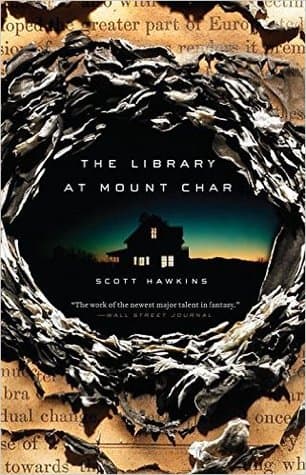
Synopsis
Covers the whole plot, including the ending.
- Difficulty
- Medium
- Pacing
- Moderate
- Mood
- Dark, Bizarre, Twisted, Intriguing, Unsettling
- Read it if
- You enjoy dark, unconventional fantasy with morally ambiguous characters, intricate world-building, and a plot that consistently subverts expectations.
- Skip it if
- You prefer traditional fantasy tropes, clear-cut heroes and villains, or shy away from graphic violence and disturbing themes.
The Library at Mount Char Plot Summary
Covers the whole plot, including the ending.
Father's Disappearance and the Siblings' Struggle
The story begins with Carolyn, one of Father's adopted 'children,' finding that Father, their guardian, has vanished. For centuries, Father raised Carolyn and her eleven siblings in his sprawling, extra-dimensional Library. Each child specialized in a specific 'catalogue' of knowledge — like War, Animals, Language, or the Dead. With Father gone, the siblings are lost, their routines broken. Carolyn, specializing in the Catalogue of the Dead, first focuses on a message from Father: 'Remember my face.' The siblings immediately start to compete for control, each believing they are best suited to inherit Father's power and the Library. This causes immediate tension and suspicion, especially between Carolyn and the ambitious Erwin.
Carolyn's Foray into the Outside World
To carry out her plan, Carolyn needs a specific antique rifle from the outside world. Despite centuries of isolation in the Library, she goes into a nearby American town. Her social skills are poor, and her understanding of human culture is strange due to Father's teachings. Her awkward interactions, like wearing a Christmas sweater over gold bicycle shorts and her blunt communication, show her disconnect from humanity. She quickly gets the rifle from a pawn shop, using her unusual abilities to intimidate the owner. This first trip shows her detachment from normal humanity and her focus on her goals.
The Introduction of Steve and the Search for Father
Carolyn recruits Steve, a local man down on his luck, by first saving him from a bear attack (which she arranged) and then forcing him to help her. Steve becomes her reluctant helper, doing errands like getting specific items from stores. Meanwhile, the other siblings, especially Erwin (War), Michael (Animals), and Rebecca (Language), search for Father. They think he might be hiding or testing them. Their search involves using their catalogue powers in destructive ways, causing local problems and deaths, showing their dangerous abilities and their disregard for human life.
The First Confrontation and Father's Return
The tension among the siblings grows into a violent fight. Erwin, using his mastery of war, ambushes several siblings, including Michael and Rebecca, trying to gain control. Their battle shows their terrifying powers, causing much damage. This chaotic scene stops abruptly with Father's shocking return. He is not the powerful figure they knew; he is weakened, appearing as a frail old man. His return immediately changes the situation. The siblings are both scared of his anger and confused by his diminished state, leading them to question his true intentions.
Father's Trial and the Revealed Betrayal
Father calls a 'family meeting,' which quickly becomes a terrifying trial. He reveals that he has been 'dead' before, and his current weakened state is a result of a betrayal. He accuses the siblings of trying to take his power and arranges brutal interrogations and punishments. He forces them to confess their ambitions and past wrongs. During this, it comes out that Father is not just a powerful entity; he is a previous God who abducted human children, erasing their memories and training them to manage his divine 'catalogs.' He details the origins of each sibling, revealing their human names and the tragic circumstances of their abductions, destroying their made-up identities.
Carolyn's True Plan Begins to Unfold
As Father continues his cruel 'trial,' Carolyn's planned scheme begins to unfold. It turns out she has been arranging events for centuries, gathering specific items and subtly influencing others. Her plan is not just about escaping Father or gaining power; it is about becoming God herself. She has prepared for every possibility, including Father's weakened state. She uses Steve as a pawn, having him plant specific items and perform actions that fit her strategy. Her actions become more calculated and ruthless, showing a depth of foresight and manipulation that surprises even Father.
The Intervention of the Pantheon and the Sun God
A new threat appears: an ancient group of gods, led by the Sun God, comes to reclaim the divine power Father stole from them centuries ago. Father, in his past life as a human librarian, found the secret to becoming a god and 'killed' the existing gods, absorbing their powers and knowledge into his Library. The Sun God and his remaining followers want to reverse this, seeing Father's weakened state as their chance. Their arrival adds another layer of cosmic conflict, with the siblings caught between Father's anger and the gods' ancient vengeance. The Sun God is especially interested in the Library's catalogues.
Carolyn's Ultimate Sacrifice and Betrayal
Carolyn's plan reaches its peak with shocking betrayals and sacrifices. She reveals that the rifle she got earlier is important for a ritual involving the Sun God. She manipulates the Sun God into believing he can reclaim his power through her, but she plans to absorb his power. She also reveals her ultimate betrayal of Father, having worked towards his downfall for centuries. Her plan involves using the human souls she has been collecting (from her Catalogue of the Dead) and the Sun God's energy to power her rise. This involves a devastating ritual that threatens to destroy the Library and everyone in it.
Steve's Role and the Human Element
Throughout the chaos, Steve, the ordinary human, gets more involved in Carolyn's divine plans. Despite his initial fear and confusion, he tries to do the right thing, often acting as Carolyn's conscience, though she ignores him. He is unknowingly important in several key moments of Carolyn's plan, such as planting specific items or starting events. His perspective provides a human element to the cosmic conflict, and his simple desire for a normal life contrasts with the gods' desire for power. Carolyn's plan depends on a final, difficult choice Steve must make, a choice that shows the humanity Carolyn has suppressed.
The Climax: A New God Is Born
The climax shows Carolyn fully using her power, directly confronting Father and the Sun God. She shows her mastery over death and the knowledge of her catalogue, using the souls she has collected as a weapon and a source of power. The battle is cataclysmic, tearing apart reality within the Library. Through cunning, centuries of preparation, and a willingness to make unthinkable sacrifices, Carolyn outmaneuvers her adversaries. She successfully integrates the Sun God's essence and Father's remaining power, transforming into a new, more powerful entity.
The Aftermath and Carolyn's New Reign
Afterward, Carolyn emerges as the new God, having killed Father and absorbed the Sun God's power. The Library, though damaged, is hers. She immediately begins to reshape reality according to her vision, showing her immense power. However, her victory comes with immense personal cost. She deals with losing her humanity, the memories of her original life, and the terrible things she did to achieve her goal. The book ends with Carolyn, now God, thinking about her new existence, the emptiness that comes with ultimate power, and the echoes of her past. She now carries the burden of creation and the weight of her choices.
The Library at Mount Char Characters
Carolyn
Protagonist
The seemingly ordinary woman who orchestrates Father's downfall to become the new God.
Carolyn is one of Father's adopted children, specializing in the Catalogue of the Dead. For centuries, she has meticulously planned to usurp Father, enduring his cruelty while secretly gathering the knowledge and resources for her ascension. She is outwardly awkward and emotionally stunted due to her upbringing, but possesses an incredible intellect, ruthless determination, and a profound understanding of death and souls. Her humanity is deeply buried but occasionally surfaces, particularly through her interactions with Steve and her memories of her original life before Father.
Relationships: Father (Abuser/Victim, Rival); Steve (Unwitting Pawn/Confidant); Siblings (Rivals, fellow victims of Father); Erwin (Primary rival among siblings)
Father
Antagonist
The cruel, ancient entity who abducted children and trained them to manage his divine Library.
Father is the powerful, sadistic being who is revealed to be a former human librarian who stole godhood. He raised Carolyn and her eleven adopted siblings with unimaginable cruelty, training them in specific 'catalogues' of universal knowledge. He views his 'children' as tools and potential successors, constantly testing and tormenting them. His power seems boundless, but he is vulnerable to certain ancient forces and betrayals. He is the original God, but his reign is characterized by tyranny and a deep-seated fear of being replaced.
Relationships: Carolyn (Abuser/Victim, Rival); Siblings (Abuser/Victims, pawns); Sun God (Ancient enemy, source of stolen power)
Steve
Supporting
An ordinary human caught in the cosmic conflict, serving as Carolyn's reluctant accomplice.
Steve is a regular guy from the outside world, down on his luck, who is unwillingly pulled into Carolyn's schemes. He serves as her driver, errand runner, and occasional moral compass. Despite the terrifying circumstances and Carolyn's bizarre behavior, Steve maintains a surprising degree of resilience and a fundamental sense of right and wrong. He provides the reader with a relatable human perspective on the alien world of Father and his children. His survival and choices are crucial to Carolyn's ultimate plan, and he represents the lingering human element within Carolyn.
Relationships: Carolyn (Captor/Captive, reluctant allies)
Erwin
Supporting
One of Father's children, specializing in the Catalogue of War, and a primary rival to Carolyn.
Erwin is the most overtly aggressive and ambitious of Father's children, specializing in the Catalogue of War. He is a master of tactics, strategy, and combat, capable of inflicting immense destruction. He openly vies for Father's position and is quick to resort to violence and intimidation to assert dominance over his siblings. Erwin views the world through the lens of conflict and power, making him a formidable antagonist to Carolyn, though he ultimately becomes a pawn in her grander scheme.
Relationships: Father (Abuser/Victim, ambitious successor); Carolyn (Rival)
Michael
Supporting
One of Father's children, specializing in the Catalogue of Animals.
Michael is one of Father's adopted children, whose catalogue is Animals. He possesses the ability to communicate with and control all forms of animal life, often appearing with various creatures, from birds to bears, at his command. He is generally less overtly aggressive than Erwin but is equally ruthless in pursuing his own interests and maintaining his domain. Michael's powers make him a significant force, capable of creating widespread chaos using the natural world.
Relationships: Father (Abuser/Victim); Siblings (Fellow victims, occasional allies/rivals)
Rebecca
Supporting
One of Father's children, specializing in the Catalogue of Language.
Rebecca is one of Father's adopted children, specializing in the Catalogue of Language. She possesses an extraordinary understanding and manipulation of all forms of communication, including spoken words, written texts, and even the underlying structures of reality that can be altered through linguistic precision. She is intelligent and observant, often acting as an interpreter or decipherer of complex information. Her power is subtle but incredibly potent, allowing her to bend perceptions and influence outcomes through carefully crafted words.
Relationships: Father (Abuser/Victim); Siblings (Fellow victims, occasional allies/rivals)
The Sun God
Antagonist
An ancient, powerful deity seeking to reclaim his stolen power from Father.
The Sun God is a member of an ancient pantheon of gods whom Father, as a human, 'killed' and absorbed their powers. He represents the old order of divinity, characterized by immense power and a desire for vengeance against Father. He is cunning and manipulative, attempting to use Carolyn and the other siblings to achieve his goals. His presence introduces a broader cosmic scale to the conflict, revealing that Father's power was not entirely original but stolen from others.
Relationships: Father (Ancient enemy); Carolyn (Unwitting tool/eventual absorber)
General
Supporting
A former human general, now an immortal servant of Father, guarding the Library.
The General is an immortal, highly skilled military commander who serves Father, guarding the Library's perimeter and enforcing Father's will. He is fiercely loyal to Father, even in his weakened state, and views the siblings with suspicion. His presence represents Father's enduring power and the dangerous, militaristic aspect of his domain. He is a formidable warrior, capable of single-handedly dispatching multiple threats, making him a significant obstacle to anyone attempting to usurp Father.
The Library at Mount Char Themes
Identity and Self-Discovery
Father creates the children's identities, erasing their memories and giving them roles. Carolyn's journey is about finding her original human self, even as she tries to go beyond it. The revelation of their human names and pasts during Father's 'trial' breaks their made-up realities. This forces them to face who they were before and who they have become. This theme explores identity when memory is stolen and power defines existence. It ends with Carolyn's struggle to keep a bit of humanity while becoming a god.
“You were a real person once. You had a real name. You had a real family. And then I took them from you.”
Abuse of Power and Control
Father's existence is built on abusing power. He kidnapped children, erased their memories, and subjected them to centuries of torment to maintain his Library and godhood. His methods are manipulative and cruel, designed to keep his 'children' subservient and scared. The siblings, in turn, often repeat this abuse on a smaller scale, using their catalogue powers to control or harm others. This shows how cycles of abuse can continue. Carolyn's plan, while a rebellion against Father, also involves manipulating Steve and the other gods, raising questions about whether new power can escape old patterns.
“He taught us to be cruel. He taught us that cruelty was power.”
The Nature of Godhood
The book breaks down and redefines godhood. Father is not a divine being but a human who stole power and learned how to 'become' God. His godhood relates to knowledge (the Library) and control. The Pantheon further complicates this, showing that godhood can be taken, lost, and reclaimed. Carolyn's goal is to become a new God, implying that godhood can be earned or seized through immense will and sacrifice, not an inherent state. It explores the responsibilities, loneliness, and moral compromises that come with ultimate power.
“God isn't born. God is made.”
Sacrifice and Its Costs
Sacrifice is a main theme, appearing in many forms. The children's lives are a sacrifice, stolen and shaped by Father. Carolyn's plan involves immense personal sacrifice, including her humanity, her memories, and the lives of others, all to reach her goal. Steve, too, is forced into sacrifices he does not understand. The book details the emotional, moral, and physical costs of these sacrifices, questioning if the ends can justify such means, especially when the goal is absolute power. Carolyn's final rise is a victory, but one filled with emptiness and loss.
“To become a god, you have to kill a god. And you have to kill everything that made you human.”
Knowledge and Power
The Library itself shows this theme. It holds all knowledge, and control over its catalogues gives immense power. Father's godhood comes from his mastery of this knowledge, and the siblings' powers are extensions of their assigned catalogues. The fight for control of the Library is a fight for ultimate power over creation. The book shows that knowledge, when used without empathy or morality, can be the most destructive force, turning information into a weapon and wisdom into a means of control.
“The Library was everything. Every secret, every truth, every lie, every possibility.”
Plot Devices & Literary Techniques
The Library
The central, extra-dimensional repository of all knowledge and the source of divine power.
The Library is more than just a building; it is a sentient, extra-dimensional entity that holds all the knowledge of the universe, organized into 'catalogues' (War, Animals, Dead, etc.). It is the source of Father's power and the object of desire for the siblings and the Pantheon. Its vastness and esoteric nature serve as a constant reminder of the incomprehensible power at stake. The Library is a character in itself, influencing events and holding secrets that drive the plot, acting as both a prison and a prize.
The Catalogues
Specialized domains of knowledge and power, each mastered by a different sibling.
The Catalogues are the specific categories of universal knowledge (e.g., War, Animals, Dead, Language, etc.) that Father assigned to each of his adopted children. Mastery of a catalogue grants immense, almost magical, power over its domain. For example, Carolyn's Catalogue of the Dead allows her to manipulate souls and death itself. These catalogues define the siblings' abilities, their roles, and their individual contributions to the larger conflict, serving as a structured system of magic within the book's universe.
Memory Erasure
Father's method of controlling his children by removing their human pasts.
Father systematically erased the memories of his adopted children, effectively stealing their human identities and replacing them with the roles he assigned. This device creates a profound sense of mystery around the siblings' origins and fuels Carolyn's underlying quest for self-discovery. The gradual revelation of their past lives and human names during Father's 'trial' is a pivotal plot point, adding immense emotional weight and explaining the deep-seated trauma and resentment that drives their actions.
The Ordinary Human Perspective (Steve)
Steve's character provides a grounding, relatable viewpoint amidst the cosmic conflict.
Steve, an average human from the outside world, serves as a crucial narrative device. His confusion, fear, and fundamental decency provide a stark contrast to the alien and often horrifying world of Father and his children. Through Steve's eyes, the reader experiences the shocking reality of the gods' powers and the stakes of their conflict. He acts as a proxy for the audience, making the fantastical elements more accessible and highlighting the profound detachment of the god-like beings from human morality and experience.
The Sun God's Pantheon
The remnants of an older divine order, seeking to reclaim power from Father.
The introduction of the Sun God and his remaining Pantheon broadens the scope of the narrative beyond Father and his children. This device reveals that Father's godhood was not unique or original, but stolen, adding layers to the mythology and introducing an ancient, cosmic conflict. Their presence provides a new antagonist for Father and another set of powerful entities for Carolyn to outmaneuver, escalating the stakes and complexity of the power struggle.
The Library at Mount Char Quotes
“The library is not a place. It is a person.”
“We are not human. We are something else. Something better.”
“The only thing that matters is the work. The work is all there is.”
“You can't un-know a thing. That's the curse of knowledge.”
“God is dead. But that's not the problem. The problem is that he's getting up.”
“The world is a story, and we are the words.”
“Fear is the mind-killer. But so is love. So is hope.”
“There are no accidents in the library. Only lessons.”
“To be a librarian is to be a weapon. Sharpened and waiting.”
“The dead are not gone. They are just... elsewhere.”
“Chaos is not the enemy. Order is not the friend. They are just... tools.”
“We wear our scars like armor. They remind us of what we've survived.”
“The truth is a mirror. It shows you what you are, not what you want to be.”
“In the end, we are all just stories waiting to be told.”
Quiz
10 questions on the plot and the characters. Each answer comes with a short explanation.
Question 1
What is the primary setting where Carolyn and her siblings were raised and studied?
- A remote monastery in the mountains
- The Library at Mount Char
- An ancient temple in a hidden valley
- A secret government facility
Show answer
B. The Library at Mount Char Carolyn and her adopted siblings were taken in by Father and raised at the Library at Mount Char, where they studied its books and learned secrets of power according to Father's ancient customs.
Question 2
What event triggers the main conflict in the story?
- Carolyn's parents returning from the dead
- The discovery of a new library
- Father going missing or possibly dying
- A rebellion among the siblings
Show answer
C. Father going missing or possibly dying Father's disappearance leaves the Library unguarded, sparking a battle for control over creation as Carolyn and others compete for this power.
Question 3
What is one of Carolyn's mundane human likes mentioned in the book?
- Pizza and video games
- Guacamole and cigarettes
- Coffee and crossword puzzles
- Tea and classical music
Show answer
B. Guacamole and cigarettes The book notes that Carolyn likes guacamole and cigarettes (and steak), highlighting her residual human traits despite her alien upbringing.
Question 4
Why do Carolyn and her siblings sometimes wonder if Father might be God?
- Because he performs miracles in public
- Because he claims to have created the universe
- Because of his cruel tutelage and the power secrets in the Library
- Because he appears in religious texts
Show answer
C. Because of his cruel tutelage and the power secrets in the Library Father's ancient customs, control over the Library with universe secrets, and cruel methods lead the siblings to speculate he might secretly be God.
Question 5
What is a key consequence of Carolyn's focus on the battle to become the new God?
- She loses all her magical powers
- She forgets to protect the things that make her human
- She accidentally destroys the Library
- She alienates all her siblings permanently
Show answer
B. She forgets to protect the things that make her human The book describes how in the war to make a new God, Carolyn has forgotten to protect her humanity, a central theme of her character arc.
Question 6
What do the books in the Library primarily contain?
- Historical records of ancient civilizations
- Secrets to the universe and power
- Fictional stories for entertainment
- Scientific textbooks on modern technology
Show answer
B. Secrets to the universe and power The Library holds secrets to the universe, which Father taught the siblings, and its unguarded state threatens control over all creation.
Question 7
How does the book describe Carolyn's outfit in one notable instance?
- A black cloak with silver embroidery
- A Christmas sweater over gold bicycle shorts
- A formal gown with library-themed patterns
- Combat gear for the upcoming battle
Show answer
B. A Christmas sweater over gold bicycle shorts The book mentions that everyone says nice things about her outfit with the Christmas sweater over the gold bicycle shorts, illustrating her quirky, human side.
Question 8
What is a major challenge Carolyn faces in the battle for the Library?
- Her competitors have powers that far exceed her own
- The Library is hidden and impossible to find
- She lacks any knowledge of the Library's secrets
- Father has returned to stop her
Show answer
A. Her competitors have powers that far exceed her own As Carolyn gathers tools for the battle, fierce competitors align against her with greater powers, but she has accounted for this with a plan.
Question 9
What aspect of Carolyn's past is highlighted to contrast with her current life?
- She was once a normal American
- She was a renowned scholar
- She grew up in poverty
- She was a child prodigy in magic
Show answer
A. She was once a normal American The book notes Carolyn was a normal American once, before her parents died and Father took her in, emphasizing the loss of her humanity.
Question 10
Which of the following best describes the tone and style of 'The Library at Mount Char' as per the description?
- Solemn and philosophical throughout
- Horrifying and hilarious, alien and human
- Lighthearted and comedic
- Purely action-oriented and fast-paced
Show answer
B. Horrifying and hilarious, alien and human The book is described as at once horrifying and hilarious, mind-blowingly alien and heartbreakingly human, blending multiple tones and themes.
The Library at Mount Char FAQ
What is 'The Library at Mount Char' about?
The novel follows Carolyn and her adopted siblings, who were raised by the enigmatic Father after their parents' deaths. They study esoteric knowledge in his Library, which holds the secrets to controlling creation. When Father goes missing, Carolyn must compete against powerful rivals—including her own siblings—to claim the Library and potentially become a new god, all while struggling to retain her humanity.
Why should I read 'The Library at Mount Char'?
It blends fantasy, horror, and dark humor in a wildly original story about power, trauma, and what it means to be human. The book features shocking plot twists, morally complex characters, and a unique magic system based on the Library's catalogs, making it a standout in speculative fiction.
What is the background/setting of 'The Library at Mount Char'?
The story alternates between the mundane modern world (like suburban America) and the surreal, timeless Library at Mount Char. The Library contains catalogs of cosmic knowledge, each studied by a sibling, and its rules defy normal reality, creating a setting that is both familiar and utterly alien.
What are the most memorable quotes from the book?
Key quotes include Carolyn's reflection, 'She was a normal American herself once,' highlighting her lost humanity, and Father's ominous teaching, 'There is no such thing as a free lunch.' These lines underscore themes of cost, power, and identity throughout the narrative.
What writing style does Scott Hawkins use in this book?
Hawkins employs a darkly humorous and visceral prose style, blending graphic violence with absurd comedy. The narrative shifts between Carolyn's detached, analytical perspective and chaotic, surreal events, creating a tone that is both intellectual and intensely emotional.
What minor details add significant meaning to the story?
Carolyn's outfit—a Christmas sweater over gold bicycle shorts—symbolizes her awkward grasp of normalcy and her fractured identity. Similarly, her fondness for guacamole and cigarettes represents fleeting connections to her past humanity, which become crucial in her final plan.
What are some subtle foreshadowing moments in the book?
Early mentions of Carolyn's 'plan' and her meticulous accounting for rivals hint at her long-game strategy to usurp Father. The repeated emphasis on her forgetting 'the things that make her human' foreshadows the emotional cost of her ascent to power.
What unexpected character connections exist?
Carolyn's relationship with Erwin, a former soldier she manipulates, evolves into a genuine bond that humanizes her. Additionally, the siblings' shared trauma under Father creates twisted loyalties and rivalries, such as David's brutal enforcement of rules masking his own desperation for order.
What are unspoken character motivations?
Carolyn is driven by a deep-seated desire for safety and control, stemming from the trauma of her parents' death and Father's abuse. Meanwhile, siblings like Margaret seek love and validation, while others, like David, crave structure and purpose, often leading to violent conflicts.
What psychological complexities do characters exhibit?
Carolyn displays dissociative traits, compartmentalizing her humanity to survive Father's teachings. The siblings each develop extreme personalities based on their assigned catalogs—like Peter's detachment or Jennifer's ferocity—reflecting how trauma shapes identity in a surreal environment.
What are the major emotional turning points?
Key moments include Carolyn's realization that she has neglected her heart while pursuing power, her bonding with Erwin, and the climax where she must choose between godhood and human connection. These shifts highlight her internal struggle between cold calculation and empathy.
How do relationship dynamics evolve among the characters?
Sibling dynamics shift from fractured alliances under Father's rule to open warfare after his disappearance. Carolyn's relationship with Erwin transitions from manipulation to genuine care, mirroring her reconnection with humanity, while rivalries like with David escalate into brutal confrontations.
Which parts of the book remain ambiguous or open-ended?
The true nature of Father—whether he is a god, an alien, or something else—is never fully explained. Additionally, the ultimate consequences of Carolyn's choices and the future of the Library are left somewhat unresolved, inviting interpretation about power and legacy.
What are controversial scenes or decisions in the story?
Carolyn's manipulation and sacrifice of others, including her siblings, for her plan sparks debate about her morality. The graphic violence, such as David's brutal enforcement of Library rules, also challenges readers with its blend of horror and dark comedy.
How does 'The Library at Mount Char' end, and what does it mean?
Carolyn achieves her goal of controlling the Library but at great personal cost, having nearly lost her humanity. The ending suggests a bittersweet victory where power comes with isolation, emphasizing themes that godhood may require sacrificing one's heart and connections.
About the author

Scott Hawkins is an author known for his work in fiction, particularly for his novel "The Library at Mount Char." This book explores themes of power, mythology, and the complexities of human relationships within a fantastical setting. Hawkins's writing often blends elements of dark fantasy and horror.
Similar books
- American Gods
Neil Gaiman
4.1 (758k) average on GoodreadsFantasyExplores ancient gods in a modern setting with a dark, mythological tone.
- Harry Potter and the Sorcerer's Stone
J.K. Rowling
4.5 (7M) average on GoodreadsFantasyRescued from a miserable life under the stairs, an orphaned boy discovers he's a wizard destined for a magical school, where he uncovers a dangerous secret tied to the dark wizard who murdered his parents.
- The Hunger Games
Suzanne Collins
4.3 (6.4M) average on GoodreadsFantasyIn a future where children fight to the death on live television, Katniss Everdeen volunteers for the arena, turning a death sentence into a fight for survival and a spark of rebellion.
- 1984
George Orwell
4.2 (3.1M) average on GoodreadsPoliticsIn a future where surveillance and thought control are absolute, a man's search for truth clashes with the Party, showing that hope can be a form of rebellion.
- Divergent
Veronica Roth
4.2 (2.9M) average on GoodreadsFantasyIn a society divided by virtues, a sixteen-year-old's difference from the norm starts a rebellion that threatens her world.
- The Hobbit, or There and Back Again
J.R.R. Tolkien
4.3 (2.9M) average on GoodreadsFantasyA comfort-loving hobbit named Bilbo Baggins is whisked away by a mischievous wizard and a band of dwarves on an unexpected journey to reclaim stolen treasure from a fearsome dragon, discovering courage and a magical ring along the way.





Enjoyed the summary?
A summary gives you the shape of the book. The book itself has the detail, the examples and the voice.
Find The Library at Mount Char on AmazonAs an Amazon Associate, BookBrief earns from qualifying purchases. How we're funded