
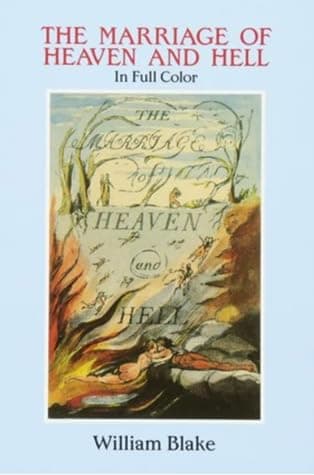
Core Idea
- Difficulty
- Hard
- Read it if
- You are interested in radical spiritual philosophy, the intersection of art and critique, or a poetic challenge to conventional morality and reason. You appreciate symbolic language and a passionate, unconventional perspective on good and evil.
- Skip it if
- You prefer straightforward philosophical arguments, literal interpretations of religious texts, or are uncomfortable with highly symbolic, often confrontational, poetic prose that subverts traditional theological concepts.
Key Takeaways from The Marriage of Heaven and Hell
The Necessary Union of Opposites
True wisdom arises from the dynamic interplay and synthesis of seemingly contradictory forces.
Blake argues that the common separation of 'heaven' and 'hell,' or good and evil, is a false division made by oppressive religious and moral systems. He proposes that these forces are interdependent. Progress, for individuals and society, depends on the tension created by opposing energies. Energy, often linked to 'hell' or 'evil' by common thought, is the vital force of creation and desire. Reason, often linked to 'heaven,' provides structure but becomes stagnant without energy. The 'marriage' means recognizing their essential, generative relationship, leading to a more complete understanding of existence and the human mind.
“Without Contraries is no progression. Attraction and Repulsion, Reason and Energy, Love and Hate, are necessary to Human existence.”
In the book: The entire structure of 'The Marriage of Heaven and Hell' serves as evidence, particularly the foundational statement 'Without Contraries is no progression.' Blake's revaluation of 'Energy' as the primary source of life and creativity, and 'Reason' as its governor, rather than its master, underpins his entire philosophical framework.
Try this: Embrace the 'contraries' within your own life and creative process. Instead of suppressing uncomfortable emotions or unconventional ideas, explore how they might fuel your growth or offer new perspectives. Recognize that conflict and tension can be catalysts for innovation and deeper understanding, rather than purely destructive forces.
Related ideas: dialectics, duality, synthesis, non-duality
Reclaiming the Devil's Perspective
Conventional morality often demonizes vital energy and desire, which are essential for creation and true insight.
Blake's 'Devil' is not the traditional figure of pure evil. Instead, it symbolizes unrestrained energy, desire, and rebellious imagination. He claims that established religious institutions, by labeling energy and desire as 'evil,' suppress humanity's most powerful creative forces. The 'Proverbs of Hell' offer the Devil's wisdom, contrasting sharply with conventional, restrictive moral sayings. Blake suggests that true poets and visionaries, even those who outwardly conform, instinctively align with this 'Devil's party' because it represents the raw source of inspiration and truth, often found outside accepted doctrines.
“The reason Milton wrote in fetters when he wrote of Angels & God, and at liberty when of Devils & Hell, is because he was a true Poet and of the Devils party without knowing it.”
In the book: The 'Proverbs of Hell' themselves, such as 'The road of excess leads to the palace of wisdom,' or 'Exuberance is Beauty.' Blake's provocative reinterpretation of John Milton's *Paradise Lost* is a key example, asserting that Milton's poetic power truly shines when depicting Hell, because his spirit was inherently aligned with its rebellious energy.
Try this: Question established norms and 'virtues' that feel restrictive or suppressive. Explore your own desires and passions, discerning whether societal conditioning has labeled them 'bad' when they might be sources of creativity and personal truth. Dare to challenge dogma and seek wisdom from unconventional sources.
Related ideas: antinomianism, transgression, desire, rebellion
The Tyranny of Abstract Reason
Pure, unbridled reason, divorced from sensory experience and passion, leads to spiritual and imaginative stagnation.
Blake strongly criticizes the Enlightenment's elevation of abstract reason as the highest human faculty, especially when it becomes a tool for moral suppression. He sees this as a 'mind-forged manacle' that restricts imagination and stifles the natural flow of energy and desire. When reason dictates 'good' and 'evil' based on an arbitrary division of body and soul, it creates a system of fear and control. For Blake, true wisdom integrates reason with passion, intuition, and sensory experience, rather than allowing abstract reason to dominate and lessen human experience. This intellectual tyranny leads to a 'sleep' of the soul, dulling genuine perception.
“All Bibles or sacred codes have been the causes of the following Errors: 1. That Man has two real existing principles Viz: a Body & a Soul. 2. That Energy, calld Evil, is alone from the Body; & that Reason, calld Good, is alone from the Soul. 3. That God will torment Man in Eternity for following his Energies.”
In the book: Blake's critique of Emmanuel Swedenborg, whom he initially admired but later saw as a systematizer who 'perverted' true vision into a rigid, rationalistic system. The 'Proverbs of Hell' consistently advocate for direct experience and the embrace of paradox over systematic logic.
Try this: Be wary of intellectual frameworks or ideologies that demand rigid adherence and dismiss intuition, emotion, or sensory experience. Cultivate a balanced approach to understanding the world, allowing both rational thought and imaginative insight to inform your perspective. Don't let abstract rules dictate your lived experience.
Related ideas: rationalism, empiricism, enlightenment, dualism
The Doors of Perception
Cleansing the channels of perception reveals the infinite nature of reality, otherwise obscured by conventional filters.
This statement captures Blake's belief that common perception is severely limited by societal conditioning, intellectual frameworks, and self-imposed mental barriers. We do not see reality as it truly is – infinite, divine, and connected – but through a distorted lens of our own making. To 'cleanse the doors of perception' means to go beyond these limits, to open oneself to direct, unmediated experience, and to see the inherent divinity in all things. This act of liberation is not about gaining new knowledge, but about removing the illusions that hide existing truth, leading to an expansion of consciousness.
“If the doors of perception were cleansed every thing would appear to man as it is, Infinite. For man has closed himself up, till he sees all things thro' narrow chinks of his cavern.”
In the book: The entire 'Memorable Fancy' sections, where Blake describes his encounters with angels and devils, challenging their fixed perspectives and expanding their understanding. The 'Proverbs of Hell' encourage breaking free from mental constraints, e.g., 'The fool sees not the same tree that a wise man sees.'
Try this: Practice mindfulness and intentional presence to notice details and connections you usually overlook. Challenge your assumptions about reality and be open to new ways of seeing. Engage in creative activities that can help bypass rational filters and access deeper intuition, allowing you to perceive the 'infinite' in the mundane.
Related ideas: epistemology, consciousness, mysticism, gnosis
The Primacy of Imagination
Imagination is not fantasy, but the direct experience of the divine, the true engine of creation and spiritual insight.
For Blake, imagination is more than mere fantasy; it is the divine faculty within humanity, the primary way we access truth and create reality. It is the active force that shapes perception and allows us to go beyond the limits of the physical world. The 'poetic genius' is not just about writing verse, but about a fundamental way of experiencing and interpreting the universe. When imagination is suppressed, humanity becomes enslaved to 'reason' and 'memory,' losing its connection to the infinite. True vision, revelation, and creation all come from this imaginative core, making it the most sacred human capacity.
“As a man is, so he sees. As the eye is formed, such are its powers.”
In the book: Blake's own life's work as a poet, painter, and engraver, where he consistently integrated text and image to create visionary works. The 'Proverbs of Hell' often advocate for the power of the mind and spirit over physical limitations: 'What is now proved was once only imagin'd.'
Try this: Cultivate your imaginative faculties through creative pursuits, dream journaling, and actively envisioning possibilities beyond current realities. Treat your imagination as a vital source of insight and guidance, rather than a mere escape. Believe in the power of your own inner vision to shape your world.
Related ideas: poetic genius, creativity, visionary art, intuition
Energy as Sacred Desire
Desire, often condemned as sinful, is the divine, active principle that drives life, creativity, and spiritual awakening.
Blake redefines 'Energy' as a divine and life-affirming force, contrasting with Christian doctrines that often link desire and passion with sin. He sees energy as the spark of creation, the impetus for all action, and the essence of existence. Suppressing energy means suppressing life itself. This 'eternal delight' is not hedonism but the joyful, boundless expression of being. It drives the 'Giant form' of humanity, constantly striving, creating, and experiencing. For Blake, true spirituality involves embracing and channeling this energy, not denying it, and recognizing its inherent goodness and divinity.
“Energy is Eternal Delight.”
In the book: The entire 'Voice of the Devil' section, where Blake explicitly states that 'Energy is the only life, and is from the Body; and Reason is the bound or outward circumference of Energy.' The 'Proverbs of Hell' are replete with affirmations of energetic expression: 'The busy bee has no time for sorrow.'
Try this: Identify areas where you might be unconsciously suppressing your own energy or desires due to internalized guilt or societal pressure. Find healthy and creative outlets for your passions. Reframe 'desire' not as a weakness, but as a powerful, divine drive for growth and experience. Embrace vitality.
Related ideas: libido, vitalism, eros, dynamism
The Annihilation of the Selfhood
True liberation comes from dissolving the egoic 'selfhood' that separates us from others and the divine.
While the term 'selfhood' is not explicitly used in The Marriage, the concept is present in Blake's critique of restrictive systems and his call for expanded perception. The 'Printing house in Hell' is a metaphor for the energetic, often painful, process of transforming conventional knowledge and breaking down individual ego barriers. For Blake, 'selfhood,' particularly in his later works, represents the fallen, isolated ego that clings to its limited perspective and seeks to dominate others. The 'marriage' of heaven and hell, the cleansing of perception, and the embrace of energy all help dissolve this narrow self and realize a more universal, connected identity, aligning with the 'Poetic Genius' common to all.
“I was in a Printing house in Hell & saw the method in which knowledge is transmitted from generation to generation.”
In the book: The 'Memorable Fancies' where Blake often 'converts' the 'Angels' by showing them their own restrictive thinking, thereby breaking down their self-imposed limitations. The emphasis on universal 'Poetic Genius' suggests a shared, rather than isolated, faculty.
Try this: Practice empathy and actively seek to understand perspectives different from your own. Engage in practices that challenge your ego and foster a sense of interconnectedness, such as service to others or deep engagement with nature. Question your own biases and assumptions.
Related ideas: ego death, non-duality, interconnectedness, transcendence
Prophetic Art as Social Critique
Art and poetry are not mere entertainment, but powerful tools for revealing truth and challenging oppressive societal structures.
Blake's work is prophetic, aiming not just to describe reality but to change it. He saw the artist as a prophet, able to see through illusions and reveal hidden spiritual truths. The Marriage directly criticizes the religious and political systems of his time, which he believed suppressed human freedom and imagination. By presenting 'Proverbs of Hell' and challenging common 'Angelic' perspectives, Blake uses his art to dismantle false authority and inspire a more liberated way of thinking and being. He laments how ancient, vital myths were later solidified into dogmatic systems that enslaved rather than enlightened.
“The ancient Poets animated all sensible objects with Gods & Geniuses, calling them by the names of countries & cities, nations & families, & they spoke of them as the anicent Greeks also did: they then drew an abstract from every thing, & always new Gods arose. And then a system was formed, which was for enslaving the vulgar by attempting to realize or abstract the mental deities into the corporeal world.”
In the book: The direct satire of established religious figures like Swedenborg and the Church of England throughout the work. Blake's own unique method of illuminated printing, where he was author, artist, and printer, was an act of artistic and intellectual independence from conventional publishing houses.
Try this: Use your creative expression, whatever form it takes, as a means to question authority, expose injustice, or articulate alternative visions for the future. Don't shy away from challenging the status quo through your work, recognizing its potential to inspire change and reveal deeper truths.
Related ideas: prophecy, satire, social commentary, activism
Rejecting Abstract Morality for Lived Experience
True morality is discovered through direct experience and the integration of all human faculties, not through rigid, external codes.
Blake rejects an externally imposed, abstract morality that dictates behavior without considering individual experience or human complexity. He argues that such systems, often from 'Angelic' reason, lead to hypocrisy and the suppression of vital energies. Instead, he advocates for a morality born from direct, often transgressive, experience. The 'Proverbs of Hell' encourage exploration and pushing boundaries, suggesting that true wisdom comes from fully engaging with life, including its 'excesses,' rather than following safe, prescribed paths. This experiential morality allows for a more authentic understanding of good and evil.
“You never know what is enough unless you know what is more than enough.”
In the book: The 'Proverbs of Hell' are a testament to this, advocating for lived experience over abstract rules: 'Prudence is a rich ugly old maid courted by Incapacity,' or 'The cistern contains; the fountain overflows.' These proverbs challenge conventional notions of virtue.
Try this: Be courageous in exploring life's experiences, even those that might be considered unconventional or challenging. Reflect on what you truly learn from your experiences, rather than simply conforming to external expectations. Develop your own internal moral compass based on empathy, wisdom gained, and an integrated understanding of yourself.
Related ideas: ethics, existentialism, autonomy, virtue ethics
The Divine Human Form
Divinity is not external, but inherent within humanity, particularly in the creative and energetic aspects of the human form.
Blake collapses the traditional dualism of body and soul, asserting their fundamental unity. For him, the body is not a fallen vessel or a prison for the soul, but an integral manifestation of the soul itself, and thus, divine. This means that divinity is not in some distant, abstract God, but within the energetic, imaginative, and sensory experience of the human being. The 'Divine Human Form' is a central concept in Blake's larger mythology, representing the perfected, unified human being who has integrated all contraries and recognized their inherent divinity. This perspective elevates humanity and its creative powers to a sacred status.
“Man has no Body distinct from his Soul; for that call'd Body is a portion of Soul discern'd by the five Senses, the chief inlets of Soul in this age.”
In the book: Blake's extensive visual art often depicts human figures in states of divine energy and cosmic significance, blurring the lines between human and divine. His assertion that 'All Religions are One' and that the 'Poetic Genius' is the first principle of all religions points to a universal, inherent divinity within humanity.
Try this: Honor your physical body and sensory experiences as integral parts of your spiritual journey. Recognize the divine spark within yourself and others, fostering a sense of inherent worth and sacredness. Cultivate self-love and self-acceptance, seeing your whole being as a manifestation of the divine.
Related ideas: pantheism, immanence, holism, divine humanity
The Marriage of Heaven and Hell Quotes
“Without contraries is no progression. Attraction and Repulsion, Reason and Energy, Love and Hatred, are necessary to Human existence.”
“The Tygers of wrath are wiser than the Horses of instruction.”
“If the doors of perception were cleansed every thing would appear to man as it is, Infinite. For man has closed himself up, till he sees all things thro' narrow chinks of his cavern.”
“Prisons are built with stones of Law, Brothels with bricks of Religion.”
“The road of excess leads to the palace of wisdom.”
“Energy is the only life and is from the Body; and Reason is the bound or outward circumference of Energy. Energy is Eternal Delight.”
“What is now proved was once only imagin'd.”
“The ancient Poets animated all sensible objects with Gods or Geniuses, calling them by the names and adorning them with the properties of woods, rivers, mountains, lakes, cities, nations, and whatever their enlarged & numerous senses could perceive.”
“I was in a Printing house in Hell & saw the method in which knowledge is transmitted from generation to generation.”
“He who desires but acts not, breeds pestilence.”
“As I was walking among the fires of hell, delighted with the enjoyments of Genius; which to Angels look like torment and insanity. I collected some of these remarks, intending to present them to the public as proverbs, & maxims, of infernal wisdom.”
“Man has no Body distinct from his Soul; for that call'd Body is a portion of Soul discern'd by the five senses, the chief inlets of Soul in this age.”
“One Law for the Lion & Ox is Oppression.”
“The Giants who formed this world into its sensual existence and now seem to live in it in chains, are in truth the causes of its life & the sources of all activity.”
Quiz
10 questions on the main ideas. Each answer comes with a short explanation.
Question 1
Which two traditional realms does Blake propose a 'marriage' between in the title of his work?
- Good and Evil
- Reason and Emotion
- Heaven and Hell
- Body and Soul
Show answer
C. Heaven and Hell The title itself, 'The Marriage of Heaven and Hell,' directly states the two realms Blake seeks to unite, challenging conventional notions of their opposition.
Question 2
What is the primary source of the 'Proverbs of Hell' within the work?
- Angels dictating to Blake
- Demons revealing truths to Blake in a subterranean cavern
- Ancient philosophical texts
- Biblical scripture interpreted differently
Show answer
B. Demons revealing truths to Blake in a subterranean cavern Blake describes being guided by a 'Devil' through a printing house in Hell, where the 'Proverbs' are revealed, emphasizing his inversion of traditional moral sources.
Question 3
Blake's 'Proverbs of Hell' often advocate for which of the following?
- Strict adherence to moral codes and societal rules
- The suppression of desires and passions
- The energetic expression of desire and the breaking of restrictive norms
- Passive contemplation and withdrawal from the world
Show answer
C. The energetic expression of desire and the breaking of restrictive norms The 'Proverbs of Hell' are famous for their inversion of conventional morality, often promoting the idea that 'Energy is Eternal Delight' and that 'Exuberance is Beauty,' challenging repression.
Question 4
According to Blake in 'The Marriage of Heaven and Hell,' who are the 'Devils' and 'Angels' truly representative of?
- Literal supernatural beings
- The 'Devils' represent energetic creators and the 'Angels' represent those who restrain and rationalize
- The 'Devils' represent pure evil and the 'Angels' represent pure good
- Figments of Blake's imagination with no deeper meaning
Show answer
B. The 'Devils' represent energetic creators and the 'Angels' represent those who restrain and rationalize Blake redefines these terms: the 'Devils' embody active energy and creation, while the 'Angels' represent passive reason and the imposition of restrictive moral systems.
Question 5
What does Blake imply about the nature of 'good' and 'evil' through the 'Proverbs of Hell'?
- They are absolute and divinely ordained categories.
- They are human constructs, often inverted, with 'evil' representing the active force of creation and 'good' representing passive obedience.
- They are interchangeable terms without any real meaning.
- Evil is the absence of good, and good is the presence of God.
Show answer
B. They are human constructs, often inverted, with 'evil' representing the active force of creation and 'good' representing passive obedience. Blake fundamentally challenges traditional definitions, suggesting that what society labels 'evil' (passion, energy) is often the source of creativity, while 'good' (restriction, reason) can be stifling.
Question 6
The 'Memorable Fancies' sections in the book are best described as:
- Biographical anecdotes from Blake's life.
- Allegorical visions and dialogues between Blake and various spiritual beings, often satirizing conventional religious thought.
- Detailed theological arguments presented in a logical sequence.
- Instructions for artistic creation and engraving techniques.
Show answer
B. Allegorical visions and dialogues between Blake and various spiritual beings, often satirizing conventional religious thought. The 'Memorable Fancies' are vivid, dream-like narratives where Blake interacts with angels and devils, often inverting their traditional roles to expose hypocrisy and restrictive thinking.
Question 7
Which statement best summarizes Blake's view on the role of 'desire' in human experience, as expressed in this work?
- Desire is inherently sinful and must be controlled by reason.
- Desire is the source of all creative energy and a path to spiritual truth.
- Desire is an illusion that distracts from true spiritual enlightenment.
- Desire leads to chaos and must be channeled into socially acceptable forms.
Show answer
B. Desire is the source of all creative energy and a path to spiritual truth. Blake champions desire and energy, famously stating 'Energy is Eternal Delight' and 'The road of excess leads to the palace of wisdom,' viewing them as vital for creation and spiritual growth.
Question 8
What is the significance of the 'printing house in Hell' described by Blake?
- It's a literal place where evil books are made.
- It symbolizes the energetic, creative process of revelation and the overturning of conventional wisdom, where 'errors' (from a traditional perspective) become truths.
- It represents the publishing industry of Blake's time, which he critiqued.
- It is a metaphor for the human mind's capacity for self-deception.
Show answer
B. It symbolizes the energetic, creative process of revelation and the overturning of conventional wisdom, where 'errors' (from a traditional perspective) become truths. The printing house in Hell is a powerful symbol of Blake's inverted cosmology, where truths are forged through active, 'infernal' energy, rather than passive, 'heavenly' reason, and where traditional 'errors' reveal deeper insights.
Question 9
Which historical figure is prominently mentioned and re-evaluated by Blake in 'The Marriage of Heaven and Hell' as someone whose works were misunderstood?
- Plato
- Isaac Newton
- John Milton
- William Shakespeare
Show answer
C. John Milton Blake famously reinterprets Milton's 'Paradise Lost,' suggesting that Milton 'was of the Devil's party without knowing it,' and that his true genius lay in his portrayal of Satan's energy.
Question 10
Blake's overall philosophical aim in 'The Marriage of Heaven and Hell' is to:
- Reconcile scientific reason with religious faith.
- Argue for the supremacy of traditional Christian morality.
- Challenge dualistic thinking, expose institutional hypocrisy, and advocate for a unified vision where opposing forces like energy and reason, or passion and intellect, are essential for creation and truth.
- Provide a literal map of the afterlife.
Show answer
C. Challenge dualistic thinking, expose institutional hypocrisy, and advocate for a unified vision where opposing forces like energy and reason, or passion and intellect, are essential for creation and truth. The core of Blake's philosophy in this work is to break down false dichotomies and show that seemingly opposing forces are necessary for a complete understanding of reality and for true creativity.
The Marriage of Heaven and Hell FAQ
What is the central message of William Blake's 'The Marriage of Heaven and Hell'?
The book challenges conventional notions of good and evil, heaven and hell, suggesting that true progress and creativity arise from the energetic union of apparent opposites rather than their separation. It advocates for the integration of reason and energy, order and disorder.
Does 'The Marriage of Heaven and Hell' advocate for an abandonment of morality?
Not an abandonment, but a re-evaluation. Blake critiques restrictive, institutionalized morality that stifles human energy and desire. He proposes a more dynamic, integrated morality rooted in individual experience and the balance of contrasting forces, rather than rigid dogma.
What are the 'Proverbs of Hell' and why are they significant?
The 'Proverbs of Hell' are a collection of 70 aphorisms presented in the book that subvert conventional wisdom and moral sayings. They are significant for concisely expressing Blake's radical philosophy, often through paradoxical statements that encourage readers to question established beliefs and embrace vital energies.
How does Blake's 'Marriage' differ from traditional religious texts?
Blake's 'Marriage' radically departs from traditional religious texts by satirizing dogmatic religion and presenting a spiritual vision that embraces 'evil' or 'energy' as essential to creation, rather than something to be suppressed. It champions individual perception and a dynamic interplay of opposites over hierarchical doctrines.
Is 'The Marriage of Heaven and Hell' a religious book?
While it engages deeply with spiritual themes and critiques religious institutions, it is not a religious book in the traditional sense. It's a philosophical and poetic work that redefines spirituality outside of conventional dogma, emphasizing individual creative energy and the reconciliation of opposites.
How can a modern reader approach the complex symbolism in Blake's work?
Modern readers can approach the symbolism by focusing on the interplay of opposites Blake presents, such as 'reason' and 'energy,' and by recognizing his critique of conventional morality. Reading with an open mind, willing to challenge assumptions, and considering the historical context of Blake's time can also be helpful.
What role do the illustrations play in 'The Marriage of Heaven and Hell'?
The illustrations are integral to the work, not merely decorative. Blake, as both poet and artist, saw text and image as inseparable, with the visuals often expanding upon or providing another layer of meaning to the poetic themes. They are crucial for a full understanding of his vision.
What is 'the infernal method' Blake describes?
The 'infernal method' is Blake's term for a process of perception and creation that involves embracing energetic impulses and challenging established norms. It's a method of understanding the world not through abstract reason alone, but through direct, passionate experience and the integration of what is conventionally deemed 'infernal' or rebellious.
How is this edition of 'The Marriage of Heaven and Hell' unique?
This edition is reproduced from a rare facsimile, allowing readers to experience the rich character of Blake's own hand-printed text and his deeply stirring, full-color illustrations as he originally intended. It also includes a typeset transcription for easier readability alongside the original artwork.
About the author
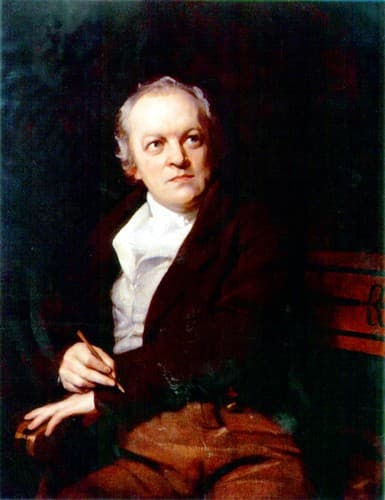
William Blake was an English poet, painter, and printmaker. Largely unrecognised during his life, Blake is now considered a seminal figure in the history of the poetry and visual art of the Romantic Age. What he called his "prophetic works" were said by 20th-century critic Northrop Frye to form "what is in proportion to its merits the least read body of poetry in the English language". His visual artistry led 21st-century critic Jonathan Jones to proclaim him "far and away the greatest artist Britain has ever produced". In 2002, Blake was placed at number 38 in the BBC's poll of the 100 Greatest Britons. While he lived in London his entire life, except for three years spent in Felpham, he produced a diverse and symbolically rich collection of works, which embraced the imagination as "the body of God" or "human existence itself".
Similar books
- Thus Spoke Zarathustra
Friedrich Nietzsche
4.0 (111k) average on GoodreadsPsychologyBoth challenge established morality and religious dogma through poetic, aphoristic prose, advocating for a revaluation of values and the embrace of human will and creation.
- The Doors of Perception
Aldous Huxley
3.9 (12k) average on GoodreadsPsychologyExplores altered states of consciousness and the idea of cleansing the 'doors of perception' to see reality more fully, echoing Blake's themes of expanded vision beyond conventional limits.
- Paradise Lost
John Milton
4.1 (6k) average on GoodreadsMysteryWhile both Blake and Milton engage with biblical narratives and the figure of Satan, their approaches diverge significantly. Milton's Paradise Lost largely upholds traditional Christian theology, portraying Satan as the embodiment of evil and rebellion against divine order, even if he endows him with compelling rhetoric. Blake, in contrast, explicitly states that Milton was 'of the Devil's party without knowing it' (Plate 6), suggesting that Milton's portrayal inadvertently glorified energy and rebellion. Blake's Marriage actively reclaims Satan not as evil, but as a symbol of vital energy and creative impulse, subverting the very framework Milton sought to reinforce. Milton's epic is a grand narrative within a hierarchical cosmos, whereas Blake's work is a deconstruction of that hierarchy, advocating for an internal, imaginative divinity.
- Eat, Pray, Love
Elizabeth Gilbert
3.6 (1.5M) average on GoodreadsLifestyleA heartbroken writer leaves her conventional life for a year-long global search for pleasure in Italy, spiritual devotion in India, and unexpected love and balance in Bali.
- Educated
Tara Westover
4.5 (796k) average on GoodreadsBiographyRaised in the Idaho mountains by fundamentalist survivalists, a young woman forges her own path to education, battling fierce family loyalty and personal demons to discover a world beyond her isolated upbringing.
- The Poisonwood Bible
Barbara Kingsolver
4.1 (659k) average on GoodreadsLiterary FictionA zealous missionary's rigid faith clashes with the Belgian Congo's wilderness and people, unraveling his family through the eyes of his five unforgettable women.




Enjoyed the summary?
A summary gives you the shape of the book. The book itself has the detail, the examples and the voice.
Find The Marriage of Heaven and Hell on AmazonAs an Amazon Associate, BookBrief earns from qualifying purchases. How we're funded