

Core Idea
- Difficulty
- Medium
- Read it if
- You are interested in a brutally honest, unsentimental, and often controversial perspective on post-colonial identity, the psychology of former slave societies, and the challenges of nation-building in the Caribbean. This is for readers who appreciate sharp prose and critical observation, even when uncomfortable.
- Skip it if
- You are looking for a sympathetic or celebratory account of Caribbean culture, or if you prefer books with optimistic conclusions and a less critical tone towards post-colonial societies. Readers sensitive to harsh judgments of developing nations or who prefer a more academic or sociological approach might find Naipaul's personal and often acerbic style challenging.
Key Takeaways from The Middle Passage
The Mimicry of Empire
Colonial societies are defined by a pervasive, often unconscious, imitation of their former masters.
Naipaul claims that post-colonial Caribbean societies are defined not by a unique local culture, but by a deep copying of their colonizers. This goes beyond language or fashion; it is a basic adoption of values, social structures, and even self-perception. The people, having lost their original cultures through slavery and displacement, try to fill this emptiness by imitating European norms. This imitation is often uncritical, creating a sense of unoriginality and a constant struggle to define an independent identity. The result is a society where even rebellion can feel like a reaction to the master, rather than an assertion of a unique self.
“Living in a borrowed culture, they were no more than mimics. They mimicked the British, and they mimicked the French, and they mimicked the Americans. The result was a society without a center, a society of echoes.”
In the book: Naipaul describes the Trinidadian movie audience's adulation of Humphrey Bogart, shouting 'That is man!' – an external validation of masculinity rather than an internal definition. He also notes the French pretensions in Martinique, where roads are considered extensions of France's national routes, illustrating a complete mental annexation.
Try this: When observing cultural phenomena in formerly colonized regions, look beyond superficial differences to understand underlying patterns of influence and adaptation. Recognize that cultural identity is a complex, often fraught, process of negotiation between inherited traditions and external impositions. Avoid romanticizing 'authentic' cultures without acknowledging the historical forces that shaped them.
Related ideas: post-colonialism, cultural-identity, mimicry, colonial-legacy
The Trauma of Rootlessness
Slavery and indenture created societies profoundly disconnected from their ancestral origins, leading to a pervasive sense of alienation.
The Middle Passage was not just a physical journey; it was a tearing away from roots. Naipaul stresses that Caribbean populations, mostly descendants of enslaved Africans and indentured Indians, were forcibly removed from their homes and traditions. This deliberate erasing of history and culture left a deep psychological mark: collective rootlessness. Without a shared, continuous past, societies find it hard to form a clear identity. This creates a feeling of being lost, of existing only as a product of outside forces, rather than having an inherent self. The constant search for identity becomes a key feature, often showing up as political instability or a desire for outside approval.
“History was for them a blank; they had no past, only a present that was a consequence of someone else's past. They were people who had been removed from their own history.”
In the book: Naipaul recounts the 'ghastly episodes of the region's colonial past,' detailing how the brutal conditions of slavery and indenture systematically dismantled existing cultures, languages, and family structures, leaving subsequent generations with little direct connection to their ancestral lands or heritage.
Try this: When analyzing social unrest or cultural struggles in such regions, consider the long-term psychological impact of historical displacement and the absence of a foundational narrative. Understand that the desire for recognition and a stable identity can drive political and social movements. Support initiatives that help communities reclaim and reconstruct their histories.
Related ideas: slavery-legacy, rootlessness, historical-trauma, diaspora
Politics of Personality, Not Principle
The absence of deep ideological roots leads to political systems driven by charismatic leaders and racial divisions rather than coherent policy.
Naipaul observes that political life in the Caribbean often lacks the strong ideological structures found in older, more established nations. Instead, politics becomes a volatile area dominated by strong individuals, racial loyalties, and immediate complaints. The lack of a shared national vision, made worse by historical divisions and outside control, means leaders often appeal to tribal loyalties rather than universal principles. This makes political discussions highly emotional, prone to demagoguery, and less focused on long-term nation-building. Elections are less about policy debates and more about a contest of wills and identities, continuing cycles of instability.
“Politics was not about ideas or principles; it was about personalities, about who could shout loudest, about who could rally the largest crowd based on race or perceived grievances.”
In the book: Naipaul vividly describes 'a racially charged election campaign in British Guiana (now Guyana),' where political rallies and rhetoric were explicitly divided along ethnic lines, highlighting how identity superseded substantive policy discussions.
Try this: When evaluating political developments in post-colonial states, be wary of simplistic analyses that ignore the deep historical currents of racial and ethnic divisions. Recognize that the fragility of institutions can make these societies particularly susceptible to charismatic, divisive figures. Advocate for stronger civic education and the development of robust, inclusive political parties.
Related ideas: political-instability, demagoguery, racial-politics, post-independence
The Burden of 'Smallness'
The limited scope and resources of small island nations contribute to a feeling of insignificance and a lack of self-generated ambition.
Naipaul subtly explores how the physical smallness and peripheral global status of these Caribbean nations contribute to a collective psychological burden. With limited resources, small populations, and a history of dependence, it is hard to develop grand ambitions or a sense of global importance. This 'smallness' can lead to feeling overlooked, like a mere footnote in world affairs, which reinforces the tendency to look outside for approval and models. It can also slow internal development, as opportunities for invention and growth seem limited, causing a brain drain and a lack of belief in their own potential.
“To be small, to be peripheral, was to be condemned to a perpetual adolescence, always looking outwards for approval, always struggling to make sense of a world that didn't quite see you.”
In the book: Naipaul's observations about the limited scale of local industries and the pervasive desire for emigration to larger, more 'significant' countries (like Britain or America) underscore the feeling of restricted horizons within these small nations.
Try this: Challenge the notion that 'small' nations are inherently less capable or significant. Support policies that empower local economies and foster regional cooperation to overcome the limitations of scale. Recognize that a sense of national pride and self-efficacy is crucial for development, and can be undermined by external perceptions of insignificance.
Related ideas: economic-development, geopolitics, national-identity, brain-drain
The Absence of a 'Native' Culture
The Caribbean is not a melting pot, but a collection of imported cultures struggling to coalesce into something genuinely new.
A debatable but central part of Naipaul's analysis is the argument that the Caribbean, unlike some other post-colonial regions, lacks a truly native culture that grew naturally over thousands of years. Instead, it is a mix of cultures—African, Indian, European—all brought by force or economic need. This means that cultural expressions, from language to religion to art, are often seen as adaptations or combinations of outside forms, rather than coming from a deep, continuous local tradition. This lack of a 'native' foundation contributes to the imitation and rootlessness, making the search for authentic self-expression a constant, often frustrating, effort. The 'melting pot' ideal, Naipaul suggests, is more a theoretical hope than a lived reality.
“There was no true native culture here, only a series of adaptations, borrowings, and imitations. Everything was imported, even the language of protest.”
In the book: Naipaul's detailed descriptions of the distinct, often separate, social lives of various ethnic groups (African descendants, Indian descendants, Chinese, Europeans) in Trinidad and Guyana, and their differing cultural practices, illustrate this lack of a singular, overarching 'native' culture.
Try this: Avoid romanticizing the idea of a singular 'Caribbean culture' without acknowledging its complex, fragmented, and often externally derived components. Understand that cultural identity is not always a neat, unified construct. Support efforts to celebrate and preserve the diverse cultural traditions present, while also recognizing the challenges of forging a cohesive national identity from disparate elements.
Related ideas: cultural-hybridity, multiculturalism, cultural-appropriation, post-colonial-identity
The Superficiality of Revolution
Political independence often fails to address deeper societal issues, leading to a superficial change that leaves core problems intact.
Naipaul is doubtful about political independence's power to change these societies. He argues that simply removing colonial administration does not automatically get rid of the ingrained mindsets, economic structures, or social hierarchies formed during centuries of colonial rule. The 'revolution' often feels superficial because it fails to address deeper issues of self-definition, economic reliance, and cultural imitation. New leaders, themselves products of the colonial system, often continue similar patterns of governance, corruption, and an outward focus. This leads to disappointment where the promise of freedom feels unfulfilled, and the core problems of the society remain, only changing their outward appearance.
“Independence was merely a change of masters, a substitution of brown faces for white ones, but the underlying structures of dependence and mimicry remained untouched.”
In the book: Naipaul's observations of political campaigns and the rhetoric of newly emerging leaders suggest a continuation of patronage systems and a focus on power rather than fundamental societal reform, implying that the change is more cosmetic than structural.
Try this: Critically examine claims of 'revolution' or 'independence' by looking beyond political rhetoric to assess whether fundamental societal changes have occurred. Understand that true decolonization requires a deep, internal transformation, not just a change of flags. Support grassroots movements that address systemic issues rather than merely focusing on changes at the top.
Related ideas: decolonization, neo-colonialism, political-reform, post-independence-struggles
The Legacy of Indolence
The historical context of forced labor and lack of ownership created a societal aversion to genuine productive work.
Naipaul controversially suggests that the legacy of slavery and indentured servitude created a societal attitude toward work that differs from societies where labor was freely chosen or rewarded. For generations, work meant exploitation, forced service, and no personal gain. This ingrained historical experience, he argues, created a collective dislike for genuine, self-motivated productive labor. Instead, there is a tendency to seek quick gains, easy paths, or to see work mainly as a way to escape rather than a path to self-fulfillment or community building. This 'indolence' is not natural but a sad result of a system designed to deny dignity and ownership to the laborer.
“Work, for them, was always something imposed, something done for another, not for oneself. It was never a source of dignity or self-worth, but a burden.”
In the book: Naipaul describes the challenges in establishing local industries and fostering a strong work ethic, often contrasting it with the perceived industriousness of other cultures. He hints at the difficulty of motivating people to invest in long-term, self-directed labor when generations have known only forced, unrewarding toil.
Try this: Recognize that attitudes towards work and entrepreneurship are deeply shaped by historical context, especially in societies with a history of forced labor. Avoid simplistic judgments about 'laziness' and instead seek to understand the systemic factors that influence economic behaviors. Support initiatives that foster ownership, skill development, and a sense of shared community investment.
Related ideas: labor-history, economic-development, slavery-impact, work-ethic
The Search for the 'Authentic Man'
In a society without clear identity, there's a desperate longing for a definitive, powerful, and authentic self, often projected onto external figures.
Naipaul often points out a widespread desire for an 'authentic man' or a clear masculine ideal within these societies. This desire comes from the deep-seated rootlessness and imitation, where individuals and the group struggle to define themselves. The 'authentic man' becomes a projection of what they feel is missing: strength, independence, a clear identity, and a sense of purpose not from colonial imposition. This search can show up in admiring charismatic leaders, popular cultural figures, or even romanticizing a past that never truly existed as imagined. It highlights how fragile self-identity is in a post-colonial context where internal validation is hard-won.
“They were looking for a man, a real man, a figure who could give them definition, who could embody the strength and authenticity they felt they lacked.”
In the book: The Trinidadian movie audience's cry of 'That is man!' for Humphrey Bogart is a prime example, indicating a search for an external archetype of masculinity and strength to emulate or admire, rather than an internal definition. This external validation reflects a deeper insecurity about self-identity.
Try this: When observing cultural heroes or political figures in post-colonial contexts, consider what societal needs and aspirations they are fulfilling, especially in terms of identity and self-worth. Understand that the search for 'authenticity' is a powerful, often unconscious, driver of collective behavior. Encourage self-definition and critical engagement with external ideals.
Related ideas: masculinity, identity-crisis, cultural-heroes, self-definition
The Middle Passage Quotes
“The only thing that mattered was the land, and the only people who mattered were those who had it.”
“Living in a borrowed culture, you are always a little out of focus.”
“History is built around people, and not the other way around.”
“The past is a foreign country; they do things differently there.”
“To be born a colonial was to be born into a world of borrowed things, borrowed ideas, borrowed emotions.”
“The greatest penalty of being a colonial was that you had to be a mimic man.”
“A people's history is the sum of their individual stories.”
“The land was not theirs; they were only permitted to live on it.”
“It was a world without originality, a world of borrowed forms and borrowed feelings.”
“The history of the West Indies is a history of the destruction of peoples.”
“Every man is a product of his history, and his history is the history of his land.”
“The past was not a source of pride, but a source of shame.”
“We were a people without a history, or with a history that was too painful to contemplate.”
“The illusion of permanence was crucial to the colonial enterprise.”
Quiz
10 questions on the main ideas. Each answer comes with a short explanation.
Question 1
Which specific event prompted V.S. Naipaul's journey to the Caribbean that forms the basis of "The Middle Passage"?
- He was commissioned by a British newspaper to report on decolonization.
- He decided to visit his ancestral home out of personal curiosity.
- The government of Trinidad invited him to record his impressions.
- He was researching a historical novel set in the Caribbean.
Show answer
C. The government of Trinidad invited him to record his impressions. The book explicitly states that in 1960, the government of Trinidad invited V. S. Naipaul to revisit his native country and record his impressions, which became the foundation for 'The Middle Passage'.
Question 2
Which of the following countries is NOT mentioned as one of the 'adjacent Caribbean societies' Naipaul visited in "The Middle Passage"?
- Trinidad
- British Guiana (now Guyana)
- Martinique
- Jamaica
Show answer
D. Jamaica The description specifically mentions Trinidad, British Guiana, and Martinique as societies Naipaul observed, but Jamaica is not listed among them.
Question 3
What is the primary legacy that Naipaul argues 'haunts' the Caribbean societies he visits in the book?
- The legacy of indigenous resistance movements.
- The legacies of slavery and colonialism.
- The economic impact of the global oil industry.
- The influence of American pop culture.
Show answer
B. The legacies of slavery and colonialism. The text clearly states that these countries are 'haunted by the legacies of slavery and colonialism and so thoroughly defined by the norms of Empire'.
Question 4
How do audiences in Trinidad react to Humphrey Bogart's appearance in a movie, according to Naipaul's observation?
- They express confusion about his foreign appeal.
- They greet him with cries of 'That is man!'
- They remain silent, showing disinterest.
- They boo his presence, indicating disapproval.
Show answer
B. They greet him with cries of 'That is man!' Naipaul specifically notes that he 'watches a Trinidadian movie audience greeting Humphrey Bogart’s appearance with cries of “That is man!”', highlighting a cultural observation.
Question 5
What is the significance of the Trinidadian slum being called 'the Gaza Strip' by locals?
- It indicates a strong connection to Middle Eastern culture.
- It reflects the area's extreme poverty and insalubrious conditions.
- It refers to its strategic military importance.
- It is a historical name dating back to colonial times.
Show answer
B. It reflects the area's extreme poverty and insalubrious conditions. The description states Naipaul ventures into 'a Trinidad slum so insalubrious that the locals call it the Gaza Strip,' implying the name reflects its poor, unhealthy, and possibly isolated or conflict-ridden conditions.
Question 6
Naipaul describes Martinique society as maintaining a 'fiction' regarding its infrastructure. What is this specific fiction?
- That its ports are the busiest in the Caribbean.
- That its roads are extensions of France’s routes nationales.
- That its public transport system is entirely self-sufficient.
- That its communication networks are superior to those in France.
Show answer
B. That its roads are extensions of France’s routes nationales. The text explicitly states Naipaul 'marvels at the Gallic pretension of Martinique society, which maintains the fiction that its roads are extensions of France’s routes nationales.'
Question 7
What is the central argument Naipaul makes about the Caribbean societies' relationship with the British Empire?
- They were actively working to dismantle imperial structures.
- They were largely indifferent to the Empire's fate.
- They were so thoroughly defined by Empire norms that they struggled to believe it was ending.
- They were eager to adopt new alliances with other global powers.
Show answer
C. They were so thoroughly defined by Empire norms that they struggled to believe it was ending. The description states these countries are 'so thoroughly defined by the norms of Empire that they can scarcely believe that the Empire is ending,' indicating a deep-seated dependence and identification.
Question 8
Naipaul's writing style in 'The Middle Passage' is described as having 'novelistic vividness and dazzling perspicacity'. What does 'perspicacity' primarily imply in this context?
- A tendency towards overly elaborate and flowery language.
- The ability to provide a clear and insightful understanding of complex issues.
- A focus on presenting only objective facts without personal interpretation.
- A preference for abstract philosophical discussions over concrete observations.
Show answer
B. The ability to provide a clear and insightful understanding of complex issues. Perspicacity refers to the quality of having a ready insight into things; keenness of mental perception and understanding. In the context of the book, it means Naipaul provides a sharp and insightful analysis of the Caribbean societies.
Question 9
How does Naipaul illustrate the ongoing impact of the region's colonial past on contemporary Caribbean society?
- By focusing exclusively on architectural remnants of the colonial era.
- By showing how it continues to inform its language, politics, and values.
- By documenting the efforts to completely erase colonial influences.
- By highlighting the region's complete economic independence from former colonial powers.
Show answer
B. By showing how it continues to inform its language, politics, and values. The text states Naipaul 'shows how they [ghastly episodes of colonial past] continue to inform its language, politics, and values,' demonstrating a pervasive, rather than superficial, impact.
Question 10
The description refers to 'The Middle Passage' as a 'classic of modern travel writing'. What characteristic makes it more than just a simple travelogue?
- Its strict adherence to a chronological itinerary of Naipaul's journey.
- Its primary focus on providing tourist recommendations and cultural events.
- Its deep analytical engagement with the historical, political, and cultural implications of what he observes.
- Its use of fictional characters to narrate the experiences.
Show answer
C. Its deep analytical engagement with the historical, political, and cultural implications of what he observes. The description highlights its 'novelistic vividness and dazzling perspicacity' and its focus on 'legacies of slavery and colonialism' and how they 'inform its language, politics, and values,' indicating a profound analytical depth beyond mere reporting.
The Middle Passage FAQ
What is 'The Middle Passage' by V.S. Naipaul about?
'The Middle Passage' is a non-fiction travelogue and memoir by V.S. Naipaul, documenting his impressions of Trinidad and other Caribbean societies (Guyana, Suriname, Martinique, Jamaica) in 1960. He explores the lasting impacts of slavery and colonialism on their culture, politics, and identity as the British Empire begins to decline.
Does 'The Middle Passage' offer a positive view of the Caribbean?
Naipaul's observations in 'The Middle Passage' are often critical and unflinching, focusing on the social and psychological scars left by colonialism and slavery. While deeply insightful, the book presents a rather bleak and pessimistic portrait of these societies struggling with their identity and future.
What is the significance of the title 'The Middle Passage'?
The title 'The Middle Passage' refers to the brutal transatlantic journey endured by enslaved Africans, symbolizing the traumatic origins of many Caribbean populations. Naipaul uses it to highlight how the historical trauma of slavery and colonialism continues to shape the region's present-day societies, culture, and identity.
How does Naipaul's 'The Middle Passage' differ from other Caribbean travelogues?
Unlike many travelogues that might offer romanticized or purely descriptive accounts, Naipaul's 'The Middle Passage' is deeply analytical and critical, delving into the psychological and political dimensions of post-colonial identity. He uses his sharp observational skills and personal connection to the region to expose complex societal issues rather than simply showcasing tourist attractions.
What kind of political insights does 'The Middle Passage' offer?
The book provides a prescient look at the political landscape of emerging Caribbean nations, examining the challenges of self-governance, racial tensions, and the lingering influence of former colonial powers. Naipaul observes election campaigns and societal structures to illustrate the difficulties these countries face in forging independent identities.
Is 'The Middle Passage' considered a historical account?
While 'The Middle Passage' is not a formal historical text, it is rich with historical context, detailing the ghastly episodes of the region's colonial past and showing their continued impact. Naipaul weaves historical facts and anecdotes into his contemporary observations to explain the origins of current societal issues.
Does 'The Middle Passage' include personal reflections from Naipaul?
Yes, 'The Middle Passage' is deeply personal, as Naipaul revisits his native Trinidad and other islands with a complex mix of familiarity and detachment. His own background as a Trinidadian of Indian descent informs his observations, adding a unique autobiographical layer to the travelogue.
What role does language play in Naipaul's observations in 'The Middle Passage'?
Naipaul pays close attention to how language reflects and reinforces colonial legacies and local identities. He observes how the adoption of European languages and cultural norms, often poorly adapted, shapes the societies he visits, highlighting the tension between inherited and authentic expressions.
What is the 'Gaza Strip' reference in 'The Middle Passage'?
Naipaul refers to a particular slum in Trinidad as the 'Gaza Strip,' a local nickname that highlights the extreme poverty and insalubrious conditions of the area. This grim comparison underscores the harsh realities and social disparities he encountered during his travels.
About the author

Sir Vidiadhar Surajprasad Naipaul was a Trinidadian-born British writer of works of fiction and nonfiction in English. He is known for his comic early novels set in Trinidad, his bleaker novels of alienation in the wider world, and his vigilant chronicles of life and travels. He wrote in prose that was widely admired, but his views sometimes aroused controversy. He published more than thirty books over fifty years.
Similar books
- A House for Mr Biswas
V. S. Naipaul
3.8 (18k) average on GoodreadsLiterary FictionExplores themes of rootlessness and the search for identity within a Trinidadian context, albeit through fiction.
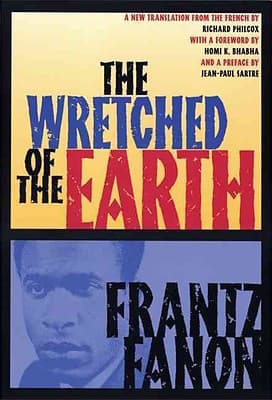
- The Wretched of the Earth
Frantz Fanon
4.2 (17k) average on GoodreadsPoliticsOffers a foundational theoretical framework for understanding the psychological and societal impacts of colonialism and decolonization.
- In a Free State
V. S. Naipaul
Another Naipaul work that examines the struggles of individuals displaced and disoriented in the post-colonial world.
- Small Island
Andrea Levy
4.0 (28k) average on GoodreadsLiterary FictionAndrea Levy's 'Small Island' (2004) offers a fictional, multi-perspective narrative about Jamaicans migrating to post-war Britain, providing a more nuanced and empathetic portrayal of Caribbean identity and the complexities of the colonial legacy. Unlike Naipaul's often top-down and critical observations, Levy's novel delves into the individual experiences, hopes, and disillusionments of her characters, highlighting their resilience, cultural richness, and the challenges they face both in their homeland and abroad. While Naipaul focuses on the 'absence' of culture, Levy beautifully illustrates the vibrant cultural heritage and the strength of character of her protagonists. 'Small Island' provides a humanizing counter-narrative to Naipaul's often dehumanizing generalizations, exploring themes of race, class, and belonging with warmth and historical detail that Naipaul's critical analysis often overlooks.
- The Old Man and the Sea
Ernest Hemingway
3.8 (831k) average on GoodreadsLiterary FictionA Cuban fisherman's long struggle with a giant marlin becomes a story of endurance and dignity, now retold for young adults with illustrations, phonetic guides, and writing prompts in Traditional Chinese.
- One Hundred Years of Solitude
Gabriel García Márquez
4.1 (753k) average on GoodreadsLiterary FictionThrough the multi-generational story of the Buendía family, a mythical town deals with the repeating patterns of time, love, and solitude, as the extraordinary mixes with the ordinary.



Enjoyed the summary?
A summary gives you the shape of the book. The book itself has the detail, the examples and the voice.
Find The Middle Passage on AmazonAs an Amazon Associate, BookBrief earns from qualifying purchases. How we're funded